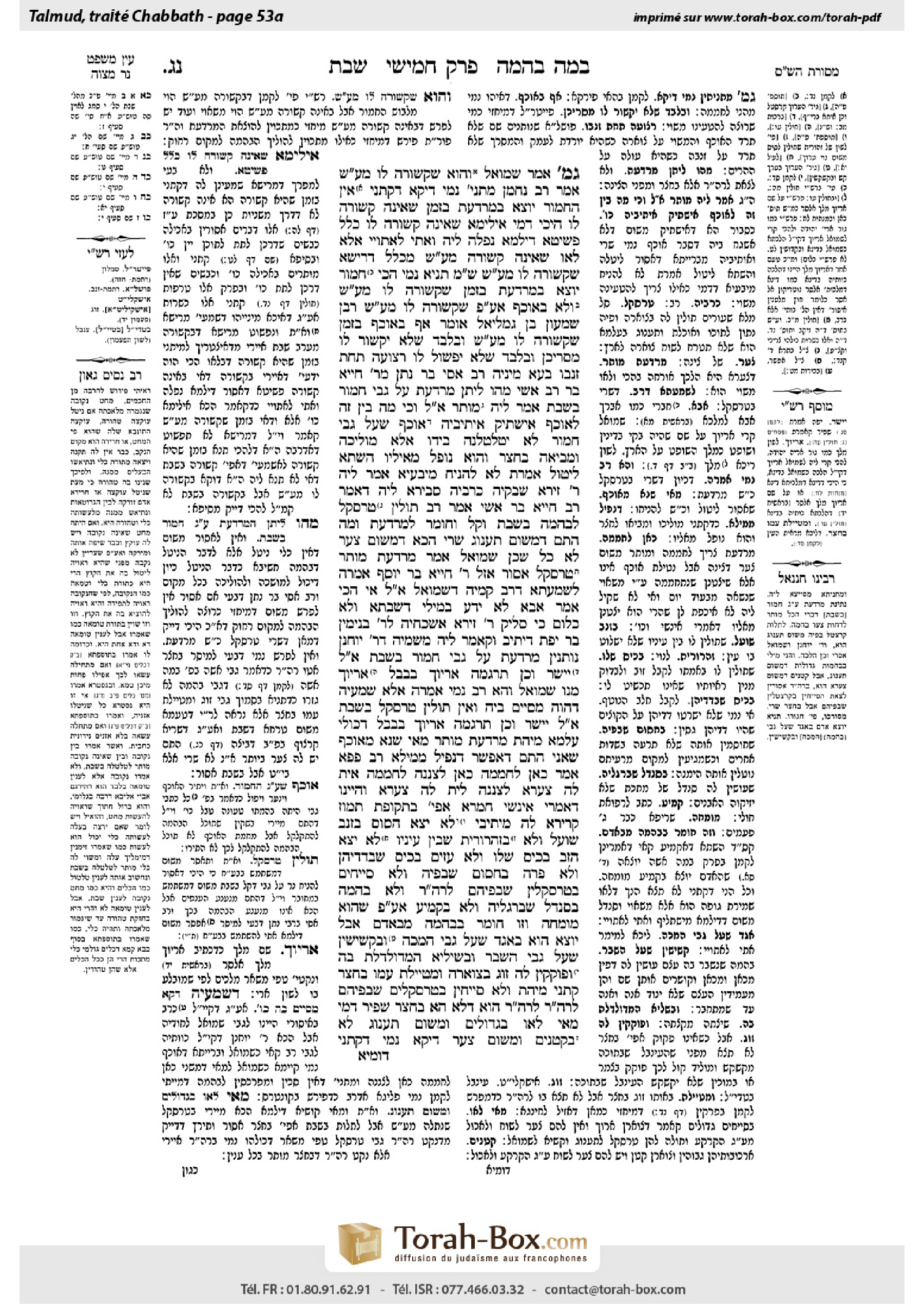
Shabbat 53a: Talmud study for Daf Yomi
Daf Yomi is the daily study of one Talmud folio. Explore 37 tractates with scans, Hebrew text, Sefaria English and AI-generated French translations where annotated.
Passage selection and English or AI-generated French translation are available where the scan has annotations. Daf Study is independent of Torah-Box and Sefaria.
Browse Shabbat · שבת · All tractatesShabbat 53a text and translations
This page of Shabbat includes the Aramaic text, an English translation and an AI-generated French translation, alongside the scan above.
שבת נ״ג א · Aramaic and Hebrew text
גְּמָ׳ אָמַר שְׁמוּאֵל: וְהוּא שֶׁקְּשׁוּרָה לוֹ מֵעֶרֶב שַׁבָּת. אָמַר רַב נַחְמָן: מַתְנִיתִין נָמֵי דַּיְקָא, דְּקָתָנֵי: אֵין הַחֲמוֹר יוֹצֵא בַּמַּרְדַּעַת בִּזְמַן שֶׁאֵינָהּ קְשׁוּרָה לוֹ.
הֵיכִי דָמֵי? אִילֵּימָא שֶׁאֵינָהּ קְשׁוּרָה לוֹ כְּלָל — פְּשִׁיטָא, דִילְמָא נָפְלָה לֵיהּ וְאָתֵי לְאֵתוּיֵי. אֶלָּא לָאו שֶׁאֵינָהּ קְשׁוּרָה מֵעֶרֶב שַׁבָּת. מִכְּלָל דְּרֵישָׁא, שֶׁקְּשׁוּרָה לוֹ מֵעֶרֶב שַׁבָּת. שְׁמַע מִינַּהּ.
תַּנְיָא נָמֵי הָכִי: חֲמוֹר יוֹצֵא בַּמַּרְדַּעַת בִּזְמַן שֶׁקְּשׁוּרָה לוֹ מֵעֶרֶב שַׁבָּת, וְלֹא בָּאוּכָּף אַף עַל פִּי שֶׁקָּשׁוּר לוֹ מֵעֶרֶב שַׁבָּת. רַבָּן שִׁמְעוֹן בֶּן גַּמְלִיאֵל אוֹמֵר: אַף בָּאוּכָּף בִּזְמַן שֶׁקָּשׁוּר לוֹ מֵעֶרֶב שַׁבָּת, וּבִלְבַד שֶׁלֹּא יִקְשׁוֹר לוֹ מַסְרֵיכָן, וּבִלְבַד שֶׁלֹּא יִפְשׁוֹל לוֹ רְצוּעָה תַּחַת זְנָבוֹ.
בְּעָא מִינֵּיהּ רַב אַסִּי בַּר נָתָן מֵרַבִּי חִיָּיא בַּר רַב אָשֵׁי: מַהוּ לִיתֵּן מַרְדַּעַת עַל גַּבֵּי חֲמוֹר בְּשַׁבָּת? אֲמַר לֵיהּ: מוּתָּר. אֲמַר לֵיהּ: וְכִי מָה בֵּין זֶה לְאוּכָּף? אִישְׁתִּיק.
אֵיתִיבֵיהּ: אוּכָּף שֶׁעַל גַּבֵּי חֲמוֹר — לֹא יְטַלְטְלֶנּוּ בְּיָדוֹ, אֶלָּא מוֹלִיכָהּ וּמְבִיאָהּ בֶּחָצֵר וְהוּא נוֹפֵל מֵאֵילָיו. הַשְׁתָּא לִיטּוֹל אָמְרַתְּ לָא, לְהַנִּיחַ מִיבַּעְיָא?!
אֲמַר לֵיהּ רַבִּי זֵירָא: שִׁבְקֵיהּ, כְּרַבֵּיהּ סְבִירָא לֵיהּ, דְּאָמַר רַב חִיָּיא בַּר אָשֵׁי אָמַר רַב: תּוֹלִין טְרַסְקָל לִבְהֵמָה בְּשַׁבָּת, וְקַל וָחוֹמֶר לְמַרְדַּעַת. וּמָה הָתָם דְּמִשּׁוּם תַּעֲנוּג שְׁרֵי, הָכָא דְּמִשּׁוּם צַעַר — לֹא כׇּל שֶׁכֵּן.
שְׁמוּאֵל אָמַר: מַרְדַּעַת מוּתָּר, טְרַסְקָל — אָסוּר. אֲזַל רַבִּי חִיָּיא בַּר יוֹסֵף אַמְרַהּ לִשְׁמַעְתָּא דְרַב קַמֵּיהּ דִּשְׁמוּאֵל. אֲמַר לֵיהּ: אִי הָכִי אָמַר אַבָּא, לָא יָדַע בְּמִילֵּי דְשַׁבְּתָא וְלָא כְּלוּם.
כִּי סָלֵיק רַבִּי זֵירָא, אַשְׁכְּחֵיהּ לְרַבִּי בִּנְיָמִין בַּר יֶפֶת דְּיָתֵיב וְקָאָמַר לֵיהּ מִשְּׁמֵיהּ דְּרַבִּי יוֹחָנָן: נוֹתְנִין מַרְדַּעַת עַל גַּבֵּי חֲמוֹר בְּשַׁבָּת. אֲמַר לֵיהּ: יִישַׁר, וְכֵן תַּרְגְּמַהּ אַרְיוֹךְ בְּבָבֶל.
״אַרְיוֹךְ״ מַנּוּ — שְׁמוּאֵל. וְהָא רַב נָמֵי אַמְרַהּ? אֶלָּא שַׁמְעֵיהּ דַּהֲוָה מְסַיֵּים בַּהּ: וְאֵין תּוֹלִין טְרַסְקָל בְּשַׁבָּת, אֲמַר לֵיהּ: יִישַׁר, וְכֵן תַּרְגְּמַהּ אַרְיוֹךְ בְּבָבֶל.
דְּכוּלֵּי עָלְמָא מִיהַת מַרְדַּעַת מוּתָּר, מַאי שְׁנָא מֵאוּכָּף? — שָׁאנֵי הָתָם דְּאֶפְשָׁר דְּנָפֵיל מִמֵּילָא.
רַב פָּפָּא אָמַר: כָּאן לְחַמְּמָהּ, כָּאן לְצַנְּנָהּ. לְחַמְּמָהּ, אִית לַהּ צַעֲרָא. לְצַנְּנָהּ, לֵית לַהּ צַעֲרָא. וְהַיְינוּ דְּאָמְרִי אִינָשֵׁי: חֲמָרָא אֲפִילּוּ בִּתְקוּפַת תַּמּוּז קָרִיר לַהּ.
מֵיתִיבִי: לֹא יֵצֵא הַסּוּס בִּזְנַב שׁוּעָל, וְלֹא בַּזַּהֲרוּרִית שֶׁבֵּין עֵינָיו. לֹא יֵצֵא הַזָּב בַּכִּיס שֶׁלּוֹ, וְלֹא עִזִּים בַּכִּיס שֶׁבְּדַדֵּיהֶן, וְלֹא פָּרָה בַּחִסּוּם שֶׁבְּפִיהָ, וְלֹא סְיָיחִים בַּטְּרַסְקָלִין שֶׁבְּפִיהֶם לִרְשׁוּת הָרַבִּים, וְלֹא בְּהֵמָה בַּסַּנְדָּל שֶׁבְּרַגְלֶיהָ, וְלֹא בַּקָּמֵיעַ אַף עַל פִּי שֶׁהוּא מוּמְחֶה — וְזֶה חוֹמֶר בַּבְּהֵמָה מִבָּאָדָם.
אֲבָל יוֹצֵא הוּא בָּאֶגֶד שֶׁעַל גַּבֵּי הַמַּכָּה, וּבַקְּשִׁישִׁין שֶׁעַל גַּבֵּי הַשֶּׁבֶר, וּבַשִּׁילְיָא הַמְדוּלְדֶּלֶת בָּהּ, וּפוֹקְקִין לָהּ זוּג בְּצַוָּארָהּ, וּמְטַיֶּילֶת עִמּוֹ בֶּחָצֵר.
קָתָנֵי מִיהַת: וְלֹא סְיָיחִין בִּטְרַסְקָלִים שֶׁבְּפִיהֶם לִרְשׁוּת הָרַבִּים. לִרְשׁוּת הָרַבִּים הוּא דְּלָא, הָא בְּחָצֵר — שַׁפִּיר דָּמֵי. מַאי לַָאו, בִּגְדוֹלִים וּמִשּׁוּם תַּעֲנוּג?!
לָא, בִּקְטַנִּים וּמִשּׁוּם צַעַר: דַּיְקָא נָמֵי, דְּקָתָנֵי
Shabbat 53a · English translation
GEMARA: Shmuel said: And with regard to the halakha taught in our mishna that a donkey may go out on Shabbat with its saddlecloth, that only applies to a case where it was tied to the animal from Shabbat eve. Rav Naḥman said: The wording of our mishna is also precise in support of Shmuel’s statement, as it teaches later in the chapter: A donkey may not go out into the public domain on Shabbat with its saddlecloth when it is not tied to its back.
The Gemara clarifies the meaning of that mishna: What are the circumstances? If you say that the later mishna is referring to a case where the saddlecloth is not tied to the animal at all, that is obvious. There is concern lest the saddlecloth fall from the animal and its owner will come to bring it and carry it four cubits in the public domain. Rather, is it not referring to a case where the saddlecloth is presently tied to the animal, but it was not tied from Shabbat eve? By inference, conclude that the first clause, i.e., our mishna, which permits the animal to go out with its saddlecloth, is referring to a case where the saddlecloth was tied to the animal from Shabbat eve. The Gemara concludes: Indeed, conclude from it that this is the correct understanding.
That was also taught in a baraita: A donkey may go out on Shabbat with its saddlecloth when it was tied to the animal from Shabbat eve, and it may not go out with the saddle, even though it was tied to the animal from Shabbat eve. Rabban Shimon ben Gamliel says: The donkey may even go out with its saddle when it was tied to the animal from Shabbat eve, provided that he does not tie the strap with which the saddle is fastened around the donkey’s belly, and provided that he does not pass a strap under the animal’s tail, which is standard procedure when placing a burden on the animal.
Rav Asi bar Natan raised a dilemma before Rabbi Ḥiyya bar Rav Ashi: What is the halakha with regard to placing a saddlecloth on a donkey on Shabbat in a private domain in order to warm the donkey with no intention to take it into the public domain? Rabbi Ḥiyya bar Ashi said to him: It is permitted. Rav Asi bar Natan said to him: What is the difference between this and a saddle, which may not be moved on Shabbat? Rabbi Ḥiyya bar Ashi remained silent and did not answer.
Rav Asi bar Natan thought that Rabbi Ḥiyya was of the opinion that even a saddle may be placed on a donkey on Shabbat. He, therefore, raised an objection from a baraita: A saddle that is on a donkey on Shabbat, and its owner wishes to remove it, he may not move it with his hand to remove it; rather, he walks the animal back and forth in the courtyard, and the saddle falls on its own. Now even with regard to removing a saddle that is already on the animal’s back, you said no, one may not move it; is prohibiting one from placing the saddle on the animal necessary?
Rabbi Zeira said to Rav Asi: Leave Rabbi Ḥiyya, and do not raise an objection to his statement, as he agrees with his teacher. As Rav Ḥiyya bar Ashi said that Rav said: One may hang a basket with fodder around the neck of an animal on Shabbat, and by means of an a fortiori inference, derive that one may place a saddlecloth on an animal’s back on Shabbat. What is the a fortiori inference? Just as there, placing the basket of fodder so that the animal can eat without bending down, which is done for the animal’s pleasure, is permitted; here, placing the saddlecloth, which is done to prevent the animal from suffering from the cold, all the more so should be permitted.
Shmuel said: A saddlecloth is permitted; however, a basket with fodder is prohibited. Rabbi Ḥiyya bar Yosef went and said the halakha of Rav before Shmuel. Shmuel said to him: If Abba, Rav, actually said that, he knows nothing at all about matters of Shabbat.
When Rabbi Zeira ascended to Eretz Yisrael he found Rabbi Binyamin bar Yefet who sat and said to him in the name of Rabbi Yoḥanan: One may place a saddlecloth on a donkey on Shabbat. Rabbi Zeira said to him: You have spoken well, and Aryokh explained the matter likewise in Babylonia.
The Gemara asks: Who is Aryokh? It is Shmuel. Didn’t Rav also say that one may place a saddlecloth on a donkey on Shabbat? With regard to a saddlecloth they agree. Why then did Rabbi Zeira attribute the ruling specifically to Shmuel? Rather, he heard Rabbi Binyamin bar Yefet conclude: However, one may not hang a basket with fodder around the neck of an animal on Shabbat. It was that part of the statement that led him to say: You have spoken well, and Aryokh explained the matter likewise in Babylonia.
The Gemara continues: In any case, everyone agrees that a saddlecloth is permitted. The question arises: How is a saddlecloth different from a saddle, which may not even be removed from the donkey? If the concern is for the animal’s suffering, why is it not permitted to remove the saddle? The Gemara answers: It is different there, as it is possible for the saddle to fall on its own. Therefore, there is no reason to permit its removal by hand.
Rav Pappa said: There is a distinction between the two cases: Here, where the Sages permitted placing a saddlecloth on a donkey on Shabbat, it is to warm the animal. There, where the Sages prohibited removing a saddle, it is to cool the animal. Placing the saddlecloth to warm the animal is permitted because otherwise it experiences discomfort from the cold. However, removing the saddle to cool the animal is prohibited because the animal does not experience discomfort from excessive heat. And that is the folk saying that people say: A donkey, even in the summer season of Tammuz, is cold. Therefore, seeing to the animal’s warmth is more important.
The Gemara raises an objection from the Tosefta to those who prohibit placing a basket with fodder around an animal’s neck on Shabbat: A horse may neither go out into the public domain on Shabbat with a fox’s tail that is placed as a talisman to ward off the evil eye nor with a string of red wool that is hung between its eyes as an ornament. Neither may a zav go out with his pouch that prevents his clothes from becoming sullied from his emissions, nor goats with a pouch that is on their udders so that they will not be scratched by stones, nor a cow with the muzzle that is on its mouth, nor foals with baskets of fodder that are around their mouths into the public domain. And an animal may neither go out with metal shoes that are on its feet, nor with an amulet that is placed on the animal to promote its good health, even if the amulet has proven effective. And this is a stricture that applies to animals beyond the strictures that apply to people, as a person is permitted to go out into the public domain with an amulet that has proved effective.
However, an animal may go out with a bandage that is on a wound, and with splints that are on a broken bone so that it will heal properly, and with the afterbirth hanging from its womb. And one may plug the bell hanging from an animal’s neck to prevent it from ringing, and then the animal may walk with it in the courtyard, which is a private domain, but not in a public domain.
In any case, it is taught here: Nor foals with baskets of fodder that are around their mouths into the public domain. By inference: It is specifically into the public domain that they may not go with fodder baskets in their mouths; however, in a courtyard, they may well walk with a basket of fodder. What? Is it not referring to large foals around whose necks fodder baskets are hung for their pleasure?
The Gemara answers: No, it is referring to small foals, and the baskets are hung to prevent their discomfort. The legs of a young foal are long and its neck is short. Consequently, eating from the ground is difficult. Hanging the fodder basket around its neck enables it to eat without bending down. The Gemara adds: This is also precise in the language of the Tosefta, as it teaches the case of the foals
Shabbat 53a · Traduction française (IA)
GUEMARA : Chmouel a dit : Quant à la halakha enseignée dans notre Michna, selon laquelle un âne peut sortir le Chabbat avec son tapis de selle, cela ne s’applique que si celui-ci était attaché à l’animal depuis la veille de Chabbat. Rav Naḥman a dit : La formulation de notre Michna confirme également avec précision la déclaration de Chmouel, car elle enseigne plus loin dans le chapitre : Un âne ne peut pas sortir dans le domaine public le Chabbat avec son tapis de selle si celui-ci n’est pas attaché à son dos.
La Guemara précise le sens de cette Michna : dans quelles circonstances ? Si tu dis que la Michna ultérieure parle d’un cas où le tapis de selle n’est pas du tout attaché à l’animal, c’est évident. On craint que le tapis ne tombe de l’animal et que son propriétaire ne vienne le ramasser et ne le transporte sur quatre coudées dans le domaine public. Ne s’agit-il pas plutôt d’un cas où le tapis est actuellement attaché à l’animal, mais ne l’était pas depuis la veille de Chabbat ? On peut en déduire que la première partie, c’est-à-dire notre Michna, qui autorise l’animal à sortir avec son tapis de selle, parle d’un cas où celui-ci était attaché à l’animal depuis la veille de Chabbat. La Guemara conclut : en effet, déduis-en que telle est la bonne interprétation.
Cela a également été enseigné dans une baraïta : Un âne peut sortir le Chabbat avec son tapis de selle si celui-ci était attaché à l’animal depuis la veille de Chabbat, mais il ne peut pas sortir avec une selle, même si celle-ci était attachée à l’animal depuis la veille de Chabbat. Rabban Chimon ben Gamliel dit : L’âne peut même sortir avec sa selle si elle était attachée à l’animal depuis la veille de Chabbat, à condition de ne pas nouer la sangle qui fixe la selle autour du ventre de l’âne et de ne pas faire passer de sangle sous sa queue, comme on le fait habituellement lorsqu’on place une charge sur l’animal.
Rav Asi bar Natan posa une question à Rabbi Ḥiyya bar Rav Ashi : quelle est la halakha concernant le fait de placer un tapis de selle sur un âne le Chabbat, dans un domaine privé, afin de le réchauffer, sans avoir l’intention de le faire sortir dans le domaine public ? Rabbi Ḥiyya bar Ashi lui répondit : C’est permis. Rav Asi bar Natan lui dit : En quoi cela diffère-t-il d’une selle, qu’il est interdit de déplacer le Chabbat ? Rabbi Ḥiyya bar Ashi garda le silence et ne répondit pas.
Rav Asi bar Natan pensa que Rabbi Ḥiyya estimait qu’on pouvait même placer une selle sur un âne le Chabbat. Il souleva donc une objection tirée d’une baraïta : Si une selle se trouve sur un âne le Chabbat et que son propriétaire souhaite l’enlever, il ne peut pas la déplacer de la main pour la retirer ; il fait plutôt marcher l’animal de long en large dans la cour, et la selle tombe d’elle-même. Or, même pour retirer une selle qui se trouve déjà sur le dos de l’animal, tu as dit non, qu’on ne peut pas la déplacer ; est-il donc nécessaire d’interdire de la placer sur l’animal ?
Rabbi Zeïra dit à Rav Asi : Laisse Rabbi Ḥiyya, et ne soulève pas d’objection à sa déclaration, car il est d’accord avec son maître. En effet, Rav Ḥiyya bar Ashi a dit au nom de Rav : On peut suspendre un panier de fourrage au cou d’un animal le Chabbat ; a fortiori, on peut placer un tapis de selle sur le dos d’un animal le Chabbat. Quel est le raisonnement a fortiori ? De même que, dans le premier cas, il est permis de placer le panier de fourrage afin que l’animal puisse manger sans se baisser, pour son confort, dans le second cas, placer le tapis de selle afin d’éviter que l’animal ne souffre du froid devrait à plus forte raison être permis.
Chmouel a dit : Le tapis de selle est permis, mais le panier de fourrage est interdit. Rabbi Ḥiyya bar Yossef alla rapporter à Chmouel la halakha de Rav. Chmouel lui dit : Si Abba, Rav, a réellement dit cela, il ne connaît absolument rien aux lois du Chabbat.
Quand Rabbi Zeïra monta en terre d’Israël, il trouva Rabbi Binyamin bar Yéfet assis, qui lui dit au nom de Rabbi Yoḥanan : On peut placer un tapis de selle sur un âne le Chabbat. Rabbi Zeïra lui dit : Tu as bien parlé, et Aryokh a expliqué la chose de la même manière en Babylonie.
La Guemara demande : Qui est Aryokh ? C’est Chmouel. Rav n’a-t-il pas lui aussi dit qu’on pouvait placer un tapis de selle sur un âne le Chabbat ? Pour le tapis de selle, ils sont d’accord. Pourquoi Rabbi Zeïra a-t-il donc attribué cette décision précisément à Chmouel ? C’est plutôt la conclusion de la déclaration de Rabbi Binyamin bar Yéfet qu’il avait entendue : toutefois, on ne peut pas suspendre un panier de fourrage au cou d’un animal le Chabbat. C’est cette partie de la déclaration qui l’a amené à dire : Tu as bien parlé, et Aryokh a expliqué la chose de la même manière en Babylonie.
La Guemara poursuit : en tout cas, tous sont d’accord pour dire que le tapis de selle est permis. La question se pose : en quoi un tapis de selle diffère-t-il d’une selle, qu’on ne peut même pas retirer de l’âne ? Si la raison est la souffrance de l’animal, pourquoi n’est-il pas permis de retirer la selle ? La Guemara répond : le cas est différent, car la selle peut tomber d’elle-même. Il n’y a donc aucune raison d’autoriser à la retirer à la main.
Rav Pappa a dit : Il y a une distinction entre les deux cas : ici, où les Sages ont permis de placer un tapis de selle sur un âne le Chabbat, c’est pour réchauffer l’animal ; là, où les Sages ont interdit de retirer une selle, c’est pour rafraîchir l’animal. Placer le tapis de selle pour réchauffer l’animal est permis, car autrement il souffre du froid. En revanche, retirer la selle pour rafraîchir l’animal est interdit, car celui-ci ne souffre pas d’une chaleur excessive. C’est ce que dit le proverbe : « Un âne a froid même pendant la saison estivale de Tammouz. » Il est donc plus important de veiller à ce que l’animal reste au chaud.
La Guemara soulève une objection tirée de la Tosefta contre ceux qui interdisent de suspendre un panier de fourrage au cou d’un animal le Chabbat : Un cheval ne peut ni sortir dans le domaine public le Chabbat avec une queue de renard, placée comme talisman pour éloigner le mauvais œil, ni avec un fil de laine rouge suspendu entre ses yeux comme ornement. Un zav ne peut pas non plus sortir avec sa pochette, qui empêche ses vêtements d’être souillés par ses écoulements ; les chèvres ne peuvent pas sortir avec une pochette placée sur leurs mamelles afin qu’elles ne soient pas écorchées par les pierres ; une vache ne peut pas sortir avec le museau qu’elle porte sur la bouche ; et les poulains ne peuvent pas sortir dans le domaine public avec des paniers de fourrage autour de la bouche. Un animal ne peut pas non plus sortir avec des chaussures en métal aux pieds, ni avec une amulette placée sur lui pour favoriser sa bonne santé, même si cette amulette a fait ses preuves. Cette rigueur s’applique aux animaux au-delà de celles qui s’appliquent aux personnes, car une personne est autorisée à sortir dans le domaine public avec une amulette qui a fait ses preuves.
Cependant, un animal peut sortir avec un bandage sur une plaie, avec des attelles sur un os cassé afin qu’il guérisse correctement, et avec le placenta pendant de son utérus. On peut boucher la clochette suspendue au cou d’un animal pour l’empêcher de sonner ; l’animal peut alors se déplacer avec elle dans la cour, qui est un domaine privé, mais pas dans le domaine public.
En tout cas, il est enseigné ici : les poulains ne peuvent pas sortir dans le domaine public avec des paniers de fourrage autour de la bouche. On peut en déduire que c’est précisément dans le domaine public qu’ils ne peuvent pas aller avec des paniers de fourrage dans la bouche ; en revanche, dans une cour, ils peuvent bel et bien se déplacer avec un panier de fourrage. Ne s’agit-il pas de grands poulains, auxquels on suspend des paniers de fourrage au cou pour leur confort ?
La Guemara répond : Non, il s’agit de petits poulains, et les paniers sont suspendus afin de prévenir leur inconfort. Les pattes d’un jeune poulain sont longues et son cou est court. Par conséquent, il lui est difficile de manger à même le sol. Suspendre le panier de fourrage à son cou lui permet de manger sans se baisser. La Guemara ajoute : la formulation de la Tosefta est également précise, puisqu’elle enseigne le cas des poulains
Traduction française générée par IA à partir de l’édition anglaise de Sefaria. Vérifie toujours un passage avec le texte source.
Text from Sefaria: William Davidson Edition - Vocalized Aramaic (CC BY NC); William Davidson Edition - English (CC BY NC).