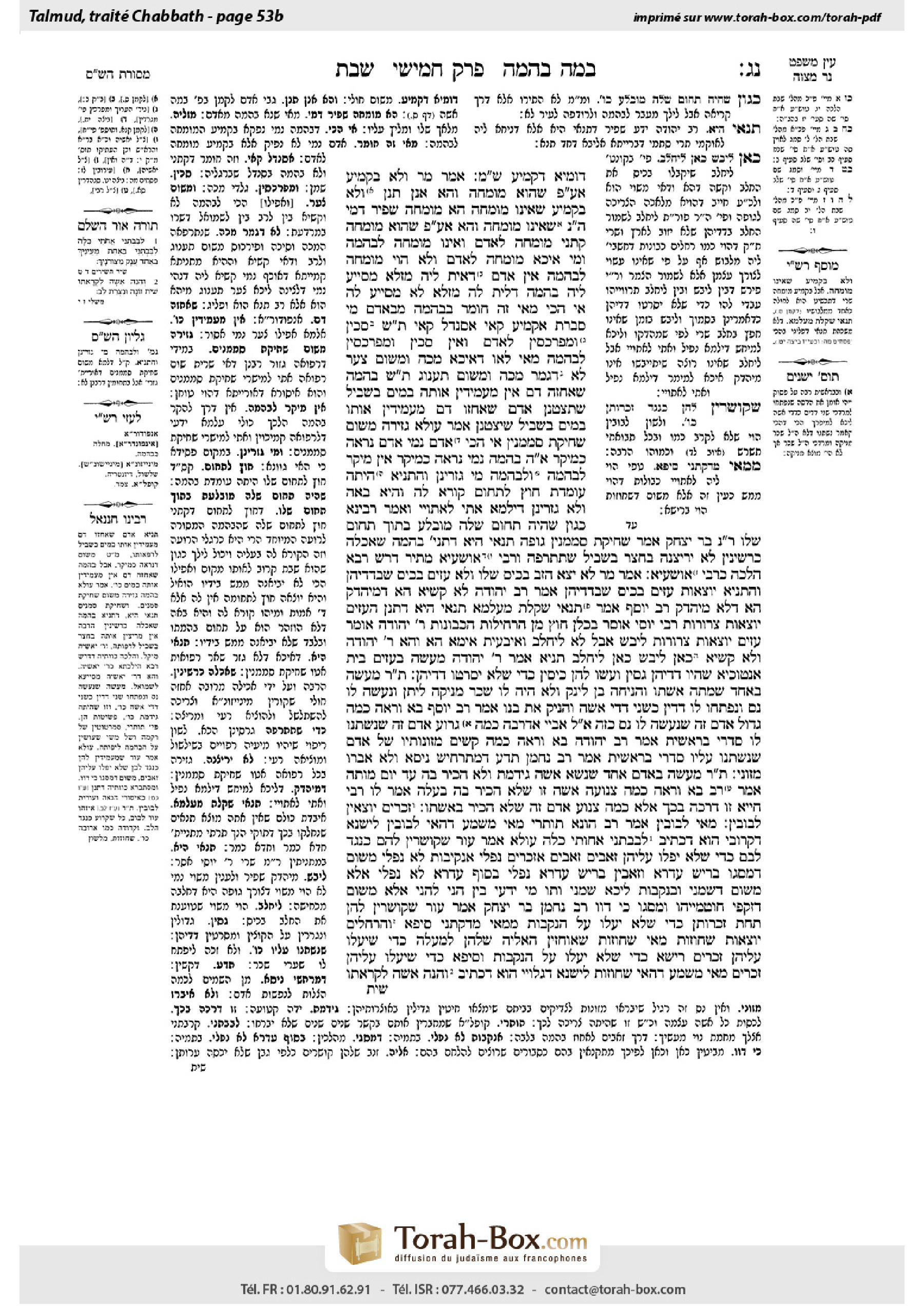
Shabbat 53b: Talmud study for Daf Yomi
Daf Yomi is the daily study of one Talmud folio. Explore 37 tractates with scans, Hebrew text, Sefaria English and AI-generated French translations where annotated.
Passage selection and English or AI-generated French translation are available where the scan has annotations. Daf Study is independent of Torah-Box and Sefaria.
Browse Shabbat · שבת · All tractatesShabbat 53b text and translations
This page of Shabbat includes the Aramaic text, an English translation and an AI-generated French translation, alongside the scan above.
שבת נ״ג ב · Aramaic and Hebrew text
דּוּמְיָא דְּקָמֵיעַ. שְׁמַע מִינָּה.
אָמַר מָר: וְלֹא בַּקָּמֵיעַ אַף עַל פִּי שֶׁהוּא מוּמְחֶה. וְהָא אֲנַן תְּנַן: וְלֹא בַּקָּמֵיעַ שֶׁאֵינוֹ מוּמְחֶה. הָא מוּמְחֶה — שַׁפִּיר דָּמֵי! הָכָא נָמֵי שֶׁאֵינוֹ מוּמְחֶה.
וְהָא ״אַף עַל פִּי שֶׁהוּא מוּמְחֶה״ קָתָנֵי! מוּמְחֶה לְאָדָם וְאֵינוֹ מוּמְחֶה לִבְהֵמָה. וּמִי אִיכָּא מוּמְחֶה לְאָדָם וְלָא הָוֵי מוּמְחֶה לִבְהֵמָה? אִין, אָדָם דְּאִית לֵיהּ מַזָּלָא — מְסַיַּיע לֵיהּ, בְּהֵמָה דְּלֵית לַהּ מַזָּלָא — לָא מְסַיַּיע לַהּ.
אִי הָכִי, מַאי ״זֶה חוֹמֶר בַּבְּהֵמָה מִבָּאָדָם״? מִי סָבְרַתְּ אַקָּמֵיעַ קָאֵי? אַסַּנְדָּל קָאֵי.
תָּא שְׁמַע: סָכִין וּמְפַרְכְּסִין לְאָדָם, וְאֵין סָכִין וּמְפַרְכְּסִין לַבְּהֵמָה. מַאי לַָאו, דְּאִיכָּא מַכָּה וּמִשּׁוּם צַעַר! לָא, דִּגְמַר מַכָּה וּמִשּׁוּם תַּעֲנוּג.
תָּא שְׁמַע: בְּהֵמָה שֶׁאֲחָזָהּ דָּם, אֵין מַעֲמִידִין אוֹתָהּ בְּמַיִם בִּשְׁבִיל שֶׁתִּצְטַנֵּן. אָדָם שֶׁאֲחָזוֹ דָּם, מַעֲמִידִין אוֹתוֹ בְּמַיִם בִּשְׁבִיל שֶׁיִּצְטַנֵּן. אָמַר עוּלָּא: גְּזֵירָה מִשּׁוּם שְׁחִיקַת סַמְמָנִין.
אִי הָכִי אָדָם נָמֵי! אָדָם נִרְאֶה כְּמֵיקֵר.
אִי הָכִי בְּהֵמָה נָמֵי נִרְאֶה כְּמֵיקֵר! אֵין מֵיקֵר לִבְהֵמָה.
וְלִבְהֵמָה מִי גָּזְרִינַן? וְהָתַנְיָא: הָיְתָה עוֹמֶדֶת חוּץ לַתְּחוּם, קוֹרֵא לָהּ וְהִיא בָּאָה. וְלָא גָּזְרִינַן דִּילְמָא אָתֵי לְאֵתוּיֵי.
אָמַר רָבִינָא: כְּגוֹן שֶׁהָיָה תְּחוּם שֶׁלָּהּ מוּבְלָע בְּתוֹךְ תְּחוּם שֶׁלּוֹ.
רַב נַחְמָן בַּר יִצְחָק אָמַר: שְׁחִיקַת סַמְמָנִין גּוּפָה תַּנָּאֵי הִיא. דְּתַנְיָא: בְּהֵמָה שֶׁאָכְלָה כַּרְשִׁינִין לֹא יְרִיצֶנָּה בֶּחָצֵר בִּשְׁבִיל שֶׁתִּתְרַפֶּה, וְרַבִּי אוֹשַׁעְיָא מַתִּיר. דָּרֵשׁ רָבָא: הֲלָכָה כְּרַבִּי אוֹשַׁעְיָא.
אָמַר מָר: לֹא יֵצֵא הַזָּב בַּכִּיס שֶׁלּוֹ, וְלֹא עִזִּים בַּכִּיס שֶׁבְּדַדֵּיהֶן. וְהָתַנְיָא: יוֹצְאוֹת עִזִּים בַּכִּיס שֶׁבְּדַדֵּיהֶן!
אָמַר רַב יְהוּדָה, לָא קַשְׁיָא: הָא דְּמִיהַדַּק, הָא דְּלָא מִיהַדַּק.
רַב יוֹסֵף אָמַר: תַּנָּאֵי שָׁקְלַתְּ מֵעָלְמָא? תַּנָּאֵי הִיא, דִּתְנַן: הָעִזִּים יוֹצְאוֹת צְרוּרוֹת, רַבִּי יוֹסֵי אוֹסֵר בְּכֻלָּן חוּץ מִן הָרְחֵילוֹת הַכְּבוּנוֹת, רַבִּי יְהוּדָה אוֹמֵר: עִזִּים יוֹצְאוֹת צְרוּרוֹת לְיַבֵּשׁ, אֲבָל לֹא לֵיחָלֵב.
וְאִיבָּעֵית אֵימָא: הָא וְהָא רַבִּי יְהוּדָה, וְלָא קַשְׁיָא: כָּאן לְיַבֵּשׁ, כָּאן לֵיחָלֵב.
תַּנְיָא, אָמַר רַבִּי יְהוּדָה: מַעֲשֶׂה בְּעִזִּים שֶׁל אַנְטוֹכְיָא שֶׁהָיוּ דַּדֵּיהֶן גַּסִּין, וְעָשׂוּ לָהֶן כִּיסִין כְּדֵי שֶׁלֹּא יִסָּרְטוּ דַּדֵּיהֶן.
תָּנוּ רַבָּנַן: מַעֲשֶׂה בְּאֶחָד שֶׁמֵּתָה אִשְׁתּוֹ וְהִנִּיחָה בֵּן לִינַק וְלֹא הָיָה לוֹ שְׂכַר מְנִיקָה לִיתֵּן, וְנַעֲשָׂה לוֹ נֵס וְנִפְתְּחוּ לוֹ דַּדִּין כִּשְׁנֵי דַּדֵּי אִשָּׁה וְהֵנִיק אֶת בְּנוֹ.
אָמַר רַב יוֹסֵף: בֹּא וּרְאֵה כַּמָּה גָּדוֹל אָדָם זֶה שֶׁנַּעֲשָׂה לוֹ נֵס כָּזֶה! אֲמַר לֵיהּ אַבָּיֵי: אַדְּרַבָּה כַּמָּה גָּרוּעַ אָדָם זֶה שֶׁנִּשְׁתַּנּוּ לוֹ סִדְרֵי בְרֵאשִׁית.
אָמַר רַב יְהוּדָה: בֹּא וּרְאֵה כַּמָּה קָשִׁים מְזוֹנוֹתָיו שֶׁל אָדָם, שֶׁנִּשְׁתַּנּוּ עָלָיו סִדְרֵי בְרֵאשִׁית. אָמַר רַב נַחְמָן: תִּדַּע, דְּמִתְרְחִישׁ נִיסָּא וְלָא אִבְּרוּ מְזוֹנֵי.
תָּנוּ רַבָּנַן: מַעֲשֶׂה בְּאָדָם אֶחָד שֶׁנָּשָׂא אִשָּׁה גִּידֶּמֶת וְלֹא הִכִּיר בָּהּ עַד יוֹם מוֹתָהּ. אָמַר רַב: בֹּא וּרְאֵה כַּמָּה צְנוּעָה אִשָּׁה זוֹ שֶׁלֹּא הִכִּיר בָּהּ בַּעֲלָהּ. אָמַר לוֹ רַבִּי חִיָּיא: זוֹ דַּרְכָּהּ בְּכָךְ. אֶלָּא: כַּמָּה צָנוּעַ אָדָם זֶה שֶׁלֹּא הִכִּיר בְּאִשְׁתּוֹ.
זְכָרִים יוֹצְאִין לְבוּבִין. מַאי ״לְבוּבִין״? אָמַר רַב הוּנָא: תּוּתָרֵי. מַאי מַשְׁמַע דְּהַאי ״לְבוּבִין״ לִישָּׁנָא דְּקָרוֹבֵי הוּא — דִּכְתִיב: ״לִבַּבְתִּנִי אֲחוֹתִי כַלָּה״.
עוּלָּא אָמַר: עוֹר שֶׁקּוֹשְׁרִין לָהֶם כְּנֶגֶד לִבָּם — כְּדֵי שֶׁלֹּא יִפְּלוּ עֲלֵיהֶן זְאֵבִים. זְאֵבִים — אַזְּכָרִים נָפְלִי, אַנְּקֵיבוֹת לָא נָפְלִי? מִשּׁוּם דִּמְסַגּוּ בְּרֵישׁ עֶדְרָא. וּזְאֵבִין — בְּרֵישׁ עֶדְרָא נָפְלִי, בְּסוֹף עֶדְרָא לָא נָפְלִי? אֶלָּא: מִשּׁוּם דְּשַׁמִּינֵי. וּבִנְקֵבוֹת לֵיכָּא דְּשַׁמִּינָן? וְתוּ, מִי יָדְעִי בֵּין הָנֵי לְהָנֵי? אֶלָּא מִשּׁוּם דְּזָקְפִי חוּטְמַיְיהוּ וּמְסַגּוּ כִּי דָּווּ.
רַב נַחְמָן בַּר יִצְחָק אָמַר: עוֹר שֶׁקּוֹשְׁרִין לָהֶן תַּחַת זַכְרוּתָן כְּדֵי שֶׁלֹּא יַעֲלוּ עַל הַנְּקֵבוֹת. מִמַּאי? — מִדְּקָתָנֵי סֵיפָא: וְהָרְחֵלִים יוֹצְאוֹת שְׁחוּזוֹת. מַאי ״שְׁחוּזוֹת״ — שֶׁאוֹחֲזִין הָאַלְיָה שֶׁלָּהֶן לְמַעְלָה כְּדֵי שֶׁיַּעֲלוּ עֲלֵיהֶן זְכָרִים. רֵישָׁא כְּדֵי שֶׁלֹּא יַעֲלוּ עַל הַנְּקֵבוֹת, וְסֵיפָא כְּדֵי שֶׁיַּעֲלוּ עֲלֵיהֶן זְכָרִים.
מַאי מַשְׁמַע דְּהַאי ״שְׁחוּזוֹת״ לִישָּׁנָא דְגַלּוֹיֵי הוּא? — דִּכְתִיב: ״וְהִנֵּה אִשָּׁה לִקְרָאתוֹ
Shabbat 53b · English translation
similar to the case of an amulet worn for healing purposes. The Gemara concludes: Indeed, learn from it that this is the correct understanding.
The Gemara further examines the baraita cited earlier. The Master said: Nor may an animal go out with an amulet on Shabbat, even if the amulet proved effective. The Gemara asks: Didn’t we learn in a mishna: One may not go out on Shabbat with an amulet that has not proved effective? By inference: If the amulet proved effective, he may well do so. The Gemara answers: Here too, it is referring to an amulet that has not proved effective.
The Gemara asks: Doesn’t the baraita teach: Even if the amulet proved effective? The Gemara answers: The baraita is referring to an amulet that proved effective for a person, and did not prove effective for an animal. The Gemara wonders: Is there an amulet that proved effective for a person and is not effective for an animal? Healing an animal should be easier than healing a person. The Gemara answers: Yes, an amulet aids a person, who is under the protection of an advocate angel [mazal]; however, it does not aid an animal, which is not under the protection of an advocate angel.
The Gemara poses a question: If so, that the baraita is referring to an amulet that did not prove effective for an animal, but if the amulet proved effective, the animal may indeed go out into the public domain with it; what is the meaning of the phrase in the Tosefta: And this is a stricture that applies to animals beyond the strictures that apply to people? The halakha is the same with regard to both people and animals. If the amulet has proven effective, even an animal may go out with it on Shabbat. If it has not proven effective, even a person may not go out with it. The Gemara responds: Do you hold that this statement is referring to an amulet? It is referring to a shoe; an animal may not go out with a shoe on Shabbat, but a person may.
With regard to whether and to what extent the discomfort of animals is a factor taken into consideration on Shabbat, the Gemara says: Come and hear that which was taught in a baraita: One may smear on oil and scrape off a scab on Shabbat for a person, and one may not smear on oil and scrape off a scab for an animal. Is it not referring here to a case where there is a wound, and he smears on oil and scrapes the scab due to the discomfort caused by the wound, and nevertheless it was permitted exclusively for a person and not for an animal? The Gemara rejects this argument: No, it is referring to a case where the wound has already ceased and healed, and he smears oil and scrapes due to the pleasure caused by the treatment.
The Gemara cites an additional proof: Come and hear that which was taught in the following baraita: With regard to an animal suffering from heart congestion that restricts its blood supply and whose temperature has risen, one may not stand it in water so that it will cool off. However, with regard to a person suffering from heart congestion that restricts his blood supply, one may stand him in water so that he will cool off. Apparently, the suffering of an animal is of no concern. Ulla said: Here, the Sages issued a decree prohibiting all healing on Shabbat due to the crushing of herbs for medicinal purposes, which is prohibited by Torah law. The Sages prohibited cooling the animal in water lest one come to grind the ingredients used in the preparation of medicine.
If so, the same decree should also apply in the case of a person. It should be prohibited to stand a sick person in water to cool him off due to the rabbinic prohibition against engaging in healing on Shabbat. The Gemara answers: In the case of a person, it appears as if he entered the water merely to cool off, not necessarily to cure an illness.
The Gemara asks: If so, say in the case of an animal as well that it appears as if it entered the water merely to cool off, not necessarily to cure an illness. The Gemara answers: An animal does not typically enter the water on its own to cool off. Neither does one typically stand an animal in water to cool it off unless it serves some healing purpose. Apparently, due to a decree, the Sages were stringent and prohibited standing the animal in water even if it will die as a result.
The Gemara now asks: Do we really issue a decree for an animal? Wasn’t it taught in a baraita: If an animal were standing beyond the Shabbat limit, a situation in which it is prohibited to go fetch it, he may call the animal and it will come to him on its own? And we do not issue a decree to prohibit calling the animal, lest he come to bring it himself. Apparently, the Sages did not issue a decree in a case where one could incur a loss and there is no actual transgression committed. Here too, it should not be prohibited to stand his animal in water due to a decree lest he come to grind herbs and thereby violate a Torah prohibition.
And Ravina said: No proof can be cited from this case, as here it is a situation where the animal’s Shabbat limit was subsumed within the limit of its owner. The animal strayed beyond its own Shabbat limit, which is determined by the Shabbat limit of the shepherd entrusted with its herding. However, the animal remained within the Shabbat limit of its owner, which extended beyond that of the shepherd. Consequently, the owner is permitted to call the animal so that it will return on its own. Even if he forgets and goes out to fetch the animal, he will not have gone beyond his Shabbat limit. The fact that the animal itself went beyond its Shabbat limit is of no concern.
Rav Naḥman bar Yitzḥak said: The matter of the decree due to crushing herbs is itself subject to a dispute between the tanna’im. As it was taught in a baraita: In the case of an animal that ate vetch, which caused a life-threatening case of constipation, one may not run it around in the courtyard to loosen its bowels due to the decree prohibiting healing. Rabbi Oshaya deems it permitted. Apparently, the tanna’im disagree whether or not healing is prohibited with regard to animals. The Gemara adds that Rava taught: The halakha is in accordance with the opinion of Rabbi Oshaya.
The Master said: Neither may a zav go out with his pouch, which prevents his clothes from becoming sullied by his emissions, nor goats with the pouch that is on their udders. The Gemara asks: Wasn’t it taught in a different baraita: Goats may go out with the pouch that is on their udders?
Rav Yehuda said: This is not difficult. This baraita is referring to a pouch that is tied tightly to the udder. It is permitted because there is no concern that the pouch will fall. That baraita is referring to a pouch that is not tightly tied. It is prohibited because of the concern that the pouch will fall and a person will come to retrieve it.
Rav Yosef said: Have you removed the tanna’im from the world? This is subject to a disagreement between the tanna’im, as we learned in our mishna: She-goats may go out with their udders bound. Rabbi Yosei Rabbi Yosei prohibits the animals from going out with all of these items, as he considers them burdens, except for the ewes that are kevunot. Rabbi Yehuda says: Goats may go out on Shabbat with their udders bound to dry their milk supply and discontinue their lactation in order to facilitate conception, as in that case, they are tied with a tight, permanent knot. However, they may not go out with their udders bound to conserve the milk, as in that case they are bound loosely. Apparently, there are tanna’im who rule leniently with regard to attaching pouches to the udders of goats and permit the practice, and others prohibit doing so.
And if you wish, say instead: Both this baraita and that baraita were taught in accordance with the opinion of Rabbi Yehuda, and nevertheless it is not difficult. Here, where the goats are permitted to go out with a pouch on their udders, the baraita is referring to a case where it was done to dry their milk supply. There, where goats are prohibited to do so, the baraita is referring to a case where it was done to conserve the milk.
The Gemara adds: It was taught in a baraita that Rabbi Yehuda said: There was an incident involving the goats belonging to the residents of a house in Antioch whose udders were especially large and they would drag along the ground. And they made pouches for them so that their udders would not get scratched.
The Gemara cites a related baraita in which the Sages taught: There was an incident where one man’s wife died, and she left him a son to nurse, and he did not have money to pay the wages of a wet-nurse. And a miracle was performed on his behalf, and he developed breasts like the two breasts of a woman, and he nursed his son.
Rav Yosef said: Come and see how great this person is that a miracle of that magnitude was performed on his behalf. Abaye said to him: On the contrary, how dishonorable is this person that the order of creation was altered on his behalf. A miracle was indeed performed on his behalf; however, it was performed in a demeaning and unpleasant manner.
Rav Yehuda added and said: Come and see how difficult it is to provide for a person’s sustenance. It is so difficult that the order of creation had to be altered on his behalf, which was apparently easier than providing him a source of financial support. Rav Naḥman said: Know that it is so, as miracles are often performed on a person’s behalf; however, it has not yet happened that food was miraculously created in a person’s home.
The Gemara relates another unusual story. The Sages taught: There was an incident involving one man who married a one-armed woman, and he did not realize that she was one-armed until the day that she died. Rav said: Come and see how modest this woman was that her husband did not realize this about her. Rabbi Ḥiyya said to him: That is typical conduct for her, as a woman typically covers herself. All the more so a one-armed woman makes sure to cover her defect. Rather, say: How modest was this man that he did not recognize this in his wife.
We learned in our mishna: Rams may go out levuvin. The Gemara asks: What is the meaning of levuvin? Rav Huna said: Tied [tutri] in pairs. The Gemara explains: From where may it be inferred that this word levuvin is a term of closeness? As it is written: “You have drawn me near [libavtini], my sister my bride” (Song of Songs 4:9).
Ulla said: Levuvin refers to animal hide that one ties over the hearts [lev] of rams so that wolves will not attack them. The Gemara asks: Do wolves attack rams but do not attack ewes? Why is this protection provided only to males? The Gemara answers: Because the males walk at the head of the flock. The Gemara asks: Do wolves attack the head of the flock but not the rear of the flock? Rather, the wolves prey specifically on the rams because they are plump. The Gemara asks: Are there no plump ones among the ewes? And furthermore, do the wolves know how to distinguish between these, the plump ones, and those, the thin ones? Rather, the wolves prey specifically on the rams because they raise their noses and walk while looking to both sides. The wolves think that they are preparing to attack them.
Rav Naḥman bar Yitzḥak said: Levuvin refers to animal hide that one ties under their male organ so that they will not mount the females. And from where do we derive that meaning? Because the latter clause states: Ewes may go out sheḥuzot. What is the meaning of sheḥuzot? It means that they fasten [she’oḥazin] their tails with animal hide so that the males may mount them more easily. It is reasonable to explain that the first clause refers to an action undertaken so that the males will not mount the females, and the latter clause to an action undertaken so that the males will mount them.
The Gemara asks: From where may it be inferred that this word sheḥuzot is a term of exposure? The Gemara answers: As it is written in the description of a wicked woman: “And behold there met him a woman
Shabbat 53b · Traduction française (IA)
semblable au cas d’une amulette portée à des fins thérapeutiques. La Guemara conclut : En effet, déduis-en que c’est là la bonne interprétation.
La Guemara examine davantage la baraïta citée précédemment. Le Maître a dit : Un animal ne peut pas non plus sortir avec une amulette pendant Chabbat, même si celle-ci s’est révélée efficace. La Guemara demande : N’avons-nous pas appris dans une Michna : « On ne peut pas sortir pendant Chabbat avec une amulette qui ne s’est pas révélée efficace » ? Cela implique que si l’amulette s’est révélée efficace, on peut le faire. La Guemara répond : Ici aussi, il s’agit d’une amulette qui ne s’est pas révélée efficace.
La Guemara demande : La baraïta n’enseigne-t-elle pas : « Même si l’amulette s’est révélée efficace » ? La Guemara répond : La baraïta parle d’une amulette qui s’est révélée efficace pour une personne, mais pas pour un animal. La Guemara s’étonne : Existe-t-il une amulette qui soit efficace pour une personne, mais pas pour un animal ? Il devrait être plus facile de guérir un animal qu’une personne. La Guemara répond : Oui. Une amulette aide une personne, qui est sous la protection d’un ange tutélaire [mazal], mais elle n’aide pas un animal, qui ne bénéficie pas de la protection d’un ange tutélaire.
La Guemara pose une question : Si la baraïta parle d’une amulette qui ne s’est pas révélée efficace pour un animal, cela signifie que si elle s’est révélée efficace, l’animal peut effectivement sortir avec elle dans le domaine public. Quel est alors le sens de la phrase de la Tossefta : « Et voici une rigueur qui s’applique aux animaux en plus des rigueurs qui s’appliquent aux personnes » ? La halakha est la même pour les personnes et les animaux. Si l’amulette s’est révélée efficace, même un animal peut sortir avec elle pendant Chabbat ; si elle ne s’est pas révélée efficace, même une personne ne peut pas sortir avec elle. La Guemara répond : Penses-tu que cette déclaration parle d’une amulette ? Elle parle d’une chaussure : un animal ne peut pas sortir avec une chaussure pendant Chabbat, mais une personne le peut.
Au sujet de la question de savoir si, et dans quelle mesure, la souffrance des animaux est prise en considération pendant Chabbat, la Guemara dit : Viens et entends ce qui a été enseigné dans une baraïta : On peut enduire d’huile une personne et lui gratter une croûte pendant Chabbat, mais on ne peut ni enduire d’huile un animal ni lui gratter une croûte. Cela ne désigne-t-il pas un cas où il y a une plaie, et où l’on enduit d’huile et gratte la croûte à cause de la souffrance causée par la plaie ? Malgré cela, cela n’a été permis que pour une personne, et non pour un animal. La Guemara rejette cet argument : Non, il s’agit d’un cas où la plaie a déjà cessé et guéri, et où l’on enduit d’huile et gratte la croûte pour le plaisir procuré par le traitement.
La Guemara cite une preuve supplémentaire : Viens et entends ce qui a été enseigné dans la baraïta suivante : Dans le cas d’un animal souffrant d’une congestion qui entrave sa circulation sanguine et dont la température a augmenté, on ne peut pas le placer dans l’eau pour le rafraîchir. En revanche, dans le cas d’une personne souffrant d’une congestion qui entrave sa circulation sanguine, on peut la placer dans l’eau pour la rafraîchir. Apparemment, la souffrance d’un animal n’est pas prise en considération. Oulla a dit : Ici, les Sages ont décrété l’interdiction de tout soin pendant Chabbat, en raison du broyage des herbes à des fins médicinales, interdit par la Torah. Les Sages ont interdit de rafraîchir l’animal dans l’eau, de peur qu’on en vienne à broyer les ingrédients utilisés dans la préparation d’un médicament.
Dans ce cas, le même décret devrait également s’appliquer à une personne. Il devrait être interdit de placer un malade dans l’eau pour le rafraîchir, en raison de l’interdiction rabbinique de prodiguer des soins pendant Chabbat. La Guemara répond : Dans le cas d’une personne, il semble qu’elle soit entrée dans l’eau simplement pour se rafraîchir, et non nécessairement pour guérir une maladie.
La Guemara demande : Dans ce cas, dis aussi, à propos d’un animal, qu’il semble être entré dans l’eau simplement pour se rafraîchir, et non nécessairement pour guérir une maladie. La Guemara répond : Un animal n’entre généralement pas de lui-même dans l’eau pour se rafraîchir. De même, on ne place généralement pas un animal dans l’eau pour le rafraîchir, sauf à des fins thérapeutiques. Apparemment, par décret, les Sages se sont montrés stricts et ont interdit de placer l’animal dans l’eau, même s’il doit en mourir.
La Guemara demande maintenant : Édicte-t-on réellement un décret pour un animal ? N’a-t-on pas enseigné dans une baraïta : Si un animal se trouve au-delà de la limite de Chabbat, où il est interdit d’aller le chercher, son propriétaire peut l’appeler et il viendra de lui-même ? Et nous n’édictons pas de décret interdisant d’appeler l’animal, de peur que son propriétaire n’aille le chercher lui-même. Apparemment, les Sages n’ont pas édicté de décret dans un cas où l’on pourrait subir une perte et où aucune transgression n’est effectivement commise. Ici aussi, il ne devrait pas être interdit de placer son animal dans l’eau, par crainte qu’on en vienne à broyer des herbes et à enfreindre ainsi une interdiction de la Torah.
Et Ravina a dit : On ne peut tirer aucune preuve de ce cas, car ici, la limite de Chabbat de l’animal était incluse dans celle de son propriétaire. L’animal s’était égaré au-delà de sa propre limite de Chabbat, déterminée par celle du berger chargé de le garder. Cependant, il était resté à l’intérieur de la limite de Chabbat de son propriétaire, qui s’étendait au-delà de celle du berger. Par conséquent, le propriétaire a le droit d’appeler l’animal afin qu’il revienne de lui-même. Même s’il oublie et sort pour aller chercher l’animal, il ne dépassera pas sa limite de Chabbat. Le fait que l’animal lui-même ait dépassé sa limite de Chabbat ne pose pas de problème.
Rav Naḥman bar Yitzḥak a dit : La question du décret lié au broyage des herbes fait elle-même l’objet d’un désaccord entre les tannaïm. En effet, il a été enseigné dans une baraïta : Dans le cas d’un animal qui a mangé de la vesce, ce qui lui a causé une constipation mettant sa vie en danger, on ne peut pas le faire courir dans la cour pour lui débloquer les intestins, en raison du décret interdisant les soins. Rabbi Oshaya estime que cela est permis. Apparemment, les tannaïm sont en désaccord sur la question de savoir si les soins aux animaux sont interdits ou non. La Guemara ajoute que Rava enseignait : La halakha est conforme à l’opinion de Rabbi Oshaya.
Le Maître a dit : Un zav ne peut pas sortir avec sa poche, qui empêche ses vêtements d’être souillés par ses écoulements, et les chèvres ne peuvent pas sortir avec la poche placée sur leurs mamelles. La Guemara demande : Une autre baraïta n’a-t-elle pas enseigné que les chèvres peuvent sortir avec la poche placée sur leurs mamelles ?
Rav Yehuda a dit : Il n’y a pas de contradiction. Cette baraïta parle d’une poche solidement attachée à la mamelle. Cela est permis, car on ne craint pas que la poche tombe. L’autre baraïta parle d’une poche qui n’est pas solidement attachée. Cela est interdit, car on craint qu’elle tombe et que quelqu’un aille la récupérer.
Rav Yosef a dit : Avez-vous éliminé les tannaïm du monde ? La question fait l’objet d’un désaccord entre les tannaïm, comme nous l’avons appris dans notre Michna : Les chèvres peuvent sortir avec leurs mamelles attachées. Rabbi Yosei interdit aux animaux de sortir avec tous ces objets, qu’il considère comme des charges, à l’exception des brebis qui sont kevunot. Rabbi Yehuda dit : Les chèvres peuvent sortir pendant Chabbat avec leurs mamelles attachées pour tarir leur lait et mettre fin à leur lactation afin de favoriser la conception, car dans ce cas, elles sont attachées par un nœud serré et permanent. En revanche, elles ne peuvent pas sortir avec leurs mamelles attachées pour conserver le lait, car dans ce cas, elles sont attachées lâchement. Apparemment, certains tannaïm sont indulgents au sujet de la fixation de poches aux mamelles des chèvres et l’autorisent, tandis que d’autres l’interdisent.
Et si tu le souhaites, dis plutôt : Les deux baraïtot ont été enseignées conformément à l’opinion de Rabbi Yehuda, et pourtant il n’y a pas de difficulté. Ici, dans le cas où les chèvres sont autorisées à sortir avec une poche sur leurs mamelles, la baraïta parle d’un cas où l’on a agi ainsi pour tarir leur lait. Là, dans le cas où les chèvres ne sont pas autorisées à le faire, la baraïta parle d’un cas où l’on a agi ainsi pour conserver le lait.
La Guemara ajoute : Il a été enseigné dans une baraïta que Rabbi Yehuda a dit : Il arriva que les chèvres appartenant aux habitants d’une maison d’Antioche eurent des mamelles particulièrement volumineuses, qui traînaient par terre. On leur fabriqua des poches afin que leurs mamelles ne soient pas écorchées.
La Guemara cite une baraïta apparentée, dans laquelle les Sages enseignèrent : Il arriva qu’un homme perdit sa femme, qui lui laissa un fils à allaiter, et il n’avait pas d’argent pour payer une nourrice. Un miracle fut accompli en sa faveur : il développa des seins semblables à ceux d’une femme et allaita son fils.
Rav Yosef a dit : Viens et vois combien cet homme était grand, puisqu’un miracle d’une telle ampleur fut accompli en sa faveur. Abaye lui a dit : Au contraire, combien cet homme était méprisable, puisque l’ordre de la création a été modifié en sa faveur. Un miracle fut certes accompli en sa faveur ; toutefois, il le fut d’une manière dégradante et désagréable.
Rav Yehuda ajouta et dit : Viens et vois combien il est difficile de subvenir aux besoins d’une personne. C’est si difficile que l’ordre de la création a dû être modifié en sa faveur, ce qui était apparemment plus facile que de lui fournir une source de revenus. Rav Naḥman a dit : Sache qu’il en est ainsi, car des miracles sont souvent accomplis en faveur d’une personne ; cependant, il n’est encore jamais arrivé que de la nourriture soit créée miraculeusement dans la maison de quelqu’un.
La Guemara rapporte une autre histoire inhabituelle. Les Sages enseignèrent : Il arriva qu’un homme épousa une femme à qui il manquait un bras, sans s’en rendre compte jusqu’au jour où elle mourut. Rav a dit : Viens et vois combien cette femme était pudique, puisque son mari ne s’en était pas rendu compte. Rabbi Ḥiyya lui a dit : C’est son comportement habituel, car une femme se couvre généralement. À plus forte raison, une femme à qui il manque un bras veille à dissimuler son infirmité. Il faut plutôt dire : Combien cet homme était pudique, puisqu’il n’avait pas remarqué cela chez sa femme.
Nous avons appris dans notre Michna : Les béliers peuvent sortir levuvin. La Guemara demande : Que signifie levuvin ? Rav Huna a dit : Attachés [tutri] par paires. La Guemara explique : D’où peut-on déduire que le mot levuvin désigne une proximité ? Car il est écrit : « Tu m’as rapprochée [libavtini], ma sœur, ma fiancée » (Cantique des Cantiques 4:9).
Oulla a dit : Levuvin désigne une peau d’animal que l’on attache sur le cœur [lev] des béliers pour que les loups ne les attaquent pas. La Guemara demande : Les loups s’attaquent-ils aux béliers, mais pas aux brebis ? Pourquoi cette protection est-elle prévue uniquement pour les mâles ? La Guemara répond : Parce que les mâles marchent en tête du troupeau. La Guemara demande : Les loups s’attaquent-ils à la tête du troupeau, mais pas à l’arrière ? Il faut plutôt dire que les loups s’en prennent spécialement aux béliers parce qu’ils sont bien en chair. La Guemara demande : N’y a-t-il pas aussi des brebis bien en chair ? Et en outre, les loups savent-ils distinguer les plus gras des plus maigres ? Il faut plutôt dire que les loups s’en prennent spécialement aux béliers parce qu’ils relèvent le museau et marchent en regardant des deux côtés. Les loups pensent qu’ils se préparent à les attaquer.
Rav Naḥman bar Yitzḥak a dit : Levuvin désigne une peau d’animal que l’on attache sous leur organe génital pour les empêcher de monter les femelles. Et d’où déduisons-nous ce sens ? De la dernière partie, qui dit : Les brebis peuvent sortir sheḥuzot. Que signifie sheḥuzot ? Cela signifie qu’elles attachent [she’oḥazin] leur queue avec une peau d’animal afin que les mâles puissent les monter plus facilement. Il est logique d’expliquer que la première partie porte sur une mesure prise pour empêcher les mâles de monter les femelles, et la dernière partie sur une mesure prise pour que les mâles les montent.
La Guemara demande : D’où peut-on déduire que le mot sheḥuzot désigne une exposition ? La Guemara répond : Car il est écrit, dans la description d’une femme perverse : « Et voici qu’une femme vint à sa rencontre
Traduction française générée par IA à partir de l’édition anglaise de Sefaria. Vérifie toujours un passage avec le texte source.
Text from Sefaria: William Davidson Edition - Vocalized Aramaic (CC BY NC); William Davidson Edition - English (CC BY NC).