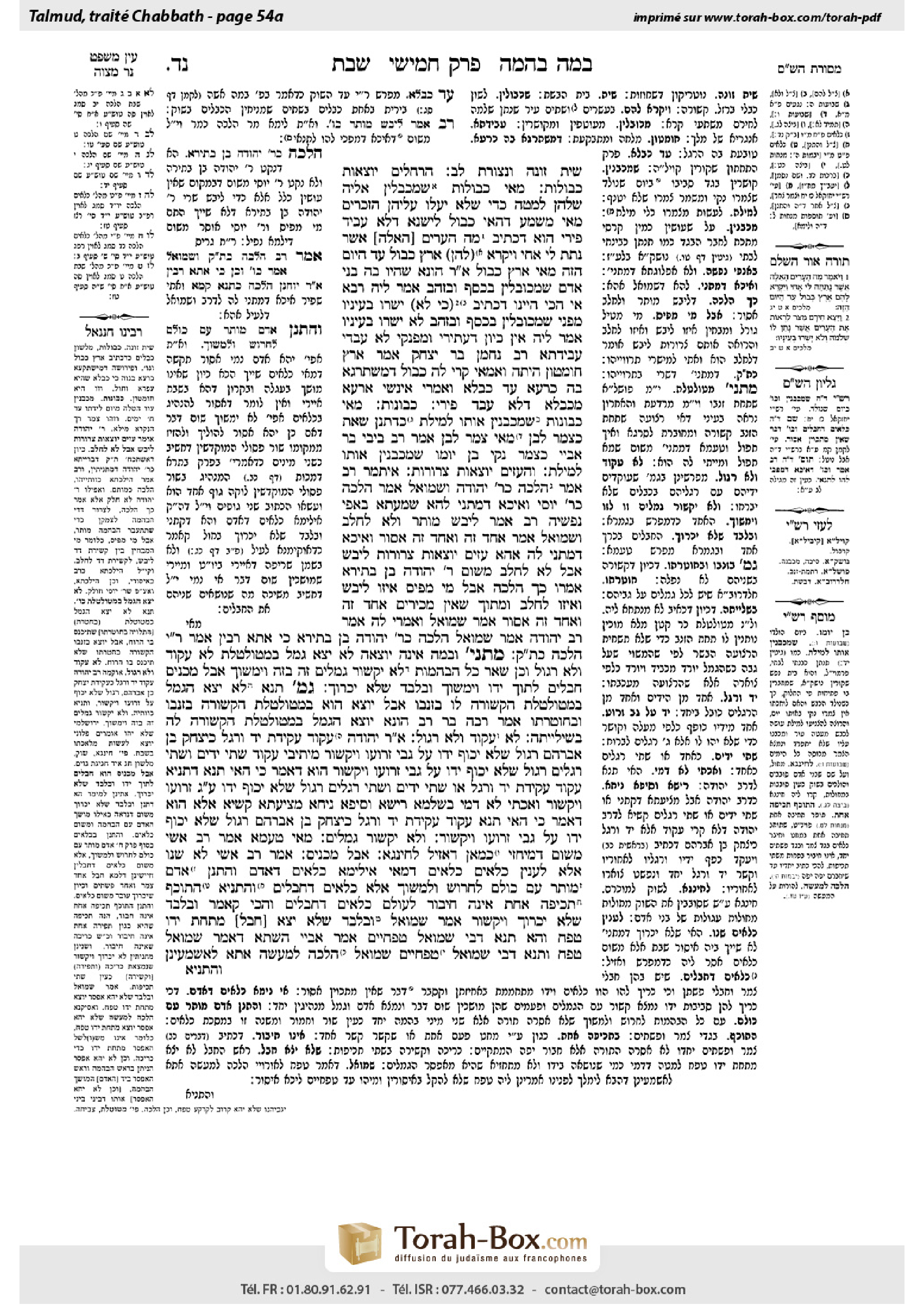
Shabbat 54a: Talmud study for Daf Yomi
Daf Yomi is the daily study of one Talmud folio. Explore 37 tractates with scans, Hebrew text, Sefaria English and AI-generated French translations where annotated.
Passage selection and English or AI-generated French translation are available where the scan has annotations. Daf Study is independent of Torah-Box and Sefaria.
Browse Shabbat · שבת · All tractatesShabbat 54a text and translations
This page of Shabbat includes the Aramaic text, an English translation and an AI-generated French translation, alongside the scan above.
שבת נ״ד א · Aramaic and Hebrew text
שִׁית זוֹנָה וּנְצוּרַת לֵב״.
הָרְחֵלִים יוֹצְאוֹת כְּבוּלוֹת. מַאי ״כְּבוּלוֹת״? — שֶׁמְּכַבְּלִין אַלְיָה שֶׁלָּהֶן לְמַטָּה כְּדֵי שֶׁלֹּא יַעֲלוּ עֲלֵיהֶן זְכָרִים. מַאי מַשְׁמַע דְּהַאי ״כָּבוּל״ לִישָּׁנָא דְּלָא עָבֵיד פֵּירֵי הוּא — דִּכְתִיב: ״מָה הֶעָרִים [הָאֵלֶּה] אֲשֶׁר נָתַתָּ לִּי אָחִי וַיִּקְרָא לָהֶן אֶרֶץ כָּבוּל עַד הַיּוֹם הַזֶּה״.
מַאי ״אֶרֶץ כָּבוּל״? אָמַר רַב הוּנָא: שֶׁהָיוּ בָּהּ בְּנֵי אָדָם שֶׁמְּכוּבָּלִין בְּכֶסֶף וּבְזָהָב. אֲמַר לֵיהּ רָבָא: אִי הָכִי, הַיְינוּ דִּכְתִיב: ״(כִּי לֹא) יָשְׁרוּ בְּעֵינָיו״ — מִפְּנֵי שֶׁמְּכוּבָּלִין בְּכֶסֶף וּבְזָהָב לֹא יָשְׁרוּ בְּעֵינָיו? אֲמַר לֵיהּ: אִין, כֵּיוָן דְּעַתִּירֵי וּמְפַנְּקִי, לָא עָבְדִי עֲבִידְתָּא.
רַב נַחְמָן בַּר יִצְחָק אָמַר: אֶרֶץ חוֹמְטוֹן הָיְתָה. וְאַמַּאי קָרֵי לַהּ ״כָּבוּל״ — דְּמִשְׂתָּרְגָא בַּהּ כַּרְעָא עַד כַּבְלָא. וְאָמְרִי אִינָשֵׁי: אַרְעָא מְכַבַּלְתָּא דְּלָא עָבְדָא פֵּירֵי.
כְּבוּנוֹת. מַאי ״כְּבוּנוֹת״? — שֶׁמְכַבְּנִין אוֹתָן לְמֵילָת. כְּדִתְנַן: שְׂאֵת — כְּצֶמֶר לָבָן. מַאי צֶמֶר לָבָן? אָמַר רַב בִּיבִי בַּר אַבָּיֵי: כְּצֶמֶר נָקִי בֶּן יוֹמוֹ שֶׁמְכַבְּנִין אוֹתוֹ לְמֵילָת.
וְהָעִזִּים יוֹצְאוֹת צְרוּרוֹת. אִיתְּמַר, רַב אָמַר: הֲלָכָה כְּרַבִּי יְהוּדָה, וּשְׁמוּאֵל אָמַר: הֲלָכָה כְּרַבִּי יוֹסֵי.
וְאִיכָּא דְמַתְנֵי לְהָא שְׁמַעְתָּא בְּאַפֵּי נַפְשַׁיהּ. רַב אָמַר: לְיַבֵּשׁ מוּתָּר וְלֹא לֵחָלֵב, וּשְׁמוּאֵל אָמַר: אֶחָד זֶה וְאֶחָד זֶה אָסוּר.
וְאִיכָּא דְמַתְנֵי לַהּ אַהָא: עִזִּים יוֹצְאוֹת צְרוּרוֹת לְיַבֵּשׁ אֲבָל לֹא לֵחָלֵב. מִשּׁוּם רַבִּי יְהוּדָה בֶּן בְּתֵירָא אָמְרוּ: כָּךְ הֲלָכָה, אֲבָל מִי מֵפִיס אֵיזוֹ לְיַבֵּשׁ וְאֵיזוֹ לֵחָלֵב? וּמִתּוֹךְ שֶׁאֵין מַכִּירִים, אֶחָד זֶה וְאֶחָד זֶה אָסוּר. אָמַר שְׁמוּאֵל: וְאָמְרִי לַהּ אָמַר רַב יְהוּדָה אָמַר שְׁמוּאֵל: הֲלָכָה כְּרַבִּי יְהוּדָה בֶּן בְּתֵירָא. כִּי אֲתָא רָבִין אָמַר רַבִּי יוֹחָנָן: הֲלָכָה כְּתַנָּא קַמָּא.
מַתְנִי׳ וּבַמָּה אֵינָהּ יוֹצְאָה? — לֹא יֵצֵא גָּמָל בִּמְטוּלְטֶלֶת, לֹא עָקוּד וְלֹא רָגוּל, וְכֵן שְׁאָר כׇּל הַבְּהֵמוֹת.
לֹא יִקְשׁוֹר גְּמַלִּים זֶה בָּזֶה וְיִמְשׁוֹךְ, אֲבָל מַכְנִיס חֲבָלִים לְתוֹךְ יָדוֹ וְיִמְשׁוֹךְ, וּבִלְבַד שֶׁלֹּא יִכְרוֹךְ.
גְּמָ׳: תָּנָא לֹא יֵצֵא הַגָּמָל בִּמְטוּלְטֶלֶת הַקְּשׁוּרָה לוֹ בִּזְנָבוֹ, אֲבָל יוֹצֵא הוּא בִּמְטוּלְטֶלֶת הַקְּשׁוּרָה בִּזְנָבוֹ וּבְחוֹטַרְתּוֹ. אָמַר רַבָּה בַּר רַב הוּנָא: יוֹצֵא הַגָּמָל בִּמְטוּלְטֶלֶת הַקְּשׁוּרָה לוֹ בְּשִׁילְיְיתָא.
לֹא עָקוּד וְלֹא רָגוּל. אָמַר רַב יְהוּדָה: ״עָקוּד״ — עֲקֵידַת יָד וָרֶגֶל, כְּיִצְחָק בֶּן אַבְרָהָם. ״רָגוּל״ — שֶׁלֹּא יָכוֹף יָדוֹ עַל גַּבֵּי זְרוֹעוֹ וְיִקְשׁוֹר.
מֵיתִיבִי: ״עָקוּד״ — שְׁתֵּי יָדַיִם וּשְׁתֵּי רַגְלַיִם. ״רָגוּל״ — שֶׁלֹּא יָכוֹף יָדוֹ עַל גַּבֵּי זְרוֹעוֹ וְיִקְשׁוֹר! הוּא דְּאָמַר כִּי הַאי תַּנָּא, דְּתַנְיָא: ״עָקוּד״ — עֲקֵידַת יָד וָרֶגֶל אוֹ שְׁתֵּי יָדַיִם וּשְׁתֵּי רַגְלַיִם, ״רָגוּל״ — שֶׁלֹּא יָכוֹף יָדוֹ עַל גַּבֵּי זְרוֹעוֹ וְיִקְשׁוֹר.
וְאַכַּתִּי לָא דָּמֵי: בִּשְׁלָמָא רֵישָׁא וְסֵיפָא — נִיחָא, מְצִיעֲתָא קַשְׁיָא!
אֶלָּא הוּא דְּאָמַר כִּי הַאי תַּנָּא, ״עָקוּד״ — עֲקֵידַת יָד וָרֶגֶל, כְּיִצְחָק בֶּן אַבְרָהָם. ״רָגוּל״ — שֶׁלֹּא יָכוֹף יָדוֹ עַל גַּבֵּי זְרוֹעוֹ וְיִקְשׁוֹר.
וְלֹא יִקְשׁוֹר גְּמַלִּים. מַאי טַעְמָא? אָמַר רַב אָשֵׁי: מִשּׁוּם דְּמֶיחְזֵי כְּמַאן דְּאָזֵיל לְחִינְגָּא.
אֲבָל מַכְנִיס. אָמַר רַב אָשֵׁי: לֹא שָׁנוּ אֶלָּא לְעִנְיַן כִּלְאַיִם. כִּלְאַיִם דְּמַאי? אִילֵּימָא כִּלְאַיִם דְּאָדָם, וְהָתְנַן: אָדָם מוּתָּר עִם כּוּלָּם לַחֲרוֹשׁ וְלִמְשׁוֹךְ!
אֶלָּא כִּלְאַיִם דַּחֲבָלִים. וְהָתַנְיָא: הַתּוֹכֵף תְּכִיפָה אַחַת — אֵינָהּ חִיבּוּר?
לְעוֹלָם כִּלְאַיִם דַּחֲבָלִים, וְהָכִי קָאָמַר: וּבִלְבַד שֶׁלֹּא יִכְרוֹךְ וְיִקְשׁוֹר.
אָמַר שְׁמוּאֵל: וּבִלְבַד שֶׁלֹּא יֵצֵא [חֶבֶל] מִתַּחַת יָדוֹ טֶפַח. וְהָא תָּנָא דְּבֵי שְׁמוּאֵל טִפְחַיִים!
אָמַר אַבָּיֵי: הַשְׁתָּא דְּאָמַר שְׁמוּאֵל טֶפַח, וְתָנָא דְּבֵי שְׁמוּאֵל טִפְחַיִים — שְׁמוּאֵל הֲלָכָה לְמַעֲשֶׂה אֲתָא לְאַשְׁמוֹעִינַן.
Shabbat 54a · English translation
with the attire of a harlot [shit zona] and wily of heart” (Proverbs 7:10). Sheḥuzot can be interpreted as an acronym of the words shit zona, attire of a harlot, with the letters tav and ḥet, which are similar in form, interchanged.
We learned in the mishna: Ewes may go out kevulot. The Gemara asks: What is the meaning of kevulot? It means that they bind their tails down with animal hide so that the males will not mount them. The Gemara explains: From where may it be inferred that this word kavul is a term meaning does not produce fruit? As it is written, when Solomon gave a portion of land to Hiram, he complained: “What cities are these which you have given me, my brother? And he called them the land of Kavul to this day” (I Kings 9:13).
What is the meaning of the land of Kavul? Rav Huna said: That the people living there were bound [mekhubalin] and surrounded by silver and gold. Rava said to him: If so, is that what is written: “And Hiram came out of Tyre to see the cities which Solomon had given him, and they pleased him not” (I Kings 9:12)? Because the people there were bound in silver and gold, the cities were not pleasing in his eyes? Rav Huna said to him: Yes, indeed, it was precisely the abundant wealth that displeased Hiram. Since the people were wealthy and delicate, they did not perform labor. Hiram was seeking people whom he could enlist in the service of the king.
Rav Naḥman bar Yitzḥak said: It was a sandy [ḥomton] expanse of land. And why was it called Kavul? It is because the leg sinks into it up to the ankle [kavla]. And people say in describing poor quality land: Land that is bound [mekhabela] shut, i.e., that does not produce fruit.
We learned in the mishna: Ewes may go out kevunot. The Gemara asks: What is the meaning of kevunot? It is that they covered [mekhabnin] the animal to produce fine wool. Sheep were wrapped in cloth from the day they were born so that their wool would remain perfectly clean and it could be used in fashioning especially fine wool garments. As we learned in a mishna: The color of a leprous sore [se’et] is like that of white wool. The Gemara asked: What is white wool? Rav Beivai bar Abaye said: Like the clean wool of a newborn lamb, which they cover from birth to produce fine wool.
Our mishna continues: And the she-goats may go out with their udders bound. Rabbi Yosei prohibits doing so. Rabbi Yehuda distinguishes between a case where the udders were bound to dry the milk supply and a case where they were bound to conserve the milk. It was stated that the amora’im disagreed with regard to the ruling in this dispute: Rav said: The halakha is in accordance with the opinion of Rabbi Yehuda, and Shmuel said: The halakha is in accordance with the opinion of Rabbi Yosei.
And there are those who teach this halakha independent of the mishna. Rav said: If the udders were bound to dry the milk supply it is permitted, and not if they were bound to conserve the milk. And Shmuel said: Both this and that are prohibited.
And there are those who taught this dispute with regard to this baraita: Goats may go out with their udders bound to dry the milk supply but not to conserve the milk. In the name of Rabbi Yehuda ben Beteira they said: That is the halakha, based on the letter of the law, but who can cast lots to determine by sight alone which udder is bound to dry the milk supply and which was bound to conserve the milk? And since one cannot distinguish between them, the Sages said: Both this and that are prohibited. Shmuel said, and some say Rav Yehuda said that Shmuel said: The halakha is in accordance with the opinion of Rabbi Yehuda ben Beteira. In terms of practical halakha, according to all versions of the disagreement, Shmuel holds that it is prohibited in both cases. When Ravin came from Eretz Yisrael to Babylonia, he said that Rabbi Yoḥanan said: The halakha is in accordance with the opinion of the anonymous first tanna of the mishna. He permits goats to go out with their udders bound in all cases.
MISHNA: And with what may an animal not go out into the public domain on Shabbat? A camel may not go out with a saddlecloth, nor may it go out akud or ragul, which are different ways of tying its legs together, as will be explained in the Gemara. And likewise, tying all other animals in those manners is prohibited.
And likewise, one may not tie camels one to the other and pull the lead camel, thereby pulling the others after it. However, he may place the ropes tied to each of the camels in his hand and pull them all, provided that he does not intertwine the ropes.
GEMARA: It was taught in the Tosefta: A camel may not go out with a saddlecloth tied to its tail alone. However, it may go out with a saddlecloth tied to both its tail and its hump, as in that case one can assume that the saddlecloth will not fall off. Rabba bar Rav Huna said: A female camel may go out with a saddlecloth tied to its afterbirth. Because any movement of the saddlecloth will cause pain, the animal will not attempt to detach it. Therefore, there is no room for concern lest it fall.
We learned in the mishna: A camel may not go out akud or ragul. Rav Yehuda said: Akud means that the animal’s foreleg and hind leg are bound together, similar to the binding of Isaac, son of Abraham, with regard to whom the term vaya’akod is employed. Ragul means that one may not bend the lower part of the foreleg onto the upper foreleg and tie it. That was done so that the camel would have the use of only three legs and would be unable to run away.
The Gemara raises an objection from the following baraita: Akud means that the animal’s two forelegs and two hind legs are bound together. Ragul means that one may not bend the lower part of the foreleg onto the upper foreleg and tie it. The Gemara answers: Rav Yehuda holds in accordance with this tanna, as it was taught in a baraita: Akud means that either the animal’s foreleg and hind leg or its two forelegs and two hind legs are bound together. Ragul means that one may not bend the lower part of the foreleg onto the upper foreleg and tie it.
The Gemara asks: And this baraita and Rav Yehuda’s statement are still not the same. Granted, the first clause, the first case of akud, and the last clause, the case of ragul, work out well. The baraita and the opinion of Rav Yehuda correspond. However, the middle clause is difficult. According to the baraita, when the animal’s two forelegs and two hind legs are bound together, that is also considered akud, contrary to Rav Yehuda’s opinion.
Rather, Rav Yehuda stated his opinion in accordance with this tanna, who said in a baraita: Akud means that the animal’s foreleg and hind leg are bound together, similar to the binding of Isaac, son of Abraham. Ragul means that one may not bend the lower part of the foreleg onto the upper foreleg and tie it.
We learned in the mishna: And one may not tie camels one to the other and pull the lead camel, thereby pulling the others after it. The Gemara asks: What is the reason for this? Rav Ashi said: Because he appears like one going to the market [ḥinga] to sell merchandise or to deliver a caravan of camels. In deference to Shabbat, one may not create that impression.
The mishna continues: However, he may place the ropes tied to each of the camels in his hand and pull them all, provided that he does not intertwine the ropes. Rav Ashi said: This prohibition was taught not with regard to the halakhot of Shabbat but only with regard to the halakhot of prohibited mixtures of diverse kinds. The Gemara asks: Diverse kinds of what? If you say that it is referring to the prohibited mixture of the diverse kinds of man and animal, i.e., a person may not be tied to an animal, just as plowing with the diverse kinds of an ox and a donkey is prohibited, that is difficult. Didn’t we learn in a mishna: A person is permitted to plow and to pull a wagon together with all animals, as the prohibition is limited to diverse kinds of animals?
Rather, the problem here is one of diverse kinds of ropes. If one rope is made of wool and another of linen, it is prohibited to intertwine them because that would create a forbidden mixture of the diverse kinds of wool and linen. However, this too is difficult, as, wasn’t it taught in a baraita: One who attaches a swatch of wool and a swatch of linen with a single stitch or knot, it is not considered a connection with regard to the prohibition of diverse kinds? All the more so in this case, where the ropes are not tied together at all but are merely intertwined, it should not be considered a connection.
The Gemara answers: Actually, the problem here is one of diverse kinds of ropes, and the mishna is saying as follows: Provided that he does not intertwine the ropes and tie them together. Ropes that are intertwined and tied together constitute a double knot, which is considered a connection with regard to the prohibition of diverse kinds of wool and linen.
Shmuel said that there is another restriction that applies to pulling camels with ropes on Shabbat. It is only permitted provided that a handbreadth of the rope does not hang below his hand to avoid the appearance that he is carrying a rope in his hand on Shabbat. The Gemara raises an objection: Didn’t a Sage of the school of Shmuel teach a baraita: Provided that two handbreadths of the rope do not hang below his hand?
Abaye said: Now that Shmuel said one handbreadth, and a Sage of the school of Shmuel taught two handbreadths, it is reasonable to conclude that Shmuel came to teach us the practical halakha. Even though the tanna’im permitted pulling the camel as long as there is less than two handbreadths of rope hanging below his hand, in practice, one should be stringent and not leave even one handbreadth hanging.
Shabbat 54a · Traduction française (IA)
« Vêtue d’un habit de prostituée [shit zona] et rusée de cœur » (Proverbes 7,10). Sheḥuzot peut être interprété comme un acronyme des mots shit zona, « habit de prostituée », en intervertissant les lettres tav et ḥet, dont les formes sont similaires.
Nous avons appris dans la Michna : Les brebis peuvent sortir kevulot. La Guemara demande : Que signifie kevulot ? Cela signifie qu’on leur attache la queue vers le bas avec une peau d’animal, afin que les mâles ne les saillissent pas. La Guemara explique : D’où peut-on déduire que le mot kavul signifie « qui ne produit pas de fruits » ? Comme il est écrit que, lorsque Salomon donna une partie de son territoire à Hiram, celui-ci se plaignit : « Quelles sont ces villes que tu m’as données, mon frère ? Et il les appela le pays de Kavul jusqu’à ce jour » (I Rois 9,13).
Que signifie « le pays de Kavul » ? Rav Houna dit : Cela signifie que ses habitants étaient entravés [mekhubalin] et entourés d’argent et d’or. Rava lui dit : Si c’est ainsi, est-ce bien ce qui est écrit : « Hiram sortit de Tyr pour voir les villes que Salomon lui avait données, et elles ne lui plurent pas » (I Rois 9,12) ? Les villes ne lui plaisaient pas parce que leurs habitants étaient entourés d’argent et d’or ? Rav Houna lui répondit : Oui, en effet, c’est précisément leur grande richesse qui déplut à Hiram. Comme les habitants étaient riches et délicats, ils ne travaillaient pas. Hiram cherchait des gens qu’il pourrait enrôler au service du roi.
Rav Naḥman bar Yitzḥak dit : C’était une étendue de terre sablonneuse [ḥomton]. Et pourquoi l’appelait-on Kavul ? Parce que la jambe s’y enfonce jusqu’à la cheville [kavla]. On dit aussi, pour décrire une terre de mauvaise qualité : « Une terre entravée [mekhabela], fermée », c’est-à-dire qui ne produit pas de fruits.
Nous avons appris dans la Michna : Les brebis peuvent sortir kevunot. La Guemara demande : Que signifie kevunot ? Cela signifie qu’on couvrait [mekhabnin] l’animal pour obtenir une laine fine. Les moutons étaient enveloppés dans un tissu dès leur naissance, afin que leur laine reste parfaitement propre et puisse servir à confectionner des vêtements en laine particulièrement fine. Comme nous l’avons appris dans une Michna : La couleur d’une plaie lépreuse [se’et] est semblable à celle de la laine blanche. La Guemara demanda : Qu’est-ce que la laine blanche ? Rav Beivai bar Abaye dit : Elle est semblable à la laine propre d’un agneau nouveau-né, que l’on couvre dès sa naissance pour obtenir une laine fine.
Notre Michna poursuit : Les chèvres peuvent sortir avec les mamelles attachées. Rabbi Yosse interdit cette pratique. Rabbi Yehouda distingue le cas où les mamelles étaient attachées pour tarir la production de lait de celui où elles l’étaient pour conserver le lait. Il a été rapporté que les amoraïm étaient en désaccord sur la décision à retenir dans cette controverse : Rav dit que la halakha suit l’opinion de Rabbi Yehouda, et Chmouel dit que la halakha suit l’opinion de Rabbi Yosse.
Certains enseignent cette halakha indépendamment de la Michna. Rav dit : Si les mamelles étaient attachées pour tarir la production de lait, c’est permis, mais cela ne l’est pas si elles étaient attachées pour conserver le lait. Chmouel dit : Les deux cas sont interdits.
Certains rapportent ce désaccord au sujet de cette baraïta : Les chèvres peuvent sortir avec les mamelles attachées pour tarir la production de lait, mais pas pour conserver le lait. Au nom de Rabbi Yehouda ben Beteira, on a dit : Telle est la halakha selon la lettre de la loi ; mais qui peut tirer au sort pour déterminer à la seule vue quelle mamelle est attachée pour tarir le lait et laquelle l’est pour le conserver ? Puisqu’on ne peut pas les distinguer, les Sages ont dit : Les deux cas sont interdits. Chmouel a dit — et certains rapportent que Rav Yehouda a dit au nom de Chmouel — que la halakha suit l’opinion de Rabbi Yehouda ben Beteira. En pratique, selon toutes les versions du désaccord, Chmouel considère les deux cas comme interdits. Lorsque Ravin vint d’Eretz Israël en Babylonie, il rapporta que Rabbi Yoḥanan avait dit : La halakha suit l’opinion du premier tanna anonyme de la Michna. Celui-ci permet aux chèvres de sortir avec les mamelles attachées dans tous les cas.
MICHNA : Avec quoi un animal ne peut-il pas sortir dans le domaine public le Chabbat ? Un chameau ne peut pas sortir avec une couverture de selle, ni sortir akud ou ragul, qui sont différentes façons de lui attacher les pattes, comme la Guemara l’expliquera. De même, il est interdit d’attacher ainsi tout autre animal.
De même, on ne peut pas attacher des chameaux les uns aux autres et tirer le chameau de tête, entraînant ainsi les autres derrière lui. Toutefois, on peut tenir dans sa main les cordes attachées à chacun des chameaux et les tirer tous, à condition de ne pas entrelacer les cordes.
GUEMARA : Il a été enseigné dans la Tosefta : Un chameau ne peut pas sortir avec une couverture de selle attachée uniquement à sa queue. Toutefois, il peut sortir avec une couverture de selle attachée à la fois à sa queue et à sa bosse, car on peut alors supposer que la couverture ne tombera pas. Rabba bar Rav Houna dit : Une chamelle peut sortir avec une couverture de selle attachée à son placenta. Comme tout mouvement de la couverture lui causerait de la douleur, l’animal ne tenterait pas de s’en débarrasser. Il n’y a donc pas lieu de craindre qu’elle tombe.
Nous avons appris dans la Michna : Un chameau ne peut pas sortir akud ou ragul. Rav Yehouda dit : Akud signifie que la patte avant de l’animal est attachée à sa patte arrière, comme dans le ligotage d’Isaac, fils d’Abraham, à propos duquel le terme vaya’akod est employé. Ragul signifie qu’on replie la partie inférieure de la patte avant sur la partie supérieure et qu’on l’attache. On procédait ainsi pour que le chameau ne puisse utiliser que trois pattes et soit incapable de s’enfuir.
La Guemara soulève une objection à partir de la baraïta suivante : Akud signifie que les deux pattes avant et les deux pattes arrière de l’animal sont attachées ensemble. Ragul signifie qu’on replie la partie inférieure de la patte avant sur la partie supérieure et qu’on l’attache. La Guemara répond : Rav Yehouda suit l’opinion de ce tanna, comme il a été enseigné dans une baraïta : Akud signifie que la patte avant et la patte arrière de l’animal, ou bien ses deux pattes avant et ses deux pattes arrière, sont attachées ensemble. Ragul signifie qu’on replie la partie inférieure de la patte avant sur la partie supérieure et qu’on l’attache.
La Guemara demande : Pourtant, cette baraïta et la déclaration de Rav Yehouda ne coïncident toujours pas. Certes, la première proposition, qui porte sur le premier cas d’akud, et la dernière proposition, qui porte sur le cas de ragul, concordent bien : la baraïta correspond à l’opinion de Rav Yehouda. Toutefois, la proposition intermédiaire pose problème. Selon la baraïta, lorsque les deux pattes avant et les deux pattes arrière de l’animal sont attachées ensemble, cela aussi est considéré comme akud, contrairement à l’opinion de Rav Yehouda.
Il faut plutôt dire que Rav Yehouda a exprimé son opinion conformément à celle de ce tanna, qui a enseigné dans une baraïta : Akud signifie que la patte avant et la patte arrière de l’animal sont attachées ensemble, comme dans le ligotage d’Isaac, fils d’Abraham. Ragul signifie qu’on replie la partie inférieure de la patte avant sur la partie supérieure et qu’on l’attache.
Nous avons appris dans la Michna : On ne peut pas attacher des chameaux les uns aux autres et tirer le chameau de tête, entraînant ainsi les autres derrière lui. La Guemara demande : Pour quelle raison ? Rav Achi dit : Parce qu’il donne l’impression d’aller au marché [ḥinga] pour vendre des marchandises ou conduire une caravane de chameaux. Par respect pour le Chabbat, on ne doit pas donner cette impression.
La Michna poursuit : Toutefois, on peut tenir dans sa main les cordes attachées à chacun des chameaux et les tirer tous, à condition de ne pas entrelacer les cordes. Rav Achi dit : Cette interdiction n’a pas été enseignée à propos des lois du Chabbat, mais uniquement à propos des lois interdisant les mélanges d’espèces. La Guemara demande : Le mélange de quelles espèces ? Si tu dis qu’il s’agit du mélange interdit entre l’homme et l’animal, c’est-à-dire qu’on ne peut pas attacher une personne à un animal, de même qu’il est interdit de labourer avec des espèces différentes, un bœuf et un âne, cela pose problème. N’avons-nous pas appris dans une Michna : Un homme est autorisé à labourer et à tirer un chariot avec toutes les espèces d’animaux, car l’interdiction se limite aux mélanges d’espèces animales ?
La difficulté concerne plutôt le mélange d’espèces de cordes. Si une corde est en laine et une autre en lin, il est interdit de les entrelacer, car cela créerait un mélange interdit de laine et de lin. Mais cela aussi pose problème : n’a-t-on pas enseigné dans une baraïta que celui qui attache un morceau de laine et un morceau de lin au moyen d’un seul point ou d’un seul nœud ne les relie pas au regard de l’interdiction des mélanges d’espèces ? À plus forte raison dans le cas présent, où les cordes ne sont pas du tout attachées ensemble, mais seulement entrelacées, cela ne devrait pas être considéré comme une liaison.
La Guemara répond : En réalité, la difficulté concerne le mélange d’espèces de cordes, et la Michna dit ceci : à condition de ne pas entrelacer les cordes et de les nouer ensemble. Des cordes entrelacées puis nouées ensemble constituent un double nœud, considéré comme une liaison au regard de l’interdiction du mélange de laine et de lin.
Chmouel dit qu’une autre restriction s’applique lorsqu’on tire des chameaux avec des cordes le Chabbat. Cela n’est permis qu’à condition qu’aucun morceau de corde d’un téfaḥ ne pende sous sa main, afin d’éviter de donner l’impression qu’il porte une corde à la main le Chabbat. La Guemara soulève une objection : un sage de l’école de Chmouel n’a-t-il pas enseigné dans une baraïta qu’aucun morceau de deux téfaḥim ne doit pendre sous sa main ?
Abayé dit : Puisque Chmouel a parlé d’un téfaḥ et qu’un sage de l’école de Chmouel a enseigné deux téfaḥim, il est raisonnable d’en conclure que Chmouel est venu nous enseigner la halakha en pratique. Même si les tannaïm ont permis de tirer le chameau tant que moins de deux téfaḥim de corde pendent sous sa main, en pratique, on doit être rigoureux et ne pas laisser pendre même un seul téfaḥ.
Traduction française générée par IA à partir de l’édition anglaise de Sefaria. Vérifie toujours un passage avec le texte source.
Text from Sefaria: William Davidson Edition - Vocalized Aramaic (CC BY NC); William Davidson Edition - English (CC BY NC).