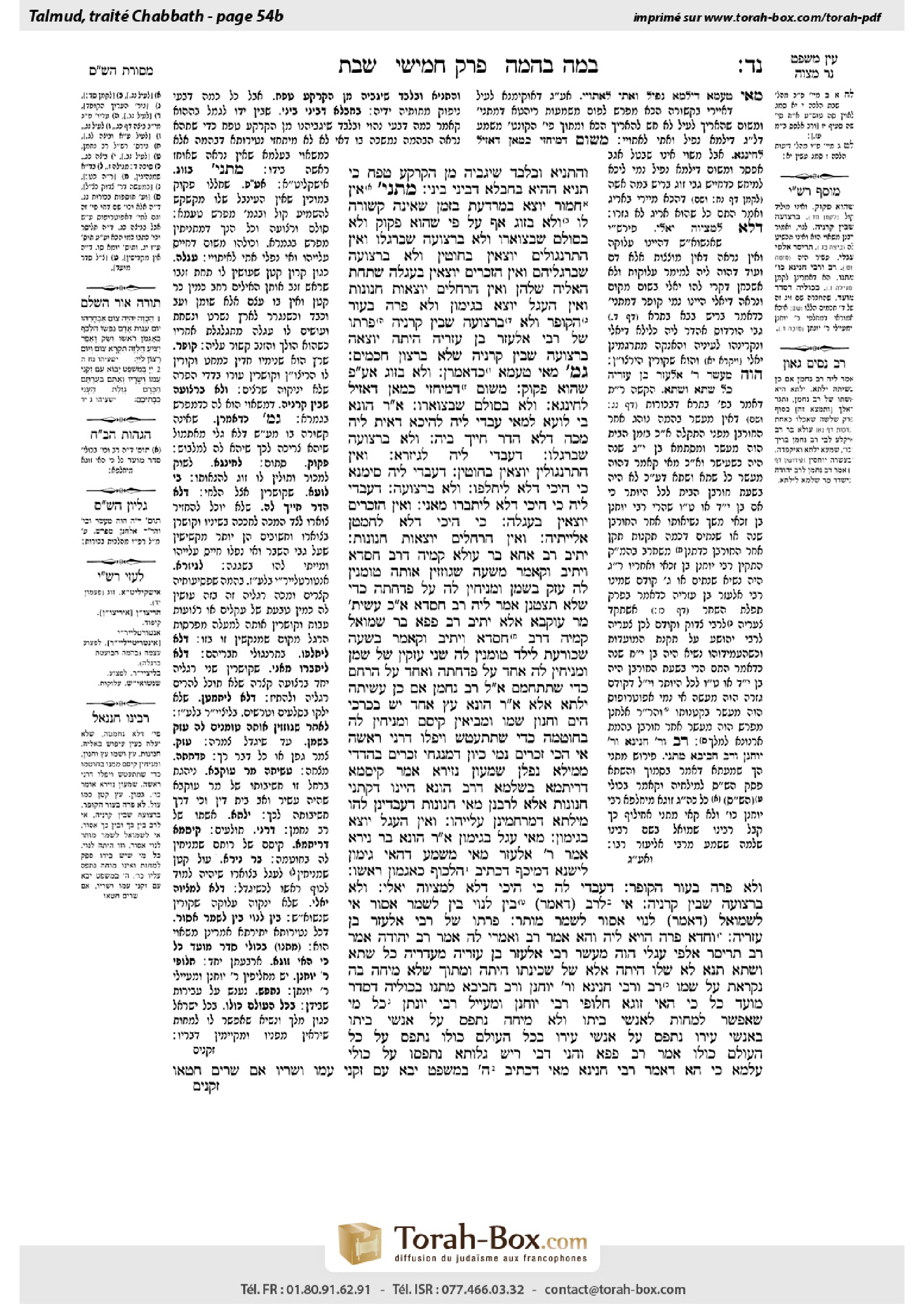
Shabbat 54b: Talmud study for Daf Yomi
Daf Yomi is the daily study of one Talmud folio. Explore 37 tractates with scans, Hebrew text, Sefaria English and AI-generated French translations where annotated.
Passage selection and English or AI-generated French translation are available where the scan has annotations. Daf Study is independent of Torah-Box and Sefaria.
Browse Shabbat · שבת · All tractatesShabbat 54b text and translations
This page of Shabbat includes the Aramaic text, an English translation and an AI-generated French translation, alongside the scan above.
שבת נ״ד ב · Aramaic and Hebrew text
וְהָתַנְיָא: וּבִלְבַד שֶׁיַּגְבִּיהַּ מִן הַקַּרְקַע טֶפַח! כִּי תַּנְיָא הַהִיא בְּחַבְלָא דְּבֵינֵי בֵּינֵי.
מַתְנִי׳ אֵין חֲמוֹר יוֹצֵא בַּמַּרְדַּעַת בִּזְמַן שֶׁאֵינָהּ קְשׁוּרָה לוֹ, וְלֹא בַּזּוּג אַף עַל פִּי שֶׁהוּא פָּקוּק, וְלֹא בְּסוּלָּם שֶׁבְּצַוָּארוֹ, וְלֹא בִּרְצוּעָה שֶׁבְּרַגְלוֹ.
וְאֵין הַתַּרְנְגוֹלִים יוֹצְאִין בְּחוּטִין וְלֹא בִּרְצוּעָה שֶׁבְּרַגְלֵיהֶם, וְאֵין הַזְּכָרִים יוֹצְאִין בָּעֲגָלָה שֶׁתַּחַת הָאַלְיָה שֶׁלָּהֶן.
וְאֵין הָרְחֵלִים יוֹצְאוֹת חֲנוּנוֹת, וְאֵין הָעֵגֶל יוֹצֵא בְּגִימוֹן, וְלֹא פָּרָה בְּעוֹר הַקּוּפָּר, וְלֹא בִּרְצוּעָה שֶׁבֵּין קַרְנֶיהָ. פָּרָתוֹ שֶׁל רַבִּי אֶלְעָזָר בֶּן עֲזַרְיָה הָיְתָה יוֹצְאָה בִּרְצוּעָה שֶׁבֵּין קַרְנֶיהָ שֶׁלֹּא בִּרְצוֹן חֲכָמִים.
גְּמָ׳ מַאי טַעְמָא — כְּדַאֲמַרַן.
וְלֹא בַּזּוּג אַף עַל פִּי שֶׁהוּא פָּקוּק: מִשּׁוּם דְּמֶיחְזֵי כְּמַאן דְּאָזֵיל לְחִינְגָּא.
וְלֹא בְּסוּלָּם שֶׁבְּצַוָּארוֹ: אָמַר רַב הוּנָא: בֵּי לוֹעָא. לְמַאי עָבְדִי לֵיהּ? — לְהֵיכָא דְּאִית לֵיהּ מַכָּה, דְּלָא הָדַר חָיֵיךְ בַּיהּ.
וְלֹא בִּרְצוּעָה שֶׁבְּרַגְלוֹ: דְּעָבְדִי לֵיהּ לְגִיזְרָא.
וְאֵין הַתַּרְנְגוֹלִין יוֹצְאִין בְּחוּטִין: דְּעָבְדִי לְהוּ סִימָנָא כִּי הֵיכִי דְּלָא לִיחְלְפוּ.
וְלֹא בִּרְצוּעָה: דְּעָבְדִי לְהוּ כִּי הֵיכִי דְּלָא לִיתְבְּרוּ מָאנֵי. וְאֵין הַזְּכָרִים יוֹצְאִין בָּעֲגָלָה: כִּי הֵיכִי דְּלָא לִחְמְטָן אַלְיָיתַיְהוּ.
וְאֵין הָרְחֵלִים יוֹצְאוֹת חֲנוּנוֹת: יָתֵיב רַב אַחָא בַּר עוּלָּא קַמֵּיהּ דְּרַב חִסְדָּא וְיָתֵיב וְקָאָמַר: מִשָּׁעָה שֶׁגּוֹזְזִין אוֹתָהּ טוֹמְנִין לָהּ עֶזֶק בְּשֶׁמֶן וּמַנִּיחִין לָהּ עַל פַּדַּחְתָּהּ כְּדֵי שֶׁלֹּא תִּצְטַנֵּן. אֲמַר לֵיהּ רַב חִסְדָּא: אִם כֵּן, עֲשִׂיתָהּ מָר עוּקְבָא.
אֶלָּא יָתֵיב רַב פָּפָּא בַּר שְׁמוּאֵל קַמֵּיהּ דְּרַב חִסְדָּא וְיָתֵיב וְקָאָמַר: בְּשָׁעָה שֶׁכּוֹרַעַת לֵילֵד טוֹמְנִין לָהּ שְׁנֵי עֲזָקִין שֶׁל שֶׁמֶן, וּמַנִּיחִין לָהּ אֶחָד עַל פַּדַּחְתָּהּ וְאֶחָד עַל הָרֶחֶם כְּדֵי שֶׁתִּתְחַמֵּם. אֲמַר לֵיהּ רַב נַחְמָן: אִם כֵּן, עֲשִׂיתָהּ יַלְתָּא.
אֶלָּא אָמַר רַב הוּנָא: עֵץ אֶחָד יֵשׁ בִּכְרַכֵּי הַיָּם וְ״יַחְנוּן״ שְׁמוֹ, וּמְבִיאִין קֵיסָם וּמַנִּיחִין לָהּ בְּחוֹטְמָהּ כְּדֵי שֶׁתִּתְעַטֵּשׁ וְיִפְּלוּ דַּרְנֵי רֹאשָׁהּ. אִי הָכִי זְכָרִים נָמֵי! כֵּיוָן דִּמְנַגְּחֵי זְכָרִים בַּהֲדָדֵי מִמֵּילָא נָפְלָן. שִׁמְעוֹן נְזִירָא אָמַר: קִיסְמָא דְּרִיתְמָא.
בִּשְׁלָמָא דְּרַב הוּנָא, הַיְינוּ דְקָתָנֵי ״חֲנוּנוֹת״, אֶלָּא לְרַבָּנַן מַאי ״חֲנוּנוֹת״? דְּעָבְדִינַן לְהוּ מִילְּתָא דִּמְרַחֲמִינַן עֲלַיְיהוּ.
וְאֵין הָעֵגֶל יוֹצֵא בְּגִימוֹן. מַאי עֵגֶל בְּגִימוֹן? אָמַר רַב הוּנָא: בַּר נִירָא. אָמַר רַבִּי אֶלְעָזָר: מַאי מַשְׁמַע דְּהַאי ״גִּימוֹן״ לִישָּׁנָא דְּמֵיכַף — דִּכְתִיב: ״הֲלָכוֹף כְּאַגְמוֹן רֹאשׁוֹ״.
וְלֹא פָּרָה בְּעוֹר הַקּוּפָּר: דְּעָבְדִי לָהּ כִּי הֵיכִי דְּלָא לִמְצְיוּהָ יָאלֵי.
וְלֹא בִּרְצוּעָה שֶׁבֵּין קַרְנֶיהָ. אִי לְרַב דְּאָמַר בֵּין לְנוֹי בֵּין לְשַׁמֵּר — אָסוּר. אִי לִשְׁמוּאֵל דְּאָמַר לְנוֹי — אָסוּר, לְשַׁמֵּר — מוּתָּר.
פָּרָתוֹ שֶׁל רַבִּי אֶלְעָזָר בֶּן עֲזַרְיָה: וַחֲדָא פָּרָה הַוְיָא לֵיהּ? וְהָא אָמַר רַב, וְאָמְרִי לָהּ אָמַר רַב יְהוּדָה אָמַר רַב: תְּרֵיסַר אַלְפֵי עִגְלֵי הֲוָה מְעַשַּׂר רַבִּי אֶלְעָזָר בֶּן עֲזַרְיָה מֵעֶדְרֵיהּ כׇּל שַׁתָּא וְשַׁתָּא.
תָּנָא: לֹא שֶׁלּוֹ הָיְתָה אֶלָּא שֶׁל שְׁכֶינְתּוֹ הָיְתָה, וּמִתּוֹךְ שֶׁלֹּא מִיחָה בָּהּ נִקְרֵאת עַל שְׁמוֹ.
רַב וְרַבִּי חֲנִינָא וְרַבִּי יוֹחָנָן וְרַב חֲבִיבָא מַתְנוּ: בְּכוּלֵּיהּ דְּסֵדֶר מוֹעֵד כָּל כִּי הַאי זוּגָא חַלּוֹפֵי רַבִּי יוֹחָנָן וּמְעַיֵּיל רַבִּי יוֹנָתָן. כׇּל מִי שֶׁאֶפְשָׁר לִמְחוֹת לְאַנְשֵׁי בֵיתוֹ וְלֹא מִיחָה — נִתְפָּס עַל אַנְשֵׁי בֵיתוֹ. בְּאַנְשֵׁי עִירוֹ — נִתְפָּס עַל אַנְשֵׁי עִירוֹ. בְּכָל הָעוֹלָם כּוּלּוֹ — נִתְפָּס עַל כָּל הָעוֹלָם כּוּלּוֹ.
אָמַר רַב פָּפָּא: וְהָנֵי דְּבֵי רֵישׁ גָּלוּתָא מִיתַּפְסוּ אַכּוּלֵּי עָלְמָא. כִּי הָא דְּאָמַר רַבִּי חֲנִינָא: מַאי דִכְתִיב ״ה׳ בַּמִּשְׁפָּט יָבֹא עִם זִקְנֵי עַמּוֹ וְשָׂרָיו״ — אִם שָׂרִים חָטְאוּ,
Shabbat 54b · English translation
The Gemara raises an objection: Wasn’t it taught in a baraita: This is only permitted provided that he raises the rope one handbreadth from the ground? Apparently, there is no restriction with regard to the length of rope that may hang below the person’s hand. The Gemara answers: When this baraita was taught, it was taught with regard to the length of rope between the camel and the person holding it. That part of the rope may not sag to the ground; rather, it must be raised at least one handbreadth so that it is clear that the rope is attached to the camel.
MISHNA: This mishna lists additional objects with which an animal may not go out into the public domain on Shabbat: A donkey may neither go out with the saddlecloth when it is not tied to its back, nor with a bell even if it is plugged to prevent it from ringing, nor with a ladder that is around its neck, nor with a strap that is around its leg.
And the roosters may not go out with strings and not with a strap on their feet, which are tied there as a sign of ownership. And the rams may not go out with a small wagon under their tails, as it was common practice to put a small wagon under the tails of grown sheep so that the tail would not be injured by dragging on the ground.
And ewes may not go out ḥanunot, nor may a calf go out with a gimon, nor may a cow go out with the skin of a hedgehog [kupar], nor with a strap between its horns. The mishna relates that Rabbi Elazar ben Azarya’s cow would go out on Shabbat with a strap between its horns, contrary to the will of the Sages.
GEMARA: We learned in the mishna that a donkey may not go out on Shabbat with a saddlecloth if it was not tied to its back. The Gemara explains: What is the reason? As we stated above, there is room for concern that when not secured, the saddlecloth is liable to fall off the animal’s back, and its owner may come to retrieve the saddlecloth in the public domain.
We also learned in the mishna: A donkey may not go out with a bell even if it is plugged to prevent it from ringing. The reason is that the animal’s owner appears like one going to the market, who adorns his donkey with bells in honor of market day.
It was also taught in the mishna: Nor with a ladder that is around its neck. Rav Huna said: This refers to a device tied to the jaw. For what purpose does the owner do so to the animal? For a circumstance in which the animal has a wound, so that it does not chafe it again and exacerbate the wound.
The mishna continues: Nor with a strap that is around its leg. The Gemara explains: What purpose does this strap serve? The owner does so to the animal to protect its strides. If its legs are slightly bent so that they knock against each other when the animal walks, a strap is tied there to prevent injury.
We learned further in the mishna: And the roosters may not go out with strings. For what purpose does the owner place the strings? He does so to the roosters as a sign indicating to whom they belong, so that they will not be confused with other roosters.
The mishna continues: Nor with a strap on their feet. The Gemara explains that the owner does so to the roosters so that they will not break vessels. When their legs are tied, they jump around less and cause less damage. The mishna teaches: Rams may not go out with a small wagon under their tails. The Gemara explains that these wagons were placed there in order that their tails will not be injured.
The mishna teaches: And ewes may not go out ḥanunot. The Gemara relates that Rav Aḥa bar Ulla sat before Rav Ḥisda and he sat and he said: From when they shear the wool off the animal, they soak a soft swatch of wool or some other material in oil and place it on the animal’s forehead so that it will not catch cold until its wool grows back. Ḥanunot refers to animals with those swatches. Rav Ḥisda said to him: If so, you turned the animal into the Exilarch, Mar Ukva. That is treatment fit for him, not for a shorn sheep.
Rather, Rav Pappa bar Shmuel sat before Rav Ḥisda, and he sat and he said: At the time that the animal crouches to give birth, those tending to the animal soak two swatches of wool in oil, and place one on the animal’s forehead and the other on its womb so that it will be warmed. Ḥanunot refers to animals with those swatches. Rav Naḥman said to him: If so, you turned the animal into Yalta, my wife, who descended from the house of the Exilarch. That is treatment fit for her, not for an animal.
Rather, Rav Huna said: There is a certain tree in the cities on the sea shore, and ḥanun is its name. Those tending to the animal bring a wood chip from the tree and place it in the animal’s nose so that it will sneeze and the worms on its head will fall. The Gemara asks: If so, not only ewes but also rams should be given this treatment. The Gemara answers: Since the rams butt heads with each other, the worms fall in any event. Shimon the Nazirite said: Ḥanunot is referring to animals into whose nose the chip of a broom tree would be placed.
The Gemara asks: Granted, according to the explanation of Rav Huna that it is the chip taken from the ḥanun tree, that is why the mishna teaches the halakha employing the term ḥanunot. However, according to the explanations proposed by the other Sages, what is the reason that the mishna employed the term ḥanunot? The Gemara explains: Because we do something to the animals that indicates that we have mercy on them; hanunot in the sense of merciful.
We learned in the mishna: And a calf may not go out on Shabbat with a gimon. The Gemara asks: What is the meaning of: A calf with a gimon? Rav Huna said: A small yoke is placed on the calf in order to train it from an early age to bear a yoke. Rabbi Elazar said: From where is it inferred that this term gimon is a term of bending? As it is written: “Is it to bow down his head like a bulrush [agmon]” (Isaiah 58:5). There is an etymological similarity between the words gimon and agmon.
The mishna continues: And a cow may not go out on Shabbat with the skin of a hedgehog placed over its udder. The Gemara explains that the owner does this to the cow so that creeping animals will not suckle from it.
It was also taught in the mishna: And not with a strap that is between its horns. The Gemara notes: If this is explained according to the opinion of Rav, whether the strap was intended as an ornament or whether it was intended to secure the animal, it is prohibited for the cow to go out into the public domain with it. If this is explained according to the opinion of Shmuel, if the strap was intended as an ornament, it is prohibited; if it was intended to secure the animal, it is permitted.
The mishna relates that the cow of Rabbi Elazar ben Azarya would go out on Shabbat with a strap between its horns, contrary to the will of the Sages. The Gemara asks: Did Rabbi Elazar ben Azarya have only one cow? Didn’t Rav say, and some say that Rav Yehuda said that Rav said: Rabbi Elazar ben Azarya would tithe from his herds 12,000 calves each and every year? There were 120, 000 calves born in his herds annually. There is no way, then, to speak of the cow of Rabbi Elazar ben Azarya.
The Gemara answers: It was taught in the Tosefta: The cow was not his; rather, it was his neighbor’s. And because he did not protest her conduct and tell her that doing so is prohibited the cow was called by his name to his discredit, as if it were his.
It was related that Rav, and Rabbi Ḥanina, and Rabbi Yoḥanan, and Rav Ḥaviva taught the statement cited below. The Gemara comments: Throughout the order of Moed, wherever this pair of Sages is mentioned, exchange Rabbi Yoḥanan and insert Rabbi Yonatan in his place. In any event, they said: Anyone who had the capability to effectively protest the sinful conduct of the members of his household and did not protest, he himself is apprehended for the sins of the members of his household and punished. If he is in a position to protest the sinful conduct of the people of his town, and he fails to do so, he is apprehended for the sins of the people of his town. If he is in a position to protest the sinful conduct of the whole world, and he fails to do so, he is apprehended for the sins of the whole world.
Rav Pappa said: And the members of the household of the Exilarch were apprehended and punished for the sins of the whole world. Because their authority extends across the entire Jewish world, it is in their hands to ensure that nobody commit a transgression. As indicated by that which Rabbi Ḥanina said: What is the meaning of that which is written: “The Lord will enter into judgment with the Elders of His people and its princes, saying: It is you who have eaten up the vineyard; the robbery of the poor is in your houses” (Isaiah 3:14)? The question arises: If the princes sinned by committing robbery,
Shabbat 54b · Traduction française (IA)
La Guemara soulève une objection : N’a-t-il pas été enseigné dans une baraïta : « Cela n’est permis qu’à condition qu’il soulève la corde d’un téfa au-dessus du sol » ? Il semble donc qu’il n’y ait aucune restriction quant à la longueur de corde qui peut pendre sous la main de la personne. La Guemara répond : Cette baraïta a été enseignée à propos de la portion de corde qui se trouve entre le chameau et la personne qui le tient. Cette portion ne doit pas traîner par terre ; elle doit au contraire être soulevée d’au moins un téfa, afin qu’il soit clair que la corde est attachée au chameau.
MICHNA : Cette Michna énumère d’autres objets avec lesquels un animal ne peut pas sortir dans le domaine public pendant Chabbat : un âne ne peut sortir ni avec une couverture de selle qui n’est pas attachée à son dos, ni avec une clochette, même si elle est bouchée pour l’empêcher de sonner, ni avec une échelle autour du cou, ni avec une courroie autour de la patte.
Les coqs ne peuvent pas sortir avec des fils, ni avec une courroie aux pattes, qui y sont attachés comme signe de propriété. Les béliers ne peuvent pas sortir avec une petite charrette sous la queue, car on avait coutume de placer une petite charrette sous la queue des moutons adultes afin que celle-ci ne soit pas blessée en traînant sur le sol.
Les brebis ne peuvent pas sortir ḥanunot, un veau ne peut pas sortir avec un gimon, et une vache ne peut pas sortir avec la peau d’un hérisson [kupar], ni avec une courroie entre les cornes. La Michna rapporte que la vache de Rabbi Elazar ben Azarya sortait pendant Chabbat avec une courroie entre les cornes, contrairement à la volonté des Sages.
GUEMARA : Nous avons appris dans la Michna qu’un âne ne peut pas sortir pendant Chabbat avec une couverture de selle si celle-ci n’est pas attachée à son dos. La Guemara explique : Quelle en est la raison ? Comme nous l’avons dit plus haut, on peut craindre que, si la couverture n’est pas fixée, elle tombe du dos de l’animal et que son propriétaire vienne la récupérer dans le domaine public.
Nous avons également appris dans la Michna qu’un âne ne peut pas sortir avec une clochette, même si elle est bouchée pour l’empêcher de sonner. La raison en est que le propriétaire de l’animal semble se rendre au marché et pare son âne de clochettes en l’honneur du jour de marché.
La Michna enseigne également : ni avec une échelle autour du cou. Rav Houna a dit : Cela désigne un dispositif attaché à la mâchoire. Dans quel but le propriétaire fait-il cela à l’animal ? Lorsque celui-ci a une blessure, afin qu’il ne la frotte pas de nouveau et ne l’aggrave pas.
La Michna poursuit : ni avec une courroie autour de la patte. La Guemara explique : À quoi sert cette courroie ? Le propriétaire en met une à l’animal pour protéger ses allures. Si ses pattes sont légèrement arquées et se heurtent lorsqu’il marche, on attache une courroie à cet endroit pour éviter qu’il se blesse.
Nous avons ensuite appris dans la Michna que les coqs ne peuvent pas sortir avec des fils. Dans quel but le propriétaire leur met-il ces fils ? Il les leur attache comme signe de propriété, afin qu’on ne les confonde pas avec d’autres coqs.
La Michna poursuit : ni avec une courroie aux pattes. La Guemara explique que le propriétaire en met aux coqs pour qu’ils ne brisent pas de récipients. Quand leurs pattes sont attachées, ils sautillent moins et causent moins de dégâts. La Michna enseigne que les béliers ne peuvent pas sortir avec une petite charrette sous la queue. La Guemara explique que ces charrettes étaient placées là afin que leur queue ne soit pas blessée.
La Michna enseigne que les brebis ne peuvent pas sortir ḥanunot. La Guemara rapporte que Rav Aḥa bar Oulla était assis devant Rav Ḥisda et dit : Lorsqu’on tond la laine de l’animal, on trempe dans l’huile un morceau de laine douce, ou d’une autre matière, et on le place sur le front de l’animal afin qu’il n’attrape pas froid jusqu’à ce que sa laine repousse. Ḥanunot désigne les animaux portant ces morceaux. Rav Ḥisda lui dit : Dans ce cas, tu as fait de l’animal l’Exilarque, Mar Ukva. Ce traitement lui convient, à lui, pas à une brebis tondue.
Mais plutôt, Rav Pappa bar Shmuel était assis devant Rav Ḥisda et dit : Au moment où l’animal s’accroupit pour mettre bas, ceux qui s’en occupent trempent deux morceaux de laine dans l’huile et en placent un sur son front et l’autre sur sa matrice, afin de le réchauffer. Ḥanunot désigne les animaux portant ces morceaux. Rav Naḥman lui dit : Dans ce cas, tu as fait de l’animal Yalta, ma femme, qui descend de la maison de l’Exilarque. Ce traitement lui convient, à elle, pas à un animal.
Mais plutôt, Rav Houna a dit : Il existe un certain arbre dans les villes du littoral, qui porte le nom de ḥanun. Ceux qui s’occupent de l’animal prennent une écharde de cet arbre et la lui placent dans le nez, afin qu’il éternue et que les vers sur sa tête tombent. La Guemara demande : Dans ce cas, ce traitement devrait être administré non seulement aux brebis, mais aussi aux béliers. La Guemara répond : Comme les béliers se donnent des coups de tête, les vers tombent de toute façon. Shimon le Nazir a dit : Ḥanunot désigne les animaux dans le nez desquels on plaçait une écharde de genêt.
La Guemara demande : Il est compréhensible que, selon l’explication de Rav Houna, il s’agisse d’une écharde prélevée sur l’arbre ḥanun ; c’est pourquoi la Michna enseigne cette halakha en employant le terme ḥanunot. Mais selon les explications proposées par les autres Sages, pourquoi la Michna a-t-elle employé ce terme ? La Guemara explique : Parce que nous faisons quelque chose pour les animaux qui témoigne de notre compassion envers eux ; hanunot signifie « traitées avec compassion ».
Nous avons appris dans la Michna qu’un veau ne peut pas sortir pendant Chabbat avec un gimon. La Guemara demande : Que signifie l’expression « un veau avec un gimon » ? Rav Houna a dit : On place un petit joug sur le veau afin de l’habituer dès son jeune âge à porter un joug. Rabbi Elazar a dit : D’où déduit-on que le terme gimon désigne le fait de se courber ? Comme il est écrit : « Est-ce pour courber la tête comme un roseau [agmon] ? » (Isaïe 58, 5). Les mots gimon et agmon présentent une similitude étymologique.
La Michna poursuit : une vache ne peut pas sortir pendant Chabbat avec la peau d’un hérisson placée sur son pis. La Guemara explique que le propriétaire fait cela afin que des animaux rampants ne tètent pas la vache.
La Michna enseigne également : ni avec une courroie entre ses cornes. La Guemara note : selon l’opinion de Rav, que la courroie soit destinée à servir d’ornement ou à maintenir l’animal, il est interdit à la vache de sortir avec elle dans le domaine public. Selon l’opinion de Shmuel, si la courroie est destinée à servir d’ornement, c’est interdit ; si elle est destinée à maintenir l’animal, c’est permis.
La Michna rapporte que la vache de Rabbi Elazar ben Azarya sortait pendant Chabbat avec une courroie entre les cornes, contrairement à la volonté des Sages. La Guemara demande : Rabbi Elazar ben Azarya n’avait-il qu’une seule vache ? Rav n’a-t-il pas dit — et certains disent que Rav Yehouda l’a dit au nom de Rav — que Rabbi Elazar ben Azarya prélevait la dîme sur ses troupeaux, à raison de 12 000 veaux chaque année ? Ses troupeaux donnaient naissance à 120 000 veaux par an. Il est donc impossible de parler de la vache de Rabbi Elazar ben Azarya.
La Guemara répond : Il a été enseigné dans la Tossefta que la vache ne lui appartenait pas ; elle appartenait plutôt à sa voisine. Comme il n’avait pas protesté contre sa conduite ni ne lui avait dit que cela était interdit, la vache fut appelée de son nom, à son déshonneur, comme si elle lui avait appartenu.
Il fut rapporté que Rav, Rabbi Ḥanina, Rabbi Yoḥanan et Rav Ḥaviva enseignèrent la déclaration citée ci-dessous. La Guemara commente : Dans tout l’ordre de Moed, chaque fois que ce groupe de Sages est mentionné, il faut remplacer Rabbi Yoḥanan par Rabbi Yonatan. Quoi qu’il en soit, ils dirent : Quiconque a la possibilité de protester efficacement contre la conduite fautive des membres de son foyer et ne le fait pas est lui-même tenu pour responsable des péchés des membres de son foyer et puni. S’il est en mesure de protester contre la conduite fautive des habitants de sa ville et ne le fait pas, il est tenu pour responsable des péchés des habitants de sa ville. S’il est en mesure de protester contre la conduite fautive du monde entier et ne le fait pas, il est tenu pour responsable des péchés du monde entier.
Rav Pappa a dit : Les membres de la maison de l’Exilarque ont été tenus pour responsables et punis des péchés du monde entier. Puisque leur autorité s’étend à tout le monde juif, ils peuvent veiller à ce que personne ne commette de transgression. C’est ce qu’indique l’enseignement de Rabbi Ḥanina : Que signifie ce qui est écrit : « L’Éternel entre en jugement avec les anciens de son peuple et ses princes, en disant : C’est vous qui avez dévoré la vigne ; le butin pris au pauvre se trouve dans vos maisons » (Isaïe 3, 14) ? La question se pose : si les princes ont péché en commettant un vol,
Traduction française générée par IA à partir de l’édition anglaise de Sefaria. Vérifie toujours un passage avec le texte source.
Text from Sefaria: William Davidson Edition - Vocalized Aramaic (CC BY NC); William Davidson Edition - English (CC BY NC).