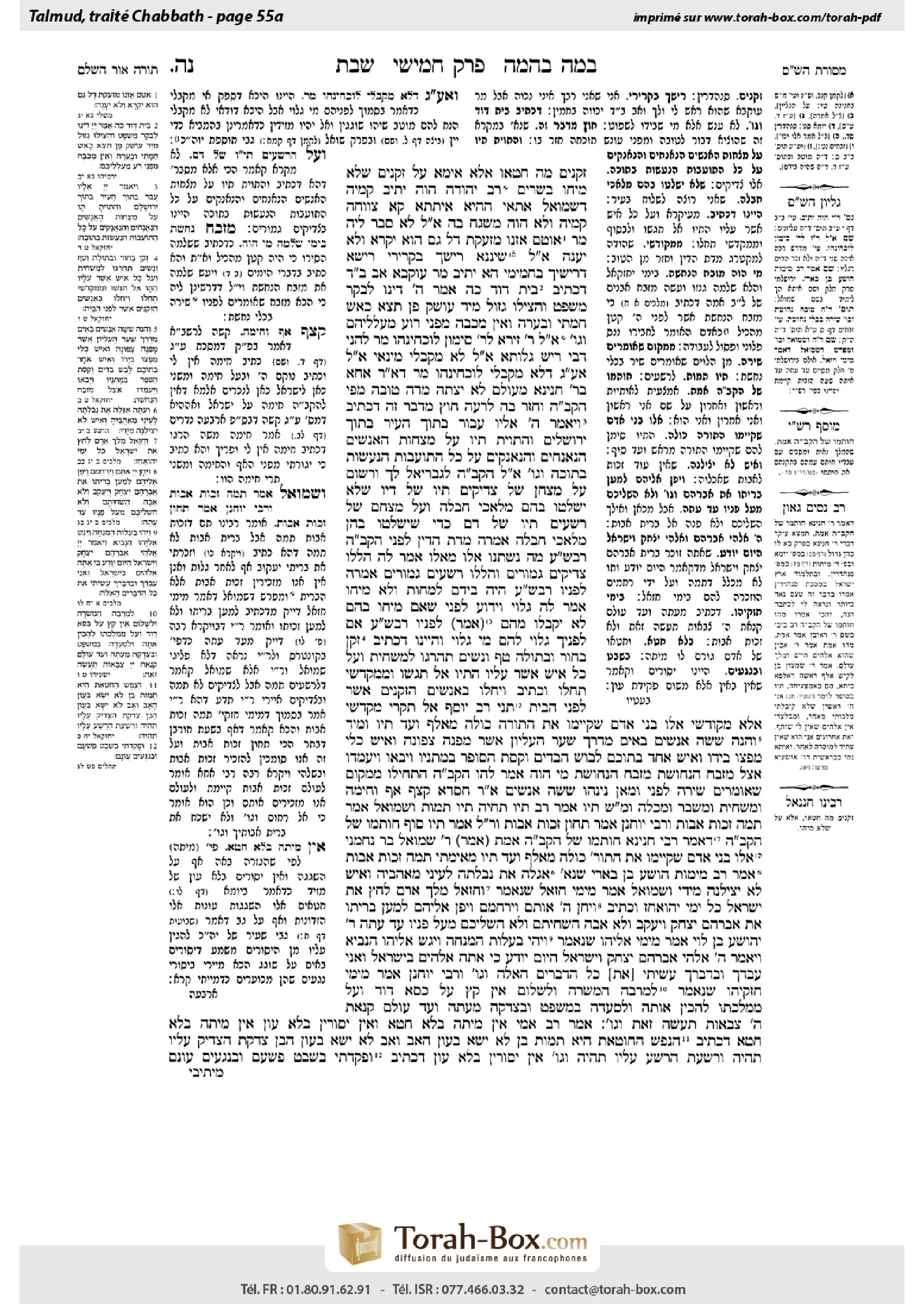
Shabbat 55a: Talmud study for Daf Yomi
Daf Yomi is the daily study of one Talmud folio. Explore 37 tractates with scans, Hebrew text, Sefaria English and AI-generated French translations where annotated.
Passage selection and English or AI-generated French translation are available where the scan has annotations. Daf Study is independent of Torah-Box and Sefaria.
Browse Shabbat · שבת · All tractatesShabbat 55a text and translations
This page of Shabbat includes the Aramaic text, an English translation and an AI-generated French translation, alongside the scan above.
שבת נ״ה א · Aramaic and Hebrew text
זְקֵנִים מֶה חָטְאוּ? אֶלָּא אֵימָא: עַל זְקֵנִים, שֶׁלֹּא מִיחוּ בַּשָּׂרִים.
רַב יְהוּדָה הֲוָה יָתֵיב קַמֵּיהּ דִּשְׁמוּאֵל. אֲתַאי הַהִיא אִיתְּתָא קָא צָוְוחָה קַמֵּיהּ, וְלָא הֲוָה מַשְׁגַּח בַּהּ. אֲמַר לֵיהּ: לָא סָבַר לֵיהּ מָר: ״אוֹטֵם אׇזְנוֹ מִזַּעֲקַת דָּל גַּם הוּא יִקְרָא וְלֹא יֵעָנֶה״? אֲמַר לֵיהּ: שִׁינָּנָא, רֵישָׁךְ בְּקָרִירֵי, רֵישָׁא דְרֵישָׁיךְ בְּחַמִּימֵי. הָא יָתֵיב מָר עוּקְבָא אַב בֵּית דִּין.
דִּכְתִיב: ״בֵּית דָּוִד כֹּה אָמַר ה׳ דִּינוּ לַבֹּקֶר מִשְׁפָּט וְהַצִּילוּ גָזוּל מִיַּד עוֹשֵׁק פֶּן תֵּצֵא כָאֵשׁ חֲמָתִי וּבָעֲרָה וְאֵין מְכַבֶּה מִפְּנֵי רוֹעַ מַעַלְלֵיהֶם וְגוֹ׳״.
אֲמַר לֵיהּ רַבִּי זֵירָא לְרַבִּי סִימוֹן: לוֹכְחִינְהוּ מָר לְהָנֵי דְּבֵי רֵישׁ גָּלוּתָא. אֲמַר לֵיהּ: לָא מְקַבְּלִי מִינַּאי. אֲמַר לֵיהּ: אַף עַל גַּב דְּלָא מְקַבְּלִי לוֹכְחִינְהוּ מָר.
דְּאָמַר רַבִּי אַחָא בְּרַבִּי חֲנִינָא: מֵעוֹלָם לֹא יָצְתָה מִדָּה טוֹבָה מִפִּי הַקָּדוֹשׁ בָּרוּךְ הוּא וְחָזַר בָּהּ לְרָעָה חוּץ מִדָּבָר זֶה, דִּכְתִיב: ״וַיֹּאמֶר ה׳ אֵלָיו עֲבוֹר בְּתוֹךְ הָעִיר בְּתוֹךְ יְרוּשָׁלִָים וְהִתְוִיתָ תָּו עַל מִצְחוֹת הָאֲנָשִׁים הַנֶּאֱנָחִים וְהַנֶּאֱנָקִים עַל כׇּל הַתּוֹעֵבוֹת הַנַּעֲשׂוֹת בְּתוֹכָהּ וְגוֹ׳״.
אָמַר לוֹ הַקָּדוֹשׁ בָּרוּךְ הוּא לְגַבְרִיאֵל: לֵךְ וּרְשׁוֹם עַל מִצְחָן שֶׁל צַדִּיקִים תָּיו שֶׁל דְּיוֹ שֶׁלֹּא יִשְׁלְטוּ בָּהֶם מַלְאֲכֵי חַבָּלָה. וְעַל מִצְחָם שֶׁל רְשָׁעִים תָּיו שֶׁל דָּם כְּדֵי שֶׁיִּשְׁלְטוּ בָּהֶן מַלְאֲכֵי חַבָּלָה.
אָמְרָה מִדַּת הַדִּין לִפְנֵי הַקָּדוֹשׁ בָּרוּךְ הוּא: רִבּוֹנוֹ שֶׁל עוֹלָם! מַה נִּשְׁתַּנּוּ אֵלּוּ מֵאֵלּוּ? אָמַר לָהּ: הַלָּלוּ צַדִּיקִים גְּמוּרִים וְהַלָּלוּ רְשָׁעִים גְּמוּרִים. אָמְרָה לְפָנָיו: רִבּוֹנוֹ שֶׁל עוֹלָם! הָיָה בְּיָדָם לִמְחוֹת וְלֹא מִיחוּ!
אָמַר לָהּ: גָּלוּי וְיָדוּעַ לְפָנַי שֶׁאִם מִיחוּ בָּהֶם לֹא יְקַבְּלוּ מֵהֶם. (אָמַר) [אָמְרָה] לְפָנָיו: רִבּוֹנוֹ שֶׁל עוֹלָם! אִם לְפָנֶיךָ גָּלוּי, לָהֶם מִי גָּלוּי?
וְהַיְינוּ דִּכְתִיב: ״זָקֵן בָּחוּר וּבְתוּלָה טַף וְנָשִׁים תַּהַרְגוּ לְמַשְׁחִית וְעַל כׇּל אִישׁ אֲשֶׁר עָלָיו הַתָּו אַל תִּגַּשׁוּ וּמִמִּקְדָּשִׁי תָּחֵלּוּ״. וּכְתִיב: ״וַיָּחֵלּוּ בָּאֲנָשִׁים הַזְּקֵנִים אֲשֶׁר לִפְנֵי הַבָּיִת״. תָּנֵי רַב יוֹסֵף: אַל תִּקְרֵי ״מִקְדָּשִׁי״ אֶלָּא ״מְקוּדָּשַׁי״ — אֵלּוּ בְּנֵי אָדָם שֶׁקִּיְּמוּ אֶת הַתּוֹרָה כֻּלָּהּ מֵאָלֶף וְעַד תָּיו. וּמִיָּד: ״וְהִנֵּה שִׁשָּׁה אֲנָשִׁים בָּאִים מִדֶּרֶךְ שַׁעַר הָעֶלְיוֹן אֲשֶׁר מׇפְנֶה צָפוֹנָה וְאִישׁ כְּלִי מַפָּצוֹ בְּיָדוֹ וְאִישׁ אֶחָד בְּתוֹכָם לָבֻשׁ הַבַּדִּים וְקֶסֶת הַסּוֹפֵר בְּמׇתְנָיו וַיָּבֹאוּ וַיַּעַמְדוּ אֵצֶל מִזְבַּח הַנְּחוֹשֶׁת״.
מִזְבֵּחַ הַנְּחוֹשֶׁת מִי הֲוָה? אָמַר לָהֶם הַקָּדוֹשׁ בָּרוּךְ הוּא: הַתְחִילוּ מִמְּקוֹם שֶׁאוֹמְרִים שִׁירָה לְפָנַי. וּמַאן נִינְהוּ שִׁשָּׁה אֲנָשִׁים? אָמַר רַב חִסְדָּא: קֶצֶף, אַף, וְחֵימָה, וּמַשְׁחִית, וּמְשַׁבֵּר, וּמְכַלֶּה.
וּמַאי שְׁנָא ״תָּיו״? אָמַר רַב: ״תָּיו״ — תִּחְיֶה, ״תָּיו״ — תָּמוּת. וּשְׁמוּאֵל אָמַר: תַּמָּה זְכוּת אָבוֹת. וְרַבִּי יוֹחָנָן אָמַר: תָּחוֹן זְכוּת אָבוֹת.
וְרֵישׁ לָקִישׁ אָמַר: ״תָּיו״ — סוֹף חוֹתָמוֹ שֶׁל הַקָּדוֹשׁ בָּרוּךְ הוּא, דְּאָמַר רַבִּי חֲנִינָא: חוֹתָמוֹ שֶׁל הַקָּדוֹשׁ בָּרוּךְ הוּא ״אֱמֶת״. (אָמַר) רַבִּי שְׁמוּאֵל בַּר נַחְמָנִי [אָמַר]: אֵלּוּ בְּנֵי אָדָם שֶׁקִּיְּמוּ אֶת הַתּוֹרָה כֻּלָּהּ מֵאָלֶף וְעַד תָּיו.
מֵאֵימָתַי תַּמָּה זְכוּת אָבוֹת? אָמַר רַב: מִימוֹת הוֹשֵׁעַ בֶּן בְּאֵרִי, שֶׁנֶּאֱמַר: ״אֲגַלֶּה אֶת נַבְלֻתָהּ לְעֵינֵי מְאַהֲבֶיהָ וְאִישׁ לֹא יַצִּילֶנָּה מִיָּדִי״.
וּשְׁמוּאֵל אָמַר: מִימֵי חֲזָאֵל, שֶׁנֶּאֱמַר: ״וַחֲזָאֵל מֶלֶךְ אֲרָם לָחַץ אֶת יִשְׂרָאֵל כֹּל יְמֵי יְהוֹאָחָז״. וּכְתִיב: ״וַיָּחׇן ה׳ אוֹתָם וַיְרַחֲמֵם וַיִּפֶן אֲלֵיהֶם לְמַעַן בְּרִיתוֹ אֶת אַבְרָהָם יִצְחָק וְיַעֲקֹב וְלֹא אָבָה הַשְׁחִיתָם וְלֹא הִשְׁלִיכָם מֵעַל פָּנָיו עַד עָתָּה״.
רַבִּי יְהוֹשֻׁעַ בֶּן לֵוִי אָמַר: מִימֵי אֵלִיָּהוּ, שֶׁנֶּאֱמַר: ״וַיְהִי בַּעֲלוֹת הַמִּנְחָה וַיִּגַּשׁ אֵלִיָּהוּ הַנָּבִיא וַיֹּאמַר ה׳ אֱלֹהֵי אַבְרָהָם יִצְחָק וְיִשְׂרָאֵל הַיּוֹם יִוָּדַע כִּי אַתָּה אֱלֹהִים בְּיִשְׂרָאֵל וַאֲנִי עַבְדֶּךָ וּבִדְבָרְךָ עָשִׂיתִי [אֵת] כׇּל הַדְּבָרִים הָאֵלֶּה וְגוֹ׳״.
וְרַבִּי יוֹחָנָן אָמַר: מִימֵי חִזְקִיָּהוּ, שֶׁנֶּאֱמַר: ״לְמַרְבֵּה הַמִּשְׂרָה וּלְשָׁלוֹם אֵין קֵץ עַל כִּסֵּא דָוִד וְעַל מַמְלַכְתּוֹ לְהָכִין אוֹתָהּ וּלְסַעֲדָהּ בְּמִשְׁפָּט וּבִצְדָקָה מֵעַתָּה וְעַד עוֹלָם קִנְאַת ה׳ צְבָאוֹת תַּעֲשֶׂה זֹּאת וְגוֹ׳״.
אָמַר רַב אַמֵּי: אֵין מִיתָה בְּלֹא חֵטְא, וְאֵין יִסּוּרִין בְּלֹא עָוֹן.
אֵין מִיתָה בְּלֹא חֵטְא — דִּכְתִיב: ״הַנֶּפֶשׁ הַחוֹטֵאת הִיא תָמוּת בֵּן לֹא יִשָּׂא בַּעֲוֹן הָאָב וְאָב לֹא יִשָּׂא בַּעֲוֹן הַבֵּן צִדְקַת הַצַּדִּיק עָלָיו תִּהְיֶה וְרִשְׁעַת הָרָשָׁע עָלָיו תִּהְיֶה וְגוֹ׳״. אֵין יִסּוּרִין בְּלֹא עָוֹן — דִּכְתִיב: ״וּפָקַדְתִּי בְשֵׁבֶט פִּשְׁעָם וּבִנְגָעִים עֲוֹנָם״.
Shabbat 55a · English translation
what did the Elders, i.e., the Sages of that generation, do that was considered a sin? Rather, say: God will enter into judgment with the Elders because they did not protest the sinful conduct of the princes.
The Gemara relates: Rav Yehuda was sitting before Shmuel when this woman came and cried before Shmuel about an injustice that had been committed against her, and Shmuel paid no attention to her. Rav Yehuda said to Shmuel: Doesn’t the Master hold in accordance with the verse: “Whoever stops his ears at the cry of the poor, he also shall cry himself, but shall not be heard” (Proverbs 21:13)? He said to him: Big-toothed one, your superior, i.e., I, your teacher, will be punished in cold water. The superior of your superior will be punished in hot water. Mar Ukva, who sits as president of the court, is responsible for those matters.
And from where is it derived that this responsibility is incumbent upon the house of the Exilarch? As it is written: “House of David, so says the Lord: Execute judgment in the morning, and deliver him that is robbed out of the hand of the oppressor, lest My fury go forth like fire, and burn so that none can quench it because of the evil of your doings” (Jeremiah 21:12). The Exilarch is a direct descendant of the house of David.
With regard to the issue of reprimand, it was related that Rabbi Zeira said to Rabbi Simon: Let the Master reprimand the members of the house of the Exilarch, as Rabbi Simon had some influence over them. Rabbi Simon said to him: They will not accept reprimand from me. Rabbi Zeira said to him: Let my master reprimand them even if they do not accept it.
As Rabbi Aḥa, son of Rabbi Ḥanina, said: Never did a promise manifesting a good attribute emerge from the mouth of the Holy One, Blessed be He, and He later retracted it and rendered it evil, except with regard to this matter, as it is written: “And the Lord said to him: Go through the midst of the city, through the midst of Jerusalem, and set a mark [tav] upon the foreheads of the men that sigh and that cry on account of all the abominations that are done in her midst” (Ezekiel 9:4).
The Holy One, Blessed be He, said to the angel Gabriel: Go and inscribe a tav of ink on the foreheads of the righteous as a sign so that the angels of destruction will not have dominion over them. And inscribe a tav of blood on the foreheads of the wicked as a sign so that the angels of destruction will have dominion over them.
The attribute of justice said before the Holy One, Blessed be He: Master of the Universe, how are these different from those? He said to that attribute: These are full-fledged righteous people and those are full-fledged wicked people. The attribute of justice said to Him: Master of the Universe, it was in the hands of the righteous to protest the conduct of the wicked, and they did not protest.
He said to that attribute: It is revealed and known before Me that even had they protested the conduct of the wicked, they would not have accepted the reprimand from them. They would have continued in their wicked ways. The attribute of justice said before Him: Master of the Universe, if it is revealed before You that their reprimand would have been ineffective, is it revealed to them? The Holy One, Blessed be He, retracted His promise to protect the righteous and decided that those who failed to protest would also be punished.
And that is the meaning of that which is written: “Slay utterly old and young, both maid, and little children, and women; but come not near any man upon whom is the mark; and begin at My Sanctuary” (Ezekiel 9:6). And it is written in that same verse: “Then they began with the elderly men who were before the house.” Rav Yosef taught: Read not: My Sanctuary [mikdashi], rather: Those sanctified to Me [mekudashai]. These are people who observed the whole Torah in its entirety from alef through tav. And immediately: “And, behold, six men came from the way of the higher gate, which lies toward the north, and every man with his weapon of destruction in his hand; and one man among them was clothed in linen, with a writer’s inkwell by his side; and they went in and stood beside the bronze altar” (Ezekiel 9:2).
The Gemara asks: Was there a bronze altar in the Temple in the time of Ezekiel? Already in the days of Solomon there was only a stone altar. Rather, this should be understood as a figure of speech. The Holy One, Blessed be He, said to them: Begin from the place where they recite songs of praise before Me. This is a reference to the Levites in the Temple whose musical instruments are made of bronze. And who are the six men mentioned here? Rav Ḥisda said: Fury, Wrath, and Rage, and Destroyer, and Breaker, and Annihilator, six angels of destruction.
The Gemara asks further: And what is different about the letter tav, that it was inscribed on the foreheads of the righteous? Rav said: Tav is the first letter of the word tiḥye, you shall live, indicating that the righteous shall live. Tav is also the first letter of the word tamut, you shall die, indicating that the wicked shall die. And Shmuel said: The letter tav is the first letter of the word tama, ceased, indicating that the merit of the Patriarchs has ceased and will not help the wicked. Rabbi Yoḥanan said: The letter tav is the first letter of the word taḥon, will have mercy, indicating that due to the merit of the Patriarchs God will have mercy on the righteous.
And Reish Lakish said: The letter tav is the last letter of the seal of the Holy One, Blessed be He, as Rabbi Ḥanina said: The seal of the Holy One, Blessed be He, is truth [emet], which ends with the letter tav. Rabbi Shmuel bar Naḥmani said: The letter tav teaches that these are people who observed the entire Torah from alef through tav.
With regard to the statement that the merit of the Patriarchs has ceased, the Gemara asks: From when did the merit of the Patriarchs cease? Rav said: From the days of the prophet Hosea, son of Beeri, as it is stated: “And now I will uncover her lewdness in the sight of her lovers, and none shall deliver her out of My hand” (Hosea 2:12). Israel will no longer be saved by the merit of the Patriarchs.
And Shmuel said: The merit of the Patriarchs ceased since the days of Hazael, as it is stated: “And Hazael, king of Aram, oppressed Israel all the days of Jehoahaz” (II Kings 13:22). And it is written there: “And the Lord was gracious to them, and had compassion on them, and turned toward them because of His covenant with Abraham, Isaac, and Jacob and would not destroy them; neither has He till now cast them away from His presence” (II Kings 13:23). That was the last time that the merit of the Patriarchs was mentioned.
Rabbi Yehoshua ben Levi said: The merit of the Patriarchs ceased since the days of Elijah the Prophet, as it is stated: “And it came to pass at the time of the evening sacrifice, that Elijah the Prophet came near and said, Lord, God of Abraham, Isaac, and Israel, let it be known this day that you are God in Israel, and that I am Your servant, and that I have done all these things at Your word” (I Kings 18:36). By inference: Let it be known this day and not afterward because the merit of the Patriarchs will cease today.
And Rabbi Yoḥanan said: The merit of the Patriarchs ceased since the days of Hezekiah, as it is stated: “For the increase of the realm and for peace without end, upon the throne of David, and upon his kingdom to order it, and to establish it with judgment and with justice; from now and forever the zeal of the Lord of hosts performs this” (Isaiah 9:6). That is to say, from this point on, the merit of the Patriarchs will not protect Israel, leaving only the zeal of the Lord.
The Gemara continues its discussion of punishment in general and the relationship between a person’s actions and the punishments meted out against him in particular: Rav Ami said: There is no death without sin; were a person not to sin, he would not die. And there is no suffering without iniquity.
The Gemara adduces proof to these assertions: There is no death without sin, as it is written: “The soul that sins, it shall die. The son shall not bear the iniquity of the father, neither shall the father bear the iniquity of the son; the righteousness of the righteous shall be upon him, and the wickedness of the wicked shall be upon him” (Ezekiel 18:20). A person dies only because of his own sins and not because of some preexistent sin. And there is no suffering without iniquity, as it is written: “Then I will punish their transgression with the rod and their iniquity with strokes” (Psalms 89:33).
Shabbat 55a · Traduction française (IA)
Qu’ont donc fait les Anciens, c’est-à-dire les Sages de cette génération, qui puisse être considéré comme une faute ? Il faut plutôt dire : Dieu entrera en jugement avec les Anciens parce qu’ils n’ont pas protesté contre la conduite pécheresse des princes.
La Guemara rapporte : Rav Yehouda était assis devant Shmouel lorsqu’une femme vint se plaindre auprès de lui d’une injustice dont elle avait été victime, mais Shmouel ne lui prêta aucune attention. Rav Yehouda dit à Shmouel : Le Maître ne tient-il pas compte du verset : « Celui qui ferme son oreille au cri du pauvre criera lui aussi, mais ne sera pas entendu » (Proverbes 21, 13) ? Shmouel lui répondit : « Grosse-dent, ton supérieur — c’est-à-dire moi, ton maître — sera puni dans de l’eau froide. Le supérieur de ton supérieur sera puni dans de l’eau chaude. Mar Oukva, qui préside le tribunal, est responsable de ces affaires. »
Et d’où déduit-on que cette responsabilité incombe à la maison de l’Exilarque ? Car il est écrit : « Maison de David, ainsi parle le Seigneur : Rendez la justice dès le matin et arrachez l’opprimé des mains de l’oppresseur, de peur que Ma fureur ne s’élance comme un feu et ne brûle sans que personne puisse l’éteindre, à cause de la méchanceté de vos actes » (Jérémie 21, 12). L’Exilarque est un descendant direct de la maison de David.
Au sujet du devoir de réprimander, on rapporte que Rabbi Zeïra dit à Rabbi Simon : Que le Maître réprimande les membres de la maison de l’Exilarque, puisque Rabbi Simon avait une certaine influence sur eux. Rabbi Simon lui répondit : Ils n’accepteront pas mes réprimandes. Rabbi Zeïra lui dit : Que mon maître les réprimande, même s’ils ne les acceptent pas.
Car Rabbi Aḥa, fils de Rabbi Ḥanina, a dit : Jamais une promesse exprimant un attribut de bonté n’est sortie de la bouche du Saint, béni soit-Il, pour qu’Il revienne ensuite sur cette promesse et la transforme en mal, sauf dans cette affaire, comme il est écrit : « Le Seigneur lui dit : Parcours la ville, parcours Jérusalem, et marque d’un signe [tav] le front des hommes qui soupirent et se lamentent à cause de toutes les abominations qui se commettent en son sein » (Ézéchiel 9, 4).
Le Saint, béni soit-Il, dit à l’ange Gabriel : Va inscrire un tav d’encre sur le front des justes, comme signe afin que les anges de la destruction n’aient pas de pouvoir sur eux. Et inscris un tav de sang sur le front des méchants, comme signe afin que les anges de la destruction aient pouvoir sur eux.
L’attribut de justice dit devant le Saint, béni soit-Il : Maître de l’Univers, en quoi ceux-ci sont-ils différents de ceux-là ? Il répondit à cet attribut : Ceux-ci sont des justes accomplis et ceux-là, des méchants accomplis. L’attribut de justice Lui dit : Maître de l’Univers, les justes avaient la possibilité de protester contre la conduite des méchants, mais ils ne l’ont pas fait.
Il répondit à cet attribut : Il M’est révélé et connu que, même s’ils avaient protesté contre la conduite des méchants, ceux-ci n’auraient pas accepté leurs réprimandes. Ils auraient continué à agir méchamment. L’attribut de justice dit devant Lui : Maître de l’Univers, s’il T’est révélé que leurs réprimandes auraient été inefficaces, cela leur est-il révélé à eux ? Le Saint, béni soit-Il, revint sur Sa promesse de protéger les justes et décida que ceux qui n’avaient pas protesté seraient eux aussi punis.
Tel est le sens de ce qui est écrit : « Tuez sans pitié les vieillards et les jeunes gens, les jeunes filles, les petits enfants et les femmes ; mais n’approchez d’aucun homme qui porte la marque, et commencez par Mon Sanctuaire » (Ézéchiel 9, 6). Et il est écrit dans ce même verset : « Ils commencèrent par les vieillards qui se tenaient devant la maison. » Rav Yosef enseigna : Ne lis pas « Mon Sanctuaire » [mikdashi], mais « ceux qui Me sont consacrés » [mekudashai]. Il s’agit de personnes qui observaient toute la Torah dans son intégralité, de alef à tav. Et aussitôt : « Et voici que six hommes arrivaient par le chemin de la porte supérieure, qui regarde vers le nord ; chacun avait à la main son arme de destruction ; parmi eux, un homme était vêtu de lin et portait à la ceinture un encrier de scribe ; ils entrèrent et se tinrent près de l’autel de bronze » (Ézéchiel 9, 2).
La Guemara demande : Y avait-il un autel de bronze dans le Temple à l’époque d’Ézéchiel ? Déjà du temps de Salomon, il n’y avait qu’un autel de pierre. Il faut plutôt comprendre qu’il s’agit d’une figure de style. Le Saint, béni soit-Il, leur dit : Commencez par l’endroit où l’on récite devant Moi des chants de louange. Cela désigne les lévites du Temple, dont les instruments de musique sont en bronze. Et qui sont les six hommes mentionnés ici ? Rav Ḥisda dit : Fureur, Colère et Rage, ainsi que Destructeur, Briseur et Anéantisseur, six anges de la destruction.
La Guemara demande encore : Qu’a donc de particulier la lettre tav, pour avoir été inscrite sur le front des justes ? Rav dit : Tav est la première lettre du mot tiḥye, « tu vivras », ce qui indique que les justes vivront. Tav est aussi la première lettre du mot tamut, « tu mourras », ce qui indique que les méchants mourront. Shmouel dit : La lettre tav est la première lettre du mot tama, « a pris fin », ce qui indique que le mérite des Patriarches a pris fin et n’aidera pas les méchants. Rabbi Yoḥanan dit : La lettre tav est la première lettre du mot taḥon, « aura pitié », ce qui indique que Dieu aura pitié des justes grâce au mérite des Patriarches.
Et Reish Lakish dit : La lettre tav est la dernière lettre du sceau du Saint, béni soit-Il, car Rabbi Ḥanina a dit : Le sceau du Saint, béni soit-Il, est la vérité [emet], qui se termine par la lettre tav. Rabbi Shmuel bar Naḥmani dit : La lettre tav enseigne qu’il s’agit de personnes qui observaient toute la Torah, de alef à tav.
À propos de l’affirmation selon laquelle le mérite des Patriarches a pris fin, la Guemara demande : À partir de quand le mérite des Patriarches a-t-il pris fin ? Rav dit : Depuis l’époque du prophète Osée, fils de Beéri, comme il est dit : « Et maintenant, je dévoilerai son impudicité aux yeux de ses amants, et nul ne la délivrera de Ma main » (Osée 2, 12). Israël ne sera plus sauvé par le mérite des Patriarches.
Shmouel dit : Le mérite des Patriarches a pris fin depuis l’époque de Hazaël, comme il est dit : « Hazaël, roi d’Aram, opprima Israël durant toute la vie de Joachaz » (II Rois 13, 22). Et il est écrit là : « Le Seigneur leur fit grâce, eut compassion d’eux et se tourna vers eux à cause de Son alliance avec Abraham, Isaac et Jacob ; Il ne voulut pas les détruire et ne les a pas encore rejetés loin de Sa présence jusqu’à ce jour » (II Rois 13, 23). C’est la dernière fois que le mérite des Patriarches est mentionné.
Rabbi Yehoshoua ben Lévi dit : Le mérite des Patriarches a pris fin depuis l’époque d’Élie le prophète, comme il est dit : « À l’heure du sacrifice du soir, Élie le prophète s’approcha et dit : Seigneur, Dieu d’Abraham, d’Isaac et d’Israël, qu’on sache aujourd’hui que Tu es Dieu en Israël, que je suis Ton serviteur et que j’ai fait toutes ces choses selon Ta parole » (I Rois 18, 36). On en déduit : « Qu’on sache aujourd’hui », et non après, car le mérite des Patriarches prendra fin aujourd’hui.
Et Rabbi Yoḥanan dit : Le mérite des Patriarches a pris fin depuis l’époque d’Ézéchias, comme il est dit : « À l’accroissement du pouvoir et à une paix sans fin, sur le trône de David et sur son royaume, pour l’établir et l’affermir par le droit et par la justice, dès maintenant et à jamais : le zèle du Seigneur des armées accomplira cela » (Isaïe 9, 6). Cela signifie qu’à partir de ce moment, le mérite des Patriarches ne protégera plus Israël ; seul restera le zèle du Seigneur.
La Guemara poursuit son examen de la punition en général et, en particulier, du rapport entre les actes d’une personne et les punitions qui lui sont infligées : Rav Ami dit : Il n’y a pas de mort sans faute ; si une personne ne commettait pas de faute, elle ne mourrait pas. Et il n’y a pas de souffrance sans iniquité.
La Guemara apporte des preuves à ces affirmations. Il n’y a pas de mort sans faute, comme il est écrit : « L’âme qui pèche, c’est elle qui mourra. Le fils ne portera pas l’iniquité du père, et le père ne portera pas l’iniquité du fils ; la justice du juste sera sur lui, et la méchanceté du méchant sera sur lui » (Ézéchiel 18, 20). Une personne ne meurt qu’à cause de ses propres fautes, et non à cause d’une faute préexistante. Et il n’y a pas de souffrance sans iniquité, comme il est écrit : « Je châtierai leur transgression par le bâton et leur iniquité par des coups » (Psaumes 89, 33).
Traduction française générée par IA à partir de l’édition anglaise de Sefaria. Vérifie toujours un passage avec le texte source.
Text from Sefaria: William Davidson Edition - Vocalized Aramaic (CC BY NC); William Davidson Edition - English (CC BY NC).