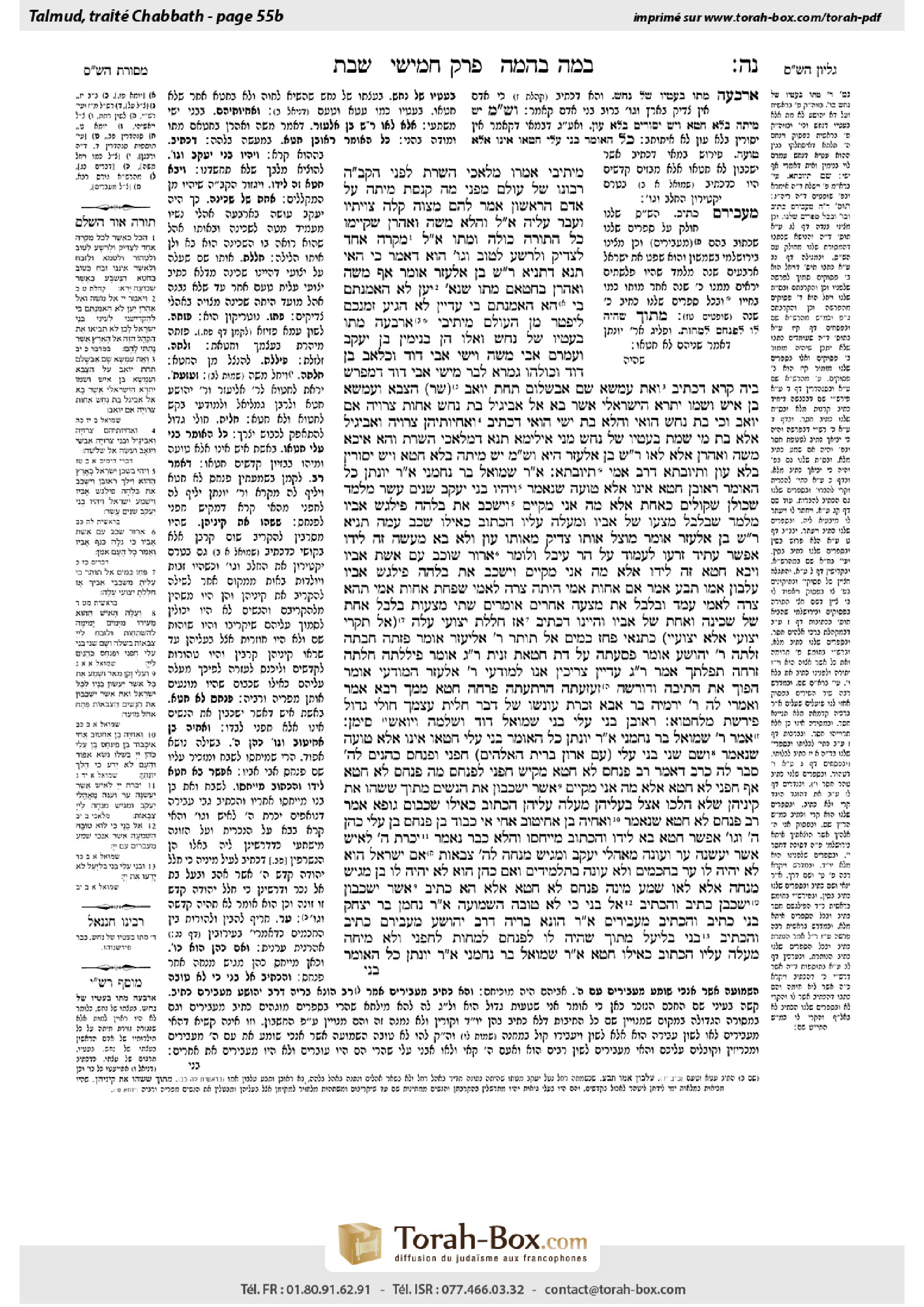
Shabbat 55b: Talmud study for Daf Yomi
Daf Yomi is the daily study of one Talmud folio. Explore 37 tractates with scans, Hebrew text, Sefaria English and AI-generated French translations where annotated.
Passage selection and English or AI-generated French translation are available where the scan has annotations. Daf Study is independent of Torah-Box and Sefaria.
Browse Shabbat · שבת · All tractatesShabbat 55b text and translations
This page of Shabbat includes the Aramaic text, an English translation and an AI-generated French translation, alongside the scan above.
שבת נ״ה ב · Aramaic and Hebrew text
מֵיתִיבִי: אָמְרוּ מַלְאֲכֵי הַשָּׁרֵת לִפְנֵי הַקָּדוֹשׁ בָּרוּךְ הוּא: רִבּוֹנוֹ שֶׁל עוֹלָם! מִפְּנֵי מָה קָנַסְתָּ מִיתָה עַל אָדָם הָרִאשׁוֹן? אָמַר לָהֶם: מִצְוָה קַלָּה צִוִּיתִיו וְעָבַר עָלֶיהָ. אָמְרוּ לוֹ: וַהֲלֹא מֹשֶׁה וְאַהֲרֹן שֶׁקִּיְּמוּ כׇּל הַתּוֹרָה כֻּלָּהּ, וּמֵתוּ! אָמַר לָהֶם: ״מִקְרֶה אֶחָד לַצַּדִּיק וְלָרָשָׁע לַטּוֹב וְגוֹ׳״!
הוּא דְּאָמַר כִּי הַאי תַּנָּא, דְּתַנְיָא, רַבִּי שִׁמְעוֹן בֶּן אֶלְעָזָר אוֹמֵר: אַף מֹשֶׁה וְאַהֲרֹן בְּחֶטְאָם מֵתוּ, שֶׁנֶּאֱמַר: ״יַעַן לֹא הֶאֱמַנְתֶּם בִּי״. הָא הֶאֱמַנְתֶּם בִּי — עֲדַיִן לֹא הִגִּיעַ זְמַנְּכֶם לִיפָּטֵר מִן הָעוֹלָם.
מֵיתִיבִי: אַרְבָּעָה מֵתוּ בְּעֶטְיוֹ שֶׁל נָחָשׁ, וְאֵלּוּ הֵן: בִּנְיָמִין בֶּן יַעֲקֹב, וְעַמְרָם אֲבִי מֹשֶׁה, וְיִשַׁי אֲבִי דָוִד, וְכִלְאָב בֶּן דָּוִד. וְכוּלְּהוּ גְּמָרָא, לְבַר מִיִּשַׁי אֲבִי דָוִד דִּמְפָרֵשׁ בָּהּ קְרָא, דִּכְתִיב: ״וְאֶת עֲמָשָׂא שָׂם אַבְשָׁלוֹם תַּחַת יוֹאָב (שַׂר) [עַל] הַצָּבָא וַעֲמָשָׂא בֶן אִישׁ וּשְׁמוֹ יִתְרָא הַיִּשְׂרְאֵלִי אֲשֶׁר בָּא אֶל אֲבִיגַיִל בַּת נָחָשׁ אֲחוֹת צְרוּיָה אֵם יוֹאָב״.
וְכִי בַּת נָחָשׁ הֲוַאי? וַהֲלֹא בַּת יִשַׁי הֲוַאי, דִּכְתִיב: ״וְאַחְיוֹתֵיהֶן צְרוּיָה וַאֲבִיגַיִל״. אֶלָּא: בַּת מִי שֶׁמֵּת בְּעֶטְיוֹ שֶׁל נָחָשׁ.
מַנִּי? אִילֵּימָא תַּנָּא דְמַלְאֲכֵי הַשָּׁרֵת, וְהָא אִיכָּא מֹשֶׁה וְאַהֲרֹן! אֶלָּא לָאו, רַבִּי שִׁמְעוֹן בֶּן אֶלְעָזָר הִיא. וּשְׁמַע מִינַּהּ יֵשׁ מִיתָה בְּלֹא חֵטְא וְיֵשׁ יִסּוּרִין בְּלֹא עָוֹן, וּתְיוּבְתָּא דְרַב אַמֵּי — תְּיוּבְתָּא.
אָמַר רַבִּי שְׁמוּאֵל בַּר נַחְמָנִי אָמַר רַבִּי יוֹנָתָן: כׇּל הָאוֹמֵר רְאוּבֵן חָטָא אֵינוֹ אֶלָּא טוֹעֶה, שֶׁנֶּאֱמַר: ״וַיִּהְיוּ בְנֵי יַעֲקֹב שְׁנֵים עָשָׂר״ — מְלַמֵּד שֶׁכּוּלָּן שְׁקוּלִים כְּאֶחָד. אֶלָּא מָה אֲנִי מְקַיֵּים ״וַיִּשְׁכַּב אֶת בִּלְהָה פִּילֶגֶשׁ אָבִיו״ — מְלַמֵּד שֶׁבִּלְבֵּל מַצָּעוֹ שֶׁל אָבִיו, וּמַעֲלֶה עָלָיו הַכָּתוּב כְּאִילּוּ שָׁכַב עִמָּהּ.
תַּנְיָא, רַבִּי שִׁמְעוֹן בֶּן אֶלְעָזָר אוֹמֵר: מוּצָּל אוֹתוֹ צַדִּיק מֵאוֹתוֹ עָוֹן, וְלֹא בָּא מַעֲשֶׂה זֶה לְיָדוֹ. אֶפְשָׁר עָתִיד זַרְעוֹ לַעֲמוֹד עַל הַר עֵיבָל וְלוֹמַר: ״אָרוּר שֹׁכֵב עִם אֵשֶׁת אָבִיו״ וְיָבֹא חֵטְא זֶה לְיָדוֹ? אֶלָּא מָה אֲנִי מְקַיֵּים ״וַיִּשְׁכַּב אֶת בִּלְהָה פִּילֶגֶשׁ אָבִיו״ — עֶלְבּוֹן אִמּוֹ תָּבַע. אָמַר: אִם אֲחוֹת אִמִּי הָיְתָה צָרָה לְאִמִּי, שִׁפְחַת אֲחוֹת אִמִּי תְּהֵא צָרָה לְאִמִּי? עָמַד וּבִלְבֵּל אֶת מַצָּעָהּ.
אֲחֵרִים אוֹמְרִים: שְׁתֵּי מַצָּעוֹת בִּלְבֵּל, אַחַת שֶׁל שְׁכִינָה וְאַחַת שֶׁל אָבִיו. וְהַיְינוּ דִּכְתִיב: ״אָז חִלַּלְתָּ יְצוּעִי עָלָה״ — אַל תִּקְרֵי ״יְצוּעִי״ אֶלָּא ״יְצוּעַיי״.
כְּתַנָּאֵי. ״פַּחַז כַּמַּיִם אַל תּוֹתַר״. רַבִּי אֱלִיעֶזֶר אוֹמֵר ״פַּזֹּתָה״, ״חַבְתָּה״, ״זַלְתָּה״. רַבִּי יְהוֹשֻׁעַ אוֹמֵר: ״פָּסַעְתָּה עַל דָּת״, ״חָטָאתָ״, ״זָנִיתָ״. רַבָּן גַּמְלִיאֵל אוֹמֵר: ״פִּילַּלְתָּה״, ״חַלְתָּה״, ״זָרְחָה תְּפִלָּתֶךָ״.
אָמַר רַבָּן גַּמְלִיאֵל: עֲדַיִן צְרִיכִין אָנוּ לַמּוֹדָעִי. רַבִּי אֶלְעָזָר הַמּוֹדָעִי אוֹמֵר: הֲפוֹךְ אֶת הַתֵּיבָה וְדוֹרְשָׁהּ: ״זִעְזַעְתָּה״, ״הִרְתַּעְתָּה״, ״פָּרַח חֵטְא מִמְּךָ״. רָבָא אָמַר, וְאָמְרִי לֵהּ רַבִּי יִרְמְיָה בַּר אַבָּא: ״זָכַרְתָּ עוֹנְשׁוֹ שֶׁל דָּבָר״, ״חִלִּיתָ עַצְמְךָ חוֹלִי גָּדוֹל״, ״פֵּירַשְׁתָּ מִלַּחְטוֹא״.
רְאוּבֵן. בְּנֵי עֵלִי. בְּנֵי שְׁמוּאֵל. דָּוִד וּשְׁלֹמֹה. וְיוֹאָשׁ. סִימָן.
אָמַר רַבִּי שְׁמוּאֵל בַּר נַחְמָנִי אָמַר רַבִּי יוֹנָתָן: כׇּל הָאוֹמֵר בְּנֵי עֵלִי חָטְאוּ אֵינוֹ אֶלָּא טוֹעֶה, שֶׁנֶּאֱמַר: ״וְשָׁם שְׁנֵי בְנֵי עֵלִי עִם אֲרוֹן בְּרִית הָאֱלֹהִים חׇפְנִי וּפִנְחָס כֹּהֲנִים לַה׳״.
סָבַר לַהּ כְּרַב, דְּאָמַר רַב: פִּנְחָס לֹא חָטָא. מַקִּישׁ חָפְנִי לְפִנְחָס: מַה פִּנְחָס לֹא חָטָא — אַף חָפְנִי לֹא חָטָא. אֶלָּא מָה אֲנִי מְקַיֵּים ״אֲשֶׁר יִשְׁכְּבֻן אֶת הַנָּשִׁים״ — מִתּוֹךְ שֶׁשִּׁהוּ אֶת קִינֵּיהֶן, שֶׁלֹּא הָלְכוּ אֵצֶל בַּעֲלֵיהֶן, מַעֲלֶה עֲלֵיהֶן הַכָּתוּב כְּאִילּוּ שְׁכָבוּם.
גּוּפָא, אָמַר רַב: פִּנְחָס לֹא חָטָא, שֶׁנֶּאֱמַר: ״וַאֲחִיָּה בֶן אֲחִטוּב אֲחִי אִי כָבוֹד בֶּן פִּנְחָס בֶּן עֵלִי כֹּהֵן ה׳ וְגוֹ׳״ — אֶפְשָׁר חֵטְא בָּא לְיָדוֹ וְהַכָּתוּב מְיַיחֲסוֹ?
וַהֲלֹא כְּבָר נֶאֱמַר: ״יַכְרֵת ה׳ לָאִישׁ אֲשֶׁר יַעֲשֶׂנָּה עֵר וְעֹנֶה מֵאׇהֳלֵי יַעֲקֹב וּמַגִּישׁ מִנְחָה לַה׳ צְבָאוֹת״. אִם יִשְׂרָאֵל הוּא — לֹא יִהְיֶה לוֹ עֵר בַּחֲכָמִים וְלֹא עוֹנֶה בַּתַּלְמִידִים. וְאִם כֹּהֵן הוּא — לֹא יִהְיֶה לוֹ בֵּן מַגִּישׁ מִנְחָה. אֶלָּא לָאו שְׁמַע מִינַּהּ: פִּנְחָס לֹא חָטָא.
אֶלָּא הָא כְתִיב ״אֲשֶׁר יִשְׁכְּבֻן״! — ״יִשְׁכָּבֵן״ כְּתִיב.
וְהָכְתִיב: ״אַל בָּנָי כִּי לֹא טוֹבָה הַשְּׁמֻעָה״! אָמַר רַב נַחְמָן בַּר יִצְחָק: ״בְּנִי״ כְּתִיב.
וְהָכְתִיב ״מַעֲבִרִים״! אָמַר רַב הוּנָא בְּרֵיהּ דְּרַב יְהוֹשֻׁעַ: ״מַעֲבִירָם״ כְּתִיב.
וְהָכְתִיב ״בְּנֵי בְלִיָּעַל״! מִתּוֹךְ שֶׁהָיָה לוֹ לְפִנְחָס לְמַחוֹת לְחׇפְנִי וְלֹא מִיחָה, מַעֲלֶה עָלָיו הַכָּתוּב כְּאִלּוּ חָטָא.
אָמַר רַבִּי שְׁמוּאֵל בַּר נַחְמָנִי אָמַר רַבִּי יוֹנָתָן: כׇּל הָאוֹמֵר
Shabbat 55b · English translation
The Gemara raises an objection from the following baraita: The ministering angels said before the Holy One, Blessed be He: Master of the Universe, why did You penalize Adam, the first man, with the death penalty? He said to them: I gave him a simple mitzva, and he violated it. They said to Him: Didn’t Moses and Aaron, who observed the whole Torah in its entirety, nevertheless die? The Holy One, Blessed be He, said to them, citing the verse: “All things come alike to all; there is one event to the righteous and to the wicked; to the good and to the clean, and to the unclean; to him who sacrifices, and to him who does not sacrifice; as is the good, so is the sinner; and he who swears, as he who fears an oath” (Ecclesiastes 9:2). Apparently, death is not dependent upon one’s actions. Everyone dies.
The Gemara answers: Rav Ami stated his position in accordance with this tanna, as it was taught in a baraita: Rabbi Shimon ben Elazar said: Even Moses and Aaron died due to their sin, as it is stated: “And the Lord spoke to Moses and Aaron: Because you did not believe in Me, to sanctify Me in the eyes of the children of Israel, therefore you shall not bring this congregation in to the land which I have given them” (Numbers 20:12). Had you believed in Me and spoken to the rock as commanded, your time would not yet have come to leave the world. Apparently, even Moses and Aaron died due to their sins.
The Gemara raises an objection from what was taught in the following baraita: Four people died due to Adam’s sin with the serpent, in the wake of which death was decreed upon all of mankind, although they themselves were free of sin. And they are: Benjamin, son of Jacob; Amram, father of Moses; Yishai, father of David; and Kilab, son of David. And all of them were learned through tradition, except for Yishai, father of David, with regard to whom there is an explicit verse interpreted homiletically, as it is written: “And Absalom placed Amasa in charge of the army in place of Joab, and Amasa was the son of a man named Ithra the Israelite, who had taken to himself Abigail the daughter of Nahash, sister of Zeruiah, the mother of Joab” (II Samuel 17:25).
The Gemara asks: And was Abigail the daughter of Nahash? Wasn’t she the daughter of Yishai, as it is written: “And Yishai begot his firstborn Eliab, and Abinadab the second, and Shimea the third, Nethanel the fourth, Raddai the fifth, Ozem the sixth, David the seventh: and their sisters were Zeruiah and Abigail. And the sons of Zeruiah: Abishai, and Joab, and Asahel, three. And Abigail bore Amasa; and the father of Amasa was Jether the Ishmaelite” (I Chronicles 2:13–17)? Apparently, Abigail was the daughter of Yishai. Rather, the verse states that Abigail was the daughter of Nahash in order to teach us that she was the daughter of one who died on account of Adam’s sin with the serpent [naḥash], though he himself was free of sin.
The Gemara now clarifies the matter: Who is the tanna of the baraita that states that four people did not die due to their own sins? If you say that it is the tanna who taught the conversation between the ministering angels and God, it is difficult, as weren’t there also Moses and Aaron who did not die due to their own sins? Rather, it must be Rabbi Shimon ben Elazar, who holds that even Moses and Aaron died because of their own sins. Learn from it then that, in principle, he agrees that there is death without sin and there is suffering without iniquity, and this is a conclusive refutation of the opinion of Rav Ami. The Gemara concludes: Indeed, it is a conclusive refutation.
Having mentioned the sins of some of the significant ancestors of the Jewish people, the Gemara now addresses several additional ancestors. Rabbi Shmuel bar Naḥmani said that Rabbi Yonatan said: Anyone who says that Reuben sinned with Bilhah is nothing other than mistaken, as it is stated: “And it came to pass, when Israel dwelt in that land, that Reuben went and lay with Bilhah his father’s concubine; and Israel heard of it. Now the sons of Jacob were twelve” (Genesis 35:22). The fact that the Torah stated the number of Jacob’s sons at that point in the narrative teaches that, even after the incident involving Bilhah, all of the brothers were equal in righteousness. Apparently, Reuben did not sin. How then do I establish the meaning of the verse: “And he lay with Bilhah his father’s concubine”? The plain understanding of the verse indicates sin. This verse teaches that Reuben rearranged his father’s bed in protest of Jacob’s placement of his bed in the tent of Bilhah and not in the tent of his mother Leah after the death of Rachel. And the verse ascribes to him liability for his action as if he had actually lain with Bilhah.
It was taught in a baraita that Rabbi Shimon ben Elazar says: This righteous person, Reuben, was saved from that sin of adultery, and that action did not come to be performed by him? Is it possible that his descendants are destined to stand on Mount Eival and say: “Cursed be he that lies with his father’s wife; because he uncovers his father’s skirt. And all the people shall say, amen” (Deuteronomy 27:20), and this sin will come to be performed by him? Is it conceivable that the members of a tribe would curse their ancestor? How then do I establish the meaning of the verse: “And he lay with Bilhah his father’s concubine”? It is understood as follows: He protested the affront to his mother. He said: If my mother’s sister Rachel was a rival to my mother, will my mother’s sister’s concubine be a rival to my mother? He immediately stood and rearranged her bed so that Jacob would enter Leah’s tent.
Aḥerim say: He rearranged two beds, one of the Divine Presence and one of his father. And that is the meaning of that which is written: “Unstable as water, you shall not excel; because you went up to your father’s bed; then you did defile it; he went up to my bed [yetzu’i]” (Genesis 49:4). Do not read it as yetzu’i, in the singular; rather, read it as yetzu’ai, my beds, in the plural, referring to both the bed of his father and to the bed of the Divine Presence, which rests in the tents of the righteous.
The Gemara notes that the matter of Reuben’s innocence is parallel to a dispute between tanna’im. As it was taught in a baraita: The verse states: “Unstable [paḥaz] as water, you shall not excel.” The Sages understood paḥaz as an acronym. Rabbi Eliezer says that it means: You were impulsive [pazta], you were liable [ḥavta], and you acted contemptuously [zalta]. Rabbi Yehoshua says that it means: You trampled the law [pasata al dat], you sinned [ḥatata], and you were promiscuous [zanita]. Rabban Gamliel says: The acronym does not refer to Reuben’s sin. It refers to his repentance: You prayed [pilalta], you trembled in fear [ḥalta], and your prayer shone forth [zarḥa].
Rabban Gamliel said: We still need the explanation of the Modaite, as Rabbi Elazar HaModa’i said: Reverse the order of the letters in the word paḥaz and then interpret it homiletically: You shook [zizata], you recoiled [hirtata]; the ḥet in paḥaz is interchanged with the letter heh, so that you would not sin, and the sin flew [parḥa] from you. Rabban Gamliel and Rabbi Elazar HaModa’i are of the opinion that Reuben did not sin. Rabbi Eliezer and Rabbi Yehoshua held that he did. Rava said, and some say that Rabbi Yirmeya bar Abba said: Reverse the letters in paḥaz and interpret: You remembered [zakharta] the punishment for that offense, you made yourself gravely ill [ḥalita] in order to refrain from sinning, and you successfully withdrew [peirashta] from sinning.
The Gemara prefaces the following statements of Rabbi Shmuel bar Naḥmani with a mnemonic: Reuben, the sons of Eli, the sons of Samuel, David, Solomon, and Josiah.
Rabbi Shmuel bar Naḥmani said that Rabbi Yonatan said: Anyone who says that the sons of Eli sinned is nothing other than mistaken, as it is written: “And the two sons of Eli, Hophni and Pinehas, were there priests of the Lord” (I Samuel 1:3).
The Gemara explains: Rabbi Yonatan holds in accordance with the opinion of Rav, as Rav said: Pinehas did not sin. And the verse juxtaposes Hophni to Pinehas; just as Pinehas did not sin, so too Hophni did not sin. The Gemara asks: How, then, do I establish the meaning of the verse: “Now Eli was very old, and heard all that his sons did to all Israel; and how they lay with the women that assembled at the door of the Tent of Meeting” (I Samuel 2:22), which indicates otherwise? The Gemara answers: Since the sons of Eli delayed sacrificing the bird-offerings of women who had given birth, a pair of doves brought as part of the purification process, and this delay caused the women not to go to their husbands in timely fashion, the verse ascribes to Hophni and Pinehas liability as if they had lain with them. They were guilty of nothing more than negligence and carelessness.
The Gemara now examines the matter itself of Rav’s statement cited in the course of the previous discussion. Rav said: Pinehas did not sin, as it is stated: “And Ahijah, the son of Ahitub, Ichabod’s brother, the son of Pinehas, the son of Eli, was the Lord’s priest in Shiloh, wearing an ephod” (I Samuel 14:3). Is it possible that sin came to Pinehas’ hand and, nevertheless, the verse traces the lineage of his grandson, Ahijah, back to him?
Wasn’t it was already stated with regard to those who engage in promiscuous relations: “The Lord will cut off from the man that does this, him that is awake and him that answers from the tents of Jacob, or any to present an offering to the Lord of hosts” (Malachi 2:12). The Sages interpreted the verse homiletically: If the sinner is an Israelite, he will not have among his descendants one who is sharp and awake among the Sages, or even one among their disciples who can answer questions. And if he is a priest, he will not have a son who will present a meal-offering. If Pinehas had sons and grandsons serving as priests, conclude from it that Pinehas did not sin.
The Gemara asks: However, isn’t it written: “And how they lay [yishkevun] with the women.” The verb yishkevun is in the plural, indicating that both sons were guilty. The Gemara answers: It is written without a vav so that it can be read as yishkeven in the singular, i.e., how he lay, indicating that only one of them sinned.
The Gemara asks further: Isn’t it written that Eli said: “No, my sons [banai]; for it is not a good report that I hear; you make the Lord’s people to transgress” (I Samuel 2:24). The fact that Eli referred to his sons in the plural indicates that they both sinned. Rav Naḥman bar Yitzḥak said: It is written in a manner that can be read as my son [beni] in the singular.
The Gemara raises another question: Isn’t it written: “You make the Lord’s people to transgress [ma’avirim] in the plural, indicating that both sons were guilty. Rav Huna, son of Rav Yehoshua, said: Here too, the word is written without a yod so that it can be read as: You cause the Lord’s people to transgress [ma’aviram] in the singular, indicating that only one of them sinned.
The Gemara raises one last challenge: Isn’t it written: “Now the sons of Eli were scoundrels; they knew not the Lord” (I Samuel 2:12), indicating that they were both sinners. The Gemara answers: Since Pinehas should have protested Hophni’s conduct, but he did not protest, the verse ascribes to him liability as if he too had sinned.
Rabbi Shmuel bar Naḥmani said that Rabbi Yonatan said: Anyone who says
Shabbat 55b · Traduction française (IA)
La Guemara soulève une objection à partir de la baraïta suivante : Les anges du service dirent devant le Saint, béni soit-Il : « Maître de l’univers, pourquoi as-Tu puni Adam, le premier homme, de la peine de mort ? » Il leur répondit : « Je lui ai donné une mitsva simple, et il l’a transgressée. » Ils Lui dirent : « Moïse et Aaron, qui ont observé toute la Torah dans son intégralité, ne sont-ils pas morts malgré tout ? » Le Saint, béni soit-Il, leur répondit en citant le verset : « Tout arrive pareillement à tous ; il y a un même sort pour le juste et pour le méchant, pour le bon et pour le pur, pour l’impur ; pour celui qui offre un sacrifice et pour celui qui n’en offre pas ; le bon est comme le pécheur, celui qui jure comme celui qui craint le serment » (Ecclésiaste 9:2). Il semble donc que la mort ne dépende pas des actes de chacun. Tout le monde meurt.
La Guemara répond : Rav Ami a exprimé sa position conformément à l’opinion de ce tanna, comme il a été enseigné dans une baraïta : Rabbi Shimon ben Elazar a dit : « Même Moïse et Aaron sont morts à cause de leur faute », comme il est dit : « L’Éternel parla à Moïse et à Aaron : Parce que vous n’avez pas cru en Moi, pour Me sanctifier aux yeux des enfants d’Israël, vous ne ferez donc pas entrer cette assemblée dans le pays que Je lui donne » (Nombres 20:12). Si vous aviez cru en Moi et parlé au rocher comme Je vous l’avais ordonné, le moment de quitter le monde ne serait pas encore venu pour vous. Il semble donc que même Moïse et Aaron soient morts à cause de leurs fautes.
La Guemara soulève une objection à partir de ce qui a été enseigné dans la baraïta suivante : Quatre personnes moururent à cause de la faute d’Adam avec le serpent, à la suite de laquelle la mort fut décrétée pour toute l’humanité, bien qu’elles-mêmes fussent exemptes de faute. Ce sont : Benjamin, fils de Jacob ; Amram, père de Moïse ; Yichaï, père de David ; et Kilav, fils de David. Tous ces cas ont été appris par tradition, à l’exception de celui de Yichaï, père de David, au sujet duquel il existe un verset explicite interprété de manière homilétique, comme il est écrit : « Absalom plaça Amasa à la tête de l’armée à la place de Joab ; Amasa était le fils d’un homme nommé Ithra l’Israélite, qui avait pris pour femme Abigaïl, fille de Nahash, sœur de Tserouya, mère de Joab » (II Samuel 17:25).
La Guemara demande : Abigaïl était-elle la fille de Nahash ? N’était-elle pas la fille de Yichaï, comme il est écrit : « Yichaï engendra son premier-né Éliab, puis Abinadab, le deuxième, Shimea, le troisième, Netanel, le quatrième, Raddaï, le cinquième, Otsèm, le sixième, David, le septième ; leurs sœurs étaient Tserouya et Abigaïl. Les fils de Tserouya étaient Avishaï, Joab et Asaël, au nombre de trois. Abigaïl donna naissance à Amasa, et le père d’Amasa était Yéter l’Ismaélite » (I Chroniques 2:13-17). Il semble donc qu’Abigaïl était la fille de Yichaï. Le verset dit plutôt qu’Abigaïl était la fille de Nahash afin de nous enseigner qu’elle était la fille d’un homme mort à cause de la faute d’Adam avec le serpent [naḥash], bien que lui-même fût exempt de faute.
La Guemara précise maintenant la question : Qui est le tanna de la baraïta qui affirme que quatre personnes ne sont pas mortes à cause de leurs propres fautes ? Si tu dis qu’il s’agit du tanna qui rapporte la conversation entre les anges du service et Dieu, cela pose une difficulté : Moïse et Aaron n’étaient-ils pas eux aussi exempts de faute, puisqu’ils ne sont pas morts à cause de leurs propres fautes ? Il faut plutôt dire qu’il s’agit de Rabbi Shimon ben Elazar, qui considère que même Moïse et Aaron sont morts à cause de leurs propres fautes. Il faut donc en déduire qu’en principe, il admet qu’il y a une mort sans faute et des souffrances sans iniquité ; cela constitue une réfutation décisive de l’opinion de Rav Ami. La Guemara conclut : En effet, c’est une réfutation décisive.
Après avoir évoqué les fautes de certains ancêtres importants du peuple juif, la Guemara aborde maintenant plusieurs autres ancêtres. Rabbi Shmuel bar Naḥmani a dit au nom de Rabbi Yonatan : Quiconque affirme que Réouven a péché avec Bilha se trompe, comme il est écrit : « Or, tandis qu’Israël demeurait dans ce pays, Réouven alla coucher avec Bilha, concubine de son père, et Israël l’apprit. Les fils de Jacob étaient au nombre de douze » (Genèse 35:22). Le fait que la Torah indique à cet endroit du récit le nombre des fils de Jacob enseigne que, même après l’incident concernant Bilha, tous les frères étaient égaux en justice. Il semble donc que Réouven n’ait pas péché. Comment faut-il alors comprendre le verset : « Il coucha avec Bilha, concubine de son père », dont le sens littéral indique une faute ? Ce verset enseigne que Réouven déplaça le lit de son père pour protester contre le fait que Jacob avait placé son lit dans la tente de Bilha, et non dans celle de sa mère Léa, après la mort de Rachel. Le verset lui impute la responsabilité de son acte comme s’il avait réellement couché avec Bilha.
Il a été enseigné dans une baraïta que Rabbi Shimon ben Elazar dit : « Ce juste, Réouven, a été préservé de cette faute d’adultère, et cet acte n’a pas été accompli par lui ? Se peut-il que ses descendants soient destinés à se tenir sur le mont Eival et à dire : “Maudit soit celui qui couche avec la femme de son père, car il découvre la nudité de son père. Et tout le peuple dira : Amen” (Deutéronome 27:20), alors que cette faute aurait été commise par lui ? Est-il concevable que les membres d’une tribu maudissent leur ancêtre ? » Comment faut-il alors comprendre le verset : « Il coucha avec Bilha, concubine de son père » ? Il faut le comprendre ainsi : il protesta contre l’affront fait à sa mère. Il dit : « Si la sœur de ma mère, Rachel, était une rivale pour ma mère, la concubine de la sœur de ma mère serait-elle une rivale pour ma mère ? » Il se leva aussitôt et déplaça son lit afin que Jacob entre dans la tente de Léa.
Aḥerim disent : Il déplaça deux lits, celui de la Présence divine et celui de son père. C’est le sens de ce qui est écrit : « Impétueux comme l’eau, tu ne l’emporteras pas, car tu es monté sur le lit de ton père ; alors tu l’as profané ; il est monté sur ma couche [yetzu’i] » (Genèse 49:4). Ne lis pas yetzu’i, au singulier ; lis plutôt yetzu’ai, « mes couches », au pluriel, ce qui fait référence à la fois au lit de son père et au lit de la Présence divine, qui réside dans les tentes des justes.
La Guemara remarque que la question de l’innocence de Réouven correspond à une controverse entre tannaïm. En effet, il a été enseigné dans une baraïta : Le verset dit : « Impétueux [paḥaz] comme l’eau, tu ne l’emporteras pas. » Les Sages ont compris paḥaz comme un acronyme. Rabbi Eliezer dit qu’il signifie : « Tu as agi impulsivement [pazta], tu as été coupable [ḥavta] et tu as agi avec mépris [zalta]. » Rabbi Yehoshoua dit qu’il signifie : « Tu as piétiné la loi [pasata al dat], tu as péché [ḥatata] et tu t’es livré à la débauche [zanita]. » Rabban Gamliel dit : « L’acronyme ne fait pas référence à la faute de Réouven. Il fait référence à son repentir : tu as prié [pilalta], tu as tremblé de crainte [ḥalta] et ta prière a resplendi [zarḥa]. »
Rabban Gamliel dit : « Il nous faut encore l’explication du Modéen, car Rabbi Elazar HaModaï a dit : Inverse l’ordre des lettres du mot paḥaz, puis interprète-le de manière homilétique : tu as tremblé [zizata], tu as reculé [hirtata] ; le ḥet de paḥaz est remplacé par la lettre hé, afin que tu ne pèches pas, et la faute s’est envolée [parḥa] loin de toi. » Rabban Gamliel et Rabbi Elazar HaModaï estiment que Réouven n’a pas péché. Rabbi Eliezer et Rabbi Yehoshoua estimaient qu’il avait péché. Rava a dit, et certains disent que c’est Rabbi Yirmeya bar Abba qui a dit : Inverse les lettres de paḥaz et interprète-le ainsi : tu t’es souvenu [zakharta] du châtiment encouru pour cette faute, tu t’es rendu gravement malade [ḥalita] afin de t’abstenir de pécher, et tu as réussi à te retirer [peirashta] du péché.
La Guemara introduit les déclarations suivantes de Rabbi Shmuel bar Naḥmani au moyen d’un aide-mémoire : Réouven, les fils d’Eli, les fils de Samuel, David, Salomon et Josias.
Rabbi Shmuel bar Naḥmani a dit au nom de Rabbi Yonatan : Quiconque affirme que les fils d’Eli ont péché se trompe, comme il est écrit : « Les deux fils d’Eli, Hofni et Pinhas, étaient là, prêtres de l’Éternel » (I Samuel 1:3).
La Guemara explique : Rabbi Yonatan suit l’opinion de Rav, car Rav a dit : Pinhas n’a pas péché. Or, le verset associe Hofni à Pinhas ; de même que Pinhas n’a pas péché, Hofni non plus n’a pas péché. La Guemara demande : Comment faut-il alors comprendre le verset : « Eli était très vieux et apprit tout ce que ses fils faisaient à tout Israël, et qu’ils couchaient avec les femmes qui se rassemblaient à l’entrée de la tente d’assignation » (I Samuel 2:22), ce qui semble indiquer le contraire ? La Guemara répond : Puisque les fils d’Eli retardaient l’offrande des sacrifices d’oiseaux des femmes qui avaient accouché, une paire de colombes apportée dans le cadre du processus de purification, et que ce retard empêchait les femmes de rejoindre leurs maris en temps voulu, le verset impute à Hofni et Pinhas la responsabilité comme s’ils avaient couché avec elles. Leur faute ne dépassait pas la négligence et le manque de vigilance.
La Guemara examine maintenant la déclaration elle-même de Rav, citée au cours de la discussion précédente. Rav a dit : Pinhas n’a pas péché, comme il est écrit : « Ahiya, fils d’Ahitouv, frère d’Ikavod, fils de Pinhas, fils d’Eli, était prêtre de l’Éternel à Shilo, portant l’éphod » (I Samuel 14:3). Se peut-il que la faute ait été imputable à Pinhas et que, malgré cela, le verset fasse remonter jusqu’à lui la généalogie de son petit-fils Ahiya ?
N’a-t-il pas déjà été dit au sujet de ceux qui ont des relations de débauche : « L’Éternel retranchera de l’homme qui agit ainsi celui qui veille et celui qui répond, des tentes de Jacob, ainsi que celui qui présente une offrande à l’Éternel des armées » (Malachie 2:12) ? Les Sages ont interprété ce verset de manière homilétique : si le pécheur est un Israélite, il n’aura pas parmi ses descendants quelqu’un de vif et d’éveillé parmi les Sages, ni même un disciple capable de répondre aux questions. Et s’il s’agit d’un prêtre, il n’aura pas de fils qui présente une offrande de farine. Si Pinhas avait des fils et des petits-fils qui servaient comme prêtres, déduis-en que Pinhas n’a pas péché.
La Guemara demande : Pourtant, n’est-il pas écrit : « Et qu’ils couchaient [yishkevun] avec les femmes » ? Le verbe yishkevun est au pluriel, ce qui indique que les deux fils étaient coupables. La Guemara répond : Le mot est écrit sans vav, de sorte qu’on peut le lire yishkeven au singulier, c’est-à-dire « qu’il couchait », ce qui indique qu’un seul d’entre eux a péché.
La Guemara demande encore : N’est-il pas écrit qu’Eli dit : « Non, mes fils [banai], car ce que j’entends dire n’est pas bon ; vous faites transgresser le peuple de l’Éternel » (I Samuel 2:24) ? Le fait qu’Eli ait désigné ses fils au pluriel indique qu’ils ont péché tous les deux. Rav Nahman bar Yitzhak a dit : Le mot est écrit d’une manière qui permet de le lire « mon fils » [beni], au singulier.
La Guemara soulève une autre question : N’est-il pas écrit : « Vous faites transgresser [ma’avirim] le peuple de l’Éternel », au pluriel, ce qui indique que les deux fils étaient coupables ? Rav Houna, fils de Rav Yehoshoua, a dit : Ici aussi, le mot est écrit sans yod, de sorte qu’on peut le lire : « Tu fais transgresser [ma’aviram] le peuple de l’Éternel », au singulier, ce qui indique qu’un seul d’entre eux a péché.
La Guemara soulève une dernière objection : N’est-il pas écrit : « Les fils d’Eli étaient des vauriens ; ils ne connaissaient pas l’Éternel » (I Samuel 2:12), ce qui indique qu’ils étaient tous deux pécheurs ? La Guemara répond : Puisque Pinhas aurait dû protester contre la conduite de Hofni, mais qu’il ne l’a pas fait, le verset lui impute la responsabilité comme s’il avait lui aussi péché.
Rabbi Shmuel bar Naḥmani a dit au nom de Rabbi Yonatan : Quiconque affirme
Traduction française générée par IA à partir de l’édition anglaise de Sefaria. Vérifie toujours un passage avec le texte source.
Text from Sefaria: William Davidson Edition - Vocalized Aramaic (CC BY NC); William Davidson Edition - English (CC BY NC).