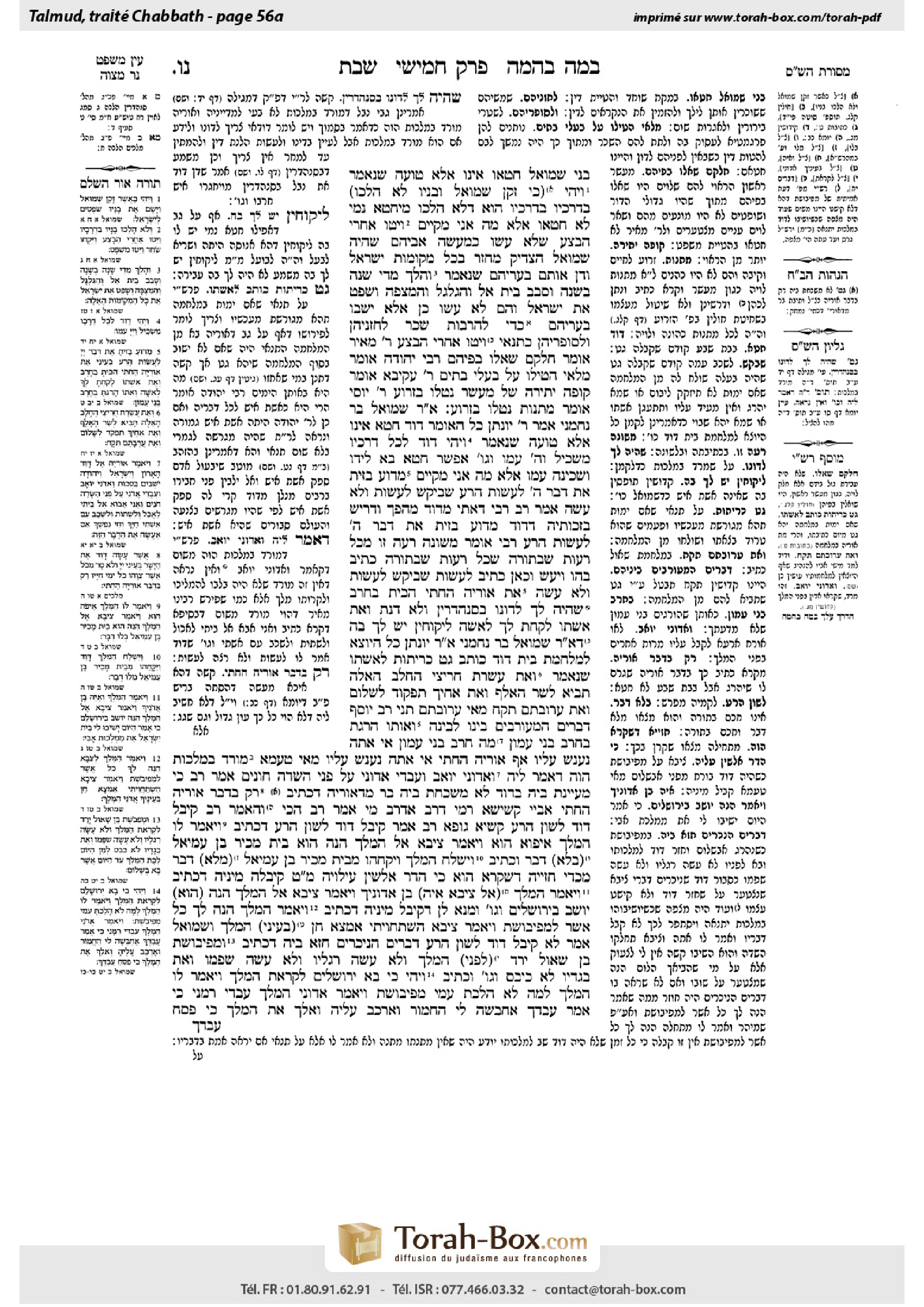
Shabbat 56a: Talmud study for Daf Yomi
Daf Yomi is the daily study of one Talmud folio. Explore 37 tractates with scans, Hebrew text, Sefaria English and AI-generated French translations where annotated.
Passage selection and English or AI-generated French translation are available where the scan has annotations. Daf Study is independent of Torah-Box and Sefaria.
Browse Shabbat · שבת · All tractatesShabbat 56a text and translations
This page of Shabbat includes the Aramaic text, an English translation and an AI-generated French translation, alongside the scan above.
שבת נ״ו א · Aramaic and Hebrew text
בְּנֵי שְׁמוּאֵל חָטְאוּ אֵינוֹ אֶלָּא טוֹעֶה, שֶׁנֶּאֱמַר: ״וַיְהִי (כִּי זָקֵן שְׁמוּאֵל וּבָנָיו לֹא הָלְכוּ) בִּדְרָכָיו״ — בִּדְרָכָיו הוּא דְּלֹא הָלְכוּ, מִיחְטָא נָמֵי לָא חָטְאוּ.
אֶלָּא מָה אֲנִי מְקַיֵּים ״וַיִּטּוּ אַחֲרֵי הַבָּצַע״ — שֶׁלֹּא עָשׂוּ כְּמַעֲשֵׂה אֲבִיהֶם, שֶׁהָיָה שְׁמוּאֵל הַצַּדִּיק מְחַזֵּר בְּכָל מְקוֹמוֹת יִשְׂרָאֵל וְדָן אוֹתָם בְּעָרֵיהֶם, שֶׁנֶּאֱמַר: ״וְהָלַךְ מִדֵּי שָׁנָה בְּשָׁנָה וְסָבַב בֵּית אֵל וְהַגִּלְגָּל וְהַמִּצְפָּה וְשָׁפַט אֶת יִשְׂרָאֵל״, וְהֵם לֹא עָשׂוּ כֵּן, אֶלָּא יָשְׁבוּ בְּעָרֵיהֶם כְּדֵי לְהַרְבּוֹת שָׂכָר לְחַזָּנֵיהֶן וּלְסוֹפְרֵיהֶן.
כְּתַנָּאֵי. ״וַיִּטּוּ אַחֲרֵי הַבָּצַע״, רַבִּי מֵאִיר אוֹמֵר חֶלְקָם שָׁאֲלוּ בְּפִיהֶם. רַבִּי יְהוּדָה אוֹמֵר: מְלַאי הִטִּילוּ עַל בַּעֲלֵי בָתִּים. רַבִּי עֲקִיבָא אוֹמֵר: קוּפָּה יְתֵירָה שֶׁל מַעֲשֵׂר נָטְלוּ בִּזְרוֹעַ. רַבִּי יוֹסֵי אוֹמֵר: מַתָּנוֹת נָטְלוּ בִּזְרוֹעַ.
אָמַר רַבִּי שְׁמוּאֵל בַּר נַחְמָנִי אָמַר רַבִּי יוֹנָתָן: כׇּל הָאוֹמֵר דָּוִד חָטָא אֵינוֹ אֶלָּא טוֹעֶה, שֶׁנֶּאֱמַר: ״וַיְהִי דָּוִד לְכׇל דְּרָכָיו מַשְׂכִּיל וַה׳ עִמּוֹ וְגוֹ׳״. אֶפְשָׁר חֵטְא בָּא לְיָדוֹ וּשְׁכִינָה עִמּוֹ?!
אֶלָּא מָה אֲנִי מְקַיֵּים ״מַדּוּעַ בָּזִיתָ אֶת דְּבַר ה׳ לַעֲשׂוֹת הָרַע״ — שֶׁבִּיקֵּשׁ לַעֲשׂוֹת וְלֹא עָשָׂה.
אָמַר רַב: רַבִּי דְּאָתֵי מִדָּוִד מְהַפֵּךְ וְדָרֵישׁ בִּזְכוּתֵיהּ דְּדָוִד. ״מַדּוּעַ בָּזִיתָ אֶת דְּבַר ה׳ לַעֲשׂוֹת הָרַע״ — רַבִּי אוֹמֵר: מְשׁוּנָּה רָעָה זוֹ מִכׇּל רָעוֹת שֶׁבַּתּוֹרָה, שֶׁכָּל רָעוֹת שֶׁבַּתּוֹרָה כְּתִיב בְּהוּ ״וַיַּעַשׂ״, וְכָאן כְּתִיב ״לַעֲשׂוֹת״ — שֶׁבִּיקֵּשׁ לַעֲשׂוֹת וְלֹא עָשָׂה.
״אֵת אוּרִיָּה הַחִתִּי הִכִּיתָ בַחֶרֶב״ — שֶׁהָיָה לְךָ לְדוּנוֹ בְּסַנְהֶדְרִין וְלֹא דַּנְתָּ. ״וְאֶת אִשְׁתּוֹ לָקַחְתָּ לְּךָ לְאִשָּׁה״ — לִיקּוּחִין יֵשׁ לְךָ בָּהּ.
דְּאָמַר רַבִּי שְׁמוּאֵל בַּר נַחְמָנִי אָמַר רַבִּי יוֹנָתָן: כׇּל הַיּוֹצֵא לְמִלְחֶמֶת בֵּית דָּוִד, כּוֹתֵב גֵּט כְּרִיתוּת לְאִשְׁתּוֹ. שֶׁנֶּאֱמַר: ״וְאֵת עֲשֶׂרֶת חֲרִיצֵי הֶחָלָב הָאֵלֶּה תָּבִיא לְשַׂר הָאָלֶף וְאֶת אַחֶיךָ תִּפְקֹד לְשָׁלוֹם וְאֶת עֲרֻבָּתָם תִּקָּח״.
מַאי ״עֲרֻבָּתָם״? — תָּנֵי רַב יוֹסֵף: דְּבָרִים הַמְעוֹרָבִים בֵּינוֹ לְבֵינָהּ.
״וְאֹתוֹ הָרַגְתָּ בְּחֶרֶב בְּנֵי עַמּוֹן״ — מַה חֶרֶב בְּנֵי עַמּוֹן אִי אַתָּה נֶעֱנָשׁ עָלָיו, אַף אוּרִיָּה הַחִתִּי אִי אַתָּה נֶעֱנָשׁ עָלָיו.
מַאי טַעְמָא — מוֹרֵד בַּמַּלְכוּת הֲוָה. דַּאֲמַר לֵיהּ: ״וַאדֹנִי יוֹאָב וְעַבְדֵי אֲדֹנִי עַל פְּנֵי הַשָּׂדֶה חֹנִים״.
אָמַר רַב: כִּי מְעַיְּינַתְּ בֵּיהּ בְּדָוִד לָא מַשְׁכַּחַתְּ בֵּיהּ בַּר מִדְּאוּרִיָּה, דִּכְתִיב: ״רַק בִּדְבַר אוּרִיָּה הַחִתִּי״.
אַבָּיֵי קַשִּׁישָׁא רָמֵי דְּרַב אַדְּרַב: מִי אָמַר רַב הָכִי? וְהָאָמַר רַב: קִיבֵּל דָּוִד לָשׁוֹן הָרָע. קַשְׁיָא.
גּוּפָא. רַב אָמַר: קִיבֵּל דָּוִד לָשׁוֹן הָרָע, דִּכְתִיב: ״וַיֹּאמֶר לוֹ הַמֶּלֶךְ אֵיפוֹא הוּא וַיֹּאמֶר צִיבָא אֶל הַמֶּלֶךְ הִנֵּה הוּא בֵּית מָכִיר בֶּן עַמִּיאֵל בְּלֹא דְבָר״. וּכְתִיב: ״וַיִּשְׁלַח הַמֶּלֶךְ וַיִּקָּחֵהוּ מִבֵּית מָכִיר בֶּן עַמִּיאֵל מִלֹּא דְבָר״.
מִכְּדִי חַזְיֵיהּ דְּשַׁקָּרָא הוּא, כִּי הֲדַר אַלְשֵׁין עִילָּוֵיהּ מַאי טַעְמָא קַבֵּיל מִינֵּיהּ? דִּכְתִיב: ״וַיֹּאמֶר הַמֶּלֶךְ אֶל צִיבָא אַיֵּה בֶּן אֲדוֹנֶיךָ וַיֹּאמֶר צִיבָא אֶל הַמֶּלֶךְ הִנֵּה הוּא יוֹשֵׁב בִּירוּשָׁלַיִם וְגוֹ׳״. וּמְנָא לַן דְּקַבֵּיל מִינֵּיהּ, דִּכְתִיב: ״וַיֹּאמֶר הַמֶּלֶךְ הִנֵּה לְךָ כֹּל אֲשֶׁר לִמְפִיבוֹשֶׁת וַיֹּאמֶר צִיבָא הִשְׁתַּחֲוֵיתִי אֶמְצָא חֵן בְּעֵינֵי הַמֶּלֶךְ״.
וּשְׁמוּאֵל אָמַר: לֹא קִיבֵּל דָּוִד לָשׁוֹן הָרָע, דְּבָרִים הַנִּיכָּרִים חֲזָא בֵּיהּ. דִּכְתִיב: ״וּמְפִיבוֹשֶׁת בֶּן שָׁאוּל יָרַד לִפְנֵי הַמֶּלֶךְ וְלֹא עָשָׂה רַגְלָיו וְלֹא עָשָׂה שְׂפָמוֹ וְאֶת בְּגָדָיו לֹא כִבֵּס וְגוֹ׳״. וּכְתִיב: ״וַיְהִי כִּי בָא יְרוּשָׁלִַים לִקְרַאת הַמֶּלֶךְ וַיֹּאמֶר לוֹ הַמֶּלֶךְ לָמָּה לֹא הָלַכְתָּ עִמִּי מְפִיבוֹשֶׁת. וַיֹּאמַר אֲדֹנִי הַמֶּלֶךְ עַבְדִּי רִמָּנִי כִּי אָמַר עַבְדְּךָ אֶחְבְּשָׁה לִּי הַחֲמוֹר וְאֶרְכַּב עָלֶיהָ וְאֵלֵךְ אֶת הַמֶּלֶךְ כִּי פִסֵּחַ
Shabbat 56a · English translation
that the sons of Samuel sinned is nothing other than mistaken, as it is stated: “And it came to pass, when Samuel was old that he made his sons judges over Israel…And his sons walked not in his ways but sought after unjust gain, and took bribes, and perverted justice” (I Samuel 8:1–3). By inference: In his ways they did not walk, however, they did not sin either. They were not the equals of their father, but they were not sinners.
However, how then do I establish the meaning of the verse: “And they sought after unjust gain,” indicating that they were sinners? It means that they did not conduct themselves in accordance with the actions of their father. As Samuel the righteous would travel to all places where the people of Israel were located and sit in judgment in their towns, as it is stated: “And he went from year to year in circuit from Beth-El, and Gilgal, and Mitzpa, and judged Israel in all those places” (I Samuel 7:16). And, however, they did not do so and travel from place to place. Rather, they sat in their own cities in order to enhance the fees collected by their attendants and scribes. Therefore, the verse ascribes to them liability as if they sinned by seeking ill-gotten gains and bribes.
The Gemara notes that this matter is parallel to a dispute between tanna’im. As it was taught in a baraita that the verse states: “And they sought after unjust gain.” Rabbi Meir says: This means that they vocally demanded their portions of the tithe due them as Levites, abusing their position to the detriment of other Levites. Rabbi Yehuda says: They imposed upon local homeowners to sell their merchandise and support them. Rabbi Akiva says: They took an extra basket of tithes, beyond that which was their due, by force. Rabbi Yosei says: They took only the gifts due them; however, they took them by force. They acted improperly, as a Levite is required to wait until he is given his gifts and may not take them.
Rabbi Shmuel bar Naḥmani said that Rabbi Yonatan said: Anyone who says that David sinned with Bathsheba is nothing other than mistaken, as it is stated: “And David succeeded in all his ways; and the Lord was with him” (I Samuel 18:14). Is it possible that sin came to his hand and nevertheless the Divine Presence was with him?
However, how then do I establish the meaning of the rebuke of the prophet Nathan: “Why have you despised the word of the Lord, to do that which is evil in My sight? Uriah the Hittite you have smitten with the sword, and his wife you have taken to be your wife, and him you have slain with the sword of the children of Ammon” (II Samuel 12:9), indicating that David sinned? The Gemara answers: David sought to do evil and have relations with Bathsheba while she was still married to Uriah but did not do so.
Rav said: Rabbi Yehuda HaNasi, who descends from the house of David, seeks to teach the verse in favor of David. With regard to that which is written: “Why have you despised the commandment of the Lord to do evil,” Rabbi Yehuda HaNasi said: This evil mentioned with regard to David is different from all other evils in the Torah; as with regard to all other evils in the Torah, it is written: And he did evil, and here it is written: To do evil. This unique phrase indicates that David sought to do evil but did not actually do so. His intentions were improper; however, his actions were proper.
That which is written: “Uriah the Hittite you have smitten with the sword,” means that you could have judged him before the Sanhedrin as one guilty of treason against the throne, and you did not judge him in that manner. Instead, you had him executed in a manner that deviated from the generally accepted principles of judgment. With regard to that which is written: “And his wife you have taken to be your wife”; it means that you have rights of marriage with her, as by law Bathsheba was already divorced from Uriah.
As Rabbi Shmuel bar Naḥmani said that Rabbi Yonatan said: Anyone who goes to a war waged by the royal house of David writes a conditional bill of divorce to his wife. That was done to prevent a situation in which the soldier’s wife would be unable to remarry because the soldier did not return from battle and there were no witnesses to his fate. The conditional bill of divorce accorded her the status of a divorcee and freed her to remarry. As it is stated: “And carry these ten cheeses to the captain of their thousand, and to your brothers bring greetings and take their pledge [arubatam]” (I Samuel 17:18).
What is the meaning of arubatam? Rav Yosef taught: It refers to matters that are shared [hame’oravim] between him, the husband, and her, the wife, i.e., marriage. The verse should be read: Take the bill of divorce that determines the status of the relationship between husband and wife. As, apparently, it was customary for men at war to send their wives a conditional divorce, since Uriah later died, Bathsheba retroactively assumed divorced status from the time that he set out to war. She was not forbidden to David.
With regard to that which is written: “And him you have slain with the sword of the children of Ammon,” it means: Just as you are not punished for soldiers killed by the sword of the children of Ammon in the course of the war, so too you are not punished for the death of Uriah the Hittite.
What is the reason that David was not liable for the death of Uriah? Because Uriah was a traitor against the throne. As he said to David: “And my lord Joab and the servants of my lord are encamped in the open fields” (II Samuel 11:11). In the presence of the king, one may not refer to another as his lord. Doing so is treason.
Rav said: When you analyze the matter of David, no sin that he committed is found in his lifetime, except for that involving Uriah. As it is written: “Because David did that which was right in the eyes of the Lord, and turned not aside from any thing that He commanded him all the days of his life, save only in the matter of Uriah the Hittite” (I Kings 15:5).
Abaye the Elder raised a contradiction between one statement of Rav and another statement of Rav: Did Rav actually say this? Didn’t Rav say: David accepted a slanderous report? Just as it is prohibited to relate a slanderous report, it is similarly prohibited to accept it. This contradiction remains unresolved, and it is difficult.
The Gemara now examines the matter itself with regard to Rav’s statement cited in the course of the previous discussion. Rav said: David accepted a slanderous report, as it is written with regard to David’s search for a surviving son of Jonathan: “And the king said to him, to Ziba, Saul’s slave: Where is he? And Ziba said to the king: Behold, he is in the house of Machir, the son of Ammiel, in Lo-Devar [belo devar]” (II Samuel 9:4). Ziba indicated to David that Jonathan’s son was inconsequential, lacking any matter [lo devar] of Torah. And it is written: “Then King David sent, and fetched him out of the house of Machir, the son of Ammiel, from Lo-Devar [milo devar]” (II Samuel 9:5). That verse can be read that after sending for him, David found him filled with matters [melo devar] of Torah.
Now, after David saw that Ziba was a liar, when Ziba once again slandered Jonathan’s son, Mephibosheth, why did David accept his report? As it is written that when David fled from Absalom, he met Ziba: “And the king said: And where is your master’s son? And Ziba said to the king: Behold, he is staying in Jerusalem, as he said: Today shall the house of Israel restore to me the kingdom of my father” (II Samuel 16:3). And from where do we derive that David accepted Ziba’s slanderous report? As it is written: “Then said the king to Ziba: Behold, all that belongs to Mephibosheth is yours. And Ziba said: I humbly beseech you that I may find favor in your sight, my lord, O king” (II Samuel 16:4).
And Shmuel said: David did not accept Ziba’s slanderous report without substantiation. Rather, he himself saw conspicuous matters in Mephibosheth that indicated that Ziba was right. As it is written: “And Mephibosheth, the son of Saul, came down to meet the king, and he had neither dressed his feet, nor trimmed his beard, nor washed his clothes from the day the king departed until the day he came back in peace” (II Samuel 19:25). David thought that he was mourning the fact that he had returned in peace. And it is written: “And it came to pass, when he came to Jerusalem to meet the king, and the king said to him: Why did you not go with me, Mephibosheth? And he answered: My lord, O king, my servant deceived me; for your servant said: I will saddle me a donkey, and I will ride on it, and go to the king; because lame is
Shabbat 56a · Traduction française (IA)
Dire que les fils de Samuel ont péché est une erreur, comme il est dit : « Or, lorsque Samuel fut vieux, il établit ses fils juges sur Israël… Ses fils ne suivirent pas ses voies, mais recherchèrent le gain injuste, acceptèrent des pots-de-vin et firent dévier le droit » (I Samuel 8, 1-3). On en déduit que, s’ils ne suivirent pas ses voies, ils ne péchèrent toutefois pas. Ils n’égalaient pas leur père, mais n’étaient pas des pécheurs.
Comment faut-il alors comprendre le verset : « Ils recherchèrent le gain injuste », qui semble indiquer qu’ils étaient pécheurs ? Cela signifie qu’ils ne se conduisirent pas comme leur père. Samuel le juste se rendait dans tous les lieux où résidaient les enfants d’Israël et siégeait comme juge dans leurs villes, comme il est dit : « Il faisait chaque année le tour de Béthel, de Guilgal et de Mitspa, et jugeait Israël dans tous ces lieux » (I Samuel 7, 16). Eux, en revanche, n’agissaient pas ainsi et ne se rendaient pas d’un lieu à l’autre. Ils siégeaient plutôt dans leurs propres villes afin d’accroître les honoraires perçus par leurs serviteurs et leurs scribes. C’est pourquoi le verset les tient pour responsables, comme s’ils avaient péché en recherchant des gains mal acquis et des pots-de-vin.
La Guemara relève que cette question correspond à une controverse entre des tannaïm. En effet, une baraïta a enseigné au sujet du verset : « Ils recherchèrent le gain injuste. » Rabbi Meïr dit : Cela signifie qu’ils réclamaient à haute voix les parts de la dîme qui leur revenaient en tant que lévites, abusant de leur position au détriment des autres lévites. Rabbi Yehouda dit : Ils imposaient aux propriétaires locaux de vendre leurs marchandises et de les entretenir. Rabbi Akiva dit : Ils prenaient de force un panier supplémentaire de dîmes, au-delà de ce qui leur revenait. Rabbi Yossei dit : Ils ne prenaient que les prélèvements qui leur revenaient, mais ils les prenaient de force. Ils agissaient de manière inconvenante, car un lévite doit attendre qu’on lui remette ses prélèvements et ne peut pas se les approprier.
Rabbi Shmuel bar Naḥmani a dit au nom de Rabbi Yonatan : Quiconque affirme que David a péché avec Bethsabée se trompe, comme il est dit : « David réussissait dans toutes ses entreprises, et l’Éternel était avec lui » (I Samuel 18, 14). Est-il possible que le péché se soit présenté à lui et que, malgré cela, la Présence divine ait été avec lui ?
Comment faut-il alors comprendre le reproche du prophète Nathan : « Pourquoi as-tu méprisé la parole de l’Éternel, en faisant ce qui est mal à ses yeux ? Tu as frappé de l’épée Ouria le Hittite, tu as pris sa femme pour en faire ta femme, et tu l’as tué par l’épée des fils d’Ammon » (II Samuel 12, 9), ce qui semble indiquer que David a péché ? La Guemara répond : David avait voulu faire le mal et avoir des relations avec Bethsabée alors qu’elle était encore mariée à Ouria, mais il ne l’a pas fait.
Rav dit : Rabbi Yehouda HaNassi, qui descend de la maison de David, cherche à interpréter le verset en faveur de David. À propos de ce qui est écrit : « Pourquoi as-tu méprisé le commandement de l’Éternel, en faisant le mal », Rabbi Yehouda HaNassi dit : Le mal mentionné ici au sujet de David diffère de tous les autres maux de la Torah. Pour tous les autres maux de la Torah, il est écrit : « Il fit le mal », tandis qu’ici il est écrit : « En faisant le mal ». Cette formulation particulière indique que David avait voulu faire le mal, mais ne l’avait pas réellement fait. Ses intentions étaient inappropriées, mais ses actes étaient convenables.
Ce qui est écrit : « Tu as frappé de l’épée Ouria le Hittite » signifie que tu aurais pu le juger devant le Sanhédrin comme coupable de trahison envers le trône, mais que tu ne l’as pas jugé de cette manière. Tu l’as plutôt fait exécuter d’une manière qui s’écartait des principes généralement admis en matière de justice. Quant à ce qui est écrit : « Tu as pris sa femme pour en faire ta femme », cela signifie que tu avais le droit de l’épouser, car, selon la loi, Bethsabée était déjà divorcée d’Ouria.
En effet, Rabbi Shmuel bar Naḥmani a dit au nom de Rabbi Yonatan : Quiconque part à une guerre menée par la maison royale de David rédige pour sa femme un acte de divorce conditionnel. On faisait cela pour éviter que la femme d’un soldat ne puisse pas se remarier si celui-ci ne revenait pas du combat et qu’il n’y avait aucun témoin de son sort. L’acte de divorce conditionnel lui conférait le statut de divorcée et lui permettait de se remarier. Comme il est dit : « Porte ces dix fromages au chef de leur millier, apporte les salutations à tes frères, puis prends leur gage [arubatam] » (I Samuel 17, 18).
Que signifie arubatam ? Rav Yossef enseigna que cela désigne les choses partagées [hame’oravim] entre lui, le mari, et elle, l’épouse, c’est-à-dire le mariage. Le verset doit se lire ainsi : « Prends l’acte de divorce qui détermine le statut de la relation entre le mari et la femme. » Apparemment, les hommes en guerre avaient coutume d’envoyer à leurs femmes un acte de divorce conditionnel ; puisque Ouria mourut par la suite, Bethsabée fut rétroactivement considérée comme divorcée à partir du moment où il partit à la guerre. Elle n’était donc pas interdite à David.
Quant à ce qui est écrit : « Et tu l’as tué par l’épée des fils d’Ammon », cela signifie : de même que tu n’es pas puni pour les soldats tués par l’épée des fils d’Ammon au cours de la guerre, tu n’es pas non plus puni pour la mort d’Ouria le Hittite.
Pourquoi David n’était-il pas responsable de la mort d’Ouria ? Parce qu’Ouria était un traître envers le trône. En effet, il dit à David : « Mon seigneur Yoav et les serviteurs de mon seigneur campent dans la campagne » (II Samuel 11, 11). En présence du roi, on ne peut pas désigner quelqu’un d’autre comme son seigneur. Cela constitue une trahison.
Rav dit : Quand on examine la vie de David, on ne trouve aucun péché qu’il ait commis, à l’exception de celui concernant Ouria. Comme il est écrit : « David fit ce qui est droit aux yeux de l’Éternel et ne s’écarta d’aucun de ses commandements durant toute sa vie, sauf dans l’affaire d’Ouria le Hittite » (I Rois 15, 5).
Abayé l’Ancien souleva une contradiction entre une déclaration de Rav et une autre déclaration de Rav : Rav a-t-il réellement dit cela ? Rav n’a-t-il pas dit que David avait accepté un rapport calomnieux ? Or, de même qu’il est interdit de rapporter des propos calomnieux, il est également interdit de les accepter. Cette contradiction demeure sans réponse et pose difficulté.
La Guemara examine maintenant la déclaration elle-même, celle de Rav citée au cours de la discussion précédente. Rav dit : David accepta un rapport calomnieux, comme il est écrit au sujet de la recherche par David d’un fils survivant de Jonathan : « Le roi lui dit, à Tsiva, serviteur de Saül : Où est-il ? Tsiva dit au roi : Le voici, dans la maison de Makhir, fils d’Ammiel, à Lo-Debar [belo devar] » (II Samuel 9, 4). Tsiva indiqua à David que le fils de Jonathan était insignifiant, dépourvu de toute chose [lo devar] relevant de la Torah. Et il est écrit : « Le roi David l’envoya chercher et le fit venir de la maison de Makhir, fils d’Ammiel, de Lo-Debar [milo devar] » (II Samuel 9, 5). Ce verset peut se lire ainsi : après l’avoir fait chercher, David le trouva rempli de choses [melo devar] relevant de la Torah.
Or, après avoir vu que Tsiva était un menteur, pourquoi David accepta-t-il à nouveau son rapport lorsque Tsiva calomnia le fils de Jonathan, Mephibosheth ? En effet, il est écrit que, lorsque David fuyait Absalom, il rencontra Tsiva : « Le roi dit : Où est le fils de ton maître ? Tsiva répondit au roi : Le voici, il reste à Jérusalem, car il a dit : Aujourd’hui, la maison d’Israël me rendra le royaume de mon père » (II Samuel 16, 3). Et d’où déduisons-nous que David accepta le rapport calomnieux de Tsiva ? De ce qui est écrit : « Alors le roi dit à Tsiva : Voici, tout ce qui appartient à Mephibosheth est à toi. Tsiva dit : Je t’en prie humblement, puissé-je trouver grâce à tes yeux, mon seigneur le roi » (II Samuel 16, 4).
Et Shmouel dit : David n’accepta pas le rapport calomnieux de Tsiva sans élément à l’appui. Au contraire, il vit lui-même chez Mephibosheth des signes manifestes indiquant que Tsiva avait raison. Comme il est écrit : « Mephibosheth, fils de Saül, descendit à la rencontre du roi ; il n’avait ni arrangé ses pieds, ni taillé sa barbe, ni lavé ses vêtements depuis le jour où le roi était parti jusqu’au jour où il revint en paix » (II Samuel 19, 25). David pensa qu’il était en deuil parce que David était revenu en paix. Et il est écrit : « Lorsqu’il arriva à Jérusalem pour rencontrer le roi, le roi lui dit : Pourquoi n’es-tu pas venu avec moi, Mephibosheth ? Il répondit : Mon seigneur le roi, mon serviteur m’a trompé ; car ton serviteur s’était dit : Je vais seller un âne, monter dessus et aller vers le roi, car je suis boiteux
Traduction française générée par IA à partir de l’édition anglaise de Sefaria. Vérifie toujours un passage avec le texte source.
Text from Sefaria: William Davidson Edition - Vocalized Aramaic (CC BY NC); William Davidson Edition - English (CC BY NC).