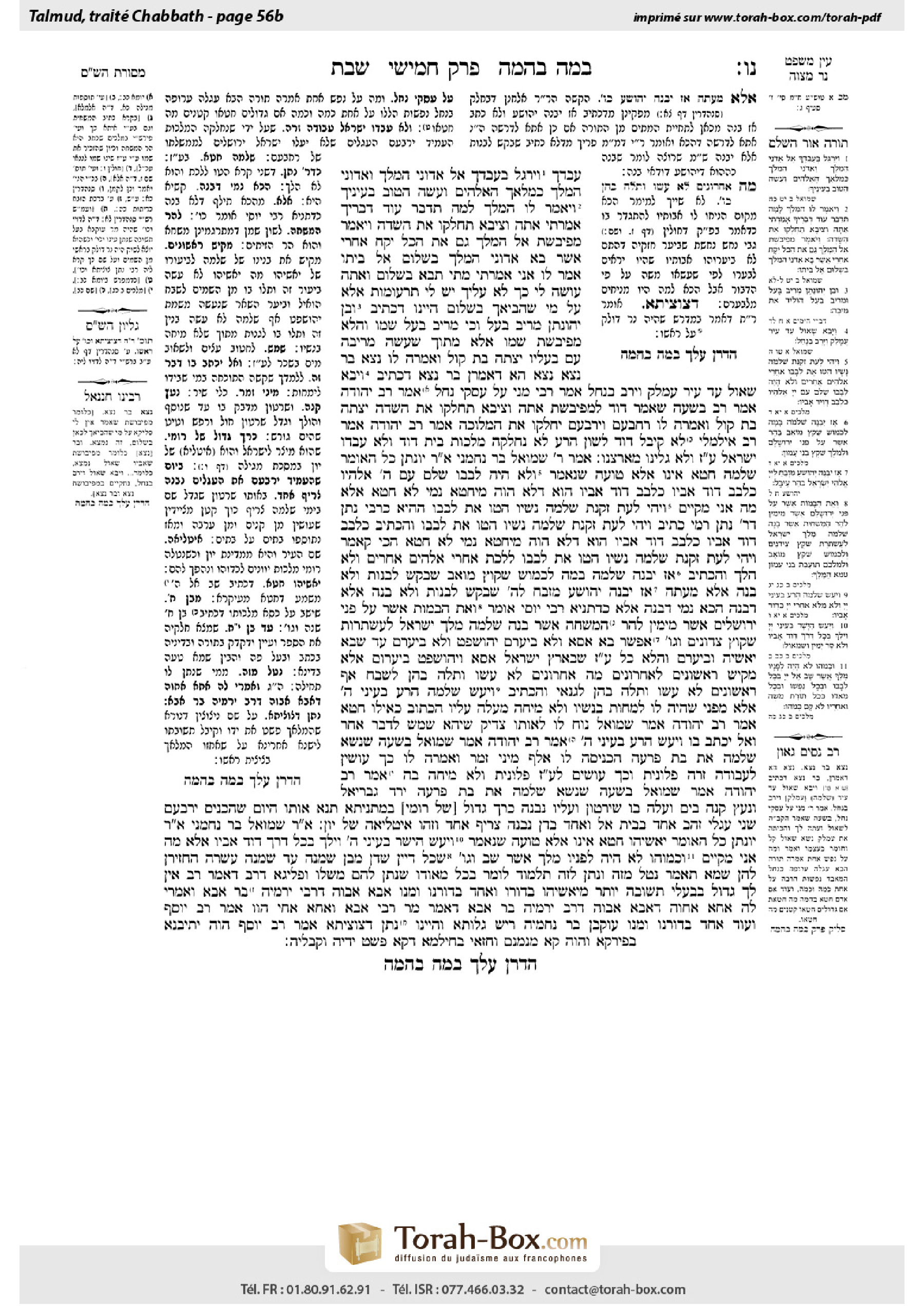
Shabbat 56b: Talmud study for Daf Yomi
Daf Yomi is the daily study of one Talmud folio. Explore 37 tractates with scans, Hebrew text, Sefaria English and AI-generated French translations where annotated.
Passage selection and English or AI-generated French translation are available where the scan has annotations. Daf Study is independent of Torah-Box and Sefaria.
Browse Shabbat · שבת · All tractatesShabbat 56b text and translations
This page of Shabbat includes the Aramaic text, an English translation and an AI-generated French translation, alongside the scan above.
שבת נ״ו ב · Aramaic and Hebrew text
עַבְדֶּךָ. וַיְרַגֵּל בְּעַבְדְּךָ אֶל אֲדֹנִי הַמֶּלֶךְ וַאדֹנִי הַמֶּלֶךְ כְּמַלְאַךְ הָאֱלֹהִים וַעֲשֵׂה הַטּוֹב בְּעֵינֶיךָ״. ״וַיֹּאמֶר לוֹ הַמֶּלֶךְ לָמָּה תְּדַבֵּר עוֹד דְּבָרֶיךָ אָמַרְתִּי אַתָּה וְצִיבָא תַּחְלְקוּ אֶת הַשָּׂדֶה. וַיֹּאמֶר מְפִיבֹשֶׁת אֶל הַמֶּלֶךְ גַּם אֶת הַכֹּל יִקָּח אַחֲרֵי אֲשֶׁר בָּא אֲדֹנִי הַמֶּלֶךְ בְּשָׁלוֹם אֶל בֵּיתוֹ״. אָמַר לוֹ: אֲנִי אָמַרְתִּי ״מָתַי תָּבֹא בְּשָׁלוֹם״, וְאַתָּה עוֹשֶׂה לִי כָּךְ? לֹא עָלֶיךָ יֵשׁ לִי תַּרְעוֹמוֹת אֶלָּא עַל מִי שֶׁהֱבִיאֲךָ בְּשָׁלוֹם.
הַיְינוּ דִּכְתִיב: ״וּבֶן יְהוֹנָתָן מְרִיב בָּעַל״, וְכִי ״מְרִיב בַּעַל״ שְׁמוֹ? וַהֲלֹא מְפִיבֹשֶׁת שְׁמוֹ! אֶלָּא מִתּוֹךְ שֶׁעָשָׂה מְרִיבָה עִם בְּעָלָיו. יָצְתָה בַּת קוֹל וְאָמְרָה לוֹ: נַצָּא בַּר נַצָּא. ״נַצָּא״ — הָא דַּאֲמַרַן. ״בַּר נַצָּא״ — דִּכְתִיב: ״וַיָּבֹא שָׁאוּל עַד עִיר עֲמָלֵק וַיָּרֶב בַּנָּחַל״, אָמַר רַבִּי מָנִי: עַל עִסְקֵי נַחַל.
אָמַר רַב יְהוּדָה אָמַר רַב: בְּשָׁעָה שֶׁאָמַר דָּוִד לִמְפִיבֹשֶׁת: אַתָּה וְצִיבָא תַּחְלְקוּ אֶת הַשָּׂדֶה, יָצְתָה בַּת קוֹל וְאָמְרָה לוֹ: רְחַבְעָם וְיָרָבְעָם יַחְלְקוּ אֶת הַמְּלוּכָה.
אָמַר רַב יְהוּדָה אָמַר רַב: אִילְמָלֵי לֹא קִיבֵּל דָּוִד לָשׁוֹן הָרָע לֹא נֶחְלְקָה מַלְכוּת בֵּית דָּוִד, וְלֹא עָבְדוּ יִשְׂרָאֵל עֲבוֹדָה זָרָה, וְלֹא גָּלִינוּ מֵאַרְצֵנוּ.
אָמַר רַבִּי שְׁמוּאֵל בַּר נַחְמָנִי אָמַר רַבִּי יוֹנָתָן: כׇּל הָאוֹמֵר שְׁלֹמֹה חָטָא אֵינוֹ אֶלָּא טוֹעֶה, שֶׁנֶּאֱמַר: ״וְלֹא הָיָה לְבָבוֹ שָׁלֵם עִם ה׳ אֱלֹהָיו כִּלְבַב דָּוִד אָבִיו״ — כִּלְבַב דָּוִד אָבִיו הוּא דְּלָא הֲוָה, מִיחְטָא נָמֵי לָא חֲטָא.
אֶלָּא מָה אֲנִי מְקַיֵּים ״וַיְהִי לְעֵת זִקְנַת שְׁלֹמֹה נָשָׁיו הִטּוּ אֶת לְבָבוֹ״ — הַהִיא כְּרַבִּי נָתָן. דְּרַבִּי נָתָן רָמֵי, כְּתִיב: ״וַיְהִי לְעֵת זִקְנַת שְׁלֹמֹה נָשָׁיו הִטּוּ אֶת לְבָבוֹ״, וְהָכְתִיב: ״כִּלְבַב דָּוִד אָבִיו״ — כִּלְבַב דָּוִד אָבִיו הוּא דְּלָא הֲוָה מִיחְטָא נָמֵי לָא חֲטָא! הָכִי קָאָמַר: ״וַיְהִי לְעֵת זִקְנַת שְׁלֹמֹה נָשָׁיו הִטּוּ אֶת לְבָבוֹ לָלֶכֶת אַחֲרֵי אֱלֹהִים אֲחֵרִים״ — וְלֹא הָלַךְ.
וְהָכְתִיב: ״אָז יִבְנֶה שְׁלֹמֹה בָּמָה לִכְמוֹשׁ שִׁקֻּץ מוֹאָב״ — שֶׁבִּקֵּשׁ לִבְנוֹת וְלֹא בָּנָה.
אֶלָּא מֵעַתָּה: ״אָז יִבְנֶה יְהוֹשֻׁעַ מִזְבֵּחַ לַה׳״ — שֶׁבִּקֵּשׁ לִבְנוֹת וְלֹא בָּנָה?! אֶלָּא דִּבְנָה, הָכָא נָמֵי דִּבְנָה!
אֶלָּא כִּדְתַנְיָא, רַבִּי יוֹסֵי אוֹמֵר: ״וְאֶת הַבָּמוֹת אֲשֶׁר עַל פְּנֵי יְרוּשָׁלִַים אֲשֶׁר מִימִין לְהַר הַמִּשְׁחָה אֲשֶׁר בָּנָה שְׁלֹמֹה מֶלֶךְ יִשְׂרָאֵל לְעַשְׁתֹּרֶת שִׁקֻּץ צִידֹנִים וְגוֹ׳״.
אֶפְשָׁר בָּא אָסָא וְלֹא בִּיעֲרָם, יְהוֹשָׁפָט וְלֹא בִּיעֲרָם, עַד שֶׁבָּא יֹאשִׁיָּה וּבִיעֲרָם? וַהֲלֹא כׇּל עֲבוֹדָה זָרָה שֶׁבְּאֶרֶץ יִשְׂרָאֵל אָסָא וִיהוֹשָׁפָט בִּיעֲרוּם! אֶלָּא מַקִּישׁ רִאשׁוֹנִים לָאַחֲרוֹנִים, מָה אַחֲרוֹנִים לֹא עָשׂוּ וְתָלָה בָּהֶן לְשֶׁבַח, אַף רִאשׁוֹנִים לֹא עָשׂוּ וְתָלָה בָּהֶן לִגְנַאי.
וְהָכְתִיב: ״וַיַּעַשׂ שְׁלֹמֹה הָרַע בְּעֵינֵי ה׳״! אֶלָּא מִפְּנֵי שֶׁהָיָה לוֹ לִמְחוֹת בְּנָשָׁיו וְלֹא מִיחָה מַעֲלֶה עָלָיו הַכָּתוּב כְּאִלּוּ חָטָא.
אָמַר רַב יְהוּדָה אָמַר שְׁמוּאֵל: נוֹחַ לוֹ לְאוֹתוֹ צַדִּיק שֶׁיְּהֵא שַׁמָּשׁ לְדָבָר אַחֵר, וְאַל יִכָּתֵב בּוֹ ״וַיַּעַשׂ הָרָע בְּעֵינֵי ה׳״.
אָמַר רַב יְהוּדָה אָמַר שְׁמוּאֵל: בְּשָׁעָה שֶׁנָּשָׂא שְׁלֹמֹה אֶת בַּת פַּרְעֹה, הִכְנִיסָה לוֹ אֶלֶף מִינֵי זֶמֶר, וְאָמְרָה לוֹ כָּךְ עוֹשִׂין לַעֲבוֹדָה זָרָה פְּלוֹנִית, וְכָךְ עוֹשִׂים לַעֲבוֹדָה זָרָה פְּלוֹנִית, וְלֹא מִיחָה בָּהּ.
אָמַר רַב יְהוּדָה אָמַר שְׁמוּאֵל: בְּשָׁעָה שֶׁנָּשָׂא שְׁלֹמֹה אֶת בַּת פַּרְעֹה יָרַד גַּבְרִיאֵל וְנָעַץ קָנֶה בַּיָּם וְעָלָה בּוֹ שִׂירְטוֹן, וְעָלָיו נִבְנָה כְּרַךְ גָּדוֹל [שֶׁל רוֹמִי].
בְּמַתְנִיתָא תָּנָא: אוֹתוֹ הַיּוֹם שֶׁהִכְנִיס יָרָבְעָם שְׁנֵי עֶגְלֵי זָהָב, אֶחָד בְּבֵית אֵל וְאֶחָד בְּדָן, נִבְנָה צְרִיף אֶחָד, וְזֶהוּ אִיטַלְיָאה שֶׁל יָוָן.
אָמַר רַבִּי שְׁמוּאֵל בַּר נַחְמָנִי אָמַר רַבִּי יוֹנָתָן: כׇּל הָאוֹמֵר יֹאשִׁיָּהוּ חָטָא — אֵינוֹ אֶלָּא טוֹעֶה, שֶׁנֶּאֱמַר: ״וַיַּעַשׂ הַיָּשָׁר בְּעֵינֵי ה׳ וַיֵּלֶךְ בְּכׇל דֶּרֶךְ דָּוִד אָבִיו״. אֶלָּא מָה אֲנִי מְקַיֵּים ״וְכָמֹהוּ לֹא הָיָה לְפָנָיו מֶלֶךְ אֲשֶׁר שָׁב וְגוֹ׳״?
שֶׁכָּל דִּין שֶׁדָּן מִבֶּן שְׁמֹנֶה עַד שְׁמֹנֶה עֶשְׂרֵה הֶחְזִירָן לָהֶן. שֶׁמָּא תֹּאמַר נָטַל מִזֶּה וְנָתַן לָזֶה — תַּלְמוּד לוֹמַר ״בְּכָל מְאֹדוֹ״: שֶׁנָּתַן לָהֶם מִשֶּׁלּוֹ.
וּפְלִיגָא דְּרַב, דְּאָמַר רַב: אֵין לְךָ גָּדוֹל בְּבַעֲלֵי תְּשׁוּבָה יוֹתֵר מִיֹּאשִׁיָּהוּ בְּדוֹרוֹ וְאֶחָד בְּדוֹרֵנוּ. וּמַנּוּ? אַבָּא אֲבוּהּ דְּרַבִּי יִרְמְיָה בַּר אַבָּא. וְאָמְרִי לַהּ אַחָא אֲחוּהּ דְּאַבָּא אֲבוּהּ דְּרַב יִרְמְיָה בַּר אַבָּא. דְּאָמַר מָר: רַבִּי אַבָּא וְאַחָא אַחֵי הֲווֹ.
אָמַר רַב יוֹסֵף: וְעוֹד אֶחָד בְּדוֹרֵנוּ. וּמַנּוּ? — עוּקְבָן בַּר נְחֶמְיָה רֵישׁ גָּלוּתָא. וְהַיְינוּ ״נָתָן דְּצוּצִיתָא״. אָמַר רַב יוֹסֵף: הֲוָה יָתֵיבְנָא בְּפִירְקָא, וַהֲוָה קָא מְנַמְנַמְנָא, וַחֲזַאי בְּחֶילְמָא דְּקָא פְּשַׁט יְדֵיהּ וְקַבְּלֵיהּ.
הדרן עלך במה בהמה
Shabbat 56b · English translation
your servant. And he slandered your servant to my lord the king; but my lord the king is like an angel of God: Do therefore what is good in your eyes” (II Samuel 19:26–28). “And the king said to him: Why do you speak any more of your matters? I have said: You and Ziba shall divide the estate. And Mephibosheth said to the king: Let him even take all, seeing that my lord the king is come back in peace to his own house” (II Samuel 19:30–31). Mephibosheth said to David as follows: I had hoped for your return, saying: When will he come in peace, and yet you do this to me, giving Ziba half of my estate? It is not against you that I have grievances, but against He who brought you back in peace. Mephibosheth’s own statement substantiates Ziba’s report about him.
This is what is written: “And the son of Jonathan was Meriv-Baal” (I Chronicles 8:34). The Gemara asks: And was Meriv-Baal his name? Wasn’t his name Mephibosheth? However, since he entered into a quarrel [meriva] with his Master [ba’al], i.e., God, and complained about God having saved David, a Divine Voice emerged and said to him: Quarrelsome one, the son of a quarrelsome one; you are just like your father, Saul. The Gemara explains: Quarrelsome one; that which we just said that Mephibosheth complained to God about His salvation of David. The son of a quarrelsome one; as it is written: “And Saul came to a city of Amalek and quarreled in the valley” (I Samuel 15:5). And Rabbi Mani said: Saul quarreled with God with regard to matters of the valley, saying: For the murder of even a single person, there is a commandment to break the neck of a heifer in a valley to atone for the crime (see Deuteronomy 21:1–9); why then must all these Amalekites be killed?
To the matter at hand: Rav Yehuda said that Rav said: When David said to Mephibosheth: You and Ziba shall divide the estate, a Divine Voice emerged and said to him: Rehoboam and Jeroboam shall divide the kingdom.
Rav Yehuda said that Rav said: Had David not accepted Ziba’s slanderous report about Mephibosheth, the kingdom of the house of David would not have been divided, Israel would not have worshipped idols because of Jeroboam, and we would not have been exiled from our land.
Rabbi Shmuel bar Naḥmani said that Rabbi Yonatan said: Anyone who says that King Solomon sinned is nothing other than mistaken, as it is stated: “And his heart was not perfect with the Lord his God, as was the heart of David, his father” (I Kings 11:4). By inference: Solomon’s heart was not equal to the heart of David, his father; however, he also did not sin.
However, how then do I establish the meaning of the verse: “For it came to pass, when Solomon was old, that his wives turned away his heart after other gods” (I Kings 11:4)? That verse is in accordance with the statement of Rabbi Natan; as Rabbi Natan raised a contradiction between the two parts of the verse. On the one hand, it is written: “For it came to pass, when Solomon was old, that his wives turned away his heart after other gods.” On the other hand, isn’t it written: “And his heart was not perfect with the Lord his God, as was the heart of David his father,” indicating that Solomon’s heart was not equal to the heart of David his father; however, he also did not sin? Rather, the verse says as follows: For it came to pass, when Solomon was old, that his wives turned away his heart, in an attempt to spur him to go after other gods; however, he did not go after them.
The Gemara asks: Isn’t it written: “Then did Solomon build [yivne] an altar for Kemosh, the abomination of Moab, in the hill that is before Jerusalem, and for Molech, the abomination of the children of Ammon” (I Kings 11:7), indicating that Solomon did in fact stray after idols? The Gemara answers: This can be understood to mean that Solomon sought to build an altar for idols but did not build it.
The Gemara objects: But now if that is the way to understand the future tense verb form yivne, what of another instance where the same form is employed: “Then did Joshua build [yivne] an altar to the Lord God of Israel in Mount Eival” (Joshua 8:30)? There too, would you say that Joshua sought to build an altar but did not build one? Rather, there, in the case of Joshua, it means that he actually built it. Here too, with regard to Solomon, it means that he actually built the altar.
Rather, this verse should be understood as it was taught in a baraita that Rabbi Yosei says: The verse states: “And the altars that were before Jerusalem, which were on the right hand of the Mount of Olives, which Solomon the king of Israel had built for Ashtoret the abomination of the Zidonim, and for Kemosh the abomination of Moab, and for Milkom the abomination of the children of Ammon, did the king defile” (II Kings 23:13). All these were destroyed by Josiah.
The Gemara asks: Is it possible that the righteous king Asa came and did not destroy them, and the righteous king Jehosaphat came and did not destroy them until Josiah came and destroyed them? Didn’t Asa and Jehosaphat destroy all the idolatry in Eretz Yisrael? Rather, the verse juxtaposes the earlier ones, i.e., Solomon, to the later ones, i.e., Josiah. Just as the later ones, Josiah, did not effect the destruction of the altars, as it was done by his predecessors, and nevertheless the verse attributes it to him to praise him as if he had destroyed all those altars, so too, the earlier ones, Solomon, did not effect the construction, and nevertheless the verse attributes it to him to disgrace him as he did not prevent their construction.
The Gemara raises another question. Isn’t it written: “And Solomon did evil in the sight of the Lord” (I Kings 11:6), clearly indicating that Solomon sinned? Rather, since he should have protested against the conduct of his wives, i.e., their involvement in idolatry, but he did not protest, the verse ascribes to him liability as if he had sinned.
Rav Yehuda said that Shmuel said: It would have been preferable for that righteous man, Solomon, to be a servant tasked with drawing water and hewing wood for another matter, i.e., idolatry, and not have the verse write about him: “And he did evil in the sight of the Lord,” even though he did not.
Rav Yehuda said that Shmuel said: When Solomon married Pharaoh’s daughter, she brought to him a thousand musical instruments and said to him: This is the way we do it for this idolatry, and this is the way we do it for that idolatry, and he did not protest that talk.
Rav Yehuda said that Shmuel said: When Solomon married Pharaoh’s daughter, the angel Gabriel descended from heaven and implanted a reed into the sea, and a sandbar grew around it, growing larger each year, and upon it the great city of Rome was built, which became God’s instrument to punish Israel.
It was taught in a baraita: On that very day that Jeroboam introduced two golden calves, one in Beth-El and the other in Dan, a single small hut was constructed, which was the first house constructed there. And that was the inauguration of Italy of Greece.
Rabbi Shmuel bar Naḥmani said that Rabbi Yonatan said: Anyone who says that Josiah sinned is nothing other than mistaken, as it is stated: “And he did that which was right in the sight of the Lord, and walked in all the way of David his father, and turned not aside to the right hand nor to the left” (II Kings 22:2). However, how then do I establish the meaning of the verse: “And like him was there no king before him that returned to the Lord with all his heart, and with all his soul, and with all his might, according to all the Torah of Moses; neither after him arose there any like him” (II Kings 23:25)? The verse states: Josiah returned to the Lord. Apparently, in his early days he was a sinner, and later he returned to God.
The Gemara answers: The reference here is not to repentance for actual sins that Josiah committed. Rather, in every judgment that he issued from the age of eight, when he was crowned, until the age of eighteen, he returned the money to the parties whom he judged liable, due to concern that in his youth he may not have judged the cases correctly. And lest you say that he took from this one, whom he exonerated, and gave to that one, whom he found culpable, therefore the verse states: Returned to the Lord with all his might [me’odo], i.e., with all his money. It means that he gave those he judged liable in his youth from his own money.
The Gemara notes that Rabbi Yonatan disagrees with Rav, as Rav said: There is no greater penitent than Josiah in his generation, and there is one in our generation. The Gemara asks: And who is the great penitent in Rav’s generation? The Gemara answers: He is Abba, father of Rabbi Yirmeya bar Abba, and some say it is Aḥa, brother of Abba, father of Rabbi Yirmeya bar Abba, as the Master said: Rabbi Abba and Aḥa were brothers.
Rav Yosef said: And there is another great penitent in our generation. And who is he? He is Okvan, son of Neḥemya the Exilarch. And that is the one also known as Natan detzutzita, i.e., from whose head sparks emerged. Rav Yosef said: I was once sitting at the lecture delivered on the Festival [pirka] and I was dozing. And I saw in a dream how an angel stretched out his hands and received Natan detzutzita, demonstrating that his repentance was accepted.
Shabbat 56b · Traduction française (IA)
ton serviteur. Et il a calomnié ton serviteur auprès de mon seigneur le roi ; mais mon seigneur le roi est comme un ange de Dieu : fais donc ce qui te semble bon. » (II Samuel 19, 26-28) « Le roi lui dit : Pourquoi parler davantage de tes affaires ? J’ai décidé : toi et Tsiba, vous partagerez le domaine. Mephibosheth dit au roi : Qu’il prenne donc tout, puisque mon seigneur le roi est revenu en paix dans sa maison. » (II Samuel 19, 30-31) Mephibosheth dit à David en substance : J’espérais ton retour, en me disant : « Quand reviendra-t-il en paix ? » Et pourtant, tu me fais cela, en donnant à Tsiba la moitié de mon domaine ! Ce n’est pas contre toi que j’ai des griefs, mais contre Celui qui t’a ramené en paix. La propre déclaration de Mephibosheth confirme le rapport de Tsiba à son sujet.
C’est ce qui est écrit : « Le fils de Jonathan était Meriv-Baal » (I Chroniques 8, 34). La Guemara demande : S’appelait-il vraiment Meriv-Baal ? Ne s’appelait-il pas Mephibosheth ? Cependant, comme il s’était disputé [meriva] avec son Maître [ba’al], c’est-à-dire Dieu, et s’était plaint que Dieu ait sauvé David, une Voix céleste se fit entendre et lui dit : « Querelleur, fils de querelleur, tu es comme ton père Saül. » La Guemara explique : « Querelleur » désigne ce que nous venons de dire, à savoir que Mephibosheth s’était plaint à Dieu de ce qu’Il avait sauvé David. « Fils de querelleur » : comme il est écrit : « Saül vint à une ville d’Amalek et se querella dans la vallée » (I Samuel 15, 5). Et Rabbi Mani dit : Saül se querella avec Dieu au sujet des affaires de la vallée, en disant : Pour le meurtre d’une seule personne, il y a le commandement de briser la nuque d’une génisse dans une vallée afin d’expier le crime (voir Deutéronome 21, 1-9) ; pourquoi donc faut-il tuer tous ces Amalécites ?
Pour en revenir au sujet : Rav Yehouda a dit au nom de Rav : Lorsque David dit à Mephibosheth : « Toi et Tsiba, vous partagerez le domaine », une Voix céleste se fit entendre et lui dit : « Roboam et Jéroboam se partageront le royaume. »
Rav Yehouda a dit au nom de Rav : Si David n’avait pas accepté le rapport calomnieux de Tsiba au sujet de Mephibosheth, le royaume de la maison de David n’aurait pas été divisé, Israël n’aurait pas adoré les idoles à cause de Jéroboam et nous n’aurions pas été exilés de notre pays.
Rabbi Shmuel bar Naḥmani a dit au nom de Rabbi Yonatan : Quiconque affirme que le roi Salomon a péché se trompe, comme il est dit : « Son cœur ne fut pas parfait envers le Seigneur son Dieu, comme l’avait été le cœur de David, son père » (I Rois 11, 4). Cela implique que le cœur de Salomon n’était pas égal à celui de David, son père ; toutefois, il n’a pas péché.
Comment faut-il alors comprendre le verset : « Il arriva, lorsque Salomon fut vieux, que ses femmes détournèrent son cœur vers d’autres dieux » (I Rois 11, 4) ? Ce verset s’accorde avec l’enseignement de Rabbi Natan, qui a relevé une contradiction entre les deux parties du verset. D’un côté, il est écrit : « Il arriva, lorsque Salomon fut vieux, que ses femmes détournèrent son cœur vers d’autres dieux. » D’un autre côté, n’est-il pas écrit : « Son cœur ne fut pas parfait envers le Seigneur son Dieu, comme l’avait été le cœur de David, son père », ce qui indique que le cœur de Salomon n’était pas égal à celui de David, son père, mais qu’il n’a pas péché ? Le verset signifie plutôt ceci : Lorsque Salomon fut vieux, ses femmes détournèrent son cœur en tentant de l’inciter à suivre d’autres dieux ; mais il ne les suivit pas.
La Guemara demande : N’est-il pas écrit : « Alors Salomon bâtit [yivne] un autel à Kemosh, l’abomination de Moav, sur la montagne en face de Jérusalem, et à Molekh, l’abomination des fils d’Ammon » (I Rois 11, 7), ce qui indique que Salomon s’est effectivement égaré en suivant les idoles ? La Guemara répond : On peut comprendre que Salomon chercha à bâtir un autel pour les idoles, mais ne le bâtit pas.
La Guemara objecte : Mais si c’est ainsi qu’il faut comprendre la forme verbale au futur yivne, qu’en est-il d’un autre passage où cette même forme est employée : « Alors Josué bâtit [yivne] un autel au Seigneur, Dieu d’Israël, sur le mont Eival » (Josué 8, 30) ? Là aussi, diras-tu que Josué chercha à bâtir un autel, mais ne le bâtit pas ? Dans le cas de Josué, cela signifie plutôt qu’il le bâtit réellement. Ici aussi, au sujet de Salomon, cela signifie qu’il bâtit effectivement l’autel.
Il faut plutôt comprendre ce verset conformément à l’enseignement d’une baraïta dans laquelle Rabbi Yosei dit : Le verset dit : « Le roi profana les autels qui étaient devant Jérusalem, à droite du mont des Oliviers, et que Salomon, roi d’Israël, avait bâtis pour Ashtoret, l’abomination des Sidoniens, pour Kemosh, l’abomination de Moav, et pour Milkom, l’abomination des fils d’Ammon » (II Rois 23, 13). Tous ces autels furent détruits par Josias.
La Guemara demande : Est-il possible que le roi juste Asa soit venu sans les détruire, puis que le roi juste Josaphat soit venu sans les détruire, jusqu’à ce que Josias vienne les détruire ? Asa et Josaphat n’avaient-ils pas détruit toute l’idolâtrie en Eretz Israël ? Le verset établit plutôt un parallèle entre les premiers, c’est-à-dire Salomon, et les derniers, c’est-à-dire Josias. De même que Josias, le dernier, n’a pas lui-même détruit les autels, puisque ses prédécesseurs l’avaient fait, mais que le verset lui attribue néanmoins cette destruction pour le louer, comme s’il avait détruit tous ces autels, de même Salomon, le premier, ne les a pas lui-même construits, mais le verset lui attribue néanmoins leur construction pour le blâmer, puisqu’il n’a pas empêché qu’ils soient bâtis.
La Guemara soulève une autre question. N’est-il pas écrit : « Salomon fit ce qui est mal aux yeux du Seigneur » (I Rois 11, 6), ce qui indique clairement que Salomon a péché ? C’est plutôt parce qu’il aurait dû s’opposer au comportement de ses femmes, c’est-à-dire à leur implication dans l’idolâtrie, mais qu’il ne l’a pas fait, que le verset lui impute une faute, comme s’il avait péché.
Rav Yehouda a dit au nom de Shmuel : Il aurait mieux valu que cet homme juste, Salomon, soit un serviteur chargé de puiser de l’eau et de tailler du bois pour une autre entreprise, c’est-à-dire l’idolâtrie, plutôt que le verset écrive à son sujet : « Il fit ce qui est mal aux yeux du Seigneur », alors qu’il ne l’avait pas fait.
Rav Yehouda a dit au nom de Shmuel : Lorsque Salomon épousa la fille de Pharaon, elle lui apporta mille instruments de musique et lui dit : « Voici comment nous procédons pour cette idolâtrie, et voici comment nous procédons pour cette autre idolâtrie. » Il ne s’opposa pas à ces propos.
Rav Yehouda a dit au nom de Shmuel : Lorsque Salomon épousa la fille de Pharaon, l’ange Gabriel descendit du ciel et planta un roseau dans la mer. Un banc de sable se forma autour de lui et s’agrandit chaque année ; la grande ville de Rome fut bâtie dessus et devint l’instrument de Dieu pour punir Israël.
Il a été enseigné dans une baraïta : Le jour même où Jéroboam introduisit deux veaux d’or, l’un à Beth-El et l’autre à Dan, une petite cabane fut construite, la première maison bâtie à cet endroit. Ce fut le commencement de l’Italie de Grèce.
Rabbi Shmuel bar Naḥmani a dit au nom de Rabbi Yonatan : Quiconque affirme que Josias a péché se trompe, comme il est dit : « Il fit ce qui est droit aux yeux du Seigneur, marcha dans toute la voie de David, son père, et ne s’en écarta ni à droite ni à gauche » (II Rois 22, 2). Comment faut-il alors comprendre le verset : « Aucun roi avant lui ne s’était tourné vers le Seigneur comme lui, de tout son cœur, de toute son âme et de toute sa force, conformément à toute la Torah de Moïse ; et après lui, aucun ne s’est levé qui lui soit semblable » (II Rois 23, 25) ? Le verset dit que Josias se tourna vers le Seigneur. Il semble donc que, dans sa jeunesse, il était pécheur, puis qu’il revint à Dieu.
La Guemara répond : Il ne s’agit pas ici d’un repentir pour des péchés réellement commis par Josias. Au contraire, pour chaque jugement qu’il avait rendu entre l’âge de huit ans, lorsqu’il fut couronné, et l’âge de dix-huit ans, il restitua l’argent aux parties qu’il avait condamnées, de crainte d’avoir mal jugé ces affaires dans sa jeunesse. Et pour que tu ne dises pas qu’il avait pris à celui qu’il avait acquitté pour donner à celui qu’il avait reconnu coupable, le verset dit : « Il se tourna vers le Seigneur de toute sa force [me’odo] », c’est-à-dire de tout son argent. Cela signifie qu’il dédommagea de ses propres deniers ceux qu’il avait condamnés dans sa jeunesse.
La Guemara relève que Rabbi Yonatan est en désaccord avec Rav, car Rav a dit : Il n’y a pas eu de plus grand pénitent que Josias à son époque, et il y en a un à notre époque. La Guemara demande : Qui est ce grand pénitent de l’époque de Rav ? C’est Abba, le père de Rabbi Yirmeya bar Abba. Certains disent que c’est Aḥa, le frère d’Abba, père de Rabbi Yirmeya bar Abba, car le maître a dit : Rabbi Abba et Aḥa étaient frères.
Rav Yosef a dit : Il y a un autre grand pénitent à notre époque. Qui est-ce ? C’est Okvan, fils de Neḥemya l’Exilarque. C’est aussi celui qu’on appelle Natan detzutzita, c’est-à-dire « celui de la tête duquel jaillissaient des étincelles ». Rav Yosef a dit : Un jour, j’étais assis à l’enseignement dispensé lors de la fête [pirka] et je somnolais. Je vis en rêve un ange tendre les mains et accueillir Natan detzutzita, montrant ainsi que son repentir avait été accepté.
Traduction française générée par IA à partir de l’édition anglaise de Sefaria. Vérifie toujours un passage avec le texte source.
Text from Sefaria: William Davidson Edition - Vocalized Aramaic (CC BY NC); William Davidson Edition - English (CC BY NC).