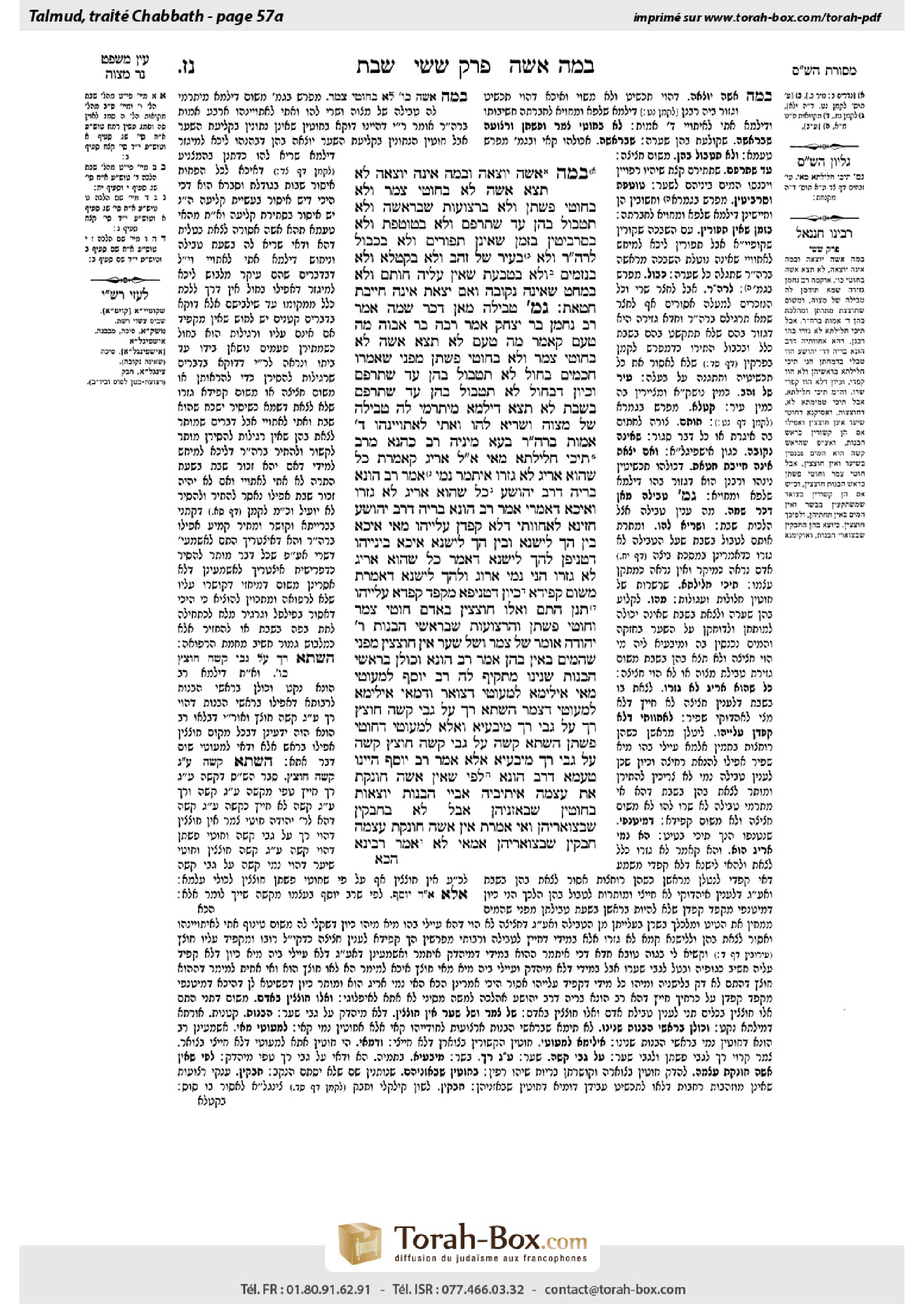
Shabbat 57a: Talmud study for Daf Yomi
Daf Yomi is the daily study of one Talmud folio. Explore 37 tractates with scans, Hebrew text, Sefaria English and AI-generated French translations where annotated.
Passage selection and English or AI-generated French translation are available where the scan has annotations. Daf Study is independent of Torah-Box and Sefaria.
Browse Shabbat · שבת · All tractatesShabbat 57a text and translations
This page of Shabbat includes the Aramaic text, an English translation and an AI-generated French translation, alongside the scan above.
שבת נ״ז א · Aramaic and Hebrew text
מַתְנִי׳ בַּמָּה אִשָּׁה יוֹצְאָה, וּבַמָּה אֵינָהּ יוֹצְאָה?
לֹא תֵּצֵא אִשָּׁה לֹא בְּחוּטֵי צֶמֶר וְלֹא בְּחוּטֵי פִּשְׁתָּן וְלֹא בִּרְצוּעוֹת שֶׁבְּרֹאשָׁהּ. וְלֹא תִּטְבּוֹל בָּהֶן, עַד שֶׁתְּרַפֵּם.
וְלֹא בְּ״טוֹטֶפֶת״ וְלֹא בְּסַרְבִּיטִין בִּזְמַן שֶׁאֵינָן תְּפוּרִים. וְלֹא בְּכָבוּל לִרְשׁוּת הָרַבִּים.
וְלֹא בְּעִיר שֶׁל זָהָב וְלֹא בְּקַטְלָא וְלֹא בִּנְזָמִים וְלֹא בְּטַבַּעַת שֶׁאֵין עָלֶיהָ חוֹתָם וְלֹא בְּמַחַט שֶׁאֵינָהּ נְקוּבָה.
וְאִם יָצָאת אֵינָהּ חַיֶּיבֶת חַטָּאת.
גְּמָ׳ טְבִילָה מַאן דְּכַר שְׁמַהּ?
אָמַר רַב נַחְמָן בַּר יִצְחָק אָמַר רַבָּה בַּר אֲבוּהּ — מַה טַּעַם קָאָמַר: מַה טַּעַם לֹא תֵּצֵא אִשָּׁה לֹא בְּחוּטֵי צֶמֶר וְלֹא בְּחוּטֵי פִּשְׁתָּן — מִפְּנֵי שֶׁאָמְרוּ חֲכָמִים בַּחוֹל לָא תִּטְבּוֹל בָּהֶן עַד שֶׁתְּרַפֵּם. וְכֵיוָן דִּבְחוֹל לָא תִּטְבּוֹל בָּהֶן עַד שֶׁתְּרַפֵּם, בְּשַׁבָּת לֹא תֵּצֵא, דִּילְמָא מִיתְרְמֵי לַהּ טְבִילָה שֶׁל מִצְוָה וְשָׁרְיָא לְהוּ, וְאָתֵי לְאֵתוֹיִינְהוּ אַרְבַּע אַמּוֹת בִּרְשׁוּת הָרַבִּים.
בְּעָא מִינֵּיהּ רַב כָּהֲנָא מֵרַב: תִּיכֵי חֲלִילָתָא מַאי? אֲמַר לֵיהּ: אָרִיג קָאָמְרַתְּ? כׇּל שֶׁהוּא אָרִיג לֹא גָּזְרוּ. אִיתְּמַר נָמֵי, אָמַר רַב הוּנָא בְּרֵיהּ דְּרַב יְהוֹשֻׁעַ: כׇּל שֶׁהוּא אָרִיג לֹא גָּזְרוּ.
וְאִיכָּא דְּאָמְרִי, אָמַר רַב הוּנָא בְּרֵיהּ דְּרַב יְהוֹשֻׁעַ: חֲזֵינָא לְאַחְווֹתִי דְּלָא קָפְדָן עֲלַיְיהוּ.
מַאי אִיכָּא בֵּין הַךְ לִישָּׁנָא וּבֵין הַךְ לִישָּׁנָא?
אִיכָּא בֵּינַיְיהוּ דִּטְנִיפָן. לְהַךְ לִישָּׁנָא דְּאָמַר כׇּל שֶׁהוּא אָרִיג לֹא גָּזְרוּ — הָנֵי נָמֵי אָרִיג נִינְהוּ, וּלְהַךְ לִישָּׁנָא דְּאָמְרַתְּ מִשּׁוּם קְפִידָא — כֵּיוָן דִּטְנִיפָא מִקְפָּד קָפְדָא עֲלַיְיהוּ.
תְּנַן הָתָם: וְאֵלּוּ חוֹצְצִין בָּאָדָם: חוּטֵי צֶמֶר וְחוּטֵי פִּשְׁתָּן וְהָרְצוּעוֹת שֶׁבְּרָאשֵׁי הַבָּנוֹת. רַבִּי יְהוּדָה אוֹמֵר: שֶׁל צֶמֶר וְשֶׁל שֵׂעָר אֵין חוֹצְצִין מִפְּנֵי שֶׁהַמַּיִם בָּאִין בָּהֶן. אָמַר רַב הוּנָא: וְכוּלָּן, בְּרָאשֵׁי הַבָּנוֹת שָׁנִינוּ.
מַתְקִיף לַהּ רַב יוֹסֵף: לְמַעוֹטֵי מַאי? אִילֵּימָא לְמַעוֹטֵי דְּצַוָּאר, וּדְמַאי: אִילֵּימָא לְמַעוֹטֵי דְּצֶמֶר — הַשְׁתָּא רַךְ עַל גַּבֵּי קָשֶׁה חוֹצֵץ, רַךְ עַל גַּבֵּי רַךְ מִיבַּעְיָא?
וְאֶלָּא לְמַעוֹטֵי דְּחוּטֵי פִשְׁתָּן. הַשְׁתָּא קָשֶׁה עַל גַּבֵּי קָשֶׁה חוֹצֵץ, קָשֶׁה עַל גַּבֵּי רַךְ מִיבַּעְיָא?
אֶלָּא אָמַר רַב יוֹסֵף, הַיְינוּ טַעְמָא דְּרַב הוּנָא: לְפִי שֶׁאֵין אִשָּׁה חוֹנֶקֶת אֶת עַצְמָהּ.
אֵיתִיבֵיהּ אַבָּיֵי: הַבָּנוֹת יוֹצְאוֹת בְּחוּטִין שֶׁבְּאׇזְנֵיהֶן, אֲבָל לֹא בַּחֲבָקִין שֶׁבְּצַוְּארֵיהֶן. וְאִי אָמְרַתְּ אֵין אִשָּׁה חוֹנֶקֶת עַצְמָהּ, חֲבָקִין שֶׁבְּצַוְּארֵיהֶן אַמַּאי לָא?
אָמַר רָבִינָא:
Shabbat 57a · English translation
The mishna lists items that a woman may or may not carry into, or wear in the public domain on Shabbat. This depends on whether the particular object is considered an ornament, which she may wear, or merely a burden for the woman, which she may not. Even if it is considered an ornament, there is still concern that she might remove it and carry it in her hand in the public domain, which is prohibited by Torah law.
MISHNA: With what items may a woman go out into the public domain on Shabbat and with what items may she not go out?
A woman may neither go out with strings of wool, nor with strings of flax, nor with strips of any other materials that a woman braids in the hair of her head. And a woman may not immerse in a ritual bath with them in her hair until she loosens them. When the strings or strips are tight, the water cannot reach her hair unobstructed, invalidating her immersion.
And, likewise, a woman may neither go out with the ornament called totefet, nor with sarvitin that are not sewn into her head covering, nor with a kavul into the public domain.
And, likewise, a woman may neither go out with a city of gold ornament, nor with a katla ornament, nor with nose rings, nor with a ring that has no seal on it, nor with a needle that is not perforated, which are merely for decorative purposes.
And if she unwittingly went out wearing any of these, she is not liable to bring a sin-offering. According to Torah law, a woman is permitted to go out into the public domain wearing ornaments. However, the Sages decreed that a woman may not go out wearing certain ornaments, lest she remove them to show them to another and inadvertently carry them four cubits in the public domain.
GEMARA: The Gemara asks: Immersion, who mentioned anything about that? The mishna is dealing with the halakhot of Shabbat, so why did it mention the halakhot of immersion?
Rav Naḥman bar Yitzḥak said that Rabba bar Avuh said: When the mishna states the halakha, it employs the style known as: What is the reason. The mention of immersion is an explanation, not a superfluous addition. The mishna should be understood as follows: What is the reason that a woman may neither go out with strings of wool nor with strings of flax? It is because the Sages said that on weekdays she may not immerse with them until she loosens them. And since on weekdays she may not immerse with them until she loosens them, on Shabbat she may not go out with them, lest a situation requiring immersion for the purpose of a mitzva come about, and she untie them, and come to carry them four cubits in the public domain.
Rav Kahana raised a dilemma before Rav: With regard to strings made into hollow chains, what is the halakha? Is it permissible for women to go out into the public domain with them on Shabbat or not? It depends on whether they are considered an interposition to immersion. Rav said to him: Woven, you say? With regard to anything woven, the Sages did not issue a decree. Because water reaches the hair unobstructed, there is no need to loosen the hollow chain and there is no concern lest she carry it in the public domain. It was also stated that Rav Huna, son of Rav Yehoshua, said: With regard to anything woven, the Sages did not issue a decree.
And some say that Rav Huna, son of Rav Yehoshua, said: I saw that my sisters are not particular about removing them, and they bathe even with woven chains tied in their hair. Apparently, water reaches the hair. Therefore, the chain is not an interposition with regard to immersion.
The Gemara asks: What practical difference is there between this version and that version of the resolution of the dilemma?
The Gemara explains: There is a practical difference between them in a case where the chains are dirty. According to this version, in which you said: With regard to anything woven, the Sages did not issue a decree, these too are woven. And according to that version, in which you said that it is due to the fact that his sisters were not particular; in this case, since they are dirty, she is particular about them and will certainly remove them when she washes. Therefore, she is required to do so when immersing in a ritual bath as well.
We learned in a mishna in tractate Mikvaot: And these are the objects that interpose for a person: Strings of wool, and strings of flax, and the straps that are on the girls’ heads. Rabbi Yehuda says: Strings of wool and strands of hair do not interpose because the water reaches the hair through them. Rav Huna said: And we learned all these, strings of wool and flax, in a case where they are used to tie the hair on the girls’ heads.
Rav Yosef strongly objects to this halakha of Rav Huna: To exclude what other places in the body did Rav Huna say this? If you say that it comes to exclude strings tied to the neck, and then, strings made of what material does it exclude? If you say that it comes to exclude strings of wool, now, the mishna stated that soft strings of wool on top of hair, which is relatively hard, interpose and invalidates the immersion. With regard to soft strings on top of the soft flesh of the neck, is it necessary to say that they interpose?
Rather, say that Rav Huna’s statement came to exclude strings of flax. A similar difficulty arises: Now the mishna stated that hard strings of wool on top of hair, which is hard, interposes and invalidates the immersion. If so, with regard to hard strings on top of the soft flesh of the neck, is it necessary to say that they interpose?
Rather, Rav Yosef said, this is the reason that Rav Huna restricts the concern for interposition to strings tied in her hair and not around her neck: Because a woman does not strangle herself when adorning herself with a string or straps around her neck. Therefore, she never tightens the strings or straps to the extent that water cannot reach the skin.
Abaye raised an objection to the explanation of Rav Yosef from a baraita: The girls may go out into the public domain on Shabbat with strings in their ears. Young girls would have their ears pierced, but earrings were not placed in their ears until they were older. Instead, they inserted strings so that the holes would not close. However, they may not go out with straps around their necks. And if you say that the principle: A woman does not strangle herself, is halakhically valid, why may they not go out into the public domain with straps around their necks? They are not tied tight and do not constitute an interposition that invalidates immersion.
Ravina said:
Shabbat 57a · Traduction française (IA)
La Michna énumère les objets avec lesquels une femme peut ou ne peut pas sortir dans le domaine public pendant Chabbat, qu’elle les porte ou s’en pare. Cela dépend du fait que l’objet soit considéré comme un ornement, qu’elle peut porter, ou simplement comme une charge, qu’elle ne peut pas porter. Même s’il est considéré comme un ornement, on craint encore qu’elle l’enlève et le porte à la main dans le domaine public, ce qui est interdit par la Torah écrite. MICHNA : Avec quels objets une femme peut-elle sortir dans le domaine public pendant Chabbat, et avec quels objets ne le peut-elle pas ?
Une femme ne peut sortir ni avec des fils de laine, ni avec des fils de lin, ni avec des bandes d’autres matières qu’elle tresse dans ses cheveux. Elle ne peut pas non plus s’immerger dans un bain rituel sans les avoir desserrés au préalable. Lorsque les fils ou les bandes sont serrés, l’eau ne peut atteindre ses cheveux sans obstacle, ce qui invalide son immersion.
De même, une femme ne peut sortir ni avec l’ornement appelé totefet, ni avec des sarvitin qui ne sont pas cousus à sa coiffe, ni avec un kavul dans le domaine public.
De même, une femme ne peut sortir ni avec un ornement appelé « ville d’or », ni avec un ornement appelé katla, ni avec des anneaux de nez, ni avec une bague dépourvue de sceau, ni avec une aiguille non perforée, ces objets ne servant qu’à la parure.
Si elle est sortie par inadvertance en portant l’un de ces objets, elle n’est pas tenue d’apporter un sacrifice expiatoire. Selon la Torah écrite, une femme est autorisée à sortir dans le domaine public en portant des ornements. Toutefois, les Sages ont décrété qu’une femme ne peut sortir avec certains ornements, de crainte qu’elle ne les enlève pour les montrer à quelqu’un et ne les porte par inadvertance sur quatre coudées dans le domaine public.
GUEMARA : La Guemara demande : Qui a parlé d’immersion ? La Michna traite des halakhot de Chabbat ; pourquoi a-t-elle donc mentionné les halakhot de l’immersion ?
Rav Naḥman bar Yitzḥak dit au nom de Rabba bar Avuh : Lorsque la Michna énonce une halakha, elle emploie la formulation connue sous le nom de « quelle en est la raison ? ». La mention de l’immersion est une explication, et non un ajout superflu. Il faut comprendre la Michna ainsi : Quelle est la raison pour laquelle une femme ne peut sortir ni avec des fils de laine ni avec des fils de lin ? C’est parce que les Sages ont dit que, les jours de semaine, elle ne peut s’immerger avec ces objets avant de les avoir desserrés. Et puisqu’elle ne peut s’immerger avec eux les jours de semaine avant de les avoir desserrés, elle ne peut sortir avec eux pendant Chabbat, de crainte qu’une situation nécessitant une immersion pour accomplir une mitsva ne se présente, qu’elle ne les dénoue alors et ne les porte sur quatre coudées dans le domaine public.
Rav Kahana souleva une question devant Rav : Quel est le statut des fils façonnés en chaînes creuses ? Les femmes peuvent-elles sortir avec eux dans le domaine public pendant Chabbat ou non ? Cela dépend du fait qu’ils constituent ou non une interposition lors de l’immersion. Rav lui dit : Tu parles d’objets tissés ? Pour tout ce qui est tissé, les Sages n’ont pas édicté de décret. Puisque l’eau atteint les cheveux sans obstacle, il n’est pas nécessaire de desserrer la chaîne creuse et l’on ne craint pas qu’elle la porte dans le domaine public. Il a également été dit que Rav Huna, fils de Rav Yehoshua, disait : Pour tout ce qui est tissé, les Sages n’ont pas édicté de décret.
Et certains disent que Rav Huna, fils de Rav Yehoshua, disait : J’ai vu que mes sœurs ne prennent pas la peine de les enlever et qu’elles se baignent même avec des chaînes tissées nouées dans les cheveux. Il semble donc que l’eau atteigne les cheveux. Par conséquent, la chaîne ne constitue pas une interposition lors de l’immersion.
La Guemara demande : Quelle différence pratique y a-t-il entre cette version et l’autre version de la réponse à la question ?
La Guemara explique : Il y a entre ces versions une différence pratique dans le cas où les chaînes sont sales. Selon cette version, qui dit : « Pour tout ce qui est tissé, les Sages n’ont pas édicté de décret », celles-ci aussi sont tissées. Mais selon l’autre version, qui attribue cela au fait que ses sœurs n’y prêtaient pas attention, dans ce cas, puisqu’elles sont sales, elle y prête attention et les enlèvera certainement lorsqu’elle se lavera. Elle doit donc également les enlever lorsqu’elle s’immerge dans un bain rituel.
Nous avons appris dans une Michna du traité Mikvaot : Voici les objets qui constituent une interposition pour une personne : les fils de laine, les fils de lin et les lanières qui se trouvent sur la tête des jeunes filles. Rabbi Yehouda dit : Les fils de laine et les mèches de cheveux ne constituent pas une interposition, car l’eau les traverse et atteint les cheveux. Rav Huna dit : Tous ces objets — les fils de laine et de lin — sont mentionnés dans le cas où ils servent à attacher les cheveux des jeunes filles.
Rav Yosef soulève une objection contre cette halakha de Rav Huna : Quels autres endroits du corps Rav Huna entendait-il exclure par cette déclaration ? Si tu dis qu’il entendait exclure les fils noués autour du cou, alors, de quelle matière sont les fils qu’il entend exclure ? Si tu dis qu’il s’agit de fils de laine, la Michna a déjà enseigné que des fils de laine mous placés sur des cheveux, qui sont relativement durs, constituent une interposition et invalident l’immersion. Quant à des fils mous placés sur la chair tendre du cou, est-il nécessaire de préciser qu’ils constituent une interposition ?
Il faut plutôt dire que la déclaration de Rav Huna visait à exclure les fils de lin. Une difficulté semblable se présente : la Michna a déjà enseigné que des fils de laine durs placés sur des cheveux, qui sont durs, constituent une interposition et invalident l’immersion. Dès lors, pour des fils durs placés sur la chair tendre du cou, est-il nécessaire de préciser qu’ils constituent une interposition ?
Rav Yosef dit plutôt que voici pourquoi Rav Huna limite le risque d’interposition aux fils noués dans les cheveux, et non à ceux noués autour du cou : une femme ne s’étrangle pas en se parant d’un fil ou de lanières autour du cou. Elle ne serre donc jamais les fils ou les lanières au point d’empêcher l’eau d’atteindre la peau.
Abaye soulève une objection à l’explication de Rav Yosef à partir d’une baraïta : Les jeunes filles peuvent sortir dans le domaine public pendant Chabbat avec des fils dans les oreilles. On perçait les oreilles des jeunes filles, mais on ne leur mettait des boucles d’oreilles qu’une fois qu’elles étaient plus âgées. À la place, on y insérait des fils afin que les trous ne se referment pas. Toutefois, elles ne peuvent sortir avec des lanières autour du cou. Or, si l’on dit que le principe selon lequel une femme ne s’étrangle pas est valable du point de vue de la halakha, pourquoi ne peuvent-elles pas sortir dans le domaine public avec des lanières autour du cou ? Elles ne sont pas nouées serrées et ne constituent pas une interposition qui invalide l’immersion.
Ravina dit :
Traduction française générée par IA à partir de l’édition anglaise de Sefaria. Vérifie toujours un passage avec le texte source.
Text from Sefaria: William Davidson Edition - Vocalized Aramaic (CC BY NC); William Davidson Edition - English (CC BY NC).