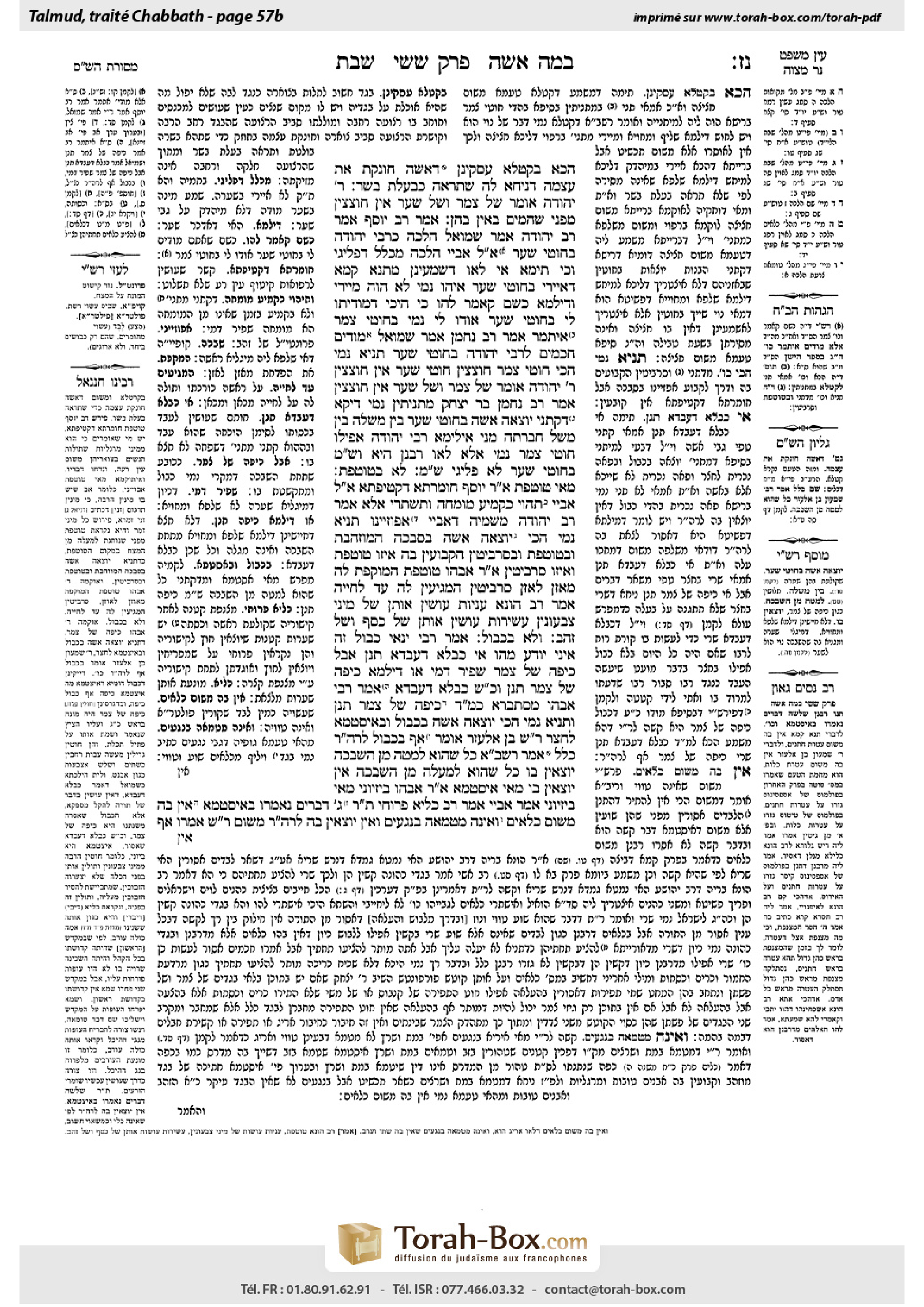
Shabbat 57b: Talmud study for Daf Yomi
Daf Yomi is the daily study of one Talmud folio. Explore 37 tractates with scans, Hebrew text, Sefaria English and AI-generated French translations where annotated.
Passage selection and English or AI-generated French translation are available where the scan has annotations. Daf Study is independent of Torah-Box and Sefaria.
Browse Shabbat · שבת · All tractatesShabbat 57b text and translations
This page of Shabbat includes the Aramaic text, an English translation and an AI-generated French translation, alongside the scan above.
שבת נ״ז ב · Aramaic and Hebrew text
הָכָא בְּקַטְלָא עָסְקִינַן, דְּאִשָּׁה חוֹנֶקֶת אֶת עַצְמָהּ — דְּנִיחָא לַהּ שֶׁתֵּרָאֶה כְּבַעֲלַת בָּשָׂר.
רַבִּי יְהוּדָה אוֹמֵר שֶׁל צֶמֶר וְשֶׁל שֵׂעָר אֵין חוֹצְצִין, מִפְּנֵי שֶׁהַמַּיִם בָּאִין בָּהֶן.
אָמַר רַב יוֹסֵף אָמַר רַב יְהוּדָה אָמַר שְׁמוּאֵל: הֲלָכָה כְּרַבִּי יְהוּדָה בְּחוּטֵי שֵׂעָר.
אֲמַר לֵיהּ אַבָּיֵי: הֲלָכָה, מִכְּלָל דִּפְלִיגִי!
וְכִי תֵּימָא, אִי לָאו דְּשָׁמְעֵיהּ לְתַנָּא קַמָּא דְּאַיְּירִי בְּחוּטֵי שֵׂעָר, אִיהוּ נָמֵי לָא הֲוָה מַיְירֵי — וְדִילְמָא ״כְּשֵׁם״ קָאָמַר לְהוּ: כִּי הֵיכִי דְּמוֹדִיתוּ לִי בְּחוּטֵי שֵׂעָר, אוֹדוֹ לִי נָמֵי בְּחוּטֵי צֶמֶר.
אִיתְּמַר, אָמַר רַב נַחְמָן אָמַר שְׁמוּאֵל: מוֹדִים חֲכָמִים לְרַבִּי יְהוּדָה בְּחוּטֵי שֵׂעָר.
תַּנְיָא נָמֵי הָכִי: חוּטֵי צֶמֶר חוֹצְצִין, חוּטֵי שֵׂעָר אֵין חוֹצְצִין. רַבִּי יְהוּדָה אוֹמֵר: שֶׁל צֶמֶר וְשֶׁל שֵׂעָר אֵין חוֹצְצִין.
אָמַר רַב נַחְמָן בַּר יִצְחָק: מַתְנִיתִין נָמֵי דַּיְקָא, דְּקָתָנֵי: יוֹצְאָה אִשָּׁה בְּחוּטֵי שֵׂעָר, בֵּין מִשֶּׁלָּה בֵּין מִשֶּׁל חֲבֶרְתָּהּ. מַנִּי? אִילֵימָא רַבִּי יְהוּדָה — אֲפִילּוּ חוּטֵי צֶמֶר נָמֵי! אֶלָּא לָאו רַבָּנַן הִיא, וּשְׁמַע מִינַּהּ בְּחוּטֵי שֵׂעָר לָא פְּלִיגִי. שְׁמַע מִינַּהּ.
לֹא בְּ״טוֹטֶפֶת״. מַאי ״טוֹטֶפֶת״? אָמַר רַב יוֹסֵף: חוּמַרְתָּא דִקְטִיפְתָּא.
אֲמַר לֵיהּ אַבָּיֵי: תִּהְוֵי כְּקָמֵיעַ מוּמְחֶה, וְתִשְׁתְּרֵי!
אֶלָּא אָמַר רַב יְהוּדָה מִשְּׁמֵיהּ דְּאַבָּיֵי: אֲפוּזְיָינֵי. תַּנְיָא נָמֵי הָכִי: יוֹצְאָה אִשָּׁה בִּסְבָכָה הַמּוּזְהֶבֶת, וּבְטוֹטֶפֶת וּבְסַרְבִּיטִין הַקְּבוּעִין בָּהּ.
אֵיזוֹ טוֹטֶפֶת וְאֵיזוֹ סַרְבִּיטִין? אָמַר רַבִּי אֲבָהוּ: טוֹטֶפֶת — הַמּוּקֶּפֶת לָהּ מֵאֹזֶן לְאֹזֶן. סַרְבִּיטִין — הַמַּגִּיעִין לָהּ עַד לְחָיֶיהָ.
אָמַר רַב הוּנָא: עֲנִיּוֹת עוֹשִׂין אוֹתָן שֶׁל מִינֵי צִבְעוֹנִין, עֲשִׁירוֹת עוֹשִׂין אוֹתָן שֶׁל כֶּסֶף וְשֶׁל זָהָב.
וְלֹא בְּכָבוּל. אָמַר רַבִּי יַנַּאי: כָּבוּל זֶה אֵינִי יוֹדֵעַ מַהוּ: אִי כַּבְלָא דְעַבְדָּא תְּנַן — אֲבָל כִּיפָּה שֶׁל צֶמֶר שַׁפִּיר דָּמֵי, אוֹ דִילְמָא כִּיפָּה שֶׁל צֶמֶר תְּנַן — וְכָל שֶׁכֵּן כַּבְלָא דְעַבְדָּא.
אָמַר רַבִּי אֲבָהוּ: מִסְתַּבְּרָא כְּמַאן דְּאָמַר כִּיפָּה שֶׁל צֶמֶר תְּנַן. וְתַנְיָא נָמֵי הָכִי: יוֹצְאָה אִשָּׁה בְּכָבוּל וּבְאִיסְטָמָא לֶחָצֵר, רַבִּי שִׁמְעוֹן בֶּן אֶלְעָזָר אוֹמֵר: אַף בְּכָבוּל לִרְשׁוּת הָרַבִּים. כְּלָל אָמַר רַבִּי שִׁמְעוֹן בֶּן אֶלְעָזָר: כׇּל שֶׁהוּא לְמַטָּה מִן הַשְּׂבָכָה — יוֹצְאִין בּוֹ, כׇּל שֶׁהוּא לְמַעְלָה מִן הַשְּׂבָכָה — אֵין יוֹצְאִין בּוֹ.
מַאי ״אִיסְטָמָא״? אָמַר רַבִּי אֲבָהוּ: בִּיזְיוֹנֵי. מַאי ״בִּיזְיוֹנֵי״? אָמַר אַבָּיֵי אָמַר רַב: כָּלְיָא פָּרוֹחֵי.
תָּנוּ רַבָּנַן, שְׁלֹשָׁה דְּבָרִים נֶאֶמְרוּ בְּאִיסְטָמָא: אֵין בָּהּ מִשּׁוּם כִּלְאַיִם, וְאֵינָהּ מְטַמְּאָה בִּנְגָעִים, וְאֵין יוֹצְאִין בָּהּ לִרְשׁוּת הָרַבִּים.
מִשּׁוּם רַבִּי שִׁמְעוֹן אָמְרוּ: אַף
Shabbat 57b · English translation
Here we are dealing with a broad, ornamented strap [katla] hanging around the neck, to which a small bib is attached. A woman does strangle herself with a katla because the strap is broad and tightening it does not cause pain. She tightens it because it pleases her that she will appear fleshy. It was considered beautiful to have flesh protrude from the katla.
In the same mishna in tractate Mikvaot, Rabbi Yehuda says: Strings of wool and strands of hair do not interpose and invalidate the immersion because the water reaches through them.
Rav Yosef said that Rav Yehuda said that Shmuel said: The halakha is in accordance with the opinion of Rabbi Yehuda with regard to strands of hair. However, the halakha is not in accordance with his opinion with regard to wool strings.
Abaye said to him: By saying that the halakha is in accordance with Rav Yehuda, by inference the Rabbis disagree with regard to strands of hair. However, no opinion stating that strands of hair constitute an interposition is cited in the mishna.
And if you say that had we not heard from the first tanna that he is speaking of strands of hair, Rabbi Yehuda would also not have spoken about them. Apparently, the first tanna prohibited strands of hair, and Rabbi Yehuda disagreed with him. Nevertheless, it could be explained otherwise. And, perhaps he prefaced what he was saying to the Rabbis with the phrase: Just as. Just as you agree with me that strands of hair do not interpose, agree with me that strings of wool also do not interpose. The fact that he mentioned strands of hair does not indicate a dispute; on the contrary, it is an attempt to establish a consensus with regard to the halakha.
Indeed, it was stated that Rav Naḥman said that Shmuel said: The Rabbis agree with Rabbi Yehuda with regard to strands of hair.
This opinion was also taught in a baraita: Strings of wool interpose. Strands of hair do not interpose. Rabbi Yehuda says: Both strings of wool and strands of hair do not interpose.
Rav Naḥman bar Yitzḥak said: The language of the mishna is also precise, as we learned in a mishna in our chapter: A woman may go out with strands of hair whether they are from her own hair or whether they are from the hair of another. Whose opinion is expressed in this mishna? If you say that it is the opinion of Rabbi Yehuda, even strings of wool should also have been permitted. Rather, is it not the opinion of the Rabbis; and conclude from it that with regard to strands of hair, they do not disagree? The Gemara determines: Indeed, conclude from it.
The mishna said that a woman may not go out with the ornament called a totefet. The Gemara asks: What is a totefet? Rav Yosef said: A packet of spices to ward off the evil eye.
Abaye said to him: And let the legal status of this packet be like that of an effective amulet, whose effectiveness is proven, and it should be permitted, as an effective amulet may be moved on Shabbat.
Rather, Rav Yehuda said in the name of Abaye: A totefet is an appuzainu, an ornament worn on the forehead. This opinion was also taught in a baraita: A woman may go out with a gilded hairnet worn to hold the hair in place, and with the totefet, and with the sarvitin that are fastened to the hairnet, since a woman would not remove her head covering to show her friend those ornaments.
And they said: Which is a totefet and which is sarvitin? Rabbi Abbahu said: Totefet is that which goes around her forehead from ear to ear. Sarvitin are those attached to the net that reach down to her cheeks.
Rav Huna said: Poor women make these ornaments from different types of colored materials. Wealthy women make them of silver and of gold.
We learned in the mishna that a woman may not go out with a kavul. Rabbi Yannai said: This kavul, I do not know what it is. Is it the seal of a slave, who would have a seal on his clothing identifying him as a slave, about which we learned in our mishna that it is prohibited, but a cap of wool that a woman places on her hair, she may well go out wearing it? Or, perhaps we learned in our mishna that going out with a cap of wool is prohibited and all the more so that going out with the seal of a slave is prohibited.
Rabbi Abbahu said: It is reasonable to say in accordance with the one who said that we learned about a cap of wool in the mishna. And this opinion was also taught in a baraita: A woman may go out with a kavul and with an istema to the courtyard on Shabbat. Rabbi Shimon ben Elazar says: She may even go out with the kavul into the public domain. Rabbi Shimon ben Elazar stated a principle: Anything that is worn beneath the hairnet, a woman may go out into the public domain with it, since a woman will not uncover her hair even to show off an ornament while in the public domain. Anything that is worn over the hairnet, like an ornamental hat, a woman may not go out with it. From the context and proximity of the halakha dealing with kavul to the statement of Rabbi Shimon ben Elazar, apparently a kavul is a wool cap worn under the net.
Since istema was mentioned in the baraita, the Gemara asks: What is an istema? Rabbi Abbahu said: Istema is a beizyunei. However, Rabbi Abbahu’s explanation employed a term from the Aramaic dialect spoken in Eretz Yisrael, which was not understood in Babylonia. Therefore, they asked there: What is a beizyunei? Abaye said that Rav said: It is a small hat or ribbon used to gather hairs that protrude [kalya paruḥei] from the headdress.
The Sages taught in the Tosefta that three things were said with regard to an istema: There is no prohibition of a mixture of diverse kinds, wool and linen, in it. Since it is made of hard felt and not woven together, the prohibition of diverse kinds does not apply to material of that kind. And it does not become impure with the ritual impurity of leprosy. Only woven garments can become impure with leprosy. And women may not go out with it to the public domain on Shabbat.
In the name of Rabbi Shimon they said: Also,
Shabbat 57b · Traduction française (IA)
Nous parlons ici d’une large lanière ornée [katla] portée autour du cou, à laquelle est attaché un petit plastron. Une femme s’étrangle effectivement avec une katla, car la lanière est large et son resserrement ne lui fait pas mal. Elle la resserre parce qu’il lui plaît de paraître en chair. À l’époque, on trouvait beau que de la chair dépasse de la katla.
Dans la même Michna du traité Mikvaot, Rabbi Yehouda dit : Les fils de laine et les mèches de cheveux ne font pas écran et n’invalident pas l’immersion, car l’eau les traverse.
Rav Yossef dit au nom de Rav Yehouda, qui dit au nom de Chmouel : La halakha suit l’avis de Rabbi Yehouda concernant les mèches de cheveux. Toutefois, la halakha ne suit pas son avis concernant les fils de laine.
Abayé lui dit : En disant que la halakha suit l’avis de Rav Yehouda, tu sous-entends que les Rabbins ne sont pas d’accord concernant les mèches de cheveux. Pourtant, la Michna ne cite aucun avis selon lequel les mèches de cheveux constituent un écran.
Et si tu dis que, si le premier tanna ne nous avait pas appris qu’il parlait de mèches de cheveux, Rabbi Yehouda n’en aurait pas parlé non plus, il semblerait que le premier tanna ait interdit les mèches de cheveux et que Rabbi Yehouda ait été en désaccord avec lui. Néanmoins, on pourrait l’expliquer autrement. Peut-être a-t-il introduit ce qu’il disait aux Rabbins par l’expression : « De même que… » De même que vous êtes d’accord avec moi pour dire que les mèches de cheveux ne font pas écran, mettez-vous d’accord avec moi pour dire que les fils de laine ne font pas non plus écran. Le fait qu’il ait mentionné les mèches de cheveux n’indique pas un désaccord ; au contraire, il cherche à établir un consensus sur la halakha.
En effet, il a été rapporté que Rav Naḥman dit au nom de Chmouel : Les Rabbins sont d’accord avec Rabbi Yehouda concernant les mèches de cheveux.
Cet avis a également été enseigné dans une baraïta : Les fils de laine font écran. Les mèches de cheveux ne font pas écran. Rabbi Yehouda dit : Ni les fils de laine ni les mèches de cheveux ne font écran.
Rav Naḥman bar Yitzḥak dit : La formulation de la Michna est également précise, comme nous l’avons appris dans une Michna de notre chapitre : Une femme peut sortir avec des mèches de cheveux, qu’elles soient faites de ses propres cheveux ou des cheveux d’une autre personne. De qui cette Michna exprime-t-elle l’avis ? Si tu dis qu’il s’agit de l’avis de Rabbi Yehouda, les fils de laine auraient eux aussi dû être permis. Ne s’agit-il pas plutôt de l’avis des Rabbins ? On en conclut donc qu’ils ne sont pas en désaccord concernant les mèches de cheveux. La Guemara conclut : En effet, conclus-en ainsi.
La Michna dit qu’une femme ne peut pas sortir avec la parure appelée totefet. La Guemara demande : Qu’est-ce qu’une totefet ? Rav Yossef dit : Un sachet d’épices destiné à éloigner le mauvais œil.
Abayé lui dit : Pourquoi ne pas attribuer à ce sachet le statut d’une amulette dont l’efficacité est avérée et permettre de la porter, puisqu’une amulette efficace peut être déplacée pendant Chabbat ?
Rav Yehouda dit au nom d’Abayé : Une totefet est une appuzainu, une parure portée sur le front. Cet avis a également été enseigné dans une baraïta : Une femme peut sortir avec un filet à cheveux doré qui maintient ses cheveux en place, avec la totefet et avec les sarvitin, qui sont fixés au filet, car une femme ne retirerait pas son couvre-chef pour montrer ces parures à son amie.
Et l’on demanda : Qu’est-ce qu’une totefet et que sont les sarvitin ? Rabbi Abbahou dit : La totefet est ce qui entoure son front, d’une oreille à l’autre. Les sarvitin sont les éléments fixés au filet et qui descendent jusqu’à ses joues.
Rav Houna dit : Les femmes pauvres confectionnent ces parures avec différentes sortes de matières colorées. Les femmes riches les font en argent et en or.
Nous avons appris dans la Michna qu’une femme ne peut pas sortir avec un kavul. Rabbi Yannai dit : Ce kavul, j’ignore ce que c’est. S’agit-il du sceau d’un esclave, qui portait un sceau sur ses vêtements l’identifiant comme esclave, et dont nous avons appris dans notre Michna qu’il est interdit de sortir avec ? Mais une femme peut-elle sortir avec un bonnet de laine qu’elle place sur ses cheveux ? Ou bien avons-nous appris dans notre Michna qu’il est interdit de sortir avec un bonnet de laine, et à plus forte raison avec le sceau d’un esclave ?
Rabbi Abbahou dit : Il est raisonnable de retenir l’avis selon lequel la Michna parle d’un bonnet de laine. Cet avis a également été enseigné dans une baraïta : Une femme peut sortir avec un kavul et avec un istema dans la cour, pendant Chabbat. Rabbi Shimon ben Elazar dit : Elle peut même sortir avec le kavul dans le domaine public. Rabbi Shimon ben Elazar a énoncé un principe : Tout ce qui se porte sous le filet à cheveux, une femme peut le porter dans le domaine public, car elle ne découvrira pas ses cheveux, même pour exhiber une parure, lorsqu’elle se trouve dans le domaine public. Tout ce qui se porte par-dessus le filet à cheveux, comme un chapeau ornemental, une femme ne peut pas sortir avec. D’après le contexte et la proximité de la halakha concernant le kavul avec la déclaration de Rabbi Shimon ben Elazar, il semble que le kavul soit un bonnet de laine porté sous le filet.
Puisque l’istema a été mentionné dans la baraïta, la Guemara demande : Qu’est-ce qu’un istema ? Rabbi Abbahou dit : L’istema est une beizyunei. Cependant, l’explication de Rabbi Abbahou employait un terme du dialecte araméen parlé en Eretz Israël, qui n’était pas compris en Babylonie. On demanda donc là-bas : Qu’est-ce qu’une beizyunei ? Abayé dit au nom de Rav : C’est un petit bonnet ou un ruban servant à rassembler les cheveux qui dépassent [kalya paruḥei] de la coiffe.
Les Sages ont enseigné dans la Tossefta que trois choses ont été dites au sujet d’un istema : il n’y a pas d’interdiction de mélanger des espèces, laine et lin, à son sujet. Comme il est fait de feutre épais et non tissé, l’interdiction du mélange d’espèces ne s’applique pas à ce type de matière. De plus, il ne devient pas impur de l’impureté rituelle de la lèpre. Seuls les vêtements tissés peuvent devenir impurs à cause de la lèpre. Enfin, les femmes ne peuvent pas sortir avec lui dans le domaine public pendant Chabbat.
Au nom de Rabbi Shimon, on a dit : De plus,
Traduction française générée par IA à partir de l’édition anglaise de Sefaria. Vérifie toujours un passage avec le texte source.
Text from Sefaria: William Davidson Edition - Vocalized Aramaic (CC BY NC); William Davidson Edition - English (CC BY NC).