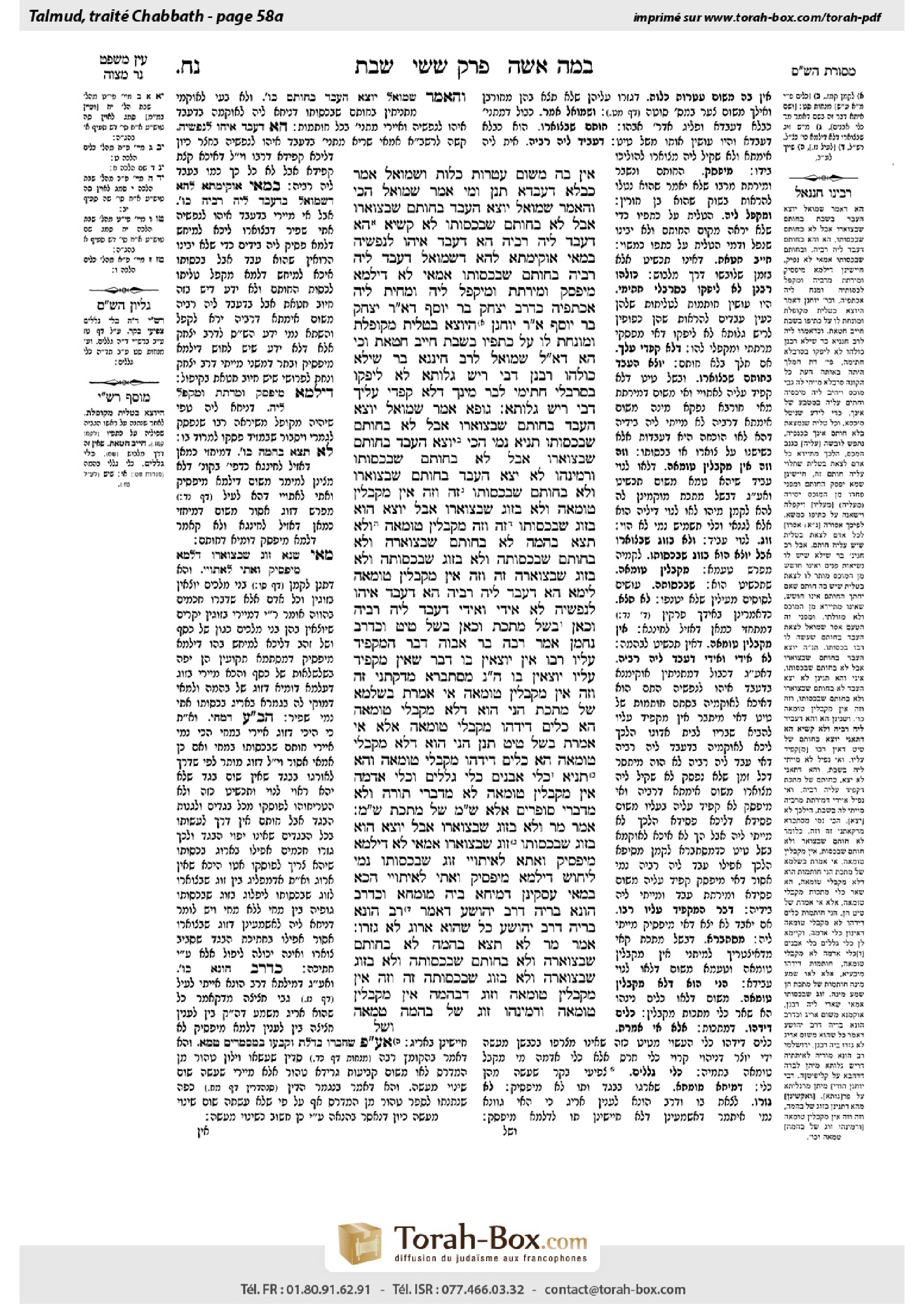
Shabbat 58a: Talmud study for Daf Yomi
Daf Yomi is the daily study of one Talmud folio. Explore 37 tractates with scans, Hebrew text, Sefaria English and AI-generated French translations where annotated.
Passage selection and English or AI-generated French translation are available where the scan has annotations. Daf Study is independent of Torah-Box and Sefaria.
Browse Shabbat · שבת · All tractatesShabbat 58a text and translations
This page of Shabbat includes the Aramaic text, an English translation and an AI-generated French translation, alongside the scan above.
שבת נ״ח א · Aramaic and Hebrew text
אֵין בָּהּ מִשּׁוּם עַטְרוֹת כַּלּוֹת.
וּשְׁמוּאֵל אָמַר: כַּבְלָא דְעַבְדָּא תְּנַן. וּמִי אָמַר שְׁמוּאֵל הָכִי? וְהָאָמַר שְׁמוּאֵל: יוֹצֵא הָעֶבֶד בְּחוֹתָם שֶׁבְּצַוָּארוֹ, אֲבָל לֹא בְּחוֹתָם שֶׁבִּכְסוּתוֹ!
לָא קַשְׁיָא: הָא דַּעֲבַד לֵיהּ רַבֵּיהּ, הָא דַּעֲבַד אִיהוּ לְנַפְשֵׁיהּ.
בְּמַאי אוֹקִימְתָּא לְהָא דִּשְׁמוּאֵל — דַּעֲבַד לֵיהּ רַבֵּיהּ? בְּחוֹתָם שֶׁבִּכְסוּתוֹ אַמַּאי לָא!
דִּילְמָא מִיפְּסַק, וּמִירְתַת וּמְיקַפֵּל לֵיהּ וּמַחֵית לֵיהּ אַכַּתְפֵּיהּ. כִּדְרַב יִצְחָק בַּר יוֹסֵף, דְּאָמַר רַב יִצְחָק בַּר יוֹסֵף אָמַר רַבִּי יוֹחָנָן: הַיּוֹצֵא בְּטַלִּית מְקֻפֶּלֶת וּמוּנַּחַת לוֹ עַל כְּתֵפָיו בְּשַׁבָּת — חַיָּיב חַטָּאת.
וְכִי הָא דַּאֲמַר לֵיהּ שְׁמוּאֵל לְרַב חִינָּנָא בַּר שֵׁילָא: כּוּלְּהוּ רַבָּנַן דְּבֵי רֵישׁ גָּלוּתָא לָא לִיפְּקוּ בְּסַרְבָּלֵי חֲתִימֵי, לְבַר מִינָּךְ — דְּלָא קָפְדִי עֲלָיךְ דְּבֵי רֵישׁ גָּלוּתָא.
גּוּפָא, אָמַר שְׁמוּאֵל: יוֹצֵא הָעֶבֶד בְּחוֹתָם שֶׁבְּצַוָּארוֹ אֲבָל לֹא בְּחוֹתָם שֶׁבִּכְסוּתוֹ. תַּנְיָא נָמֵי הָכִי: יוֹצֵא הָעֶבֶד בְּחוֹתָם שֶׁבְּצַוָּארוֹ אֲבָל לֹא בְּחוֹתָם שֶׁבִּכְסוּתוֹ.
וּרְמִינְהוּ: לֹא יֵצֵא הָעֶבֶד בְּחוֹתָם שֶׁבְּצַוָּארוֹ וְלֹא בְּחוֹתָם שֶׁבִּכְסוּתוֹ, זֶה וָזֶה אֵין מְקַבְּלִין טוּמְאָה. וְלֹא בְּזוֹג שֶׁבְּצַוָּארוֹ, אֲבָל יוֹצֵא הוּא בְּזוֹג שֶׁבִּכְסוּתוֹ, זֶה וָזֶה מְקַבְּלִין טוּמְאָה.
וְלֹא תֵּצֵא בְּהֵמָה לֹא בְּחוֹתָם שֶׁבְּצַוָּארָהּ, וְלֹא בְּחוֹתָם שֶׁבִּכְסוּתָהּ, וְלֹא בְּזוֹג שֶׁבִּכְסוּתָהּ, וְלֹא בְּזוֹג שֶׁבְּצַוָּארָהּ, זֶה וָזֶה אֵין מְקַבְּלִין טוּמְאָה!
לֵימָא, הָא דַּעֲבַד לֵיהּ רַבֵּיהּ, הָא דַּעֲבַד אִיהוּ לְנַפְשֵׁיהּ.
לָא, אִידִי וְאִידִי דַּעֲבַד לֵיהּ רַבֵּיהּ — וְכָאן בְּשֶׁל מַתֶּכֶת, וְכָאן בְּשֶׁל טִיט, וְכִדְרַב נַחְמָן אָמַר רַבָּה בַּר אֲבוּהּ: דָּבָר הַמַּקְפִּיד עָלָיו רַבּוֹ — אֵין יוֹצְאִין בּוֹ. דָּבָר שֶׁאֵין מַקְפִּיד עָלָיו — יוֹצְאִין בּוֹ.
הָכִי נָמֵי מִסְתַּבְּרָא, מִדְּקָתָנֵי: זֶה וָזֶה אֵין מְקַבְּלִין טוּמְאָה. אִי אָמְרַתְּ בִּשְׁלָמָא שֶׁל מַתֶּכֶת — הָנֵי הוּא דְּלָא מְקַבְּלִי טוּמְאָה, הָא כֵּלִים דִּידְהוּ מְקַבְּלִי טוּמְאָה.
אֶלָּא אִי אָמְרַתְּ בְּשֶׁל טִיט תְּנַן, הָנֵי הוּא דְּלָא מְקַבְּלִי טוּמְאָה, הָא כֵּלִים דִּידְהוּ מְקַבְּלִי טוּמְאָה?!
וְהָא תַּנְיָא: כְּלֵי אֲבָנִים כְּלֵי גְלָלִים וּכְלֵי אֲדָמָה — אֵין מְקַבְּלִין טוּמְאָה לֹא מִדִּבְרֵי תוֹרָה וְלֹא מִדִּבְרֵי סוֹפְרִים. אֶלָּא שְׁמַע מִינַּהּ שֶׁל מַתֶּכֶת. שְׁמַע מִינַּהּ.
אָמַר מָר: וְלֹא בְּזוֹג שֶׁבְּצַוָּארוֹ, אֲבָל יוֹצֵא הוּא בְּזוֹג שֶׁבִּכְסוּתוֹ.
זוֹג שֶׁבְּצַוָּארוֹ אַמַּאי לָא — דִּילְמָא מִיפְּסִיק וְאָתֵי לְאֵיתוֹיֵי? זוֹג שֶׁבִּכְסוּתוֹ נָמֵי לִיחוּשׁ דִּילְמָא מִיפְּסִיק וְאָתֵי לְאֵיתוֹיֵי!
הָכָא בְמַאי עָסְקִינַן — דִּימְחָא בֵּיהּ מוּמְחָא. וְכִדְרַב הוּנָא בְּרֵיהּ דְּרַב יְהוֹשֻׁעַ. דְּאָמַר רַב הוּנָא בְּרֵיהּ דְּרַב יְהוֹשֻׁעַ: כׇּל שֶׁהוּא אָרוּג לֹא גָּזְרוּ.
אָמַר מָר: לֹא תֵּצֵא בְּהֵמָה לֹא בְּחוֹתָם שֶׁבְּצַוָּארָהּ, וְלֹא בְּחוֹתָם שֶׁבִּכְסוּתָהּ, וְלֹא בְּזוֹג שֶׁבְּצַוָּארָהּ, וְלֹא בְּזוֹג שֶׁבִּכְסוּתָהּ, זֶה וָזֶה אֵין מְקַבְּלִין טוּמְאָה.
וְזוֹג דִּבְהֵמָה אֵין מְקַבְּלִין טוּמְאָה? וּרְמִינְהוּ: זוֹג שֶׁל בְּהֵמָה — טְמֵאָה,
Shabbat 58a · English translation
the rabbinic decree prohibiting adorning brides with bridal crowns to commemorate the destruction of the Temple does not apply to an istema.
Earlier, the Gemara cited Rabbi Abbahu’s opinion that the kavul mentioned in the mishna, which one may not wear into the public domain on Shabbat, is a woolen cap. And Shmuel said: It is the seal of a slave that we learned about in the mishna. The Gemara asks: And did Shmuel actually say this? Didn’t Shmuel say: A slave may go out on Shabbat with a seal that is around his neck but not with a seal that is on his clothes? Apparently, Shmuel holds that one may go out into the public domain with a slave’s seal. How, then, could he say that kavul in the mishna, with which one may not go out into the public domain, is referring to the seal of a slave?
The Gemara answers: This is not difficult. This, where Shmuel said that one may go out with a slave’s seal on Shabbat, is referring to a case where his master made it for him. The slave will not remove it because he fears his master. Therefore, there is no concern lest he carry it. However, that, where the mishna said that it is prohibited to go out with a kavul, which according to Shmuel is the seal of a slave, is referring to a case where he made it for himself to indicate to all who his master is so that he may enjoy his master’s protection. In that case, since it is dependent solely upon his discretion, there is concern lest he remove the seal and carry it. Therefore, the Sages prohibited going out with it into the public domain.
The Gemara asks: In what case did you establish this statement of Shmuel? It is in the case of a seal that his master made for him. If so, why may he not go out with a seal on his clothes? There too, since his master made it for him he will not remove it.
The Gemara answers: There the concern is that perhaps the seal will be severed, and the slave will fear his master and fold his cloak and place it on his shoulders so that his master will not see that he has no seal on his clothing. That concern is in accordance with the opinion of Rav Yitzḥak bar Yosef; as Rav Yitzḥak bar Yosef said that Rabbi Yoḥanan said: One who goes out into the public domain with a cloak folded and resting on his shoulders on Shabbat is liable to bring a sin-offering. That is not the manner in which one wears a garment; it is the manner in which one carries a burden.
And this is like that which Shmuel said to Rav Ḥinnana bar Sheila: All of the Sages affiliated with the house of the Exilarch may not go out on Shabbat with sealed cloaks [sarbal], i.e., garments with seals on them, except for you, since the people of the Exilarch’s house are not particular with regard to you. The Sages affiliated with the Exilarch were officially considered servants of the house and would wear the seal of the house of the Exilarch. Therefore, it was prohibited for them to go out into the public domain on Shabbat with a cloak bearing the Exilarch’s seal, lest the seal break and, in fear of the Exilarch, they remove the cloak, fold it, place it on their shoulders, and carry it on Shabbat. Only Rav Ḥinnana bar Sheila was permitted to go out with this seal on Shabbat since the people of the Exilarch’s house were not exacting with him. Even if he wore clothing with no seal, they would not consider it an act of insubordination against the Exilarch.
The Gemara discusses the matter itself: Shmuel said that a slave may go out with a seal that is around his neck but not with a seal that is on his clothes. That opinion was also taught in a baraita: A slave may go out with a seal that is around his neck but not with a seal that is on his clothes.
The Gemara raises a contradiction from another baraita: The slave may neither go out with a seal that is around his neck nor with a seal that is on his clothes on Shabbat, and both this and that cannot become ritually impure. And he may not go out with a bell that is hung around his neck; however, he may go out with a bell that is on his clothes, and both this and that can become ritually impure.
And an animal may neither go out with a seal that is around its neck, nor with a seal that is on its clothes, nor with a bell that is on its clothes, nor with a bell that is around its neck since with regard to an animal these are considered burdens not ornaments. Both this, the seal, and that, the bell, cannot become ritually impure because animal ornaments and utensils do not fall into the category of objects that can become ritually impure. Apparently, it is even prohibited for a slave to go out with a seal around his neck, contrary to Shmuel’s opinion.
The Gemara answers: Say that this baraita, which permits going out, is referring to a case where his master made him the seal. Since he fears removing it, there is no concern that he will come to carry it. That baraita, which prohibits going out, is referring to a case where he made it for himself and there is concern lest he come to remove it and carry it.
The Gemara rejects this resolution: No, both this and that are referring to a case where his master made it for him. The difference can be explained differently. And here, where it was prohibited, it is referring to a seal of metal, and here, where it was permitted, it is a seal of clay. And as Rav Naḥman said that Rabba bar Avuh said: With an object about which his master is particular, one may not go out on Shabbat, lest it become detached from the garment, and fear of his master lead the slave to carry it in his hand. With an object about which his master is not particular, one may go out with it.
The Gemara adds: So too, it is reasonable to understand the baraita from the fact that it teaches there: This seal and that seal cannot become ritually impure. Granted, if you say it is referring to a metal seal, it is possible to understand the novel aspect of the baraita as follows: These are the objects that cannot become ritually impure; however, their vessels made of the same material can become ritually impure.
However, if you say that we learned with regard to seals of clay, can it be similarly inferred that these seals are the objects that cannot become ritually impure; however, their vessels made of the same material can become ritually impure?
Wasn’t it taught in a baraita: Vessels of stone, vessels of dung, and vessels of earth that are not made into earthenware can neither become ritually impure by Torah law nor by rabbinic law? Apparently, even an actual vessel made of clay cannot become ritually impure. Rather, learn from it that this baraita is referring to utensils made of metal. The Gemara concludes: Indeed, conclude from it.
In that same baraita the Master said that the slave may not go out with a bell that is around his neck, but he may go out with a bell that is on his clothes.
The Gemara asks: With a bell that is around his neck, why may he not go out? It is due to concern lest it be severed and he come to carry it. If so, with a bell on his clothes too, let us be concerned lest it be severed and he come to carry it.
The Gemara answers: With what are we dealing here? With a case where the bell is woven into the garment, and it is in accordance with the opinion of Rav Huna, son of Rav Yehoshua, as Rav Huna, son of Rav Yehoshua, said: Anything that is woven into a garment, the Sages did not issue a decree prohibiting going out with it on Shabbat.
In the baraita cited earlier, it was taught that the Master said: An animal may neither go out with a seal that is around its neck, nor with a seal that is on its clothes, nor with a bell that is on its clothes, nor with a bell that is around its neck. Both this and that cannot become ritually impure.
The Gemara asks: And does a bell of an animal not become ritually impure? The Gemara proceeds to raise a contradiction from that which was taught in another baraita: The bell of an animal can become ritually impure,
Shabbat 58a · Traduction française (IA)
Le décret rabbinique interdisant de parer les mariées de couronnes nuptiales en souvenir de la destruction du Temple ne s’applique pas à un istema.
Précédemment, la Guemara a cité l’avis de Rabbi Abbahou selon lequel le kavoul mentionné dans la Michna, qu’il est interdit de porter dans le domaine public le Chabbat, est un bonnet de laine. Chmouel a dit, lui : « Il s’agit du sceau d’un esclave dont parle la Michna. » La Guemara demande : Chmouel a-t-il vraiment dit cela ? N’a-t-il pas dit : « Un esclave peut sortir le Chabbat avec un sceau autour du cou, mais pas avec un sceau sur ses vêtements » ? Il semble donc que, selon Chmouel, on puisse sortir dans le domaine public avec le sceau d’un esclave. Comment, dès lors, a-t-il pu dire que le kavoul de la Michna, avec lequel il est interdit de sortir dans le domaine public, désigne le sceau d’un esclave ?
La Guemara répond : Il n’y a pas de difficulté. Le cas où Chmouel a dit qu’un esclave peut sortir le Chabbat avec un sceau est celui où son maître le lui a fait. L’esclave ne l’enlèvera pas, car il craint son maître. Il n’y a donc pas lieu de craindre qu’il le transporte. En revanche, le cas où la Michna interdit de sortir avec un kavoul, qui désigne selon Chmouel le sceau d’un esclave, est celui où l’esclave l’a fait lui-même pour indiquer à tous qui est son maître, afin de bénéficier de sa protection. Dans ce cas, comme cela dépend uniquement de sa volonté, on peut craindre qu’il enlève le sceau et le transporte. Les Sages ont donc interdit de sortir avec lui dans le domaine public.
La Guemara demande : Dans quel cas avez-vous établi cette déclaration de Chmouel ? Dans celui d’un sceau que son maître a fait pour lui. Si tel est le cas, pourquoi ne peut-il pas sortir avec un sceau sur ses vêtements ? Là aussi, puisque son maître le lui a fait, il ne l’enlèvera pas.
La Guemara répond : Dans ce cas, on craint que le sceau ne se détache et que l’esclave, par crainte de son maître, ne replie son manteau et ne le pose sur ses épaules, afin que son maître ne voie pas qu’il n’a pas de sceau sur son vêtement. Cette crainte correspond à l’avis de Rav Yitsḥak bar Yossef, car Rav Yitsḥak bar Yossef a dit que Rabbi Yoḥanan a dit : « Celui qui sort dans le domaine public le Chabbat avec un manteau replié et posé sur ses épaules est passible d’un sacrifice expiatoire. » Ce n’est pas ainsi que l’on porte un vêtement ; c’est ainsi que l’on transporte une charge.
Cela rejoint ce que Chmouel a dit à Rav Ḥinnana bar Sheila : « Tous les Sages attachés à la maison de l’Exilarque ne peuvent pas sortir le Chabbat avec des manteaux munis de sceaux [sarbal], sauf toi, car les gens de la maison de l’Exilarque ne sont pas exigeants à ton égard. » Les Sages attachés à l’Exilarque étaient officiellement considérés comme des serviteurs de sa maison et portaient le sceau de celle-ci. Il leur était donc interdit de sortir dans le domaine public le Chabbat avec un manteau portant le sceau de l’Exilarque, de peur que le sceau ne se détache et que, par crainte de l’Exilarque, ils n’enlèvent leur manteau, ne le replient, ne le posent sur leurs épaules et ne le transportent le Chabbat. Seul Rav Ḥinnana bar Sheila était autorisé à sortir le Chabbat avec ce sceau, car les gens de la maison de l’Exilarque n’étaient pas stricts avec lui. Même s’il portait un vêtement sans sceau, ils n’y verraient pas un acte d’insubordination envers l’Exilarque.
La Guemara revient à la question elle-même : Chmouel a dit qu’un esclave peut sortir avec un sceau autour du cou, mais pas avec un sceau sur ses vêtements. Cet avis a également été enseigné dans une baraïta : « Un esclave peut sortir avec un sceau autour du cou, mais pas avec un sceau sur ses vêtements. »
La Guemara soulève une contradiction à partir d’une autre baraïta : « Un esclave ne peut sortir le Chabbat ni avec un sceau autour du cou ni avec un sceau sur ses vêtements ; ni l’un ni l’autre ne peuvent contracter l’impureté rituelle. Il ne peut pas non plus sortir avec une clochette suspendue autour du cou ; en revanche, il peut sortir avec une clochette sur ses vêtements, et l’une comme l’autre peuvent contracter l’impureté rituelle. »
Un animal ne peut sortir ni avec un sceau autour du cou, ni avec un sceau sur ses vêtements, ni avec une clochette sur ses vêtements, ni avec une clochette autour du cou, car, pour un animal, ces objets sont considérés comme des charges et non comme des ornements. Ni l’un, le sceau, ni l’autre, la clochette, ne peuvent contracter l’impureté rituelle, car les ornements et les ustensiles des animaux ne relèvent pas de la catégorie des objets susceptibles de contracter l’impureté rituelle. Il semble donc qu’il soit même interdit à un esclave de sortir avec un sceau autour du cou, contrairement à l’avis de Chmouel.
La Guemara répond : Il faut comprendre que la baraïta qui autorise à sortir concerne un sceau que son maître a fait pour lui. Comme il craint de l’enlever, il n’y a pas lieu de craindre qu’il en vienne à le transporter. La baraïta qui interdit de sortir concerne un sceau qu’il a fait lui-même, et l’on craint alors qu’il ne l’enlève et ne le transporte.
La Guemara rejette cette résolution : Non, les deux cas concernent un sceau que son maître a fait pour lui. La différence s’explique autrement : le cas où cela est interdit concerne un sceau en métal, tandis que celui où cela est permis concerne un sceau en argile. Comme l’a dit Rav Naḥman au nom de Rabba bar Avouh : « On ne peut pas sortir le Chabbat avec un objet auquel son maître tient, de peur qu’il ne se détache du vêtement et que la crainte de son maître ne pousse l’esclave à le transporter dans sa main. En revanche, on peut sortir avec un objet auquel son maître ne tient pas. »
La Guemara ajoute : Il est également raisonnable de comprendre la baraïta ainsi, d’après ce qu’elle enseigne là-bas : « Ni l’un ni l’autre de ces sceaux ne peuvent contracter l’impureté rituelle. » En effet, si l’on dit qu’il s’agit d’un sceau en métal, on peut comprendre ainsi la nouveauté de la baraïta : ces objets ne peuvent pas contracter l’impureté rituelle, mais les récipients faits du même matériau, eux, le peuvent.
Cependant, si l’on dit que nous avons appris cela au sujet de sceaux en argile, peut-on en déduire de même que ces sceaux ne peuvent pas contracter l’impureté rituelle, mais que les récipients faits du même matériau, eux, le peuvent ?
N’a-t-on pas enseigné dans une baraïta : « Les ustensiles en pierre, les ustensiles en fumier et les ustensiles en terre qui ne sont pas fabriqués sous forme de poterie ne peuvent contracter l’impureté rituelle ni selon la Torah écrite ni selon la loi rabbinique » ? Il semble donc que même un véritable récipient en argile ne puisse pas contracter l’impureté rituelle. Il faut plutôt en déduire que cette baraïta parle d’ustensiles en métal. La Guemara conclut : En effet, déduis-en que c’est bien le cas.
Dans cette même baraïta, le Maître a dit que l’esclave ne peut pas sortir avec une clochette autour du cou, mais qu’il peut sortir avec une clochette sur ses vêtements.
La Guemara demande : Pourquoi ne peut-il pas sortir avec une clochette autour du cou ? C’est parce qu’on craint qu’elle ne se détache et qu’il en vienne à la transporter. Si tel est le cas, pour une clochette sur ses vêtements aussi, craignons qu’elle ne se détache et qu’il en vienne à la transporter.
La Guemara répond : De quoi s’agit-il ici ? D’un cas où la clochette est tissée dans le vêtement, conformément à l’avis de Rav Houna, fils de Rav Yehochoua. Car Rav Houna, fils de Rav Yehochoua, a dit : « Les Sages n’ont pas décrété qu’il soit interdit de sortir le Chabbat avec un objet tissé dans un vêtement. »
Dans la baraïta citée précédemment, le Maître a enseigné : « Un animal ne peut sortir ni avec un sceau autour du cou, ni avec un sceau sur ses vêtements, ni avec une clochette sur ses vêtements, ni avec une clochette autour du cou. Ni l’un ni l’autre ne peuvent contracter l’impureté rituelle. »
La Guemara demande : La clochette d’un animal ne peut-elle donc pas contracter l’impureté rituelle ? La Guemara soulève alors une contradiction à partir de ce qui a été enseigné dans une autre baraïta : « La clochette d’un animal peut contracter l’impureté rituelle, »
Traduction française générée par IA à partir de l’édition anglaise de Sefaria. Vérifie toujours un passage avec le texte source.
Text from Sefaria: William Davidson Edition - Vocalized Aramaic (CC BY NC); William Davidson Edition - English (CC BY NC).