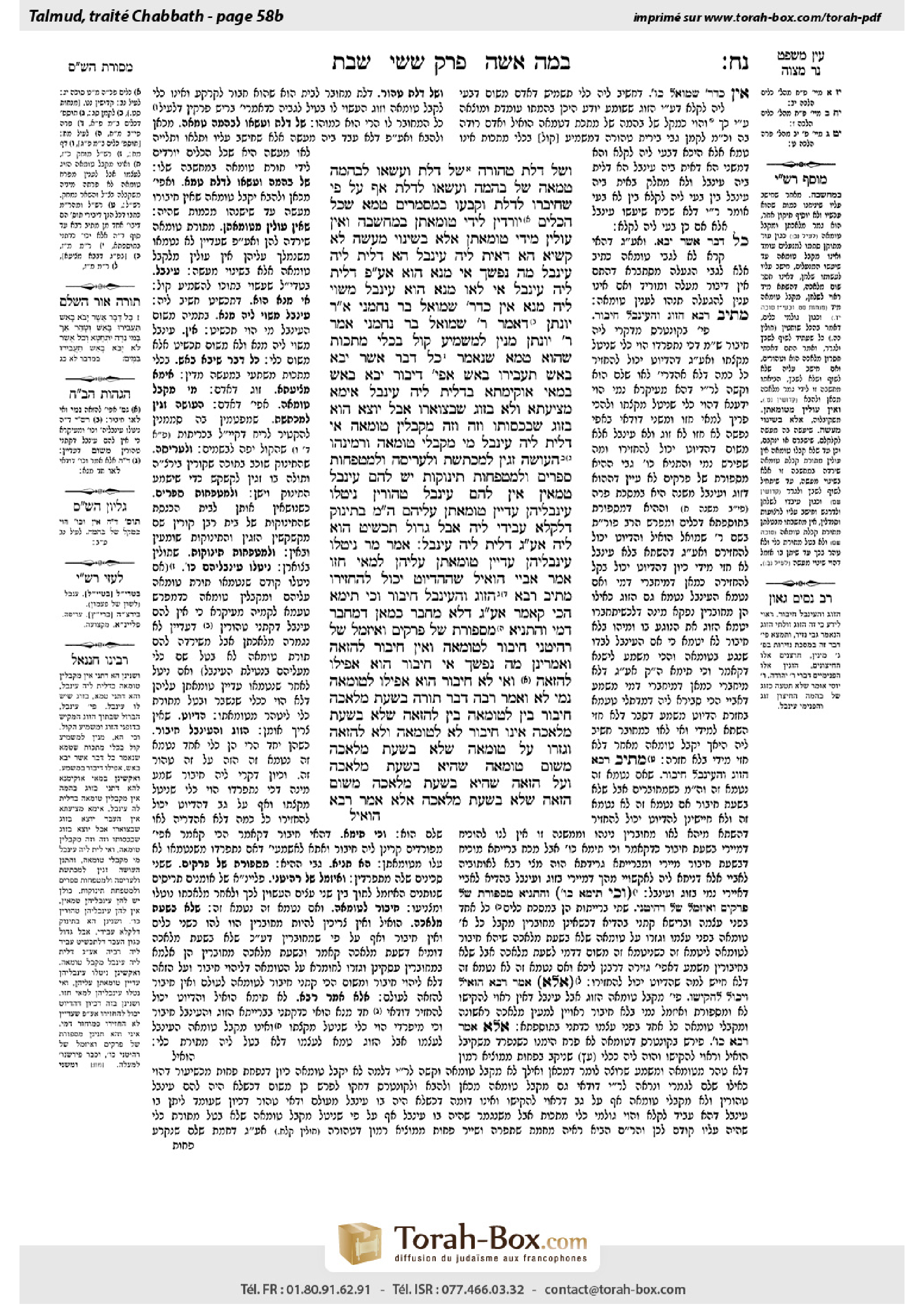
Shabbat 58b: Talmud study for Daf Yomi
Daf Yomi is the daily study of one Talmud folio. Explore 37 tractates with scans, Hebrew text, Sefaria English and AI-generated French translations where annotated.
Passage selection and English or AI-generated French translation are available where the scan has annotations. Daf Study is independent of Torah-Box and Sefaria.
Browse Shabbat · שבת · All tractatesShabbat 58b text and translations
This page of Shabbat includes the Aramaic text, an English translation and an AI-generated French translation, alongside the scan above.
שבת נ״ח ב · Aramaic and Hebrew text
וְשֶׁל דֶּלֶת — טָהוֹר.
שֶׁל דֶּלֶת וַעֲשָׂאוֹ לִבְהֵמָה — טָמֵא. שֶׁל בְּהֵמָה וַעֲשָׂאוֹ לְדֶלֶת, אַף עַל פִּי שֶׁחִבְּרוֹ לַדֶּלֶת וּקְבָעוֹ בְּמַסְמְרִים — טָמֵא, שֶׁכׇּל הַכֵּלִים יוֹרְדִין לִידֵי טוּמְאָתָן בְּמַחְשָׁבָה, וְאֵין עוֹלִין מִידֵּי טוּמְאָתָן אֶלָּא בְּשִׁנּוּי מַעֲשֶׂה!
לָא קַשְׁיָא: הָא דְּאִית לֵיהּ עִינְבָּל, הָא דְּלֵית לֵיהּ עִינְבָּל.
מָה נַפְשָׁךְ: אִי מָנָא הוּא, אַף עַל פִּי דְּלֵית לֵיהּ עִינְבָּל. אִי לָאו מָנָא הוּא — עִינְבָּל מְשַׁוֵּי לֵיהּ מָנָא?!
אִין, כִּדְרַבִּי שְׁמוּאֵל בַּר נַחְמָנִי אָמַר רַבִּי יוֹנָתָן. דְּאָמַר רַבִּי שְׁמוּאֵל בַּר נַחְמָנִי אָמַר רַבִּי יוֹנָתָן: מִנַּיִן לְמַשְׁמִיעַ קוֹל בִּכְלֵי מַתָּכוֹת שֶׁהוּא טָמֵא, שֶׁנֶּאֱמַר: ״כׇּל דָּבָר אֲשֶׁר יָבֹא בָאֵשׁ תַּעֲבִירוּ בָאֵשׁ״ — אֲפִילּוּ דִּבּוּר, יָבֹא בָּאֵשׁ.
בְּמַאי אוֹקִימְתָּא — בִּדְלֵית לֵיהּ עִינְבָּל? אֵימָא מְצִיעֲתָא: וְלֹא בְּזוֹג שֶׁבְּצַוָּארוֹ, אֲבָל יוֹצֵא הוּא בְּזוֹג שֶׁבִּכְסוּתוֹ, וְזֶה וָזֶה מְקַבְּלִין טוּמְאָה. אִי דְּלֵית לֵיהּ עִינְבָּל מִי מְקַבְּלִי טוּמְאָה?
וּרְמִינְהוּ: הָעוֹשֶׂה זֹגִין לְמַכְתֶּשֶׁת וְלַעֲרִיסָה וּלְמִטְפְּחוֹת סְפָרִים וּלְמִטְפְּחוֹת תִּינוֹקוֹת, יֵשׁ לָהֶם עִינְבָּל — טְמֵאִין, אֵין לָהֶם עִינְבָּל — טְהוֹרִין, נִיטְּלוּ עִינְבְּלֵיהֶן — עֲדַיִן טוּמְאָתָן עֲלֵיהֶם.
הָנֵי מִילֵּי בְּתִינוֹק, דִּלְקָלָא עָבְדִי לֵיהּ. אֲבָל גָּדוֹל — תַּכְשִׁיט הוּא לֵיהּ, אַף עַל גַּב דְּלֵית לֵיהּ עִינְבָּל.
אָמַר מָר: נִיטְּלוּ עִינְבְּלֵיהֶן עֲדַיִן טוּמְאָתָן עֲלֵיהֶן. לְמַאי חֲזוּ? אָמַר אַבָּיֵי: הוֹאִיל שֶׁהַהֶדְיוֹט יָכוֹל לְהַחֲזִירוֹ.
מֵתִיב רָבָא: הַזּוּג וְהָעִינְבָּל חִבּוּר.
וְכִי תֵּימָא, הָכִי קָאָמַר: אַף עַל גַּב דְּלָא מְחַבַּר — כְּמַאן דִּמְחַבַּר דָּמֵי. וְהָתַנְיָא: מַסְפּוֹרֶת שֶׁל פְּרָקִים וְאִיזְמֵל שֶׁל רָהִיטְנֵי — חִבּוּר לַטּוּמְאָה וְאֵין חִבּוּר לַהַזָּאָה.
וְאָמְרִינַן: מָה נַפְשָׁךְ, אִי חִבּוּר הוּא — אֲפִלּוּ לְהַזָּאָה, וְאִי לָא חִבּוּר הוּא — אֲפִילּוּ לְטוּמְאָה נָמֵי לָא!
וְאָמַר רַבָּה: דְּבַר תּוֹרָה, בִּשְׁעַת מְלָאכָה — חִבּוּר בֵּין לְטוּמְאָה בֵּין לְהַזָּאָה. שֶׁלֹּא בִּשְׁעַת מְלָאכָה — אֵינוֹ חִבּוּר לֹא לְטוּמְאָה וְלֹא לְהַזָּאָה. וְגָזְרוּ עַל טוּמְאָה שֶׁלֹּא בִּשְׁעַת מְלָאכָה מִשּׁוּם טוּמְאָה שֶׁהִיא בִּשְׁעַת מְלָאכָה, וְעַל הַזָּאָה שֶׁהִיא בִּשְׁעַת מְלָאכָה מִשּׁוּם הַזָּאָה שֶׁלֹּא בִּשְׁעַת מְלָאכָה.
אֶלָּא אָמַר רָבָא:
Shabbat 58b · English translation
and the bell of a door is ritually pure. The door itself is not considered a vessel. It is considered part of the house, and therefore its status is like that of the house. The house is attached to the ground, and therefore it cannot become ritually impure. Everything connected to it, including the bell, assumes that status.
If one took the bell of a door and converted it into a bell for an animal, it can become ritually impure; however, if one took the bell of an animal and converted it into a bell for a door, even though he attached it to the door and even fastened it with nails, it can still become ritually impure because all utensils descend into their state of ritual impurity by means of thought alone, i.e., as a result of a decision to designate them for a specific purpose through which they will become susceptible to ritual impurity, they receive that status immediately. However, they only ascend from their state of ritual impurity by means of an action that effects physical change to the vessel itself. A change in designation alone is ineffective. This baraita states that an animal bell can become ritually impure, contrary to that which was taught in the previous baraita.
The Gemara answers: This is not difficult. This baraita, where it was taught that the bell can become ritually impure, is referring to a case where it has a clapper [inbal]. That baraita, where it was taught that the bell cannot become ritually impure, is referring to a case where it does not have a clapper.
The Gemara asks: Whichever way you look at it, this is difficult. If the bell is a vessel, then even though it has no clapper it should be susceptible to ritual impurity. If it is not a vessel, does a clapper render it a vessel?
The Gemara answers: Yes, the clapper can determine the bell’s status with regard to ritual impurity, in accordance with that which Rabbi Shmuel bar Naḥmani said that Rabbi Yonatan said. As Rabbi Shmuel bar Naḥmani said that Rabbi Yonatan said: From where is it derived that a metal vessel that produces sound is considered a vessel and can become ritually impure? As it is stated: “Every thing that passes through the fire, you shall make it pass through the fire, and it shall be clean; nevertheless, it shall be purified with the water of sprinkling; and all that does not pass through the fire you shall make to go through water” (Numbers 31:23). And the Sages interpret the verse homiletically: Every thing [davar], even speech [dibbur]; in other words, even an object that makes a sound you shall pass through fire to purify it because it is a vessel.
However, the matter can be clarified further. In what case did you establish the baraita; in the case of a bell that does not have a clapper? If so, say the middle clause of that baraita: And he may not go out with a bell that is hung around his neck; however, he may go out with a bell that is on his clothes, and both this and that can become ritually impure. If it is referring to a bell that does not have a clapper, can it become ritually impure?
The Gemara raises a contradiction from the Tosefta: One who makes bells for the mortar used to crush spices, and for the cradle, and for mantles of Torah scrolls, and for coverings of small children, if they have a clapper they can become ritually impure, and if they do not have a clapper they are ritually pure and cannot become impure. If after they became ritually impure their clappers were removed, their ritual impurity still remains upon them. Apparently, even with regard to bells used by people, the original existence of a clapper determines whether or not the bell is considered a vessel.
The Gemara answers: This applies only to the bells of a small child, since they are placed on him to produce sound. If the bell does not make a sound, it serves no purpose and, consequently, cannot become ritually impure. However, with regard to an adult, the bell is an ornament for him even though it does not have a clapper.
It was taught in the Tosefta that the Master said: If their clappers were removed after they became ritually impure, their ritual impurity still remains upon them. The Gemara wonders: For what use are they suited after their clappers are removed? They are essentially broken and should therefore become ritually pure. Abaye said: The reason that their impurity remains is because a common person is able to replace the clapper into the bell. According to Abaye, with regard to any vessel that comes apart, if a common person is capable of reassembling it and it does not require the expertise of a craftsman, it is not considered broken and its ritual impurity is not nullified.
Rava raised an objection to this explanation from that which was taught: The connection between the bell and the clapper, this is a connection. Therefore, if they are detached from each other, the bell should be considered broken.
And he adds: And if you say that when employing the term connection, it is saying as follows: Even though it is not connected, it has the legal status as if it were connected. Wasn’t it taught in a baraita: The connection between the different parts of scissors made of different parts that are made to come apart and the connection between the blade of a carpenter’s plane, which can be removed from its handle, and its handle are considered a connection with regard to contracting ritual impurity? If one part becomes ritually impure, the other parts become ritually impure as well. The baraita continues: However, they are not considered a connection with regard to the sprinkling of the waters of a purification offering. When waters of purification are sprinkled on these implements in order to purify them from ritual impurity imparted by a corpse (see Numbers 19:17–19), the water must be sprinkled on each part individually.
The Gemara asks: Whichever way you look at it, there is a difficulty: If it is considered a connection, they should be considered connected even with regard to sprinkling; and if they are not considered a connection, they should not be so considered even with regard to ritual impurity.
And Rabba said: By Torah law, when in use, they are considered a connection, both with regard to ritual impurity and with regard to sprinkling. And when not in use, even if the parts are connected, since they are made to come apart and they are commonly dismantled, they are neither considered a connection with regard to ritual impurity nor with regard to sprinkling. And the Sages issued a decree that they should be considered a connection with regard to ritual impurity even when not in use, due to ritual impurity when in use. If one component becomes ritually impure, the other component becomes ritually impure as well. And, as a further stringency, they issued a decree that they should not be considered a connection with regard to sprinkling even when in use, due to sprinkling when not in use. The waters of purification must be sprinkled on each part individually. Nevertheless, this type of connection with regard to ritual impurity is only relevant when the two parts are actually connected. When the parts are separate, even if they can be reattached easily, the vessel is considered broken. This contradicts Abaye’s explanation.
Rather, Rava said: It should be explained differently:
Shabbat 58b · Traduction française (IA)
et la clochette d’une porte est rituellement pure. La porte elle-même n’est pas considérée comme un ustensile. Elle est considérée comme faisant partie de la maison et a donc le même statut que celle-ci. La maison est fixée au sol et ne peut donc pas devenir rituellement impure. Tout ce qui lui est relié, y compris la clochette, acquiert le même statut.
Si quelqu’un prend la clochette d’une porte et la transforme en clochette pour un animal, elle peut devenir rituellement impure. En revanche, s’il prend la clochette d’un animal et la transforme en clochette pour une porte, même s’il l’attache à la porte et la fixe avec des clous, elle peut encore devenir rituellement impure, car tous les ustensiles acquièrent le statut d’impureté rituelle par la seule pensée : une décision de les destiner à un usage précis qui les rend susceptibles de contracter l’impureté rituelle leur confère immédiatement ce statut. En revanche, ils ne sortent de leur statut d’impureté rituelle que par une action qui entraîne une modification matérielle de l’ustensile lui-même. Un simple changement de destination ne suffit pas. Cette baraïta affirme qu’une clochette d’animal peut devenir rituellement impure, contrairement à ce qui a été enseigné dans la baraïta précédente.
La Guemara répond : Il n’y a pas de difficulté. La baraïta qui enseigne que la clochette peut devenir rituellement impure parle d’un cas où elle comporte un battant [inbal]. L’autre baraïta, qui enseigne que la clochette ne peut pas devenir rituellement impure, parle d’un cas où elle n’a pas de battant.
La Guemara demande : Dans les deux cas, cela pose difficulté. Si la clochette est un ustensile, elle devrait être susceptible de contracter l’impureté rituelle même sans battant. Si elle n’est pas un ustensile, un battant suffit-il à en faire un ustensile ?
La Guemara répond : Oui, le battant peut déterminer le statut de la clochette au regard de l’impureté rituelle, conformément à ce que Rabbi Shmuel bar Naḥmani a dit au nom de Rabbi Yonatan. En effet, Rabbi Shmuel bar Naḥmani a dit au nom de Rabbi Yonatan : D’où apprend-on qu’un ustensile en métal qui produit un son est considéré comme un ustensile et peut devenir rituellement impur ? Car il est dit : « Tout objet qui passe par le feu, vous le ferez passer par le feu, et il sera pur ; néanmoins, il sera purifié avec l’eau d’aspersion ; et tout ce qui ne passe pas par le feu, vous le ferez passer par l’eau » (Nombres 31,23). Les Sages interprètent ce verset par homilétique : tout objet [davar], même une parole [dibbur] ; autrement dit, même un objet qui produit un son, vous le ferez passer par le feu pour le purifier, car c’est un ustensile.
Cependant, on peut encore clarifier la question. Dans quel cas avez-vous interprété la baraïta ? Dans celui d’une clochette sans battant. Si tel est le cas, examinons la clause médiane de cette baraïta : « Il ne peut pas sortir avec une clochette suspendue à son cou, mais il peut sortir avec une clochette attachée à ses vêtements ; et l’une comme l’autre peuvent devenir rituellement impures. » Si elle parle d’une clochette sans battant, comment peut-elle devenir rituellement impure ?
La Guemara soulève une contradiction à partir de la Tosefta : celui qui fabrique des clochettes pour le mortier servant à broyer les épices, pour le berceau, pour les manteaux des rouleaux de la Torah et pour les couvertures des jeunes enfants : si elles ont un battant, elles peuvent devenir rituellement impures ; si elles n’en ont pas, elles sont rituellement pures et ne peuvent pas devenir impures. Si, après qu’elles sont devenues rituellement impures, on leur retire leur battant, elles conservent leur impureté rituelle. Apparemment, même pour les clochettes utilisées par des personnes, c’est la présence initiale d’un battant qui détermine si la clochette est considérée comme un ustensile.
La Guemara répond : Cela ne concerne que les clochettes d’un jeune enfant, car elles sont placées sur lui pour produire un son. Si la clochette ne produit pas de son, elle ne sert à rien et ne peut donc pas devenir rituellement impure. En revanche, pour un adulte, la clochette est un ornement, même si elle n’a pas de battant.
Il a été enseigné dans la Tosefta que le Maître a dit : si l’on retire leur battant après qu’elles sont devenues rituellement impures, elles conservent leur impureté rituelle. La Guemara s’interroge : À quoi peuvent-elles servir une fois leur battant retiré ? Elles sont en fait brisées et devraient donc devenir rituellement pures. Abaye a dit : leur impureté demeure parce qu’une personne ordinaire peut remettre le battant dans la clochette. Selon Abaye, pour tout ustensile démontable, si une personne ordinaire est capable de le remonter sans avoir besoin du savoir-faire d’un artisan, il n’est pas considéré comme brisé et son impureté rituelle n’est pas annulée.
Rava objecta à cette explication en s’appuyant sur ce qui a été enseigné : la liaison entre la clochette et le battant est considérée comme une liaison. Par conséquent, s’ils sont détachés l’un de l’autre, la clochette devrait être considérée comme brisée.
Et il ajoute : Si vous dites que, lorsqu’on emploie le terme « liaison », cela signifie ceci : même si les éléments ne sont pas reliés, ils ont le statut juridique de parties reliées, n’a-t-il pas été enseigné dans une baraïta que la liaison entre les différentes parties d’une paire de ciseaux démontable et la liaison entre la lame d’un rabot de menuisier, qui peut être retirée de son manche, et ce manche sont considérées comme une liaison pour ce qui est de contracter l’impureté rituelle ? Si une partie devient rituellement impure, les autres parties le deviennent aussi. La baraïta poursuit : toutefois, elles ne sont pas considérées comme reliées pour ce qui est de l’aspersion des eaux d’une offrande de purification. Lorsque ces eaux sont aspergées sur ces instruments afin de les purifier de l’impureté rituelle transmise par un cadavre (voir Nombres 19,17–19), il faut en asperger chaque partie individuellement.
La Guemara demande : Dans les deux cas, cela pose difficulté. Si les éléments sont considérés comme reliés, ils devraient l’être également pour l’aspersion ; et s’ils ne sont pas considérés comme reliés, ils ne devraient pas l’être non plus au regard de l’impureté rituelle.
Et Rabba a dit : selon la Torah, lorsqu’ils sont utilisés, ils sont considérés comme reliés, tant au regard de l’impureté rituelle qu’au regard de l’aspersion. Lorsqu’ils ne sont pas utilisés, même si les éléments sont reliés, puisqu’ils sont conçus pour être démontés et qu’on les démonte habituellement, ils ne sont considérés comme reliés ni au regard de l’impureté rituelle ni au regard de l’aspersion. Les Sages ont décrété qu’ils seraient considérés comme reliés au regard de l’impureté rituelle même lorsqu’ils ne sont pas utilisés, en raison de l’impureté rituelle lorsqu’ils sont utilisés. Si l’un des éléments devient rituellement impur, l’autre le devient lui aussi. Et, à titre de rigueur supplémentaire, ils ont décrété qu’ils ne seraient pas considérés comme reliés au regard de l’aspersion, même lorsqu’ils sont utilisés, en raison de l’aspersion lorsqu’ils ne sont pas utilisés. Les eaux de purification doivent être aspergées sur chaque partie individuellement. Néanmoins, cette forme de liaison au regard de l’impureté rituelle ne s’applique que lorsque les deux parties sont effectivement reliées. Lorsque les parties sont séparées, même si elles peuvent être facilement rattachées, l’ustensile est considéré comme brisé. Cela contredit l’explication d’Abaye.
Rava a plutôt dit : Il faut l’expliquer autrement :
Traduction française générée par IA à partir de l’édition anglaise de Sefaria. Vérifie toujours un passage avec le texte source.
Text from Sefaria: William Davidson Edition - Vocalized Aramaic (CC BY NC); William Davidson Edition - English (CC BY NC).