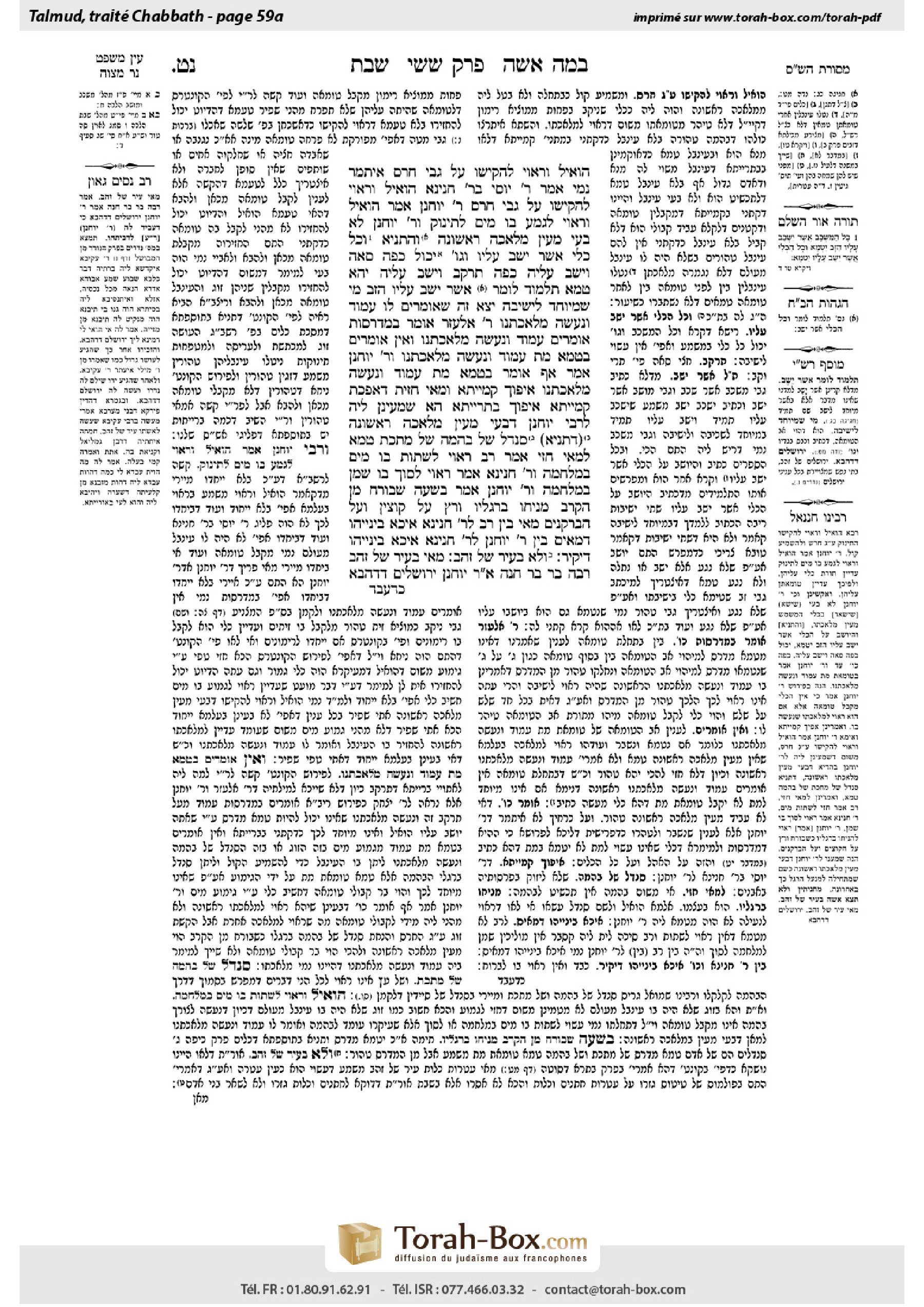
Shabbat 59a: Talmud study for Daf Yomi
Daf Yomi is the daily study of one Talmud folio. Explore 37 tractates with scans, Hebrew text, Sefaria English and AI-generated French translations where annotated.
Passage selection and English or AI-generated French translation are available where the scan has annotations. Daf Study is independent of Torah-Box and Sefaria.
Browse Shabbat · שבת · All tractatesShabbat 59a text and translations
This page of Shabbat includes the Aramaic text, an English translation and an AI-generated French translation, alongside the scan above.
שבת נ״ט א · Aramaic and Hebrew text
הוֹאִיל וְרָאוּי לְהַקִּישׁוֹ עַל גַּבֵּי חֶרֶס.
אִיתְּמַר נָמֵי, אָמַר רַבִּי יוֹסֵי בְּרַבִּי חֲנִינָא: הוֹאִיל וְרָאוּי לְהַקִּישׁוֹ עַל גַּבֵּי חֶרֶס. רַבִּי יוֹחָנָן אָמַר: הוֹאִיל וְרָאוּי לְגַמֵּעַ בּוֹ מַיִם לְתִינוֹק.
וְרַבִּי יוֹחָנָן לָא בָּעֵי מֵעֵין מְלָאכָה רִאשׁוֹנָה? וְהָתַנְיָא: ״וְכׇל כְּלִי אֲשֶׁר יֵשֵׁב עָלָיו וְגוֹ׳״ — יָכוֹל כָּפָה סְאָה וְיָשַׁב עָלֶיהָ, כָּפָה תַּרְקַב וְיָשַׁב עָלֶיהָ יְהֵא טָמֵא, תַּלְמוּד לוֹמַר: ״אֲשֶׁר יֵשֵׁב עָלָיו הַזָּב״ — מִי שֶׁמְיוּחָד לִישִׁיבָה, יָצָא זֶה שֶׁאוֹמְרִים לוֹ: עֲמוֹד וְנַעֲשֶׂה מְלַאכְתֵּנוּ.
רַבִּי אֶלְעָזָר אוֹמֵר: בְּמִדְרָסוֹת אוֹמְרִים ״עֲמוֹד וְנַעֲשֶׂה מְלַאכְתֵּנוּ״, וְאֵין אוֹמְרִים בִּטְמֵא מֵת ״עֲמוֹד וְנַעֲשֶׂה מְלַאכְתֵּנוּ״. וְרַבִּי יוֹחָנָן אָמַר: אַף אוֹמֵר בִּטְמֵא מֵת ״עֲמוֹד וְנַעֲשֶׂה מְלַאכְתֵּנוּ״.
אֵיפוֹךְ קַמַּיְיתָא. וּמַאי חֲזֵית דְּאָפְכַתְּ קַמַּיְיתָא? אֵיפוֹךְ בָּתְרָיְיתָא!
הָא שָׁמְעִינַן לֵיהּ לְרַבִּי יוֹחָנָן דְּבָעֵי מֵעֵין מְלָאכָה רִאשׁוֹנָה. דְּתַנְיָא: סַנְדָּל שֶׁל בְּהֵמָה שֶׁל מַתֶּכֶת טָמֵא. לְמַאי חֲזֵי? אָמַר רַב: רָאוּי לִשְׁתּוֹת בּוֹ מַיִם בַּמִּלְחָמָה. וְרַבִּי חֲנִינָא אָמַר: רָאוּי לָסוּךְ בּוֹ שֶׁמֶן בַּמִּלְחָמָה. וְרַבִּי יוֹחָנָן אָמַר: בְּשָׁעָה שֶׁבּוֹרֵחַ מִן הַקְּרָב מַנִּיחוֹ בְּרַגְלָיו וְרָץ עַל קוֹצִין וְעַל הַבַּרְקָנִים.
מַאי בֵּין רַב לְרַבִּי חֲנִינָא? אִיכָּא בֵּינַיְיהוּ דִּמְאִיס.
בֵּין רַבִּי יוֹחָנָן לְרַבִּי חֲנִינָא? אִיכָּא בֵּינַיְיהוּ דְּיַקִּיר.
וְלֹא בְּעִיר שֶׁל זָהָב. מַאי ״בְּעִיר שֶׁל זָהָב״? רַבָּה בַּר בַּר חָנָה אָמַר רַבִּי יוֹחָנָן: יְרוּשָׁלַיִם דְּדַהֲבָא,
Shabbat 59a · English translation
It is considered a vessel since a bell without a clapper is suited to strike on earthenware and produce a sound of similar quality to that produced by a clapper. If so, even when the clapper is removed, the bell may still be used for its original purpose.
It was also stated that Rabbi Yosei, son of Rabbi Ḥanina, said: It is considered a vessel, since a bell without a clapper is suited to strike on earthenware. Rabbi Yoḥanan said: It is considered a vessel, since it is suited for use to give water to a child to drink.
And with regard to the essence of Rabbi Yoḥanan’s statement, the Gemara asks: And does Rabbi Yoḥanan not require that the vessel’s new usage must be of the same type as the original labor in order for it to retain its ritual impurity after it has undergone change? Wasn’t it taught in a baraita: “Every bed on which a zav is lying is ritually impure and every vessel on which he is sitting shall be ritually impure” (Leviticus 15:4). I might have thought, based on this verse, that if one overturned a vessel the size of a se’a and sat on it, or overturned a vessel the size of a half-se’a [tarkav] and sat on it, the vessel would become ritually impure. Therefore, the verse states: On which the zav is sitting, i.e., that which is designated for sitting, excluding that vessel with regard to which one says to the zav: Stand and we will perform our labor with the vessel. In that case, because the vessel is primarily used for purposes other than sitting, it does not become ritually impure even when the zav sits on it.
There is a dispute between the amora’im on this matter: Rabbi Elazar says: With regard to ritual impurity imparted by treading [midras], i.e., the halakhot pertaining to a zav or to a menstruating woman who sits or lies down on an object, one states the principle: Stand and we will perform our labor to maintain the purity of the vessel. However, one does not state with regard to one who is ritually impure due to a corpse: Stand and we will perform our labor to maintain the purity of the vessel. In other words, an object that became ritually impure through contact with a corpse and was subsequently broken, since it is possible to use it for some other purpose, it remains a vessel and susceptible to ritual impurity. However, Rabbi Yoḥanan said: Even with regard to one who is ritually impure due to a corpse, one states the principle: Stand and we will perform our labor to maintain the purity of the vessel. According to his opinion, a vessel that is no longer suited for its initial use, even though it serves another purpose, is considered broken. Therefore, the bell, since it is no longer suited for ringing, remains ritually pure according to Rabbi Yoḥanan’s opinion, even though it remains suited for drinking water.
The Gemara answers: Reverse the opinions in the first dispute: It was not Rabbi Yoḥanan who gave that reason; it was Rabbi Yosei, son of Rabbi Ḥanina. The Gemara asks: And what did you see that led you to reverse the first? Reverse the opinions of Rabbi Yoḥanan and Rabbi Elazar in the latter dispute, and avoid a contradiction in the statements of Rabbi Yoḥanan in that way.
The Gemara answers: That is because we learned elsewhere that Rabbi Yoḥanan requires that the vessel’s new use will be of the same type as the original labor. His opinion here is consistent with his opinion there. As it was taught in a baraita: The shoe of an animal, if it is made of metal, can become ritually impure. The Gemara asks: For what use by people is it suited? Vessels designated for animal use do not become ritually impure unless they have some use for people. Rav said: It is suited for use as a vessel from which one could drink water in war when there are no other available vessels. And Rabbi Ḥanina said: It is suited for use as a vessel from which one could smear oil on his body during a war. And Rabbi Yoḥanan said: When he flees from the battlefield he places it on his foot and runs over thorns and the thistles. Apparently, the only use for the shoe of an animal that would render it capable of becoming ritually impure when used by a person is use of the same type as the original labor.
The Gemara asks parenthetically: What is the practical difference between the explanation of Rav and that of Rabbi Ḥanina? The Gemara answers: There is a practical difference between them in a case where the sandal is repulsive and dirty. In Rav’s opinion, since one would not drink water from it, it cannot become ritually impure. According to Rabbi Ḥanina, since one could still use it to spread oil on his body, it can become ritually impure.
What is the practical difference between the explanation of Rabbi Yoḥanan and that of Rabbi Ḥanina? There is a practical difference between them in a case where the shoe is heavy. It is suited for spreading oil; it is not suited for one to place on his foot. Therefore, it cannot become ritually impure according to Rabbi Yoḥanan.
We learned in the mishna: And neither may a woman go out on Shabbat to the public domain with a city of gold. The Gemara asks: What is the meaning of: With a city of gold? Rabba bar bar Ḥana said that Rabbi Yoḥanan said: Jerusalem of Gold, a gold tiara engraved with a depiction of the city of Jerusalem,
Shabbat 59a · Traduction française (IA)
Elle est considérée comme un ustensile, car une clochette sans battant peut servir à frapper sur de la poterie et à produire un son d’une qualité semblable à celui que produirait un battant. Ainsi, même si le battant est retiré, la clochette peut encore servir à son usage initial.
Il a également été dit que Rabbi Yossei, fils de Rabbi Ḥanina, a déclaré : Elle est considérée comme un ustensile, car une clochette sans battant peut servir à frapper sur de la poterie. Rabbi Yoḥanan a déclaré : Elle est considérée comme un ustensile, car elle peut servir à donner de l’eau à boire à un enfant.
Quant au fond de la déclaration de Rabbi Yoḥanan, la Guemara demande : Rabbi Yoḥanan n’exige-t-il pas que le nouvel usage de l’ustensile soit du même type que son usage initial pour qu’il conserve son impureté rituelle après avoir été transformé ? N’a-t-il pas été enseigné dans une baraïta : « Tout lit sur lequel un zav est couché est rituellement impur, et tout ustensile sur lequel il est assis sera rituellement impur » (Lévitique 15,4) ? J’aurais pu penser, d’après ce verset, que si l’on retournait un ustensile d’une capacité d’un séa et que l’on s’asseyait dessus, ou si l’on retournait un ustensile d’une capacité d’un demi-séa [tarkav] et que l’on s’asseyait dessus, l’ustensile deviendrait rituellement impur. Le verset précise donc : « sur lequel le zav est assis », c’est-à-dire un objet destiné à servir de siège, à l’exclusion de cet ustensile au sujet duquel on dit au zav : « Lève-toi, et nous allons nous servir de l’ustensile pour notre travail. » Dans ce cas, puisque l’ustensile sert principalement à des usages autres que celui de s’asseoir dessus, il ne devient pas rituellement impur, même si le zav s’y assied.
Les amoraïm sont en désaccord sur cette question. Rabbi Elazar dit : En matière d’impureté rituelle transmise par le fait de s’asseoir ou de s’allonger [midras] — c’est-à-dire les halakhot concernant un zav ou une femme menstruée qui s’assied ou s’allonge sur un objet —, on applique le principe : « Lève-toi, et nous allons nous servir de l’ustensile pour notre travail », afin de préserver la pureté de l’ustensile. En revanche, on n’applique pas ce principe dans le cas d’une personne rituellement impure à cause d’un cadavre. Autrement dit, un objet devenu rituellement impur par contact avec un cadavre et qui a ensuite été brisé reste un ustensile et demeure susceptible d’impureté rituelle, puisqu’il peut servir à un autre usage. Mais Rabbi Yoḥanan a dit : Même dans le cas d’une personne rituellement impure à cause d’un cadavre, on applique le principe : « Lève-toi, et nous allons nous servir de l’ustensile pour notre travail », afin de préserver la pureté de l’ustensile. Selon lui, un ustensile qui ne convient plus à son usage initial est considéré comme brisé, même s’il sert à un autre usage. Par conséquent, selon Rabbi Yoḥanan, la clochette, puisqu’elle ne convient plus à son usage initial, qui est de sonner, reste rituellement pure, même si elle peut encore servir à boire de l’eau.
La Guemara répond : Inverse les opinions dans le premier désaccord : ce n’est pas Rabbi Yoḥanan qui a donné cette raison, mais Rabbi Yossei, fils de Rabbi Ḥanina. La Guemara demande : Qu’est-ce qui t’a conduit à inverser les opinions dans le premier désaccord ? Inverse plutôt les opinions de Rabbi Yoḥanan et de Rabbi Elazar dans le désaccord ultérieur ; tu éviteras ainsi une contradiction entre les déclarations de Rabbi Yoḥanan.
La Guemara répond : C’est parce que nous avons appris ailleurs que Rabbi Yoḥanan exige que le nouvel usage de l’ustensile soit du même type que son usage initial. Son opinion ici est donc conforme à celle qu’il exprime là-bas. En effet, il a été enseigné dans une baraïta : Une chaussure d’animal, si elle est en métal, peut devenir rituellement impure. La Guemara demande : À quel usage humain peut-elle servir ? Les ustensiles destinés aux animaux ne deviennent pas rituellement impurs, à moins qu’ils puissent servir à un usage humain. Rav a dit : Elle peut servir de récipient pour boire de l’eau pendant une guerre, lorsqu’il n’y a pas d’autres récipients disponibles. Rabbi Ḥanina a dit : Elle peut servir de récipient pour s’enduire le corps d’huile pendant une guerre. Et Rabbi Yoḥanan a dit : Lorsqu’un homme fuit le champ de bataille, il la met à son pied et court sur les épines et les chardons. Il apparaît donc que le seul usage de la chaussure d’un animal qui lui permettrait de devenir rituellement impure lorsqu’une personne s’en sert est un usage du même type que son usage initial.
La Guemara demande incidemment : Quelle est la différence pratique entre l’explication de Rav et celle de Rabbi Ḥanina ? Elle répond : La différence se manifeste dans le cas d’une sandale répugnante et sale. Selon Rav, puisqu’on ne boirait pas d’eau dans cette sandale, elle ne peut pas devenir rituellement impure. Selon Rabbi Ḥanina, puisqu’on peut tout de même s’en servir pour s’enduire le corps d’huile, elle peut devenir rituellement impure.
Quelle est la différence pratique entre l’explication de Rabbi Yoḥanan et celle de Rabbi Ḥanina ? La différence se manifeste dans le cas d’une chaussure lourde. Elle convient pour s’enduire le corps d’huile, mais il ne convient pas de la mettre au pied. Elle ne peut donc pas devenir rituellement impure selon Rabbi Yoḥanan.
Nous avons appris dans la Michna : Une femme ne peut pas non plus sortir pendant Chabbat dans le domaine public en portant une « ville d’or ». La Guemara demande : Que signifie « ville d’or » ? Rabba bar bar Ḥana a dit au nom de Rabbi Yoḥanan : « Jérusalem d’or », un diadème d’or gravé d’une représentation de la ville de Jérusalem,
Traduction française générée par IA à partir de l’édition anglaise de Sefaria. Vérifie toujours un passage avec le texte source.
Text from Sefaria: William Davidson Edition - Vocalized Aramaic (CC BY NC); William Davidson Edition - English (CC BY NC).