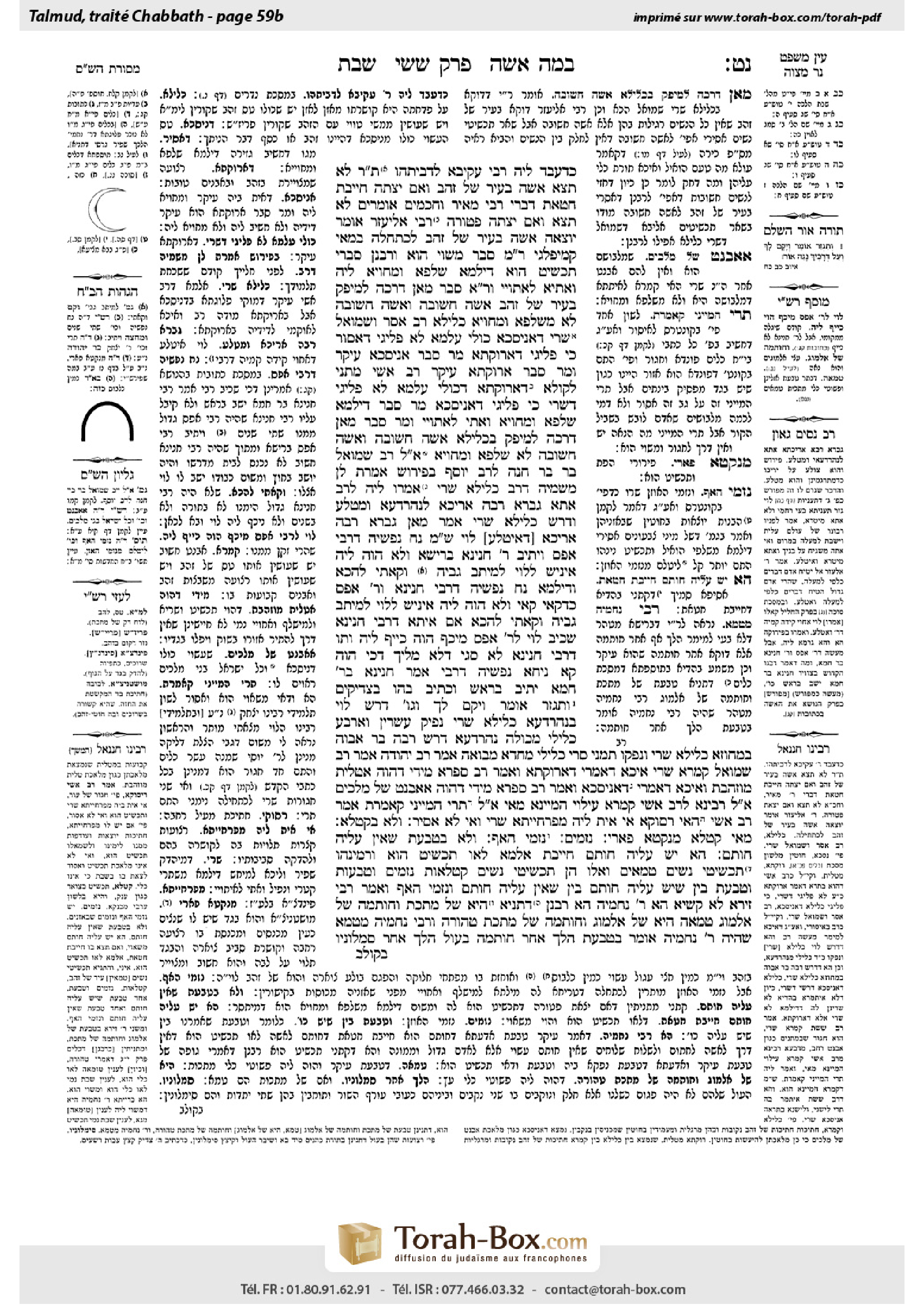
Shabbat 59b: Talmud study for Daf Yomi
Daf Yomi is the daily study of one Talmud folio. Explore 37 tractates with scans, Hebrew text, Sefaria English and AI-generated French translations where annotated.
Passage selection and English or AI-generated French translation are available where the scan has annotations. Daf Study is independent of Torah-Box and Sefaria.
Browse Shabbat · שבת · All tractatesShabbat 59b text and translations
This page of Shabbat includes the Aramaic text, an English translation and an AI-generated French translation, alongside the scan above.
שבת נ״ט ב · Aramaic and Hebrew text
כְּדַעֲבַד לֵיהּ רַבִּי עֲקִיבָא לִדְבֵיתְהוּ.
תָּנוּ רַבָּנַן: לֹא תֵּצֵא אִשָּׁה בְּעִיר שֶׁל זָהָב, וְאִם יָצְתָה חַיֶּיבֶת חַטָּאת, דִּבְרֵי רַבִּי מֵאִיר. וַחֲכָמִים אוֹמְרִים: לֹא תֵּצֵא, וְאִם יָצְתָה — פְּטוּרָה. רַבִּי אֱלִיעֶזֶר אוֹמֵר: יוֹצְאָה אִשָּׁה בְּעִיר שֶׁל זָהָב לְכַתְּחִלָּה.
בְּמַאי קָמִיפַּלְגִי? רַבִּי מֵאִיר סָבַר מַשּׂוֹי הוּא. וְרַבָּנַן סָבְרִי תַּכְשִׁיט הוּא — דִּילְמָא שָׁלְפָא וּמַחְוְיָא לֵיהּ וְאָתְיָא לְאֵתוֹיֵי. וְרַבִּי אֱלִיעֶזֶר סָבַר: מַאן דִּרְכֵּהּ לְמִיפַּק בְּעִיר שֶׁל זָהָב — אִשָּׁה חֲשׁוּבָה, וְאִשָּׁה חֲשׁוּבָה לָא שָׁלְפָא וּמַחְוְיָא.
כְּלִילָא, רַב אָסַר וּשְׁמוּאֵל שָׁרֵי.
דַּאֲנִיסְכָּא, כּוּלֵּי עָלְמָא לָא פְּלִיגִי דַּאֲסִיר. כִּי פְּלִיגִי דַּאֲרוּקְתָּא: מָר סָבַר אֲנִיסְכָּא עִקָּר, וּמָר סָבַר אֲרוּקְתָּא עִקָּר.
רַב אָשֵׁי מַתְנֵי לְקוּלָּא: דַּאֲרוּקְתָּא דְּכוּלֵּי עָלְמָא לָא פְּלִיגִי דִּשְׁרֵי. כִּי פְּלִיגִי דַּאֲנִיסְכָּא: מָר סָבַר דִּילְמָא שָׁלְפָא וּמַחְוְיָא וְאָתֵי לְאֵתוּיֵי, וּמָר סָבַר מַאן דִּרְכֵּהּ לְמִיפַּק בִּכְלִילָא — אִשָּׁה חֲשׁוּבָה, וְאִשָּׁה חֲשׁוּבָה לָא שָׁלְפָא וּמַחְוְיָא.
אֲמַר לֵיהּ רַב שְׁמוּאֵל בַּר בַּר חָנָה לְרַב יוֹסֵף: בְּפֵרוּשׁ אֲמַרְתְּ לַן מִשְּׁמֵיהּ דְּרַב — ״כְּלִילָא שְׁרֵי״.
אֲמַרוּ לֵיהּ לְרַב: אֲתָא גַּבְרָא רַבָּה אֲרִיכָא לִנְהַרְדְּעָא וּמִטְּלַע, וְדָרֵשׁ ״כְּלִילָא שְׁרֵי״. אֲמַר: מַאן גַּבְרָא רַבָּה אֲרִיכָא [דְּאִיטְּלַע] — לֵוִי, שְׁמַע מִינַּהּ נָח נַפְשֵׁיהּ דְּרַבִּי אַפָּס וִיתִיב רַבִּי חֲנִינָא בְּרֵישָׁא, וְלָא הֲוָה לֵיהּ אִינִישׁ לְלֵוִי לְמֵיתַב גַּבֵּיהּ, וְקָאָתֵי לְהָכָא.
וְדִילְמָא נָח נַפְשֵׁיהּ דְּרַבִּי חֲנִינָא, וְרַבִּי אַפָּס כִּדְקָאֵי קָאֵי, וְלָא הֲוָה לֵיהּ אִינִישׁ לְלֵוִי לְמֵיתַב גַּבֵּיהּ, וְקָאָתֵי לְהָכָא? אִם אִיתָא דְּרַבִּי חֲנִינָא שְׁכֵיב — לֵוִי לְרַבִּי אַפָּס מִיכָּף הֲוָה כְּיִיף לֵיהּ. וְתוּ, דְּרַבִּי חֲנִינָא לָא סַגִּי דְּלָא מָלֵיךְ, דְּכִי הֲוָה קָא נִיחָא נַפְשֵׁיהּ דְּרַבִּי אָמַר: חֲנִינָא בְּרַבִּי חָמָא יֵשֵׁב בָּרֹאשׁ. וּכְתִיב בְּהוּ בְּצַדִּיקִים: ״וְתִגְזַר אֹמֶר וְיָקׇם לָךְ וְגוֹ׳״.
דְּרַשׁ לֵוִי בִּנְהַרְדְּעָא ״כְּלִילָא שְׁרֵי״. נְפוּק עֶשְׂרִין וְאַרְבַּע כְּלִילֵי מִכּוּלַּהּ נְהַרְדְּעָא. דְּרַשׁ רַבָּה בַּר אֲבוּהּ בְּמָחוֹזָא ״כְּלִילָא שְׁרֵי״, וּנְפַקוּ תַּמְנֵי סְרֵי כְּלִילֵי מֵחֲדָא מְבוֹאָה.
אָמַר רַב יְהוּדָה אָמַר רַב שְׁמוּאֵל: קַמְרָא שְׁרֵי. אִיכָּא דְאָמְרִי דַּאֲרוּקְתָּא, וְאָמַר רַב סָפְרָא: מִידֵּי דְּהָוֵה אַטַּלִּית מוּזְהֶבֶת.
וְאִיכָּא דְאָמְרִי דַּאֲנִיסְכָּא, וְאָמַר רַב סָפְרָא: מִידֵּי דְּהָוֵה אַאַבְנֵט שֶׁל מְלָכִים.
אֲמַר לֵיהּ רָבִינָא לְרַב אָשֵׁי: קַמְרָא עִילָּוֵי הֶמְיָינָא מַאי? אֲמַר לֵיהּ תְּרֵי הֶמְיָינֵי קָאָמְרַתְּ.
אָמַר רַב אָשֵׁי: הַאי רְסוֹקָא, אִי אִית לֵיהּ מַפְרְחָיָיתָא — שְׁרֵי, וְאִי לָא — אֲסִיר.
וְלֹא בְּקַטְלָא. מַאי קַטְלָא — מְנַקְּטָא פָּארֵי. נְזָמִים — נִזְמֵי הָאָף.
וְלֹא בְּטַבַּעַת שֶׁאֵין עָלֶיהָ חוֹתָם. הָא יֵשׁ עָלֶיהָ חוֹתָם — חַיֶּיבֶת. אַלְמָא לָאו תַּכְשִׁיט הוּא.
וּרְמִינְהוּ: תַּכְשִׁיטֵי נָשִׁים טְמֵאִים. וְאֵלּוּ הֵן תַּכְשִׁיטֵי נָשִׁים: קַטְלָאוֹת, נְזָמִים וְטַבָּעוֹת, וְטַבַּעַת בֵּין שֶׁיֵּשׁ עָלֶיהָ חוֹתָם בֵּין שֶׁאֵין עָלֶיהָ חוֹתָם, וְנִזְמֵי הָאָף.
וְאָמַר רַבִּי זֵירָא, לָא קַשְׁיָא: הָא רַבִּי נְחֶמְיָה, הָא רַבָּנַן.
דְּתַנְיָא: הִיא שֶׁל מַתֶּכֶת וְחוֹתָמָהּ שֶׁל אַלְמוֹג — טְמֵאָה, הִיא שֶׁל אַלְמוֹג וְחוֹתָמָהּ שֶׁל מַתֶּכֶת — טְהוֹרָה, וְרַבִּי נְחֶמְיָה מְטַמֵּא, שֶׁהָיָה רַבִּי נְחֶמְיָה אוֹמֵר: בְּטַבַּעַת הַלֵּךְ אַחַר חוֹתָמָהּ. בְּעוֹל הַלֵּךְ אַחַר סִמְלוֹנָיו.
Shabbat 59b · English translation
like the one that Rabbi Akiva made for his wife.
And on this subject, the Sages taught in the Tosefta: A woman may not go out into the public domain on Shabbat with a city of gold ornament. And if she went out with it into the public domain she is liable to bring a sin-offering; that is the statement of Rabbi Meir. And the Rabbis say: She may not go out with it ab initio, and if she went out she is exempt. And Rabbi Eliezer says: A woman may go out with a city of gold ornament ab initio.
The Gemara explains: With regard to what principle do they disagree? Rabbi Meir holds that it is considered a burden and not an ornament, and one who carries a burden into the public domain is liable to bring a sin-offering. And the Rabbis hold that it is an ornament. Why, then, did they prohibit going out into the public domain wearing it? They are concerned lest she remove it, and show it to another, and come to carry it in the public domain. And Rabbi Eliezer holds: Whose manner is it to go out with a city of gold ornament? Only an important woman, and in that case there is no concern, as an important woman does not remove ornaments and show them to others.
After discussing going out into the public domain on Shabbat with a city of gold ornament, the Gemara discusses other ornaments. There is a dispute among amora’im with regard to a kelila, which is a tiara-like ornament. Rav prohibited going out with it, and Shmuel permitted doing so.
The Gemara sets the parameters of the disagreement: With a kelila made of metal, everyone agrees that it is prohibited to go out into the public domain. Where they disagree is in the case of a woven fabric inlaid with metal. One Sage, Rav, holds that in that type of ornament the metal is the primary element, and it is prohibited. And one Sage, Shmuel, holds that the woven fabric is the primary element, and it is consequently permitted.
Rav Ashi taught this disagreement with a lenient interpretation, as he said: With a kelila of woven fabric, everyone agrees that it is permitted to go out into the public domain. Where they disagree is in the case of a metal ornament. One Sage, Rav, holds that it is prohibited because there is concern lest she remove it, and show it to another, and come to carry it in the public domain. And one Sage, Shmuel, holds that it is permitted. Whose manner is to go out with a kelila ornament? Only an important woman; and an important woman does not remove ornaments and show them to others.
On the same topic, Rav Shmuel bar bar Ḥana said to Rav Yosef who, due to illness, forgot his learning: You explicitly said to us in the name of Rav: With regard to a kelila, it is permitted to go out into the public domain on Shabbat.
The Gemara relates that one day they said to Rav: A great, tall man came to Neharde’a and he was limping. And he taught: With a kelila, it is permitted to go out into the public domain on Shabbat. Rav said: Who is a great, tall man who limps? Levi. Conclude from this that Rabbi Afes passed away and Rabbi Ḥanina is sitting at the head of the yeshiva in Eretz Yisrael in his place. And, consequently, Levi had no one before whom to sit and study and he came here. As long as Rabbi Afes headed the yeshiva, Rabbi Ḥanina would sit outside the study hall. Entering the study hall would indicate that he accepted the authority of Rabbi Afes. Rabbi Ḥanina, who was a great man, refused to do so. In deference to Rabbi Ḥanina, Levi would sit with him as a colleague outside the study hall. When Levi arrived from Eretz Yisrael, it was clear that Rabbi Afes must have died. Levi, who considered himself Rabbi Ḥanina’s equal in terms of both scholarship and age, did not want to defer to Rabbi Ḥanina’s authority and decided to go to elsewhere, to Babylonia.
The Gemara asks: How did Rav arrive at that particular conclusion? And perhaps Rabbi Ḥanina died and Rabbi Afes remained standing in his position at the head of the yeshiva as he stood previously; and Levi had no one with whom to sit outside the study hall, and that is why he came here? The Gemara answers that that could not be the case for two reasons. First, if it were so, that Rabbi Ḥanina died, Levi would have been subject to the authority of Rabbi Afes. It was only in deference to Rabbi Ḥanina that Levi did not enter the study hall. And furthermore, it could not be that Rabbi Ḥanina died and did not reign as head of the yeshiva, as when Rabbi Yehuda HaNasi died, he said in his dying testament: Ḥanina, son of Rabbi Ḥama, shall sit at the head of the yeshiva. And of the righteous it is written: “You will decree a saying and it will be established for you, and the light will shine on your ways” (Job 22:28). Since the statement that Rabbi Ḥanina will serve at the head of the yeshiva crossed the lips of a righteous person, Rabbi Yehuda HaNasi, it is inconceivable that it would not have been realized.
The Gemara returns to the subject of kelila. When Levi taught in Neharde’a that with the kelila ornament, one is permitted to go out into the public domain on Shabbat, twenty-four women wearing the kelila ornament went out into the public domain from all of Neharde’a. When Rabba bar Avuh taught in Meḥoza that the kelila ornament is permitted, eighteen women wearing the kelila ornament went out from one alleyway. Meḥoza was a wealthy mercantile city, and many women there owned precious jewelry.
Rav Yehuda said that Rav Shmuel said: With a precious gilded belt [kamra], a woman is permitted to go out into the public domain on Shabbat. Some say that he was referring to a belt made of woven fabric and inlaid with gold. And Rav Safra said: It is permitted just as it is permitted in the case of a gilded cloak.
And some say that it is referring to a belt made entirely of metal. And Rav Safra said: It is permitted just as it is permitted to go out into the public domain on Shabbat with the belt of kings made entirely of gold.
Ravina said to Rav Ashi: With regard to going out with a gilded belt over another belt [hemyana], what is the halakha? He said to him: Two belts you said; it is certainly uncommon to wear two belts. Therefore, one of them is a burden.
Rav Ashi said: This short cloak; if it has short straps with which to tie it, it is permitted to go out with it, and if not, it is prohibited.
We learned in the mishna: And a woman may not go out on Shabbat with a katla. The Gemara explains: What is a katla? A type of small bib hung from the neck. The nezamim mentioned in the mishna with which a woman may not go out on Shabbat refer to nose rings, not earrings.
We learned in the mishna: Nor with a ring that has no seal on it. By inference: If it does have a seal on it, she is liable to bring a sin-offering. She is only exempt from bringing a sacrifice when she goes out with a ring that does not have a seal on it, which is an ornament; however, a ring with a seal on it, typically used by men for sealing documents, is considered a burden for a woman on Shabbat. Apparently, that ring is not an ornament.
The Gemara raises a contradiction from a mishna in tractate Kelim: Women’s ornaments can become ritually impure. And these are women’s ornaments: Bibs; earrings; and rings; and a ring whether it has a seal on it or whether it does not have a seal on it; and nose rings. Apparently, even a ring that has a seal on it is considered a woman’s ornament.
And Rabbi Zeira said: This is not difficult. Rather, this ruling in our mishna, which distinguishes between a ring with a seal and a ring without a seal, is in accordance with the opinion of Rabbi Neḥemya; that ruling in the mishna in tractate Kelim, which does not distinguish between rings, is in accordance with the opinion of the Rabbis.
As it was taught in a baraita: If the ring were made of metal and its seal was made of coral, it can become ritually impure because the primary component of the ring is metal, a material that can become ritually impure. If the ring were made of coral and its seal of metal, it is ritually pure and cannot become ritually impure. Rabbi Neḥemya deems it ritually impure, as Rabbi Neḥemya would say: With regard to a ring, follow its seal; if the seal were made of material that can become ritually impure, the entire ring can become ritually impure, and if it were made of material that cannot become ritually impure, the entire ring remains pure. The same is true with regard to a yoke of an animal: Follow its rods. Rods are placed in the yoke to fasten it to the animal; the component material of the rods determines whether or not the entire yoke can become ritually impure.
Shabbat 59b · Traduction française (IA)
comme celui que Rabbi Akiva avait fabriqué pour sa femme.
À ce sujet, les Sages ont enseigné dans la Tosefta : une femme ne peut pas sortir dans le domaine public pendant Chabbat avec un ornement en forme de ville d’or. Si elle est sortie avec cet ornement dans le domaine public, elle est tenue d’apporter un sacrifice expiatoire ; telle est l’opinion de Rabbi Meïr. Les Sages disent : elle ne peut pas sortir avec cet ornement a priori, mais si elle est sortie, elle est quitte. Rabbi Eliezer dit : une femme peut sortir a priori avec un ornement en forme de ville d’or.
La Guemara explique : sur quel principe porte leur désaccord ? Rabbi Meïr considère qu’il s’agit d’une charge et non d’un ornement ; or, celui qui transporte une charge dans le domaine public est tenu d’apporter un sacrifice expiatoire. Les Sages, eux, considèrent qu’il s’agit d’un ornement. Pourquoi interdisent-ils donc de sortir dans le domaine public en le portant ? Ils craignent qu’elle ne l’enlève pour le montrer à une autre femme et qu’elle en vienne à le transporter dans le domaine public. Rabbi Eliezer considère que seules les femmes importantes ont l’habitude de sortir avec un ornement en forme de ville d’or ; dans ce cas, il n’y a pas lieu de craindre cela, car une femme importante n’enlève pas ses ornements pour les montrer aux autres.
Après avoir traité de la sortie dans le domaine public pendant Chabbat avec un ornement en forme de ville d’or, la Guemara aborde d’autres ornements. Les amoraïm sont en désaccord au sujet d’une kelila, un ornement semblable à un diadème. Rav interdit de sortir avec cet ornement, tandis que Chmouel le permet.
La Guemara précise les termes du désaccord : pour une kelila en métal, tous conviennent qu’il est interdit de sortir dans le domaine public. Leur désaccord porte sur le cas d’un tissu tissé incrusté de métal. L’un des Sages, Rav, estime que, dans ce type d’ornement, le métal est l’élément principal et que c’est donc interdit. L’autre Sage, Chmouel, estime que le tissu est l’élément principal, et que c’est par conséquent permis.
Rav Achi enseigna ce désaccord selon une interprétation indulgente, car il dit : pour une kelila en tissu, tous conviennent qu’il est permis de sortir dans le domaine public. Leur désaccord porte sur le cas d’un ornement en métal. L’un des Sages, Rav, estime qu’il est interdit, car on craint qu’elle ne l’enlève pour le montrer à une autre femme et qu’elle en vienne à le transporter dans le domaine public. L’autre Sage, Chmouel, estime que c’est permis. Seules les femmes importantes ont l’habitude de sortir avec une kelila ; or, une femme importante n’enlève pas ses ornements pour les montrer aux autres.
Sur le même sujet, Rav Chmouel bar bar Ḥana dit à Rav Yossef, qui, à cause de sa maladie, avait oublié son enseignement : « Tu nous as dit explicitement au nom de Rav qu’il est permis de sortir dans le domaine public pendant Chabbat avec une kelila. »
La Guemara rapporte qu’un jour, on dit à Rav : « Un homme grand et imposant est arrivé à Nehardea, et il boite. Il a enseigné qu’il est permis de sortir dans le domaine public pendant Chabbat avec une kelila. » Rav dit : « Qui est cet homme grand et imposant qui boite ? C’est Levi. » Conclus-en que Rabbi Afes est mort et que Rabbi Ḥanina siège à sa place à la tête de la yéchiva en terre d’Israël. Par conséquent, Levi n’avait personne auprès de qui s’asseoir pour étudier et il est venu ici. Tant que Rabbi Afes dirigeait la yéchiva, Rabbi Ḥanina s’asseyait à l’extérieur de la salle d’étude. Entrer dans la salle d’étude aurait signifié qu’il reconnaissait l’autorité de Rabbi Afes. Rabbi Ḥanina, qui était un grand homme, refusait de le faire. Par égard pour Rabbi Ḥanina, Levi s’asseyait avec lui, en collègue, à l’extérieur de la salle d’étude. Lorsque Levi arriva de terre d’Israël, il était évident que Rabbi Afes devait être mort. Levi, qui se considérait l’égal de Rabbi Ḥanina tant par son savoir que par son âge, ne voulait pas se soumettre à l’autorité de Rabbi Ḥanina et décida de partir ailleurs, en Babylonie.
La Guemara demande : comment Rav est-il parvenu précisément à cette conclusion ? Et si Rabbi Ḥanina était mort tandis que Rabbi Afes était resté à la tête de la yéchiva, comme auparavant ? Levi n’aurait alors eu personne avec qui s’asseoir à l’extérieur de la salle d’étude, et c’est pourquoi il serait venu ici. La Guemara répond que cela ne pouvait pas être le cas, pour deux raisons. Premièrement, si Rabbi Ḥanina était mort, Levi aurait été soumis à l’autorité de Rabbi Afes. C’est uniquement par égard pour Rabbi Ḥanina que Levi n’entrait pas dans la salle d’étude. De plus, il ne pouvait pas se faire que Rabbi Ḥanina soit mort sans avoir dirigé la yéchiva, car, lorsque Rabbi Yehouda HaNassi mourut, il déclara dans ses dernières volontés : « Ḥanina, fils de Rabbi Ḥama, siègera à la tête de la yéchiva. » Et à propos des justes, il est écrit : « Tu décréteras une parole et elle s’accomplira pour toi, et la lumière brillera sur tes voies » (Job 22:28). Puisque Rabbi Yehouda HaNassi, un juste, avait déclaré que Rabbi Ḥanina dirigerait la yéchiva, il est inconcevable que cela ne se soit pas réalisé.
La Guemara revient au sujet de la kelila. Lorsque Levi enseigna à Nehardea qu’il était permis de sortir dans le domaine public pendant Chabbat avec une kelila, vingt-quatre femmes portant une kelila sortirent dans le domaine public, venant de toute la ville de Nehardea. Lorsque Rabba bar Avouha enseigna à Meḥoza que la kelila était permise, dix-huit femmes portant une kelila sortirent d’une seule ruelle. Meḥoza était une riche ville commerçante, et de nombreuses femmes y possédaient des bijoux précieux.
Rav Yehouda dit au nom de Rav Chmouel : une femme est autorisée à sortir dans le domaine public pendant Chabbat avec une ceinture précieuse dorée [kamra]. Certains disent qu’il s’agissait d’une ceinture en tissu tissé, incrustée d’or. Rav Safra dit : c’est permis, comme dans le cas d’un manteau doré.
D’autres disent qu’il s’agissait d’une ceinture entièrement en métal. Rav Safra dit : c’est permis, comme il est permis de sortir dans le domaine public pendant Chabbat avec la ceinture des rois, entièrement en or.
Ravina dit à Rav Achi : quelle est la halakha concernant le fait de sortir avec une ceinture dorée par-dessus une autre ceinture [hemyana] ? Il lui répondit : « Tu parles de deux ceintures ; il est certainement inhabituel d’en porter deux. Par conséquent, l’une d’elles constitue une charge. »
Rav Achi dit : cette cape courte, si elle est munie de courtes lanières pour l’attacher, il est permis de sortir avec ; sinon, c’est interdit.
Nous avons appris dans la Michna : une femme ne peut pas sortir pendant Chabbat avec un katla. La Guemara explique : qu’est-ce qu’un katla ? Une sorte de petit plastron suspendu au cou. Les nezamim mentionnés dans la Michna, avec lesquels une femme ne peut pas sortir pendant Chabbat, désignent des anneaux de nez et non des boucles d’oreilles.
Nous avons appris dans la Michna : ni avec une bague qui n’a pas de chaton. Il en ressort que si elle en a un, elle est tenue d’apporter un sacrifice expiatoire. Elle n’est quitte de l’obligation d’apporter un sacrifice que lorsqu’elle sort avec une bague sans chaton, qui est un ornement ; en revanche, une bague avec un chaton, généralement utilisée par les hommes pour sceller des documents, est considérée comme une charge pour une femme pendant Chabbat. Il semble donc que cette bague ne soit pas un ornement.
La Guemara soulève une contradiction à partir d’une Michna du traité Kelim : les ornements des femmes peuvent contracter l’impureté rituelle. Voici les ornements des femmes : les plastrons, les boucles d’oreilles, les bagues, qu’elles aient ou non un chaton, et les anneaux de nez. Il semble donc qu’une bague avec un chaton soit elle aussi considérée comme un ornement féminin.
Rabbi Zeira dit : il n’y a pas de difficulté. La règle de notre Michna, qui distingue entre une bague avec chaton et une bague sans chaton, est conforme à l’opinion de Rabbi Neḥemya ; celle de la Michna du traité Kelim, qui ne distingue pas entre les bagues, est conforme à l’opinion des Sages.
Comme il a été enseigné dans une baraïta : si la bague était en métal et son chaton en corail, elle peut contracter l’impureté rituelle, car l’élément principal de la bague est le métal, une matière susceptible de contracter l’impureté rituelle. Si la bague était en corail et son chaton en métal, elle est rituellement pure et ne peut pas contracter l’impureté rituelle. Rabbi Neḥemya la considère comme rituellement impure, car Rabbi Neḥemya disait : pour une bague, on suit son chaton ; si celui-ci est fait d’une matière susceptible de contracter l’impureté rituelle, toute la bague peut la contracter, et s’il est fait d’une matière qui ne peut pas la contracter, toute la bague reste pure. Il en va de même pour le joug d’un animal : on suit ses tiges. Des tiges sont placées dans le joug pour l’attacher à l’animal ; le matériau dont elles sont faites détermine si le joug entier peut ou non contracter l’impureté rituelle.
Traduction française générée par IA à partir de l’édition anglaise de Sefaria. Vérifie toujours un passage avec le texte source.
Text from Sefaria: William Davidson Edition - Vocalized Aramaic (CC BY NC); William Davidson Edition - English (CC BY NC).