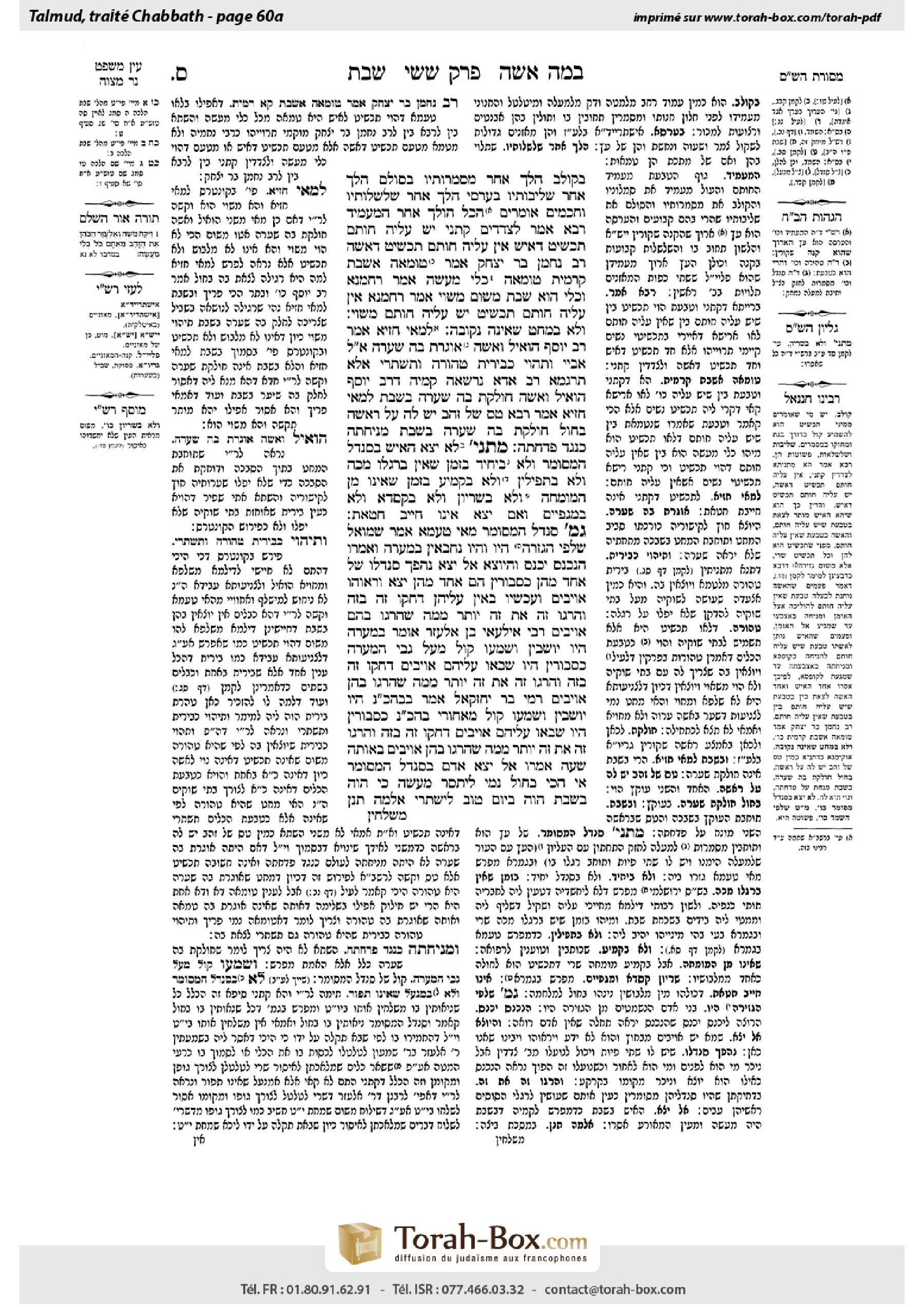
Shabbat 60a: Talmud study for Daf Yomi
Daf Yomi is the daily study of one Talmud folio. Explore 37 tractates with scans, Hebrew text, Sefaria English and AI-generated French translations where annotated.
Passage selection and English or AI-generated French translation are available where the scan has annotations. Daf Study is independent of Torah-Box and Sefaria.
Browse Shabbat · שבת · All tractatesShabbat 60a text and translations
This page of Shabbat includes the Aramaic text, an English translation and an AI-generated French translation, alongside the scan above.
שבת ס׳ א · Aramaic and Hebrew text
בְּקוֹלָב הַלֵּךְ אַחַר מַסְמְרוֹתָיו. בְּסוּלָּם הַלֵּךְ אַחַר שְׁלִיבוֹתָיו. בְּעַרְסָא הַלֵּךְ אַחַר שַׁלְשְׁלוֹתָיו. וַחֲכָמִים אוֹמְרִים: הַכֹּל הוֹלֵךְ אַחַר הַמַּעֲמִיד.
רָבָא אָמַר, לִצְדָדִים קָתָנֵי: יֵשׁ עָלֶיהָ חוֹתָם — תַּכְשִׁיט דְּאִישׁ, אֵין עָלֶיהָ חוֹתָם — תַּכְשִׁיט דְּאִשָּׁה.
רַב נַחְמָן בַּר יִצְחָק אָמַר: טוּמְאָה אַשַּׁבָּת קָרָמֵית?! טוּמְאָה, ״כְּלִי מַעֲשֶׂה״ אֲמַר רַחֲמָנָא — וּכְלִי הוּא. שַׁבָּת, מִשּׁוּם מַשּׂוֹי אֲמַר רַחֲמָנָא, אֵין עָלֶיהָ חוֹתָם — תַּכְשִׁיט, יֵשׁ עָלֶיהָ חוֹתָם — מַשּׂוֹי.
וְלֹא בְּמַחַט שֶׁאֵינָהּ נְקוּבָה. לְמַאי חַזְיָא? אָמַר רַב יוֹסֵף: הוֹאִיל וְאִשָּׁה אוֹגֶרֶת בָּהּ שְׂעָרָהּ.
אֲמַר לֵיהּ אַבָּיֵי: וְתֶהֱוֵי כְּבִירִית טְהוֹרָה, וְתִשְׁתְּרֵי.
אֶלָּא תַּרְגְּמַהּ רַב אַדָּא נַרְשָׁאָה קַמֵּיהּ דְּרַב יוֹסֵף: הוֹאִיל וְאִשָּׁה חוֹלֶקֶת בָּהּ שְׂעָרָהּ. בְּשַׁבָּת לְמַאי חַזְיָא? אָמַר רָבָא: טַס שֶׁל זָהָב יֵשׁ לָהּ עַל רֹאשָׁהּ. בַּחוֹל חוֹלֶקֶת בָּהּ שְׂעָרָהּ, בְּשַׁבָּת מַנִּיחָתָהּ כְּנֶגֶד פַּדַּחְתָּהּ.
מַתְנִי׳ לֹא יֵצֵא הָאִישׁ בְּסַנְדָּל הַמְסוּמָּר. וְלֹא בְּיָחִיד, בִּזְמַן שֶׁאֵין בְּרַגְלוֹ מַכָּה. וְלֹא בִּתְפִילִּין, וְלֹא בְּקָמֵיעַ בִּזְמַן שֶׁאֵינוֹ מִן הַמּוּמְחֶה. וְלֹא בְּשִׁרְיוֹן וְלֹא בְּקַסְדָּא וְלֹא בְּמַגָּפַיִים. וְאִם יָצָא — אֵינוֹ חַיָּיב חַטָּאת.
גְּמָ׳ סַנְדָּל הַמְסוּמָּר מַאי טַעְמָא?
אָמַר שְׁמוּאֵל: שִׁלְפֵי הַשְּׁמָד הָיוּ, וְהָיוּ נֶחְבָּאִין בִּמְעָרָה, וְאָמְרוּ: הַנִּכְנָס — יִכָּנֵס, וְהַיּוֹצֵא — אַל יֵצֵא.
נֶהְפַּךְ סַנְדָּלוֹ שֶׁל אֶחָד מֵהֶן, כִּסְבוּרִין הֵם אֶחָד מֵהֶן יָצָא וְרָאוּהוּ אוֹיְבִים וְעַכְשָׁו בָּאִין עֲלֵיהֶן. דָּחֲקוּ זֶה בָּזֶה וְהָרְגוּ זֶה אֶת זֶה יוֹתֵר מִמַּה שֶּׁהָרְגוּ בָּהֶם אוֹיְבִים.
רַבִּי אִילְעַאי בֶּן אֶלְעָזָר אוֹמֵר: בִּמְעָרָה הָיוּ יוֹשְׁבִין, וְשָׁמְעוּ קוֹל מֵעַל גַּבֵּי הַמְּעָרָה. כִּסְבוּרִין הָיוּ שֶׁבָּאוּ עֲלֵיהֶם אוֹיְבִים. דָּחֲקוּ זֶה בָּזֶה וְהָרְגוּ זֶה אֶת זֶה יוֹתֵר מִמַּה שֶּׁהָרְגוּ בָּהֶן אוֹיְבִים.
רָמֵי בַּר יְחֶזְקֵאל אָמַר: בְּבֵית הַכְּנֶסֶת הָיוּ יוֹשְׁבִין, וְשָׁמְעוּ קוֹל מֵאֲחוֹרֵי בֵּית הַכְּנֶסֶת. כִּסְבוּרִין הָיוּ שֶׁבָּאוּ עֲלֵיהֶם אוֹיְבִים. דָּחֲקוּ זֶה בָּזֶה וְהָרְגוּ זֶה אֶת זֶה יוֹתֵר מִמַּה שֶּׁהָרְגוּ בָּהֶן אוֹיְבִים.
בְּאוֹתָהּ שָׁעָה אָמְרוּ: אַל יֵצֵא אָדָם בְּסַנְדָּל הַמְסוּמָּר. אִי הָכִי, בְּחוֹל נָמֵי לִיתְּסַר! מַעֲשֶׂה כִּי הֲוָה — בְּשַׁבָּת הֲוָה. בְּיוֹם טוֹב לִישְׁתְּרֵי! אַלְּמָה תְּנַן:
Shabbat 60a · English translation
With a hanging board, follow its nails, upon which the objects hang. With a ladder, follow its rungs. With a large scale, follow its chains and not its baseplates. And the Rabbis say, with regard to all of these vessels, everything follows the support. The legal status of the object is not determined by the component of the vessel most significant in terms of function. It is determined by the component most significant in terms of structure. Therefore, according to Rabbi Neḥemya there is a distinction, even in the halakhot of Shabbat, between a ring with a seal and a ring without a seal, as in his opinion the seal constitutes the primary function of the ring. However, the Rabbis hold with regard to the halakhot of ritual impurity that the essential part of the ring is the ring itself, not the seal. Therefore, they permit going out into the public domain on Shabbat even with a ring that has a seal.
Rava said: This contradiction can be resolved in another manner. The mishna dealing with the halakhot of ritual impurity taught with regard to the two types of rings disjunctively, i.e., referring to different circumstances: A ring that has a seal on it can become ritually impure because it is a man’s ornament; a ring that does not have a seal on it can become ritually impure because it is a woman’s ornament.
Rav Naḥman bar Yitzḥak said an additional resolution to the contradiction between the mishnayot: Are you raising a contradiction from the halakhot of ritual impurity to the halakhot of Shabbat? The underlying principles of these areas of halakha are totally different. With regard to ritual impurity, the Torah stated: “All vessels with which labor is done” (Numbers 31:51), and a ring with a seal is a vessel and can therefore become ritually impure. However, with regard to Shabbat, the Torah stated that the prohibition is due to the fact that the object is a burden. Therefore, in a case where there is not a seal on it, it is an ornament and may be worn in the public domain. In a case where there is a seal on it, it is a burden and may not be worn.
We also learned in the mishna: Nor with a needle that is not perforated. The Gemara asks: For what use is that type of needle suited? Rav Yosef said: Since a woman gathers her hair and pins it to her hairnet with the unperforated needle.
Abaye said to him: And if so, let the needle be like a ritually pure garter and consequently be permitted. There is a type of garter, a strap that ensures that a woman’s stockings will not fall, that cannot become ritually impure. A woman is permitted to go out into the public domain wearing it on Shabbat even if it is ornamented. For reasons of modesty, a woman will certainly not remove her garter or display it in the public domain. Similarly, with regard to the needle, the assumption is that a woman will not loosen her hair in the street.
Rather, Rav Adda from the city of Naresh explained before Rav Yosef: Since a woman parts her hair with it. The Gemara asks: On Shabbat, when it is prohibited to comb one’s hair, for what use is this needle suited? Rava said: There is a gold plate on the other end of the needle. On a weekday, she uses it to part her hair. On Shabbat, she inserts the needle into her head covering and lays the gold plate against her forehead for ornamental purposes.
MISHNA: A man may not go out on Shabbat with a spiked sandal, as will be explained in the Gemara. And he may not go out with a single sandal when there is no wound on his foot. And he may neither go out with phylacteries, nor with an amulet when it is not from an expert, but rather it was written by someone who has not established a reputation as an expert in writing amulets that are effective for those who carry them. And he may neither go out with shiryon, nor with a kasda, nor with maggafayim. These terms will be explained in the Gemara. And if he went out into the public domain with any of these, he is not liable to bring a sin-offering.
GEMARA: The Gemara asks: What is the reason that the Sages prohibited going out with a spiked sandal on Shabbat?
Shmuel said: They were those who eluded the decrees of religious persecution, and after one of the wars they were hiding in a cave. And those hiding said: One who seeks to enter the cave may enter, but one who seeks to leave the cave may not leave. One leaving has no way to determine whether or not the enemy is lying in wait outside the cave. Therefore, leaving could reveal the presence of those hiding in the cave.
It happened that the sandal of one of them was reversed, the front of the sandal was in the back, and his footprints appeared like the steps of one leaving the cave. They thought that one of them left and feared that their enemies saw him and were now coming upon them to attack. In their panic, they pushed one another and killed one another in greater numbers than their enemies had killed among them. To commemorate this disaster that resulted from a spiked sandal, they prohibited going out into the public domain with it.
Rabbi Elai ben Elazar says that the reason for the decree was different. Once they were sitting in a cave and heard the sound of a spiked sandal atop the cave. They thought that their enemies had come upon them. They pushed one another and killed one another in greater numbers than their enemies had killed among them.
Rami bar Yeḥezkel said that the reason for the decree was different. They were sitting in a synagogue and they heard the sound of a spiked sandal from behind the synagogue. They thought that their enemies had come upon them. They pushed one another, and killed one another in greater numbers than their enemies had killed among them.
To commemorate that disaster which occurred due to a spiked sandal, at that time they said: A person may not go out with a spiked sandal. The Gemara asks: If so, on a weekday it should also be prohibited. The Gemara answers: When this incident occurred, it was on Shabbat. Therefore, they issued the decree prohibiting the spiked sandal specifically in parallel circumstances. The Gemara challenges: If so, on a Festival wearing a spiked sandal should be permitted. Why, then, did we learn in the same mishna:
Shabbat 60a · Traduction française (IA)
Pour une planche suspendue, on se règle sur ses clous, auxquels les objets sont accrochés. Pour une échelle, on se règle sur ses barreaux. Pour une grande balance, on se règle sur ses chaînes et non sur ses plateaux. Les Sages disent, quant à eux, que pour tous ces ustensiles, tout dépend de leur support. Le statut de l’objet n’est pas déterminé par la partie de l’ustensile la plus importante du point de vue de sa fonction, mais par celle qui est la plus importante du point de vue de sa structure. Par conséquent, selon Rabbi Neḥemya, il existe une distinction, même dans les halakhot de Chabbat, entre une bague avec un chaton et une bague sans chaton, car, à son avis, le chaton constitue la fonction principale de la bague. Les Sages considèrent toutefois, pour les halakhot de l’impureté rituelle, que la partie essentielle de la bague est la bague elle-même, et non le chaton. C’est pourquoi ils permettent de sortir dans le domaine public pendant Chabbat même avec une bague munie d’un chaton.
Rava dit : On peut résoudre cette contradiction d’une autre manière. La Michna qui traite des halakhot de l’impureté rituelle enseignait au sujet des deux types de bagues en les distinguant, c’est-à-dire en se référant à des situations différentes : une bague munie d’un chaton peut devenir rituellement impure parce qu’elle est un ornement masculin ; une bague sans chaton peut devenir rituellement impure parce qu’elle est un ornement féminin.
Rav Naḥman bar Yitzḥak proposa une autre résolution de la contradiction entre les Michnayot : « Opposes-tu les halakhot de l’impureté rituelle aux halakhot de Chabbat ? » Les principes qui sous-tendent ces domaines de la halakha sont entièrement différents. Concernant l’impureté rituelle, la Torah dit : « Tous les ustensiles avec lesquels on effectue un travail » (Nombres 31:51), et une bague munie d’un chaton est un ustensile ; elle peut donc devenir rituellement impure. Mais concernant Chabbat, la Torah indique que l’interdiction tient au fait que l’objet constitue un fardeau. Par conséquent, s’il n’a pas de chaton, c’est un ornement et on peut le porter dans le domaine public. S’il a un chaton, c’est un fardeau et on ne peut pas le porter.
Nous avons également appris dans la Michna : « Ni avec une aiguille non perforée. » La Guemara demande : À quel usage ce type d’aiguille convient-il ? Rav Yossef dit : Une femme rassemble ses cheveux et les fixe à son filet à cheveux avec l’aiguille non perforée.
Abayé lui dit : « Dans ce cas, que l’aiguille soit comme une jarretière rituellement pure, et qu’elle soit donc permise. » Il existe un type de jarretière, une lanière qui empêche les bas d’une femme de tomber, qui ne peut pas devenir rituellement impure. Une femme a le droit de sortir dans le domaine public pendant Chabbat en la portant, même si elle est ornée. Par souci de pudeur, une femme ne retirera certainement pas sa jarretière et ne la montrera pas dans le domaine public. De même, pour l’aiguille, on présume qu’une femme ne défera pas ses cheveux dans la rue.
Rav Adda, de la ville de Naresh, expliqua plutôt devant Rav Yossef : elle s’en sert pour tracer une raie dans ses cheveux. La Guemara demande : Pendant Chabbat, alors qu’il est interdit de se peigner, à quel usage cette aiguille convient-elle ? Rava dit : Une plaque d’or se trouve à l’autre extrémité de l’aiguille. En semaine, elle s’en sert pour tracer une raie dans ses cheveux. Pendant Chabbat, elle insère l’aiguille dans sa coiffe et pose la plaque d’or sur son front à des fins ornementales.
MICHNA : Un homme ne peut pas sortir pendant Chabbat avec une sandale à crampons, comme cela sera expliqué dans la Guemara. Il ne peut pas non plus sortir avec une seule sandale s’il n’a pas de blessure au pied. Il ne peut sortir ni avec des tefillin, ni avec une amulette qui n’a pas été écrite par un expert, c’est-à-dire par quelqu’un qui n’a pas acquis la réputation d’écrire des amulettes efficaces pour ceux qui les portent. Il ne peut sortir ni avec un shiryon, ni avec une kasda, ni avec des maggafayim. Ces termes seront expliqués dans la Guemara. S’il est sorti dans le domaine public avec l’un de ces objets, il n’est pas tenu d’apporter un sacrifice expiatoire.
GUEMARA : La Guemara demande : Pour quelle raison les Sages ont-ils interdit de sortir avec une sandale à crampons pendant Chabbat ?
Chmouel dit : Il s’agissait de personnes qui avaient échappé aux décrets de persécution religieuse et qui, après l’une des guerres, se cachaient dans une grotte. Ceux qui s’y cachaient dirent : « Celui qui veut entrer dans la grotte peut entrer, mais celui qui veut en sortir ne peut pas sortir. » Celui qui sort n’a aucun moyen de savoir si l’ennemi se tient en embuscade à l’extérieur de la grotte. Par conséquent, sa sortie risquait de révéler la présence de ceux qui se cachaient dans la grotte.
Il arriva que la sandale de l’un d’eux se retrouva à l’envers : l’avant de la sandale était à l’arrière, et ses empreintes ressemblaient à celles d’une personne sortant de la grotte. Ils pensèrent que l’un d’eux était sorti et craignirent que leurs ennemis l’aient vu et viennent maintenant les attaquer. Pris de panique, ils se bousculèrent et s’entretuèrent ; ils furent plus nombreux à être tués ainsi que par leurs ennemis. Pour commémorer cette catastrophe causée par une sandale à crampons, ils interdirent de sortir avec celle-ci dans le domaine public.
Rabbi Ilai ben Elazar dit que la raison du décret était différente. Un jour, ils étaient assis dans une grotte et entendirent le bruit d’une sandale à crampons au-dessus de la grotte. Ils pensèrent que leurs ennemis les avaient repérés. Ils se bousculèrent et s’entretuèrent ; ils furent plus nombreux à être tués ainsi que par leurs ennemis.
Rami bar Yeḥezkel dit que la raison du décret était différente. Ils étaient assis dans une synagogue et entendirent le bruit d’une sandale à crampons derrière la synagogue. Ils pensèrent que leurs ennemis les avaient repérés. Ils se bousculèrent et s’entretuèrent ; ils furent plus nombreux à être tués ainsi que par leurs ennemis.
Pour commémorer cette catastrophe survenue à cause d’une sandale à crampons, ils décrétèrent alors : « Une personne ne peut pas sortir avec une sandale à crampons. » La Guemara demande : Dans ce cas, cela devrait également être interdit en semaine. La Guemara répond : Lorsque cet incident se produisit, c’était pendant Chabbat. Ils émirent donc le décret interdisant la sandale à crampons précisément dans des circonstances analogues. La Guemara objecte : Dans ce cas, il devrait être permis de porter une sandale à crampons pendant une fête. Pourquoi, alors, avons-nous appris dans la même Michna :
Traduction française générée par IA à partir de l’édition anglaise de Sefaria. Vérifie toujours un passage avec le texte source.
Text from Sefaria: William Davidson Edition - Vocalized Aramaic (CC BY NC); William Davidson Edition - English (CC BY NC).