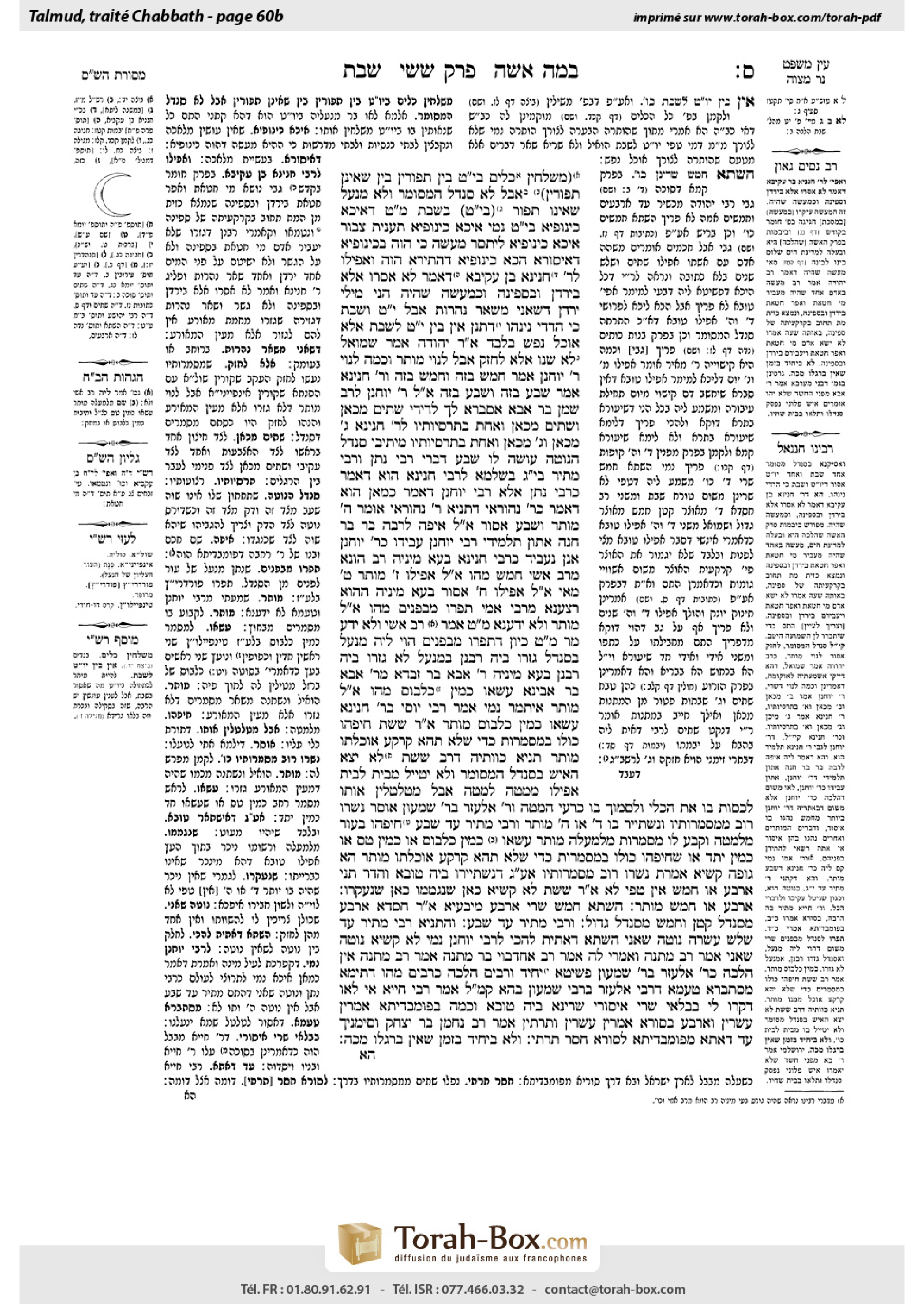
Shabbat 60b: Talmud study for Daf Yomi
Daf Yomi is the daily study of one Talmud folio. Explore 37 tractates with scans, Hebrew text, Sefaria English and AI-generated French translations where annotated.
Passage selection and English or AI-generated French translation are available where the scan has annotations. Daf Study is independent of Torah-Box and Sefaria.
Browse Shabbat · שבת · All tractatesShabbat 60b text and translations
This page of Shabbat includes the Aramaic text, an English translation and an AI-generated French translation, alongside the scan above.
שבת ס׳ ב · Aramaic and Hebrew text
מְשַׁלְּחִין כֵּלִים בְּיוֹם טוֹב בֵּין תְּפוּרִין בֵּין שֶׁאֵינָן תְּפוּרִין — אֲבָל לֹא סַנְדָּל הַמְסוּמָּר וְלֹא מִנְעָל שֶׁאֵינוֹ תָּפוּר בְּיוֹם טוֹב!
בְּשַׁבָּת מַאי טַעְמָא — דְּאִיכָּא כִּינּוּפְיָא, בְּיוֹם טוֹב נָמֵי אִיכָּא כִּינּוּפְיָא. תַּעֲנִית צִבּוּר אִיכָּא כִּינּוּפְיָא, לִיתְּסַר? מַעֲשֶׂה כִּי הֲוָה בְּכִינּוּפְיָא דְאִיסּוּרָא, הָכָא כִּינּוּפְיָא דְהֶתֵּירָא הֲוָה.
וַאֲפִילּוּ לְרַבִּי חֲנִינָא בֶּן עֲקִיבָא, דְּאָמַר: לֹא אָסְרוּ אֶלָּא בְּיַרְדֵּן וּבִסְפִינָה וּכְמַעֲשֶׂה שֶׁהָיָה. הָנֵי מִילֵּי יַרְדֵּן דְּשָׁאנֵי מִשְּׁאָר נְהָרוֹת. אֲבָל יוֹם טוֹב וְשַׁבָּת כִּי הֲדָדֵי נִינְהוּ, דִּתְנַן: אֵין בֵּין יוֹם טוֹב לַשַּׁבָּת אֶלָּא אוֹכֶל נֶפֶשׁ בִּלְבַד.
אָמַר רַב יְהוּדָה אָמַר שְׁמוּאֵל: לֹא שָׁנוּ אֶלָּא לְחַזֵּק, אֲבָל לְנוֹי — מוּתָּר. וְכַמָּה לְנוֹי? רַבִּי יוֹחָנָן אָמַר: חָמֵשׁ בָּזֶה וְחָמֵשׁ בָּזֶה. וְרַבִּי חֲנִינָא אָמַר: שֶׁבַע בָּזֶה וְשֶׁבַע בָּזֶה.
אֲמַר לֵיהּ רַבִּי יוֹחָנָן לְרַב שֶׁמֶן בַּר אַבָּא, אַסְבְּרַהּ לָךְ: לְדִידִי, שְׁתַּיִם מִכָּאן וּשְׁתַּיִם מִכָּאן וְאַחַת בִּתְרֵסִיּוֹתָיו. לְרַבִּי חֲנִינָא, שָׁלֹשׁ מִכָּאן וְשָׁלֹשׁ מִכָּאן וְאַחַת בִּתְרֵסִיּוֹתָיו.
מֵיתִיבִי: סַנְדָּל הַנּוֹטֶה עוֹשֶׂה לוֹ שֶׁבַע, דִּבְרֵי רַבִּי נָתָן. וְרַבִּי מַתִּיר בִּשְׁלֹשׁ עֶשְׂרֵה.
בִּשְׁלָמָא לְרַבִּי חֲנִינָא, הוּא דְּאָמַר כְּרַבִּי נָתָן. אֶלָּא רַבִּי יוֹחָנָן, דְּאָמַר כְּמַאן? הוּא דְּאָמַר כְּרַבִּי נְהוֹרַאי, דְּתַנְיָא: רַבִּי נְהוֹרַאי אוֹמֵר, חָמֵשׁ מוּתָּר וְשֶׁבַע אָסוּר.
אֲמַר לֵיהּ אֵיפָה לְרַבָּה בַּר בַּר חַנָּה: אַתּוּן תַּלְמִידֵי רַבִּי יוֹחָנָן עֲבִידוּ כְּרַבִּי יוֹחָנָן, אֲנַן נַעֲבֵיד כְּרַבִּי חֲנִינָא.
בְּעָא מִינֵּיהּ רַב הוּנָא מֵרַב אָשֵׁי: חָמֵשׁ מַהוּ? אֲמַר לֵיהּ: אֲפִילּוּ שֶׁבַע מֻתָּר. תֵּשַׁע מַאי? אֲמַר לֵיהּ: אֲפִילּוּ שְׁמוֹנֶה אָסוּר.
בְּעָא מִינֵּיהּ הָהוּא רַצְעָנָא מֵרַבִּי אַמֵּי: תְּפָרוֹ מִבִּפְנִים — מַהוּ? אֲמַר לֵיהּ: מוּתָּר, וְלָא יָדַעְנָא מַאי טַעְמָא.
אָמַר רַב אָשֵׁי: וְלָא יָדַע מָר מַאי טַעְמָא?! כֵּיוָן דִּתְפָרוֹ מִבִּפְנִים הָוֵי לֵיהּ מִנְעָל. בְּסַנְדָּל גְּזַרוּ בֵּיהּ רַבָּנַן, בְּמִנְעָל לָא גְזַרוּ בֵּיהּ רַבָּנַן.
בְּעָא מִינֵּיהּ רַבִּי אַבָּא בַּר זַבְדָּא מֵרַבִּי אַבָּא בַּר אֲבִינָא: עֲשָׂאוֹ כְּמִין כַּלְבּוֹס, מַהוּ? אֲמַר לֵיהּ: מוּתָּר. אִיתְּמַר נָמֵי, אָמַר רַבִּי יוֹסֵי בְּרַבִּי חֲנִינָא: עֲשָׂאוֹ כְּמִין כַּלְבּוֹס — מוּתָּר.
אָמַר רַב שֵׁשֶׁת: חִיפָּהוּ כֻּלּוֹ בְּמַסְמְרוֹת כְּדֵי שֶׁלֹּא תְּהֵא קַרְקַע אוֹכַלְתּוֹ — מוּתָּר.
תַּנְיָא כְּווֹתֵיהּ דְּרַב שֵׁשֶׁת: לֹא יֵצֵא הָאִישׁ בְּסַנְדָּל הַמְסוּמָּר, וְלֹא יְטַיֵּיל מִבַּיִת לְבַיִת, אֲפִלּוּ מִמִּטָּה לְמִטָּה. אֲבָל מְטַלְטְלִין אוֹתוֹ לְכַסּוֹת בּוֹ אֶת הַכְּלִי וְלִסְמוֹךְ בּוֹ כַּרְעֵי הַמִּטָּה. וְרַבִּי אֶלְעָזָר בְּרַבִּי שִׁמְעוֹן אוֹסֵר. נָשְׁרוּ רוֹב מַסְמְרוֹתָיו וְנִשְׁתַּיְּירוּ בּוֹ אַרְבַּע אוֹ חָמֵשׁ — מוּתָּר. וְרַבִּי מַתִּיר עַד שֶׁבַע. חִיפָּהוּ בְּעוֹר מִלְּמַטָּה וְקָבַע לוֹ מַסְמְרוֹת מִלְּמַעְלָה — מוּתָּר. עֲשָׂאוֹ כְּמִין כַּלְבּוֹס אוֹ כְּמִין טַס אוֹ כְּמִין יָתֵד, אוֹ שֶׁחִיפָּהוּ כּוּלּוֹ בְּמַסְמְרוֹת כְּדֵי שֶׁלֹּא תְּהֵא קַרְקַע אוֹכַלְתּוֹ — מוּתָּר.
הָא גּוּפַהּ קַשְׁיָא. אָמְרַתְּ נָשְׁרוּ רוֹב מַסְמְרוֹתָיו — אַף עַל גַּב דְּנִשְׁתַּיְּירוּ בֵּיהּ טוּבָא, וַהֲדַר תָּנֵי: אַרְבַּע אוֹ חָמֵשׁ — אִין, טְפֵי — לָא!
אָמַר רַב שֵׁשֶׁת: לָא קַשְׁיָא — כָּאן שֶׁנִּגְמְמוּ, כָּאן שֶׁנֶּעֶקְרוּ.
אַרְבַּע אוֹ חָמֵשׁ מוּתָּר. הַשְׁתָּא חָמֵשׁ שְׁרֵי, אַרְבַּע מִיבַּעְיָא?! אָמַר רַב חִסְדָּא: אַרְבַּע מִסַּנְדָּל קָטָן, וְחָמֵשׁ מִסַּנְדָּל גָּדוֹל.
וְרַבִּי מַתִּיר עַד שֶׁבַע. וְהָתַנְיָא: רַבִּי מַתִּיר עַד שְׁלֹשׁ עֶשְׂרֵה! נוֹטֶה שָׁאנֵי.
הַשְׁתָּא דַּאֲתֵית לְהָכִי, לְרַבִּי יוֹחָנָן נָמֵי לָא קַשְׁיָא: נוֹטֶה שָׁאנֵי.
אָמַר רַב מַתְנָה, וְאָמְרִי לַהּ אָמַר רַב אַחָדְבוּי בַּר מַתְנָה אָמַר רַב מַתְנָה: אֵין הֲלָכָה כְּרַבִּי אֶלְעָזָר בְּרַבִּי שִׁמְעוֹן. פְּשִׁיטָא, יָחִיד וְרַבִּים הֲלָכָה כְּרַבִּים! מַהוּ דְּתֵימָא: מִסְתַּבְּרָא טַעְמָא דְּרַבִּי אֶלְעָזָר בְּרַבִּי שִׁמְעוֹן בְּהָא, קָא מַשְׁמַע לַן.
אָמַר רַבִּי חִיָּיא: אִי לָאו דְּקָרוּ לִי ״בַּבְלַאי שָׁרֵי אִיסּוּרֵי״ שָׁרֵינָא בֵּיהּ טוּבָא. וְכַמָּה? בְּפוּמְבְּדִיתָא אָמְרִין: עֶשְׂרִין וְאַרְבַּע. בְּסוּרָא אָמְרִין: עֶשְׂרִין וְתַרְתֵּין. אָמַר רַב נַחְמָן בַּר יִצְחָק, וְסִימָנָיךְ: עַד דַּאֲתָא מִפּוּמְבְּדִיתָא לְסוּרָא חֲסַר תַּרְתֵּי.
וְלֹא בְּיָחִיד בִּזְמַן שֶׁאֵין בְּרַגְלוֹ מַכָּה.
Shabbat 60b · English translation
One may send garments as a gift on a Festival, whether they are sewn or whether they are not sewn, because any object fit for any use on a Festival may be sent as a gift. However, one may neither send a spiked sandal nor an unsewn shoe on a Festival, since using them is prohibited. Apparently, one may not wear a spiked sandal on a Festival.
The Gemara explains: What is the reason that the Sages prohibited wearing a spiked sandal on Shabbat? It is because there is an assemblage of people. On a Festival too, there is an assemblage of people. The Gemara asks: On a communal fast day, there is an assemblage of people; wearing a spiked sandal should be prohibited then, as well. The Gemara answers: When this incident occurred, it was on a day when there was an assemblage of prohibition, i.e., a day on which performing labor is prohibited. Here, a fast day, is a day when there is an assemblage of permission, a day on which performing labor is permitted, and the two are not comparable. However, extending the scope of commemorative decrees to apply to comparable situations, e.g., from Shabbat to the Festivals, is acceptable.
And this is true even according to the opinion of Rabbi Ḥanina ben Akiva, who said in the following case that a decree issued due to a specific set of circumstances is applied only to those specific circumstances. The ashes of the red heifer were once transported across the Jordan River in a boat. A source of ritual impurity was discovered at the bottom of the boat. The Sages sought to issue a decree prohibiting transport of the ashes of the red heifer over any body of water, sea or river, over a bridge, or in a boat. Rabbi Ḥanina ben Akiva said that decrees that are issued due to a specific event apply only to precisely those circumstances. Therefore, he said: They only prohibited transporting the ashes of a red heifer in the Jordan River and in a boat, and like the incident that occurred. However, even according to this approach, which limits restriction, that applies only to the Jordan River and not to other rivers. This is because it is different from other rivers in several respects, e.g., width and depth. However, a Festival and Shabbat are similar to one another, as it was taught in the mishna: The halakhic difference between a Festival and Shabbat is only with regard to preparation of food.
Rav Yehuda said that Shmuel said: The Sages taught that a spiked sandal is prohibited only when the nails were placed in the sandal to strengthen its form; however, if they were placed in the sandal for beauty, it is permitted. The Gemara asks: And with how many nails is it considered to be for beauty? Rabbi Yoḥanan said: Five on this sandal and five on that one. And Rabbi Ḥanina said: Seven on this one and seven on that one.
Rabbi Yoḥanan said to Rav Shemen bar Abba: I will explain it to you: According to my opinion, when inserting nails for beauty, two are inserted from here, its outer side, one near the toes and one near the heel, and two are inserted from there, its inner side, one near the toes and one near the heel, and one is inserted on its straps; and for Rabbi Ḥanina, three from here, and three from there, and one on its straps.
The Gemara raises an objection from a baraita: For an uneven sandal, whose soles are not straight, one makes seven nails on the bottom to straighten it, and it is then permitted for use on Shabbat; that is the statement of Rabbi Natan. And Rabbi Yehuda HaNasi permits straightening the sandal with thirteen nails.
The Gemara notes: Granted, according to Rabbi Ḥanina, there is no problem, as he stated his opinion in accordance with the opinion of Rabbi Natan. However, Rabbi Yoḥanan, in accordance with whose opinion did he state his opinion? Neither of the tanna’im agrees with his opinion. The Gemara answers: He stated his opinion in accordance with the opinion of Rabbi Nehorai, as it was taught in a baraita that Rabbi Nehorai says: With five nails inserted into the sole, it is permitted to go out into the public domain on Shabbat; and with seven nails, it is prohibited to go out into the public domain on Shabbat.
The Sage, Ifa, said to Rabba bar bar Ḥana: You, who are students of Rabbi Yoḥanan, act in accordance with the opinion of Rabbi Yoḥanan. We will act in accordance with the opinion of Rabbi Ḥanina.
Rav Huna raised a dilemma before Rav Ashi: With a sandal that has five nails inserted into the sole, what is the halakha with regard to going out into the public domain? He said to him: Even with seven nails it is permitted. He asked further: With nine, what is the halakha? He said to him: Even with eight it is prohibited.
That shoemaker raised a dilemma before Rabbi Ami: If one sewed the sole and attached it to the sandal from within, what is the halakha? May he go out into the public domain after inserting nails into it? Rabbi Ami said to him: It is permitted, and I do not know the reason.
Rav Ashi said: And does the Master not know the reason? It is obvious. Since he sewed it from within, it is no longer a sandal, it is a shoe. With regard to a sandal, the Sages issued a decree; with regard to a shoe, the Sages did not issue a decree.
Rabbi Abba bar Zavda raised a dilemma before Rabbi Abba bar Avina: If he shaped the nail like tongs [kelavus] by bending a nail with two sharp ends and sticking both ends into the sandal, what is the halakha? May he go out into the public domain with it on Shabbat? He said to him: It is permitted. It was also stated that Rabbi Yosei, son of Rabbi Ḥanina, said: If he shaped it like tongs it is permitted.
Rav Sheshet said: If he covered the entire sole in nails, so that contact with the ground will not wear it away, it is permitted to go out with that sandal on Shabbat, since it is no longer the spiked sandal with regard to which they issued a decree.
It was taught in the Tosefta in accordance with the opinion of Rav Sheshet: A man may not go out with a spiked sandal, and may not walk with it even from house to house within his courtyard, and may not even walk from bed to bed within his house. However, since the decree was issued with regard to circumstances identical to a specific incident, it only applies to wearing the sandal. Therefore, one may carry the sandal to cover a vessel with it and to support the legs of the bed with it. And Rabbi Elazar, son of Rabbi Shimon, prohibits using it for other purposes as well. If most of its nails fell out, and four or five remain in it, it is permitted to go out with it. And Rabbi Yehuda HaNasi permits going out into the public domain with the sandal, even if up to seven nails remain in it. If he covered it with leather from beneath the wood frame of the sandal and inserted nails into it from above, it is permitted. If he made the nail like a tong, or made one end flat like a platter [tas], or sharpened it like a peg, or covered it entirely with nails so that contact with the ground will not wear it away, it is permitted to go out with it.
The Gemara analyzes the Tosefta cited in support of Rav Sheshet’s opinion. This Tosefta itself is difficult, as it is self-contradictory. On the one hand you said: If most of its nails fell out it is permitted; apparently, that is the halakha even though many nails remain in the sole. And, however, subsequently it was taught in the Tosefta, without specifying the number of nails that were there from the outset: With four or five nails, yes, going out is permitted; however, with more nails, no, it is prohibited.
Rav Sheshet said: This is not difficult, and it can be resolved as follows: Here, where it was permitted to go out wearing the sandal if the majority of nails fell out, it is referring to a case where they were broken, i.e., the heads of the nails were broken off while most of the nail remained embedded in the sole. In that case, it is clearly evident that most of the nails fell out. Here, where it was permitted only if four or five nails remain, it is referring to a case where they were totally removed and only the nails that remain in the shoe are visible.
The Gemara continues its detailed analysis of the Tosefta: It was taught that if most of the nails in the sandal came out and only four or five nails remain, it is permitted to go out wearing it. The Gemara asks: Now, if it was mentioned that when five nails remain, going out is permitted, is it necessary to mention four? Rav Ḥisda said that the Tosefta means: If four nails remain from the nails in a small sandal, and if five nails remain from the nails in a large sandal, going out is permitted.
It was taught in the Tosefta: And Rabbi Yehuda HaNasi permits up to seven. The Gemara asks: Wasn’t it taught in a baraita that for a sandal with an uneven sole, Rabbi Yehuda HaNasi permits up to thirteen? The Gemara answers: An uneven sole is different. Since the nails are inserted for the purpose of straightening the sole, it does not have the legal status of a spiked sandal.
The Gemara notes: Now that you have arrived at this new explanation that a sandal with an uneven sole has a different legal status, for Rabbi Yoḥanan, who stated, contrary to the opinions of the tanna’im in this baraita, that the number of nails permitted in each sandal is five, this baraita is also not difficult. He could explain that a sandal with an uneven sole is different and requires additional nails. However, in the case of a sandal with an even sole, even the other tanna’im would not permit that many.
Rav Mattana said, and some say Rav Aḥadvoi bar Mattana said that Rav Mattana said: The halakha is not in accordance with the opinion of Rabbi Elazar, son of Rabbi Shimon, who completely prohibited moving a spiked sandal. The Gemara asks: That is obvious. Isn’t there a halakhic principle that in a dispute between an individual and the many, the halakha is in accordance with the opinion of the many? The Gemara answers: Lest you say that the rationale for the opinion of Rabbi Elazar, son of Rabbi Shimon, is more reasonable in this case, and therefore the halakha should be ruled in accordance with his opinion. Rav Mattana teaches us that that is not the halakha.
Rabbi Ḥiyya said: If not for the fact that they would call me: Babylonian who permits prohibitions, I would permit the insertion of many nails into a spiked sandal. The Gemara asks: And how many nails would he have permitted? In Pumbedita they said: Twenty-four nails. In Sura they said: Twenty-two. Rav Naḥman bar Yitzḥak said: And this is your mnemonic to remember which opinion was stated in Sura and which opinion was stated in Pumbedita: Until Rabbi Ḥiyya came from Pumbedita to Sura he lost two nails from his shoe. Since the route that Rabbi Ḥiyya took from Pumbedita to Eretz Yisrael passed through Sura, one could say: Due to the rigors of the journey, two nails fell from the sandal of Rabbi Ḥiyya between Pumbedita and Sura.
It was taught in the mishna: And he may not go out with a single sandal when there is no wound on his foot.
Shabbat 60b · Traduction française (IA)
On peut envoyer des vêtements en cadeau pendant un jour de fête, qu’ils soient cousus ou non, car tout objet qui peut servir à quelque usage que ce soit pendant un jour de fête peut être envoyé en cadeau. Toutefois, on ne peut envoyer ni une sandale à clous ni une chaussure non cousue pendant un jour de fête, puisque leur utilisation est interdite. Il semble donc qu’on ne puisse pas porter de sandale à clous pendant un jour de fête.
La Guemara explique : Pourquoi les Sages ont-ils interdit de porter une sandale à clous pendant Chabbat ? Parce qu’il y a un rassemblement de personnes. Il y a aussi un rassemblement de personnes pendant un jour de fête. La Guemara demande : Lors d’un jeûne public, il y a un rassemblement de personnes ; le port d’une sandale à clous devrait donc également y être interdit. La Guemara répond : Lorsque l’incident s’est produit, c’était un jour de rassemblement associé à une interdiction, c’est-à-dire un jour où le travail est interdit. Ici, lors d’un jour de jeûne, il s’agit d’un jour de rassemblement associé à une permission, un jour où le travail est permis ; les deux situations ne sont donc pas comparables. Toutefois, il est acceptable d’étendre la portée des décrets commémoratifs à des situations comparables, par exemple de Chabbat aux jours de fête.
Et cela est vrai même selon l’opinion de Rabbi Ḥanina ben Akiva, qui a dit, dans le cas suivant, qu’un décret promulgué en raison de circonstances particulières ne s’applique qu’à ces circonstances. Les cendres de la vache rousse furent un jour transportées sur le Jourdain, dans un bateau. Une source d’impureté rituelle fut découverte au fond du bateau. Les Sages envisagèrent de promulguer un décret interdisant de transporter les cendres de la vache rousse au-dessus de toute étendue d’eau — mer ou rivière —, sur un pont ou dans un bateau. Rabbi Ḥanina ben Akiva dit que les décrets promulgués en raison d’un événement particulier ne s’appliquent qu’à des circonstances exactement identiques. Il dit donc : ils ont interdit de transporter les cendres de la vache rousse uniquement sur le Jourdain et dans un bateau, comme lors de l’incident qui s’était produit. Toutefois, même selon cette approche restrictive, cette règle ne s’applique qu’au Jourdain et non aux autres rivières, car celui-ci en diffère à plusieurs égards, par exemple par sa largeur et sa profondeur. En revanche, un jour de fête et Chabbat se ressemblent, comme l’enseigne la Michna : la seule différence halakhique entre un jour de fête et Chabbat concerne la préparation des aliments.
Rav Yehuda a dit au nom de Shmuel : Les Sages ont enseigné qu’une sandale à clous est interdite uniquement lorsque les clous y ont été placés pour en renforcer la structure ; en revanche, s’ils y ont été placés pour l’embellir, elle est permise. La Guemara demande : Combien de clous faut-il pour que cela soit considéré comme un ornement ? Rabbi Yoḥanan dit : cinq sur cette sandale et cinq sur l’autre. Rabbi Ḥanina dit : sept sur celle-ci et sept sur l’autre.
Rabbi Yoḥanan dit à Rav Shemen bar Abba : Je vais te l’expliquer. Selon moi, lorsqu’on insère des clous pour embellir la sandale, on en met deux de ce côté, le côté extérieur, l’un près des orteils et l’autre près du talon, deux de l’autre côté, le côté intérieur, l’un près des orteils et l’autre près du talon, et un sur les lanières. Selon Rabbi Ḥanina, on en met trois de ce côté, trois de l’autre côté et un sur les lanières.
La Guemara soulève une objection à partir d’une baraïta : pour une sandale dont la semelle est irrégulière, on met sept clous en dessous afin de la redresser, et il est alors permis de l’utiliser pendant Chabbat. Telle est l’opinion de Rabbi Natan. Rabbi Yehuda HaNassi permet de redresser la sandale avec treize clous.
La Guemara fait remarquer : Certes, il n’y a pas de difficulté selon Rabbi Ḥanina, car son opinion concorde avec celle de Rabbi Natan. Mais selon l’opinion de qui Rabbi Yoḥanan a-t-il formulé la sienne ? Aucun des deux tannaïm ne partage son avis. La Guemara répond : Il a formulé son avis conformément à celui de Rabbi Nehorai, car une baraïta enseigne que Rabbi Nehorai dit : avec cinq clous insérés dans la semelle, il est permis de sortir dans le domaine public pendant Chabbat ; avec sept clous, il est interdit d’y sortir pendant Chabbat.
Le Sage Ifa dit à Rabba bar bar Ḥana : Vous, qui êtes les élèves de Rabbi Yoḥanan, agissez conformément à l’opinion de Rabbi Yoḥanan. Nous, nous agirons conformément à celle de Rabbi Ḥanina.
Rav Huna posa une question à Rav Ashi : Quel est le statut, quant au fait de sortir dans le domaine public, d’une sandale dont la semelle comporte cinq clous ? Il lui répondit : Même avec sept clous, c’est permis. Il demanda ensuite : Et avec neuf clous, quel est le statut ? Il lui répondit : Même avec huit, c’est interdit.
Un cordonnier posa une question à Rabbi Ami : Si l’on a cousu la semelle et qu’on l’a fixée à la sandale par l’intérieur, quel est le statut ? Peut-on sortir avec elle dans le domaine public après y avoir inséré des clous ? Rabbi Ami lui répondit : C’est permis, mais j’en ignore la raison.
Rav Ashi dit : Et le Maître n’en connaît-il pas la raison ? C’est évident. Puisqu’on l’a cousue par l’intérieur, ce n’est plus une sandale, mais une chaussure. Les Sages ont promulgué un décret au sujet d’une sandale, mais ils n’en ont pas promulgué au sujet d’une chaussure.
Rabbi Abba bar Zavda posa une question à Rabbi Abba bar Avina : Si l’on a donné au clou la forme d’une pince [kelavus], en le courbant de manière à obtenir deux extrémités pointues, puis en enfonçant les deux extrémités dans la sandale, quel est le statut ? Peut-on sortir avec elle dans le domaine public pendant Chabbat ? Il lui répondit : C’est permis. Il a également été rapporté que Rabbi Yosei, fils de Rabbi Ḥanina, a dit : si l’on lui donne la forme d’une pince, c’est permis.
Rav Sheshet dit : Si l’on a recouvert toute la semelle de clous, de sorte que le contact avec le sol ne l’use pas, il est permis de sortir avec cette sandale pendant Chabbat, puisqu’elle n’est plus la sandale à clous visée par le décret.
Il est enseigné dans la Tosefta, conformément à l’opinion de Rav Sheshet : un homme ne peut pas sortir avec une sandale à clous, ni même marcher avec elle d’une maison à l’autre dans sa cour, ni même d’un lit à l’autre dans sa maison. Toutefois, puisque le décret a été promulgué à propos de circonstances identiques à celles d’un incident précis, il ne s’applique qu’au port de la sandale. On peut donc transporter la sandale pour couvrir un récipient ou pour soutenir les pieds du lit. Rabbi Elazar, fils de Rabbi Shimon, interdit également de l’utiliser à d’autres fins. Si la plupart de ses clous sont tombés et qu’il en reste quatre ou cinq, il est permis de sortir avec elle. Rabbi Yehuda HaNassi permet de sortir dans le domaine public avec la sandale, même s’il y reste jusqu’à sept clous. Si on l’a recouverte de cuir sous l’armature en bois de la sandale et qu’on y a inséré des clous par-dessus, c’est permis. Si l’on a donné au clou la forme d’une pince, aplati l’une de ses extrémités en forme de plat [tas], aiguisé le clou comme une cheville, ou recouvert toute la sandale de clous afin que le contact avec le sol ne l’use pas, il est permis de sortir avec elle.
La Guemara analyse la Tosefta citée à l’appui de l’opinion de Rav Sheshet. Cette Tosefta présente elle-même une difficulté, car elle se contredit. D’un côté, elle dit : si la plupart de ses clous sont tombés, c’est permis ; il semble donc que cela soit la halakha même si de nombreux clous restent dans la semelle. Mais, par la suite, la Tosefta enseigne, sans préciser combien de clous s’y trouvaient au départ : avec quatre ou cinq clous, oui, il est permis de sortir ; mais avec davantage de clous, non, c’est interdit.
Rav Sheshet dit : Il n’y a pas de difficulté ; on peut résoudre la contradiction ainsi : ici, lorsqu’il était permis de sortir avec la sandale si la majorité des clous étaient tombés, il s’agit d’un cas où ils s’étaient brisés, c’est-à-dire que la tête des clous s’était cassée alors que la majeure partie de chaque clou restait enfoncée dans la semelle. Dans ce cas, il est clairement évident que la plupart des clous sont tombés. Là, lorsqu’il n’était permis de sortir que s’il en restait quatre ou cinq, il s’agit d’un cas où les clous avaient été entièrement retirés et où seuls ceux qui restaient dans la chaussure étaient visibles.
La Guemara poursuit son analyse détaillée de la Tosefta : il y était enseigné que si la plupart des clous de la sandale étaient sortis et qu’il n’en restait que quatre ou cinq, il était permis de sortir en la portant. La Guemara demande : Si l’on a mentionné qu’il est permis de sortir lorsqu’il reste cinq clous, était-il nécessaire de mentionner quatre ? Rav Ḥisda dit que la Tosefta veut dire : si quatre clous restent dans une petite sandale, et si cinq clous restent dans une grande sandale, il est permis de sortir.
Il est enseigné dans la Tosefta : Rabbi Yehuda HaNassi permet jusqu’à sept clous. La Guemara demande : N’a-t-il pas été enseigné dans une baraïta que, pour une sandale à semelle irrégulière, Rabbi Yehuda HaNassi permet jusqu’à treize clous ? La Guemara répond : Une sandale à semelle irrégulière est différente. Puisque les clous y sont insérés pour redresser la semelle, elle n’a pas le statut juridique d’une sandale à clous.
La Guemara fait remarquer : Maintenant que l’on a adopté cette nouvelle explication, selon laquelle une sandale à semelle irrégulière a un statut différent, il n’y a pas non plus de difficulté pour Rabbi Yoḥanan, qui a dit, contrairement aux opinions des tannaïm de cette baraïta, que cinq clous sont permis sur chaque sandale. Il pourrait lui aussi expliquer qu’une sandale à semelle irrégulière est différente et nécessite des clous supplémentaires. Cependant, dans le cas d’une sandale à semelle régulière, même les autres tannaïm ne permettraient pas d’en mettre autant.
Rav Mattana a dit — et certains disent que Rav Aḥadvoi bar Mattana a rapporté au nom de Rav Mattana — que la halakha ne suit pas l’opinion de Rabbi Elazar, fils de Rabbi Shimon, qui interdisait complètement de déplacer une sandale à clous. La Guemara demande : Cela va de soi. N’existe-t-il pas un principe halakhique selon lequel, dans un désaccord entre un individu et la majorité, la halakha suit l’opinion de la majorité ? La Guemara répond : On pourrait penser que, dans ce cas, le raisonnement de Rabbi Elazar, fils de Rabbi Shimon, est plus convaincant et que la halakha devrait donc suivre son opinion. Rav Mattana nous enseigne que ce n’est pas la halakha.
Rabbi Ḥiyya dit : Si je ne craignais pas qu’on m’appelle « Babylonien qui autorise les interdits », je permettrais d’insérer de nombreux clous dans une sandale à clous. La Guemara demande : Combien de clous aurait-il permis ? À Pumbedita, on disait : vingt-quatre clous. À Sura, on disait : vingt-deux. Rav Naḥman bar Yitzḥak dit : Voici un moyen mnémotechnique pour se rappeler quelle opinion était rapportée à Sura et laquelle à Pumbedita : avant que Rabbi Ḥiyya n’arrive de Pumbedita à Sura, il avait perdu deux clous de sa chaussure. Comme le trajet de Rabbi Ḥiyya de Pumbedita vers la Terre d’Israël passait par Sura, on pouvait dire : les difficultés du voyage firent tomber deux clous de la sandale de Rabbi Ḥiyya entre Pumbedita et Sura.
Il est enseigné dans la Michna : il ne peut pas sortir avec une seule sandale s’il n’a pas de blessure au pied.
Traduction française générée par IA à partir de l’édition anglaise de Sefaria. Vérifie toujours un passage avec le texte source.
Text from Sefaria: William Davidson Edition - Vocalized Aramaic (CC BY NC); William Davidson Edition - English (CC BY NC).