Shabbat 61a: Talmud study for Daf Yomi
Daf Yomi is the daily study of one Talmud folio. Explore 37 tractates with scans, Hebrew text, Sefaria English and AI-generated French translations where annotated.
Passage selection and English or AI-generated French translation are available where the scan has annotations. Daf Study is independent of Torah-Box and Sefaria.
Browse Shabbat · שבת · All tractatesShabbat 61a text and translations
This page of Shabbat includes the Aramaic text, an English translation and an AI-generated French translation, alongside the scan above.
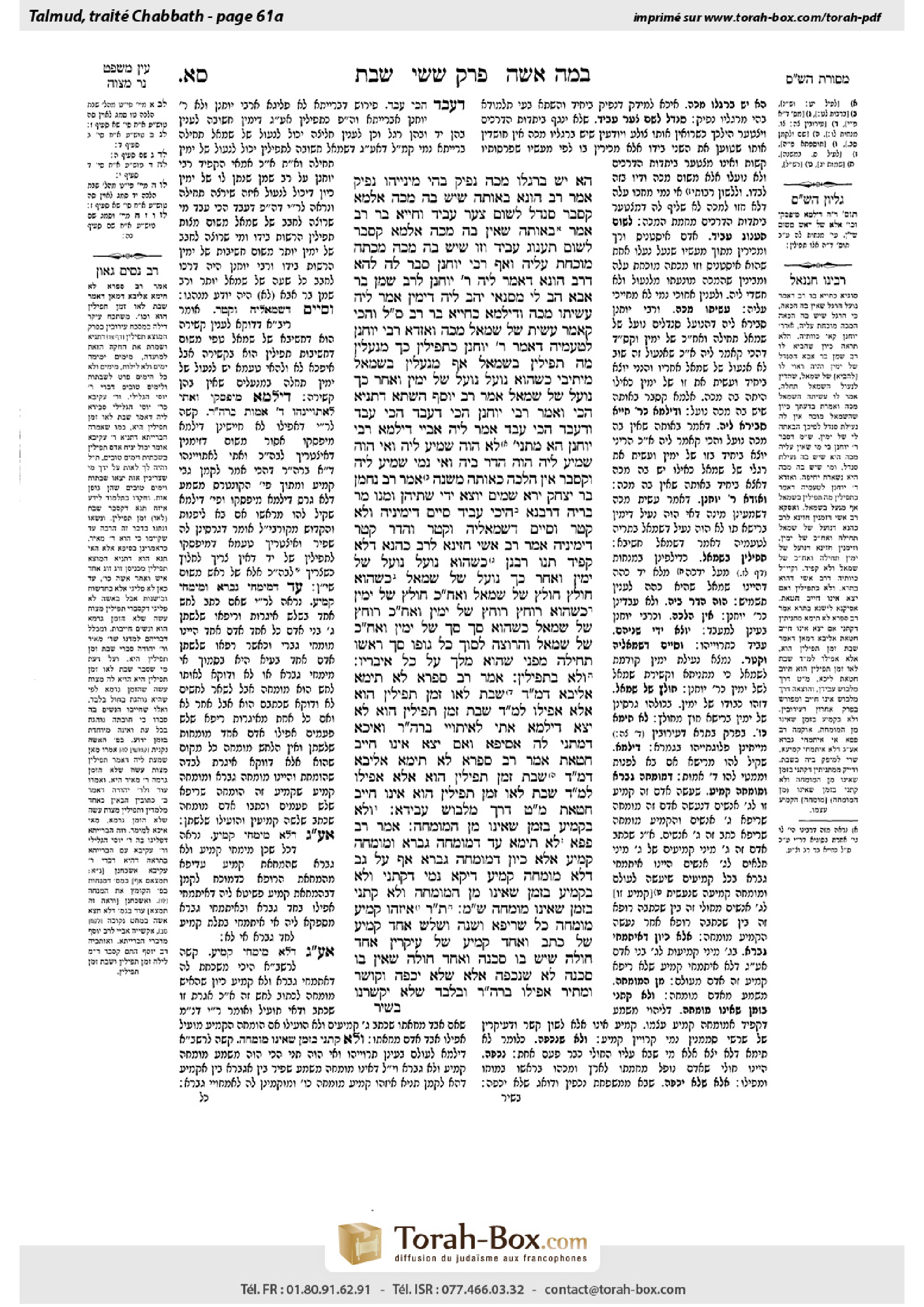
שבת ס״א א · Aramaic and Hebrew text
הָא יֵשׁ בְּרַגְלוֹ מַכָּה — נָפֵיק. בְּהֵי מִינַּיְיהוּ נָפֵיק? אָמַר רַב הוּנָא: בְּאוֹתָהּ שֶׁיֵּשׁ בָּהּ מַכָּה. אַלְמָא קָסָבַר, סַנְדָּל לְשׁוּם צַעַר עֲבִיד.
וְחִיָּיא בַּר רַב אָמַר: בְּאוֹתָהּ שֶׁאֵין בָּהּ מַכָּה. אַלְמָא קָסָבַר, לְשׁוּם תַּעֲנוּג עֲבִיד, וְזוֹ שֶׁיֵּשׁ בָּהּ מַכָּה — מַכָּתָהּ מוֹכַחַת עָלֶיהָ.
וְאַף רַבִּי יוֹחָנָן סָבַר לַהּ לְהָא דְּרַב הוּנָא. דְּאָמַר לֵיהּ רַבִּי יוֹחָנָן לְרַב שֶׁמֶן בַּר אַבָּא: הַב לִי מְסָנַאי. יְהַב לֵיהּ דְּיָמִין. אֲמַר לֵיהּ עֲשִׂיתוֹ מַכָּה.
וְדִילְמָא כְּחִיָּיא בַּר רַב סְבִירָא לֵיהּ, וְהָכִי קָאָמַר: עָשִׂיתָ שֶׁל שְׂמֹאל מַכָּה.
וְאַזְדָּא רַבִּי יוֹחָנָן לְטַעְמֵיהּ. דַּאֲמַר רַבִּי יוֹחָנָן: כִּתְפִילִּין כָּךְ מִנְעָלִין. מַה תְּפִילִּין בִּשְׂמֹאל, אַף מִנְעָלִין בִּשְׂמֹאל.
מֵיתִיבִי: כְּשֶׁהוּא נוֹעֵל — נוֹעֵל שֶׁל יָמִין וְאַחַר כָּךְ נוֹעֵל שֶׁל שְׂמֹאל!
אָמַר רַב יוֹסֵף: הַשְׁתָּא דְּתַנְיָא הָכִי, וְאָמַר רַבִּי יוֹחָנָן הָכִי, דַּעֲבַד הָכִי — עֲבַד, וְדַעֲבַד הָכִי — עֲבַד.
אֲמַר לֵיהּ אַבָּיֵי: דִּילְמָא רַבִּי יוֹחָנָן הָא מַתְנִיתִין לָא הֲוָה שְׁמִיעַ לֵיהּ, וְאִי הֲוָה שְׁמִיעַ לֵיהּ הֲוָה הָדַר בֵּיהּ. וְאִי נָמֵי שְׁמִיעַ לֵיהּ, וְקָסָבַר אֵין הֲלָכָה כְּאוֹתָהּ מִשְׁנָה.
אָמַר רַב נַחְמָן בַּר יִצְחָק: יְרֵא שָׁמַיִם יוֹצֵא יְדֵי שְׁתֵּיהֶן. וּמַנּוּ? — מָר בְּרֵיהּ דְּרַבְנָא. הֵיכִי עָבֵיד? — סָיֵים דְּיַמִּינֵיהּ וְלָא קָטַר, וְסָיֵים דִּשְׂמָאלֵיהּ וְקָטַר, וַהֲדַר קָטַר דְּיַמִּינֵיהּ. אָמַר רַב אָשֵׁי: חֲזֵינָא לְרַב כָּהֲנָא דְּלָא קָפֵיד.
תָּנוּ רַבָּנַן: כְּשֶׁהוּא נוֹעֵל — נוֹעֵל שֶׁל יָמִין וְאַחַר כָּךְ נוֹעֵל שֶׁל שְׂמֹאל. כְּשֶׁהוּא חוֹלֵץ — חוֹלֵץ שֶׁל שְׂמֹאל וְאַחַר כָּךְ חוֹלֵץ שֶׁל יָמִין.
כְּשֶׁהוּא רוֹחֵץ — רוֹחֵץ שֶׁל יָמִין וְאַחַר כָּךְ רוֹחֵץ שֶׁל שְׂמֹאל. כְּשֶׁהוּא סָךְ — סָךְ שֶׁל יָמִין וְאַחַר כָּךְ שֶׁל שְׂמֹאל. וְהָרוֹצֶה לָסוּךְ כׇּל גּוּפוֹ — סָךְ רֹאשׁוֹ תְּחִילָּה, מִפְּנֵי שֶׁהוּא מֶלֶךְ עַל כׇּל אֵיבָרָיו.
וְלֹא בִּתְפִילִּין. אָמַר רַב סָפְרָא: לָא תֵּימָא אַלִּיבָּא דְּמַאן דְּאָמַר שַׁבָּת לָאו זְמַן תְּפִילִּין הוּא. אֶלָּא אֲפִילּוּ לְמַאן דְּאָמַר שַׁבָּת זְמַן תְּפִילִּין הוּא — לֹא יֵצֵא, דִּילְמָא אָתֵי לְאֵיתוּיֵי בִּרְשׁוּת הָרַבִּים.
וְאִיכָּא דְמַתְנֵי לַהּ אַסֵּיפָא: וְאִם יָצָא אֵינוֹ חַיָּיב חַטָּאת. אָמַר רַב סָפְרָא: לָא תֵּימָא אַלִּיבָּא דְמַאן דְּאָמַר שַׁבָּת זְמַן תְּפִילִּין הוּא, אֶלָּא אֲפִילּוּ לְמַאן דְּאָמַר שַׁבָּת לָאו זְמַן תְּפִילִּין הוּא — אֵינוֹ חַיָּיב חַטָּאת. מַאי טַעְמָא? — דֶּרֶךְ מַלְבּוּשׁ עֲבִידָא.
וְלֹא בְּקָמֵיעַ בִּזְמַן שֶׁאֵינוֹ מִן הַמּוּמְחֶה. אָמַר רַב פָּפָּא: לָא תֵּימָא עַד דְּמוּמְחֶה גַּבְרָא וּמוּמְחֶה קָמֵיעַ, אֶלָּא כֵּיוָן דְּמוּמְחֶה גַּבְרָא, אַף עַל גַּב דְּלָא מוּמְחֶה קָמֵיעַ.
דַּיְקָא נָמֵי, דְּקָתָנֵי: ״וְלֹא בְּקָמֵיעַ בִּזְמַן שֶׁאֵינוֹ מִן הַמּוּמְחֶה״, וְלָא קָתָנֵי: ״בִּזְמַן שֶׁאֵינוֹ מוּמְחֶה״. שְׁמַע מִינַּהּ.
תָּנוּ רַבָּנַן: אֵיזֶהוּ קָמֵיעַ מוּמְחֶה — כֹּל שֶׁרִיפֵּא, וְשָׁנָה, וְשִׁלֵּשׁ. אֶחָד קָמֵיעַ שֶׁל כְּתָב וְאֶחָד קָמֵיעַ שֶׁל עִיקָּרִין, אֶחָד חוֹלֶה שֶׁיֵּשׁ בּוֹ סַכָּנָה וְאֶחָד חוֹלֶה שֶׁאֵין בּוֹ סַכָּנָה.
לֹא שֶׁנִּכְפָּה, אֶלָּא שֶׁלֹּא יִכָּפֶה.
וְקוֹשֵׁר וּמַתִּיר אֲפִילּוּ בִּרְשׁוּת הָרַבִּים. וּבִלְבַד שֶׁלֹּא יִקְשְׁרֶנּוּ
Shabbat 61a · English translation
By inference: If there is a wound on his foot, he may go out with one sandal. In that case, with a sandal on which of his feet does he go out? Rav Huna said: With a sandal on the foot that has a wound on it. Apparently, he holds: A sandal is made for the purpose of avoiding pain. Typically, a person wears sandals only in order to avoid the pain of walking on stones and the like. When he is seen with only one sandal, it is clear that he is oblivious to that pain and the only reason that he is wearing the sandal is due to the wound on his foot. Consequently, no one will suspect that he went out wearing two sandals and that if he is wearing one, he must be carrying the other one.
And Ḥiyya bar Rav said: He goes out with a sandal on the foot that does not have a wound on it. Apparently, he holds that the sandal is made for the purpose of providing comfort, and he wears it on his healthy foot. And it does not arouse suspicion because, with regard to that foot on which there is a wound, its wound indicates that he is unable to wear a sandal on that foot, and it is clear that he left the other sandal at home.
The Gemara comments: And Rabbi Yoḥanan also holds that the opinion of Rav Huna, which maintains that one only wears sandals to avoid pain, is correct. As Rabbi Yoḥanan said to Rav Shemen bar Abba, his attendant: Give me my sandal. He gave him the right sandal. He said to him: You have rendered this foot as one with a wound. In Rabbi Yoḥanan’s opinion, one must always put on his left shoe first. One who puts on the right shoe first is no longer permitted to put on the left shoe. By handing him his right sandal, he is forcing Rabbi Yoḥanan to go out with one sandal, leading onlookers to conclude that he has a wound on that foot. That incident corresponds to Rav Huna’s opinion that one wears the sandal on the wounded foot.
The Gemara rejects this: And perhaps, he holds in accordance with the opinion of Ḥiyya bar Rav, which maintains that one wears the sandal on the healthy foot, and he is saying as follows: By handing me my right shoe, you have rendered my left foot, on which I have no shoe, as one with a wound. No proof can be cited from that incident, as Rabbi Yoḥanan’s opinion cannot be ascertained from the exchange with his attendant.
And Rabbi Yoḥanan follows his regular line of reasoning. As Rabbi Yoḥanan said: Just as one dons phylacteries, so too, one puts on shoes. Just as phylacteries are placed on the left arm, so too, when putting on shoes one begins with the left foot.
The Gemara raises an objection to Rabbi Yoḥanan’s opinion from a baraita: When one puts on his shoes, he puts on the right shoe first and afterward puts on the left shoe.
Rav Yosef said: Now that it was taught in a baraita in this manner, and Rabbi Yoḥanan stated the halakha in that manner, one who acted this way acted properly, and one who acted that way acted properly, as each custom has a basis.
Abaye said to him: Why is the Gemara certain that Rabbi Yoḥanan disagrees with the baraita? Perhaps Rabbi Yoḥanan had not heard this baraita, and had he heard it, he would have retracted his opinion. And even if he heard it, perhaps he heard it and held that the halakha is not in accordance with that mishna. In any case, it is necessary to rule in accordance with one of the opinions.
Rav Naḥman bar Yitzḥak said: And one who fears Heaven fulfills both opinions. And who is this God-fearing person? Mar, son of Rabbana. How does he conduct himself? He puts on his right shoe and does not tie the laces. And then he puts on his left shoe and ties it, and then afterward ties the laces of his right shoe. Rav Ashi said: I saw that Rav Kahana was not particular with regard to the order in which he put on his shoes.
After citing this excerpt from Hilkhot Derekh Eretz with regard to putting on shoes, the Gemara cites the entire matter. The Sages taught: When one puts on his shoes, he puts on the right shoe first and afterward puts on the left shoe because the right always takes precedence. When he removes them, he removes the left and afterward he removes the right, so that the right shoe will remain on the foot longer.
When one washes his feet, he washes the right first and afterward he washes the left. And one who wishes to spread oil on his feet spreads oil on the right first and afterward spreads oil on the left. And one who wishes to spread oil on his entire body, spreads oil on his head first because it is the king of all his other limbs.
We learned in the mishna: And he may neither go out with phylacteries. Rav Safra said: Do not say that this halakha is only in accordance with the opinion of the one who said that Shabbat is not an appropriate time to don phylacteries, i.e., it is prohibited to don phylacteries on Shabbat, and that is the reason that one may not go out into the public domain with them. Rather, even according to the one who said that Shabbat is an appropriate time to don phylacteries, he may not go out with them due to the concern lest he come to carry them in his hand in the public domain, which is prohibited by Torah law.
And some teach the statement of Rav Safra as referring to the latter clause of the mishna: And if he went out into the public domain with phylacteries he is not liable to bring a sin-offering. Rav Safra said: Do not say that this halakha is only according to the opinion of the one who said that Shabbat is an appropriate time to don phylacteries, and therefore he does not violate a Torah prohibition by going out into the public domain with phylacteries and is not liable to bring a sin-offering. Rather, even according to the opinion of one who said that Shabbat is not an appropriate time to don phylacteries, he is not liable to bring a sin-offering. What is the reason that he is exempt? Donning phylacteries is performed in the manner of wearing a garment or an ornament. Although one may not use phylacteries on Shabbat, there is no Torah prohibition against moving them.
We learned in the mishna: Nor with an amulet when it is not from an expert. Rav Pappa said: Do not say that the meaning of the mishna is that one may only go out with an amulet if the person who wrote it is an expert and the amulet has proven effective. Rather, if the person who wrote it is an expert, even though the amulet has not proven effective, he may go out with it.
The Gemara comments: The language of the mishna is also precise, as it teaches: Nor with an amulet when it is not from an expert, and it does not teach: When the amulet is not effective. Apparently, it is sufficient if the writer of the amulet is an expert, even if the effectiveness of the amulet has not been proven. The Gemara comments: Indeed, learn from it.
The Sages taught in the Tosefta: What is an effective amulet? It is any amulet that healed one person once, and healed him again, and healed him a third time. That is the criterion for an effective amulet, and it applies to both a written amulet and an amulet of herbal roots; both if it has proven effective in healing a sick person who is dangerously ill, and if it has proven effective in healing a sick person who is not dangerously ill. It is permitted to go out with these types of amulets on Shabbat.
And an amulet was not only permitted in a case where one has already fallen due to epilepsy and wears the amulet in order to prevent an additional fall. Rather, even if one has never fallen, and he wears the amulet so that he will not contract the illness and fall, he is permitted to go out with it on Shabbat is permitted.
And he may tie and untie it even in the public domain, as long as he does not tie it
Shabbat 61a · Traduction française (IA)
Par déduction : s’il a une plaie au pied, il peut sortir avec une seule sandale. Dans ce cas, à quel pied porte-t-il la sandale ? Rav Houna dit : au pied qui a une plaie. Apparemment, il considère que la sandale sert à éviter la douleur. En général, on ne porte des sandales que pour éviter la douleur causée par les pierres et autres obstacles sur lesquels on marche. Lorsqu’on le voit avec une seule sandale, il est clair qu’il ne se soucie pas de cette douleur et que la seule raison pour laquelle il porte la sandale est la plaie à son pied. Par conséquent, personne ne soupçonnera qu’il est sorti avec deux sandales et que, s’il n’en porte qu’une, il transporte l’autre.
Et Ḥiyya bar Rav dit : il sort avec une sandale au pied qui n’a pas de plaie. Apparemment, il considère que la sandale sert à apporter du confort et la porte donc au pied sain. Cela ne suscite pas de soupçon, car la plaie au pied blessé montre qu’il ne peut pas y porter de sandale, et il est clair qu’il a laissé l’autre sandale chez lui.
La Guemara fait remarquer que Rabbi Yoḥanan considère lui aussi que l’opinion de Rav Houna, selon laquelle on ne porte des sandales que pour éviter la douleur, est juste. En effet, Rabbi Yoḥanan dit à Rav Shemen bar Abba, son assistant : « Donne-moi ma sandale. » Celui-ci lui tend la sandale droite. Rabbi Yoḥanan lui dit : « Tu as rendu ce pied semblable à un pied qui a une plaie. » Selon Rabbi Yoḥanan, on doit toujours enfiler d’abord la chaussure gauche. Celui qui enfile d’abord la chaussure droite ne peut plus enfiler la gauche. En lui tendant sa sandale droite, son assistant oblige Rabbi Yoḥanan à sortir avec une seule sandale, ce qui amène les passants à conclure qu’il a une plaie à ce pied. Cet épisode concorde avec l’opinion de Rav Houna, selon laquelle on porte la sandale au pied blessé.
La Guemara rejette cette conclusion : peut-être Rabbi Yoḥanan suit-il l’opinion de Ḥiyya bar Rav, selon laquelle on porte la sandale au pied sain, et veut-il dire : « En me tendant ma chaussure droite, tu as rendu mon pied gauche, qui n’a pas de chaussure, semblable à un pied qui a une plaie. » On ne peut tirer aucune preuve de cet épisode, car l’opinion de Rabbi Yoḥanan ne peut être déterminée à partir de cet échange avec son assistant.
Et Rabbi Yoḥanan suit son raisonnement habituel. En effet, Rabbi Yoḥanan dit : de même qu’on met les tefillin, de même on enfile ses chaussures. De même que les tefillin se mettent au bras gauche, de même, lorsqu’on enfile ses chaussures, on commence par le pied gauche.
La Guemara soulève une objection à l’opinion de Rabbi Yoḥanan à partir d’une baraïta : lorsqu’on enfile ses chaussures, on met d’abord la chaussure droite, puis la chaussure gauche.
Rav Yossef dit : puisque la baraïta enseigne ainsi, tandis que Rabbi Yoḥanan a énoncé la halakha autrement, celui qui agit d’une manière agit correctement, et celui qui agit de l’autre manière agit correctement, car chacune de ces pratiques repose sur une source.
Abayé lui dit : pourquoi la Guemara est-elle certaine que Rabbi Yoḥanan est en désaccord avec la baraïta ? Peut-être Rabbi Yoḥanan n’avait-il pas entendu cette baraïta ; s’il l’avait entendue, il serait revenu sur son opinion. Et même s’il l’avait entendue, peut-être l’a-t-il entendue tout en considérant que la halakha ne suit pas cette Michna. Dans tous les cas, il faut statuer conformément à l’une des opinions.
Rav Naḥman bar Yitzḥak dit : celui qui craint le Ciel suit les deux opinions. Et qui est cette personne craignant Dieu ? Mar, fils de Rabbana. Comment procède-t-il ? Il enfile sa chaussure droite sans en nouer les lacets. Puis il enfile sa chaussure gauche et la lace, puis noue les lacets de sa chaussure droite. Rav Ashi dit : j’ai vu que Rav Kahana ne se souciait pas de l’ordre dans lequel il enfilait ses chaussures.
Après avoir cité cet extrait des Hilkhot Derekh Eretz concernant le fait d’enfiler ses chaussures, la Guemara cite le passage complet. Les Sages ont enseigné : lorsqu’on enfile ses chaussures, on met d’abord la chaussure droite, puis la chaussure gauche, car la droite a toujours la préséance. Lorsqu’on les enlève, on retire d’abord la gauche, puis la droite, afin que la chaussure droite reste plus longtemps au pied.
Lorsqu’on se lave les pieds, on lave d’abord le droit, puis le gauche. Celui qui souhaite s’enduire les pieds d’huile commence par le pied droit, puis s’enduit le pied gauche. Et celui qui souhaite s’enduire tout le corps d’huile commence par la tête, car elle est le roi de tous les autres membres.
Nous avons appris dans la Michna : et il ne peut pas non plus sortir avec des tefillin. Rav Safra dit : ne dis pas que cette halakha ne suit que l’opinion de celui qui dit que Chabbat n’est pas un moment approprié pour mettre les tefillin, c’est-à-dire qu’il est interdit de les mettre le Chabbat, et que c’est pour cette raison qu’on ne peut pas sortir avec eux dans le domaine public. Au contraire, même selon celui qui dit que Chabbat est un moment approprié pour mettre les tefillin, il ne peut pas sortir avec eux, de crainte qu’il ne vienne à les transporter à la main dans le domaine public, ce qui est interdit par la Torah.
Certains enseignent la déclaration de Rav Safra comme se rapportant à la dernière partie de la Michna : s’il est sorti dans le domaine public avec des tefillin, il n’est pas tenu d’apporter un sacrifice expiatoire. Rav Safra dit : ne dis pas que cette halakha ne suit que l’opinion de celui qui dit que Chabbat est un moment approprié pour mettre les tefillin, et que, par conséquent, sortir avec des tefillin dans le domaine public ne constitue pas une transgression d’une interdiction de la Torah et ne le rend pas passible d’un sacrifice expiatoire. Au contraire, même selon celui qui dit que Chabbat n’est pas un moment approprié pour mettre les tefillin, il n’est pas tenu d’apporter un sacrifice expiatoire. Pour quelle raison est-il exempt ? Le port des tefillin s’effectue à la manière d’un vêtement ou d’un ornement. Bien qu’on ne puisse pas se servir des tefillin le Chabbat, leur transport ne fait l’objet d’aucune interdiction de la Torah.
Nous avons appris dans la Michna : ni avec une amulette si elle ne provient pas d’un expert. Rav Pappa dit : ne dis pas que la Michna signifie qu’on ne peut sortir avec une amulette que si celui qui l’a écrite est un expert et que l’amulette a fait ses preuves. Au contraire, si celui qui l’a écrite est un expert, on peut sortir avec, même si l’amulette n’a pas fait ses preuves.
La Guemara fait remarquer que la formulation de la Michna est également précise, puisqu’elle enseigne : « ni avec une amulette si elle ne provient pas d’un expert », et non : « si l’amulette n’est pas efficace ». Apparemment, il suffit que l’auteur de l’amulette soit un expert, même si l’efficacité de l’amulette n’a pas été prouvée. La Guemara fait remarquer : en effet, tire-en la conclusion.
Les Sages ont enseigné dans la Tosefta : qu’est-ce qu’une amulette efficace ? C’est toute amulette qui a guéri une personne une fois, puis une deuxième fois, puis une troisième fois. Tel est le critère d’une amulette efficace, qu’il s’agisse d’une amulette écrite ou d’une amulette faite de racines de plantes, et qu’elle ait fait ses preuves en guérissant un malade gravement atteint ou un malade qui ne l’est pas gravement. Il est permis de sortir avec ces types d’amulette le Chabbat.
Et l’amulette n’est pas permise uniquement dans le cas où une personne est déjà tombée à cause de l’épilepsie et la porte pour prévenir une nouvelle chute. Au contraire, même si elle n’est jamais tombée et porte l’amulette pour ne pas contracter la maladie et tomber, il lui est permis de sortir avec le Chabbat.
Et il peut la nouer et la dénouer même dans le domaine public, à condition de ne pas la nouer.
Traduction française générée par IA à partir de l’édition anglaise de Sefaria. Vérifie toujours un passage avec le texte source.
Text from Sefaria: William Davidson Edition - Vocalized Aramaic (CC BY NC); William Davidson Edition - English (CC BY NC).