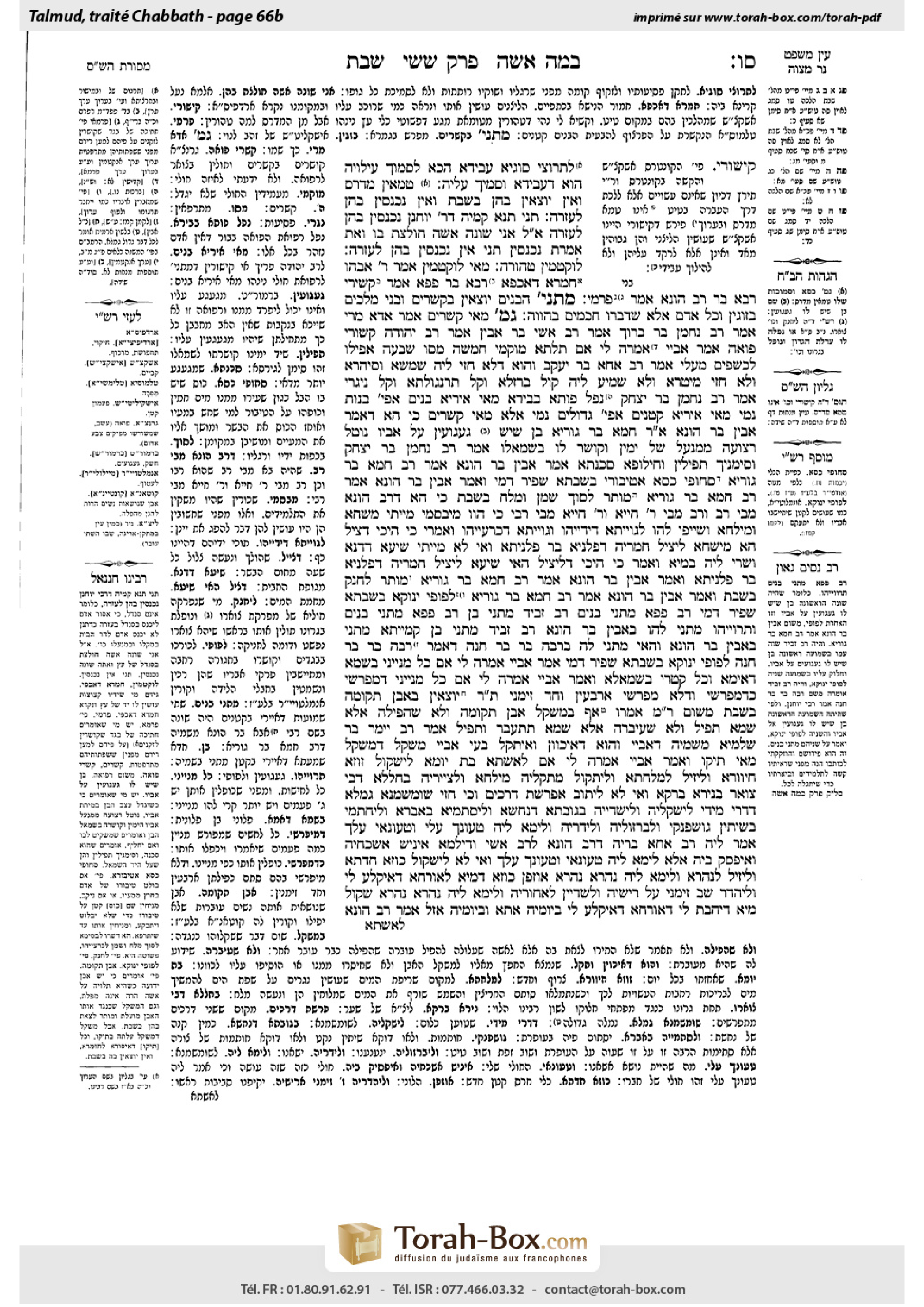
Shabbat 66b: Talmud study for Daf Yomi
Daf Yomi is the daily study of one Talmud folio. Explore 37 tractates with scans, Hebrew text, Sefaria English and AI-generated French translations where annotated.
Passage selection and English or AI-generated French translation are available where the scan has annotations. Daf Study is independent of Torah-Box and Sefaria.
Browse Shabbat · שבת · All tractatesShabbat 66b text and translations
This page of Shabbat includes the Aramaic text, an English translation and an AI-generated French translation, alongside the scan above.
שבת ס״ו ב · Aramaic and Hebrew text
לְתָרוֹצֵי סוּגְיָא עֲבִידָא, הָכָא — לִסְמוֹךְ עִילָּוֵיהּ הוּא דַּעֲבִידָא, וְסָמֵיךְ עֲלֵיהּ.
טְמֵאִין מִדְרָס, וְאֵין יוֹצְאִין בָּהֶן בְּשַׁבָּת, וְאֵין נִכְנָסִין בָּהֶן לָעֲזָרָה.
תָּנֵי תַּנָּא קַמֵּיהּ דְּרַבִּי יוֹחָנָן: ״נִכְנָסִין בָּהֶן לָעֲזָרָה״.
אֲמַר לֵיהּ: אֲנִי שׁוֹנֶה ״אִשָּׁה חוֹלֶצֶת בּוֹ״, וְאַתְּ אָמְרַתְּ ״נִכְנָסִין״?! תְּנִי ״אֵין נִכְנָסִין בָּהֶן לָעֲזָרָה״.
לוּקַטְמִין טְהוֹרָה. מַאי לוּקַטְמִין? אָמַר רַבִּי אֲבָהוּ: חֲמָרָא דְּאַכַּפָּא. רָבָא בַּר פָּפָּא אָמַר: קִישְׁרֵי. רָבָא בַּר רַב הוּנָא אָמַר: פְּרָמֵי.
מַתְנִי׳ הַבָּנִים יוֹצְאִין בִּקְשָׁרִים וּבְנֵי מְלָכִים בְּזוֹגִין, וְכׇל אָדָם — אֶלָּא שֶׁדִּבְּרוּ חֲכָמִים בַּהוֹוֶה.
גְּמָ׳ מַאי קְשָׁרִים? אָמַר אַדָּא מָרִי אָמַר רַב נַחְמָן בַּר בָּרוּךְ אָמַר רַב אָשֵׁי בַּר אָבִין אָמַר רַב יְהוּדָה: קִשּׁוּרֵי פוּאָה.
אָמַר אַבָּיֵי, אֲמַרָה לִי אֵם: תְּלָתָא — מוֹקְמִי, חֲמִשָּׁה — מַסּוּ, שִׁבְעָה — אֲפִילּוּ לִכְשָׁפִים מְעַלּוּ.
אָמַר רַב אַחָא בַּר יַעֲקֹב: וְהוּא דְּלָא חֲזִי לֵיהּ שִׁמְשָׁא וְסֵיהֲרָא, וְלָא חֲזִי מִיטְרָא, וְלָא שְׁמִיעַ לֵיהּ קָל בַּרְזְלָא, וְקָל תַּרְנוּגְלָא, וְקָל נִיגְרֵי. אָמַר רַב נַחְמָן בַּר יִצְחָק: נְפַל פּוּתָא בְּבֵירָא.
מַאי אִירְיָא בָּנִים? אֲפִילּוּ בָּנוֹת נָמֵי! מַאי אִירְיָא קְטַנִּים? אֲפִילּוּ גְּדוֹלִים נָמֵי!
אֶלָּא מַאי קְשָׁרִים — כִּי הָא דְּאָמַר אָבִין בַּר הוּנָא אָמַר רַבִּי חָמָא בַּר גּוּרְיָא: בֵּן שֶׁיֵּשׁ לוֹ גַּעְגּוּעִין עַל אָבִיו — נוֹטֵל רְצוּעָה מִמִּנְעָל שֶׁל יָמִין וְקוֹשֵׁר לוֹ בִּשְׂמֹאלוֹ. אָמַר רַב נַחְמָן בַּר יִצְחָק: וְסִימָנָיךְ — תְּפִילִּין, וְחִילּוּפָא סַכַּנְתָּא.
אָמַר אָבִין בַּר הוּנָא אָמַר רַב חָמָא בַּר גּוּרְיָא: סַחוֹפֵי כָּסָא אַטִּיבּוּרֵי בְּשַׁבְּתָא — שַׁפִּיר דָּמֵי.
וְאָמַר אָבִין בַּר הוּנָא אָמַר רַב חָמָא בַּר גּוּרְיָא: מוּתָּר לָסוּךְ שֶׁמֶן וּמֶלַח בְּשַׁבָּת.
כִּי הָא דְּרַב הוּנָא מִבֵּי רַב, וְרַב מִבֵּי רַבִּי חִיָּיא, וְרַבִּי חִיָּיא מִבֵּי רַבִּי, כִּי הֲווֹ מִיבַּסְּמִי מַיְיתוּ מִשְׁחָא וּמִילְחָא, וְשָׁיְיפִי לְהוּ לְגַוָּיָיתָא דִּידַיְיהוּ וְגַוָּיָיתָא דְּכַרְעַיְיהוּ, וְאָמְרִי: ״כִּי הֵיכִי דְּצָיֵל הָא מִישְׁחָא לֵיצִיל חַמְרֵיהּ דִּפְלָנְיָא בַּר פְּלָנִיתָא״. וְאִי לָא — מַיְיתֵי שִׁיעָא דְּדַנָּא וְשָׁרֵי לֵיהּ בְּמַיָּא, וְאָמַר: ״כִּי הֵיכִי דְּצָיֵל הַאי שִׁיעָא לֵיצִיל חַמְרֵיהּ דִּפְלָנְיָא בַּר פְּלָנִיתָא״.
וְאָמַר אָבִין בַּר הוּנָא אָמַר רַב חָמָא בַּר גּוּרְיָא: מוּתָּר לֵחָנֵק בְּשַׁבָּת.
וְאָמַר אָבִין בַּר הוּנָא אָמַר רַב חָמָא בַּר גּוּרְיָא: לַפּוֹפֵי יָנוֹקָא בְּשַׁבְּתָא — שַׁפִּיר דָּמֵי.
רַב פָּפָּא מַתְנֵי ״בָּנִים״, רַב זְבִיד מַתְנֵי ״בֵּן״. רַב פָּפָּא מַתְנֵי ״בָּנִים״, וְתַרְוַיְיהוּ מַתְנֵי לְהוּ בְּאָבִין בַּר הוּנָא. רַב זְבִיד מַתְנֵי ״בֵּן״ — קַמַּיְיתָא מַתְנֵי בְּאָבִין בַּר הוּנָא, וְהַאי מַתְנֵי לַהּ בְּרַבָּה בַּר בַּר חָנָה. דְּאָמַר רַבָּה בַּר בַּר חָנָה: לַפּוֹפֵי יָנוֹקָא בְּשַׁבְּתָא — שַׁפִּיר דָּמֵי.
אָמַר אַבָּיֵי, אֲמַרָה לִי אֵם: כֹּל מִנְיָינֵי — בִּשְׁמָא דְאִימָּא, וְכֹל קִטְרֵי — בִּשְׂמָאלָא.
וְאָמַר אַבָּיֵי, אֲמַרָה לִי אֵם: כֹּל מִנְיָינֵי דְּמִפָּרְשִׁי — כִּדְמִפָּרְשִׁי, וּדְלָא מִפָּרְשִׁי — אַרְבְּעִין וְחַד זִימְנֵי.
תָּנוּ רַבָּנַן: יוֹצְאִין בְּאֶבֶן תְּקוּמָה בְּשַׁבָּת. מִשּׁוּם רַבִּי מֵאִיר אָמְרוּ: אַף בְּמִשְׁקַל אֶבֶן תְּקוּמָה. וְלֹא שֶׁהִפִּילָה, אֶלָּא שֶׁמָּא תַּפִּיל. וְלֹא שֶׁעִיבְּרָה, אֶלָּא שֶׁמָּא תִּתְעַבֵּר וְתַפִּיל. אָמַר רַב יֵימַר בַּר שֶׁלֶמְיָא מִשְּׁמֵיהּ דְּאַבָּיֵי: וְהוּא דְּאִיכַּוַּון וְאִיתְּקַל. בָּעֵי אַבָּיֵי: מִשְׁקָל דְּמִשְׁקָל מַאי? תֵּיקוּ.
וְאָמַר אַבָּיֵי, אֲמַרָה לִי אֵם: לְאִשָּׁתָא בַּת יוֹמָא — לִישְׁקוֹל זוּזָא חִיוּוֹרָא, וְלֵיזִיל לְמִלְחֲתָא, וְלִיתְקוֹל מַתְקָלֵיהּ מִילְחָא, וְלִצְיְירֵיהּ בַּחֲלָלָא דְבֵי צַוָּאר בְּנִירָא בַּרְקָא.
וְאִי לָא — לִיתֵּיב אַפָּרָשַׁת דְּרָכִים, וְכִי חָזֵי שׁוּמְשְׁמָנָא גַּמְלָא דְּדָרֵי מִידֵּי, לִישְׁקְלֵיהּ וְלִישְׁדְּיֵיהּ בְּגוּבְתָּא דִנְחָשָׁא, וְלִיסְתְּמֵיהּ בַּאֲבָרָא, וְלִיחְתְּמֵיהּ בְּשִׁיתִּין גּוּשְׁפַּנְקֵי, וּלְבַרְזוֹלֵיהּ, וְלִידְרֵיהּ, וְלֵימָא לֵיהּ: ״טְעוּנָךְ עֲלַי וּטְעוּנַאי עֲלָךְ״. אֲמַר לֵיהּ רַב אַחָא בְּרֵיהּ דְּרַב הוּנָא לְרַב אָשֵׁי: וְדִילְמָא אִינִישׁ אַשְׁכְּחֵיהּ וְאִיפְּסִק בֵּיהּ? אֶלָּא לֵימָא לֵיהּ: ״טְעוּנַאי וּטְעוּנָךְ עֲלָךְ״.
וְאִי לָא, לִישְׁקוֹל כּוּזָא חַדְתָּא, וְלֵיזִיל לְנַהְרָא, וְלֵימָא לֵיהּ: ״נַהֲרָא נַהֲרָא, אוֹזְפַן כּוּזָא דְמַיָּא לְאוֹרְחָא דְּאִיקְּלַע לִי״. וְלַיהְדַּר שָׁב זִימְנֵי עַל רֵישֵׁיהּ, וְלִשְׁדְּיֵיהּ לַאֲחוֹרֵיהּ, וְלֵימָא לֵיהּ: ״נַהֲרָא נַהֲרָא, שְׁקוֹל מַיָּא דִּיהַבְתְּ לִי, דְּאוֹרְחָא דְּאִיקְּלַע לִי בְּיוֹמֵיהּ אֲתָא וּבְיוֹמֵיהּ אֲזַל״.
אָמַר רַב הוּנָא:
Shabbat 66b · English translation
it is made merely to align his steps and straighten his posture. He does not completely lean all his weight on it. Here, in the case of a wooden leg, it is made to lean on, and in fact he leans all his weight on it.
It was taught in the mishna that the supports of a zav and his chair are subject to ritual impurity imparted by treading, and one may not go out with them on Shabbat, and one may not enter into the Temple courtyard with them.
The tanna, who recited mishnayot before Rabbi Yoḥanan, taught the opposite halakha in the mishna: One may enter into the Temple courtyard with them.
Rabbi Yoḥanan said to him: I teach that a woman may perform ḥalitza with this support, as it has the legal status of a shoe in every sense, and you say that one may enter the Temple courtyard? Teach the mishna in the following manner: One may not enter into the Temple courtyard with them.
We learned in the mishna that loketamin are pure. The Gemara asks: What are loketamin? Rabbi Abbahu said: They are wooden toys in the shape of a donkey one carried on the shoulders, creating the impression that the donkey is riding him. Rava bar Pappa said: They are stilts used to avoid getting dirty when walking in mud or for amusement. Rava bar Rav Huna said: They are masks [peramei].
MISHNA: Young boys may go out on Shabbat with knots as a folk remedy and princes with bells. And any person is permitted to go out on Shabbat with those objects; however, the Sages spoke in the present, addressing situations that were prevalent.
GEMARA: We learned in the mishna that young boys may go out on Shabbat with knots. The Gemara asks: What are these knots? Adda Mari said that Rav Naḥman bar Barukh said that Rav Ashi bar Avin said that Rav Yehuda said: They are garlands of the madder plant that are tied for their medicinal qualities.
Abaye said: Mother, actually his foster mother, said to me about the healing properties of madder: Three garlands maintain the illness at its present state and prevent it from worsening, five garlands heal the illness, and seven are effective even against sorcery.
Rav Aḥa bar Ya’akov said: And that benefit provided by the madder plant is specifically in a case where one on whom the knots were tied does not look at the sun and the moon, and does not see rain, and hears neither the sound of clanging iron, nor the sound of the hen, nor the sound of footsteps. Rav Naḥman bar Yitzḥak said: If that is the case, the remedial powers of the madder fell in a pit, i.e., if so many conditions exist, for all intents and purposes it provides no benefit at all.
The Gemara asks: If these knots in the madder plant have remedial qualities, why specifically were boys mentioned in the mishna? Even girls can benefit from the cure as well. By the same token, why specifically were young boys mentioned in the mishna? Even adults can benefit from the cure as well.
Rather, what are these knots? Like that which Avin bar Huna said that Rav Ḥama bar Gurya said: A son who has longings for his father and has a difficult time leaving him, the father takes a strap from the right shoe and ties it on the boy’s left arm as a talisman to help the child overcome his longings. These feelings are more common in small children and especially in boys for their fathers, as fathers were more involved in raising their sons than they were in raising their daughters. Therefore, the Sages allowed specifically young boys to go out with these knots. With regard to this practice, Rav Naḥman bar Yitzḥak said: And your mnemonic for where to tie the strap is phylacteries, which are tied by the right hand on the left arm. And the opposite, tying the strap from the left shoe onto his right arm, is dangerous because it will exacerbate his longings.
On the topic of the use of various forms of healing and medicinal practices and their permissibility on Shabbat, the Gemara cites additional statements by that Sage on these topics. Avin bar Huna said that Rav Ḥama bar Gurya said: With regard to overturning an empty cup in which there had been hot water and placing it on one’s navel for healing purposes on Shabbat, he may well do so.
And Avin bar Huna said that Rav Ḥama bar Gurya said: It is permissible to smear oil and salt on oneself on Shabbat.
As in this case of Rav Huna, who departed from the house of Rav, and Rav, who departed from the house of Rabbi Ḥiyya, and Rabbi Ḥiyya, who departed from the house of Rabbi Yehuda HaNasi, when they were drunk, the rabbi would bring oil and salt and rub them on the palms of their hands and the soles of their feet and say: Just as this oil is clear, so let the wine of so-and-so, son of so-and-so, his mother, become clear. In other words, let them become sober. And if he could not bring oil and salt, or if they did not work, he would bring the sealing clay of a barrel and soak it in water and say: Just as this sealing clay is clear, so let the wine of so-and-so, son of so-and-so, become clear.
And Avin bar Huna said that Rav Ḥama bar Gurya said: It is permitted to strangle, i.e., tightly bandage the neck of one whose vertebra was dislocated in order to reset it, on Shabbat.
And Avin bar Huna said that Rav Ḥama bar Gurya said: With regard to tightly swaddling a baby born on Shabbat in order to align any limbs that may have been dislocated in birth, one may well do so.
There were different versions with regard to the halakhot of Avin bar Huna. Rav Pappa taught two halakhot with regard to children in his name and Rav Zevid taught one halakha with regard to a child in his name. The Gemara explains: Rav Pappa taught two halakhot with regard to children, and he taught both of them in the name of Avin bar Huna, i.e., the halakha with regard to knots and the halakha with regard to swaddling. Rav Zevid taught one halakha with regard to a child. The first, with regard to knots, he taught in the name of Avin bar Huna. And this, with regard to swaddling, he taught in the name of Rabba bar bar Ḥana, as Rabba bar bar Ḥana said: With regard to tightly swaddling a baby on Shabbat, one may well do so.
The Gemara cites additional statements said by Abaye in the name of the woman who raised him with regard to remedies. Abaye said, Mother said to me: All incantations that are repeated are intoned using the name of the mother of the one requiring the incantation, and all knots tied for the purpose of healing are tied on the left.
And Abaye said, Mother said to me: All incantations for which the number of times they must be intoned is specified, one recites them as they are specified; and those for which the number of times they must be intoned is not specified, one recites them forty-one times.
The Sages taught in a baraita: One may go out with a preservation stone, which prevent miscarriages, on Shabbat. They said in the name of Rabbi Meir that one may go out even with the counterweight of a preservation stone; i.e., a stone or another object that was weighed against and found equivalent to the weight of the preservation stone, which is also effective. And this leniency applies not only to a woman who miscarried in the past and is concerned that she may miscarry again; rather, it applies even to a woman who never miscarried and is concerned lest she miscarry for the first time. And it applies not only to a woman who is aware that she is pregnant; rather, it applies even if a woman suspects that she may become pregnant and miscarry. Rav Yeimar bar Shelamya said in the name of Abaye: And this applies only when he happened upon an object that was found equal to the preservation stone when he weighed it against that stone, not when one alters the object to equal the weight of the preservation stone. Abaye raised a dilemma: With regard to a counterweight to the counterweight, i.e., one who finds an object and determines its weight by weighing it against the counterweight of the preservation stone, what is its legal status? May a woman go out into the public domain with it? The Gemara concludes: Let this dilemma stand unresolved.
And Abaye said, Mother said to me: To heal a fever of one day, let one take a pale, i.e., newly minted, dinar and go to the salt pools, and weigh its weight in salt against it, and let him bind the salt to the opening of the neckline of his garment with a thread made of hair.
And if this remedy is not effective, let him sit at a crossroads, and when he sees a large ant carrying something, he should take the ant and place it in a copper tube, and close it with lead, and seal it with sixty seals, and shake it, and lift it, and say to it: Your burden is upon me and my burden, my fever, is upon you. Rav Aḥa, son of Rav Huna, said to Rav Ashi: And perhaps a different person already found this ant and used this remedy to end his illness. In that case, by accepting the burden of the ant, he is bringing another’s illness upon himself. Rather, let him say to the ant: My burden and your burden are upon you.
And if that remedy is not effective, let him take a new jug, and go to the river, and say to it: River, river, lend me a jug of water for a guest who happened to come to me. And let him turn it around his head seven times, and pour out the water behind him, and say to it: River, river, take back the water that you gave me because the guest who happened to come to me came on its day and left on its day.
Rav Huna said:
Shabbat 66b · Traduction française (IA)
Il sert uniquement à régulariser sa démarche et à redresser sa posture. Il ne s’appuie pas dessus de tout son poids. Ici, dans le cas d’une jambe de bois, celle-ci est faite pour servir d’appui et, de fait, il s’appuie dessus de tout son poids.
Il a été enseigné dans la Michna que les supports d’un zav et son siège sont sujets à l’impureté rituelle transmise par foulage, qu’on ne peut pas sortir avec eux le Chabbat et qu’on ne peut pas entrer avec eux dans la cour du Temple.
Le tanna qui récitait des michnayot devant Rabbi Yoḥanan enseigna dans la Michna la halakha inverse : on peut entrer avec eux dans la cour du Temple.
Rabbi Yoḥanan lui dit : « Moi, j’enseigne qu’une femme peut accomplir la ḥalitsa avec ce support, puisqu’il a, à tous égards, le statut juridique d’une chaussure, et toi, tu dis qu’on peut entrer dans la cour du Temple ? » Enseigne la Michna de la manière suivante : on ne peut pas entrer avec eux dans la cour du Temple.
Nous avons appris dans la Michna que les loketamin sont purs. La Guemara demande : Que sont les loketamin ? Rabbi Abbahu dit : Ce sont des jouets en bois en forme d’âne, que l’on portait sur les épaules, donnant l’impression que l’âne le chevauchait. Rava bar Pappa dit : Ce sont des échasses utilisées pour éviter de se salir en marchant dans la boue ou pour s’amuser. Rava bar Rav Huna dit : Ce sont des masques [peramei].
MICHNA : Les jeunes garçons peuvent sortir le Chabbat avec des nœuds servant de remède populaire, et les princes avec des clochettes. Toute personne est autorisée à sortir le Chabbat avec ces objets ; toutefois, les Sages se sont exprimés en se référant aux situations courantes.
GUEMARA : Nous avons appris dans la Michna que les jeunes garçons peuvent sortir le Chabbat avec des nœuds. La Guemara demande : Que sont ces nœuds ? Adda Mari dit au nom de Rav Naḥman bar Barukh, qui dit au nom de Rav Ashi bar Avin, qui dit au nom de Rav Yehuda : Ce sont des guirlandes de garance nouées pour leurs propriétés médicinales.
Abaye dit : « Ma mère — en réalité, sa nourrice — m’a dit au sujet des propriétés médicinales de la garance : trois guirlandes maintiennent la maladie dans son état actuel et l’empêchent de s’aggraver ; cinq la guérissent ; et sept sont efficaces même contre la sorcellerie. »
Rav Aḥa bar Ya’akov dit : Le bénéfice procuré par la garance n’existe que si la personne à laquelle les nœuds ont été attachés ne regarde ni le soleil ni la lune, ne voit pas la pluie et n’entend ni le bruit du fer qui s’entrechoque, ni le chant de la poule, ni le bruit des pas. Rav Naḥman bar Yitzḥak dit : Si c’est le cas, les vertus médicinales de la garance sont tombées dans un puits ; autrement dit, si tant de conditions sont requises, en pratique, elle ne procure absolument aucun bénéfice.
La Guemara demande : Si ces nœuds de garance ont des propriétés curatives, pourquoi la Michna mentionne-t-elle spécifiquement les garçons ? Les filles aussi peuvent bénéficier de ce remède. De même, pourquoi la Michna mentionne-t-elle spécifiquement les jeunes garçons ? Les adultes aussi peuvent en bénéficier.
Mais que sont donc ces nœuds ? Ils correspondent à ce qu’Avin bar Huna a dit au nom de Rav Ḥama bar Gurya : lorsqu’un fils éprouve un grand manque de son père et a du mal à le quitter, le père prend une lanière de sa chaussure droite et la noue autour du bras gauche du garçon, comme talisman pour l’aider à surmonter ce manque. Ces sentiments sont plus fréquents chez les jeunes enfants, et particulièrement chez les garçons envers leur père, car les pères participaient davantage à l’éducation de leurs fils qu’à celle de leurs filles. C’est pourquoi les Sages ont autorisé spécifiquement les jeunes garçons à sortir avec ces nœuds. À propos de cette pratique, Rav Naḥman bar Yitzḥak dit : Le moyen mnémotechnique pour se rappeler où nouer la lanière est celui des tefillin, que la main droite attache au bras gauche. À l’inverse, nouer la lanière de la chaussure gauche autour du bras droit est dangereux, car cela intensifierait le manque.
À propos de l’emploi de différentes formes de guérison et de pratiques médicinales, et de leur autorisation le Chabbat, la Guemara cite d’autres déclarations de ce Sage sur ces sujets. Avin bar Huna dit au nom de Rav Ḥama bar Gurya : on peut bien retourner, à des fins thérapeutiques le Chabbat, une coupe vide qui avait contenu de l’eau chaude et la poser sur son nombril.
Avin bar Huna dit aussi au nom de Rav Ḥama bar Gurya : il est permis de s’enduire d’huile et de sel le Chabbat.
Ainsi, lorsque Rav Huna quittait la maison de Rav, que Rav quittait la maison de Rabbi Ḥiyya et que Rabbi Ḥiyya quittait la maison de Rabbi Yehuda HaNasi, s’ils étaient ivres, le maître leur apportait de l’huile et du sel, les leur frottait sur les paumes des mains et les plantes des pieds et disait : « De même que cette huile est limpide, que le vin d’untel, fils d’untelle, devienne limpide. » Autrement dit, qu’ils retrouvent leur sobriété. S’il ne pouvait pas apporter d’huile et de sel, ou si cela ne fonctionnait pas, il apportait l’argile de scellement d’un tonneau, la faisait tremper dans l’eau et disait : « De même que cette argile de scellement est limpide, que le vin d’untel, fils d’untelle, devienne limpide. »
Avin bar Huna dit aussi au nom de Rav Ḥama bar Gurya : il est permis d’étrangler, c’est-à-dire de bander étroitement le cou d’une personne dont une vertèbre s’est déplacée afin de la remettre en place, le Chabbat.
Avin bar Huna dit aussi au nom de Rav Ḥama bar Gurya : on peut bien emmailloter étroitement, le Chabbat, un bébé né ce jour-là, afin de réaligner les membres qui auraient pu être déplacés pendant l’accouchement.
Il existait différentes versions des halakhot transmises par Avin bar Huna. Rav Pappa enseignait en son nom deux halakhot concernant les enfants, tandis que Rav Zevid en enseignait une en son nom concernant un enfant. La Guemara explique : Rav Pappa enseignait deux halakhot concernant les enfants, toutes deux au nom d’Avin bar Huna, à savoir la halakha des nœuds et celle de l’emmaillotage. Rav Zevid enseignait une halakha concernant un enfant. La première, celle des nœuds, il l’enseignait au nom d’Avin bar Huna. Celle concernant l’emmaillotage, il l’enseignait au nom de Rabba bar bar Ḥana, car Rabba bar bar Ḥana disait : on peut bien emmailloter étroitement un bébé le Chabbat.
La Guemara cite d’autres déclarations d’Abaye au nom de la femme qui l’avait élevé, concernant les remèdes. Abaye dit : « Ma mère m’a dit : toutes les incantations qui sont répétées se récitent en mentionnant le nom de la mère de la personne qui a besoin de l’incantation, et tous les nœuds noués à des fins thérapeutiques se font à gauche. »
Abaye dit aussi : « Ma mère m’a dit : pour toute incantation dont le nombre de récitations est précisé, on la récite le nombre indiqué ; et pour celles dont le nombre de récitations n’est pas précisé, on la récite quarante et une fois. »
Les Sages ont enseigné dans une baraïta : on peut sortir le Chabbat avec une pierre protectrice, qui empêche les fausses couches. On a enseigné au nom de Rabbi Meir qu’on peut sortir même avec le contrepoids d’une pierre protectrice, c’est-à-dire une pierre ou un autre objet pesé et trouvé d’un poids égal à celui de la pierre protectrice, qui est également efficace. Cette permission ne concerne pas seulement une femme qui a fait une fausse couche par le passé et craint d’en faire une autre ; elle concerne aussi une femme qui n’en a jamais fait et craint d’en faire une pour la première fois. Elle ne concerne pas seulement une femme qui sait qu’elle est enceinte ; elle concerne également une femme qui soupçonne qu’elle pourrait tomber enceinte et faire une fausse couche. Rav Yeimar bar Shelamya dit au nom d’Abaye : cela ne s’applique que si l’on est tombé par hasard sur un objet dont le poids s’est révélé égal à celui de la pierre protectrice lorsqu’on l’a pesé contre cette pierre, et non si l’on modifie l’objet pour lui donner le même poids que la pierre protectrice. Abaye souleva une difficulté : quel est le statut du contrepoids du contrepoids, c’est-à-dire d’un objet trouvé dont on a déterminé le poids en le pesant contre le contrepoids de la pierre protectrice ? Une femme peut-elle sortir avec cet objet dans le domaine public ? La Guemara conclut : que cette question reste sans réponse.
Abaye dit aussi : « Ma mère m’a dit : pour guérir une fièvre d’un jour, prends un dinar pâle, c’est-à-dire fraîchement frappé, rends-toi aux salines, pèse contre lui son poids en sel, puis attache le sel à l’ouverture du col de ton vêtement avec un fil de crin. »
Et si ce remède n’est pas efficace, qu’il s’assoie à un carrefour ; lorsqu’il voit une grosse fourmi porter quelque chose, qu’il la prenne, la place dans un tube de cuivre, le ferme avec du plomb, le scelle de soixante sceaux, puis le secoue et le soulève, en lui disant : « Ton fardeau est sur moi, et mon fardeau, ma fièvre, est sur toi. » Rav Aḥa, fils de Rav Huna, dit à Rav Ashi : « Peut-être une autre personne a-t-elle déjà trouvé cette fourmi et utilisé ce remède pour mettre fin à sa maladie. Dans ce cas, en prenant sur lui le fardeau de la fourmi, il attire sur lui la maladie d’autrui. » Il dira plutôt à la fourmi : « Mon fardeau et ton fardeau sont sur toi. »
Et si ce remède n’est pas efficace, qu’il prenne une cruche neuve, aille au fleuve et lui dise : « Fleuve, fleuve, prête-moi une cruche d’eau pour un invité qui est arrivé chez moi par hasard. » Qu’il fasse tourner la cruche sept fois autour de sa tête, puis verse l’eau derrière lui et dise : « Fleuve, fleuve, reprends l’eau que tu m’as donnée, car l’invité qui est arrivé chez moi par hasard est venu le jour qui était le sien et est reparti le jour qui était le sien. »
Rav Huna dit :
Traduction française générée par IA à partir de l’édition anglaise de Sefaria. Vérifie toujours un passage avec le texte source.
Text from Sefaria: William Davidson Edition - Vocalized Aramaic (CC BY NC); William Davidson Edition - English (CC BY NC).