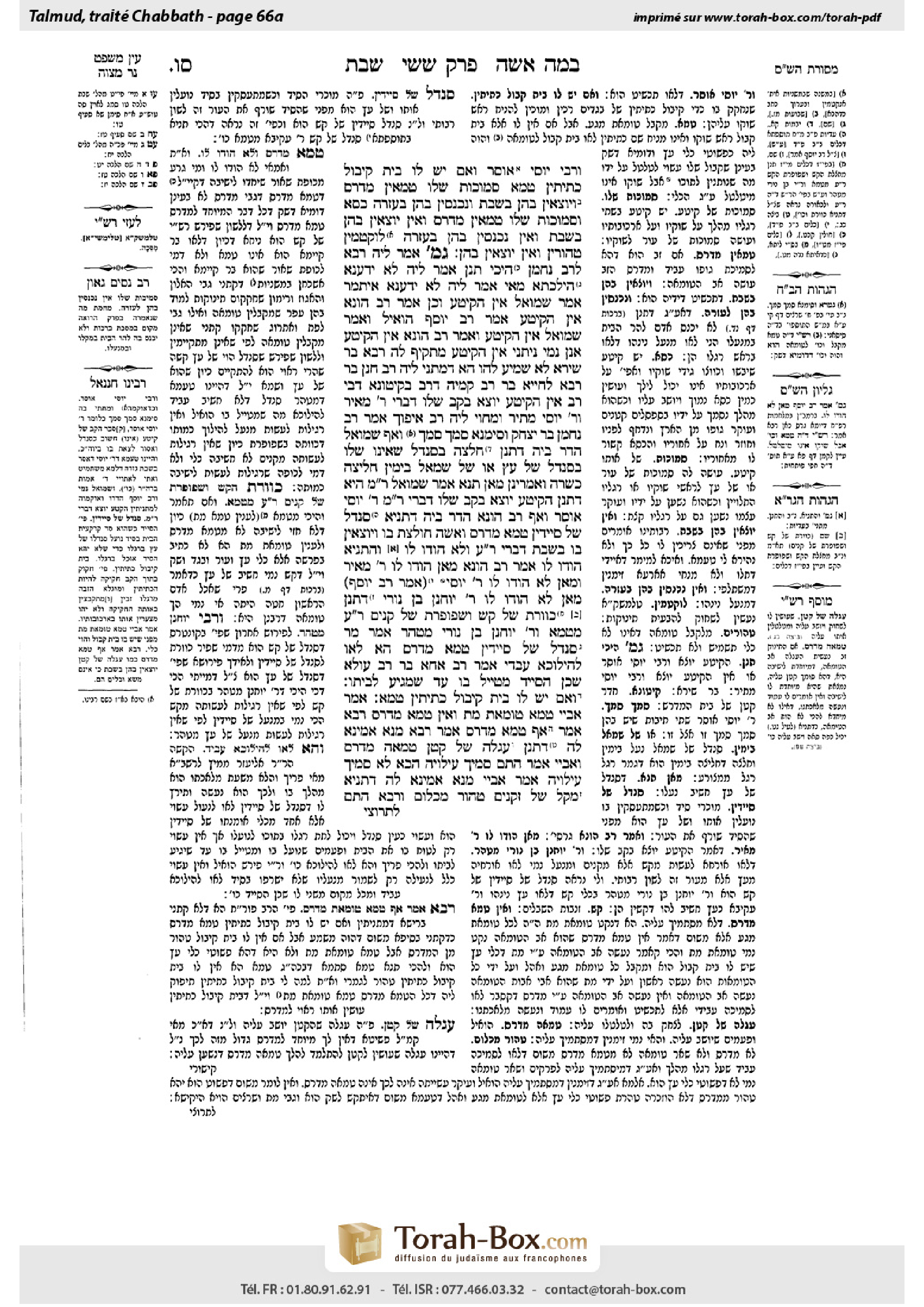
Shabbat 66a: Talmud study for Daf Yomi
Daf Yomi is the daily study of one Talmud folio. Explore 37 tractates with scans, Hebrew text, Sefaria English and AI-generated French translations where annotated.
Passage selection and English or AI-generated French translation are available where the scan has annotations. Daf Study is independent of Torah-Box and Sefaria.
Browse Shabbat · שבת · All tractatesShabbat 66a text and translations
This page of Shabbat includes the Aramaic text, an English translation and an AI-generated French translation, alongside the scan above.
שבת ס״ו א · Aramaic and Hebrew text
וְרַבִּי יוֹסֵי אוֹסֵר.
וְאִם יֵשׁ לוֹ בֵּית קִיבּוּל כְּתִיתִין — טָמֵא.
סָמוֹכוֹת שֶׁלּוֹ טְמֵאִין מִדְרָס, וְיוֹצְאִין בָּהֶן בְּשַׁבָּת, וְנִכְנָסִין בָּהֶן בָּעֲזָרָה.
כִּסֵּא וְסָמוֹכוֹת שֶׁלּוֹ טְמֵאִין מִדְרָס, וְאֵין יוֹצְאִין בָּהֶן בְּשַׁבָּת, וְאֵין נִכְנָסִין בָּהֶן בַּעֲזָרָה.
לוּקַטְמִין טְהוֹרִין, וְאֵין יוֹצְאִין בָּהֶן.
גְּמָ׳ אֲמַר לֵיהּ רָבָא לְרַב נַחְמָן: הֵיכִי תְּנַן? אֲמַר לֵיהּ: לָא יָדַעְנָא. הִילְכְתָא מַאי? אֲמַר לֵיהּ: לָא יָדַעְנָא.
אִיתְּמַר, אָמַר שְׁמוּאֵל: ״אֵין הַקִּיטֵּעַ״, וְכֵן אָמַר רַב הוּנָא: ״אֵין הַקִּיטֵּעַ״. אָמַר רַב יוֹסֵף: הוֹאִיל וְאָמַר שְׁמוּאֵל ״אֵין הַקִּיטֵּעַ״ וְאָמַר רַב הוּנָא ״אֵין הַקִּיטֵּעַ״ — אֲנַן נָמֵי נִיתְנֵי ״אֵין הַקִּיטֵּעַ״.
מַתְקִיף לַהּ רָבָא בַּר שִׁירָא: לָא שְׁמִיעַ לְהוּ הָא דְּמַתְנֵי לֵיהּ רַב חָנָן בַּר רָבָא לְחִיָּיא בַּר רַב קַמֵּיהּ דְּרַב בְּקִיטוֹנָא דְבֵי רַב? אֵין הַקִּיטֵּעַ יוֹצֵא בְּקַב שֶׁלּוֹ — דִּבְרֵי רַבִּי מֵאִיר, וְרַבִּי יוֹסֵי מַתִּיר. וּמַחְוֵי לֵיהּ רַב: אֵיפוֹךְ. אָמַר רַב נַחְמָן בַּר יִצְחָק, וְסִימָנָא: ״סָמֶךְ״ ״סָמֶךְ״.
וְאַף שְׁמוּאֵל הֲדַר בֵּיהּ. דִּתְנַן: חָלְצָה בְּסַנְדָּל שֶׁאֵינוֹ שֶׁלּוֹ, בְּסַנְדָּל שֶׁל עֵץ, אוֹ שֶׁל שְׂמֹאל בְּיָמִין — חֲלִיצָה כְּשֵׁרָה.
וְאָמְרִינַן: מַאן תַּנָּא? אָמַר שְׁמוּאֵל: רַבִּי מֵאִיר הִיא, דִּתְנַן: הַקִּיטֵּעַ יוֹצֵא בְּקַב שֶׁלּוֹ — דִּבְרֵי רַבִּי מֵאִיר, רַבִּי יוֹסֵי אוֹסֵר.
וְאַף רַב הוּנָא הֲדַר בֵּיהּ, דְּתַנְיָא: סַנְדָּל שֶׁל סַיָּידִין טָמֵא מִדְרָס, וְאִשָּׁה חוֹלֶצֶת בּוֹ, וְיוֹצְאִין בּוֹ בְּשַׁבָּת — דִּבְרֵי רַבִּי עֲקִיבָא, וְלֹא הוֹדוּ לוֹ.
וְהָתַנְיָא ״הוֹדוּ לוֹ״! אָמַר רַב הוּנָא: מַאן ״הוֹדוּ לוֹ״ — רַבִּי מֵאִיר, וּמַאן ״לֹא הוֹדוּ לוֹ״ — רַבִּי יוֹסֵי.
אָמַר רַב יוֹסֵף: מַאן ״לֹא הוֹדוּ לוֹ״ — רַבִּי יוֹחָנָן בֶּן נוּרִי. דִּתְנַן: כַּוֶּרֶת שֶׁל קַשׁ וּשְׁפוֹפֶרֶת שֶׁל קָנִים — רַבִּי עֲקִיבָא מְטַמֵּא, וְרַבִּי יוֹחָנָן בֶּן נוּרִי מְטַהֵר.
אָמַר מָר: סַנְדָּל שֶׁל סַיָּידִין טָמֵא מִדְרָס. הָא לָאו לְהִילּוּכָא עֲבִיד! אָמַר רַב אַחָא בַּר רַב עוּלָּא: שֶׁכֵּן הַסַּיָּיד מְטַיֵּיל בּוֹ עַד שֶׁמַּגִּיעַ לְבֵיתוֹ.
וְאִם יֵשׁ לוֹ בֵּית קִיבּוּל כְּתִיתִין — טָמֵא. אָמַר אַבָּיֵי: טָמֵא טוּמְאַת מֵת, וְאֵין טָמֵא מִדְרָס. רָבָא אָמַר: אַף טָמֵא מִדְרָס.
אָמַר רָבָא: מְנָא אָמֵינָא לַהּ — דִּתְנַן: עֲגָלָה שֶׁל קָטָן — טְמֵאָה מִדְרָס. וְאַבָּיֵי אֲמַר: הָתָם סָמֵיךְ עִילָּוֵיהּ, הָכָא לָא סָמֵיךְ עִילָּוֵיהּ.
אָמַר אַבָּיֵי: מְנָא אָמֵינָא לַהּ — דְּתַנְיָא: מַקֵּל שֶׁל זְקֵנִים טָהוֹר מִכְּלוּם!
וְרָבָא: הָתָם
Shabbat 66a · English translation
And Rabbi Yosei prohibits going out into the public domain with the wooden leg, since he does not consider it to have the legal status of a shoe.
And if the wooden leg has a receptacle for pads, a concave space at the top of the leg into which pads are placed to cushion the amputated leg, it assumes the status of a wooden vessel and can become ritually impure.
And his supports, which are shoes that one who had both of his feet amputated places on his knees in order to walk on his knees, if a zav wears them, they are subject to ritual impurity imparted by treading. A zav is a primary source of ritual impurity. If he touches a vessel it assumes first-degree ritual impurity status. However, vessels on which he treads, sits, lies, or leans become primary sources of ritual impurity, provided they are designated for that purpose. These supports are vessels designated for treading. And one may go out with them into the public domain on Shabbat since they have the legal status of shoes. And one may enter the Temple courtyard with them. Although, generally, wearing shoes in the Temple courtyard is prohibited, in this regard, the supports do not have the legal status of shoes.
However, if one who is crippled to the extent that he cannot walk at all sits on a chair that is attached to him, places supports on his hands, and propels himself along with his hands, his chair and supports are subject to ritual impurity imparted by treading. And one may not go out with them on Shabbat, and one may not enter the Temple courtyard with them.
Loketamin, which will be explained in the Gemara, are ritually pure in the sense that they cannot become ritually impure because they are not vessels, and one may not go out with them on Shabbat.
GEMARA: Rava said to Rav Naḥman: How did we learn the dispute in our mishna? Does Rabbi Meir rule that the amputee may go out with a wooden leg and foot and Rabbi Yosei prohibits him from doing so? Or is it Rabbi Meir who prohibited him from doing so, and Rabbi Yosei’s opinion is the lenient one? Rav Naḥman said to him: I don’t know. And Rava asked: What is the halakha in this matter? Rav Naḥman said to him: I don’t know.
It was stated: Shmuel said that the correct reading of the mishna is: An amputee may not go out, and Rabbi Yosei permits him to do so. And, likewise, Rav Huna said that the correct reading of the mishna is: An amputee may not. Rav Yosef said: Since Shmuel said that the correct reading of the mishna is: An amputee may not, and Rav Huna said: An amputee may not, we will also learn the mishna: An amputee may not.
Rava bar Shira strongly objects to this: And did they not hear that Rav Ḥanan bar Rava taught the mishna to Ḥiyya bar Rav before Rav in a small room [kituna] in the school of Rav: An amputee may not go out on Shabbat with his wooden leg; this is the statement of Rabbi Meir. And Rabbi Yosei permits going out with it. And Rav signaled him with a hand gesture to reverse the opinions, Rabbi Meir permits going out and Rabbi Yosei prohibits doing so. Rav Naḥman bar Yitzḥak said: And the mnemonic to remember which tanna permits and which tanna prohibits is samekh samekh. The letter samekh appears both in the name Yosei and in the Hebrew word for prohibits [oser]. In that way, one remembers that Rabbi Yosei is the one who prohibits it.
The Gemara comments: And even Shmuel, who said that the correct reading of the mishna is: An amputee may not, and Rabbi Yosei permits it, reversed his opinion. As we learned in a mishna: The ḥalitza ceremony, which frees a childless widow from the obligation to enter into levirate marriage with her brother-in-law, involves the widow removing her brother-in-law’s sandal from his foot. If she removed a sandal that is not his, or a wooden sandal, or the sandal of the left foot that was on his right foot, the ḥalitza is valid.
And we said: Who is the tanna who holds that a wooden sandal is considered a shoe for this purpose? Shmuel said: It is Rabbi Meir, as we learned in a mishna: An amputee may go out with his wooden leg, this is the statement of Rabbi Meir, and Rabbi Yosei prohibits doing so. Ultimately, Shmuel accepted Rav’s reading of the mishna.
And Rav Huna also reversed his opinion, as it was taught in a baraita: With regard to a plasterers’ sandal worn by those who work with lime and would cover their leather shoes with a shoe woven from straw or reeds so that the leather shoes would not get ruined by the lime. If the plasterer is a zav and walks with his shoes covered, the shoe covering is subject to ritual impurity imparted by treading, as the legal status of that sandal is that of a shoe. A woman may perform ḥalitza with it, and one may go out with it on Shabbat; this is the statement of Rabbi Akiva. And the Rabbis did not agree with him.
The Gemara asks: Wasn’t it taught in a baraita that they agreed with him? Rav Huna said in resolution of this apparent contradiction: Who is the Sage whose opinion is referred to in the phrase: They agreed with him? It is Rabbi Meir. And who is the Sage whose opinion is referred to in the phrase: They did not agree with him? It is Rabbi Yosei. Even Rav Huna accepted Rav’s reading of the mishna that Rabbi Yosei prohibits going out with a wooden leg.
Rav Yosef said: Who is the Sage whose opinion is referred to in the phrase: They did not agree with Rabbi Akiva? It is Rabbi Yoḥanan ben Nuri. As we learned in a mishna: A receptacle made of straw and a tube made of reeds, Rabbi Akiva deems these vessels capable of becoming ritually impure, and Rabbi Yoḥanan ben Nuri deems them pure, i.e., incapable of becoming ritually impure because they are not vessels. According to Rabbi Yoḥanan ben Nuri, straw objects are not considered vessels fit for use.
It was taught in a baraita that the Master said: A plasterers’ sandal is subject to ritual impurity imparted by treading. The Gemara asks: How could that be? These sandals are not made for walking. Rav Aḥa bar Rav Ulla said: They are used for walking, as, at times, the plasterer walks in them until he reaches his house.
We learned in the mishna: And if the wooden leg has a receptacle for pads, it is capable of becoming ritually impure. Abaye said: It is subject to ritual impurity due to contact with ritual impurity imparted by a corpse, and it is not subject to ritual impurity imparted by treading. If a zav uses a wooden leg it merely assumes first-degree ritual impurity status, since he cannot lean all his weight on it. Rava said: The artificial foot is even subject to ritual impurity imparted by treading.
Rava said: From where do I derive to say this halakha? As we learned in a mishna: The wagon of a small child utilized to teach him to walk (Tosafot) is subject to ritual impurity imparted by treading, since its purpose is to lean on it. And Abaye said: The two cases are not comparable. There, in the case of the wagon, he leans all his weight on it; here, in the case of the wooden leg, he does not lean all his weight on it.
Abaye said: From where do I derive to say this halakha? As it was taught in a baraita: A walking stick, typically used by the elderly, is pure, i.e., incapable of becoming ritually impure from any form of ritual impurity. Apparently, an object upon which one does not lean all his weight is not subject to ritual impurity imparted by treading.
And how does Rava respond to this proof? He says that there is a distinction between the cases: There, in the case of a walking stick used by the elderly,
Shabbat 66a · Traduction française (IA)
Et Rabbi Yosei interdit de sortir dans le domaine public avec la jambe de bois, car il ne lui reconnaît pas le statut juridique d’une chaussure.
Et si la jambe de bois comporte un réceptacle pour des coussinets — un creux aménagé à son sommet, dans lequel on place des coussinets pour amortir le contact avec la jambe amputée —, elle acquiert le statut d’un ustensile en bois et peut devenir rituellement impure.
Quant à ses supports, c’est-à-dire les chaussures qu’une personne amputée des deux pieds place sur ses genoux afin de marcher à genoux, si un zav les porte, ils sont susceptibles de contracter l’impureté rituelle par piétinement. Un zav est une source primaire d’impureté rituelle. S’il touche un ustensile, celui-ci acquiert le statut d’objet impur au premier degré. En revanche, les ustensiles sur lesquels il piétine, s’assied, s’allonge ou s’appuie deviennent des sources primaires d’impureté rituelle, à condition d’être destinés à cet usage. Ces supports sont des ustensiles destinés au piétinement. On peut sortir avec eux dans le domaine public pendant Chabbat, puisqu’ils ont le statut juridique de chaussures. On peut également entrer avec eux dans la cour du Temple. Bien qu’il soit généralement interdit d’y porter des chaussures, les supports n’ont pas, à cet égard, le statut juridique de chaussures.
En revanche, si une personne est handicapée au point de ne pas pouvoir marcher du tout, qu’elle s’assied sur un siège qui lui est attaché, place des supports sur ses mains et se propulse à l’aide de celles-ci, son siège et ses supports sont susceptibles de contracter l’impureté rituelle par piétinement. Il est interdit de sortir avec eux pendant Chabbat et d’entrer avec eux dans la cour du Temple.
Les loketamin, qui seront expliqués dans la Guemara, sont rituellement purs, en ce sens qu’ils ne peuvent pas devenir rituellement impurs, car ce ne sont pas des ustensiles ; il est interdit de sortir avec eux pendant Chabbat.
GUEMARA : Rava dit à Rav Naḥman : Comment avons-nous appris la controverse de notre Michna ? Rabbi Meïr estime-t-il que l’amputé peut sortir avec une jambe et un pied de bois, tandis que Rabbi Yosei le lui interdit ? Ou bien est-ce Rabbi Meïr qui le lui interdit, tandis que l’avis de Rabbi Yosei est indulgent ? Rav Naḥman lui répondit : « Je ne sais pas. » Rava demanda : « Quelle est la halakha en la matière ? » Rav Naḥman lui répondit : « Je ne sais pas. »
Il a été rapporté que Shmuel a dit que la version correcte de la Michna est : « Un amputé ne peut pas sortir », et que Rabbi Yosei le lui permet. Rav Huna a également dit que la version correcte de la Michna est : « Un amputé ne peut pas sortir. » Rav Yosef dit : Puisque Shmuel a dit que la version correcte de la Michna est « Un amputé ne peut pas sortir », et que Rav Huna a dit : « Un amputé ne peut pas sortir », nous aussi, nous apprendrons la Michna ainsi : « Un amputé ne peut pas sortir. »
Rava bar Shira s’y oppose vivement : N’ont-ils donc pas entendu Rav Ḥanan bar Rava enseigner la Michna à Ḥiyya bar Rav, devant Rav, dans une petite pièce [kituna] de l’école de Rav : « Un amputé ne peut pas sortir pendant Chabbat avec sa jambe de bois ; telle est l’opinion de Rabbi Meïr. Rabbi Yosei permet de sortir avec elle. » Rav lui fit signe de la main d’inverser les avis : Rabbi Meïr permet de sortir avec elle et Rabbi Yosei l’interdit. Rav Naḥman bar Yitzḥak dit : Le moyen mnémotechnique pour se rappeler quel tanna permet et lequel interdit est samekh samekh. La lettre samekh apparaît à la fois dans le nom Yosei et dans le mot hébreu signifiant « interdit » [oser]. On se rappelle ainsi que c’est Rabbi Yosei qui l’interdit.
La Guemara fait remarquer : Même Shmuel, qui avait dit que la version correcte de la Michna est : « Un amputé ne peut pas sortir », et que Rabbi Yosei le permet, a changé d’avis. En effet, nous avons appris dans une Michna : La cérémonie de la ḥalitsa, qui libère une veuve sans enfant de l’obligation d’épouser son beau-frère dans le cadre du lévirat, comporte le retrait par la veuve de la sandale de son beau-frère. Si elle a retiré une sandale qui ne lui appartenait pas, une sandale en bois, ou la sandale du pied gauche qui était chaussée au pied droit de son beau-frère, la ḥalitsa est valide.
Et nous avons dit : Quel est le tanna qui estime qu’une sandale en bois est considérée comme une chaussure à cet effet ? Shmuel a répondu : C’est Rabbi Meïr, comme nous l’avons appris dans une Michna : « Un amputé peut sortir avec sa jambe de bois ; telle est l’opinion de Rabbi Meïr, tandis que Rabbi Yosei l’interdit. » Finalement, Shmuel a accepté la version de la Michna donnée par Rav.
Rav Huna a lui aussi changé d’avis, comme cela a été enseigné dans une baraïta : La sandale des plâtriers est portée par ceux qui travaillent avec de la chaux et recouvrent leurs chaussures en cuir d’une chaussure tressée en paille ou en roseaux, afin que la chaux n’abîme pas leurs chaussures en cuir. Si le plâtrier est un zav et marche avec ses chaussures ainsi recouvertes, la chaussure de protection est susceptible de contracter l’impureté rituelle par piétinement, car cette sandale a le statut juridique d’une chaussure. Une femme peut accomplir la ḥalitsa avec elle et l’on peut sortir avec elle pendant Chabbat ; telle est l’opinion de Rabbi Akiva. Les Sages ne furent pas d’accord avec lui.
La Guemara demande : N’a-t-on pas enseigné dans une baraïta qu’ils furent d’accord avec lui ? Rav Huna résout cette contradiction apparente : Quel est le Sage dont l’avis est désigné par l’expression « ils furent d’accord avec lui » ? C’est Rabbi Meïr. Et quel est le Sage dont l’avis est désigné par l’expression « ils ne furent pas d’accord avec lui » ? C’est Rabbi Yosei. Même Rav Huna a accepté la version de la Michna donnée par Rav, selon laquelle Rabbi Yosei interdit de sortir avec une jambe de bois.
Rav Yosef dit : Quel est le Sage dont l’avis est désigné par l’expression « ils ne furent pas d’accord avec Rabbi Akiva » ? C’est Rabbi Yoḥanan ben Nuri. En effet, nous avons appris dans une Michna : Rabbi Akiva considère qu’un réceptacle en paille et un tube en roseaux sont des ustensiles susceptibles de devenir rituellement impurs, tandis que Rabbi Yoḥanan ben Nuri les considère comme purs, c’est-à-dire incapables de devenir rituellement impurs, car ce ne sont pas des ustensiles. Selon Rabbi Yoḥanan ben Nuri, les objets en paille ne sont pas considérés comme des ustensiles adaptés à un usage.
Il a été enseigné dans une baraïta que le Maître a dit : « La sandale des plâtriers est susceptible de contracter l’impureté rituelle par piétinement. » La Guemara demande : Comment cela se peut-il ? Ces sandales ne sont pas faites pour marcher. Rav Aḥa bar Rav Ulla dit : Elles servent à marcher, car il arrive que le plâtrier les porte jusqu’à sa maison.
Nous avons appris dans la Michna : « Si la jambe de bois comporte un réceptacle pour des coussinets, elle peut devenir rituellement impure. » Abaye dit : Elle est susceptible de contracter l’impureté rituelle par contact avec l’impureté provenant d’un cadavre, mais pas l’impureté rituelle par piétinement. Si un zav utilise une jambe de bois, celle-ci n’acquiert que le statut d’objet impur au premier degré, puisqu’il ne peut pas s’appuyer de tout son poids dessus. Rava dit : Le pied artificiel est également susceptible de contracter l’impureté rituelle par piétinement.
Rava dit : D’où est-ce que je déduis cette halakha ? De ce que nous avons appris dans une Michna : Le chariot d’un jeune enfant, utilisé pour lui apprendre à marcher (Tosafot), est susceptible de contracter l’impureté rituelle par piétinement, puisqu’il est destiné à ce qu’il s’appuie dessus. Abaye dit : Les deux cas ne sont pas comparables. Dans le cas du chariot, l’enfant s’appuie dessus de tout son poids ; dans celui de la jambe de bois, il ne s’appuie pas dessus de tout son poids.
Abaye dit : D’où est-ce que je déduis cette halakha ? De ce qui a été enseigné dans une baraïta : Une canne, généralement utilisée par les personnes âgées, est pure, c’est-à-dire incapable de devenir rituellement impure, quelle que soit la source d’impureté rituelle. Il ressort apparemment qu’un objet sur lequel on ne s’appuie pas de tout son poids n’est pas susceptible de contracter l’impureté rituelle par piétinement.
Et comment Rava répond-il à cette preuve ? Il dit qu’il y a une différence entre les cas : là, dans le cas d’une canne utilisée par les personnes âgées,
Traduction française générée par IA à partir de l’édition anglaise de Sefaria. Vérifie toujours un passage avec le texte source.
Text from Sefaria: William Davidson Edition - Vocalized Aramaic (CC BY NC); William Davidson Edition - English (CC BY NC).