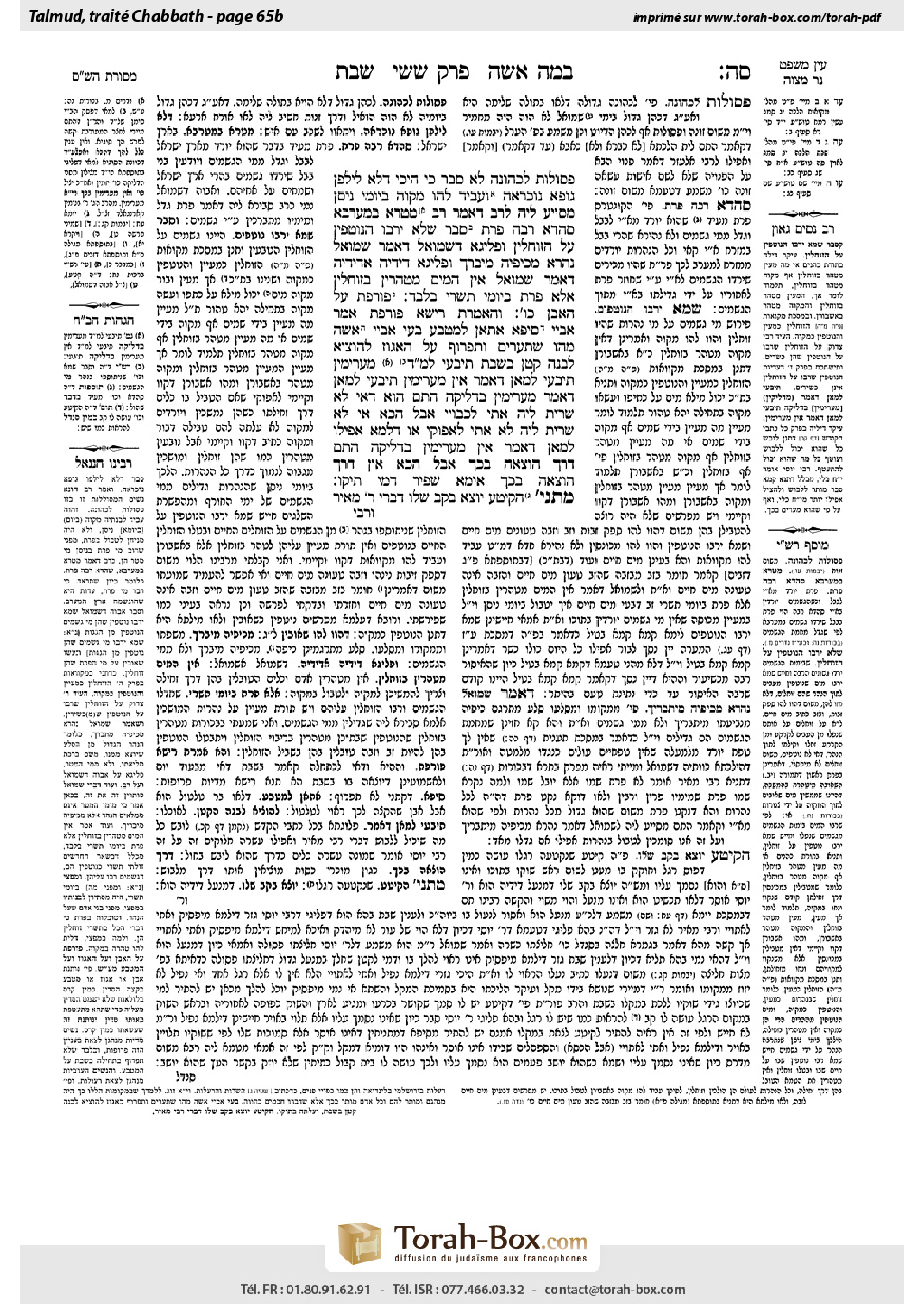
Shabbat 65b: Talmud study for Daf Yomi
Daf Yomi is the daily study of one Talmud folio. Explore 37 tractates with scans, Hebrew text, Sefaria English and AI-generated French translations where annotated.
Passage selection and English or AI-generated French translation are available where the scan has annotations. Daf Study is independent of Torah-Box and Sefaria.
Browse Shabbat · שבת · All tractatesShabbat 65b text and translations
This page of Shabbat includes the Aramaic text, an English translation and an AI-generated French translation, alongside the scan above.
שבת ס״ה ב · Aramaic and Hebrew text
פְּסוּלוֹת לַכְּהוּנָּה.
לָא — סָבַר כִּי הֵיכִי דְּלָא לֵילְפָן גּוּפָא נוּכְרָאָה.
וְעָבֵיד לְהוּ מִקְוֶה בְּיוֹמֵי נִיסָן, מְסַיַּיע לֵיהּ לְרַב, דְּאָמַר רַב: מִטְרָא בְּמַעְרְבָא סָהֲדָא רַבָּה פְּרָת. סָבַר, שֶׁלֹּא יִרְבּוּ הַנּוֹטְפִין עַל הַזּוֹחֲלִין.
וּפְלִיגָא דִּשְׁמוּאֵל. דְּאָמַר שְׁמוּאֵל: נַהֲרָא מִכֵּיפֵיהּ מִיבָּרַךְ. וּפְלִיגָא דִּידֵיהּ אַדִּידֵיהּ, דְּאָמַר שְׁמוּאֵל: אֵין הַמַּיִם מְטַהֲרִין בְּזוֹחֲלִין אֶלָּא פְּרָת בְּיוֹמֵי תִשְׁרֵי בִּלְבַד.
פּוֹרֶפֶת עַל הָאֶבֶן כּוּ׳. וְהָאָמְרַתְּ רֵישָׁא ״פּוֹרֶפֶת״? אָמַר אַבָּיֵי: סֵיפָא אֲתָאן לְמַטְבֵּעַ.
בָּעֵי אַבָּיֵי: אִשָּׁה מַהוּ שֶׁתַּעֲרִים וְתִפְרוֹף עַל הָאֱגוֹז לְהוֹצִיא לִבְנָהּ קָטָן בְּשַׁבָּת?
תִּיבְּעֵי לְמַאן דְּאָמַר מַעֲרִימִין. תִּיבְּעֵי לְמַאן דְּאָמַר אֵין מַעֲרִימִין.
תִּיבְּעֵי לְמַאן דְּאָמַר מַעֲרִימִין בִּדְלֵיקָה: הָתָם הוּא דְּאִי לָא שָׁרֵית לֵיהּ אָתֵי לְכַבּוֹיֵי, אֲבָל הָכָא אִי לָא שָׁרֵית לֵיהּ לָא אָתֵי לְאַפּוֹקֵי.
אוֹ דִלְמָא, אֲפִילּוּ לְמַאן דְּאָמַר אֵין מַעֲרִימִין בִּדְלֵיקָה, הָתָם — דֶּרֶךְ הוֹצָאָה בְּכָךְ, אֲבָל הָכָא — אֵין דֶּרֶךְ הוֹצָאָה בְּכָךְ, אֵימָא שַׁפִּיר דָּמֵי. תֵּיקוּ.
מַתְנִי׳ הַקִּיטֵּעַ יוֹצֵא בְּקַב שֶׁלּוֹ — דִּבְרֵי רַבִּי מֵאִיר,
Shabbat 65b · English translation
are disqualified from marrying into the priesthood. The act renders a woman a zona. It is prohibited for a priest to marry her (Tosafot).
The Gemara rejects this: No, that is not necessarily so. Perhaps the reason for Shmuel’s father’s insistence was because he thought to prevent them from lying next to one another so that they would not become accustomed to sleeping with a foreign body, which could stimulate sexual desire.
And he made a ritual bath for them in the days of Nisan. This supports the opinion of Rav, as Rav said: When rain falls in the West, Eretz Yisrael, the great witness attesting to that fact is the Euphrates, as the water flow in the Euphrates increases after the rainy season. The rainfall in northern Babylonia, where the source of the Euphrates is located, is essentially parallel to the rainfall in Eretz Yisrael. The increased water flow of the Euphrates in the spring is the result of the rainfall in the winter. Shmuel’s father held that immersion in the Euphrates would not purify them. A river maintains its status as a river in terms of purification through immersion only if it is established that the rain water that fell would not exceed the naturally flowing spring water. In the halakhot of ritual baths, there are two manners of purification. The first is the immersion in a place where water is gathered, e.g., collected rainwater that does not flow and remains in place. The second is immersion in flowing waters in their natural state, e.g., a spring or a river. However, rainwater purifies only when it is collected; it does not purify when it is flowing.
And he disagrees with his son Shmuel, as Shmuel said: The river is blessed from its riverbed (ge’onim); the additional water in the river is not from rainfall but rather from subterranean sources. And this statement of Shmuel disagrees with another ruling that he himself issued, as Shmuel said: The water purifies when flowing only in the Euphrates during the days of Tishrei alone. Since rain does not fall in the summer, only then is it clear that the water is in fact river water.
We learned in the mishna: A woman may fasten her cloak on a stone, and on a nut, and on a coin, as long as she does not fasten her cloak with them ab initio on Shabbat. The Gemara asks: Didn’t you say in the first clause of this halakha in the mishna that a woman may fasten, indicating that she is permitted to do so even ab initio? How do you explain the contradiction? Abaye said: In the latter clause of the mishna we have arrived at the case of a coin, one of the examples cited in the mishna. The halakha with regard to a coin is the exception. Because a coin is set-aside from use on Shabbat, one might conclude that it may not be used at all; nevertheless, it is only prohibited to fasten the cloak on the coin ab initio on Shabbat itself.
Abaye raised a dilemma: What is the halakha with regard to a case where a woman employs artifice to circumvent the halakha and fastens her garment on a nut in order to take the nut out in a permissible fashion to her young child in the public domain on Shabbat?
The Gemara notes: This is a dilemma according to the one who said that one may employ artifice when there is a fire on Shabbat. One is permitted to wear several layers of garments to take them out of a burning house on Shabbat. And this is a dilemma according to the one who said that one may not employ artifice when there is a fire on Shabbat.
The Gemara elaborates: This is a dilemma according to the one who said that one may employ artifice when there is a fire on Shabbat, as the cases are distinct. Perhaps there, artifice is permitted because if you do not permit him to take the garments out of the burning house in that manner, he will come to extinguish the fire. However, here, if you do not permit the woman to employ artifice and take the nut out to her child in the public domain, she will not come to take it out.
Or perhaps, even according to one who said that one may not employ artifice in the case of a fire, there is a distinction between the cases. There, in the case of a fire, wearing garments is the typical manner in which one takes clothing out to the public domain. However, here, utilizing a nut as a button is not the typical manner in which one takes a nut out to the public domain. Since no Torah prohibition is violated by doing so, say that she may well employ artifice to take the nut out to her son. The Gemara concludes: Let this dilemma stand unresolved.
MISHNA: One with an amputated leg may go out on Shabbat with his wooden leg, as it has the legal status of a shoe; this is the statement of Rabbi Meir.
Shabbat 65b · Traduction française (IA)
Elles sont inaptes à épouser des membres de la prêtrise. Cet acte confère à une femme le statut de zona. Il est interdit à un prêtre de l’épouser (Tosafot).
La Guemara rejette cette explication : non, ce n’est pas nécessairement le cas. Peut-être le père de Shmuel insistait-il parce qu’il voulait les empêcher de s’allonger l’une près de l’autre, afin qu’elles ne s’habituent pas à dormir avec un corps étranger, susceptible d’éveiller le désir sexuel.
Et il leur aménagea un bain rituel au mois de nissan. Cela confirme l’opinion de Rav, car Rav a dit : « Lorsque la pluie tombe à l’ouest, en Terre d’Israël, le grand témoin qui l’atteste est l’Euphrate », puisque le débit de l’Euphrate augmente après la saison des pluies. Les précipitations dans le nord de la Babylonie, où se trouve la source de l’Euphrate, sont essentiellement parallèles à celles de la Terre d’Israël. L’augmentation du débit de l’Euphrate au printemps résulte des pluies de l’hiver. Le père de Shmuel estimait que l’immersion dans l’Euphrate ne les purifierait pas. Une rivière ne conserve son statut de rivière aux fins de purification par immersion que s’il est établi que le volume des eaux de pluie tombées ne dépasse pas celui de l’eau de source qui s’écoule naturellement. Dans les règles relatives aux bains rituels, il existe deux modes de purification. Le premier est l’immersion dans un lieu où l’eau est rassemblée, par exemple dans des eaux de pluie recueillies, qui ne s’écoulent pas et restent en place. Le second est l’immersion dans des eaux qui s’écoulent naturellement, par exemple une source ou une rivière. Cependant, l’eau de pluie ne purifie que lorsqu’elle est recueillie ; elle ne purifie pas lorsqu’elle s’écoule.
Et il est en désaccord avec son fils Shmuel, car Shmuel a dit : « La rivière est alimentée par son lit (ge’onim) » ; l’eau supplémentaire de la rivière ne provient pas des précipitations, mais de sources souterraines. Cette déclaration de Shmuel est en désaccord avec une autre décision qu’il a lui-même rendue, car Shmuel a dit : « L’eau courante ne purifie que dans l’Euphrate, et seulement pendant les jours de tishri. » Puisqu’il ne pleut pas en été, c’est seulement alors qu’il est certain que l’eau provient bien de la rivière.
Nous avons appris dans la Michna : une femme peut attacher son manteau à une pierre, à une noix ou à une pièce de monnaie, à condition de ne pas l’attacher avec ces objets a priori pendant Chabbat. La Guemara demande : n’est-il pas dit, dans la première partie de cette halakha de la Michna, qu’une femme peut attacher son manteau, ce qui indique qu’elle en a la permission même a priori ? Comment expliquer cette contradiction ? Abaye a dit : dans la dernière partie de la Michna, nous en sommes au cas d’une pièce de monnaie, l’un des exemples cités dans la Michna. La halakha relative à une pièce de monnaie fait exception. Comme une pièce est muktzé pendant Chabbat, on pourrait en conclure qu’il est interdit de s’en servir en toute circonstance ; néanmoins, il est seulement interdit d’attacher le manteau à la pièce a priori, pendant Chabbat même.
Abaye souleva une question : quelle est la halakha dans le cas où une femme use d’un subterfuge pour contourner la halakha et attache son vêtement à une noix afin de l’emporter licitement à son jeune enfant dans le domaine public pendant Chabbat ?
La Guemara note : cette question se pose selon celui qui dit qu’on peut user d’un subterfuge en cas d’incendie pendant Chabbat. Il est permis de porter plusieurs couches de vêtements pour les sortir d’une maison en flammes pendant Chabbat. La question se pose également selon celui qui dit qu’on ne peut pas user d’un subterfuge en cas d’incendie pendant Chabbat.
La Guemara développe : cette question se pose selon celui qui dit qu’on peut user d’un subterfuge en cas d’incendie pendant Chabbat, car les deux cas sont distincts. Peut-être que, dans ce cas, le subterfuge est permis parce que, si on ne lui permet pas de sortir les vêtements de la maison en flammes de cette manière, il en viendra à éteindre le feu. Mais ici, si on ne permet pas à la femme d’user d’un subterfuge et d’emporter la noix à son enfant dans le domaine public, elle ne cherchera pas à l’emporter.
Ou peut-être que, même selon celui qui dit qu’on ne peut pas user d’un subterfuge en cas d’incendie, les cas sont différents. Là, en cas d’incendie, porter les vêtements est la manière habituelle de les sortir vers le domaine public. Mais ici, utiliser une noix comme bouton n’est pas la manière habituelle de sortir une noix vers le domaine public. Puisqu’aucune interdiction de la Torah n’est enfreinte de cette façon, disons qu’elle peut bien user d’un subterfuge pour emporter la noix à son fils. La Guemara conclut : laissons cette question sans réponse.
MICHNA : celui qui a une jambe amputée peut sortir pendant Chabbat avec sa jambe de bois, car celle-ci a le statut juridique d’une chaussure ; telle est l’opinion de Rabbi Meïr.
Traduction française générée par IA à partir de l’édition anglaise de Sefaria. Vérifie toujours un passage avec le texte source.
Text from Sefaria: William Davidson Edition - Vocalized Aramaic (CC BY NC); William Davidson Edition - English (CC BY NC).