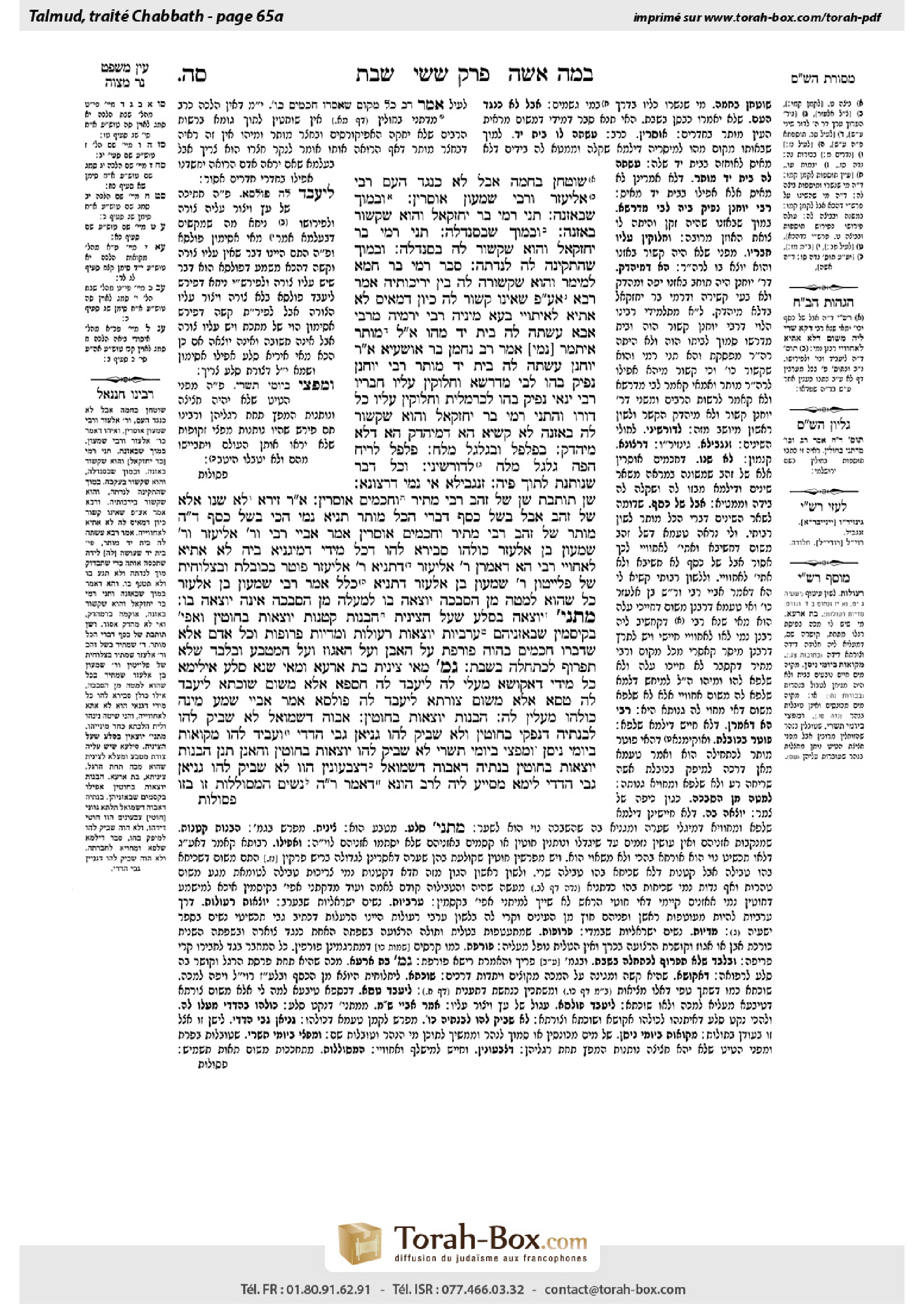
Shabbat 65a: Talmud study for Daf Yomi
Daf Yomi is the daily study of one Talmud folio. Explore 37 tractates with scans, Hebrew text, Sefaria English and AI-generated French translations where annotated.
Passage selection and English or AI-generated French translation are available where the scan has annotations. Daf Study is independent of Torah-Box and Sefaria.
Browse Shabbat · שבת · All tractatesShabbat 65a text and translations
This page of Shabbat includes the Aramaic text, an English translation and an AI-generated French translation, alongside the scan above.
שבת ס״ה א · Aramaic and Hebrew text
שׁוֹטְחָן בַּחַמָּה, אֲבָל לֹא כְּנֶגֶד הָעָם. רַבִּי אֱלִיעֶזֶר וְרַבִּי שִׁמְעוֹן אוֹסְרִין.
וּבְמוֹךְ שֶׁבְּאׇזְנָהּ. תָּנֵי רָמֵי בַּר יְחֶזְקֵאל: וְהוּא שֶׁקָּשׁוּר בְּאׇזְנָהּ.
וּבְמוֹךְ שֶׁבְּסַנְדָּלָהּ. תָּנֵי רָמֵי בַּר יְחֶזְקֵאל: וְהוּא שֶׁקָּשׁוּר לָהּ בְּסַנְדָּלָהּ.
וּבְמוֹךְ שֶׁהִתְקִינָה לָהּ לְנִדָּתָהּ. סָבַר רָמֵי בַּר חָמָא לְמֵימַר, וְהוּא שֶׁקָּשׁוּר לָהּ בֵּין יְרֵיכוֹתֶיהָ. אָמַר רָבָא: אַף עַל פִּי שֶׁאֵינוֹ קָשׁוּר לָהּ, כֵּיוָן דִּמְאִיס לָא אָתְיָא לְאֵיתוֹיֵי.
בְּעָא מִינֵּיהּ רַבִּי יִרְמְיָה מֵרַבִּי אַבָּא: עָשְׂתָה לָהּ בֵּית יָד, מַהוּ? אֲמַר לֵיהּ: מוּתָּר. אִיתְּמַר [נָמֵי], אָמַר רַב נַחְמָן בַּר אוֹשַׁעְיָא אָמַר רַבִּי יוֹחָנָן: עָשְׂתָה לָהּ בֵּית יָד — מוּתָּר.
רַבִּי יוֹחָנָן נָפֵיק בְּהוּ לְבֵי מִדְרְשָׁא, וַחֲלוּקִין עָלָיו חֲבֵרָיו. רַבִּי יַנַּאי נָפֵיק בְּהוּ לְכַרְמְלִית, וַחֲלוּקִין עָלָיו כׇּל דּוֹרוֹ. וְהָתָנֵי רָמֵי בַּר יְחֶזְקֵאל: וְהוּא שֶׁקָּשׁוּר לָהּ בְּאׇזְנָהּ! לָא קַשְׁיָא: הָא דְּמִיהַדַּק, הָא דְּלָא מִיהַדַּק.
בַּפִּלְפֵּל וּבְגַלְגַּל מֶלַח. פִּלְפֵּל לְרֵיחַ הַפֶּה, גַּלְגַּל מֶלַח לְדוּרְשִׁינֵּי. וְכׇל דָּבָר שֶׁנּוֹתֶנֶת לְתוֹךְ פִּיהָ. זַנְגְּבִילָא, אִי נָמֵי דָּרְצוּנָא.
שֵׁן תּוֹתֶבֶת שֵׁן שֶׁל זָהָב, רַבִּי מַתִּיר וַחֲכָמִים אוֹסְרִין. אָמַר רַבִּי זֵירָא לֹא שָׁנוּ אֶלָּא שֶׁל זָהָב, אֲבָל בְּשֶׁל כֶּסֶף דִּבְרֵי הַכֹּל מוּתָּר. תַּנְיָא נָמֵי הָכִי: בְּשֶׁל כֶּסֶף דִּבְרֵי הַכֹּל מוּתָּר. שֶׁל זָהָב, רַבִּי מַתִּיר וַחֲכָמִים אוֹסְרִין.
אָמַר אַבָּיֵי: רַבִּי וְרַבִּי אֱלִיעֶזֶר וְרַבִּי שִׁמְעוֹן בֶּן אֶלְעָזָר כּוּלְּהוּ סְבִירָא לְהוּ דְּכֹל מִידֵּי דְּמִיגַּנְּיָא בֵּיהּ לָא אָתְיָא לְאַחְוֹיֵי.
רַבִּי — הָא דַּאֲמַרַן. רַבִּי אֱלִיעֶזֶר — דְּתַנְיָא: רַבִּי אֱלִיעֶזֶר פּוֹטֵר בְּכוֹבֶלֶת וּבִצְלוֹחִית שֶׁל פִּלְיָיטוֹן.
רַבִּי שִׁמְעוֹן בֶּן אֶלְעָזָר — דְּתַנְיָא, כְּלָל אָמַר רַבִּי שִׁמְעוֹן בֶּן אֶלְעָזָר: כׇּל שֶׁהוּא לְמַטָּה מִן הַסְּבָכָה יוֹצְאָה בּוֹ, לְמַעְלָה מִן הַסְּבָכָה — אֵינָהּ יוֹצְאָה בּוֹ.
מַתְנִי׳ יוֹצְאָה בְּסֶלַע שֶׁעַל הַצִּינִּית. הַבָּנוֹת קְטַנּוֹת יוֹצְאוֹת בְּחוּטִין, וַאֲפִילּוּ בְּקֵיסָמִין שֶׁבְּאׇזְנֵיהֶם. עַרְבִיּוֹת יוֹצְאוֹת רְעוּלוֹת וּמָדִיּוֹת פְּרוּפוֹת, וְכׇל אָדָם — אֶלָּא שֶׁדִּבְּרוּ חֲכָמִים בַּהֹוֶה. פּוֹרֶפֶת עַל הָאֶבֶן וְעַל הָאֱגוֹז וְעַל הַמַּטְבֵּעַ, וּבִלְבַד שֶׁלֹּא תִּפְרוֹף לְכַתְּחִלָּה בְּשַׁבָּת.
גְּמָ׳ מַאי צִינִּית? בַּת אַרְעָא.
וּמַאי שְׁנָא סֶלַע? אִילֵּימָא כֹּל מִידֵּי דַּאֲקוֹשָׁא מְעַלֵּי לַהּ, לֶיעְבַּד לַהּ חַסְפָּא! אֶלָּא מִשּׁוּם שׁוּכְתָּא — לֶיעְבַּד לָהּ טַסָּא! אֶלָּא מִשּׁוּם צוּרְתָּא, לֶיעְבַּד לָהּ פּוּלְסָא! אָמַר אַבָּיֵי: שְׁמַע מִינַּהּ כּוּלְּהוּ מְעַלּוּ לָהּ.
הַבָּנוֹת יוֹצְאוֹת בְּחוּטִין. אֲבוּהּ דִּשְׁמוּאֵל לָא שָׁבֵיק לְהוּ לִבְנָתֵיהּ דְּנָפְקָן בְּחוּטִין, וְלָא שָׁבֵיק לְהוּ גָּנְיָאן גַּבֵּי הֲדָדֵי, וְעָבֵיד לְהוּ מִקְוָאוֹת בְּיוֹמֵי נִיסָן וּמַפָּצֵי בְּיוֹמֵי תִשְׁרֵי.
לָא שָׁבֵיק לְהוּ יוֹצְאוֹת בְּחוּטִין, וְהָאֲנַן תְּנַן: הַבָּנוֹת יוֹצְאוֹת בְּחוּטִין! בְּנָתֵיהּ דַּאֲבוּהּ דִּשְׁמוּאֵל דְּצִבְעוֹנִין הֲווֹ.
לָא שָׁבֵיק לְהוּ גָּנְיָאן גַּבֵּי הֲדָדֵי, לֵימָא מְסַיַּיע לֵיהּ לְרַב הוּנָא. דְּאָמַר רַב הוּנָא: נָשִׁים הַמְסוֹלְלוֹת זוֹ בָּזוֹ
Shabbat 65a · English translation
One whose clothes fell into water on a Festival may not dry them in the conventional manner; however, he may spread them out in the sun, but not before the people, who may suspect that he laundered his clothes on Shabbat. Rabbi Eliezer and Rabbi Shimon prohibit doing so even in a place concealed from view. Apparently, the Sages disagree whether or not an action prohibited due to the appearance of prohibition is prohibited everywhere.
We learned in the mishna that a woman may go out on Shabbat with a cloth that is in her ear. Rami bar Yeḥezkel taught: And that is specifically in a case where the cloth is tied to her ear and she will not come to carry it.
The mishna continues: A woman may go out with a cloth that is in her sandal. Rami bar Yeḥezkel taught: And that is specifically in a case where the cloth is tied to her sandal.
We learned in the mishna: A woman may go out with a cloth that she placed due to her menstrual flow. Rami bar Ḥama considered saying that it is permitted specifically in a case where it is tied between her thighs. Rava said: It is permitted even though it is not tied to her; since it is repulsive, she will not come to carry it even if it falls.
Rabbi Yirmeya raised a dilemma before Rabbi Abba: If she made herself a handgrip in which she could hold the cloth, what is the halakha? Since she does not have to touch the cloth with her bare hand, is there concern that she will come to carry it or not? He said to him: It is permitted. It was also stated that Rav Naḥman bar Oshaya said that Rabbi Yoḥanan said: If she made herself a handgrip it is permitted.
Rabbi Yoḥanan went out with a cloth in his ear to the study hall on Shabbat, and his colleagues are in disagreement with him and rule that it is prohibited to do so because it was not tied to his ear. Rabbi Yannai went out with it, a cloth in his ear, to a karmelit, an intermediate domain, neither public nor private. And all the Sages of his generation are in disagreement with him. The Gemara asks: Didn’t Rami bar Yeḥezkel teach: And that is specifically in a case where the cloth is tied to her ear? How could these Sages ignore this halakha? The Gemara answers: This is not difficult; this, where it was taught that certain Sages went out with a cloth, is in a case where it was stuck tightly in their ears. Therefore, it was permitted even though it was not tied. That, where Rami bar Yeḥezkel said that going out with a cloth is permitted only when it is tied, is in a case where it was not stuck tightly in his ear.
We learned in the mishna: A woman may go out with pepper and with a grain of salt in her mouth. The Gemara explains: She places pepper in her mouth to prevent mouth odor and a grain of salt to treat a toothache. With regard to that which we learned in the mishna: A woman may go out on Shabbat with any thing that she places in her mouth: This refers to ginger or, alternatively, to cinnamon [dartzona].
We learned in the mishna that the Sages disagree whether or not a woman may go out on Shabbat with a false tooth and a gold tooth; Rabbi Yehuda HaNasi permits doing so and the Rabbis prohibit doing so. Rabbi Zeira said: They only taught the dispute with regard to a gold tooth. Since it is precious, she might remove it from her mouth to show her friends and come to carry it. However, with regard to a silver tooth, which is less precious, there is no concern that she will remove it from her mouth. Everyone agrees that it is permitted. That opinion was also taught in a baraita: With regard to a tooth made of silver, everyone agrees that it is permitted. With regard to a tooth of gold, Rabbi Yehuda HaNasi permits going out with it and the Rabbis prohibit going out with it.
Abaye said: Rabbi Yehuda HaNasi, and Rabbi Eliezer, and Rabbi Shimon ben Elazar all hold that anything that makes her unappealing when removed, she will not come to remove it and show it to others. Therefore, it is permitted for her to go out with it.
The Gemara elaborates: The opinion of Rabbi Yehuda HaNasi is that which we just stated. The opinion of Rabbi Eliezer is as it was taught in a baraita: Rabbi Eliezer exempts a woman who went out with a bundle of fragrant herbs and with a flask of balsam oil, since a woman whose odor is foul does not remove and show the bundle to others.
The opinion of Rabbi Shimon ben Elazar is as it was taught in a baraita. Rabbi Shimon ben Elazar stated a principle: Anything that is worn beneath the net, a woman may go out into the public domain with it, since a woman will not uncover her hair while in the public domain even to show off an ornament. Anything that is worn over the net, e.g., an ornamental hat, a woman may not go out with it, since there is concern that she will remove it and carry it.
MISHNA: A woman may go out with a sela coin that she ties on a wound on her foot. The young girls may go out with strings, and even with wood chips that are in the holes in their ears so that the holes will not seal. Young girls would have their ears pierced, but earrings were not placed in their ears until they were older. Jewish women in Arab countries may go out veiled, with a scarf covering their face, and Jewish women in Media may go out with cloaks fastened with stones. And, any person in any place is permitted to go out on Shabbat clothed in that way; however, the Sages spoke in the present, addressing prevalent situations. A woman may fasten her cloak on a stone by inserting a small stone and wrapping her cloak around it, as she would with a button. And likewise, she may do so on a nut or on a coin, as long as she does not fasten her cloak with them on Shabbat ab initio.
GEMARA: The Gemara asks: What is the tzinit with regard to which the mishna taught that a woman may go out with a coin tied to it on Shabbat? The Gemara explains: It is a wound on the sole of her foot.
The Gemara asks: What is different about a sela? Why specifically is a coin placed on the wound? If you say that any object that is hard is beneficial for her, make an earthenware shard for her instead. Rather, it is beneficial due to the rust on the coin. If so, make a small silver plate for her. Why specifically a coin? Rather it is beneficial due to the image engraved on the coin. If so, make her an unminted coin and engrave an image on it. Abaye said: Learn from it that all these factors together are beneficial for her.
The mishna taught that the young girls may go out with strings. The Gemara relates that Shmuel’s father did not allow his daughters to go out with strings, and did not allow them to lie next to each other, and he made ritual baths for them in the days of Nisan and mats in the Euphrates River in the days of Tishrei. Since the water was shallow and the riverbed muddy, he placed mats on the riverbed so that they could immerse without getting dirty.
The Gemara analyzes the conduct of Shmuel’s father: He did not allow them to go out with strings. Didn’t we learn in the mishna that the girls may go out with strings? The Gemara answers: The strings with which the daughters of Shmuel’s father went out were colorful ones, and he was concerned that because the strings were beautiful they would come to remove them to show them to others and carry them.
He did not allow them to lie next to one another. Let us say that this supports the opinion of Rav Huna, as Rav Huna said: Women who rub against one another motivated by sexual desire
Shabbat 65a · Traduction française (IA)
Celui dont les vêtements sont tombés dans l'eau pendant une fête ne peut pas les sécher de la manière habituelle ; cependant, il peut les étendre au soleil, mais pas devant les gens, qui pourraient soupçonner qu'il a lavé ses vêtements le chabbat. Rabbi Eliezer et Rabbi Shimon interdisent de le faire même dans un endroit dissimulé à la vue. Apparemment, les Sages sont en désaccord sur le point de savoir si une action interdite en raison de l'apparence d'une interdiction est interdite partout.
Nous avons appris dans la Michna qu'une femme peut sortir le chabbat avec un tissu dans son oreille. Rami bar Yeḥezkel a enseigné : Et cela est spécifiquement dans le cas où le tissu est attaché à son oreille et qu'elle ne viendra pas à le porter.
La Michna continue : Une femme peut sortir avec un tissu dans sa sandale. Rami bar Yeḥezkel a enseigné : Et cela est spécifiquement dans le cas où le tissu est attaché à sa sandale.
Nous avons appris dans la Michna : Une femme peut sortir avec un tissu qu'elle a placé en raison de ses règles menstruelles. Rami bar Ḥama a envisagé de dire que c'est permis spécifiquement dans le cas où il est attaché entre ses cuisses. Rava a dit : C'est permis même s'il n'est pas attaché à elle ; puisque c'est répugnant, elle ne viendra pas à le porter même s'il tombe.
Rabbi Yirmeya a soulevé un dilemme devant Rabbi Abba : Si elle s'est fait une poignée à laquelle elle peut tenir le tissu, quelle est la halakha ? Puisqu'elle n'a pas à toucher le tissu à mains nues, y a-t-il une crainte qu'elle vienne à le porter ou non ? Il lui a dit : C'est permis. Il a également été dit que Rav Naḥman bar Oshaya a dit que Rabbi Yoḥanan a dit : Si elle s'est fait une poignée, c'est permis.
Rabbi Yoḥanan est sorti avec un tissu dans son oreille à la salle d'étude le chabbat, et ses collègues sont en désaccord avec lui et décident que c'est interdit de le faire parce qu'il n'était pas attaché à son oreille. Rabbi Yannai est sorti avec, un tissu dans son oreille, dans un karmelit, un domaine intermédiaire, ni public ni privé. Et tous les Sages de sa génération sont en désaccord avec lui. La Guemara demande : N'est-ce pas que Rami bar Yeḥezkel a enseigné : Et cela est spécifiquement dans le cas où le tissu est attaché à son oreille ? Comment ces Sages ont-ils pu ignorer cette halakha ? La Guemara répond : Ce n'est pas difficile ; cela, où il a été enseigné que certains Sages sont sortis avec un tissu, est dans le cas où il était coincé fermement dans leurs oreilles. Par conséquent, c'était permis même s'il n'était pas attaché. Cela, où Rami bar Yeḥezkel a dit que sortir avec un tissu est permis seulement lorsqu'il est attaché, est dans le cas où il n'était pas coincé fermement dans son oreille.
Nous avons appris dans la Michna : Une femme peut sortir avec du poivre et un grain de sel dans la bouche. La Guemara explique : Elle place du poivre dans sa bouche pour prévenir la mauvaise haleine et un grain de sel pour traiter une douleur dentaire. Concernant ce que nous avons appris dans la Michna : Une femme peut sortir le chabbat avec n'importe quelle chose qu'elle place dans sa bouche : Cela fait référence au gingembre ou, alternativement, à la cannelle [dartzona].
Nous avons appris dans la Michna que les Sages sont en désaccord sur le point de savoir si une femme peut sortir le chabbat avec une fausse dent et une dent en or ; Rabbi Yehuda HaNasi le permet et les Rabbins l'interdisent. Rabbi Zeira a dit : Ils n'ont enseigné le désaccord qu'en ce qui concerne une dent en or. Puisqu'elle est précieuse, elle pourrait la retirer de sa bouche pour la montrer à ses amies et en arriver à la porter. Cependant, en ce qui concerne une dent en argent, qui est moins précieuse, il n'y a pas de crainte qu'elle la retire de sa bouche. Tout le monde est d'accord que c'est permis. Cet avis a également été enseigné dans une baraïta : En ce qui concerne une dent faite d'argent, tout le monde est d'accord que c'est permis. En ce qui concerne une dent d'or, Rabbi Yehuda HaNasi permet de sortir avec et les Rabbins interdisent de sortir avec.
Abaye a dit : Rabbi Yehuda HaNasi, Rabbi Eliezer et Rabbi Shimon ben Elazar sont tous d'avis que tout ce qui la rend peu attrayante lorsqu'il est retiré, elle n'en arrivera pas à le retirer et à le montrer aux autres. Par conséquent, il lui est permis de sortir avec.
La Guemara précise : L'avis de Rabbi Yehuda HaNasi est celui que nous venons de mentionner. L'avis de Rabbi Eliezer est celui qui a été enseigné dans une baraïta : Rabbi Eliezer exempte une femme qui est sortie avec un bouquet d'herbes parfumées et avec une fiole d'huile de baies, car une femme dont l'odeur est fétide ne retire pas et ne montre pas le bouquet aux autres.
L'avis de Rabbi Shimon ben Elazar est celui qui a été enseigné dans une baraïta. Rabbi Shimon ben Elazar a énoncé un principe : Tout ce qui est porté sous le filet, une femme peut sortir dans le domaine public avec, car une femme ne découvrira pas ses cheveux dans le domaine public même pour montrer un ornement. Tout ce qui est porté au-dessus du filet, par exemple un chapeau orné, une femme ne peut pas sortir avec, car il y a une crainte qu'elle le retire et le porte.
MICHNA : Une femme peut sortir avec une pièce de sela qu'elle attache sur une plaie à son pied. Les jeunes filles peuvent sortir avec des ficelles, et même avec des éclats de bois qui sont dans les trous de leurs oreilles afin que les trous ne se referment pas. Les jeunes filles se faisaient percer les oreilles, mais des boucles d'oreilles n'étaient pas placées dans leurs oreilles jusqu'à ce qu'elles soient plus âgées. Les femmes juives dans les pays arabes peuvent sortir voilées, avec un foulard couvrant leur visage, et les femmes juives en Médie peuvent sortir avec des manteaux attachés avec des pierres. Et, toute personne en tout lieu est permise de sortir le chabbat vêtue de cette manière ; cependant, les Sages ont parlé au présent, s'adressant aux situations prévalentes. Une femme peut attacher son manteau sur une pierre en insérant une petite pierre et en enroulant son manteau autour, comme elle le ferait avec un bouton. Et de même, elle peut le faire sur une noix ou sur une pièce, tant qu'elle n'attache pas son manteau avec eux le chabbat ab initio.
GUEMARA : La Guemara demande : Quelle est la tzinit à propos de laquelle la Michna a enseigné qu'une femme peut sortir avec une pièce de monnaie attachée dessus le chabbat ? La Guemara explique : C'est une plaie sur la plante de son pied.
La Guemara demande : Qu'y a-t-il de particulier dans le cas d'un sela ? Pourquoi spécifiquement une pièce de monnaie est-elle placée sur la plaie ? Si vous dites que tout objet dur est bénéfique pour elle, faites-lui plutôt un fragment de poterie. Plutôt, c'est en raison de la rouille sur la pièce qu'elle est bénéfique. Si c'est le cas, faites-lui une petite plaque d'argent. Pourquoi spécifiquement une pièce ? Plutôt, c'est en raison de l'image gravée sur la pièce qu'elle est bénéfique. Si c'est le cas, faites-lui une pièce non frappée et gravez-y une image. Abaye a dit : Apprenez-en que tous ces facteurs ensemble sont bénéfiques pour elle.
La Michna a enseigné que les jeunes filles peuvent sortir avec des cordons. La Guemara rapporte que le père de Chmuel ne permettait pas à ses filles de sortir avec des cordons, et ne leur permettait pas de se coucher l'une à côté de l'autre, et il leur préparait des bains rituels dans les jours de Nissan et des nattes dans le fleuve Euphrate dans les jours de Tichri. Étant donné que l'eau était peu profonde et le lit du fleuve boueux, il plaçait des nattes sur le lit du fleuve afin qu'elles puissent s'immerger sans se salir.
La Guemara analyse la conduite du père de Chmuel : il ne leur permettait pas de sortir avec des cordons. N'avons-nous pas appris dans la Michna que les filles peuvent sortir avec des cordons ? La Guemara répond : Les cordons avec lesquels les filles du père de Chmuel sortaient étaient colorés, et il craignait que, parce que les cordons étaient beaux, elles viennent à les retirer pour les montrer aux autres et les porter.
Il ne leur permettait pas de se coucher l'une à côté de l'autre. Disons que cela soutient l'opinion de Rav Houna, car Rav Houna a dit : Les femmes qui se frottent l'une contre l'autre motivées par le désir sexuel
Traduction française générée par IA à partir de l’édition anglaise de Sefaria. Vérifie toujours un passage avec le texte source.
Text from Sefaria: William Davidson Edition - Vocalized Aramaic (CC BY NC); William Davidson Edition - English (CC BY NC).