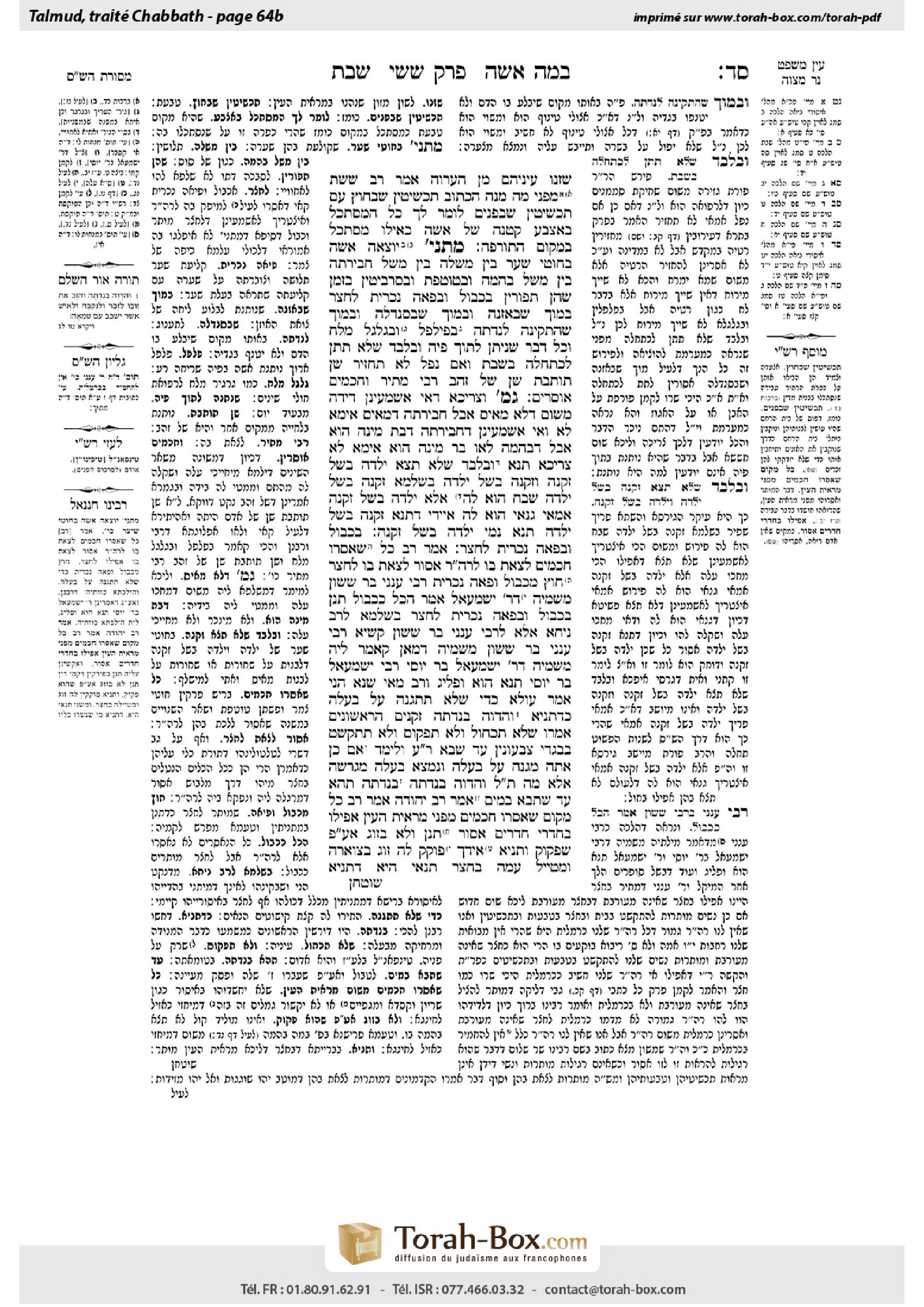
Shabbat 64b: Talmud study for Daf Yomi
Daf Yomi is the daily study of one Talmud folio. Explore 37 tractates with scans, Hebrew text, Sefaria English and AI-generated French translations where annotated.
Passage selection and English or AI-generated French translation are available where the scan has annotations. Daf Study is independent of Torah-Box and Sefaria.
Browse Shabbat · שבת · All tractatesShabbat 64b text and translations
This page of Shabbat includes the Aramaic text, an English translation and an AI-generated French translation, alongside the scan above.
שבת ס״ד ב · Aramaic and Hebrew text
שֶׁזָּנוּ עֵינֵיהֶם מִן הָעֶרְוָה.
אָמַר רַב שֵׁשֶׁת: מִפְּנֵי מָה מָנָה הַכָּתוּב תַּכְשִׁיטִין שֶׁבַּחוּץ עִם תַּכְשִׁיטִין שֶׁבִּפְנִים? — לוֹמַר לָךְ: כׇּל הַמִּסְתַּכֵּל בְּאֶצְבַּע קְטַנָּה שֶׁל אִשָּׁה כְּאִילּוּ מִסְתַּכֵּל בִּמְקוֹם הַתּוּרְפָּה.
מַתְנִי׳ יוֹצְאָה אִשָּׁה בְּחוּטֵי שֵׂעָר, בֵּין מִשֶּׁלָּהּ בֵּין מִשֶּׁל חֲבֶירְתָּהּ בֵּין מִשֶּׁל בְּהֵמָה.
וּבְטוֹטֶפֶת, וּבְסַרְבִּיטִין בִּזְמַן שֶׁהֵן תְּפוּרִין.
בְּכָבוּל וּבְפֵאָה נׇכְרִית לֶחָצֵר. בְּמוֹךְ שֶׁבְּאׇזְנָהּ, וּבְמוֹךְ שֶׁבְּסַנְדָּלָהּ, וּבְמוֹךְ שֶׁהִתְקִינָה לְנִדָּתָהּ.
בְּפִילְפֵּל, וּבְגַלְגַּל מֶלַח, וְכׇל דָּבָר שֶׁנִּיתָּן לְתוֹךְ פִּיהָ, וּבִלְבַד שֶׁלֹּא תִּתֵּן לְכַתְּחִלָּה בְּשַׁבָּת, וְאִם נָפַל — לֹא תַּחֲזִיר.
שֵׁן תּוֹתֶבֶת, שֵׁן שֶׁל זָהָב — רַבִּי מַתִּיר, וַחֲכָמִים אוֹסְרִים.
גְּמָ׳ וּצְרִיכָא, דְּאִי אַשְׁמְעִינַן דִּידַהּ מִשּׁוּם דְּלָא מְאִיס, אֲבָל חֲבֶירְתַּהּ דִּמְאִיס — אֵימָא לָא.
וְאִי אַשְׁמְעִינַן דַּחֲבֶירְתַּהּ — דְּבַת מִינַהּ הוּא, אֲבָל דִּבְהֵמָה לָאו בַּר מִינַהּ הוּא אֵימָא לָא, צְרִיכָא.
תָּנָא: וּבִלְבַד שֶׁלֹּא תֵּצֵא יַלְדָּה בְּשֶׁל זְקֵנָה וּזְקֵנָה בְּשֶׁל יַלְדָּה.
בִּשְׁלָמָא זְקֵנָה בְּשֶׁל יַלְדָּה — שֶׁבַח הוּא לָהּ. אֶלָּא יַלְדָּה בְּשֶׁל זְקֵנָה אַמַּאי? גְּנַאי הוּא לָהּ! אַיְּידִי דִּתְנָא זְקֵנָה בְּשֶׁל יַלְדָּה, תְּנָא נָמֵי יַלְדָּה בְּשֶׁל זְקֵנָה.
בְּכָבוּל וּבְפֵאָה נׇכְרִית לֶחָצֵר. אָמַר רַב: כׇּל שֶׁאָסְרוּ חֲכָמִים לָצֵאת בּוֹ לִרְשׁוּת הָרַבִּים, אָסוּר לָצֵאת בּוֹ לֶחָצֵר — חוּץ מִכָּבוּל וּפֵאָה נׇכְרִית.
רַבִּי עֲנָנִי בַּר שָׂשׂוֹן מִשְּׁמֵיהּ דְּרַבִּי יִשְׁמָעֵאל אָמַר: הַכֹּל כְּכָבוּל.
תְּנַן: בְּכָבוּל וּבְפֵאָה נׇכְרִית לֶחָצֵר. בִּשְׁלָמָא לְרַב — נִיחָא, אֶלָּא לְרַבִּי עֲנָנִי בַּר שָׂשׂוֹן קַשְׁיָא! רַבִּי עֲנָנִי בַּר שָׂשׂוֹן מִשְּׁמֵיהּ דְמַאן קָאָמַר לֵיהּ? — מִשְּׁמֵיהּ דְּרַבִּי יִשְׁמָעֵאל בַּר יוֹסֵי, רַבִּי יִשְׁמָעֵאל בַּר יוֹסֵי תַּנָּא הוּא וּפְלִיג.
וְרַב, מַאי שְׁנָא הָנֵי? אָמַר עוּלָּא: כְּדֵי שֶׁלֹּא תִּתְגַּנֶּה עַל בַּעְלָהּ. כִּדְתַנְיָא: ״וְהַדָּוָה בְּנִדָּתָהּ״ — זְקֵנִים הָרִאשׁוֹנִים אָמְרוּ שֶׁלֹּא תִּכְחוֹל וְלֹא תִּפְקוֹס וְלֹא תִּתְקַשֵּׁט בְּבִגְדֵי צִבְעוֹנִין, עַד שֶׁבָּא רַבִּי עֲקִיבָא וְלִימֵּד: אִם כֵּן — אַתָּה מְגַנָּהּ עַל בַּעְלָהּ, וְנִמְצָא בַּעְלָהּ מְגָרְשָׁהּ. אֶלָּא מַה תַּלְמוּד לוֹמַר: ״וְהַדָּוָה בְּנִדָּתָהּ״ — בְּנִדָּתָהּ תְּהֵא עַד שֶׁתָּבֹא בַּמַּיִם.
אָמַר רַב יְהוּדָה אָמַר רַב: כׇּל מָקוֹם שֶׁאָסְרוּ חֲכָמִים מִפְּנֵי מַרְאִית הָעַיִן — אֲפִילּוּ בְּחַדְרֵי חֲדָרִים אָסוּר.
תְּנַן: וְלֹא בְּזוֹג אַף עַל פִּי שֶׁפָּקוּק. וְתַנְיָא אִידַּךְ: פּוֹקֵק לָהּ זוֹג בְּצַוָּארָהּ וּמְטַיֵּיל עִמָּהּ בֶּחָצֵר.
תַּנָּאֵי הִיא, דְּתַנְיָא:
Shabbat 64b · English translation
they nourished their eyes from nakedness.
With regard to the verse that lists the ornaments, Rav Sheshet said: For what reason did the verse list outer ornaments, i.e., a bracelet, with inner ornaments, i.e., a kumaz? To tell you that anyone who gazes upon a woman’s little finger is considered as if he gazed upon her naked genitals. The atonement was for the sin of looking.
MISHNA: The mishna continues to discuss those items with which it is permitted to go out and those items with which it is prohibited to go out on Shabbat. A woman may go out with strands of hair that she put on her head, whether they are from her own hair that she made into a wig, or whether they are from the hair of another, or whether they are from the hair of an animal.
And a woman may go out with an ornament called totefet, and with sarvitin when they are sewn and will not fall.
She may go out on Shabbat with a woolen cap or with a wig to the courtyard, although not to the public domain. And likewise she may go out with a cloth that is in her ear, and with a cloth in her sandal, and with a cloth that she placed due to her menstrual status.
She may go out on Shabbat with pepper, or with a grain of salt, or anything placed in her mouth for healing or for preventing bad odor, as long as she does not put these objects in her mouth for the first time on Shabbat. And if it fell out she may not replace it.
A false tooth as well as (Ramban) a gold tooth, Rabbi Yehuda HaNasi permits going out with it, and the Rabbis prohibit doing so.
GEMARA: We learned in the mishna that a woman may go out with different strands of hair. The Gemara comments: And it is necessary to cite all of the cases. If the mishna taught us only with regard to her own hair, I would have said that she may go out with it because it is not repulsive, as it is her own hair; therefore, there is no concern lest she come to remove the strands and carry them in the public domain. However, the hair of another, which is repulsive and a different color from hers, say no, she may not go out with it, due to concern lest she be embarrassed, remove it, and come to carry it in the public domain.
And if the mishna taught us that she is permitted to go out with the hair of another, I would have said that she may go out with it because it is hair of her own kind. Therefore, it is not repulsive in her eyes and she will not come to remove it. However, the hair of an animal, since it is not of her own kind, say no, she may not go out with it due to concern lest she remove it. Therefore, it is necessary to cite all three cases.
It was taught in the Tosefta: It is permitted as long as a girl does not go out with the hair of an elderly woman, and an elderly woman does not go out with the hair of a girl.
The Gemara challenges: Granted, the Gemara cited the case of an elderly woman who goes out with the hair of a girl, as it is a reasonable scenario because it is flattering for her to look young. However, why would a girl go out with the hair of an elderly woman? Since it is demeaning for her to appear elderly, it is an unlikely scenario. The Gemara answers: Since the mishna taught the case of an elderly woman with the hair of a girl, it also taught the improbable case of a girl with the hair of an elderly woman.
It was taught in the mishna that a woman may go out with a woolen cap or with a wig to the courtyard. Rav said: With regard to all ornaments and garments with which the Sages prohibited going out into the public domain on Shabbat, it is also prohibited to go out with them into the courtyard due to the concern lest she forget and go out to the street, with the exception of a woolen cap and a wig.
Rabbi Anani bar Sason said in the name of Rabbi Yishmael: All ornaments have the same legal status as a woolen cap and may be worn into the courtyard.
We learned in the mishna that it is permitted to go out with a woolen cap or a wig into the courtyard. Granted, according to the opinion of Rav the matter works out well, as the mishna allows one to go out into a courtyard only with a woolen cap and a wig. However, according to the opinion of Rabbi Anani bar Sason, it is difficult. The Gemara answers: In whose name did Rabbi Anani bar Sason say his halakha? In the name of Rabbi Yishmael bar Yosei, and Rabbi Yishmael bar Yosei is a tanna and, as such, has the authority to dispute the determination in the mishna.
The Gemara asks: And according to Rav, what is different about these, the woolen cap and the wig, that the mishna permitted going out into the courtyard with them? Ulla said: So that she will not become unappealing to her husband. That would be the result if all ornamentation was prohibited. As it was taught in a baraita with regard to the verse: “And of her that is sick in her menstrual status [niddata]” (Leviticus 15:33), the Elders of the early generations said that this verse comes to teach us that the menstruating woman should be distanced from her husband in all senses, like a person ostracized [menudeh] by the Sages. This includes that she may not paint her eyes blue, and she may not rouge [pokeset] her face, and she may not adorn herself with colorful clothing. Until Rabbi Akiva came and taught: If you do so, you are making her unappealing to her husband, and her husband will consequently divorce her. Therefore, extreme strictures should not be instituted. Rather, what is the meaning of that which the verse states: “And of her that is sick in her menstrual status”? She shall remain prohibited in her menstrual status even after the flow of blood has stopped until she immerses in the water of a ritual bath.
Rav Yehuda said that Rav said: Wherever the Sages prohibited an action due to the appearance of prohibition, even in the innermost chambers, where no one will see it, it is prohibited. When prohibiting an action, the Sages did not distinguish between different circumstances. They prohibited performing the action in all cases.
The Gemara raises an objection. We learned in the mishna that an animal belonging to a Jew may not go out on Shabbat with a bell around its neck, even though it is plugged and makes no sound, due to the appearance of prohibition, as it appears as if he were taking the animal to the marketplace. And it was taught in another baraita: He may plug the bell on the animal’s neck and walk with it in the courtyard. Apparently, although the Sages prohibited this action due to the appearance of prohibition, they permitted it in the courtyard.
The Gemara answers: It is subject to a dispute between tanna’im in this matter, as it was taught in a baraita:
Shabbat 64b · Traduction française (IA)
elles nourrissaient leurs yeux de nudité.
À propos du verset qui énumère les ornements, Rav Sheshet dit : Pourquoi le verset a-t-il associé des ornements extérieurs, comme un bracelet, à des ornements intérieurs, comme un kumaz ? Pour t’enseigner que quiconque regarde le petit doigt d’une femme est considéré comme s’il avait regardé ses parties génitales nues. L’expiation concernait le péché du regard.
Michna : La Michna poursuit son examen des objets avec lesquels il est permis de sortir et de ceux avec lesquels il est interdit de sortir pendant Chabbat. Une femme peut sortir avec des mèches qu’elle a posées sur sa tête, qu’elles proviennent de ses propres cheveux, qu’elle a façonnés en perruque, des cheveux d’une autre personne ou des poils d’un animal.
Une femme peut sortir avec un ornement appelé totefet, ainsi qu’avec des sarvitin, à condition qu’ils soient cousus et ne risquent pas de tomber.
Pendant Chabbat, elle peut sortir dans la cour avec un bonnet de laine ou une perruque, mais pas dans le domaine public. De même, elle peut sortir avec un tissu placé dans son oreille, avec un tissu dans sa sandale et avec un tissu qu’elle a placé en raison de son statut menstruel.
Pendant Chabbat, elle peut sortir avec du poivre, un grain de sel ou tout autre objet placé dans sa bouche pour se soigner ou prévenir la mauvaise haleine, à condition de ne pas le mettre dans sa bouche pour la première fois pendant Chabbat. S’il tombe, elle ne peut pas le remettre.
Au sujet d’une dent artificielle ainsi que (Ramban) d’une dent en or, Rabbi Yehouda haNassi permet de sortir avec, tandis que les Rabbins l’interdisent.
Guemara : Nous avons appris dans la Michna qu’une femme peut sortir avec différentes sortes de mèches. La Guemara fait remarquer qu’il était nécessaire de mentionner tous les cas. Si la Michna nous avait enseigné uniquement le cas de ses propres cheveux, j’aurais dit qu’elle peut sortir avec ceux-ci parce qu’ils ne sont pas repoussants, puisqu’il s’agit de ses propres cheveux ; il n’y a donc pas lieu de craindre qu’elle enlève les mèches et les transporte dans le domaine public. En revanche, pour les cheveux d’une autre personne, qui sont repoussants et d’une couleur différente de la sienne, on aurait pu dire qu’elle ne peut pas sortir avec, de crainte qu’elle soit gênée, les enlève et les transporte dans le domaine public.
Et si la Michna nous avait enseigné qu’elle est autorisée à sortir avec les cheveux d’une autre personne, j’aurais dit qu’elle peut sortir avec ceux-ci parce qu’ils sont de la même espèce que ses propres cheveux. Ils ne lui paraissent donc pas repoussants et elle ne les enlèvera pas. En revanche, les poils d’un animal, puisqu’ils ne sont pas de la même espèce que ses cheveux, on aurait pu dire qu’elle ne peut pas sortir avec, de crainte qu’elle les enlève. Il était donc nécessaire de mentionner les trois cas.
Il a été enseigné dans la Tosefta : C’est permis, à condition qu’une jeune fille ne sorte pas avec les cheveux d’une vieille femme et qu’une vieille femme ne sorte pas avec les cheveux d’une jeune fille.
La Guemara objecte : Certes, la Guemara a cité le cas d’une vieille femme qui sort avec les cheveux d’une jeune fille, car ce cas est plausible puisqu’il est flatteur pour elle d’avoir l’air jeune. Mais pourquoi une jeune fille sortirait-elle avec les cheveux d’une vieille femme ? Comme il serait dégradant pour elle de paraître âgée, ce cas est peu vraisemblable. La Guemara répond : Puisque la Michna a enseigné le cas d’une vieille femme portant les cheveux d’une jeune fille, elle a également enseigné le cas improbable d’une jeune fille portant les cheveux d’une vieille femme.
La Michna a enseigné qu’une femme peut sortir dans la cour avec un bonnet de laine ou une perruque. Rav a dit : Pour tous les ornements et vêtements avec lesquels les Sages ont interdit de sortir dans le domaine public pendant Chabbat, il est également interdit de sortir avec eux dans la cour, de crainte qu’elle oublie et sorte dans la rue, à l’exception du bonnet de laine et de la perruque.
Rabbi Anani bar Sason a dit au nom de Rabbi Yishmael : Tous les ornements ont le même statut qu’un bonnet de laine et peuvent être portés dans la cour.
Nous avons appris dans la Michna qu’il est permis de sortir dans la cour avec un bonnet de laine ou une perruque. Certes, selon l’opinion de Rav, cela s’accorde bien, puisque la Michna n’autorise à sortir dans la cour qu’avec un bonnet de laine ou une perruque. Mais selon l’opinion de Rabbi Anani bar Sason, cela pose une difficulté. La Guemara répond : Au nom de qui Rabbi Anani bar Sason a-t-il énoncé sa halakha ? Au nom de Rabbi Yishmael bar Yosei, qui est un tanna et a donc autorité pour contester la décision de la Michna.
La Guemara demande : Et selon Rav, en quoi le bonnet de laine et la perruque se distinguent-ils pour que la Michna ait autorisé à sortir dans la cour avec eux ? Oulla dit : C’est pour qu’elle ne devienne pas repoussante aux yeux de son mari. Tel serait le résultat si tous les ornements étaient interdits. En effet, il a été enseigné dans une baraïta au sujet du verset : « Et de celle qui est malade de son état menstruel [niddata] » (Lévitique 15:33) : les Anciens des premières générations ont dit que ce verset vient nous enseigner que la femme menstruée doit être éloignée de son mari à tous égards, comme une personne mise au ban [menudeh] par les Sages. Cela implique qu’elle ne peut pas se farder les yeux en bleu, ni se rougir [pokeset] le visage, ni se parer de vêtements colorés. Puis Rabbi Akiva vint et enseigna : Si vous faites cela, vous la rendez repoussante aux yeux de son mari, qui finira par divorcer d’elle. Il ne faut donc pas imposer des rigueurs excessives. Quel est alors le sens des mots du verset : « Et de celle qui est malade de son état menstruel » ? Elle reste interdite en raison de son état menstruel même après l’arrêt de l’écoulement du sang, jusqu’à ce qu’elle s’immerge dans les eaux d’un bain rituel.
Rav Yehouda a dit au nom de Rav : Partout où les Sages ont interdit une action en raison de son apparence de transgression, elle est interdite même dans les pièces les plus retirées, où personne ne peut la voir. Lorsqu’ils interdisent une action, les Sages ne distinguent pas les circonstances : ils l’interdisent dans tous les cas.
La Guemara soulève une objection. Nous avons appris dans la Michna qu’un animal appartenant à un Juif ne peut pas sortir pendant Chabbat avec une clochette autour du cou, même si elle est bouchée et ne produit aucun son, en raison de l’apparence de transgression : cela donne l’impression qu’il conduit l’animal au marché. Or, il a été enseigné dans une autre baraïta : il peut boucher la clochette autour du cou de l’animal et le faire marcher dans la cour. Il semble donc que, bien que les Sages aient interdit cette action en raison de l’apparence de transgression, ils l’aient permise dans la cour.
La Guemara répond : Cette question fait l’objet d’un désaccord entre tannaïm, comme il a été enseigné dans une baraïta :
Traduction française générée par IA à partir de l’édition anglaise de Sefaria. Vérifie toujours un passage avec le texte source.
Text from Sefaria: William Davidson Edition - Vocalized Aramaic (CC BY NC); William Davidson Edition - English (CC BY NC).