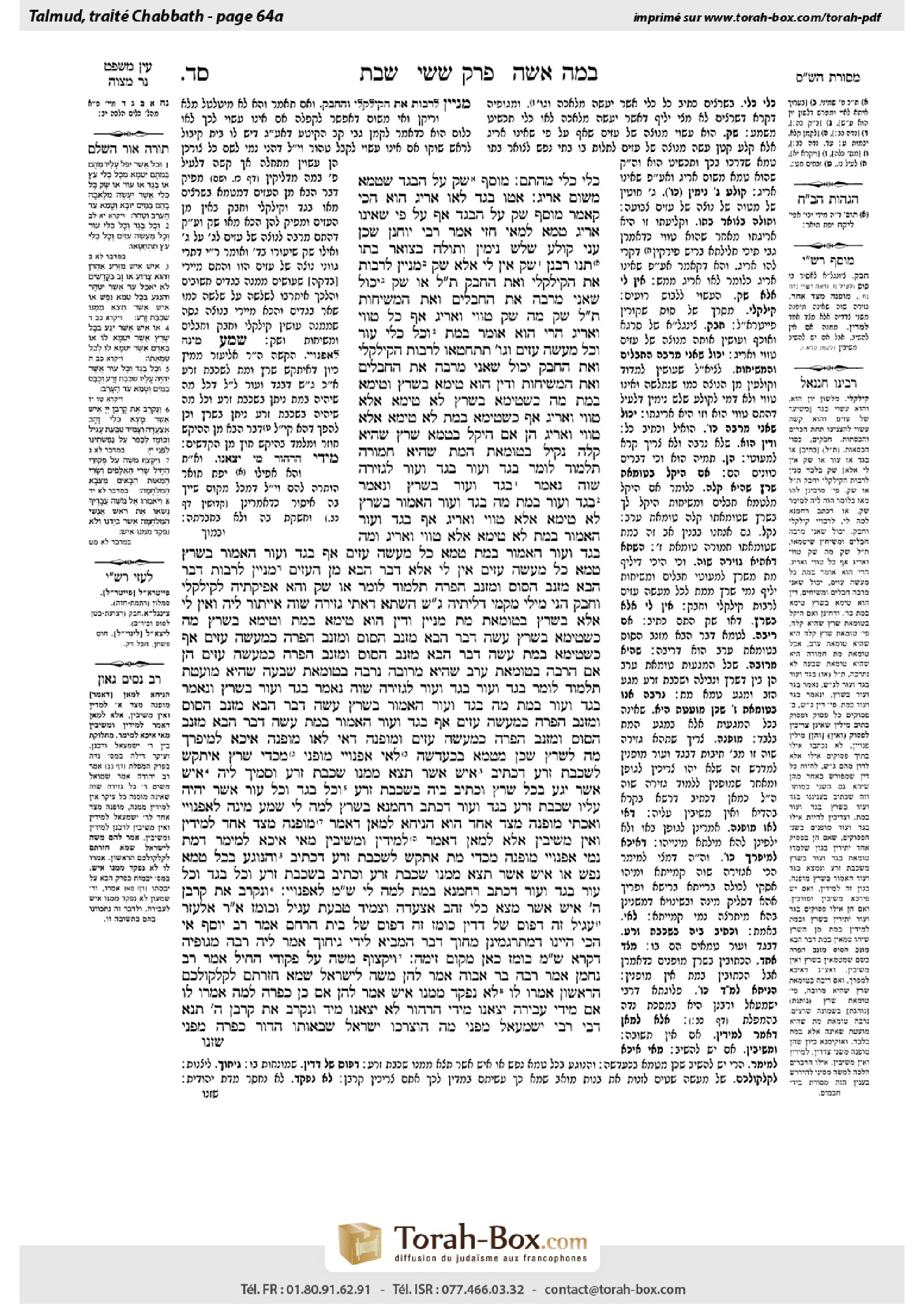
Shabbat 64a: Talmud study for Daf Yomi
Daf Yomi is the daily study of one Talmud folio. Explore 37 tractates with scans, Hebrew text, Sefaria English and AI-generated French translations where annotated.
Passage selection and English or AI-generated French translation are available where the scan has annotations. Daf Study is independent of Torah-Box and Sefaria.
Browse Shabbat · שבת · All tractatesShabbat 64a text and translations
This page of Shabbat includes the Aramaic text, an English translation and an AI-generated French translation, alongside the scan above.
שבת ס״ד א · Aramaic and Hebrew text
״כְּלִי״ ״כְּלִי״ מֵהָתָם.
מוּסָף שַׂק עַל הַבֶּגֶד שֶׁטָּמֵא מִשּׁוּם אָרִיג. אַטּוּ בֶּגֶד לָאו אָרִיג הוּא?! הָכִי קָאָמַר: מוּסָף שַׂק עַל הַבֶּגֶד, אַף עַל פִּי שֶׁאֵינוֹ אָרִיג — טָמֵא. לְמַאי חֲזֵי? אָמַר רַבִּי יוֹחָנָן: שֶׁכֵּן עָנִי קוֹלֵעַ שָׁלֹשׁ נִימִין וְתוֹלָה בְּצַוַּאר בִּתּוֹ.
תָּנוּ רַבָּנַן: ״שָׂק״ — אֵין לִי אֶלָּא שַׂק, מִנַּיִין לְרַבּוֹת אֶת הַקִּילְקְלִי וְאֶת הַחֲבָק — תַּלְמוּד לוֹמַר: ״אוֹ שָׂק״. יָכוֹל שֶׁאֲנִי מְרַבֶּה אֶת הַחֲבָלִים וְאֶת הַמְּשִׁיחוֹת — תַּלְמוּד לוֹמַר: ״שָׂק״. מָה שַׂק טְוִוי וְאָרִיג — אַף כֹּל טְוִוי וְאָרִיג.
הֲרֵי הוּא אוֹמֵר בְּמֵת: ״וְכׇל כְּלִי עוֹר וְכׇל מַעֲשֵׂה עִזִּים וְגוֹ׳ תִּתְחַטָּאוּ״ — לְרַבּוֹת הַקִּילְקְלִי וְאֶת הַחֲבָק.
יָכוֹל שֶׁאֲנִי מְרַבֶּה אֶת הַחֲבָלִים וְאֶת הַמְּשִׁיחוֹת? וְדִין הוּא: טִימֵּא בַּשֶּׁרֶץ, וְטִימֵּא בַּמֵּת. מָה כְּשֶׁטִּימֵּא בַּשֶּׁרֶץ — לֹא טִימֵּא אֶלָּא טְוִוי וְאָרִיג, אַף כְּשֶׁטִּימֵּא בַּמֵּת — לֹא טִימֵּא אֶלָּא טְוִוי וְאָרִיג.
הֵן אִם הֵיקֵל בְּטוּמְאַת שֶׁרֶץ שֶׁהִיא קַלָּה, נָקֵיל בְּטוּמְאַת הַמֵּת שֶׁהִיא חֲמוּרָה?! — תַּלְמוּד לוֹמַר ״בֶּגֶד״ וָ״עוֹר״ ״בֶּגֶד״ וָ״עוֹר״ לִגְזֵירָה שָׁוָה.
נֶאֱמַר ״בֶּגֶד״ וָ״עוֹר״ בְּשֶׁרֶץ וְנֶאֱמַר ״בֶּגֶד״ וָ״עוֹר״ בְּמֵת. מָה בֶּגֶד וָעוֹר הָאָמוּר בְּשֶׁרֶץ — לֹא טִימֵּא אֶלָּא טְוִוי וְאָרִיג, אַף בֶּגֶד וָעוֹר הָאָמוּר בְּמֵת — לֹא טִימֵּא אֶלָּא טְוִוי וְאָרִיג.
וּמָה בֶּגֶד וָעוֹר הָאָמוּר בְּמֵת — טִמֵּא כׇּל מַעֲשֵׂה עִזִּים, אַף בֶּגֶד וָעוֹר הָאָמוּר בְּשֶׁרֶץ — טִמֵּא כׇּל מַעֲשֵׂה עִזִּים.
אֵין לִי אֶלָּא דָּבָר הַבָּא מִן הָעִזִּים, מִנַּיִין לְרַבּוֹת דָּבָר הַבָּא מִזְּנַב הַסּוּס וּמִזְּנַב הַפָּרָה? — תַּלְמוּד לוֹמַר: ״אוֹ שָׂק״.
וְהָא אַפֵּיקְתֵּיהּ לְקִילְקְלִי וַחֲבָק?
הָנֵי מִילֵּי מִקַּמֵּי דְּתֵיתֵי גְּזֵירָה שָׁוָה, הַשְׁתָּא דְּאָתְיָא גְּזֵירָה שָׁוָה אִיַּיתַּר לֵיהּ.
וְאֵין לִי אֶלָּא בְּשֶׁרֶץ, בְּטוּמְאַת מֵת מִנַּיִין?
וְדִין הוּא: טִימֵּא בְּמֵת וְטִימֵּא בְּשֶׁרֶץ. מָה כְּשֶׁטִּימֵּא בְּשֶׁרֶץ — עָשָׂה דָּבָר הַבָּא מִזְּנַב הַסּוּס וּמִזְּנַב הַפָּרָה כְּמַעֲשֵׂה עִזִּים, אַף כְּשֶׁטִּימֵּא בְּמֵת — עָשָׂה דָּבָר הַבָּא מִזְּנַב הַסּוּס וּמִזְּנַב הַפָּרָה כְּמַעֲשֵׂה עִזִּים.
הֵן אִם רִיבָּה בְּטוּמְאַת עֶרֶב שֶׁהִיא מְרוּבָּה, נְרַבֶּה בְּטוּמְאַת שִׁבְעָה שֶׁהִיא מוּעֶטֶת?!
תַּלְמוּד לוֹמַר: ״בֶּגֶד״ וָ״עוֹר״ ״בֶּגֶד״ וָ״עוֹר״ לִגְזֵירָה שָׁוָה. נֶאֱמַר ״בֶּגֶד״ וָ״עוֹר״ בְּשֶׁרֶץ, וְנֶאֱמַר ״בֶּגֶד״ וָ״עוֹר״ בְּמֵת. מָה ״בֶּגֶד״ וָ״עוֹר״ הָאָמוּר בְּשֶׁרֶץ — עָשָׂה דָּבָר הַבָּא מִזְּנַב הַסּוּס וּמִזְּנַב הַפָּרָה כְּמַעֲשֵׂה עִזִּים, אַף ״בֶּגֶד״ וָ״עוֹר״ הָאָמוּר בְּמֵת — עָשָׂה דָּבָר הַבָּא מִזְּנַב הַסּוּס וּמִזְּנַב הַפָּרָה כְּמַעֲשֵׂה עִזִּים.
וּמוּפְנֶה. דְּאִי לָאו מוּפְנֶה, אִיכָּא לְמִיפְרַךְ: מָה לְשֶׁרֶץ שֶׁכֵּן מְטַמֵּא בְּכַעֲדָשָׁה?!
לָאיֵי אִפְּנוֹיֵי מוּפְנֵי. מִכְּדֵי שֶׁרֶץ אִיתַּקַּשׁ לְשִׁכְבַת זֶרַע, דִּכְתִיב: ״אִישׁ אֲשֶׁר תֵּצֵא מִמֶּנּוּ שִׁכְבַת זָרַע״, וּסְמִיךְ לֵיהּ: ״אִישׁ אֲשֶׁר יִגַּע בְּכׇל שֶׁרֶץ״, וּכְתִיב בֵּיהּ בְּשִׁכְבַת זֶרַע: ״וְכׇל בֶּגֶד וְכׇל עוֹר אֲשֶׁר יִהְיֶה עָלָיו שִׁכְבַת זָרַע״ — ״בֶּגֶד״ וָ״עוֹר״ דִּכְתַב רַחֲמָנָא בְּשֶׁרֶץ לְמָה לִי? שְׁמַע מִינַּהּ לְאַפְנוֹיֵי.
וְאַכַּתִּי מוּפְנֶה מִצַּד אֶחָד הוּא. הָנִיחָא לְמַאן דְּאָמַר מוּפְנֶה מִצַּד אֶחָד לְמֵידִין וְאֵין מְשִׁיבִין. אֶלָּא לְמַאן דְּאָמַר לְמֵידִין וּמְשִׁיבִין, מַאי אִיכָּא לְמֵימַר?
דְּמֵת נָמֵי אִפְּנוֹיֵי מוּפְנֶה: מִכְּדִי מֵת אִתַּקַּשׁ לְשִׁכְבַת זֶרַע, דִּכְתִיב: ״וְהַנֹּגֵעַ בְּכׇל טְמֵא נֶפֶשׁ אוֹ אִישׁ אֲשֶׁר תֵּצֵא מִמֶּנּוּ שִׁכְבַת זָרַע״, וּכְתִיב בְּשִׁכְבַת זֶרַע: ״וְכׇל בֶּגֶד וְכׇל עוֹר״ — ״בֶּגֶד״ וָ״עוֹר״ דִּכְתַב רַחֲמָנָא בְּמֵת לְמָה לִי? — שְׁמַע מִינַּהּ לְאַפְנוֹיֵי.
״וַנַּקְרֵב אֶת קׇרְבַּן ה׳ אִישׁ אֲשֶׁר מָצָא כְלִי זָהָב אֶצְעָדָה וְצָמִיד טַבַּעַת עָגִיל וְכוּמָז״. אָמַר רַבִּי אֶלְעָזָר: ״עָגִיל״ — זֶה דְּפוּס שֶׁל דַּדִּין. ״כּוּמָז״ — זֶה דְּפוּס שֶׁל בֵּית הָרֶחֶם.
אָמַר רַב יוֹסֵף: אִי הָכִי, הַיְינוּ דִּמְתַרְגְּמִינַן ״מָחוֹךְ״ — דָּבָר הַמֵּבִיא לִידֵי גִּיחוּךְ. אֲמַר לֵיהּ רַבָּה: מִגּוּפֵיהּ דִּקְרָא שְׁמַע מִינַּהּ, ״כּוּמָז״ — כָּאן מְקוֹם זִימָּה.
״וַיִּקְצֹף מֹשֶׁה עַל פְּקוּדֵי הֶחָיִל״. אָמַר רַב נַחְמָן אָמַר רַבָּה בַּר אֲבוּהּ: אָמַר לָהֶן מֹשֶׁה לְיִשְׂרָאֵל, שֶׁמָּא חֲזַרְתֶּם לְקִלְקוּלְכֶם הָרִאשׁוֹן? אָמְרוּ לוֹ: ״לֹא נִפְקַד מִמֶּנּוּ אִישׁ״. אָמַר לָהֶן: אִם כֵּן כַּפָּרָה לָמָּה? אָמְרוּ לוֹ: אִם מִידֵי עֲבֵירָה יָצָאנוּ, מִידֵי הִרְהוּר לֹא יָצָאנוּ! מִיָּד ״וַנַּקְרֵב אֶת קׇרְבַּן ה׳״.
תָּנָא דְּבֵי רַבִּי יִשְׁמָעֵאל: מִפְּנֵי מָה הוּצְרְכוּ יִשְׂרָאֵל שֶׁבְּאוֹתוֹ הַדּוֹר כַּפָּרָה — מִפְּנֵי
Shabbat 64a · English translation
from the word vessel written there, with regard to the halakhot of ritual impurity imparted by a corpse, and the word vessel written with regard to the halakhot of other impurities.
It was taught in the baraita that a sack is added to the category of “garment”; it too is ritually impure due to woven fabric. The Gemara asks: Is that to say that a garment is not a woven fabric? Rather, the statement should be emended and say as follows: A sack made from goat hair is added to the category of garment; even though it is not woven it can nevertheless become ritually impure. The Gemara asks: For what is a garment made of unwoven goat hair suitable? Rabbi Yoḥanan said: Since a poor person occasionally braids three goat hairs and hangs it on his daughter’s neck as an ornament.
The Sages taught a detailed halakhic exposition of that verse in a different baraita. From the fact that the verse mentioned sack, I have only derived that a whole sack can become ritually impure. From where is it derived to include even reins [kilkeli] and a saddle band fastened under the horse’s belly in the category of those objects that can become ritually impure? The verse states: “Or sack”; “or” teaches that the verse is referring to items similar to a sack as well. I might have thought, on that basis, that I should include even the ropes and measuring cords. The verse states: “Sack,” just as a sack is spun and woven, so too, everything that is spun and woven can become ritually impure. Ropes and measuring cords are not made from spun threads, and they are certainly not woven.
The baraita continues: Now, it says with regard to the halakhot of ritual impurity imparted by a corpse: “And every garment and all that is made of skins and all work of goats’ hair and all things made of wood you shall purify” (Numbers 31:20). This verse comes to include reins and the band under the horse’s belly within the category of: All work of goats’ hair. They too can become ritually impure.
I might have thought that I would include even the ropes and thin cords in this category. The Gemara begins with a logical analysis. And it may be inferred logically to the contrary, that a rope cannot become impure. The verse deemed impure an object that came in contact with a creeping animal, and it deemed impure an object that came in contact with a corpse. Just as when it rendered an object impure from contact with a creeping animal it only rendered impure objects spun and woven, as stated above; so too, when it rendered impure an object from contact with a corpse, it only rendered impure objects spun and woven.
There is room to distinguish: Are these indeed comparable? If the Torah was lenient with regard to the ritual impurity of an object that came in contact with a creeping animal, which is a less severe form of impurity, saying that ropes do not become impure from contact with that form of ritual impurity, will we be lenient with regard to ritual impurity imparted by a corpse, which is more severe? Perhaps, since impurity imparted by a corpse is more severe, even objects not woven and spun, e.g., ropes, become ritually impure from contact with it. Therefore, the verse states garment and leather, garment and leather to establish a verbal analogy.
The term garment and leather is stated with regard to ritual impurity imparted by a creeping animal: “And whatever any of them falls upon when they are dead will be impure whether it be any vessel of wood, or a garment, or leather, or sack, whatever vessel it be with which any work is done it must be put into water and it will be impure until evening, then it will be clean” (Leviticus 11:32). And garment and leather is stated with regard to ritual impurity imparted by a corpse. Just as garment and leather stated with regard to a creeping animal only rendered impure objects that are spun and woven, so too, garment and leather stated with regard to a corpse only rendered impure objects that are spun and woven.
Utilizing the same verbal analogy, one could say: And just as garment and leather stated with regard to a corpse rendered impure any object that is the work of goats’ hair, so too, garment and leather stated with regard to a creeping animal rendered impure any object that is the work of goats’ hair.
I have only derived from this verbal analogy that an object that comes from goats can become ritually impure; from where do I derive to include an item that comes from a horse’s tail or from a cow’s tail? The verse states: Or a sack, and anything like a sack, i.e., these other items as well.
The Gemara asks: Didn’t you already derive ritual impurity with regard to reins and a saddle band from this verse? How can ritual impurity for items that come from a horse’s tail and a cow’s tail be derived from the same verse?
The Gemara answers: That applies only before the verbal analogy was cited; now that the verbal analogy was cited, the verse is rendered extraneous. The fact that any item that falls in the category of: “And all work of goats’ hair,” can become ritually impure is derived from the verbal analogy. Reins and a saddle bands are included in the category of work of goats’ hair. Therefore, they need not be derived from that phrase. Consequently, a different halakha can be derived from that extraneous phrase: Objects that come from a horse’s tail or a cow’s tail can become ritually impure.
The baraita continues: And I have derived that an object made from a horse’s tail can become impure only with regard to a creeping animal; however, with regard to a corpse, from where is this derived?
The Gemara begins with a logical analysis. And it may be inferred logically that this is so. The Torah rendered impure a sack that came into contact with a corpse and rendered impure a sack that came into contact with a creeping animal. Just as when the Torah rendered items that came into contact with a creeping animal impure it made the legal status of that which comes from a horse’s tail and a cow’s tail equal to the legal status of that which is made from goats’ hair, i.e., that it contracts ritual impurity, so too when the Torah rendered impure items that came into contact with a corpse, it made the legal status of that which comes from a horse’s tail and a cow’s tail equal to the legal status of that which is made from goats’ hair.
The Gemara rejects this: Are these indeed comparable? If the verse added additional objects to the category of ritual impurity that lasts until nightfall, e.g., the impurity imparted by a creeping animal, which is extensive, will we add additional objects to the category of ritual impurity that lasts for seven days, which is limited to the case of impurity from a corpse? The fact that items made of a horse’s tail or a cow’s tail are added to the already broad category of ritual impurity that lasts until nightfall is not necessarily an indication that they are to be added to the category of ritual impurity that lasts seven days.
The verse states: Garment and leather, garment and leather to establish a verbal analogy. Garment and leather is stated with regard to ritual impurity imparted by a creeping animal, and garment and leather is stated with regard to ritual impurity imparted by a corpse. Just as with regard to the garment and leather stated in the halakhot of a creeping animal the Torah rendered the legal status of an item made from a horse’s tail or a cow’s tail equal to the legal status of that which is made from goats’ hair, so too, with regard to the garment and leather stated in the halakhot of a corpse, the Torah rendered the legal status of an item made from a horse’s tail or a cow’s tail equal to the legal status of that which is made from goats’ hair.
The Gemara notes: And it must be that the words garment and leather are free. Those terms must be superfluous in their context. The Torah included those terms for the express purpose of establishing the verbal analogy. A verbal analogy that is based on otherwise extraneous terms cannot be logically refuted. Because if these terms are not free, the verbal analogy can be refuted: What is unique to a creeping animal? Its ritual impurity is stringent in that it renders objects ritually impure even by means of contact with a lentil-bulk of a creeping animal. That is not the case with regard to a corpse, which is less severe in that it renders objects ritually impure only by means of contact with an olive-bulk of a corpse. Unless the terms are free, the analogy can be refuted.
Indeed [la’ei], they are free. The Gemara proves that the terms garment and leather are extraneous in their context. Now, since ritual impurity from contact with a creeping animal is juxtaposed to ritual impurity from contact with semen, as it is written: “And whoever touches anything that is impure by the dead or a man from whom semen is emitted” (Leviticus 22:4), and juxtaposed to that is the verse: “Or whoever touches any creeping animal which makes him impure, or a person who may make him impure with any impurity that he has” (Leviticus 22:5). And it is written in the halakhot of the ritual impurity of semen: “And every garment and every hide on which the semen is must be washed with water and will be impure until evening” (Leviticus 15:17). Since the verses appear next to each other, the halakhot of each can be derived from the other. Consequently, the words garment and leather, which the Torah wrote with regard to a creeping animal, why do I need them? The relevant halakha could be derived from the halakhot of seminal impurity. Learn from it that garment and leather were mentioned to render them free.
The Gemara comments: And still, it is free only from one side of the verbal analogy. Although the terms garment and leather stated with regard to ritual impurity imparted by a creeping animal are extraneous in their context, and the relevant halakha could have been derived in another manner, those terms stated with regard to ritual impurity imparted by a corpse are not extraneous in their context. This verbal analogy is only free from one side. It works out well according to the opinion of the one who said, with regard to a verbal analogy that is free from only one side, one can derive from it and cannot refute it logically. However, according to the opinion of the one who said that one can derive from a verbal analogy of this kind and one can refute it logically, what can be said?
The Gemara answers: Garment and leather stated with regard to impurity imparted by a corpse are also free. Now, since a corpse is juxtaposed with semen, as it is written: “And whoever touches anything that is impure by the dead or a man whose semen is emitted from him” (Leviticus 22:4); and it is stated with regard to semen: “And every garment and every hide” (Leviticus 15:17); the terms garment and leather, which the Torah wrote with regard to ritual impurity imparted by a corpse, why do I need them? Learn from it that they are mentioned in order to render them free. These terms are extraneous in their context, and were written for the purpose of the verbal analogy with the halakhot of creeping animals.
The Gemara interprets verses written with regard to the Midianite war discussed above: “And we have brought an offering before the Lord what every man has gotten of jewels of gold, chains, and bracelets, rings, agil, and kumaz, to make atonement for our souls before the Lord” (Numbers 31:50). Rabbi Elazar said: Agil is a mold in the shape of a woman’s breasts worn over them as an ornament. Kumaz is a mold in the shape of the womb.
Rav Yosef said: If so, that is the reason that we translate kumaz into Aramaic as maḥokh, meaning an item that leads to foolishness. Rabba said to him: This meaning is learned from the verse itself; kumaz is an acronym for: Here [kan] is the place of [mekom] lewdness [zimma].
Later in that chapter, it is written: “And Moses was angry with the officers of the host, the captains over thousands, and captains over hundreds, who came from the battle” (Numbers 31:14); Rav Naḥman said that Rabba bar Avuh said that Moses said to Israel: Perhaps you have returned to your original sinful behavior, when you sinned with the daughters of Moab and Midian at Shittim? They said to him: “Not one man of us is missing” (Numbers 31:49), we remain as wholesome in deed as we were. He said to them: If so, why do you need atonement? The princes brought these ornaments to atone for their souls. They said to him: If we have emerged from the grasps of actual transgression, we have not emerged from the grasps of thoughts of transgression. Immediately, they decided: “And we have brought an offering before the Lord.”
The Sage of the school of Rabbi Yishmael taught: For what reason did Israel in that generation require atonement? Because
Shabbat 64a · Traduction française (IA)
du mot « ustensile » qui y figure, à propos des lois de l’impureté rituelle transmise par un cadavre, et du mot « ustensile » qui figure à propos des lois des autres impuretés.
Il a été enseigné dans la baraïta qu’un sac est inclus dans la catégorie des « vêtements » ; lui aussi peut devenir rituellement impur parce qu’il est fait d’un tissu tissé. La Guemara demande : Cela signifie-t-il qu’un vêtement n’est pas un tissu tissé ? Il faut plutôt corriger l’énoncé ainsi : un sac en poil de chèvre est inclus dans la catégorie des vêtements ; bien qu’il ne soit pas tissé, il peut néanmoins devenir rituellement impur. La Guemara demande : À quoi peut servir un vêtement en poil de chèvre non tissé ? Rabbi Yoḥanan a dit : Il arrive qu’un pauvre tresse trois poils de chèvre et les suspende au cou de sa fille comme ornement.
Les Sages ont enseigné une explication halakhique détaillée de ce verset dans une autre baraïta. Du fait que le verset mentionne un sac, j’ai seulement appris qu’un sac entier peut devenir rituellement impur. D’où apprend-on qu’il faut inclure aussi les rênes [kilkeli] et la sangle fixée sous le ventre du cheval parmi les objets susceptibles de devenir rituellement impurs ? Le verset dit : « ou un sac » ; le mot « ou » enseigne que le verset vise aussi des objets semblables à un sac. J’aurais pu penser qu’il fallait inclure même les cordes et les cordons de mesure. Le verset dit : « un sac » ; de même qu’un sac est filé et tissé, tout ce qui est filé et tissé peut aussi devenir rituellement impur. Les cordes et les cordons de mesure ne sont pas faits de fils filés et ne sont certainement pas tissés.
La baraïta poursuit : Or, à propos des lois de l’impureté rituelle transmise par un cadavre, il est dit : « Tout vêtement, tout ce qui est fait de peaux, tout ouvrage en poil de chèvre et tout objet en bois, vous le purifierez » (Nombres 31:20). Ce verset inclut les rênes et la sangle sous le ventre du cheval dans la catégorie de « tout ouvrage en poil de chèvre ». Eux aussi peuvent devenir rituellement impurs.
J’aurais pu penser qu’il fallait inclure même les cordes et les cordelettes fines dans cette catégorie. La Guemara commence par un raisonnement logique : on pourrait déduire le contraire, à savoir qu’une corde ne peut pas devenir impure. Le verset a déclaré impur un objet entré en contact avec un animal rampant, et il a déclaré impur un objet entré en contact avec un cadavre. De même que, lorsqu’il a rendu impur un objet ayant touché un animal rampant, il n’a rendu impurs que les objets filés et tissés, comme indiqué plus haut, de même, lorsqu’il a rendu impur un objet ayant touché un cadavre, il n’a rendu impurs que les objets filés et tissés.
On peut établir une distinction : ces cas sont-ils vraiment comparables ? Si la Torah s’est montrée clémente concernant l’impureté rituelle d’un objet ayant touché un animal rampant, forme d’impureté moins sévère, et a indiqué que les cordes ne deviennent pas impures par contact avec un tel objet, allons-nous nous montrer indulgents concernant l’impureté rituelle transmise par un cadavre, qui est plus sévère ? Peut-être que, puisque l’impureté transmise par un cadavre est plus sévère, même des objets qui ne sont ni tissés ni filés, comme les cordes, deviennent rituellement impurs à son contact. C’est pourquoi le verset mentionne « vêtement » et « cuir », « vêtement » et « cuir », afin d’établir une analogie verbale.
Les termes « vêtement » et « cuir » sont employés à propos de l’impureté rituelle transmise par un animal rampant : « Tout ce sur quoi tombera l’un d’eux, lorsqu’ils seront morts, sera impur : tout ustensile de bois, vêtement, cuir ou sac ; quel que soit l’ustensile servant à un travail, il devra être plongé dans l’eau et sera impur jusqu’au soir ; ensuite, il sera pur » (Lévitique 11:32). Les termes « vêtement » et « cuir » sont également employés à propos de l’impureté rituelle transmise par un cadavre. De même que « vêtement » et « cuir », employés à propos d’un animal rampant, ne rendent impurs que les objets filés et tissés, de même « vêtement » et « cuir », employés à propos d’un cadavre, ne rendent impurs que les objets filés et tissés.
En utilisant la même analogie verbale, on pourrait dire : de même que « vêtement » et « cuir », employés à propos d’un cadavre, rendent impur tout objet qui est un ouvrage en poil de chèvre, de même « vêtement » et « cuir », employés à propos d’un animal rampant, rendent impur tout objet qui est un ouvrage en poil de chèvre.
Je n’ai appris de cette analogie verbale que ceci : un objet provenant d’une chèvre peut devenir rituellement impur. D’où apprend-on qu’il faut inclure un objet provenant de la queue d’un cheval ou de celle d’une vache ? Le verset dit : « ou un sac », c’est-à-dire tout ce qui ressemble à un sac, y compris ces autres objets.
La Guemara demande : N’as-tu pas déjà déduit de ce verset l’impureté rituelle des rênes et de la sangle ? Comment peut-on déduire du même verset l’impureté rituelle des objets provenant de la queue d’un cheval ou de celle d’une vache ?
La Guemara répond : Cela ne s’applique qu’avant que l’analogie verbale ait été invoquée ; maintenant qu’elle l’a été, le verset est superflu. Le fait que tout objet relevant de la catégorie « tout ouvrage en poil de chèvre » puisse devenir rituellement impur se déduit de l’analogie verbale. Les rênes et les sangles sont incluses dans la catégorie des ouvrages en poil de chèvre. Il n’est donc pas nécessaire de les déduire de cette expression. Par conséquent, une autre halakha peut être déduite de cette expression superflue : les objets provenant de la queue d’un cheval ou de celle d’une vache peuvent devenir rituellement impurs.
La baraïta poursuit : J’ai déduit qu’un objet fait de la queue d’un cheval peut devenir impur en ce qui concerne un animal rampant ; mais d’où déduit-on que cela vaut aussi pour un cadavre ?
La Guemara commence par un raisonnement logique : on pourrait déduire qu’il en est ainsi. La Torah a rendu impur un sac ayant été en contact avec un cadavre et a rendu impur un sac ayant été en contact avec un animal rampant. De même que, lorsque la Torah a rendu impurs des objets ayant touché un animal rampant, elle a assimilé, quant à leur statut, les objets provenant de la queue d’un cheval ou de celle d’une vache à ceux faits de poil de chèvre, c’est-à-dire qu’ils deviennent rituellement impurs, de même, lorsque la Torah a rendu impurs des objets ayant touché un cadavre, elle a assimilé, quant à leur statut, les objets provenant de la queue d’un cheval ou de celle d’une vache à ceux faits de poil de chèvre.
La Guemara rejette cette déduction : ces cas sont-ils vraiment comparables ? Si le verset a ajouté des objets à la catégorie de l’impureté rituelle qui dure jusqu’au soir, par exemple celle transmise par un animal rampant, catégorie étendue, allons-nous ajouter des objets à la catégorie de l’impureté rituelle qui dure sept jours, limitée au cas de l’impureté transmise par un cadavre ? Le fait que des objets faits de la queue d’un cheval ou d’une vache soient ajoutés à la catégorie déjà vaste de l’impureté rituelle qui dure jusqu’au soir n’indique pas nécessairement qu’ils doivent aussi être ajoutés à celle de l’impureté rituelle qui dure sept jours.
Le verset dit : « vêtement » et « cuir », « vêtement » et « cuir », afin d’établir une analogie verbale. Les termes « vêtement » et « cuir » sont employés à propos de l’impureté rituelle transmise par un animal rampant, et ils sont également employés à propos de l’impureté rituelle transmise par un cadavre. De même que, dans les lois relatives à un animal rampant, la Torah a assimilé, quant à leur statut, les objets faits de la queue d’un cheval ou d’une vache à ceux faits de poil de chèvre, de même, dans les lois relatives à un cadavre, la Torah a assimilé, quant à leur statut, les objets faits de la queue d’un cheval ou d’une vache à ceux faits de poil de chèvre.
La Guemara fait remarquer qu’il faut nécessairement que les termes « vêtement » et « cuir » soient libres, c’est-à-dire superflus dans leur contexte. La Torah les a inclus expressément afin d’établir l’analogie verbale. Une analogie verbale fondée sur des termes autrement superflus ne peut pas être réfutée par un raisonnement logique. En effet, si ces termes ne sont pas libres, on peut réfuter l’analogie : qu’est-ce qui caractérise l’impureté transmise par un animal rampant ? Elle est sévère, car elle rend un objet rituellement impur même par contact avec un animal rampant de la taille d’une lentille. Ce n’est pas le cas de l’impureté transmise par un cadavre, moins sévère, qui ne rend un objet rituellement impur que par contact avec un morceau de cadavre de la taille d’une olive. Si les termes ne sont pas libres, l’analogie peut être réfutée.
En effet [la’ei], ils sont libres. La Guemara prouve que les termes « vêtement » et « cuir » sont superflus dans leur contexte. Or, puisque l’impureté rituelle résultant du contact avec un animal rampant est rapprochée de celle résultant du contact avec du sperme, comme il est écrit : « Celui qui touche quelque chose d’impur par un mort, ou un homme dont le sperme s’écoule » (Lévitique 22:4), et que le verset suivant dit : « Ou celui qui touche un animal rampant quelconque qui le rend impur, ou une personne qui peut le rendre impur par quelque impureté que ce soit » (Lévitique 22:5). Il est également écrit, dans les lois de l’impureté rituelle du sperme : « Tout vêtement et toute peau sur lesquels se trouve du sperme seront lavés à l’eau et seront impurs jusqu’au soir » (Lévitique 15:17). Puisque les versets se suivent, on peut déduire les lois de l’un à partir de celles de l’autre. Par conséquent, pourquoi ai-je besoin des termes « vêtement » et « cuir » que la Torah a écrits à propos d’un animal rampant ? La halakha pertinente pouvait être déduite des lois de l’impureté du sperme. Apprends-en que « vêtement » et « cuir » ont été mentionnés afin d’être libres.
La Guemara fait remarquer : pourtant, ils ne sont libres que d’un côté de l’analogie verbale. Bien que les termes « vêtement » et « cuir » employés à propos de l’impureté rituelle transmise par un animal rampant soient superflus dans leur contexte et que la halakha pertinente puisse être déduite autrement, les termes employés à propos de l’impureté rituelle transmise par un cadavre ne sont pas superflus dans leur contexte. Cette analogie verbale n’est donc libre que d’un côté. Cela convient selon l’opinion de celui qui dit qu’à partir d’une analogie verbale libre d’un seul côté, on peut déduire une halakha sans pouvoir la réfuter par un raisonnement logique. Mais selon l’opinion de celui qui dit qu’on peut déduire une halakha d’une telle analogie verbale tout en pouvant la réfuter par un raisonnement logique, que peut-on répondre ?
La Guemara répond : les termes « vêtement » et « cuir » employés à propos de l’impureté transmise par un cadavre sont eux aussi libres. Or, puisque le cadavre est rapproché du sperme, comme il est écrit : « Celui qui touche quelque chose d’impur par un mort, ou un homme dont le sperme s’écoule » (Lévitique 22:4), et qu’il est dit à propos du sperme : « Tout vêtement et toute peau » (Lévitique 15:17), pourquoi ai-je besoin des termes « vêtement » et « cuir » que la Torah a écrits à propos de l’impureté rituelle transmise par un cadavre ? Apprends-en qu’ils ont été mentionnés afin d’être libres. Ces termes sont superflus dans leur contexte et ont été écrits en vue de l’analogie verbale avec les lois relatives aux animaux rampants.
La Guemara interprète les versets relatifs à la guerre contre Midian évoquée plus haut : « Nous avons apporté en offrande à l’Éternel ce que chacun a trouvé en bijoux d’or : chaînes, bracelets, bagues, agil et kumaz, afin d’expier pour nos âmes devant l’Éternel » (Nombres 31:50). Rabbi Elazar a dit : Agil est un moule en forme de seins de femme, porté par-dessus ceux-ci comme ornement. Kumaz est un moule en forme de matrice.
Rav Yossef a dit : Si c’est ainsi, voilà pourquoi nous traduisons kumaz en araméen par maḥokh, c’est-à-dire un objet qui conduit à la folie. Rabba lui a dit : Ce sens s’apprend du verset lui-même ; kumaz est un acronyme de : Ici [kan] se trouve le lieu [mekom] de la débauche [zimma].
Plus loin dans ce chapitre, il est écrit : « Moïse se mit en colère contre les officiers de l’armée, les chefs de milliers et les chefs de centaines qui revenaient du combat » (Nombres 31:14). Rav Naḥman a dit que Rabba bar Avuh a dit que Moïse dit à Israël : Peut-être êtes-vous retournés à votre ancien comportement fautif, lorsque vous avez péché avec les filles de Moab et de Midian à Shittim ? Ils lui dirent : « Aucun homme parmi nous ne manque » (Nombres 31:49) ; nous sommes restés aussi intègres dans nos actes que nous l’étions auparavant. Il leur dit : Si c’est ainsi, pourquoi avez-vous besoin d’expiation ? Les princes ont apporté ces ornements afin d’expier pour leurs âmes. Ils lui dirent : Si nous avons échappé à l’emprise de la transgression effective, nous n’avons pas échappé à celle des pensées de transgression. Aussitôt, ils décidèrent : « Nous avons apporté en offrande à l’Éternel. »
Le tanna de l’école de Rabbi Yishmaël enseignait : Pour quelle raison Israël, dans cette génération, avait-il besoin d’expiation ? Parce que
Traduction française générée par IA à partir de l’édition anglaise de Sefaria. Vérifie toujours un passage avec le texte source.
Text from Sefaria: William Davidson Edition - Vocalized Aramaic (CC BY NC); William Davidson Edition - English (CC BY NC).