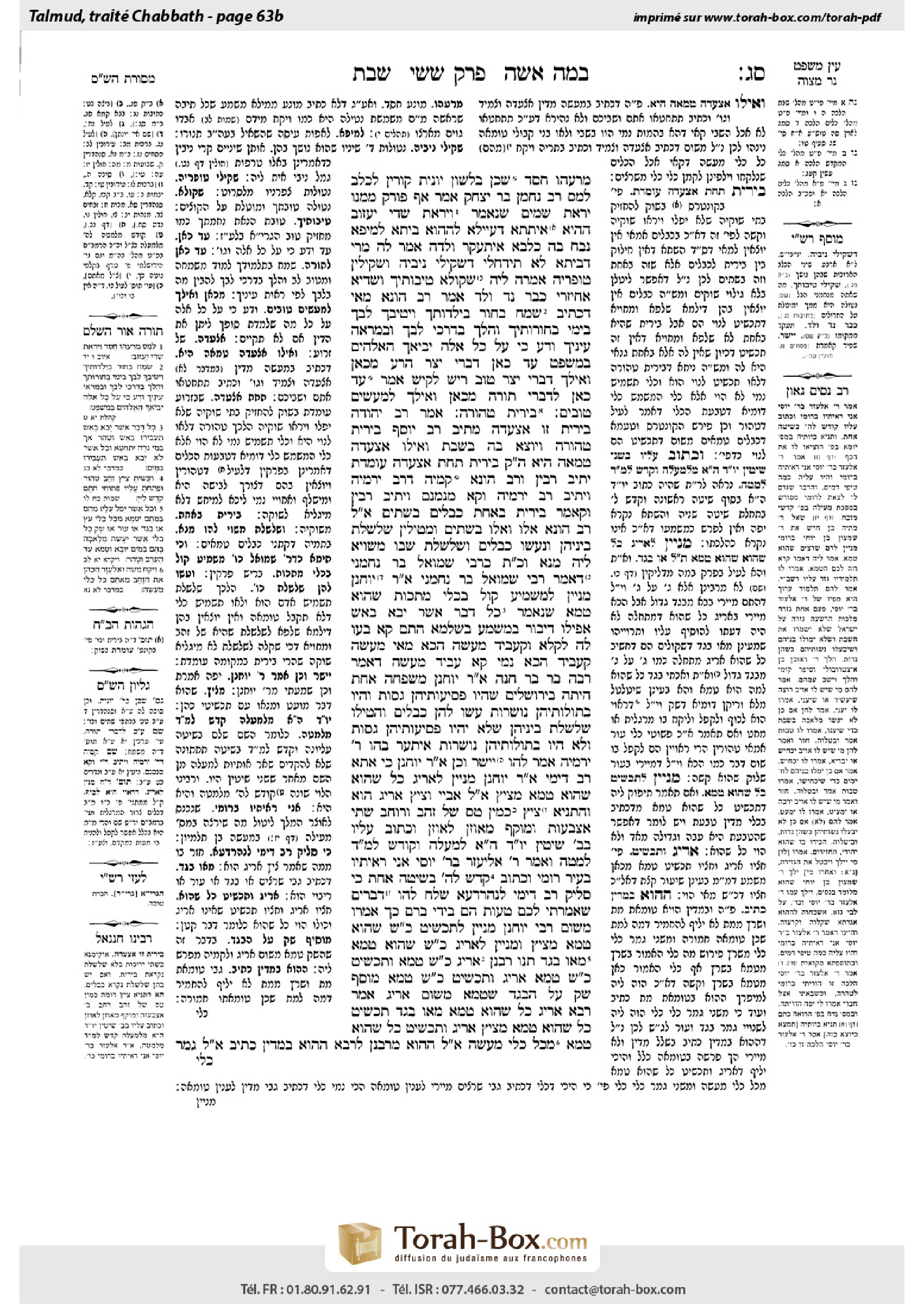
Shabbat 63b: Talmud study for Daf Yomi
Daf Yomi is the daily study of one Talmud folio. Explore 37 tractates with scans, Hebrew text, Sefaria English and AI-generated French translations where annotated.
Passage selection and English or AI-generated French translation are available where the scan has annotations. Daf Study is independent of Torah-Box and Sefaria.
Browse Shabbat · שבת · All tractatesShabbat 63b text and translations
This page of Shabbat includes the Aramaic text, an English translation and an AI-generated French translation, alongside the scan above.
שבת ס״ג ב · Aramaic and Hebrew text
מֵרֵעֵהוּ חָסֶד״ — שֶׁכֵּן בְּלָשׁוֹן יְוָנִית קוֹרִין לְכֶלֶב ״לַמָּס״. רַב נַחְמָן בַּר יִצְחָק אָמַר: אַף פּוֹרֵק מִמֶּנּוּ יִרְאַת שָׁמַיִם, שֶׁנֶּאֱמַר ״וְיִרְאַת שַׁדַּי יַעֲזוֹב״.
הַהִיא אִיתְּתָא דַּעֲיַילָא לְהָהוּא בֵּיתָא לְמֵיפָא. נְבַח בָּהּ כַּלְבָּא, אִיתְעֲקַר וַלְדַּהּ. אֲמַר לַהּ מָרֵי דְבֵיתָא לָא תִּידְחֲלִי, דִּשְׁקִילִי נִיבֵיהּ וּשְׁקִילִין טוּפְרֵיהּ. אֲמַרָה לֵיהּ: שְׁקִילָא טֵיבוּתָיךְ וְשַׁדְיָא אַחִיזְרֵי, כְּבָר נָד וָלָד.
אָמַר רַב הוּנָא: מַאי דִכְתִיב: ״שְׂמַח בָּחוּר בְּיַלְדוּתֶךָ וִיטִיבְךָ לִבְּךָ בִּימֵי בְחוּרוֹתֶיךָ וְהַלֵּךְ בְּדַרְכֵי לִבְּךָ וּבְמַרְאֵה עֵינֶיךָ וְדָע כִּי עַל כׇּל אֵלֶּה יְבִיאֲךָ הָאֱלֹהִים בַּמִּשְׁפָּט״ — עַד כָּאן דִּבְרֵי יֵצֶר הָרָע, מִכָּאן וְאֵילָךְ דִּבְרֵי יֵצֶר טוֹב.
רֵישׁ לָקִישׁ אָמַר: עַד כָּאן לְדִבְרֵי תוֹרָה, מִכָּאן וְאֵילָךְ לְמַעֲשִׂים טוֹבִים.
בִּירִית טְהוֹרָה. אָמַר רַב יְהוּדָה: בִּירִית זוֹ אֶצְעָדָה.
מֵתִיב רַב יוֹסֵף: בִּירִית טְהוֹרָה וְיוֹצֵא בָּהּ בְּשַׁבָּת, וְאִילּוּ אֶצְעָדָה טְמֵאָה הִיא!
הָכִי קָאָמַר: בִּירִית תַּחַת אֶצְעָדָה עוֹמֶדֶת.
יָתֵיב רָבִין וְרַב הוּנָא קַמֵּיהּ דְּרַב יִרְמְיָה, וְיָתֵיב רַב יִרְמְיָה וְקָא מְנַמְנֵם. וְיָתֵיב רָבִין וְקָאָמַר: — בִּירִית בְּאַחַת, כְּבָלִים בִּשְׁתַּיִם.
אֲמַר לֵיהּ רַב הוּנָא: אֵלּוּ וְאֵלּוּ בִּשְׁתַּיִם, וּמְטִילִין שַׁלְשֶׁלֶת בֵּינֵיהֶן וְנַעֲשׂוּ כְּבָלִים.
וְשַׁלְשֶׁלֶת שֶׁבּוֹ מְשַׁוְּיָא לֵיהּ מָנָא?
וְכִי תֵּימָא כְּרַבִּי שְׁמוּאֵל בַּר נַחְמָנִי, דְּאָמַר רַבִּי שְׁמוּאֵל בַּר נַחְמָנִי אָמַר רַבִּי יוֹחָנָן: מִנַּיִין לְמַשְׁמִיעַ קוֹל בִּכְלֵי מַתָּכוֹת שֶׁהוּא טָמֵא — שֶׁנֶּאֱמַר: ״כׇּל דָּבָר אֲשֶׁר יָבֹא בָאֵשׁ״ — אֲפִילּוּ דִּיבּוּר בַּמַּשְׁמָע.
בִּשְׁלָמָא הָתָם — קָא בָעוּ לַהּ לְקָלָא, וְקָעָבֵיד מַעֲשֶׂה, הָכָא מַאי מַעֲשֶׂה קָעָבֵיד?
הָכָא נָמֵי קָא עָבֵיד מַעֲשֶׂה, דְּאָמַר רַבָּה בַּר בַּר חָנָה אָמַר רַבִּי יוֹחָנָן: מִשְׁפָּחָה אַחַת הָיְתָה בִּירוּשָׁלַיִם שֶׁהָיוּ פְּסִיעוֹתֵיהֶן גַּסּוֹת וְהָיוּ בְּתוּלוֹתֵיהֶן נוֹשְׁרוֹת, עָשׂוּ לָהֶן כְּבָלִים וְהֵטִילוּ שַׁלְשֶׁלֶת בֵּינֵיהֶן, שֶׁלֹּא יִהְיוּ פְּסִיעוֹתֵיהֶן גַּסּוֹת וְלֹא הָיוּ בְּתוּלוֹתֵיהֶן נוֹשְׁרוֹת. אִיתְּעַר בְּהוּ רַבִּי יִרְמְיָה, אֲמַר לְהוּ: יִישַׁר, וְכֵן אָמַר רַבִּי יוֹחָנָן.
כִּי אֲתָא רַב דִּימִי אָמַר רַבִּי יוֹחָנָן: מִנַּיִין לְאָרִיג כׇּל שֶׁהוּא שֶׁהוּא טָמֵא — מִצִּיץ.
אֲמַר לֵיהּ אַבָּיֵי: וְצִיץ אָרִיג הוּא?! וְהָתַנְיָא: צִיץ כְּמִין טַס שֶׁל זָהָב, וְרוֹחַב שְׁתֵּי אֶצְבָּעוֹת, וּמוּקָּף מֵאוֹזֶן לְאוֹזֶן, וְכָתוּב עָלָיו בִּשְׁתֵּי שִׁיטִין: ״יוֹד הֵא״ לְמַעְלָה, וְ״קוֹדֶשׁ לָמֶד״ לְמַטָּה.
וְאָמַר רַבִּי אֱלִיעֶזֶר בְּרַבִּי יוֹסֵי: אֲנִי רְאִיתִיו בְּרוֹמִי וְכָתוּב עָלָיו ״קֹדֶשׁ לַה׳״ בְּשִׁיטָה אַחַת.
כִּי סְלֵיק רַב דִּימִי לִנְהַרְדְּעָא שְׁלַח לְהוּ: דְּבָרִים שֶׁאָמַרְתִּי לָכֶם טָעוּת הֵם בְּיָדִי, בְּרַם כָּךְ אָמְרוּ מִשּׁוּם רַבִּי יוֹחָנָן: מִנַּיִין לְתַכְשִׁיט כׇּל שֶׁהוּא שֶׁהוּא טָמֵא — מִצִּיץ. וּמִנַּיִין לְאָרִיג כׇּל שֶׁהוּא שֶׁהוּא טָמֵא: — מֵ״אוֹ בֶגֶד״.
תָּנוּ רַבָּנַן: אָרִיג כׇּל שֶׁהוּא — טָמֵא, וְתַכְשִׁיט כׇּל שֶׁהוּא — טָמֵא. אָרִיג וְתַכְשִׁיט כׇּל שֶׁהוּא — טָמֵא. מוּסָף שַׂק עַל הַבֶּגֶד שֶׁטָּמֵא מִשּׁוּם אָרִיג.
אָמַר רָבָא: אָרִיג כׇּל שֶׁהוּא טָמֵא — מֵ״אוֹ בֶגֶד״. תַּכְשִׁיט כׇּל שֶׁהוּא טָמֵא — מִצִּיץ. אָרִיג וְתַכְשִׁיט כׇּל שֶׁהוּא טָמֵא — מִ״כׇּל כְּלִי מַעֲשֶׂה״.
אֲמַר לֵיהּ הָהוּא מֵרַבָּנַן לְרָבָא: הָהוּא בְּמִדְיָן כְּתִיב!
אֲמַר לֵיהּ: גָּמַר
Shabbat 63b · English translation
kindness from his friend and awe of the Almighty will leave” (Job 6:14), since in the Greek language they call a dog lamas. Rav Naḥman bar Yitzḥak said: One who keeps an evil dog in his home even divests himself of fear of Heaven, as it is stated at the end of that verse: “And awe of the Almighty will leave.”
The Gemara relates: A certain pregnant woman who entered to use the oven in a certain house to bake, the dog in that house barked at her, and her fetus was displaced. The owner of the house said to her: Do not be afraid because his teeth have been removed and his claws have been removed. She said to him: Take your goodness and throw it on the thorns. Your encouragement is useless as the fetus has already been displaced and will certainly die.
On a related note, Rav Huna said: What is the meaning of that which is written: “Rejoice young man in your youth, and let your heart cheer you in the days of your youth, and walk in the ways of your heart and in the sight of your eyes; but know that for all these things God will bring you to judgment” (Ecclesiastes 11:9)? Until here, “the sight of your eyes,” these are the words of the evil inclination; from here on, “but know that, etc.,” these are the words of the good inclination.
Reish Lakish said: Until here, the verse refers to matters of Torah. One is provided the opportunity to study and involve himself in the Torah and rejoice in its innovations; from here on, “but know that, etc.,” it refers to good deeds. One will ultimately stand trial for that which he studied and did not implement.
We learned in the mishna that a garter is pure. Rav Yehuda said: Garter; that is a bracelet worn on the arm.
Rav Yosef raised an objection: It is stated here that a garter is pure and a woman may go out with it on Shabbat, while a bracelet is ritually impure. It is mentioned explicitly in the verse enumerating the spoils of the war with the Midianites: “And we have brought the Lord’s offering, what every man has gotten, of jewels of gold, armlets, and bracelets, signet rings, earrings, and girdles, to make atonement for our souls before the Lord” (Numbers 31:50). Earlier in that chapter it is written with regard to the spoils: “Purify yourselves on the third day and on the seventh day both you and your captives” (Numbers 31:19). Apparently, a bracelet can become ritually impure.
Rather, this is what Rav Yehuda is saying: A garter on the leg is in place of a bracelet on the arm. It goes around the leg to hold a stocking in place just as a bracelet goes around the arm. However, unlike a bracelet, a garter cannot become ritually impure because it is not an ornament. It simply holds up the stocking.
The Gemara relates: Ravin and Rav Huna were sitting before Rav Yirmeya. And Rav Yirmeya was sitting and dozing as the two students conversed. And Ravin sat and said: The difference between a garter and ankle chains is that a garter is worn on one leg, and ankle chains are worn on two legs.
Rav Huna said to him: These garters and those ankle chains are both worn on two legs. And when she wears garters on both legs they place a chain between them, and they become vessels with the legal status equal to that of ankle chains.
And Ravin asked: And does the chain that is connected to it render it a vessel? If a garter without a chain is not considered a vessel, why would the addition of a chain render it a vessel that can become ritually impure?
And if you say the reason for this is in accordance with the opinion of Rabbi Shmuel bar Naḥmani, as Rabbi Shmuel bar Naḥmani said that Rabbi Yoḥanan said: From where is it derived that a metal vessel that makes a sound is considered a vessel and can become ritually impure? As it is stated: “Every thing that passes through the fire, you shall make it pass through the fire, and it shall be clean; nevertheless it shall be purified with the water of sprinkling; and all that does not pass through the fire you shall make to go through water” (Numbers 31:23). And the Sages interpret the verse homiletically: Every thing [davar], even speech [dibbur]; in other words, even an object that makes a sound shall pass through fire to become purified because it is a vessel.
However, this case is not similar. Granted, there, they require the vessel for the purpose of its sound and it performs an action. However, here, what action does the chain perform? Although it creates a sound, the chain serves no purpose.
He said to him: Here, too, the chain is performing a purposeful action, as Rabba bar bar Ḥana said that Rabbi Yoḥanan said: There was one family in Jerusalem whose daughters’ strides were lengthy, and as a result their hymen membranes would fall away. In order to solve this problem they made them ankle chains and they hung a chain between them so that their strides would not be so large and, indeed, their hymen membranes would no longer fall away. Meanwhile, Rabbi Yirmeya awoke from their voices and said to them: Correct, and Rabbi Yoḥanan said likewise.
On the topic of ritual impurity, the Gemara relates: When Rav Dimi came from Eretz Yisrael to Babylonia, he said that Rabbi Yoḥanan said: From where is it derived that a woven fabric of any size can become ritually impure? It is derived from the frontplate [tzitz] of the High Priest, which is considered a vessel despite its small size.
Abaye said to him: And is the frontplate a woven fabric? Wasn’t it taught in a baraita: The frontplate is made like a kind of smooth plate of gold, and its width is two fingerbreadths, and it encircles the forehead from ear to ear. And on it is written in two lines: Yod heh, i.e., the Tetragrammaton, above, and kodesh lamed, i.e., sacred to, below. Thus, the words: Sacred to God, were written on the frontplate. In deference to the name of God, it would be written on the top line, and the words: Sacred to, on the line below.
And Rabbi Eliezer, son of Rabbi Yosei, said: I saw it in the Caesar’s treasury in the city of Rome and Sacred to God was written on one line. In any case, since the frontplate is a gold plate, how can it serve as a source for ritual impurity in fabrics?
When Rav Dimi ascended to Neharde’a, he sent to the yeshiva students: The statements I said to you with regard to woven fabrics of any size becoming ritually impure regardless of their size, they are my mistake. However, this is what they said in the name of Rabbi Yoḥanan: From where is it derived that an ornament of any size can become ritually impure? It is derived from the frontplate. And from where is it derived that a woven fabric of any size can become ritually impure? It is derived from the verse: “Or a garment or leather or sack; any vessel with which any work is done must be put into water and it shall be unclean until evening, then it shall be clean” (Leviticus 11:32). From the extraneous phrase, “or a garment,” it is derived that any garment, regardless how small, falls into this category.
Similarly, the Sages taught in a baraita: A woven fabric of any size can become ritually impure, and an ornament of any size can become ritually impure. An object that is half woven fabric and half ornament of any size can become ritually impure. And a sack is added to the category of garment; it too is ritually impure due to woven fabric.
Rava said in explanation of the baraita: A woven fabric of any size is ritually impure as derived from the phrase “or a garment.” An ornament of any size is ritually impure, as derived from the halakhot of the frontplate. A woven fabric and an ornament of any size is ritually impure, as derived from that which is stated: “And Moses and Elazar the priest took the gold from them, all vessels with which labor is done” (Numbers 31:51). Any object that can be utilized for any action falls into the category of: All vessels with which labor is done.
One of the Sages said to Rava: That verse is written with regard to Midian. There it is referring specifically to ritual impurity imparted by a corpse, and how is it possible to derive from that halakhot of ritual impurity in general?
Rava said to him: He derived by means of a verbal analogy
Shabbat 63b · Traduction française (IA)
« La bonté envers son prochain et la crainte du Tout-Puissant l’abandonneront » (Job 6,14), car en grec, le mot « chien » se dit lamas. Rav Naḥman bar Yitzḥak dit : Celui qui garde chez lui un chien méchant se dépouille même de la crainte du Ciel, comme il est dit à la fin de ce verset : « Et la crainte du Tout-Puissant l’abandonnera. »
La Guemara rapporte : Une femme enceinte entra dans une certaine maison pour y faire cuire quelque chose au four. Le chien de la maison aboya contre elle et son fœtus fut déplacé. Le propriétaire de la maison lui dit : « N’aie pas peur, car on lui a enlevé ses dents et ses griffes. » Elle lui répondit : « Prends ta bonté et jette-la dans les épines. » Tes paroles rassurantes ne servent à rien, puisque le fœtus a déjà été déplacé et va certainement mourir.
À ce propos, Rav Houna dit : Quel est le sens de ce qui est écrit : « Réjouis-toi, jeune homme, dans ta jeunesse ; que ton cœur te rende joyeux aux jours de ta jeunesse ; marche selon les voies de ton cœur et selon ce que voient tes yeux ; mais sache que, pour tout cela, Dieu te fera comparaître en jugement » (Ecclésiaste 11,9) ? Jusqu’ici, « selon ce que voient tes yeux », ce sont les paroles du mauvais penchant ; à partir de là, « mais sache que, etc. », ce sont les paroles du bon penchant.
Reish Lakish dit : Jusqu’ici, le verset parle de l’étude de la Torah. On a la possibilité d’étudier la Torah, de s’y consacrer et de se réjouir de ses nouveautés ; à partir de là, « mais sache que, etc. », il s’agit des bonnes actions. On finira par être jugé pour ce qu’on a étudié sans le mettre en pratique.
Nous avons appris dans la Michna qu’une jarretière est pure. Rav Yehouda dit : Une jarretière, c’est un bracelet porté au bras.
Rav Yossef objecta : Il est dit ici qu’une jarretière est pure et qu’une femme peut la porter pour sortir le Chabbat, tandis qu’un bracelet est impur au regard de la loi rituelle. Cela est explicitement mentionné dans le verset qui énumère le butin de la guerre contre les Midianites : « Nous avons apporté l’offrande du Seigneur, ce que chaque homme a trouvé en objets d’or, bracelets de bras et bracelets, anneaux à cachet, boucles d’oreilles et ceintures, afin de faire expiation pour nos personnes devant le Seigneur » (Nombres 31,50). Plus tôt dans ce chapitre, il est écrit au sujet du butin : « Purifiez-vous le troisième jour et le septième jour, vous et vos captifs » (Nombres 31,19). Il semble donc qu’un bracelet puisse contracter l’impureté rituelle.
Il faut plutôt comprendre que voici ce que dit Rav Yehouda : La jarretière portée à la jambe tient lieu de bracelet porté au bras. Elle entoure la jambe pour maintenir un bas en place, tout comme un bracelet entoure le bras. Toutefois, contrairement au bracelet, une jarretière ne peut pas contracter l’impureté rituelle, car ce n’est pas un ornement. Elle ne fait que maintenir le bas.
La Guemara rapporte : Ravin et Rav Houna étaient assis devant Rav Yirmeya. Rav Yirmeya était assis et somnolait tandis que les deux élèves discutaient. Ravin était assis et dit : La différence entre une jarretière et des chaînes de cheville est qu’une jarretière se porte à une jambe, tandis que les chaînes de cheville se portent aux deux jambes.
Rav Houna lui dit : Ces jarretières et ces chaînes de cheville se portent toutes deux aux deux jambes. Quand une femme porte des jarretières aux deux jambes, on place une chaîne entre elles ; elles deviennent alors des ustensiles ayant le même statut juridique que les chaînes de cheville.
Ravin demanda : Et la chaîne qui y est attachée en fait-elle un ustensile ? Si une jarretière sans chaîne n’est pas considérée comme un ustensile, pourquoi l’ajout d’une chaîne en ferait-il un ustensile susceptible de contracter l’impureté rituelle ?
Et si tu dis que cela s’explique conformément à l’opinion de Rabbi Shmuel bar Naḥmani, car Rabbi Shmuel bar Naḥmani a dit au nom de Rabbi Yoḥanan : D’où apprend-on qu’un ustensile en métal qui émet un son est considéré comme un ustensile et peut contracter l’impureté rituelle ? Comme il est dit : « Tout objet qui passe par le feu, vous le ferez passer par le feu et il sera pur ; néanmoins, il sera purifié par l’eau de purification ; et tout ce qui ne passe pas par le feu, vous le ferez passer par l’eau » (Nombres 31,23). Les Sages interprètent ce verset de manière homilétique : « Tout objet » [davar], même une parole [dibbur] ; autrement dit, même un objet qui émet un son doit passer par le feu pour être purifié, car c’est un ustensile.
Cependant, ce cas n’est pas comparable. Certes, là-bas, on a besoin de l’ustensile pour le son qu’il produit, et il accomplit une fonction. Mais ici, quelle fonction la chaîne accomplit-elle ? Bien qu’elle produise un son, la chaîne ne sert à rien.
Il lui dit : Ici aussi, la chaîne remplit une fonction utile, car Rabba bar bar Ḥana a dit au nom de Rabbi Yoḥanan : Il y avait à Jérusalem une famille dont les filles faisaient de grandes enjambées ; de ce fait, leur hymen se détachait. Pour résoudre ce problème, on leur fabriqua des chaînes de cheville et on suspendit une chaîne entre elles, afin que leurs enjambées ne soient pas aussi grandes ; ainsi, leur hymen ne se détachait plus. Entre-temps, Rabbi Yirmeya se réveilla en entendant leurs voix et leur dit : « C’est exact ; Rabbi Yoḥanan a dit la même chose. »
Au sujet de l’impureté rituelle, la Guemara rapporte : Lorsque Rav Dimi vint d’Eretz Israël en Babylonie, il dit au nom de Rabbi Yoḥanan : D’où apprend-on qu’un tissu tissé, quelle que soit sa taille, peut contracter l’impureté rituelle ? On l’apprend de la plaque frontale [tzitz] du grand prêtre, qui est considérée comme un ustensile malgré sa petite taille.
Abayé lui dit : Mais la plaque frontale est-elle un tissu tissé ? N’a-t-il pas été enseigné dans une baraïta : La plaque frontale est faite comme une sorte de plaque d’or lisse ; sa largeur est de deux doigts et elle entoure le front d’une oreille à l’autre. On y inscrit, sur deux lignes : en haut, Yod heh, c’est-à-dire le Tétragramme, et en bas, kodesh lamed, c’est-à-dire « consacré à ». Ainsi, les mots « consacré à Dieu » étaient inscrits sur la plaque frontale. Par déférence pour le nom de Dieu, celui-ci était inscrit sur la ligne du haut et les mots « consacré à » sur celle du bas.
Rabbi Eliezer, fils de Rabbi Yossei, dit : « Je l’ai vue dans le trésor de César, dans la ville de Rome, et les mots “Consacré à Dieu” étaient inscrits sur une seule ligne. » Quoi qu’il en soit, puisque la plaque frontale est une plaque d’or, comment peut-elle servir de source pour l’impureté rituelle des tissus ?
Lorsque Rav Dimi monta à Neharde’a, il fit transmettre aux élèves de la yeshiva : « Les propos que je vous ai tenus sur le fait que des tissus tissés, quelle que soit leur taille, contractent l’impureté rituelle, sont erronés. Voici plutôt ce qu’ils ont dit au nom de Rabbi Yoḥanan : D’où apprend-on qu’un ornement, quelle que soit sa taille, peut contracter l’impureté rituelle ? On l’apprend de la plaque frontale. Et d’où apprend-on qu’un tissu tissé, quelle que soit sa taille, peut contracter l’impureté rituelle ? On l’apprend du verset : “Ou un vêtement, ou du cuir, ou un sac ; tout ustensile servant à quelque travail que ce soit devra être mis dans l’eau et sera impur jusqu’au soir ; alors il sera pur” (Lévitique 11,32). De l’expression superflue “ou un vêtement”, on apprend que tout vêtement, aussi petit soit-il, entre dans cette catégorie. »
De même, les Sages ont enseigné dans une baraïta : Un tissu tissé, quelle que soit sa taille, peut contracter l’impureté rituelle, et un ornement, quelle que soit sa taille, peut contracter l’impureté rituelle. Un objet composé pour moitié de tissu tissé et pour moitié d’un ornement peut contracter l’impureté rituelle, quelle que soit sa taille. Et le sac est ajouté à la catégorie des vêtements ; lui aussi contracte l’impureté rituelle en raison de son tissu tissé.
Rava expliqua la baraïta : Un tissu tissé, quelle que soit sa taille, est impur au regard de la loi rituelle, comme on l’apprend de l’expression « ou un vêtement ». Un ornement, quelle que soit sa taille, est impur au regard de la loi rituelle, comme on l’apprend des halakhot de la plaque frontale. Un objet composé de tissu tissé et d’un ornement, quelle que soit sa taille, est impur au regard de la loi rituelle, comme on l’apprend de ce qui est dit : « Moïse et Éléazar le prêtre leur prirent l’or, tous les ustensiles servant au travail » (Nombres 31,51). Tout objet pouvant servir à quelque usage que ce soit entre dans la catégorie de « tous les ustensiles servant au travail ».
L’un des Sages dit à Rava : Ce verset est écrit au sujet de Midian. Il y est question spécifiquement de l’impureté rituelle transmise par un cadavre ; comment peut-on en déduire des halakhot sur l’impureté rituelle en général ?
Rava lui dit : Il l’a déduit au moyen d’une analogie verbale.
Traduction française générée par IA à partir de l’édition anglaise de Sefaria. Vérifie toujours un passage avec le texte source.
Text from Sefaria: William Davidson Edition - Vocalized Aramaic (CC BY NC); William Davidson Edition - English (CC BY NC).