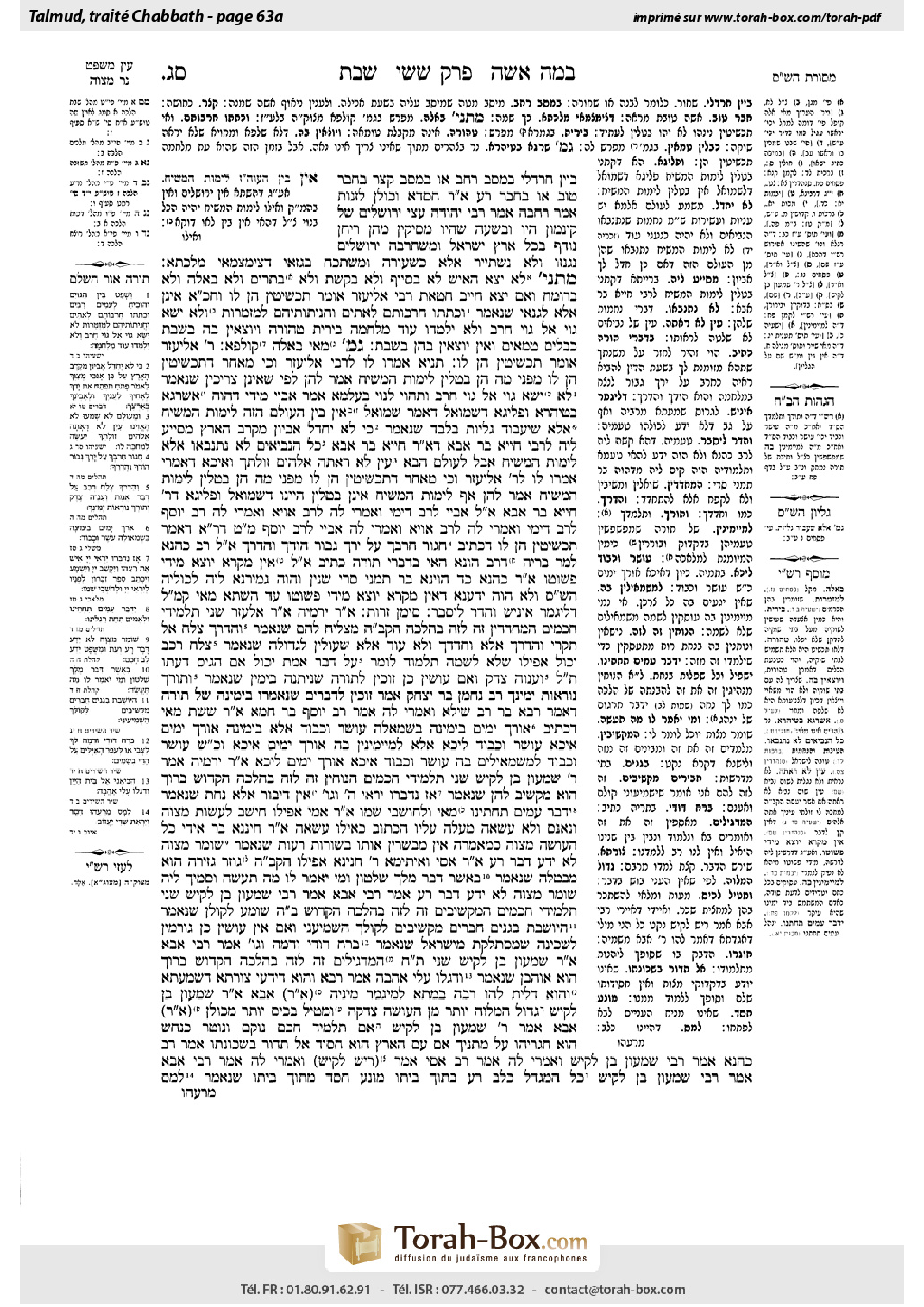
Shabbat 63a: Talmud study for Daf Yomi
Daf Yomi is the daily study of one Talmud folio. Explore 37 tractates with scans, Hebrew text, Sefaria English and AI-generated French translations where annotated.
Passage selection and English or AI-generated French translation are available where the scan has annotations. Daf Study is independent of Torah-Box and Sefaria.
Browse Shabbat · שבת · All tractatesShabbat 63a text and translations
This page of Shabbat includes the Aramaic text, an English translation and an AI-generated French translation, alongside the scan above.
שבת ס״ג א · Aramaic and Hebrew text
בְּיַיִן חַרְדָּלִי? בְּמֵסַב רָחָב, אוֹ בְּמֵסַב קָצָר? בְּחָבֵר טוֹב, אוֹ בְּחָבֵר רָע? אָמַר רַב חִסְדָּא: וְכוּלָּן לִזְנוּת.
אָמַר רַחֲבָה אָמַר רַבִּי יְהוּדָה: עֲצֵי יְרוּשָׁלַיִם שֶׁל קִינָּמוֹן הָיוּ, וּבְשָׁעָה שֶׁהָיוּ מַסִּיקִין מֵהֶן, רֵיחָן נוֹדֵף בְּכָל אֶרֶץ יִשְׂרָאֵל. וּמִשֶּׁחָרְבָה יְרוּשָׁלַיִם נִגְנְזוּ, וְלֹא נִשְׁתַּיֵּיר אֶלָּא כִּשְׂעוֹרָה, וּמִשְׁתְּכַח בֵּי גַזָּא דְּצִימְצְמַאי מַלְכְּתָא.
מַתְנִי׳ לֹא יֵצֵא הָאִישׁ לֹא בְּסַיִיף וְלֹא בְּקֶשֶׁת וְלֹא בִּתְרִיס וְלֹא בְּאַלָּה וְלֹא בְּרוֹמַח. וְאִם יָצָא — חַיָּיב חַטָּאת.
רַבִּי אֱלִיעֶזֶר אוֹמֵר: תַּכְשִׁיטִין הֵן לוֹ.
וַחֲכָמִים אוֹמְרִים: אֵינָן אֶלָּא לִגְנַאי, שֶׁנֶּאֱמַר: ״וְכִתְּתוּ חַרְבוֹתָם לְאִתִּים וַחֲנִיתוֹתֵיהֶם לְמַזְמֵרוֹת וְלֹא יִשָּׂא גוֹי אֶל גּוֹי חֶרֶב וְלֹא יִלְמְדוּ עוֹד מִלְחָמָה״.
בִּירִית — טְהוֹרָה וְיוֹצְאִין בָּהּ בְּשַׁבָּת.
כְּבָלִים — טְמֵאִים וְאֵין יוֹצְאִין בָּהֶן בְּשַׁבָּת.
גְּמָ׳ מַאי בְּ׳אַלָּה׳ — קוּלְפָא.
רַבִּי אֱלִיעֶזֶר אוֹמֵר תַּכְשִׁיטִין הֵן לוֹ. תַּנְיָא: אָמְרוּ לוֹ לְרַבִּי אֱלִיעֶזֶר: וְכִי מֵאַחַר דְּתַכְשִׁיטִין הֵן לוֹ, מִפְּנֵי מָה הֵן בְּטֵלִין לִימוֹת הַמָּשִׁיחַ? אָמַר לָהֶן: לְפִי שֶׁאֵינָן צְרִיכִין, שֶׁנֶּאֱמַר: ״לֹא יִשָּׂא גוֹי אֶל גּוֹי חֶרֶב״. וְתֶהֱוֵי לְנוֹי בְּעָלְמָא! אָמַר אַבָּיֵי: מִידֵּי דְּהָוֵה אַשְּׁרָגָא בְּטִיהֲרָא.
וּפְלִיגָא דִּשְׁמוּאֵל. דְּאָמַר שְׁמוּאֵל: אֵין בֵּין הָעוֹלָם הַזֶּה לִימוֹת הַמָּשִׁיחַ אֶלָּא שִׁיעְבּוּד גָּלֻיוֹת בִּלְבַד, שֶׁנֶּאֱמַר: ״כִּי לֹא יֶחְדַּל אֶבְיוֹן מִקֶּרֶב הָאָרֶץ״.
מְסַיַּיע לֵיהּ לְרַבִּי חִיָּיא בַּר אַבָּא. דְּאָמַר רַבִּי חִיָּיא בַּר אַבָּא: כׇּל הַנְּבִיאִים לֹא נִתְנַבְּאוּ אֶלָּא לִימוֹת הַמָּשִׁיחַ, אֲבָל לְעוֹלָם הַבָּא: ״עַיִן לֹא רָאָתָה אֱלֹהִים זוּלָתְךָ״.
וְאִיכָּא דְאָמְרִי: אָמְרוּ לוֹ לְרַבִּי אֱלִיעֶזֶר: וְכִי מֵאַחַר דְּתַכְשִׁיטִין הֵן לוֹ, מִפְּנֵי מָה הֵן בְּטֵלִין לִימוֹת הַמָּשִׁיחַ? אָמַר לָהֶן: אַף לִימוֹת הַמָּשִׁיחַ אֵינָן בְּטֵלִין. הַיְינוּ דִּשְׁמוּאֵל, וּפְלִיגָא דְּרַבִּי חִיָּיא בַּר אַבָּא.
אֲמַר לֵיהּ אַבָּיֵי לְרַב דִּימִי, וְאָמְרִי לַהּ לְרַב אַוְיָא, וְאָמְרִי לַהּ רַב יוֹסֵף לְרַב דִּימִי, וְאָמְרִי לַהּ לְרַב אַוְיָא, וְאָמְרִי לַהּ אַבָּיֵי לְרַב יוֹסֵף: מַאי טַעְמָא דְּרַבִּי אֱלִיעֶזֶר דְּאָמַר תַּכְשִׁיטִין הֵן לוֹ — דִּכְתִיב: ״חֲגוֹר חַרְבְּךָ עַל יָרֵךְ גִּבּוֹר הוֹדְךָ וַהֲדָרֶךָ״.
אֲמַר לֵיהּ רַב כָּהֲנָא לְמָר בְּרֵיהּ דְּרַב הוּנָא: הַאי בְּדִבְרֵי תוֹרָה כְּתִיב! אֲמַר לֵיהּ: אֵין מִקְרָא יוֹצֵא מִידֵי פְּשׁוּטוֹ.
אָמַר רַב כָּהֲנָא: כַּד הֲוֵינָא בַּר תַּמְנֵי סְרֵי שְׁנִין וַהֲוָה גְּמִירְנָא לֵיהּ לְכוּלֵּיהּ תַּלְמוּדָא, וְלָא הֲוָה יָדַעְנָא דְּאֵין מִקְרָא יוֹצֵא מִידֵּי פְּשׁוּטוֹ עַד הַשְׁתָּא. מַאי קָא מַשְׁמַע לַן? דְּלִיגְמַר אִינִישׁ וַהֲדַר לִיסְבַּר.
סִימָן ״זָרוֹת״.
אָמַר רַבִּי יִרְמְיָה אָמַר רַבִּי אֶלְעָזָר: שְׁנֵי תַּלְמִידֵי חֲכָמִים הַמְחַדְּדִין זֶה לְזֶה בַּהֲלָכָה הַקָּדוֹשׁ בָּרוּךְ הוּא מַצְלִיחַ לָהֶם, שֶׁנֶּאֱמַר: ״וַהֲדָרְךָ צְלַח״. אַל תִּקְרֵי: ״וַהֲדָרְךָ״, אֶלָּא ״וַחֲדָדְךָ״. וְלֹא עוֹד אֶלָּא שֶׁעוֹלִין לִגְדוּלָּה, שֶׁנֶּאֱמַר: ״צְלַח רְכַב״. יָכוֹל אֲפִילּוּ שֶׁלֹּא לִשְׁמָהּ — תַּלְמוּד לוֹמַר: ״עַל דְּבַר אֱמֶת״. יָכוֹל אִם הֵגֵיס דַּעְתּוֹ — תַּלְמוּד לוֹמַר: ״וְעַנְוָה צֶדֶק״. וְאִם עוֹשִׂין כֵּן זוֹכִין לַתּוֹרָה שֶׁנִּיתְּנָה בְּיָמִין, שֶׁנֶּאֱמַר: ״וְתוֹרְךָ נוֹרָאוֹת יְמִינֶךָ״.
רַב נַחְמָן בַּר יִצְחָק אָמַר: זוֹכִין לִדְבָרִים שֶׁנֶּאֶמְרוּ בִּימִינָהּ שֶׁל תּוֹרָה. דְּאָמַר רָבָא בַּר רַב שֵׁילָא, וְאָמְרִי לַהּ אָמַר רַב יוֹסֵף בַּר חָמָא אָמַר רַב שֵׁשֶׁת: מַאי דִכְתִיב ״אֹרֶךְ יָמִים בִּימִינָהּ בִּשְׂמֹאלָהּ עֹשֶׁר וְכָבוֹד״ — אֶלָּא בִּימִינָהּ אֹרֶךְ יָמִים אִיכָּא, עֹשֶׁר וְכָבוֹד לֵיכָּא?! אֶלָּא: לַמַּיְימִינִין בָּהּ — אֹרֶךְ יָמִים אִיכָּא, וְכָל שֶׁכֵּן עוֹשֶׁר וְכָבוֹד. לַמַּשְׂמְאִילִים בָּהּ — עוֹשֶׁר וְכָבוֹד אִיכָּא, אוֹרֶךְ יָמִים לֵיכָּא.
אָמַר רַבִּי יִרְמְיָה אָמַר רַבִּי שִׁמְעוֹן בֶּן לָקִישׁ: שְׁנֵי תַּלְמִידֵי חֲכָמִים הַנּוֹחִין זֶה לָזֶה בַּהֲלָכָה הַקָּדוֹשׁ בָּרוּךְ הוּא מַקְשִׁיב לָהֶן, שֶׁנֶּאֱמַר: ״אָז נִדְבְּרוּ יִרְאֵי ה׳ וְגוֹ׳״ — אֵין דִּבּוּר אֶלָּא נַחַת, שֶׁנֶּאֱמַר: ״יַדְבֵּר עַמִּים תַּחְתֵּינוּ״.
מַאי ״וּלְחוֹשְׁבֵי שְׁמוֹ״? אָמַר רַבִּי אַמֵּי: אֲפִילּוּ חִישֵּׁב לַעֲשׂוֹת מִצְוָה, וְנֶאֱנַס וְלֹא עֲשָׂאָהּ, מַעֲלֶה עָלָיו הַכָּתוּב כְּאִילּוּ עֲשָׂאָהּ.
אָמַר רַב חִינָּנָא בַּר אִידִי: כָּל הָעוֹשֶׂה מִצְוָה כְּמַאֲמָרָהּ אֵין מְבַשְּׂרִין אוֹתוֹ בְּשׂוֹרוֹת רָעוֹת, שֶׁנֶּאֱמַר: ״שׁוֹמֵר מִצְוָה לֹא יֵדַע דָּבָר רָע״.
אָמַר רַב אַסִּי, וְאִיתֵּימָא רַבִּי חֲנִינָא: אֲפִילּוּ הַקָּדוֹשׁ בָּרוּךְ הוּא גּוֹזֵר גְּזֵירָה — הוּא מְבַטְּלָהּ, שֶׁנֶּאֱמַר: ״בַּאֲשֶׁר דְּבַר מֶלֶךְ שִׁלְטוֹן וּמִי יֹאמַר לוֹ מַה תַּעֲשֶׂה״, וּסְמִיךְ לֵיהּ: ״שׁוֹמֵר מִצְוָה לֹא יֵדַע דָּבָר רָע״.
אָמַר רַבִּי אַבָּא אָמַר רַבִּי שִׁמְעוֹן בֶּן לָקִישׁ: שְׁנֵי תַּלְמִידֵי חֲכָמִים הַמַּקְשִׁיבִים זֶה לָזֶה בַּהֲלָכָה הַקָּדוֹשׁ בָּרוּךְ הוּא שׁוֹמֵעַ לְקוֹלָן, שֶׁנֶּאֱמַר: ״הַיּוֹשֶׁבֶת בַּגַּנִּים חֲבֵרִים מַקְשִׁיבִים לְקוֹלֵךְ הַשְׁמִיעִנִי״.
וְאִם אֵין עוֹשִׂין כֵּן — גּוֹרְמִין לַשְּׁכִינָה שֶׁמִּסְתַּלֶּקֶת מִיִּשְׂרָאֵל, שֶׁנֶּאֱמַר: ״בְּרַח דּוֹדִי וּדְמֵה וְגוֹ׳״.
אָמַר רַבִּי אַבָּא אָמַר רַבִּי שִׁמְעוֹן בֶּן לָקִישׁ: שְׁנֵי תַּלְמִידֵי חֲכָמִים הַמַּדְגִּילִים זֶה לָזֶה בַּהֲלָכָה הַקָּדוֹשׁ בָּרוּךְ הוּא אוֹהֲבָן, שֶׁנֶּאֱמַר: ״וְדִגְלוֹ עָלַי אַהֲבָה״. אָמַר רָבָא: וְהוּא דְּיָדְעִי צוּרְתָּא דִשְׁמַעְתָּא. וְהוּא דְּלֵית לְהוּ רַבָּה בְּמָתָא לְמִיגְמַר מִינֵּיהּ.
אָמַר רַבִּי אַבָּא אָמַר רַבִּי שִׁמְעוֹן בֶּן לָקִישׁ: גָּדוֹל הַמַּלְוֶה יוֹתֵר מִן הָעוֹשֶׂה צְדָקָה. וּמֵטִיל בַּכִּיס, יוֹתֵר מִכּוּלָּן.
אָמַר רַבִּי אַבָּא אָמַר רַבִּי שִׁמְעוֹן בֶּן לָקִישׁ: אִם תַּלְמִיד חָכָם נוֹקֵם וְנוֹטֵר כְּנָחָשׁ הוּא — חׇגְרֵיהוּ עַל מׇתְנֶיךָ. אִם עַם הָאָרֶץ הוּא חָסִיד — אַל תָּדוּר בִּשְׁכוּנָתוֹ.
אָמַר רַב כָּהֲנָא אָמַר רַבִּי שִׁמְעוֹן בֶּן לָקִישׁ, וְאָמְרִי לַהּ אָמַר רַב אַסִּי אָמַר רֵישׁ לָקִישׁ, וְאָמְרִי לַהּ אָמַר רַבִּי אַבָּא אָמַר רַבִּי שִׁמְעוֹן בֶּן לָקִישׁ: כׇּל הַמְגַדֵּל כֶּלֶב רַע בְּתוֹךְ בֵּיתוֹ מוֹנֵעַ חֶסֶד מִתּוֹךְ בֵּיתוֹ, שֶׁנֶּאֱמַר: ״לַמָּס
Shabbat 63a · English translation
on black wine? Sitting on a wide divan or on a narrow divan? With a good friend or a bad friend? And Rav Ḥisda said: And all these allude to promiscuity. These are all euphemisms for different types of women. Well-kneaded bread refers to a woman who is not a virgin; white wine refers to a fair-complexioned woman; a wide divan refers to a fat woman; a good friend refers to a good-looking woman.
On the topic of Jerusalem, Raḥava said that Rabbi Yehuda said: The logs of Jerusalem used for fuel were from the cinnamon tree, and when they would ignite them, their fragrance would waft through all of Eretz Yisrael. And since Jerusalem was destroyed, these fragrant logs were buried, and only a sliver the size of a grain of barley remains, and it is located in the treasury of [gazzai] Tzimtzemai the queen.
MISHNA: Just as it is prohibited for a woman to carry out certain items unique to a woman into the public domain, the Sages said that a man may neither go out on Shabbat with a sword, nor with a bow, nor with a shield [teris], nor with an alla, nor with a spear. And if he unwittingly went out with one of these weapons to the public domain he is liable to bring a sin-offering.
Rabbi Eliezer says: These weapons are ornaments for him; just as a man is permitted to go out into the public domain with other ornaments, he is permitted to go out with weapons.
And the Rabbis say: They are nothing other than reprehensible and in the future they will be eliminated, as it is written: “And they shall beat their swords into plowshares and their spears into pruning hooks; nation will not raise sword against nation, neither will they learn war anymore” (Isaiah 2:4).
With regard to women’s ornaments, they added that a garter placed on her leg to hold up stockings is pure and cannot become ritually impure as a utensil, and she may even go out with it on Shabbat.
However, ankle chains, which were also women’s ornaments, can become ritually impure, and she may not go out with them on Shabbat.
GEMARA: The Gemara asks: What is the meaning of the term alla? It means club [kulpa].
We learned in the mishna that Rabbi Eliezer says: These weapons are ornaments for him. It was taught in a baraita that elaborates on this subject: The Rabbis said to Rabbi Eliezer: And since, in your opinion, they are ornaments for him, why are they to be eliminated in the messianic era? He said to them: They will not be needed anymore, as it is stated: “Nation will not raise sword against nation” (Isaiah 2:4). The Gemara asks: And let the weapons be merely for ornamental purposes, even though they will not be needed for war. Abaye said: It is just as in the case of a candle in the afternoon. Since its light is not needed, it serves no ornamental purpose. Weapons, too; when not needed for war, they serve no ornamental purpose either.
And this baraita disagrees with the opinion of Shmuel, as Shmuel said: The only difference between this world and the messianic era is subjugation of the exiles to other kingdoms, from which the Jewish people will be released. However, in other respects, the world will remain as it is, as it is written: “Because the poor will not cease from within the land” (Deuteronomy 15:11). Society will not change, and wars will continue to be waged.
However, this baraita supports the opinion of Rabbi Ḥiyya bar Abba who disagrees with Shmuel. As Rabbi Ḥiyya bar Abba said: All of the prophets only prophesied with regard to the messianic era; however, with regard to the World-to-Come it was stated: “No eye sees, God, except You, that which He will do for he that waits for Him” (Isaiah 64:3). What will be in the World-to-Come cannot be depicted even by means of prophecy.
And some say the disagreement between Rabbi Eliezer and the Rabbis was different. They said to Rabbi Eliezer: Since in your opinion they are ornaments for him, why will they be eliminated in the messianic era? He said to them: Even in the messianic era they will not be eliminated. And that is in accordance with that which Shmuel stated that the world will remain fundamentally the same, and he disagrees with Rabbi Ḥiyya bar Abba.
Abaye said to Rav Dimi, and some say it was to Rav Avya, and some say Rav Yosef said to Rav Dimi, and some say it was to Rav Avya, and some say Abaye said to Rav Yosef: What is the reason for the opinion of Rabbi Eliezer who said: These weapons are ornaments for him? As it is written: “Gird your sword upon your thigh, mighty one, your glory and your splendor” (Psalms 45:4), indicating that a sword is considered an ornament.
The Gemara relates that some time later Rav Kahana said to Mar, son of Rav Huna: Is that really a proof? This verse is written in reference to matters of Torah and should be interpreted as a metaphor. He said to him: Nevertheless, a verse does not depart from its literal meaning, although there may be additional homiletical interpretations.
Rav Kahana said about this: When I was eighteen years old and had already learned the entire Talmud, and yet I did not know that a verse does not depart from its literal meaning until now. The Gemara asks: What is Rav Kahana teaching us with that statement? The Gemara answers: He comes to teach that a person should first learn and then understand the rationale.
Zarot is a mnemonic acronym for Elazar [zayin], Reish Lakish [reish], and their students [vav, tav], the amoraim who interpreted the verse in Psalms cited above
Rabbi Yirmeya said that Rabbi Elazar said: Two Torah scholars who sharpen one another in halakha; the Holy One, Blessed be He, ensures success for them, as it is written: “And in your majesty [vahadarkha] prosper, ride on, in behalf of truth and meekness and righteousness; and let your right hand teach you tremendous things” (Psalms 45:5). The Sages said:
Do not read “and your majesty [vahadarkha],” rather, by changing some of the vocalization and the letters, read it as and He will sharpen you [veḥidedkha], and ultimately you will be successful.
Moreover, they who act in that manner will rise to prominence, as it is written: “Prosper, ride on.”
I might have thought even if one engages in the study of Torah not for its own sake; therefore, the verse states: “On behalf of truth.”
I might have thought that one would be rewarded with prosperity even if he became arrogant; therefore, the verse states: “Meekness and righteousness.”
And if they do so in the proper manner they merit the Torah that was given with the right hand of the Holy One, Blessed be He, as it is written: “And let your right hand teach you tremendous things” (Psalms 45:5).
Rav Naḥman bar Yitzḥak said: They are rewarded with the matters stated with regard to the right hand of the Torah. As Rava bar Rav Sheila said and some say Rav Yosef bar Ḥama said that Rav Sheshet said: What is the meaning of that which is written, “Length of days is in her right hand and in her left hand are riches and honor” (Proverbs 3:16)? Is that to say, however, that in her right there is length of days, but there are not riches and honor? Rather, it means: Those who relate to it with the skilled right hand, i.e., who study Torah for its own sake and with proper intentions, there is length of days and all the more so riches and honor for them. Whereas, those who relate to it with the unskilled left hand, there are riches and honor; there is not length of days.
Rabbi Yirmeya said that Rabbi Shimon ben Lakish said: Two Torah scholars who are agreeable to each other when engaging in discussions of halakha, the Holy One, Blessed be He, listens to them, as it is stated: “Then they that feared the Lord spoke [nidberu] one with another; and the Lord hearkened, and heard, and a book of remembrance was written before Him, for them that fear the Lord, and that think upon His name” (Malachi 3:16). And the term speech [dibbur] means nothing other than calm, as it is stated: “He subdues [yadber] people under us” (Psalms 47:4). He will cause the nations to submit to the Jewish people leading to a period of calm. Here too the term dibbur indicates calm and agreeability.
The Gemara asks: What is the meaning of the phrase in that verse: “And that think upon His name”? Rabbi Ami said: Even if one merely planned to perform a mitzva, and ultimately due to circumstances beyond his control did not perform that mitzva, the verse ascribes him credit as if he performed it.
The Gemara continues in praise of those who perform mitzvot: Rav Ḥinnana bar Idi said: Anyone who performs a mitzva as it was commanded, others do not apprise him of bad tidings, as it is stated: “He who keeps the commandment shall know no evil thing” (Ecclesiastes 8:5).
Rav Asi, and some say Rabbi Ḥanina said: Even if the Holy One, Blessed be He, issued a decree, He may abrogate it, as it is stated: “For the word of the King has authority and who may say to Him: What do You do?” (Ecclesiastes 8:4). And, although this indicates that even though the King, God, issued a decree, juxtaposed to it is the verse: “He who guards the commandment shall know no evil thing” (Ecclesiastes 8:5). For one who observes mitzvot properly, the decree is abrogated and he will know no evil.
Rabbi Abba said that Rabbi Shimon ben Lakish said: Two Torah scholars who listen to each other in the discussion of halakha, the Holy One, Blessed be He, hears their voice, as it is stated: “You who dwell in gardens, the companions heed your voice, cause me to hear it” (Song of Songs 8:13).
And if they do not do so, i.e., they do not listen to each other, they cause the Divine Presence to depart from among Israel, as it is stated in the following verse: “Run away, my beloved, and be like a gazelle or a young hart upon the mountains of spices” (Song of Songs 8:14).
Rabbi Abba said that Rabbi Shimon ben Lakish said: Two individual Torah scholars who, while studying together, cause one another to err [madgilim] in halakha [Tosafot], nevertheless, the Holy One, Blessed be He, loves them, as it is stated: “And his banner [vediglo] over me is love” (Song of Songs 2:4). Rava said: And that is only true in a case where they know the foundation of the law, and their error resulted from the lack of more sophisticated knowledge. And that is only true in a case where they do not have a prominent person in the city from whom they could learn without error.
Rabbi Abba said that Rabbi Shimon ben Lakish said: One who loans another money is greater than one who gives him charity. And the one who places money into a common purse, i.e., one who enters into a partnership with a needy person, is the greatest of them all, since in that case the needy person is not embarrassed when receiving the assistance.
Rabbi Abba said that Rabbi Shimon ben Lakish said: Even if a Torah scholar is as vengeful and begrudging as a snake, wrap him tightly around your waist, i.e., keep him close, because you will benefit from his Torah. On the other hand, even if an am ha’aretz is righteous, do not dwell in his neighborhood, as his righteousness does not compensate for the fact that he is ignorant.
Rav Kahana said that Rabbi Shimon ben Lakish said, and some say Rav Asi said that Reish Lakish said, and some say Rabbi Abba said that Rabbi Shimon ben Lakish said: Anyone who raises an evil dog within his home prevents kindness from entering into his home, since poor people will hesitate to enter his house. As it is alluded to in the verse: “To him that is afflicted [lamas],
Shabbat 63a · Traduction française (IA)
du vin noir ? Assis sur un divan large ou sur un divan étroit ? Avec un bon ami ou un mauvais ami ? Rav Ḥisda dit : Tout cela fait allusion à la débauche. Ce sont autant d’euphémismes désignant différents types de femmes. Le pain bien pétri désigne une femme qui n’est pas vierge ; le vin blanc, une femme au teint clair ; le divan large, une femme corpulente ; et le bon ami, une belle femme.
À propos de Jérusalem, Raḥava rapporte au nom de Rabbi Yehuda : Les bûches de Jérusalem utilisées comme combustible provenaient du cannelier et, lorsqu’on les allumait, leur parfum se répandait dans tout Eretz Yisrael. Depuis la destruction de Jérusalem, ces bûches odorantes ont été enfouies ; il n’en reste qu’un éclat de la taille d’un grain d’orge, qui se trouve dans le trésor de [gazzai] Tzimtzemai, la reine.
Michna : De même qu’il est interdit à une femme de porter dans le domaine public certains objets propres aux femmes, les Sages ont dit qu’un homme ne peut sortir le Chabbat ni avec une épée, ni avec un arc, ni avec un bouclier [teris], ni avec une alla, ni avec une lance. S’il est sorti par inadvertance dans le domaine public avec l’une de ces armes, il est tenu d’apporter un sacrifice expiatoire.
Rabbi Eliezer dit : Ces armes sont des parures pour lui ; de même qu’un homme a le droit de sortir dans le domaine public avec d’autres parures, il a le droit d’en sortir avec des armes.
Les Rabbins disent : Elles ne sont que des objets répréhensibles et, à l’avenir, elles disparaîtront, comme il est écrit : « Ils forgeront leurs épées pour en faire des socs de charrue et leurs lances pour en faire des serpes ; une nation ne lèvera plus l’épée contre une autre nation, et l’on n’apprendra plus la guerre » (Isaïe 2,4).
À propos des parures féminines, ils ont ajouté qu’une jarretière placée sur la jambe pour retenir les bas est pure et ne peut devenir rituellement impure en tant qu’ustensile ; une femme peut même la porter en sortant le Chabbat.
En revanche, les chaînes de cheville, qui étaient elles aussi des parures féminines, peuvent devenir rituellement impures, et une femme ne peut pas les porter en sortant le Chabbat.
Guemara : La Guemara demande : Que signifie le terme alla ? Il désigne une massue [kulpa].
Nous avons appris dans la Michna que Rabbi Eliezer dit : Ces armes sont des parures pour lui. Une baraïta qui développe ce sujet enseigne que les Rabbins dirent à Rabbi Eliezer : Puisque, selon toi, elles sont des parures pour lui, pourquoi disparaîtront-elles à l’ère messianique ? Il leur répondit : Elles ne seront plus nécessaires, comme il est dit : « Une nation ne lèvera plus l’épée contre une autre nation » (Isaïe 2,4). La Guemara demande : Mais les armes pourraient-elles ne servir qu’à la parure, même si elles ne sont plus nécessaires pour la guerre ? Abaye dit : C’est comme une lampe en plein après-midi. Puisque sa lumière n’est pas nécessaire, elle ne sert pas de parure. De même, les armes, lorsqu’elles ne sont pas nécessaires à la guerre, ne servent pas non plus de parure.
Cette baraïta est en désaccord avec l’opinion de Shmuel, car Shmuel a dit : La seule différence entre ce monde-ci et l’ère messianique est l’assujettissement des exilés aux autres royaumes, dont le peuple juif sera libéré. À tous les autres égards, le monde restera tel qu’il est, comme il est écrit : « Car le pauvre ne cessera pas d’être au milieu du pays » (Deutéronome 15,11). La société ne changera pas et les guerres continueront d’être menées.
Cependant, cette baraïta appuie l’opinion de Rabbi Ḥiyya bar Abba, qui est en désaccord avec Shmuel. En effet, Rabbi Ḥiyya bar Abba a dit : Tous les prophètes n’ont prophétisé qu’au sujet de l’ère messianique ; quant au Monde à venir, il est dit : « Aucun œil, ô Dieu, n’a vu, hormis Toi, ce que Tu feras pour celui qui T’attend » (Isaïe 64,3). Ce qui existera dans le Monde à venir ne peut être décrit, même par la prophétie.
Certains rapportent une autre version du désaccord entre Rabbi Eliezer et les Rabbins. Ils dirent à Rabbi Eliezer : Puisque, selon toi, elles sont des parures pour lui, pourquoi disparaîtront-elles à l’ère messianique ? Il leur répondit : Même à l’ère messianique, elles ne disparaîtront pas. Cela est conforme à ce que Shmuel a déclaré : le monde restera fondamentalement tel qu’il est. Shmuel est donc en désaccord avec Rabbi Ḥiyya bar Abba.
Abaye dit à Rav Dimi — certains disent que c’était à Rav Avya — et certains disent que Rav Yosef dit à Rav Dimi — certains disent que c’était à Rav Avya — et certains disent qu’Abaye dit à Rav Yosef : Quelle est la raison de l’opinion de Rabbi Eliezer, qui dit que ces armes sont des parures pour lui ? C’est ce qui est écrit : « Ceins ton épée sur ta cuisse, puissant, ta gloire et ta splendeur » (Psaumes 45,4), ce qui indique qu’une épée est considérée comme une parure.
La Guemara rapporte que, quelque temps plus tard, Rav Kahana dit à Mar, fils de Rav Huna : Est-ce vraiment une preuve ? Ce verset est écrit à propos de la Torah et doit être interprété comme une métaphore. Il lui répondit : Malgré tout, un verset ne s’écarte pas de son sens littéral, même s’il peut recevoir en outre des interprétations homilétiques.
Rav Kahana dit à ce propos : À dix-huit ans, j’avais déjà appris tout le Talmud, et pourtant je ne savais pas, jusqu’à présent, qu’un verset ne s’écarte pas de son sens littéral. La Guemara demande : Que nous enseigne Rav Kahana par cette déclaration ? La Guemara répond : Il vient enseigner qu’il faut d’abord apprendre, puis comprendre la raison.
Zarot est un moyen mnémotechnique pour Elazar [zayin], Reish Lakish [reish] et leurs disciples [vav, tav], les amoraïm qui ont interprété le verset des Psaumes cité plus haut.
Rabbi Yirmeya rapporte au nom de Rabbi Elazar : Lorsque deux érudits de la Torah s’aiguisent mutuellement en halakha, le Saint, béni soit-Il, assure leur réussite, comme il est écrit : « Et dans ta majesté [vahadarkha], prospère, avance, au nom de la vérité, de l’humilité et de la justice ; que ta droite t’enseigne des choses prodigieuses » (Psaumes 45,5). Les Sages ont dit : Ne lis pas « et dans ta majesté [vahadarkha] », mais, en modifiant quelque peu la vocalisation et les lettres, lis « et Il t’aiguisera [veḥidedkha] », et tu finiras par réussir. De plus, ceux qui agissent ainsi accéderont à une position éminente, comme il est écrit : « Prospère, avance. » J’aurais pu penser qu’il en serait ainsi même si l’on étudiait la Torah sans le faire pour elle-même ; c’est pourquoi le verset dit : « Au nom de la vérité. » J’aurais pu penser que l’on serait récompensé par la prospérité même si l’on devenait arrogant ; c’est pourquoi le verset dit : « L’humilité et la justice. » Et s’ils agissent de la manière qui convient, ils méritent la Torah qui fut donnée par la droite du Saint, béni soit-Il, comme il est écrit : « Que ta droite t’enseigne des choses prodigieuses » (Psaumes 45,5).
Rav Naḥman bar Yitzḥak dit : Ils sont récompensés par les choses associées à la droite de la Torah. En effet, Rava bar Rav Sheila — et certains disent Rav Yosef bar Ḥama — rapporte au nom de Rav Sheshet : Que signifie ce qui est écrit : « La longueur des jours est dans sa droite, et dans sa gauche se trouvent richesse et honneur » (Proverbes 3,16) ? Cela voudrait-il dire que sa droite contient la longueur des jours, mais pas la richesse et l’honneur ? Cela signifie plutôt que ceux qui s’y rapportent de la main droite habile, c’est-à-dire qui étudient la Torah pour elle-même et avec les intentions qui conviennent, ont la longueur des jours, et à plus forte raison la richesse et l’honneur. Quant à ceux qui s’y rapportent de la main gauche inhabile, ils ont la richesse et l’honneur, mais pas la longueur des jours.
Rabbi Yirmeya rapporte au nom de Rabbi Shimon ben Lakish : Lorsque deux érudits de la Torah sont conciliants l’un envers l’autre dans leurs discussions de halakha, le Saint, béni soit-Il, les écoute, comme il est dit : « Alors ceux qui craignaient l’Éternel se parlèrent [nidberu] l’un à l’autre ; l’Éternel fut attentif et écouta, et un livre de mémoire fut écrit devant Lui, pour ceux qui craignent l’Éternel et méditent sur Son nom » (Malachie 3,16). Or, le terme « parole » [dibbur] ne désigne rien d’autre que l’apaisement, comme il est dit : « Il soumet [yadber] les peuples sous nous » (Psaumes 47,4). Il fera soumettre les nations au peuple juif, ce qui conduira à une période de calme. Ici aussi, le terme dibbur indique le calme et la concorde.
La Guemara demande : Que signifie l’expression « et méditent sur Son nom » dans ce verset ? Rabbi Ami dit : Même si quelqu’un a seulement eu l’intention d’accomplir une mitsva et que, finalement, en raison de circonstances indépendantes de sa volonté, il ne l’a pas accomplie, le verset lui en attribue le mérite comme s’il l’avait accomplie.
La Guemara poursuit l’éloge de ceux qui accomplissent les mitsvot. Rav Ḥinnana bar Idi dit : Quiconque accomplit une mitsva conformément au commandement ne reçoit pas de mauvaises nouvelles, comme il est dit : « Celui qui observe le commandement ne connaîtra aucun malheur » (Ecclésiaste 8,5).
Rav Asi — et certains disent Rabbi Ḥanina — dit : Même si le Saint, béni soit-Il, a prononcé un décret, Il peut l’annuler, comme il est dit : « Car la parole du roi fait autorité, et qui peut lui dire : Que fais-tu ? » (Ecclésiaste 8,4). Bien que cela indique que le Roi, Dieu, a prononcé un décret, le verset qui suit lui est juxtaposé : « Celui qui observe le commandement ne connaîtra aucun malheur » (Ecclésiaste 8,5). Pour celui qui observe correctement les mitsvot, le décret est annulé et il ne connaîtra aucun mal.
Rabbi Abba rapporte au nom de Rabbi Shimon ben Lakish : Lorsque deux érudits de la Torah s’écoutent dans leur discussion de halakha, le Saint, béni soit-Il, entend leur voix, comme il est dit : « Toi qui habites dans les jardins, les compagnons prêtent l’oreille à ta voix ; fais-la-moi entendre » (Cantique des Cantiques 8,13).
S’ils n’agissent pas ainsi, c’est-à-dire s’ils ne s’écoutent pas l’un l’autre, ils font partir la Présence divine du milieu d’Israël, comme il est dit dans le verset suivant : « Fuis, mon bien-aimé, et sois semblable à une gazelle ou à un jeune cerf sur les montagnes des aromates » (Cantique des Cantiques 8,14).
Rabbi Abba rapporte au nom de Rabbi Shimon ben Lakish : Même si deux érudits de la Torah, lorsqu’ils étudient ensemble, se font commettre mutuellement des erreurs [madgilim] en halakha [Tosafot], le Saint, béni soit-Il, les aime néanmoins, comme il est dit : « Et son étendard [vediglo] au-dessus de moi est amour » (Cantique des Cantiques 2,4). Rava dit : Cela n’est vrai que s’ils connaissent le fondement de la loi et que leur erreur résulte d’un manque de connaissances plus approfondies. Cela n’est vrai que s’ils n’ont pas dans leur ville une personnalité éminente auprès de laquelle ils pourraient apprendre sans commettre d’erreur.
Rabbi Abba rapporte au nom de Rabbi Shimon ben Lakish : Celui qui prête de l’argent à quelqu’un est supérieur à celui qui lui donne la charité. Et celui qui met de l’argent en commun, c’est-à-dire celui qui s’associe à une personne dans le besoin, est le plus grand de tous, car dans ce cas, la personne dans le besoin n’est pas gênée de recevoir cette aide.
Rabbi Abba rapporte au nom de Rabbi Shimon ben Lakish : Même si un érudit de la Torah est aussi vindicatif et rancunier qu’un serpent, serre-le étroitement autour de ta taille, c’est-à-dire garde-le près de toi, car tu tireras profit de sa Torah. En revanche, même si un am ha’aretz est vertueux, ne vis pas dans son voisinage, car sa vertu ne compense pas son ignorance.
Rav Kahana rapporte au nom de Rabbi Shimon ben Lakish — et certains disent que Rav Asi rapporte au nom de Reish Lakish, et certains disent que Rabbi Abba rapporte au nom de Rabbi Shimon ben Lakish : Quiconque élève un chien méchant dans sa maison empêche la bonté d’y entrer, car les pauvres hésiteront à entrer chez lui. Cela est suggéré par le verset : « À celui qui est accablé [lamas],
Traduction française générée par IA à partir de l’édition anglaise de Sefaria. Vérifie toujours un passage avec le texte source.
Text from Sefaria: William Davidson Edition - Vocalized Aramaic (CC BY NC); William Davidson Edition - English (CC BY NC).