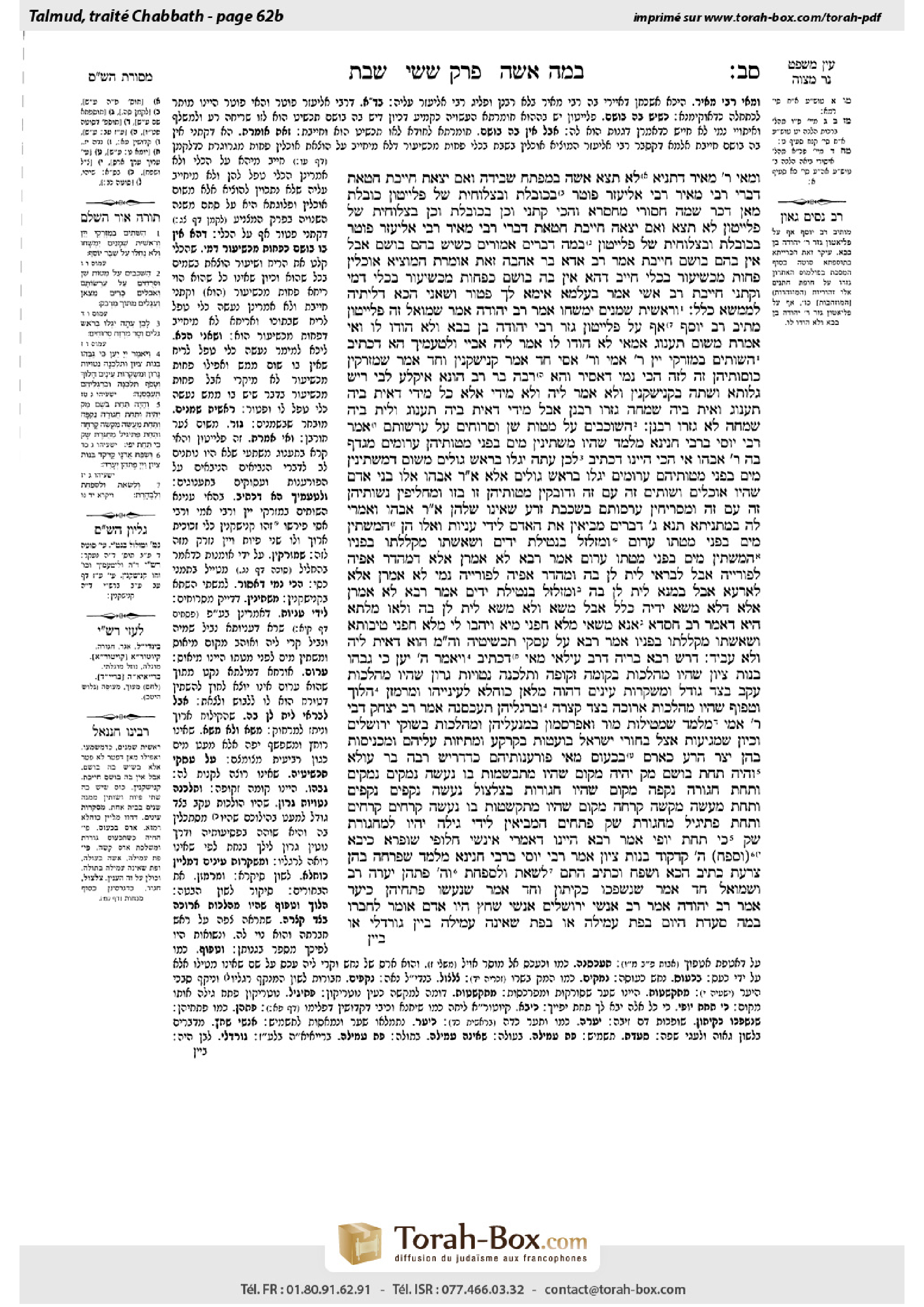
Shabbat 62b: Talmud study for Daf Yomi
Daf Yomi is the daily study of one Talmud folio. Explore 37 tractates with scans, Hebrew text, Sefaria English and AI-generated French translations where annotated.
Passage selection and English or AI-generated French translation are available where the scan has annotations. Daf Study is independent of Torah-Box and Sefaria.
Browse Shabbat · שבת · All tractatesShabbat 62b text and translations
This page of Shabbat includes the Aramaic text, an English translation and an AI-generated French translation, alongside the scan above.
שבת ס״ב ב · Aramaic and Hebrew text
וּמַאי רַבִּי מֵאִיר? דְּתַנְיָא: לֹא תֵּצֵא אִשָּׁה בְּמַפְתֵּחַ שֶׁבְּיָדָהּ, וְאִם יָצָאת — חַיֶּיבֶת חַטָּאת, דִּבְרֵי רַבִּי מֵאִיר. רַבִּי אֱלִיעֶזֶר פּוֹטֵר בְּכוֹבֶלֶת וּבִצְלוֹחִית שֶׁל פִּלְיָיטוֹן.
כּוֹבֶלֶת — מַאן דְּכַר שְׁמַהּ?
חַסּוֹרֵי מִחַסְּרָא וְהָכִי קָתָנֵי: וְכֵן בְּכוֹבֶלֶת וְכֵן בִּצְלוֹחִית שֶׁל פִּלְיָיטוֹן לֹא תֵּצֵא, וְאִם יָצְאָה — חַיֶּיבֶת חַטָּאת, דִּבְרֵי רַבִּי מֵאִיר. רַבִּי אֱלִיעֶזֶר פּוֹטֵר בְּכוֹבֶלֶת וּבִצְלוֹחִית שֶׁל פִּלְיָיטוֹן. בַּמֶּה דְּבָרִים אֲמוּרִים — כְּשֶׁיֵּשׁ בָּהֶם בּוֹשֶׂם, אֲבָל אֵין בָּהֶם בּוֹשֶׂם — חַיֶּיבֶת.
אָמַר רַב אַדָּא בַּר אַהֲבָה: זֹאת אוֹמֶרֶת הַמּוֹצִיא אוֹכָלִין פָּחוֹת מִכְּשִׁיעוּר בִּכְלִי — חַיָּיב. דְּהָא אֵין בָּהּ בּוֹשֶׂם כְּפָחוֹת מִכְּשִׁיעוּר בִּכְלִי דָּמֵי, וְקָתָנֵי חַיֶּיבֶת.
רַב אָשֵׁי אָמַר: בְּעָלְמָא אֵימָא לָךְ פָּטוּר, וְשָׁאנֵי הָכָא דְּלֵיתֵיהּ לְמַמָּשָׁא כְּלָל.
״וְרֵאשִׁית שְׁמָנִים יִמְשָׁחוּ״, אָמַר רַב יְהוּדָה אָמַר שְׁמוּאֵל: זֶה פִּלְיָיטוֹן.
מֵתִיב רַב יוֹסֵף: אַף עַל פִּלְיָיטוֹן גְּזַר רַבִּי יְהוּדָה בֶּן בָּבָא, וְלֹא הוֹדוּ לוֹ. וְאִי אָמְרַתְּ, מִשּׁוּם תַּעֲנוּג, אַמַּאי לֹא הוֹדוּ לוֹ?
אֲמַר לֵיהּ אַבָּיֵי: וּלְטַעְמָיךְ, הָא דִּכְתִיב: ״הַשֹּׁתִים בְּמִזְרְקֵי יַיִן״ — רַבִּי אַמֵּי וְרַבִּי אַסִּי, חַד אָמַר קְנִישְׁקְנִין, וְחַד אָמַר שֶׁמְּזָרְקִין כּוֹסוֹתֵיהֶן זֶה לָזֶה. הָכִי נָמֵי דַּאֲסִיר? וְהָא רַבָּה בַּר רַב הוּנָא אִיקְּלַע לְבֵי רֵישׁ גָּלוּתָא וְאִישְׁתִּי בִּקְנִישְׁקְנִין, וְלָא אֲמַר לֵיהּ וְלָא מִידֵּי!
אֶלָּא: כׇּל מִידֵּי דְּאִית בֵּיהּ תַּעֲנוּג וְאִית בֵּיהּ שִׂמְחָה — גְּזַרוּ רַבָּנַן, אֲבָל מִידֵּי דְּאִית בֵּיהּ תַּעֲנוּג וְלֵית בֵּיהּ שִׂמְחָה — לָא גְזַרוּ רַבָּנַן.
״הַשֹּׁכְבִים עַל מִטּוֹת שֵׁן וּסְרֻחִים עַל עַרְשׂוֹתָם״. אָמַר רַבִּי יוֹסֵי בְּרַבִּי חֲנִינָא: מְלַמֵּד שֶׁהָיוּ מַשְׁתִּינִין מַיִם בִּפְנֵי מִטּוֹתֵיהֶן עֲרוּמִּים.
מְגַדֵּף בַּהּ רַבִּי אֲבָהוּ: אִי הָכִי, הַיְינוּ דִּכְתִיב: ״לָכֵן עַתָּה יִגְלוּ בְּרֹאשׁ גֹּלִים״ — מִשּׁוּם דְּמַשְׁתִּינִין מַיִם בִּפְנֵי מִטּוֹתֵיהֶם עֲרוּמִּים יִגְלוּ בְּרֹאשׁ גּוֹלִים?!
אֶלָּא אָמַר רַבִּי אֲבָהוּ: אֵלּוּ בְּנֵי אָדָם שֶׁהָיוּ אוֹכְלִים וְשׁוֹתִים זֶה עִם זֶה, וְדוֹבְקִין מִטּוֹתֵיהֶן זוֹ בָּזוֹ, וּמַחֲלִיפִין נְשׁוֹתֵיהֶן זֶה עִם זֶה, וּמַסְרִיחִין עַרְסוֹתָם בְּשִׁכְבַת זֶרַע שֶׁאֵינוֹ שֶׁלָּהֶן.
אָמַר רַבִּי אֲבָהוּ, וְאָמְרִי לַהּ בְּמַתְנִיתָא תָּנָא: שְׁלֹשָׁה דְּבָרִים מְבִיאִין אֶת הָאָדָם לִידֵי עֲנִיּוּת, וְאֵלּוּ הֵן: הַמַּשְׁתִּין מַיִם בִּפְנֵי מִטָּתוֹ עָרוֹם, וּמְזַלְזֵל בִּנְטִילַת יָדַיִם, וְשֶׁאִשְׁתּוֹ מְקַלַּלְתּוֹ בְּפָנָיו.
הַמַּשְׁתִּין מַיִם בִּפְנֵי מִטָּתוֹ עָרוֹם, אָמַר רָבָא: לָא אֲמַרַן אֶלָּא דְּמַהְדַּר אַפֵּיהּ לְפוּרְיֵיהּ, אֲבָל לְבָרַאי — לֵית לַן בַּהּ.
וּמַהְדַּר אַפֵּיהּ לְפוּרְיֵיהּ, נָמֵי לָא אֲמַרַן אֶלָּא לְאַרְעָא, אֲבָל בְּמָנָא — לֵית לַן בַּהּ.
וּמְזַלְזֵל בִּנְטִילַת יָדַיִם, אָמַר רָבָא: לָא אֲמַרַן אֶלָּא דְּלָא מְשָׁא יְדֵיהּ כְּלָל, אֲבָל מְשָׁא וְלָא מְשָׁא — לֵית לַן בַּהּ.
וְלָאו מִלְּתָא הִיא, דְּאָמַר רַב חִסְדָּא: אֲנָא מְשַׁאי מְלֵא חָפְנַי מַיָּא וִיהַבוּ לִי מְלֵא חָפְנַי טֵיבוּתָא.
וְשֶׁאִשְׁתּוֹ מְקַלַּלְתּוֹ בְּפָנָיו, אָמַר רָבָא: עַל עִסְקֵי תַּכְשִׁיטֶיהָ. וְהָנֵי מִילֵּי הוּא דְּאִית לֵיהּ וְלָא עָבֵיד.
דָּרֵשׁ רָבָא בְּרֵיהּ דְּרַב עִילָּאֵי, מַאי דִכְתִיב: ״וַיֹּאמֶר ה׳ יַעַן כִּי גָבְהוּ בְּנוֹת צִיּוֹן״ — שֶׁהָיוּ מְהַלְּכוֹת בְּקוֹמָה זְקוּפָה. ״וַתֵּלַכְנָה נְטוּיוֹת גָּרוֹן״ — שֶׁהָיוּ מְהַלְּכוֹת עָקֵב בְּצַד גּוּדָל. ״וּמְשַׂקְּרוֹת עֵינַיִם״ — דַּהֲוָה מָלְיָאן כּוּחְלָא לְעֵינַיְיהוּ וּמְרַמְּזָן. ״הָלוֹךְ וְטָפוֹף״ — שֶׁהָיוּ מְהַלְּכוֹת אֲרוּכָּה בְּצַד קְצָרָה. ״וּבְרַגְלֵיהֶן תְּעַכַּסְנָה״ — אָמַר רַב יִצְחָק דְּבֵי רַבִּי אַמֵּי: מְלַמֵּד שֶׁמַּטִּילוֹת מוֹר וַאֲפַרְסְמוֹן בְּמִנְעֲלֵיהֶן וּמְהַלְּכוֹת בְּשׁוּקֵי יְרוּשָׁלַיִם, וְכֵיוָן שֶׁמַּגִּיעוֹת אֵצֶל בַּחוּרֵי יִשְׂרָאֵל בּוֹעֲטוֹת בַּקַּרְקַע וּמַתִּיזוֹת עֲלֵיהֶם וּמַכְנִיסוֹת בָּהֶן יֵצֶר הָרָע כְּאֶרֶס בְּכָעוּס.
מַאי פּוּרְעֲנוּתַיְהִי? — כִּדְדָרֵישׁ רַבָּה בַּר עוּלָּא: ״וְהָיָה תַחַת בֹּשֶׂם מַק יִהְיֶה״ — מָקוֹם שֶׁהָיוּ מִתְבַּשְּׂמוֹת בּוֹ נַעֲשָׂה נְמָקִים נְמָקִים. ״וְתַחַת חֲגוֹרָה נִקְפָּה״ — מָקוֹם שֶׁהָיוּ חֲגוּרוֹת בְּצִלְצוֹל נַעֲשָׂה נְקָפִים נְקָפִים. ״וְתַחַת מַעֲשֶׂה מִקְשֶׁה קׇרְחָה״ — מָקוֹם שֶׁהָיוּ מִתְקַשְּׁטוֹת בּוֹ נַעֲשָׂה קְרָחִים קְרָחִים. ״וְתַחַת פְּתִיגִיל מַחֲגֹרֶת שָׂק״ — פְּתָחִים הַמְּבִיאִין לִידֵי גִּילָה, יִהְיוּ לְמַחֲגֹרֶת שָׂק. ״כִּי תַחַת יֹפִי״ — אָמַר רָבָא, הַיְינוּ דְּאָמְרִי אִינָשֵׁי: חַלּוֹפֵי שׁוּפְרָא — כֵּיבָא.
״וְסִפַּח ה׳ קׇדְקֹד בְּנוֹת צִיּוֹן״ — אָמַר רַבִּי יוֹסֵי בְּרַבִּי חֲנִינָא: מְלַמֵּד שֶׁפָּרְחָה בָּהֶן צָרַעַת. כְּתִיב הָכָא ״וְשִׂפַּח״, וּכְתִיב הָתָם: ״לַשְׂאֵת וְלַסַּפַּחַת״.
״וַה׳ פׇּתְהֵן יְעָרֶה״. רַב וּשְׁמוּאֵל, חַד אָמַר: שֶׁנִּשְׁפְּכוּ כְּקִיתוֹן, וְחַד אָמַר: שֶׁנַּעֲשׂוּ פִּתְחֵיהֶן כְּיַעַר.
אָמַר רַב יְהוּדָה אָמַר רַב: אַנְשֵׁי יְרוּשָׁלַיִם אַנְשֵׁי שַׁחַץ הָיוּ. אָדָם אוֹמֵר לַחֲבֵרוֹ: בַּמֶּה סָעַדְתָּ הַיּוֹם? בְּפַת עֲמִילָה, אוֹ בְּפַת שֶׁאֵינָהּ עֲמִילָה? בְּיַיִן גּוֹרְדָּלִי, אוֹ
Shabbat 62b · English translation
And to what statement of Rabbi Meir is the Gemara referring? As it was taught in a baraita: A woman may not go out on Shabbat with a key that is in her hand, and if she went out she is liable to bring a sin-offering; this is the statement of Rabbi Meir. Rabbi Eliezer exempts a woman who goes out with a bundle of fragrant herbs and with a flask of balsam oil [palyaton].
The Gemara finds the statement of Rabbi Eliezer difficult: A bundle of fragrant herbs; who mentioned anything about that? Rabbi Meir did not mention a bundle of herbs; why did Rabbi Eliezer mention it in his response?
The Gemara answers that the baraita is incomplete and it teaches the following: And likewise, with a bundle of fragrant herbs, and likewise with a flask of balsam oil she may not go out, and if she went out she is liable to bring a sin-offering; this is the statement of Rabbi Meir. Rabbi Eliezer exempts in the cases of a bundle of fragrant herbs and a flask of balsam oil. In what case is this statement said? In a case where the vessels have perfume in them; however, in a case where they do not have perfume in them, she is liable for carrying the flask out into the public domain on Shabbat.
Rav Adda bar Ahava said: That is to say that one who carries out a measure of food that is less than the measure that determines liability on Shabbat, but he does so in a vessel, he is liable. Although he is not liable for carrying the food out into the public domain, he is liable for carrying out the vessel. In that case, the vessel is not subordinate to the food, and therefore it is significant. Since the case of the flask in which there is no perfume is comparable to the case in which there is less than the required measurement of food in a vessel, and it was taught in the case of the flask that she is liable even though the fragrance of the perfume remains in the vessel, it stands to reason that one who carries a vessel containing less than a measure of food is also liable.
Rav Ashi said: That is no proof because, in general, I would say to you that he is exempt in a case where there is less than the measure that determines liability for food. However, it is different here, in the case of the empty flask of perfume as, in that case, there is no substance at all. Because the vessel is completely empty, he is liable for carrying the flask.
Related to the mention of perfume, the Gemara cites several statements. It is stated: “That drink wine in mizrekei, and anoint themselves with the chief ointments; but they are not grieved for the hurt of Joseph” (Amos 6:6). Rav Yehuda said that Shmuel said: “The chief ointments” is balsam oil.
Rav Yosef raised an objection from the Tosefta: Rabbi Yehuda ben Bava issued a decree on balsam oil as well, prohibiting its use due to mourning over the destruction of the Temple, and the Sages did not agree with him. And if you say that balsam oil is the chief ointment cited in the verse, and the decree was issued due to the pleasure it provides, why didn’t the Sages agree with his decree? Doesn’t the verse criticize those who do not feel the pain of the people?
Abaye said to him: And according to your reasoning, that which is written in the same verse: “That drink wine in mizrekei”; Rabbi Ami and Rabbi Asi disagree over the meaning of the term mizrekei. One said: They are multi-spouted vessels [kenishkanin], wine vessels with spouts from which several people can drink at one time, and one said that they throw [mezarkin] their cups to one another in joy and jest. Is that also prohibited? Didn’t Rabba bar Rav Huna visit the house of the Exilarch and see the Exilarch drink from a multi-spouted vessel, and Rabba bar Rav Huna did not say anything to him?
Rather, the principle is as follows: With regard to any matter in which there is an element of pleasure and in which there is an element of joy, the Sages issued a decree prohibiting it due to mourning over the destruction of the Temple. However, with regard to a matter in which there is an element of pleasure and in which there is no element of joy, the Sages did not issue a decree. Since there is no element of joy in balsam oil, even though it is precious and pleasurable, they did not issue a decree prohibiting it.
The Gemara interprets additional verses related to the critique of the leadership of Samaria. It is stated: “That lie upon beds of ivory and stretch [seruḥim] upon their couches and eat the lambs out of the flock and the calves out of the midst of the stall” (Amos 6:4). Rabbi Yosei, son of Rabbi Ḥanina, said: This term, seruḥim, interpreted homiletically, teaches that their sin was that they would urinate before their beds while naked.
Rabbi Abbahu ridiculed that interpretation: If so, that this is the meaning of the term seruḥim, is this the meaning of that which is written: “Therefore now they shall go into exile at the head of the exiles and the revelry of those seruḥim shall pass away” (Amos 6:7), because they urinate before their beds while naked they will be exiled at the head of exiles? Although doing so is revolting, a punishment so severe is certainly excessive.
Rather, Rabbi Abbahu said: This verse is referring to a grave sin. These are people who would eat and drink with each other, and join their beds to each other, and swap wives with each other, and defile their beds with semen that was not theirs. That is the meaning of seruḥim upon their couches. For those severe transgressions they deserved to be exiled at the head of exiles.
On a related note, Rabbi Abbahu said, and some say it was taught in a baraita: Three matters bring a person to a state of poverty as a divine punishment from Heaven: One who urinates before his bed while naked, and one who demeans the ritual washing of the hands, and one whose wife curses him in his presence.
The Gemara explains: With regard to one who urinates before his bed while naked, Rava said: We only said this prohibition in a case where he turns his face toward his bed and urinates toward it; however, if he turns his face and urinates toward the outer portion of the room, we have no problem with it.
And where one turns his face toward his bed, too, we only said this prohibition in a case where he urinates on the ground; however, if he urinates into a vessel, we have no problem with it since that is not considered disgusting.
With regard to one who demeans the ritual washing of the hands, Rava said: We only said this statement in a case where he does not wash his hands at all; however, if he washes his hands and does not wash them with a significant amount of water, we have no problem with it.
The Gemara notes: And that is not so, as Rav Ḥisda said: I wash my hands with handfuls of water and they gave me in reward handfuls of prosperity. Apparently, in order to garner the benefits of ritual washing of his hands, one should use a significant amount of water.
With regard to one whose wife curses him in his presence, Rava said: This is referring to a case where she curses him over matters relating to her ornaments, i.e., she complains that he does not provide her with jewelry. The Gemara comments: And that applies only when he has the resources to buy her jewelry but does not do so; however, if he does not have sufficient resources he need not be concerned.
Since the Gemara spoke of sins in the First Temple era, it continues to explain other verses with similar content. Rava, son of Rav Ilai, interpreted the following verse homiletically. What is the meaning of that which is written: “The Lord says because the daughters of Zion are haughty and walk with outstretched necks and wanton eyes, walking and mincing as they go and making a tinkling with their feet” (Isaiah 3:16)?
“Because the daughters of Zion are haughty,” indicates that they would walk with upright stature and carry themselves in an immodest way.
“And walk with outstretched necks,” indicates that they would walk in small steps, heel to toe, so onlookers would notice them.
“Wanton eyes,” indicates that they would fill their eyes with blue eye shadow and beckon.
“Walking and mincing [tafof] as they go,” indicates that the wealthy women would walk a tall woman alongside a short one so that the tall woman would stand out. This is derived from the interchangeability of the letters tet and tzadi; tzafo, meaning, in this case, to be seen.
“Making a tinkling [te’akasna] with their feet,” Rabbi Yitzḥak from the school of Rabbi Ami said: This teaches that they would place myrrh and balsam in their shoes and would walk in the marketplaces of Jerusalem. And once they approached a place where the young men of Israel were congregated, they would stamp their feet on the ground and splash the perfume toward them and instill the evil inclination into them like venom of a viper [ke’eres bakhos].
What was their punishment for these sins? As Rabba bar Ulla taught: “And it shall come to pass that instead of a sweet smell, there shall be a stench; and instead of a belt, a rope; and instead of well-set hair, baldness; and instead of a fine dress, a girding of sackcloth; instead of beauty, a brand” (Isaiah 3:24).
He explains: “And it shall come to pass that instead of a sweet smell there shall be a stench,” indicates that the place that they would perfume became decaying sores.
“And instead of a sash, a rope [nikpe],” indicates that the place where they were girded with a sash became covered with many bruises [nekafim].
“And instead of well-set hair, baldness,” indicates that the place where they would style their hair became bald spots.
“And instead of a fine dress [petigil], a girding of sackcloth,” indicates that the orifices [petaḥim] that lead to pleasure [gil] will become a place for a girding of sackcloth.
“Instead of beauty, a brand [ki],” Rava said: That is the popular expression that people say: Instead of beauty, a sore [kiva].
With regard to a different verse: “The Lord will smite with a scab the crown of the head of the daughters of Zion and the Lord will lay bare their secret parts” (Isaiah 3:17). And the Lord will smite with a scab the crown of the heads of the daughters of Zion; Rabbi Yosei, son of Rabbi Ḥanina, said: This teaches that there was an outbreak of leprosy among them. It is written here, scab [sippaḥ], and it is written there, among the types of leprosy: “For a sore, and for a scab [sappaḥat], and for a bright spot” (Leviticus 14:56).
With regard to the verse: And the Lord will lay bare their secret parts [pot’hen ye’areh], Rav and Shmuel disagree. One says: It means that they, i.e., their innards, were poured out [ye’areh] like a jug. And one says: That their orifices [pitḥeihen] were covered with hair as thick as a forest [ya’ar].
On the topic of the sins of Jerusalem and the abundance that existed before its destruction, Rav Yehuda said that Rav said: The people of Jerusalem were people of arrogance. They would couch their crude behavior in euphemisms. A person would say to another: On what did you dine today? Well-kneaded bread or bread that is not well-kneaded? On white wine or
Shabbat 62b · Traduction française (IA)
À quelle déclaration de Rabbi Meïr la Guemara fait-elle référence ? Comme il est enseigné dans une baraïta : Une femme ne peut pas sortir le Chabbat avec une clé à la main ; si elle sort ainsi, elle est passible d’un sacrifice expiatoire. Telle est la déclaration de Rabbi Meïr. Rabbi Eliezer exempte une femme qui sort avec un bouquet d’herbes odorantes et un flacon d’huile de baume [palyaton].
La déclaration de Rabbi Eliezer pose une difficulté à la Guemara : « Un bouquet d’herbes odorantes » : qui en a parlé ? Rabbi Meïr n’a pas mentionné de bouquet d’herbes. Pourquoi Rabbi Eliezer l’a-t-il mentionné dans sa réponse ?
La Guemara répond que la baraïta est incomplète et qu’elle enseigne ceci : De même, elle ne peut pas sortir avec un bouquet d’herbes odorantes ni avec un flacon d’huile de baume ; si elle sort ainsi, elle est passible d’un sacrifice expiatoire. Telle est la déclaration de Rabbi Meïr. Rabbi Eliezer l’exempte dans les cas du bouquet d’herbes odorantes et du flacon d’huile de baume. Dans quel cas cette déclaration s’applique-t-elle ? Lorsque les récipients contiennent du parfum. En revanche, s’ils n’en contiennent pas, elle est passible pour avoir transporté le flacon dans le domaine public le Chabbat.
Rav Adda bar Ahava dit : Cela signifie donc que celui qui transporte dans un récipient une quantité de nourriture inférieure à la mesure qui entraîne la responsabilité le Chabbat est passible. Bien qu’il ne soit pas passible pour avoir transporté la nourriture dans le domaine public, il l’est pour avoir transporté le récipient. Dans ce cas, le récipient n’est pas considéré comme accessoire à la nourriture et a donc une importance propre. Puisque le cas du flacon sans parfum est comparable à celui où une quantité de nourriture inférieure à la mesure requise se trouve dans un récipient, et qu’il a été enseigné au sujet du flacon qu’elle est passible même si le parfum a laissé son odeur dans le récipient, il s’ensuit que celui qui transporte un récipient contenant moins que la quantité requise de nourriture est lui aussi passible.
Rav Achi dit : Cela ne constitue pas une preuve, car, en général, je te dirais qu’il est exempt lorsque la quantité de nourriture est inférieure à la mesure qui entraîne la responsabilité. Mais le cas du flacon de parfum vide est différent, car il ne contient absolument aucune substance. Puisque le récipient est complètement vide, il est passible pour avoir transporté le flacon.
À propos du parfum qui vient d’être mentionné, la Guemara rapporte plusieurs déclarations. Il est écrit : « Ils boivent du vin dans des mizrekei et s’oignent des meilleurs parfums, mais ne s’affligent pas de la ruine de Joseph » (Amos 6, 6). Rav Yehouda a dit au nom de Chmouel : « Les meilleurs parfums » désigne l’huile de baume.
Rav Yossef souleva une objection à partir de la Tossefta : Rabbi Yehouda ben Bava a également décrété l’interdiction de l’huile de baume, en raison du deuil pour la destruction du Temple, mais les Sages ne se sont pas rangés à son avis. Or, si tu dis que l’huile de baume est le meilleur parfum mentionné dans le verset et que le décret a été pris en raison du plaisir qu’elle procure, pourquoi les Sages ne se sont-ils pas rangés à son avis ? Le verset ne critique-t-il pas ceux qui ne ressentent pas la douleur du peuple ?
Abayé lui dit : Et selon ton raisonnement, que dire de ce qui est écrit dans le même verset : « Ils boivent du vin dans des mizrekei » ? Rabbi Ami et Rabbi Assi divergent sur le sens du terme mizrekei. L’un dit qu’il s’agit de récipients à becs multiples [kenishkanin], des récipients à vin munis de becs par lesquels plusieurs personnes peuvent boire en même temps ; l’autre dit qu’ils se lancent [mezarkin] leurs coupes dans un esprit de joie et de plaisanterie. Cela aussi est-il interdit ? Pourtant, Rabba bar Rav Houna se rendit chez l’Exilarque et le vit boire dans un récipient à becs multiples, sans rien lui dire.
En réalité, voici le principe : pour toute chose qui procure du plaisir et comporte aussi une dimension de réjouissance, les Sages ont décrété une interdiction en raison du deuil pour la destruction du Temple. En revanche, pour une chose qui procure du plaisir sans comporter de dimension de réjouissance, les Sages n’ont pas pris de décret. Puisque l’huile de baume ne comporte pas de dimension de réjouissance, bien qu’elle soit précieuse et agréable, les Sages n’en ont pas interdit l’usage.
La Guemara interprète d’autres versets qui dénoncent les dirigeants de Samarie. Il est écrit : « Ils sont étendus sur des lits d’ivoire, s’étalent [seruḥim] sur leurs divans, mangent les agneaux du troupeau et les veaux au milieu de l’étable » (Amos 6, 4). Rabbi Yossi, fils de Rabbi Ḥanina, dit que le terme seruḥim, interprété de manière homilétique, enseigne que leur faute consistait à uriner nus devant leurs lits.
Rabbi Abbahou tourna cette interprétation en dérision : Si seruḥim signifie cela, est-ce donc le sens de ce qui est écrit : « C’est pourquoi ils seront maintenant déportés à la tête des déportés, et les réjouissances de ces seruḥim prendront fin » (Amos 6, 7) ? Seront-ils déportés à la tête des déportés parce qu’ils urinaient nus devant leurs lits ? Bien que leur comportement soit répugnant, une punition aussi sévère serait certainement disproportionnée.
Rabbi Abbahou dit plutôt : Ce verset fait référence à une faute grave. Il s’agit de personnes qui mangeaient et buvaient ensemble, rapprochaient leurs lits, échangeaient leurs épouses et souillaient leurs lits avec du sperme qui n’était pas le leur. Voilà le sens de seruḥim sur leurs divans. C’est pour ces transgressions graves qu’ils méritaient d’être déportés à la tête des déportés.
À ce propos, Rabbi Abbahou dit — et certains disent que cela a été enseigné dans une baraïta — : Trois choses conduisent une personne à la pauvreté, comme punition divine venue du Ciel : uriner nu devant son lit, mépriser l’ablution rituelle des mains et être maudit par son épouse en sa présence.
La Guemara explique : au sujet de celui qui urine nu devant son lit, Rava dit : Nous n’avons énoncé cette interdiction que dans le cas où il tourne le visage vers son lit et urine en sa direction. En revanche, s’il tourne le visage et urine vers l’extérieur de la pièce, il n’y a pas de problème.
Même lorsqu’il tourne le visage vers son lit, nous n’avons énoncé cette interdiction que dans le cas où il urine sur le sol. En revanche, s’il urine dans un récipient, il n’y a pas de problème, car cela n’est pas considéré comme répugnant.
Au sujet de celui qui méprise l’ablution rituelle des mains, Rava dit : Nous n’avons formulé cette déclaration que dans le cas où il ne se lave pas du tout les mains. En revanche, s’il se lave les mains, mais n’utilise pas une grande quantité d’eau, il n’y a pas de problème.
La Guemara relève que ce n’est pas ainsi, car Rav Ḥisda a dit : « Je me lave les mains avec des poignées d’eau, et l’on m’a accordé en récompense des poignées de prospérité. » Il apparaît donc que, pour obtenir les bienfaits de l’ablution rituelle des mains, il faut utiliser une grande quantité d’eau.
Au sujet de celui dont l’épouse le maudit en sa présence, Rava dit : Il s’agit d’un cas où elle le maudit au sujet de ses parures, c’est-à-dire qu’elle se plaint qu’il ne lui fournisse pas de bijoux. La Guemara précise que cela ne s’applique que s’il a les moyens de lui acheter des bijoux et ne le fait pas ; s’il n’en a pas les moyens, il n’a pas à s’en inquiéter.
Puisque la Guemara a parlé des fautes commises à l’époque du Premier Temple, elle poursuit en expliquant d’autres versets de même teneur. Rava, fils de Rav Ilai, interpréta le verset suivant de manière homilétique. Quel est le sens de ce qui est écrit : « Le Seigneur dit : Parce que les filles de Sion sont orgueilleuses, qu’elles marchent le cou tendu et les yeux provocants, qu’elles avancent en minaudant et font tinter leurs pieds » (Isaïe 3, 16) ? « Parce que les filles de Sion sont orgueilleuses » indique qu’elles marchaient la tête haute et se comportaient de manière impudique. « Qu’elles marchent le cou tendu » indique qu’elles avançaient à petits pas, talon contre orteil, afin que les passants les remarquent. « Les yeux provocants » indique qu’elles se fardaient les yeux de bleu et faisaient des signes de l’œil. « Qu’elles avancent en minaudant [tafof] » indique que les femmes riches faisaient marcher une grande femme à côté d’une petite, afin que la grande se distingue. Cette interprétation repose sur l’interchangeabilité des lettres tet et tsadi : tzafo signifie ici « être vu ». « Et font tinter [te’akasna] leurs pieds » : Rabbi Yitzḥak, de l’école de Rabbi Ami, dit que cela enseigne qu’elles mettaient de la myrrhe et du baume dans leurs chaussures et se promenaient dans les marchés de Jérusalem. Lorsqu’elles approchaient d’un endroit où les jeunes hommes d’Israël étaient réunis, elles frappaient le sol du pied et faisaient jaillir le parfum vers eux, éveillant en eux le mauvais penchant comme le venin d’une vipère [ke’eres bakhos].
Quelle fut leur punition pour ces fautes ? Rabba bar Oula a enseigné : « Au lieu d’un parfum agréable, il y aura une puanteur ; au lieu d’une ceinture, une corde ; au lieu d’une coiffure bien arrangée, la calvitie ; au lieu d’un vêtement élégant, un sac en guise de ceinture ; au lieu de beauté, une marque » (Isaïe 3, 24). Il explique : « Au lieu d’un parfum agréable, il y aura une puanteur » indique que les endroits qu’elles parfumaient devinrent des plaies purulentes. « Au lieu d’une ceinture, une corde [nikpe] » indique que l’endroit où elles portaient une ceinture se couvrit de nombreuses ecchymoses [nekafim]. « Au lieu d’une coiffure bien arrangée, la calvitie » indique que les endroits où elles se coiffaient devinrent des plaques chauves. « Au lieu d’un vêtement élégant [petigil], un sac en guise de ceinture » indique que les orifices [petaḥim] qui procurent le plaisir [gil] deviendront un endroit où l’on porte un sac en guise de ceinture. « Au lieu de beauté, une marque [ki] » : Rava dit que c’est l’expression populaire que l’on emploie : « Au lieu de beauté, une plaie [kiva]. »
À propos d’un autre verset : « Le Seigneur frappera d’une gale le sommet de la tête des filles de Sion, et le Seigneur mettra à nu leurs parties secrètes » (Isaïe 3, 17). Au sujet de « Le Seigneur frappera d’une gale le sommet de la tête des filles de Sion », Rabbi Yossi, fils de Rabbi Ḥanina, dit que cela enseigne qu’une épidémie de lèpre s’était déclarée parmi elles. Ici, le mot gale [sippaḥ] est écrit, et ailleurs, parmi les types de lèpre, il est écrit : « pour une plaie, pour une gale [sappaḥat] et pour une tache brillante » (Lévitique 14, 56).
Au sujet du verset « Le Seigneur mettra à nu leurs parties secrètes [pot’hen ye’areh] », Rav et Chmouel divergent. L’un dit que cela signifie que leurs entrailles furent répandues [ye’areh] comme le contenu d’une cruche. L’autre dit que leurs orifices [pitḥeihen] furent couverts d’un épais tapis de poils, comme une forêt [ya’ar].
À propos des fautes de Jérusalem et de l’abondance qui y régnait avant sa destruction, Rav Yehouda a dit au nom de Rav : Les habitants de Jérusalem étaient arrogants. Ils masquaient leur comportement grossier par des euphémismes. Quelqu’un disait à un autre : « Qu’as-tu mangé aujourd’hui ? Du pain bien pétri ou du pain qui ne l’est pas bien ? Du vin blanc ou
Traduction française générée par IA à partir de l’édition anglaise de Sefaria. Vérifie toujours un passage avec le texte source.
Text from Sefaria: William Davidson Edition - Vocalized Aramaic (CC BY NC); William Davidson Edition - English (CC BY NC).