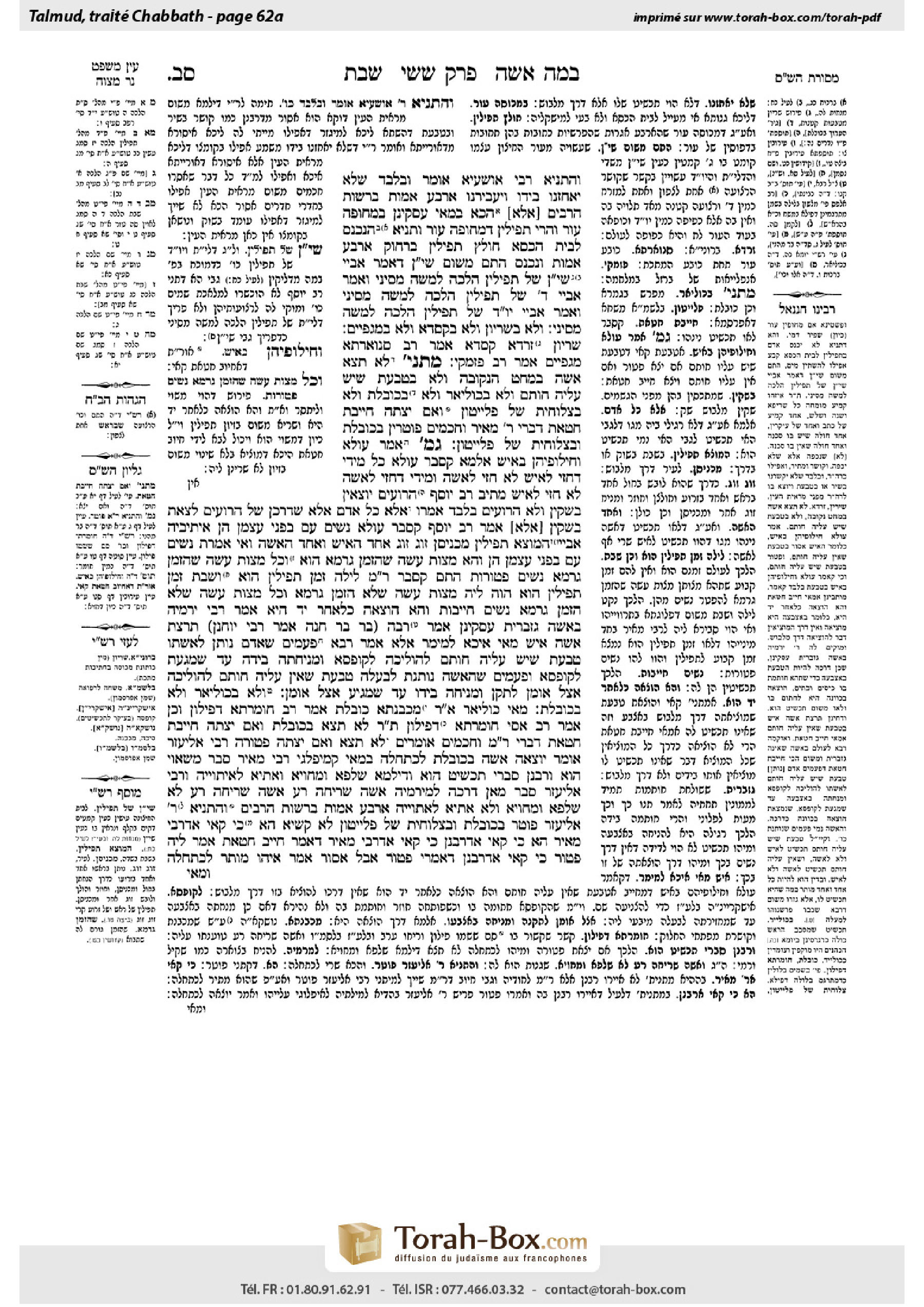
Shabbat 62a: Talmud study for Daf Yomi
Daf Yomi is the daily study of one Talmud folio. Explore 37 tractates with scans, Hebrew text, Sefaria English and AI-generated French translations where annotated.
Passage selection and English or AI-generated French translation are available where the scan has annotations. Daf Study is independent of Torah-Box and Sefaria.
Browse Shabbat · שבת · All tractatesShabbat 62a text and translations
This page of Shabbat includes the Aramaic text, an English translation and an AI-generated French translation, alongside the scan above.
שבת ס״ב א · Aramaic and Hebrew text
וְהָתַנְיָא, רַבִּי אוֹשַׁעְיָא אוֹמֵר: וּבִלְבַד שֶׁלֹּא יֹאחֲזֶנּוּ בְּיָדוֹ וְיַעֲבִירֶנּוּ אַרְבַּע אַמּוֹת בִּרְשׁוּת הָרַבִּים!
[אֶלָּא] הָכָא בְּמַאי עָסְקִינַן — בִּמְחוּפֶּה עוֹר.
וַהֲרֵי תְּפִילִּין דִּמְחוּפּוֹת עוֹר, וְתַנְיָא: הַנִּכְנָס לְבֵית הַכִּסֵּא — חוֹלֵץ תְּפִילִּין בְּרִחוּק אַרְבַּע אַמּוֹת וְנִכְנָס.
הָתָם מִשּׁוּם שִׁין. דְּאָמַר אַבָּיֵי: שִׁין שֶׁל תְּפִילִּין הֲלָכָה לְמֹשֶׁה מִסִּינַי. וְאָמַר אַבָּיֵי: דָּלֶת שֶׁל תְּפִילִּין הֲלָכָה לְמֹשֶׁה מִסִּינַי. וְאָמַר אַבָּיֵי: יוֹד שֶׁל תְּפִילִּין הֲלָכָה לְמֹשֶׁה מִסִּינַי.
וְלֹא בְּשִׁרְיוֹן וְלֹא בְּקַסְדָּא וְלֹא בְּמַגָּפַיִים.
שִׁרְיוֹן — זַרְדָּא. קַסְדָּא — אָמַר רַב: סַנְוָארְתָא. מַגָּפַיִים — אָמַר רַב: פֻּזְמָקֵי.
מַתְנִי׳ לֹא תֵּצֵא אִשָּׁה בַּמַּחַט הַנְּקוּבָה, וְלֹא בְּטַבַּעַת שֶׁיֵּשׁ עָלֶיהָ חוֹתָם, וְלֹא בְּכוֹלֵיאָר, וְלֹא בְּכוֹבֶלֶת, וְלֹא בִּצְלוֹחִית שֶׁל פִּלְיָיטוֹן.
וְאִם יָצְתָה — חַיֶּיבֶת חַטָּאת, דִּבְרֵי רַבִּי מֵאִיר. וַחֲכָמִים פּוֹטְרִין בְּכוֹבֶלֶת וּבִצְלוֹחִית שֶׁל פִּלְיָיטוֹן.
גְּמָ׳ אָמַר עוּלָּא וְחִילּוּפֵיהֶן בְּאִישׁ. אַלְמָא קָסָבַר עוּלָּא: כָּל מִידֵּי דַּחֲזֵי לְאִישׁ לָא חֲזֵי לְאִשָּׁה, וּמִידִּי דַּחֲזֵי לְאִשָּׁה לָא חֲזֵי לְאִישׁ.
מֵתִיב רַב יוֹסֵף: הָרוֹעִים יוֹצְאִין בְּשַׂקִּין. וְלֹא הָרוֹעִים בִּלְבַד אָמְרוּ, אֶלָּא כָּל אָדָם. אֶלָּא שֶׁדַּרְכָּן שֶׁל הָרוֹעִים לָצֵאת בְּשַׂקִּין.
[אֶלָּא] אָמַר רַב יוֹסֵף: קָסָבַר עוּלָּא נָשִׁים עַם בִּפְנֵי עַצְמָן הֵן.
אֵיתִיבֵיהּ אַבָּיֵי: הַמּוֹצֵא תְּפִילִּין — מַכְנִיסָן זוּג זוּג, אֶחָד הָאִישׁ וְאֶחָד הָאִשָּׁה. וְאִי אָמְרַתְּ נָשִׁים עַם בִּפְנֵי עַצְמָן הֵן, וְהָא מִצְוַת עֲשֵׂה שֶׁהַזְּמַן גְּרָמָא הוּא, וְכׇל מִצְוַת עֲשֵׂה שֶׁהַזְּמַן גְּרָמָא נָשִׁים פְּטוּרוֹת?
הָתָם קָסָבַר רַבִּי מֵאִיר: לַיְלָה זְמַן תְּפִילִּין הוּא, וְשַׁבָּת זְמַן תְּפִילִּין הוּא. הָוֵה לֵיהּ מִצְוַת עֲשֵׂה שֶׁלֹּא הַזְּמַן גְּרָמָא, וְכׇל מִצְוַת עֲשֵׂה שֶׁלֹּא הַזְּמַן גְּרָמָא — נָשִׁים חַיָּיבוֹת.
וְהָא הוֹצָאָה כִּלְאַחַר יָד הִיא!
אָמַר רַבִּי יִרְמְיָה: בָּאִשָּׁה גִּזְבָּרִית עָסְקִינַן. אָמַר רַבָּה בַּר בַּר חָנָה אָמַר רַבִּי יוֹחָנָן: תֵּרַצְתָּ אִשָּׁה, אִישׁ מַאי אִיכָּא לְמֵימַר?
אֶלָּא אָמַר רָבָא: פְּעָמִים שֶׁאָדָם נוֹתֵן לְאִשְׁתּוֹ טַבַּעַת שֶׁיֵּשׁ עָלֶיהָ חוֹתָם לְהוֹלִיכָהּ לַקּוּפְסָא, וּמַנִּיחָתָהּ בְּיָדָהּ עַד שֶׁמַּגַּעַת לַקּוּפְסָא. וּפְעָמִים שֶׁהָאִשָּׁה נוֹתֶנֶת לְבַעֲלָהּ טַבַּעַת שֶׁאֵין עָלֶיהָ חוֹתָם לְהוֹלִיכָהּ אֵצֶל אוּמָּן לְתַקֵּן, וּמַנִּיחָהּ בְּיָדוֹ עַד שֶׁמַּגִּיעַ אֵצֶל אוּמָּן.
וְלֹא בְּכוֹלֵיאָר וְלֹא בְּכוֹבֶלֶת. מַאי כּוֹלֵיאָר? אָמַר רַב: מַכְבַּנְתָּא. כּוֹבֶלֶת — אָמַר רַב: חוּמַרְתָּא דְפִילוֹן. וְכֵן אָמַר רַב אַסִּי: חוּמַרְתָּא דְפִילוֹן.
תָּנוּ רַבָּנַן: לֹא תֵּצֵא בְּכוֹבֶלֶת, וְאִם יָצְתָה — חַיֶּיבֶת חַטָּאת, דִּבְרֵי רַבִּי מֵאִיר. וַחֲכָמִים אוֹמְרִים: לֹא תֵּצֵא, וְאִם יָצְתָה — פְּטוּרָה. רַבִּי אֱלִיעֶזֶר אוֹמֵר: יוֹצְאָה אִשָּׁה בְּכוֹבֶלֶת לְכַתְּחִלָּה.
בְּמַאי קָמִיפַּלְגִי? רַבִּי מֵאִיר סָבַר מַשּׂאוֹי הוּא. וְרַבָּנַן סָבְרִי תַּכְשִׁיט הוּא, וְדִילְמָא שָׁלְפָא וּמַחְוְיָא, וְאָתְיָא לְאֵיתוֹיֵיהּ. וְרַבִּי אֱלִיעֶזֶר סָבַר: מַאן דִּרְכַּהּ לְמִירְמֵיהּ — אִשָּׁה שֶׁרֵיחָהּ רַע, אִשָּׁה שֶׁרֵיחָהּ רָע לָא שָׁלְפָא וּמַחְוְיָא, וְלָא אָתְיָא לְאֵתוֹיֵיהּ אַרְבַּע אַמּוֹת בִּרְשׁוּת הָרַבִּים.
וְהָתַנְיָא, רַבִּי אֱלִיעֶזֶר פּוֹטֵר בְּכוֹבֶלֶת וּבִצְלוֹחִית שֶׁל פְּלַיְיטוֹן!
לָא קַשְׁיָא: הָא כִּי קָאֵי — אַדְּרַבִּי מֵאִיר. הָא כִּי קָאֵי — אַדְּרַבָּנַן. כִּי קָאֵי אַדְּרַבִּי מֵאִיר דְּאָמַר חַיָּיב חַטָּאת — אָמַר אִיהוּ פָּטוּר. כִּי קָאֵי אַדְּרַבָּנַן דְּאָמְרִי פָּטוּר אֲבָל אָסוּר — אָמַר אִיהוּ מוּתָּר לְכַתְּחִלָּה.
Shabbat 62a · English translation
But wasn’t it taught in a baraita that Rabbi Oshaya says with regard to an amulet: As long as he does not hold it in his hand and carry it four cubits in the public domain? Apparently, even with regard to an amulet, there is a distinction between wearing it and carrying it.
Rather, with what are we dealing here? With an amulet that is covered in leather. Since the writing itself is covered, the name of God is not degraded when the amulet is brought into the bathroom with him.
The Gemara objects. There is writing on the scrolls of phylacteries, which is covered in the leather of boxes housing the scrolls, and nevertheless it was taught in a baraita: One who enters a bathroom while wearing phylacteries must remove the phylacteries at a distance of four cubits and only then enter. There is no halakhic difference whether or not the writing is covered.
The Gemara rejects this: There, with regard to phylacteries, the prohibition to enter the bathroom is not due to the sacred writing on the scrolls inside the phylacteries. Rather, it is due to the letter shin that protrudes from the leather of the boxes housing the scroll in the phylacteries of the head, as Abaye said: The source of the requirement of the shin of the phylacteries is a halakha transmitted to Moses from Sinai. It is required by Torah law. And, Abaye said: The knot in the shape of the letter dalet in the straps of the phylacteries of the head is a halakha transmitted to Moses from Sinai. And, Abaye said: The letter yod of the phylacteries is a halakha transmitted to Moses from Sinai. It is due to those letters that one must safeguard the sanctity of the phylacteries and refrain from taking them into the bathroom.
We learned in the mishna: And he may neither go out with shiryon, nor with a kasda, nor with maggafayim. These terms were not understood, and therefore the Gemara explains them:
Shiryon is a coat of mail [zerada], armor made of scales. Kasda: Rav said that it is a leather hat [sanvarta] worn under a metal helmet. Maggafayim: Rav said they are leg armor worn beneath the knee.
MISHNA: A woman may neither go out to the public domain with a perforated needle, i.e., a standard needle with an eye, nor with a ring that has a seal on it, nor with a kulyar, nor with a kovelet, the identity of which will be discussed in the Gemara, nor with a flask of balsam oil.
And if she did go out into the public domain, she is liable to bring a sin-offering; this is the statement of Rabbi Meir, who holds that in doing so she violated the Torah prohibition of carrying a burden in the public domain on Shabbat. And the Rabbis exempt one who goes out on Shabbat with a kovelet and with a flask of balsam oil. In their opinion, these are ornaments, and therefore they do not fundamentally violate the Torah prohibition of carrying in the public domain on Shabbat.
GEMARA: With regard to that which we learned in the mishna that a woman may not go out on Shabbat with a ring that has a seal, and by inference that she may go out with a ring without a seal, Ulla said: And the reverse of these halakhot is true with regard to a man. A man who wears a ring with a seal in the public domain is exempt. However, if he wears a ring without a seal, he is liable to bring a sin-offering as it is not considered an ornament for a man. Based on that statement, the Gemara concludes: Apparently, Ulla holds that every object that is suitable for a man is not suitable for a woman, and an object that is suitable for a woman is not suitable for a man.
Rav Yosef raised an objection from the Tosefta: Shepherds may go out on Shabbat in garments made of sacks. And not with regard to the shepherds alone did the Sages say that they are permitted to go out in sacks on Shabbat; rather, any person may do so. However, the Sages taught the halakha with regard to shepherds because it is the standard practice of shepherds to go out in sacks. Apparently, although a sack is not a typical garment for most people, it is permitted even for one who is not a shepherd and would not generally wear it. Based on the same principle, although men do not generally wear women’s ornaments and women do not generally wear men’s ornaments, since occasionally a man might wear an ornament belonging to a woman or vice versa, each should be permitted to go out into the public domain with the ornament of the other.
Rather, Rav Yosef said: Ulla holds that women are a people unto themselves. The difference between the standard practice of men and women is greater than the difference between the standard practice of practitioners of different professions.
Abaye raised an objection to Rav Yosef’s statement from the Tosefta: One who finds phylacteries outside of the city on Shabbat should don them and bring them into the city one pair at a time. This applies to both a man and a woman. And if you say that women are a people unto themselves, isn’t the mitzva to don phylacteries a time-bound, positive mitzva, as there are times when the mitzva to don phylacteries is not in effect? And the following is a halakhic principle: Women are exempt from every time-bound, positive mitzva. If, in fact, the clothing and ornaments of a man are not suitable for a woman under any circumstances, why is a woman permitted to don the phylacteries and bring them into the city on Shabbat? Shouldn’t that be considered a prohibited act of carrying?
The Gemara answers: There, with regard to phylacteries, Rabbi Meir holds that night is an appropriate time to don phylacteries, and Shabbat and Festivals are similarly an appropriate time to don phylacteries. Consequently, the mitzva of phylacteries is a positive mitzva that is not time bound; and in every positive mitzva that is not time bound, women are obligated. Therefore, women are permitted to don the phylacteries and bring them into the city.
With regard to Rabbi Meir’s ruling in the mishna that a woman is liable by Torah law if she goes out into the public domain wearing a ring with a seal, the Gemara asks: Isn’t it considered carrying out in a backhanded manner? A ring with a seal is not an ornament for a woman; it is an object like any other. One typically carries objects holding them in his hand. Wearing an object around one’s finger is atypical. There is no Torah prohibition violated when a labor is performed in an atypical manner.
Rabbi Yirmeya said that we are dealing in the mishna with a woman who is a treasurer for charity. A woman with that occupation typically wears a ring with a seal on her finger in order to perform her job. She does not, though, wear it as an ornament. Rabba bar bar Ḥana said that Rabbi Yoḥanan said: You answered and explained why, in the case of a woman, she would be liable to bring a sin-offering. However, in the case of a man who wore a ring without a seal, what is there to say? Why should he be liable?
Rather, Rava said that there is a different reason: Sometimes a person gives his wife a ring that has a seal on it to take it to his house and place it in a box for safekeeping, and, in order to ensure that she does not lose the ring, the woman places it in on her hand, i.e., on her finger, until she reaches the box. And, likewise, sometimes a woman gives her husband a ring that does not have a seal on it to take it to a craftsman to repair it, and the husband places it on his hand, i.e., on his finger, until he reaches the craftsman. The purpose of wearing these rings is not for ornamentation. Nevertheless, it is considered a typical manner of carrying them.
We learned in the mishna: Nor with a kulyar, nor with a kovelet. The Gemara asks: What is a kulyar? Rav said: A brooch with which a woman fastens the collar of her garment. Kovelet: Rav said that it is a bundle of fragrant herbs [pilon]. And, similarly, Rav Asi said: A bundle of fragrant herbs.
The Sages taught in a baraita: A woman may not go out on Shabbat with a bundle of fragrant herbs, and if she did go out she is liable to bring a sin-offering, as she violated a Torah prohibition; this is the statement of Rabbi Meir. And the Rabbis say: She may not go out ab initio; however, if she went out, she is exempt. Rabbi Eliezer says: A woman may go out with a bundle of fragrant herbs even ab initio.
The Gemara asks: With regard to what principle do they disagree? Rabbi Meir holds that it is a burden. Therefore, one who takes it out into the public domain on Shabbat is liable to bring a sin-offering. And the Rabbis hold that it is an ornament. Nevertheless, they prohibited going out with it ab initio due to concern lest she remove the bundle of herbs from its place, and show it to others, and come to carry it in the public domain. And Rabbi Eliezer holds: Whose practice is it to place fragrant herbs on herself? A woman whose odor is foul. But a woman whose odor is foul does not remove and show the bundle to others because, by doing so, her odor will be detected, a situation that she would prefer to avoid. And, therefore she will not come to carry it four cubits in the public domain.
This baraita cites the opinion of Rabbi Eliezer, who permits, even ab initio, going out into the public domain with a bundle of herbs. The Gemara asks: Wasn’t it taught in another baraita: Rabbi Eliezer exempts a woman who goes out on Shabbat with a bundle of herbs and with a flask of balsam oil? With regard to the halakhot of Shabbat, exempt means that although it is not prohibited by Torah law, it is prohibited ab initio by rabbinic law.
The Gemara answers: This is not difficult. When Rabbi Eliezer made this statement, it was when he was addressing the statement of Rabbi Meir. When Rabbi Eliezer made that statement, it was when he was addressing the statement of the Rabbis. To clarify: When he was addressing the statement of Rabbi Meir, who said that she is liable to bring a sin-offering, he said to him that she is exempt from bringing the sacrifice. When he was addressing the statement of the Rabbis, who said that she is exempt but it is prohibited ab initio, he said that it is permitted even ab initio.
Shabbat 62a · Traduction française (IA)
Mais n’a-t-il pas été enseigné dans une baraïta que Rabbi Oshaya dit au sujet d’une amulette : « À condition de ne pas la tenir dans sa main et de la transporter sur quatre coudées dans le domaine public » ? Apparemment, même pour une amulette, il y a une différence entre la porter sur soi et la transporter.
Mais de quoi s’agit-il ici ? D’une amulette recouverte de cuir. Puisque l’écriture elle-même est recouverte, le nom de Dieu n’est pas profané lorsqu’on l’emporte avec soi aux toilettes.
La Guemara objecte : il y a une écriture sur les parchemins des phylactères, recouverts par le cuir des boîtiers qui les abritent ; pourtant, une baraïta a enseigné : celui qui entre aux toilettes avec ses phylactères doit les retirer à quatre coudées de l’entrée, puis seulement entrer. Que l’écriture soit couverte ou non ne change donc rien à la halakha.
La Guemara rejette cette objection : dans le cas des phylactères, l’interdiction d’entrer aux toilettes ne tient pas à l’écriture sacrée des parchemins qu’ils contiennent. Elle tient plutôt à la lettre shin qui dépasse du cuir des boîtiers abritant le parchemin des phylactères de la tête. En effet, Abayé a dit : l’obligation de la lettre shin des phylactères relève d’une halakha transmise à Moïse au Sinaï. Elle est requise par la Torah. Abayé a également dit : le nœud en forme de lettre dalet des lanières des phylactères de la tête relève d’une halakha transmise à Moïse au Sinaï. Et Abayé a dit : la lettre yod des phylactères relève d’une halakha transmise à Moïse au Sinaï. C’est en raison de ces lettres qu’il faut préserver la sainteté des phylactères et s’abstenir de les emporter aux toilettes.
Nous avons appris dans la Michna : il ne peut sortir ni avec un shiryon, ni avec un kasda, ni avec des maggafayim. Ces termes n’étant pas compris, la Guemara les explique :
Le shiryon est une cotte de mailles [zerada], une armure faite d’écailles. Le kasda : Rav a dit qu’il s’agit d’un bonnet de cuir [sanvarta] porté sous un casque de métal. Les maggafayim : Rav a dit qu’il s’agit de protections pour les jambes, portées sous le genou.
MICHNA : Une femme ne peut sortir dans le domaine public avec une aiguille percée, c’est-à-dire une aiguille ordinaire munie d’un chas, ni avec une bague portant un sceau, ni avec un kulyar, ni avec une kovelet, dont l’identité sera examinée dans la Guemara, ni avec un flacon d’huile de baume.
Si elle est sortie dans le domaine public, elle est tenue d’apporter un sacrifice expiatoire ; telle est l’opinion de Rabbi Meïr, qui estime qu’elle a ainsi transgressé l’interdiction de la Torah de transporter une charge dans le domaine public pendant Chabbat. Les Sages exemptent celle qui sort pendant Chabbat avec une kovelet ou un flacon d’huile de baume. À leur avis, ce sont des ornements et, par conséquent, leur transport dans le domaine public pendant Chabbat ne constitue pas, en soi, une transgression de l’interdiction de la Torah.
À propos de ce que nous avons appris dans la Michna, à savoir qu’une femme ne peut sortir pendant Chabbat avec une bague portant un sceau, ce qui implique qu’elle peut sortir avec une bague sans sceau, Oulla a dit : ces halakhot sont inversées pour un homme. Un homme qui porte une bague avec sceau dans le domaine public est exempt. En revanche, s’il porte une bague sans sceau, il est tenu d’apporter un sacrifice expiatoire, car celle-ci n’est pas considérée comme un ornement pour un homme. La Guemara en conclut : apparemment, Oulla estime que tout objet adapté à un homme ne convient pas à une femme, et que tout objet adapté à une femme ne convient pas à un homme.
Rav Yossef objecta à partir de la Tossefta : les bergers peuvent sortir pendant Chabbat vêtus de vêtements faits de sacs. Les Sages n’ont pas réservé cette permission de sortir en sacs pendant Chabbat aux seuls bergers : toute personne peut le faire. Toutefois, ils ont enseigné cette halakha à propos des bergers parce qu’il est d’usage chez eux de sortir en sacs. Apparemment, bien qu’un sac ne soit pas un vêtement habituel pour la plupart des gens, même une personne qui n’est pas bergère et ne le porterait généralement pas peut le faire. Selon le même principe, bien que les hommes ne portent généralement pas les ornements des femmes et que les femmes ne portent généralement pas ceux des hommes, puisque cela peut arriver, chacun devrait être autorisé à sortir dans le domaine public avec l’ornement de l’autre.
Rav Yossef dit plutôt : Oulla estime que les femmes constituent un groupe à part. La différence entre les usages habituels des hommes et ceux des femmes est plus grande que celle entre les usages habituels des personnes exerçant des métiers différents.
Abayé objecta à l’affirmation de Rav Yossef à partir de la Tossefta : celui qui trouve des phylactères hors de la ville pendant Chabbat doit les mettre et les apporter dans la ville, une paire à la fois. Cela s’applique aussi bien à un homme qu’à une femme. Or, si tu dis que les femmes constituent un groupe à part, la mitsva de mettre les phylactères n’est-elle pas une mitsva positive liée au temps, puisqu’il y a des moments où elle ne s’applique pas ? Et voici un principe halakhique : les femmes sont exemptées de toute mitsva positive liée au temps. Si, en réalité, les vêtements et les ornements d’un homme ne conviennent en aucune circonstance à une femme, pourquoi une femme serait-elle autorisée à mettre les phylactères et à les apporter dans la ville pendant Chabbat ? Ne devrait-on pas considérer cela comme un transport interdit ?
La Guemara répond : dans le cas des phylactères, Rabbi Meïr estime que la nuit est un moment approprié pour les mettre, et que Chabbat et les fêtes sont également des moments appropriés. Par conséquent, la mitsva des phylactères est une mitsva positive qui n’est pas liée au temps ; or, les femmes sont astreintes à toute mitsva positive qui n’est pas liée au temps. C’est pourquoi elles sont autorisées à mettre les phylactères et à les apporter dans la ville.
À propos de la décision de Rabbi Meïr dans la Michna, selon laquelle une femme est passible en vertu de la Torah si elle sort dans le domaine public en portant une bague avec sceau, la Guemara demande : ne s’agit-il pas d’un transport effectué de manière inhabituelle ? Une bague avec sceau n’est pas un ornement pour une femme ; c’est un objet comme un autre. En règle générale, on transporte les objets en les tenant dans la main. Porter un objet au doigt est inhabituel. Or, effectuer un travail de manière inhabituelle ne constitue pas une transgression de l’interdiction de la Torah.
Rabbi Yirmeya dit que la Michna traite d’une femme qui est trésorière d’une œuvre de charité. Une femme exerçant cette fonction porte habituellement une bague avec sceau au doigt afin d’accomplir son travail. Elle ne la porte toutefois pas comme ornement. Rabba bar bar Ḥana a dit au nom de Rabbi Yoḥanan : tu as répondu et expliqué pourquoi une femme serait tenue d’apporter un sacrifice expiatoire. Mais que dire du cas d’un homme qui porte une bague sans sceau ? Pourquoi serait-il passible ?
Rava dit plutôt qu’il y a une autre raison : il arrive qu’un homme donne à sa femme une bague avec sceau pour qu’elle la rapporte chez lui et la mette dans une boîte afin de la garder en sécurité. Pour éviter de la perdre, la femme la met à sa main, c’est-à-dire à son doigt, jusqu’à ce qu’elle arrive à la boîte. De même, il arrive qu’une femme donne à son mari une bague sans sceau pour qu’il l’apporte à un artisan afin de la faire réparer ; le mari la met à sa main, c’est-à-dire à son doigt, jusqu’à ce qu’il arrive chez l’artisan. Ces bagues ne sont pas portées comme ornements. Néanmoins, il s’agit d’une manière habituelle de les transporter.
Nous avons appris dans la Michna : ni avec un kulyar, ni avec une kovelet. La Guemara demande : qu’est-ce qu’un kulyar ? Rav a dit : une broche avec laquelle une femme attache le col de son vêtement. Et qu’est-ce qu’une kovelet ? Rav a dit qu’il s’agit d’un bouquet d’herbes odorantes [pilon]. De même, Rav Assi a dit : un bouquet d’herbes odorantes.
Les Sages ont enseigné dans une baraïta : une femme ne peut sortir pendant Chabbat avec un bouquet d’herbes odorantes ; si elle est sortie, elle est tenue d’apporter un sacrifice expiatoire, car elle a transgressé une interdiction de la Torah. Telle est l’opinion de Rabbi Meïr. Les Sages disent : elle ne peut pas sortir ainsi a priori, mais si elle est sortie, elle est exemptée. Rabbi Éliézer dit : une femme peut sortir avec un bouquet d’herbes odorantes, même a priori.
La Guemara demande : sur quel principe sont-ils en désaccord ? Rabbi Meïr estime qu’il s’agit d’une charge. Par conséquent, celui qui l’emporte dans le domaine public pendant Chabbat est tenu d’apporter un sacrifice expiatoire. Les Sages estiment qu’il s’agit d’un ornement. Néanmoins, ils ont interdit de sortir ainsi a priori, par crainte qu’elle ne retire le bouquet d’herbes de son emplacement pour le montrer à d’autres, et qu’elle en vienne à le transporter dans le domaine public. Rabbi Éliézer estime : qui a l’habitude de se mettre des herbes odorantes ? Une femme dont l’odeur est désagréable. Or, une femme dont l’odeur est désagréable ne retire pas le bouquet pour le montrer aux autres, car son odeur serait alors détectée, ce qu’elle préfère éviter. Par conséquent, elle n’en viendra pas à le transporter sur quatre coudées dans le domaine public.
Cette baraïta cite l’opinion de Rabbi Éliézer, qui permet de sortir dans le domaine public avec un bouquet d’herbes odorantes, même a priori. La Guemara demande : n’a-t-il pas été enseigné dans une autre baraïta que Rabbi Éliézer exempte une femme qui sort pendant Chabbat avec un bouquet d’herbes odorantes et un flacon d’huile de baume ? Dans les halakhot de Chabbat, « exempt » signifie que, bien que cela ne soit pas interdit par la Torah, cela reste interdit a priori par décret rabbinique.
La Guemara répond : il n’y a pas de difficulté. Rabbi Éliézer a formulé cette déclaration lorsqu’il répondait à l’opinion de Rabbi Meïr, et l’autre déclaration lorsqu’il répondait à l’opinion des Sages. Pour préciser : lorsqu’il répondait à Rabbi Meïr, qui disait qu’elle était tenue d’apporter un sacrifice expiatoire, il lui a dit qu’elle était exemptée d’apporter le sacrifice. Lorsqu’il répondait aux Sages, qui disaient qu’elle était exemptée mais qu’il était interdit de sortir ainsi a priori, il a dit que cela était permis même a priori.
Traduction française générée par IA à partir de l’édition anglaise de Sefaria. Vérifie toujours un passage avec le texte source.
Text from Sefaria: William Davidson Edition - Vocalized Aramaic (CC BY NC); William Davidson Edition - English (CC BY NC).