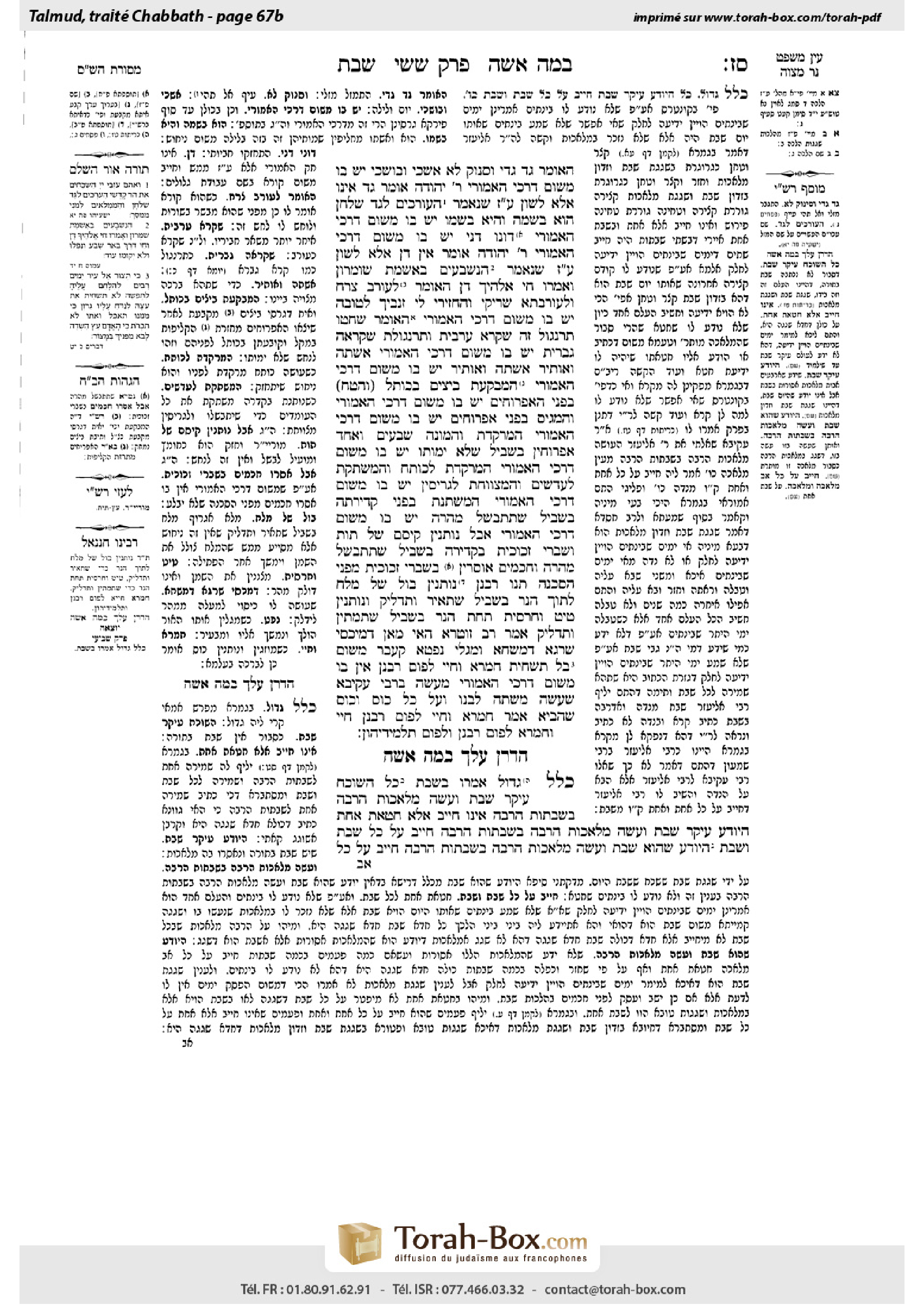
Shabbat 67b: Talmud study for Daf Yomi
Daf Yomi is the daily study of one Talmud folio. Explore 37 tractates with scans, Hebrew text, Sefaria English and AI-generated French translations where annotated.
Passage selection and English or AI-generated French translation are available where the scan has annotations. Daf Study is independent of Torah-Box and Sefaria.
Browse Shabbat · שבת · All tractatesShabbat 67b text and translations
This page of Shabbat includes the Aramaic text, an English translation and an AI-generated French translation, alongside the scan above.
שבת ס״ז ב · Aramaic and Hebrew text
הָאוֹמֵר ״גַּד גַּדִּי, וּסְנוּק לָא אַשְׁכִּי וּבוּשְׁכִּי״ — יֵשׁ בּוֹ מִשּׁוּם דַּרְכֵי הָאֱמוֹרִי. רַבִּי יְהוּדָה אוֹמֵר: ״גַּד״ אֵינוֹ אֶלָּא לְשׁוֹן עֲבוֹדָה זָרָה, שֶׁנֶּאֱמַר: ״הָעֹרְכִים לַגַּד שֻׁלְחָן״.
הוּא בִּשְׁמָהּ וְהִיא בִּשְׁמוֹ — יֵשׁ בּוֹ מִשּׁוּם דַּרְכֵי הָאֱמוֹרִי.
״דּוּנוּ דַּנַּי״ — יֵשׁ בּוֹ מִשּׁוּם דַּרְכֵי הָאֱמוֹרִי. רַבִּי יְהוּדָה אוֹמֵר: אֵין ״דָּן״ אֶלָּא לְשׁוֹן עֲבוֹדָה זָרָה, שֶׁנֶּאֱמַר: ״הַנִּשְׁבָּעִים בְּאַשְׁמַת שֹׁמְרוֹן וְאָמְרוּ חֵי אֱלֹהֶיךָ דָּן״.
הָאוֹמֵר לְעוֹרֵב ״צְרַח״, וּלְעוֹרֶבְתָּא ״שְׁרִיקִי וְהַחֲזִירִי לִי זְנָבִיךְ לְטוֹבָה״ — יֵשׁ בּוֹ מִשּׁוּם דַּרְכֵי הָאֱמוֹרִי.
הָאוֹמֵר ״שַׁחֲטוּ תַּרְנְגוֹל זֶה שֶׁקָּרָא עַרְבִית״ וְ״תַרְנְגוֹלֶת שֶׁקָּרְאָה גַּבְרִית״ — יֵשׁ בּוֹ מִשּׁוּם דַּרְכֵי הָאֱמוֹרִי.
״אֶשְׁתֶּה וְאוֹתִיר, אֶשְׁתֶּה וְאוֹתִיר״ — יֵשׁ בּוֹ מִשּׁוּם דַּרְכֵי הָאֱמוֹרִי.
הַמְבַקַּעַת בֵּיצִים בַּכּוֹתֶל, וְהַטָּח בִּפְנֵי הָאֶפְרוֹחִים — יֵשׁ בּוֹ מִשּׁוּם דַּרְכֵי הָאֱמוֹרִי.
וְהַמֵּגִיס בִּפְנֵי אֶפְרוֹחִים — יֵשׁ בּוֹ מִשּׁוּם דַּרְכֵי הָאֱמוֹרִי.
הַמְרַקֶּדֶת, וְהַמּוֹנָה שִׁבְעִים וְאֶחָד אֶפְרוֹחִין בִּשְׁבִיל שֶׁלֹּא יָמוּתוּ — יֵשׁ בּוֹ מִשּׁוּם דַּרְכֵי הָאֱמוֹרִי.
הַמְרַקֶּדֶת לְכוּתָּח, וְהַמְשַׁתֶּקֶת לַעֲדָשִׁים, וְהַמְצַוַּוחַת לִגְרִיסִין — יֵשׁ בּוֹ מִשּׁוּם דַּרְכֵי הָאֱמוֹרִי.
הַמַּשְׁתֶּנֶת בִּפְנֵי קְדֵירָתָהּ בִּשְׁבִיל שֶׁתִּתְבַּשֵּׁל מְהֵרָה — יֵשׁ בּוֹ מִשּׁוּם דַּרְכֵי הָאֱמוֹרִי.
אֲבָל נוֹתְנִין קֵיסָם שֶׁל תּוּת וְשִׁבְרֵי זְכוּכִית בִּקְדֵירָה בִּשְׁבִיל שֶׁתִּתְבַּשֵּׁל מְהֵרָה, וַחֲכָמִים אוֹסְרִין בְּשִׁבְרֵי זְכוּכִית מִפְּנֵי הַסַּכָּנָה.
תָּנוּ רַבָּנַן: נוֹתְנִין בּוּל שֶׁל מֶלַח לְתוֹךְ הַנֵּר בִּשְׁבִיל שֶׁתָּאִיר וְתַדְלִיק. וְנוֹתְנִין טִיט וְחַרְסִית תַּחַת הַנֵּר בִּשְׁבִיל שֶׁתַּמְתִּין וְתַדְלִיק.
אָמַר רַב זוּטְרָא: הַאי מַאן דִּמְכַסֵּי שְׁרָגָא דְּמִשְׁחָא וּמְגַלֵּי נַפְטָא קָעָבַר מִשּׁוּם ״בַּל תַּשְׁחִית״.
״חַמְרָא וְחַיֵּי לְפוּם רַבָּנַן״ — אֵין בּוֹ מִשּׁוּם דַּרְכֵי הָאֱמוֹרִי. מַעֲשֶׂה בְּרַבִּי עֲקִיבָא שֶׁעָשָׂה מִשְׁתֶּה לִבְנוֹ, וְעַל כׇּל כּוֹס וָכוֹס שֶׁהֵבִיא אָמַר: ״חַמְרָא וְחַיֵּי לְפוּם רַבָּנַן, חַיֵּי וְחַמְרָא לְפוּם רַבָּנַן וּלְפוּם תַּלְמִידֵיהוֹן״.
הדרן עלך במה אשה
מַתְנִי׳ כְּלָל גָּדוֹל אָמְרוּ בְּשַׁבָּת: כׇּל הַשּׁוֹכֵחַ עִיקַּר שַׁבָּת, וְעָשָׂה מְלָאכוֹת הַרְבֵּה בְּשַׁבָּתוֹת הַרְבֵּה — אֵינוֹ חַיָּיב אֶלָּא חַטָּאת אַחַת. הַיּוֹדֵעַ עִיקַּר שַׁבָּת, וְעָשָׂה מְלָאכוֹת הַרְבֵּה בְּשַׁבָּתוֹת הַרְבֵּה — חַיָּיב עַל כׇּל שַׁבָּת וְשַׁבָּת. הַיּוֹדֵעַ שֶׁהוּא שַׁבָּת, וְעָשָׂה מְלָאכוֹת הַרְבֵּה בְּשַׁבָּתוֹת הַרְבֵּה — חַיָּיב עַל כׇּל
Shabbat 67b · English translation
After some discussion of the ways of the Amorite, the Gemara cites additional statements from the Amorite chapter in the Tosefta and from other sources on this topic. One who says: My fortune be fortunate [gad gaddi] and be not weary by day or by night; that statement contains an element of the ways of the Amorite. Rabbi Yehuda says: That is more severe than the ways of the Amorite, as gad is nothing other than a term of idolatry, as it is stated: “And you that forsake the Lord, that forget My holy mountain, that prepare a table for Gad, and that offer mingled wine in full measure unto Meni” (Isaiah 65:11). Gad gaddi is a form of prayer to an idol.
One who requests that he be called by his wife’s name and she be called by his name for good fortune, his request contains an element of the ways of the Amorite.
One who says: Let my barrels be strengthened [donu danei], that contains an element of the ways of the Amorite. Rabbi Yehuda says: That is more severe than the ways of the Amorite, as Dan is nothing other than a term of idol worship, as it is stated: “They that swear by the sin of Samaria and say: As your god Dan lives” (Amos 8:14).
One who hears a raven calling and is concerned about a bad omen and says to the raven: Scream, and says to the female raven: Whistle and turn your tail to me for the best; those statements contain an element of the ways of the Amorite.
One who says: Slaughter this rooster that calls out in the evening and says: Slaughter this chicken that calls out like a male rooster; those statements contain an element of the ways of the Amorite.
One who says: I will drink and leave over, I will drink and leave over, so that his wine will increase; that statement contains an element of the ways of the Amorite.
One who cracks eggs on a wall and smears them in front of the chicks; that series of actions contains an element of the ways of the Amorite.
And one who stirs the pot in front of chicks as an auspicious practice so they do not die; that action contains an element of the ways of the Amorite.
A woman who dances and counts the chicks until she reaches the number of seventy-one chicks, so they won’t die; her action contains an element of the ways of the Amorite.
A woman who dances to ensure that the kutaḥ, a spice made from whey salt and bread, that she is preparing will be successful, and a woman who silences bystanders to ensure that the lentils will cook properly, and a woman who screams to ensure that the pearl barley will cook properly; all these contain an element of the ways of the Amorite.
A woman who urinates in front of her pot so it will cook quickly; that action contains an element of the ways of the Amorite.
But one may put a chip of mulberry wood and shards of glass in the pot so it will cook quickly, as doing so is effective and not merely superstition. And the Rabbis prohibit shards of glass not due to superstition; rather, due to the danger involved if the glass is not strained out completely.
The Sages taught in the Tosefta: One may place a lump of salt into a candle so it will burn brightly; that is effective and not merely for good fortune, so there is no element of the ways of the Amorites involved. And similarly, one may put mud or clay under a candle so it will burn longer.
Rav Zutra said: He who covers an oil lamp or who uncovers a kerosene lamp for no purpose violates the prohibition: Do not destroy, since by doing so the fuel burns more quickly.
One who says while drinking: Wine and life to the mouth of the Sages, this does not fall into the category of the ways of the Amorite. There was an incident with Rabbi Akiva who made a banquet for his son, and over each and every cup he brought he said: Wine and life to the mouth of the Sages, wine and life to the mouth of the Sages and to the mouth of their students.
MISHNA: The Sages stated a significant principle with regard to the halakhot of Shabbat: One who forgets the essence of Shabbat, i.e., one who is entirely ignorant of the mitzva of Shabbat according to Torah law, and performed numerous prohibited labors on multiple Shabbatot, is liable to bring only one sin-offering for all those labors when he becomes aware that those actions were prohibited. One who knows the essence of Shabbat but forgets which day is Shabbat, i.e., one who lost track of the days of the week, and performs numerous prohibited labors on multiple Shabbatot is liable to bring a sin-offering for each Shabbat when he becomes aware that he performed those actions on Shabbat. One who is aware that the day is Shabbat but temporarily forgot that certain labors were prohibited and performed numerous prohibited labors on multiple Shabbatot is liable to bring a sin-offering for each
Shabbat 67b · Traduction française (IA)
Après avoir discuté des pratiques des Amoréens, la Guemara cite d’autres enseignements tirés du chapitre de la Tosefta consacré aux pratiques des Amoréens, ainsi que d’autres sources sur ce sujet. Celui qui dit : « Que ma fortune me soit favorable [gad gaddi] et ne se lasse ni le jour ni la nuit » prononce une formule qui relève des pratiques des Amoréens. Rabbi Yehouda dit : « Cela est plus grave que les pratiques des Amoréens, car gad n’est autre qu’un terme désignant une divinité idolâtre, comme il est dit : “Et vous qui abandonnez le Seigneur, qui oubliez ma montagne sainte, qui dressez une table pour Gad et qui remplissez une coupe de vin mêlé pour Meni” (Isaïe 65, 11). » Gad gaddi est une forme de prière adressée à une idole.
Celui qui demande qu’on l’appelle du nom de sa femme et que sa femme soit appelée du sien, afin d’attirer la bonne fortune, formule une demande qui relève des pratiques des Amoréens.
Celui qui dit : « Que mes tonneaux se renforcent [donu danei] » prononce une formule qui relève des pratiques des Amoréens. Rabbi Yehouda dit : « Cela est plus grave que les pratiques des Amoréens, car Dan n’est autre qu’un terme désignant une divinité idolâtre, comme il est dit : “Ceux qui jurent par le péché de Samarie et disent : ‘Aussi vrai que ton dieu Dan est vivant’” (Amos 8, 14). »
Celui qui entend un corbeau croasser, s’inquiète d’un mauvais présage et dit au corbeau : « Croasse ! », puis dit à la corneille : « Siffle et tourne ta queue vers moi, pour que cela me soit favorable ! » prononce des paroles qui relèvent des pratiques des Amoréens.
Celui qui dit : « Abattez ce coq qui chante le soir », puis : « Abattez cette poule qui chante comme un coq », prononce des paroles qui relèvent des pratiques des Amoréens.
Celui qui dit : « Je boirai et j’en laisserai, je boirai et j’en laisserai », afin que son vin augmente, prononce une formule qui relève des pratiques des Amoréens.
Celui qui casse des œufs contre un mur et les étale devant les poussins accomplit une série d’actes qui relève des pratiques des Amoréens.
Celui qui remue la marmite devant les poussins en guise de présage favorable, afin qu’ils ne meurent pas, accomplit un acte qui relève des pratiques des Amoréens.
Une femme qui danse et compte les poussins jusqu’à en atteindre le nombre de soixante et onze, afin qu’ils ne meurent pas, accomplit un acte qui relève des pratiques des Amoréens.
Une femme qui danse pour assurer la réussite du kouteḥ qu’elle prépare, condiment composé de petit-lait, de sel et de pain ; une femme qui fait taire les personnes présentes afin que les lentilles cuisent correctement ; et une femme qui crie afin que l’orge perlé cuise correctement : toutes ces pratiques relèvent des pratiques des Amoréens.
Une femme qui urine devant sa marmite afin que son contenu cuise rapidement accomplit un acte qui relève des pratiques des Amoréens.
Mais on peut mettre dans la marmite un morceau de bois de mûrier et des éclats de verre afin que son contenu cuise rapidement, car cela est efficace et ne relève pas simplement de la superstition. Les Sages interdisent les éclats de verre, non pas en raison de la superstition, mais à cause du danger que présente le fait de ne pas filtrer complètement le verre.
Les Sages ont enseigné dans la Tosefta : on peut placer un morceau de sel dans une lampe afin qu’elle brûle avec éclat ; cela est efficace et ne sert pas simplement à attirer la bonne fortune, de sorte qu’il n’y a là aucune pratique des Amoréens. De même, on peut mettre de la boue ou de l’argile sous une lampe afin qu’elle brûle plus longtemps.
Rav Zoutra a dit : Celui qui couvre une lampe à huile ou découvre une lampe à kérosène sans raison enfreint l’interdit de détruire, car il fait ainsi brûler le combustible plus rapidement.
Celui qui dit en buvant : « Du vin et la vie à la bouche des Sages » ne relève pas des pratiques des Amoréens. Un jour, Rabbi Akiva organisa un banquet pour son fils et, pour chacune des coupes qu’il apportait, il disait : « Du vin et la vie à la bouche des Sages ! Du vin et la vie à la bouche des Sages et à la bouche de leurs élèves ! »
MICHNA : Les Sages ont énoncé un principe important concernant les halakhot de Chabbat : celui qui oublie l’essentiel de Chabbat, c’est-à-dire celui qui ignore entièrement la mitsva de Chabbat selon la Torah écrite, et accomplit de nombreux travaux interdits pendant plusieurs Chabbatot, n’est tenu d’apporter qu’un seul sacrifice expiatoire pour l’ensemble de ces travaux lorsqu’il prend conscience que ces actes étaient interdits. Celui qui connaît l’essentiel de Chabbat, mais oublie quel jour est Chabbat, c’est-à-dire celui qui a perdu le compte des jours de la semaine, et accomplit de nombreux travaux interdits pendant plusieurs Chabbatot, est tenu d’apporter un sacrifice expiatoire pour chaque Chabbat lorsqu’il prend conscience qu’il a accompli ces actes Chabbat. Celui qui sait que le jour est Chabbat, mais oublie temporairement que certains travaux sont interdits et accomplit de nombreux travaux interdits pendant plusieurs Chabbatot, est tenu d’apporter un sacrifice expiatoire pour chaque
Traduction française générée par IA à partir de l’édition anglaise de Sefaria. Vérifie toujours un passage avec le texte source.
Text from Sefaria: William Davidson Edition - Vocalized Aramaic (CC BY NC); William Davidson Edition - English (CC BY NC).