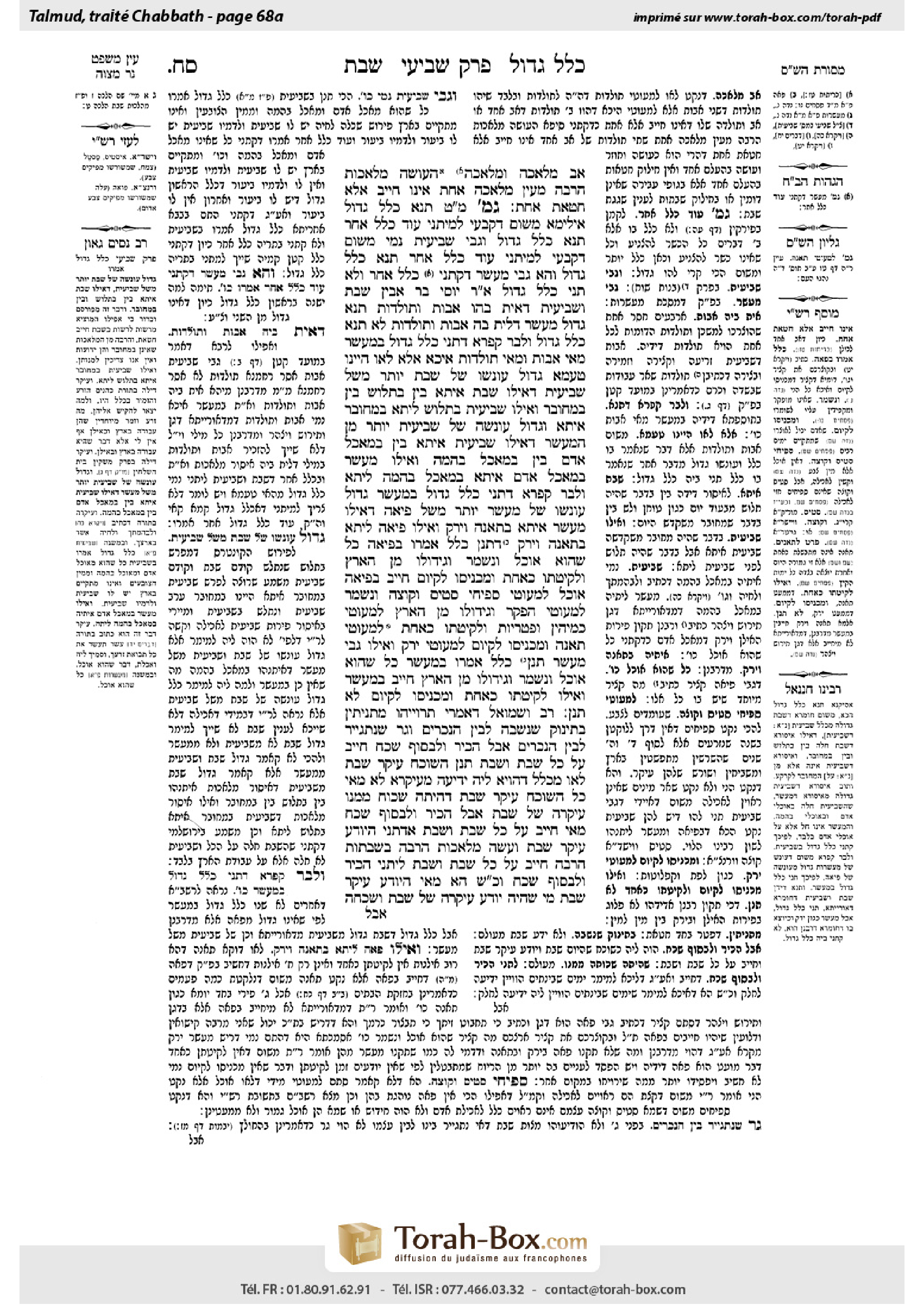
Shabbat 68a: Talmud study for Daf Yomi
Daf Yomi is the daily study of one Talmud folio. Explore 37 tractates with scans, Hebrew text, Sefaria English and AI-generated French translations where annotated.
Passage selection and English or AI-generated French translation are available where the scan has annotations. Daf Study is independent of Torah-Box and Sefaria.
Browse Shabbat · שבת · All tractatesShabbat 68a text and translations
This page of Shabbat includes the Aramaic text, an English translation and an AI-generated French translation, alongside the scan above.
שבת ס״ח א · Aramaic and Hebrew text
אַב מְלָאכָה וּמְלָאכָה. הָעוֹשֶׂה מְלָאכוֹת הַרְבֵּה מֵעֵין מְלָאכָה אַחַת, אֵינוֹ חַיָּיב אֶלָּא חַטָּאת אַחַת.
גְּמָ׳ מַאי טַעְמָא תְּנָא ״כְּלָל גָּדוֹל״? אִילֵּימָא מִשּׁוּם דְּקָבָעֵי לְמִיתְנֵי: ״עוֹד כְּלָל אַחֵר אָמְרוּ״, תְּנָא ״כְּלָל גָּדוֹל״. וְגַבֵּי שְׁבִיעִית נָמֵי, מִשּׁוּם דְּקָבָעֵי לְמִיתְנֵי: ״עוֹד כְּלָל אַחֵר אָמְרוּ״, תְּנָא ״כְּלָל גָּדוֹל״. וְהָא גַּבֵּי מַעֲשֵׂר, דְּקָתָנֵי: ״כְּלָל אַחֵר אָמְרוּ״, וְלָא תָּנֵי ״כְּלָל גָּדוֹל״!
אָמַר רַבִּי יוֹסֵי בַּר אָבִין: שַׁבָּת וּשְׁבִיעִית דְּאִית בְּהוּ אָבוֹת וְתוֹלָדוֹת — תְּנָא ״גָּדוֹל״, מַעֲשֵׂר דְּלֵית בֵּהּ אָבוֹת וְתוֹלָדוֹת, לָא תְּנָא ״כְּלָל גָּדוֹל״. וּלְבַר קַפָּרָא, דְּתָנֵי ״כְּלָל גָּדוֹל״ בְּמַעֲשֵׂר, מַאי אָבוֹת וּמַאי תּוֹלָדוֹת אִיכָּא?
אֶלָּא לָאו הַיְינוּ טַעְמָא, גָּדוֹל עוֹנְשָׁהּ שֶׁל שַׁבָּת יוֹתֵר מִשֶּׁל שְׁבִיעִית, דְּאִילּוּ שַׁבָּת אִיתַהּ בֵּין בְּתָלוּשׁ בֵּין בִּמְחוּבָּר, וְאִילּוּ שְׁבִיעִית בְּתָלוּשׁ לֵיתַהּ בִּמְחוּבָּר אִיתַהּ. וְגָדוֹל עוֹנְשָׁהּ שֶׁל שְׁבִיעִית יוֹתֵר מִן הַמַּעֲשֵׂר, דְּאִילּוּ שְׁבִיעִית אִיתַהּ בֵּין בְּמַאֲכַל אָדָם בֵּין בְּמַאֲכַל בְּהֵמָה, וְאִילּוּ מַעֲשֵׂר בְּמַאֲכַל אָדָם אִיתֵהּ בְּמַאֲכַל בְּהֵמָה לֵיתֵהּ.
וּלְבַר קַפָּרָא דְּתָנֵי ״כְּלָל גָּדוֹל״ בַּמַּעֲשֵׂר: גָּדוֹל עוֹנְשׁוֹ שֶׁל מַעֲשֵׂר יוֹתֵר מִשֶּׁל פֵּיאָה, דְּאִילּוּ מַעֲשֵׂר אִיתֵהּ בִּתְאֵנָה וְיָרָק וְאִילּוּ פֵּיאָה לֵיתַהּ בִּתְאֵנָה וְיָרָק. דִּתְנַן, כְּלָל אָמְרוּ בַּפֵּיאָה: כׇּל שֶׁהוּא אוֹכֶל וְנִשְׁמָר וְגִידּוּלוֹ מִן הָאָרֶץ וּלְקִיטָתוֹ כְּאַחַת וּמַכְנִיסוֹ לְקִיּוּם — חַיָּיב בְּפֵיאָה.
אוֹכֶל — לְמַעוֹטֵי סְפִיחֵי סְטִיס וְקוֹצָה. וְנִשְׁמָר — לְמַעוֹטֵי הֶפְקֵר. וְגִידּוּלוֹ מִן הָאָרֶץ — לְמַעוֹטֵי כְּמֵיהִין וּפִטְרִיּוֹת. וּלְקִיטָתוֹ כְּאַחַת — לְמַעוֹטֵי תְּאֵנָה. וּמַכְנִיסוֹ לְקִיּוּם — לְמַעוֹטֵי יָרָק.
וְאִילּוּ גַּבֵּי מַעֲשֵׂר תְּנַן, כְּלָל אָמְרוּ בַּמַּעֲשֵׂר: כׇּל שֶׁהוּא אוֹכֶל וְנִשְׁמָר וְגִידּוּלוֹ מִן הָאָרֶץ — חַיָּיב בְּמַעֲשֵׂר. וְאִילּוּ לְקִיטָתוֹ כְּאַחַת וּמַכְנִיסוֹ לְקִיּוּם לָא תְּנַן.
רַב וּשְׁמוּאֵל דְּאָמְרִי תַּרְוַיְיהוּ: מַתְנִיתִין בְּתִינוֹק שֶׁנִּשְׁבָּה לְבֵין הַגּוֹיִם, וְגֵר שֶׁנִּתְגַּיֵּיר לְבֵין הַגּוֹיִם. אֲבָל הִכִּיר וּלְבַסּוֹף שָׁכַח — חַיָּיב עַל כׇּל שַׁבָּת וְשַׁבָּת. תְּנַן: ״הַשּׁוֹכֵחַ עִיקַּר שַׁבָּת״, לָאו מִכְּלָל דְּהַוְיָא לֵיהּ יְדִיעָה מֵעִיקָּרָא?! לָא, מַאי ״כׇּל הַשּׁוֹכֵחַ עִיקַּר שַׁבָּת״ — שֶׁהָיְתָה שְׁכוּחָה מִמֶּנּוּ עִיקָּרָהּ שֶׁל שַׁבָּת.
אֲבָל הִכִּיר וּלְבַסּוֹף שָׁכַח מַאי — חַיָּיב עַל כׇּל שַׁבָּת וְשַׁבָּת? אַדְּתָנֵי הַיּוֹדֵעַ עִיקַּר שַׁבָּת וְעָשָׂה מְלָאכוֹת הַרְבֵּה בְּשַׁבָּתוֹת הַרְבֵּה חַיָּיב עַל כׇּל שַׁבָּת וְשַׁבָּת, לִיתְנֵי ״הִכִּיר וּלְבַסּוֹף שָׁכַח״, וְכׇל שֶׁכֵּן הָא! מַאי ״הַיּוֹדֵעַ עִיקַּר שַׁבָּת״ — מִי שֶׁהָיָה יוֹדֵעַ עִיקָּרָהּ שֶׁל שַׁבָּת וּשְׁכֵחָהּ.
Shabbat 68a · English translation
and every primary category of labor that he performed. One who performs numerous prohibited labors subsumed under a single category of labor is liable to bring only one sin-offering.
GEMARA: The Gemara attempts to clarify the language of the mishna and asks: Why did the mishna teach the phrase: A significant principle? If you say it is because of the following reason, it is problematic.
Here, because the tanna wants to teach in a mishna later in the chapter with regard to a matter that includes two halakhot employing the term: Furthermore, they stated another principle; therefore, in this mishna, which relates to a greater number of halakhot, he taught employing the term: A significant principle.
And with regard to the Sabbatical Year as well, because in a later mishna (Shevi’it 7:2) the tanna wants to teach: Furthermore, another principle, at the beginning of the chapter he taught employing the phrase: A significant principle. There too, the choice of language is understood.
However, with regard to the halakhot of tithes, where the mishna (Ma’asrot 1:1) states two principles one after the other, the tanna taught later in the same mishna: And furthermore, they stated another principle, and even so, at the beginning of the mishna the tanna did not teach: A significant principle, opting instead to say simply: They stated a principle.
Rabbi Yosei bar Avin said that the term: A significant principle, is not dependent on the existence of another principle; rather, it is dependent on the significance of the principle. Therefore, with regard to the halakhot of Shabbat and the Sabbatical Year, which include primary categories and subcategories, the tanna taught in the mishna: A significant principle. With regard to the halakhot of tithes, which do not include primary categories and subcategories and all its halakhot are on equal footing, he did not teach employing the term: A significant principle. The Gemara asks: And according to the variant reading of the mishna taught by bar Kappara, who taught the phrase: A significant principle, with regard to tithes, what primary categories and subcategories are there with regard to tithes?
Rather, isn’t this the reason the Mishna employs the term: A significant principle; because it is significant relative to other principles? The scope of the materials whose use warrants punishment for desecrating Shabbat is greater than the scope of the materials whose use warrants punishment for desecrating the Sabbatical Year. As the halakhot of Shabbat are in effect both with regard to plants that are detached from the ground and with regard to those that are attached, while the halakhot of the Sabbatical Year with regard to detached plants, they are not in effect, but with regard to attached plants they are in effect. And the scope of the materials whose use warrants punishment for desecration of the Sabbatical Year are greater than the scope of the materials whose use warrants punishment for violating the halakhot of tithes. As, by Torah law, the halakhot of the Sabbatical Year are in effect both with regard to human food and with regard to animal food, while the halakhot of tithes are in effect with regard to human food, but with regard to animal food they are not in effect.
And according to the opinion of bar Kappara, who taught the phrase: A significant principle, with regard to tithes as well: The scope of the materials for which one warrants punishment for violating the halakhot of tithes is greater than the scope of the materials for which one warrants punishment for violating the halakhot of pe’a. As, by rabbinic law, the obligation of tithes is in effect with regard to both figs and vegetables, while the obligation of pe’a is not in effect with regard to figs and vegetables. As we learned in a mishna in tractate Pe’a: They stated a principle with regard to pe’a: Anything that is food, and is protected, and grows from the ground, and is gathered as one, and one brings it in to storage to preserve is obligated in pe’a.
The Gemara explains that which is excluded by each criterion in the mishna. Food, to exclude the aftergrowths of woad [satis] and madder. As these plants are used for dyeing and not for food, the obligation of pe’a does not apply to them. And protected, to exclude ownerless crops, which by definition are not protected. And grows from the ground, to exclude truffles and mushrooms, which, unlike other plants, do not draw sustenance from the ground. And is gathered as one, to exclude the fig tree whose fruit is gathered throughout an extended period, as the figs do not all ripen together. And one brings it in to storage to preserve; to exclude vegetables, which cannot be stored for lengthy periods.
While, with regard to tithes, we learned in a mishna: They stated a principle with regard to tithes: Anything that is food, and is protected, and grows from the ground is obligated in tithes; we did not learn with regard to tithes, the following criteria: Gathered as one, and which one brings in to storage to preserve. Apparently, figs and vegetables are obligated in tithes, making the scope of the materials obligated in tithes greater than the scope of those obligated in pe’a.
The mishna discusses an individual who forgets the very essence of Shabbat. The Gemara seeks to understand how a Jew could forget the very existence of Shabbat. It was Rav and Shmuel who both said: Our mishna is referring to both a child who was taken captive among the gentiles and never educated and a convert who converted among the gentiles and never learned the halakhot of Shabbat. However, one who once knew of the essence of Shabbat and ultimately forgot is liable for each and every Shabbat, as we learned in the mishna with regard to one who knows the essence of Shabbat. The Gemara seeks to clarify this approach. We learned in our mishna: One who forgets the essence of Shabbat. Doesn’t this phrase indicate by inference that he was aware of Shabbat originally? In order to forget one must have previously been aware. This poses a difficulty to the opinion of Rav and Shmuel. The Gemara refutes this: No, what is the meaning of: One who forgets the essence of Shabbat? That the essence of Shabbat was always forgotten from him, i.e., he never knew it.
The Gemara further asks: However, based on that understanding, in the case of one who knew the essence of Shabbat and ultimately forgot, what is the halakha? Is he liable for each and every Shabbat? If so, instead of the mishna teaching the next halakha: One who knows the essence of Shabbat and performs many labors on multiple Shabbatot is liable to bring a sin-offering for each and every Shabbat, let it teach: One who knew the essence of Shabbat and ultimately forgot and, all the more so, one who knows the essence of Shabbat would be liable for each Shabbat. The Gemara answers: According to the opinion of Rav and Shmuel, what is the meaning of the phrase: One who knows the essence of Shabbat? One who once knew the essence of Shabbat and has now forgotten it.
Shabbat 68a · Traduction française (IA)
et chaque catégorie principale de travail qu’il a accomplie. Celui qui accomplit de nombreux travaux interdits relevant d’une seule catégorie de travail n’est tenu d’apporter qu’un seul sacrifice expiatoire.
GUEMARA : La Guemara cherche à clarifier la formulation de la Michna et demande : Pourquoi la Michna a-t-elle employé l’expression « un principe important » ? Si l’on avance que c’est pour la raison suivante, cela pose problème. Ici, puisque le tanna veut enseigner, dans une Michna ultérieure du chapitre, à propos d’un sujet qui comprend deux halakhot, l’expression « ils ont également énoncé un autre principe », il a donc employé dans cette Michna, qui traite d’un plus grand nombre de halakhot, l’expression « un principe important ». De même, à propos de l’année sabbatique, puisque le tanna veut enseigner dans une Michna ultérieure (Shevi’it 7:2) : « Ils ont également énoncé un autre principe », il a employé au début du chapitre l’expression « un principe important ». Là aussi, ce choix de formulation s’explique. Cependant, à propos des halakhot des dîmes, où la Michna (Ma’asrot 1:1) énonce deux principes l’un après l’autre, le tanna enseigne plus loin dans cette même Michna : « Et ils ont également énoncé un autre principe ». Malgré cela, au début de la Michna, le tanna n’a pas employé l’expression « un principe important », préférant dire simplement : « Ils ont énoncé un principe ».
Rabbi Yosei bar Avin a dit que l’expression « un principe important » ne dépend pas de l’existence d’un autre principe ; elle dépend plutôt de l’importance du principe. C’est pourquoi, à propos des halakhot de Chabbat et de l’année sabbatique, qui comprennent des catégories principales et des catégories secondaires, le tanna a employé dans la Michna l’expression « un principe important ». À propos des halakhot des dîmes, qui ne comprennent pas de catégories principales et secondaires et dont toutes les halakhot sont de même niveau, il n’a pas employé l’expression « un principe important ». La Guemara demande : Et selon la version de la Michna enseignée par bar Kappara, qui a employé l’expression « un principe important » à propos des dîmes, quelles catégories principales et secondaires y a-t-il dans le domaine des dîmes ?
Mais n’est-ce pas plutôt pour cette raison que la Michna emploie l’expression « un principe important » : parce que ce principe est important par rapport aux autres principes ? La portée des matières dont l’utilisation entraîne une sanction pour profanation de Chabbat est plus vaste que celle des matières dont l’utilisation entraîne une sanction pour profanation de l’année sabbatique. En effet, les halakhot de Chabbat s’appliquent aussi bien aux plantes détachées du sol qu’à celles qui y sont attachées, tandis que les halakhot de l’année sabbatique ne s’appliquent pas aux plantes détachées, mais s’appliquent aux plantes attachées. Et la portée des matières dont l’utilisation entraîne une sanction pour profanation de l’année sabbatique est plus vaste que celle des matières dont l’utilisation entraîne une sanction pour transgression des halakhot des dîmes. En effet, selon la Torah écrite, les halakhot de l’année sabbatique s’appliquent aussi bien à la nourriture destinée aux humains qu’à celle destinée aux animaux, tandis que les halakhot des dîmes s’appliquent à la nourriture destinée aux humains, mais pas à celle destinée aux animaux.
Et selon l’opinion de bar Kappara, qui a également employé l’expression « un principe important » à propos des dîmes, la portée des matières pour lesquelles on est passible d’une sanction en transgressant les halakhot des dîmes est plus vaste que celle des matières pour lesquelles on est passible d’une sanction en transgressant les halakhot de la pe’a. En effet, selon la loi rabbinique, l’obligation des dîmes s’applique aussi bien aux figues qu’aux légumes, tandis que l’obligation de pe’a ne s’applique ni aux figues ni aux légumes. Comme nous l’avons appris dans une Michna du traité Pe’a : « Ils ont énoncé un principe concernant la pe’a : tout ce qui est un aliment, est protégé, pousse dans le sol, est récolté en une seule fois et est apporté dans un lieu de stockage pour y être conservé est soumis à l’obligation de pe’a. »
La Guemara explique ce que chaque critère de la Michna exclut. « Un aliment » exclut les repousses de la guède [satis] et de la garance. Ces plantes étant utilisées pour la teinture et non pour l’alimentation, l’obligation de pe’a ne s’y applique pas. « Est protégé » exclut les récoltes sans propriétaire, qui, par définition, ne sont pas protégées. « Pousse dans le sol » exclut les truffes et les champignons qui, contrairement aux autres plantes, ne tirent pas leur nourriture du sol. « Est récolté en une seule fois » exclut le figuier, dont les fruits sont récoltés sur une longue période, car les figues ne mûrissent pas toutes en même temps. « Est apporté dans un lieu de stockage pour y être conservé » exclut les légumes, qui ne peuvent pas être stockés pendant de longues périodes.
Tandis qu’à propos des dîmes, nous avons appris dans une Michna : « Ils ont énoncé un principe concernant les dîmes : tout ce qui est un aliment, est protégé et pousse dans le sol est soumis à l’obligation des dîmes » ; nous n’avons pas appris, à propos des dîmes, les critères suivants : « est récolté en une seule fois » et « est apporté dans un lieu de stockage pour y être conservé ». Il apparaît donc que les figues et les légumes sont soumis à l’obligation des dîmes, ce qui rend plus vaste la portée des matières soumises aux dîmes que celle des matières soumises à la pe’a.
La Michna traite d’un individu qui oublie jusqu’à l’essence même de Chabbat. La Guemara cherche à comprendre comment un Juif pourrait oublier jusqu’à l’existence même de Chabbat. Rav et Shmuel ont tous deux dit que notre Michna parle aussi bien d’un enfant qui a été capturé par des non-Juifs et n’a jamais été éduqué que d’un converti qui s’est converti parmi les non-Juifs et n’a jamais appris les halakhot de Chabbat. Cependant, celui qui a autrefois connu l’essence de Chabbat et l’a finalement oubliée est passible d’un sacrifice pour chaque Chabbat, comme nous l’avons appris dans la Michna à propos de celui qui connaît l’essence de Chabbat. La Guemara cherche à clarifier cette approche. Nous avons appris dans notre Michna : « Celui qui oublie l’essence de Chabbat. » Cette expression n’indique-t-elle pas, par déduction, qu’il connaissait auparavant Chabbat ? Pour oublier, il faut avoir su auparavant. Cela pose une difficulté à l’opinion de Rav et Shmuel. La Guemara réfute cette objection : Non, que signifie « celui qui oublie l’essence de Chabbat » ? Que l’essence de Chabbat lui a toujours échappé, c’est-à-dire qu’il ne l’a jamais connue.
La Guemara demande encore : Cependant, selon cette interprétation, quelle est la halakha dans le cas de celui qui connaissait l’essence de Chabbat et l’a finalement oubliée ? Est-il passible d’un sacrifice pour chaque Chabbat ? Si oui, au lieu d’enseigner la halakha suivante dans la Michna : « Celui qui connaît l’essence de Chabbat et accomplit de nombreux travaux durant plusieurs Chabbatot est tenu d’apporter un sacrifice expiatoire pour chaque Chabbat », qu’elle enseigne : « Celui qui connaissait l’essence de Chabbat et l’a finalement oubliée » ; à plus forte raison, celui qui connaît l’essence de Chabbat serait-il passible d’un sacrifice pour chaque Chabbat. La Guemara répond : Selon l’opinion de Rav et Shmuel, que signifie l’expression « celui qui connaît l’essence de Chabbat » ? Celui qui a autrefois connu l’essence de Chabbat et l’a maintenant oubliée.
Traduction française générée par IA à partir de l’édition anglaise de Sefaria. Vérifie toujours un passage avec le texte source.
Text from Sefaria: William Davidson Edition - Vocalized Aramaic (CC BY NC); William Davidson Edition - English (CC BY NC).