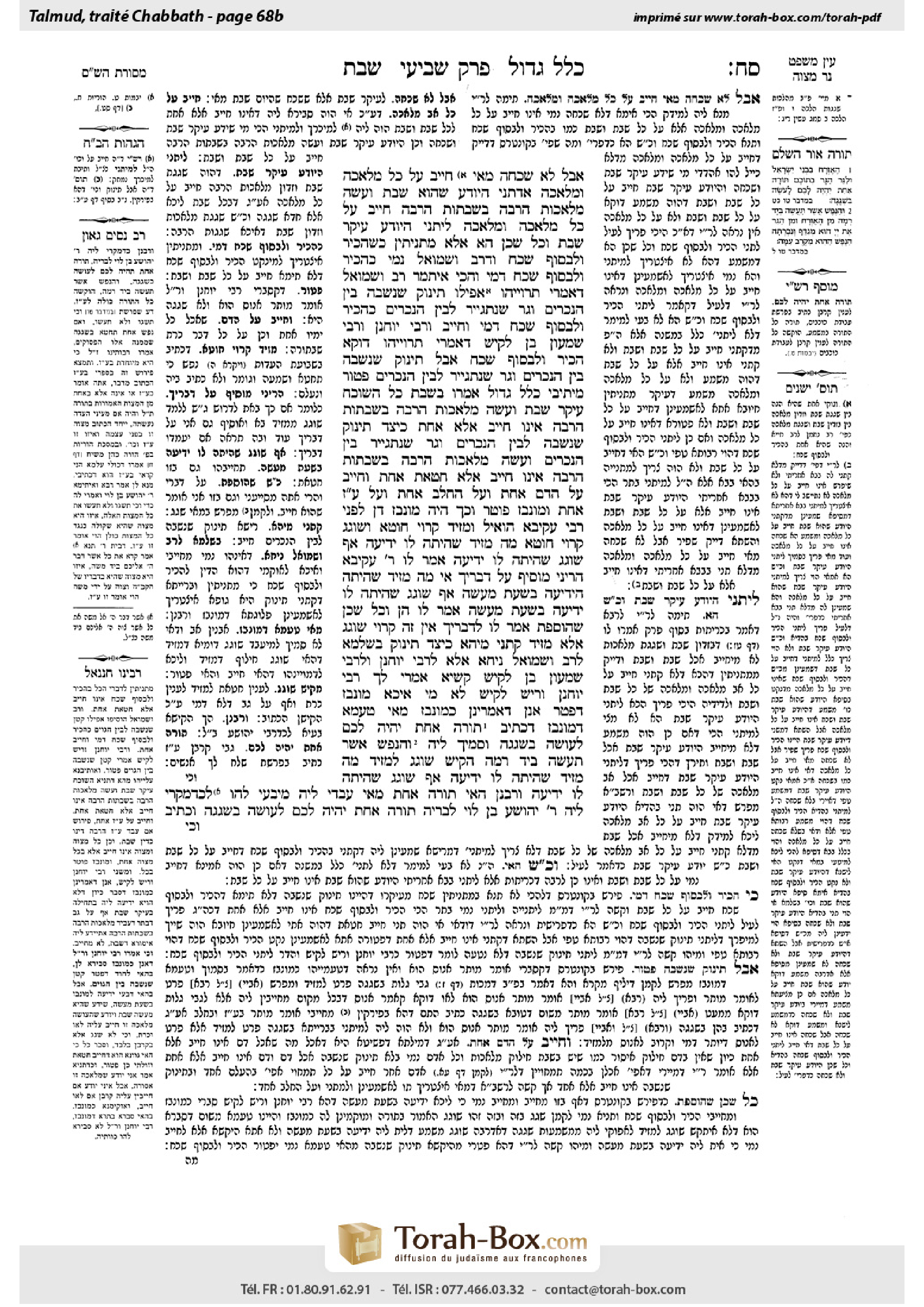
Shabbat 68b: Talmud study for Daf Yomi
Daf Yomi is the daily study of one Talmud folio. Explore 37 tractates with scans, Hebrew text, Sefaria English and AI-generated French translations where annotated.
Passage selection and English or AI-generated French translation are available where the scan has annotations. Daf Study is independent of Torah-Box and Sefaria.
Browse Shabbat · שבת · All tractatesShabbat 68b text and translations
This page of Shabbat includes the Aramaic text, an English translation and an AI-generated French translation, alongside the scan above.
שבת ס״ח ב · Aramaic and Hebrew text
אֲבָל לֹא שְׁכֵחָהּ, מַאי — חַיָּיב עַל כׇּל מְלָאכָה וּמְלָאכָה? אַדְּתָנֵי הַיּוֹדֵעַ שֶׁהוּא שַׁבָּת וְעָשָׂה מְלָאכוֹת הַרְבֵּה בְּשַׁבָּתוֹת הַרְבֵּה חַיָּיב עַל כׇּל מְלָאכָה וּמְלָאכָה, לִיתְנֵי ״הַיּוֹדֵעַ עִיקַּר שַׁבָּת״, וְכׇל שֶׁכֵּן הָא! אֶלָּא, מַתְנִיתִין כְּשֶׁהִכִּיר וּלְבַסּוֹף שָׁכַח, וּדְרַב וּשְׁמוּאֵל נָמֵי כְּהִכִּיר וּלְבַסּוֹף שָׁכַח דָּמֵי. וְהָכִי אִיתְּמַר: רַב וּשְׁמוּאֵל דְּאָמְרִי תַּרְוַיְיהוּ אֲפִילּוּ תִּינוֹק שֶׁנִּשְׁבָּה בֵּין הַגּוֹיִם וְגֵר שֶׁנִּתְגַּיֵּיר לְבֵין הַגּוֹיִם — כְּהִכִּיר וּלְבַסּוֹף שָׁכַח דָּמֵי, וְחַיָּיב.
וְרַבִּי יוֹחָנָן וְרַבִּי שִׁמְעוֹן בֶּן לָקִישׁ דְּאָמְרִי תַּרְוַיְיהוּ: דַּוְקָא הִכִּיר וּלְבַסּוֹף שָׁכַח — אֲבָל תִּינוֹק שֶׁנִּשְׁבָּה בֵּין הַגּוֹיִם וְגֵר שֶׁנִּתְגַּיֵּיר לְבֵין הַגּוֹיִם — פָּטוּר. מֵיתִיבִי: כְּלָל גָּדוֹל אָמְרוּ בַּשַּׁבָּת: כׇּל הַשּׁוֹכֵחַ עִיקַּר שַׁבָּת, וְעָשָׂה מְלָאכוֹת הַרְבֵּה בְּשַׁבָּתוֹת הַרְבֵּה — אֵינוֹ חַיָּיב אֶלָּא אַחַת. כֵּיצַד? — תִּינוֹק שֶׁנִּשְׁבָּה לְבֵין הַגּוֹיִם, וְגֵר שֶׁנִּתְגַּיֵּיר בֵּין הַגּוֹיִם, וְעָשָׂה מְלָאכוֹת הַרְבֵּה בְּשַׁבָּתוֹת הַרְבֵּה — אֵינוֹ חַיָּיב אֶלָּא חַטָּאת אַחַת. וְחַיָּיב עַל הַדָּם אַחַת, וְעַל הַחֵלֶב אַחַת, וְעַל עֲבוֹדָה זָרָה אַחַת, וּמוֹנְבַּז פּוֹטֵר.
וְכָךְ הָיָה מוֹנְבַּז דָּן לִפְנֵי רַבִּי עֲקִיבָא: הוֹאִיל וּמֵזִיד קָרוּי ״חוֹטֵא״ וְשׁוֹגֵג קָרוּי ״חוֹטֵא״, מָה מֵזִיד שֶׁהָיְתָה לוֹ יְדִיעָה — אַף שׁוֹגֵג שֶׁהָיְתָה לוֹ יְדִיעָה. אָמַר לוֹ רַבִּי עֲקִיבָא, הֲרֵינִי מוֹסִיף עַל דְּבָרֶיךָ: אִי מָה מֵזִיד שֶׁהָיְתָה הַיְּדִיעָה בִּשְׁעַת מַעֲשֶׂה — אַף שׁוֹגֵג שֶׁהָיְתָה לוֹ יְדִיעָה בִּשְׁעַת מַעֲשֶׂה!
אָמַר לוֹ: הֵן, וְכׇל שֶׁכֵּן שֶׁהוֹסַפְתָּ. אָמַר לוֹ: לִדְבָרֶיךָ, אֵין זֶה קָרוּי שׁוֹגֵג אֶלָּא מֵזִיד.
קָתָנֵי מִיהָא ״כֵּיצַד תִּינוֹק״. בִּשְׁלָמָא לְרַב וּשְׁמוּאֵל נִיחָא. אֶלָּא לְרַבִּי יוֹחָנָן וּלְרַבִּי שִׁמְעוֹן בֶּן לָקִישׁ, קַשְׁיָא! אָמְרִי לָךְ רַבִּי יוֹחָנָן וְרֵישׁ לָקִישׁ: לָא מִי אִיכָּא מוֹנְבַּז דְּפָטַר? אֲנַן דְּאָמְרִינַן כְּמוֹנְבַּז.
מַאי טַעְמָא דְמוֹנְבַּז? דִּכְתִיב: ״תּוֹרָה אַחַת יִהְיֶה לָכֶם לָעֹשֶׂה בִּשְׁגָגָה״, וּסְמִיךְ לֵיהּ ״וְהַנֶּפֶשׁ אֲשֶׁר תַּעֲשֶׂה בְּיָד רָמָה״ — הִקִּישׁ שׁוֹגֵג לְמֵזִיד. מָה מֵזִיד שֶׁהָיְתָה לוֹ יְדִיעָה, אַף שׁוֹגֵג שֶׁהָיְתָה לוֹ יְדִיעָה.
וְרַבָּנַן, הַאי ״תּוֹרָה אַחַת״ מַאי עָבְדִי לֵיהּ? מִיבְּעֵי לְהוּ לְכִדְמַקְרֵי לֵיהּ רַבִּי יְהוֹשֻׁעַ בֶּן לֵוִי לִבְרֵיהּ: ״תּוֹרָה אַחַת יִהְיֶה לָכֶם לָעֹשֶׂה בִּשְׁגָגָה״, וּכְתִיב:
Shabbat 68b · English translation
The Gemara raises another difficulty: But if he did not forget the essence of Shabbat, and he knows that today is Shabbat, what would the halakha be? Certainly he would be liable for each and every prohibited labor. If so, instead of teaching the halakha: One who knows that it is Shabbat and performs many labors on multiple Shabbatot is liable for each and every labor, let the mishna teach the halakha: One who knows the essence of Shabbat is liable for each and every labor that he performs and all the more so that one who is aware that today is Shabbat would be liable for each labor. Rather, when our mishna refers to forgetting, it is referring to a case where he knew and ultimately forgot. And the case described by Rav and Shmuel also has the same legal status as one who knew and ultimately forgot. And it was stated as follows: It was Rav and Shmuel who both said: Even a child who was taken captive among the gentiles and a convert who converted among the gentiles have the same legal status as one who knew and ultimately forgot, and they are liable to bring a sin-offering for their unwitting transgression, even though they never learned about Shabbat.
And it was Rabbi Yoḥanan and Rabbi Shimon ben Lakish who both said: He is liable to bring a sin-offering specifically if he knew of the essence of Shabbat and ultimately forgot. However, a child who was taken captive among the gentiles and a convert who converted among the gentiles are exempt from bringing a sin-offering. They have the legal status of one who performed the prohibited labor due to circumstances beyond his control. The Gemara raises an objection from that which was taught in a baraita: They stated a significant principle with regard to the halakhot of Shabbat: One who forgets the essence of Shabbat, i.e., one who does not know that there is a mitzva of Shabbat in the Torah, and performs many prohibited labors on multiple Shabbatot is liable to bring only one sin-offering. How so? With regard to a child who was taken captive among the gentiles and a convert who converted among the gentiles and does not know the essence of Shabbat; and if he performed many prohibited labors on multiple Shabbatot, he is only liable to bring one sin-offering for all his unwitting transgressions. And he is liable to bring one sin-offering for all the blood he unwittingly ate before he learned of the prohibition; and one sin-offering for all the forbidden fat that he ate; and one for all the idolatry that he worshipped. And Munbaz, one of the Sages, deems him exempt from bringing any sacrifice.
And Munbaz deliberated before Rabbi Akiva as follows: Since one who commits a transgression intentionally is called a sinner in the Torah and one who commits a transgression unwittingly is called a sinner, just as one who commits the transgression intentionally is liable for punishment only in a case where he had prior knowledge that it was prohibited, so too, one who commits the transgression unwittingly is liable to bring a sin-offering only in a case where he had prior knowledge. However, the action of one who had no prior knowledge at all is not considered unwitting; rather, it has the same legal status as an action performed due to circumstances beyond one’s control, and he is completely exempt. Rabbi Akiva said to him: I will elaborate upon your statement and follow your reasoning to its logical conclusion and thereby test the validity of your reasoning. If so, just as one who commits the transgression intentionally is liable for punishment only in a case where he had the awareness that he was sinning at the time that he performed the action, so too, with regard to one who commits the transgression unwittingly, say that he is only liable to bring a sin-offering in a case where he had awareness that he was sinning at the time that he performed the action. If that is the case, it is no longer an unwitting transgression.
Munbaz said to him: Yes, there is nothing unusual about that. In my opinion it is correct and all the more so now that you have elaborated upon my statement. Awareness at the time that one is performing the action is one of the criteria of my definition of an unwitting transgression, as will be explained below. Rabbi Akiva said to him: According to your statement, since while performing the action one is aware that it is prohibited, his action is not called unwitting; rather, it is a full-fledged intentional transgression.
Returning to our issue: In any case, as an example of one who forgot the essence of Shabbat, it was taught: How so? A child who was taken captive. Granted, according to the opinion of Rav and Shmuel it works out well, as they consider the legal status of a child taken captive equal to that of one who unwittingly forgot the essence of Shabbat. However, according to the opinion of Rabbi Yoḥanan and Rabbi Shimon ben Lakish, who consider the legal status of a child taken captive equal to that of one who committed the action due to circumstances beyond his control and is therefore exempt, it is difficult because he is liable to bring a sin-offering according to the opinion of the Rabbis in the baraita. Rabbi Yoḥanan and Rabbi Shimon ben Lakish could have said to you: Isn’t there the opinion of Munbaz who deemed him exempt in that case? We stated our opinion in accordance with the opinion of Munbaz.
The Gemara asks: What is the rationale for the opinion of Munbaz? Is it based entirely upon the fact that the Torah refers to sinners, both intentional and unwitting, as sinners? The Gemara explains that the source for the opinion of Munbaz is as it is written: “The native of the children of Israel, and the stranger who lives among them, there shall be one law for you, for one who acts unwittingly” (Numbers 15:29), and adjacent to it is the verse: “And the person who acts with a high hand, whether a native or a stranger, he blasphemes God, and that soul shall be cut off from the midst of his people” (Numbers 15:30). The Torah juxtaposes unwitting transgression to intentional transgression. Just as one who commits the transgression intentionally is only liable in a case where he had prior knowledge, so too, one who commits the transgression unwittingly is only liable in a case where he had prior knowledge.
The Gemara asks: And what do the Rabbis do with the juxtaposition derived from that verse: One law? The Gemara answers: They require it for that which Rabbi Yehoshua ben Levi taught his son. It is written: “There shall be one law for you, for one who acts unwittingly.” And it is written:
Shabbat 68b · Traduction française (IA)
La Guemara soulève une autre difficulté : Mais s’il n’a pas oublié l’essence du Chabbat et sait que nous sommes aujourd’hui Chabbat, quelle serait la halakha ? Il serait certainement passible pour chacun des travaux interdits. Dès lors, au lieu d’enseigner la halakha suivante : celui qui sait que c’est Chabbat et accomplit de nombreux travaux pendant plusieurs Chabbatot est passible pour chacun des travaux, que la Michna enseigne plutôt : celui qui connaît l’essence du Chabbat est passible pour chacun des travaux qu’il accomplit, et à plus forte raison celui qui sait que nous sommes aujourd’hui Chabbat serait passible pour chaque travail. En réalité, lorsque notre Michna parle d’oubli, elle vise un cas où il a su, puis a fini par oublier. Le cas décrit par Rav et Shmuel a lui aussi le statut de celui qui a su, puis a fini par oublier. Voici donc ce qui a été dit : Rav et Shmuel ont tous deux déclaré que même un enfant capturé par les non-Juifs et un converti qui s’est converti parmi les non-Juifs ont le statut de celui qui a su, puis a fini par oublier ; ils sont passibles d’apporter un sacrifice expiatoire pour leur transgression involontaire, bien qu’ils n’aient jamais appris ce qu’est le Chabbat.
Rabbi Yoḥanan et Rabbi Shimon ben Lakish ont tous deux déclaré qu’il n’est passible d’apporter un sacrifice expiatoire que s’il a connu l’essence du Chabbat, puis l’a oubliée. En revanche, un enfant capturé par les non-Juifs et un converti qui s’est converti parmi les non-Juifs sont dispensés d’apporter un sacrifice expiatoire. Ils ont le statut de celui qui a accompli le travail interdit en raison de circonstances indépendantes de sa volonté. La Guemara soulève une objection à partir de ce qui a été enseigné dans une baraïta : Ils ont énoncé un principe important concernant les halakhot du Chabbat : celui qui oublie l’essence du Chabbat, c’est-à-dire celui qui ignore que la Torah comporte une mitsva relative au Chabbat, et accomplit de nombreux travaux interdits pendant plusieurs Chabbatot, n’est passible que d’un seul sacrifice expiatoire. Comment cela s’applique-t-il ? Il s’agit d’un enfant capturé par les non-Juifs ou d’un converti qui s’est converti parmi les non-Juifs et ignore l’essence du Chabbat ; s’il accomplit de nombreux travaux interdits pendant plusieurs Chabbatot, il n’est passible que d’un seul sacrifice expiatoire pour toutes ses transgressions involontaires. Il est également passible d’un seul sacrifice expiatoire pour tout le sang qu’il a consommé involontairement avant d’apprendre l’interdiction, d’un seul pour toute la graisse interdite qu’il a consommée et d’un seul pour tous les actes d’idolâtrie qu’il a commis. Quant à Munbaz, l’un des Sages, il le dispense d’apporter tout sacrifice.
Munbaz raisonna devant Rabbi Akiva de la manière suivante : puisque la Torah qualifie de pécheur celui qui commet une transgression intentionnellement comme celui qui la commet involontairement, et que celui qui commet intentionnellement la transgression n’est passible d’une peine que s’il savait auparavant qu’elle était interdite, de même, celui qui commet la transgression involontairement n’est passible d’apporter un sacrifice expiatoire que s’il le savait auparavant. Toutefois, l’acte de celui qui n’en savait absolument rien auparavant n’est pas considéré comme involontaire ; il a plutôt le statut d’un acte accompli en raison de circonstances indépendantes de sa volonté, et il est entièrement dispensé. Rabbi Akiva lui dit : Je vais développer ton propos, suivre ton raisonnement jusqu’à sa conclusion logique et ainsi en éprouver la validité. Si tel est le cas, de même que celui qui commet intentionnellement la transgression n’est passible d’une peine que s’il avait conscience de pécher au moment où il accomplissait l’acte, dis aussi que celui qui commet la transgression involontairement n’est passible d’apporter un sacrifice expiatoire que s’il avait conscience de pécher au moment où il accomplissait l’acte. Dans ce cas, il ne s’agirait plus d’une transgression involontaire.
Munbaz lui dit : Oui, cela n’a rien d’étonnant. À mon avis, c’est exact, et cela vaut d’autant plus maintenant que tu as développé mon propos. Avoir conscience au moment où l’on accomplit l’acte est l’un des critères de ma définition d’une transgression involontaire, comme cela sera expliqué plus loin. Rabbi Akiva lui dit : Selon ton propos, puisque, en accomplissant l’acte, la personne a conscience qu’il est interdit, son acte n’est pas qualifié d’involontaire ; c’est plutôt une transgression pleinement intentionnelle.
Revenons à notre sujet : en tout état de cause, comme exemple de celui qui a oublié l’essence du Chabbat, il a été enseigné : Comment cela s’applique-t-il ? Il s’agit d’un enfant capturé. Cela s’accorde bien avec l’opinion de Rav et Shmuel, puisqu’ils considèrent que le statut d’un enfant capturé est identique à celui de quelqu’un qui a oublié l’essence du Chabbat de manière involontaire. En revanche, selon l’opinion de Rabbi Yoḥanan et de Rabbi Shimon ben Lakish, qui considèrent que le statut d’un enfant capturé est identique à celui de quelqu’un qui a accompli l’acte en raison de circonstances indépendantes de sa volonté et qui est donc dispensé, une difficulté se pose : selon l’opinion des Rabbins dans la baraïta, il est passible d’apporter un sacrifice expiatoire. Rabbi Yoḥanan et Rabbi Shimon ben Lakish auraient pu te répondre : l’opinion de Munbaz, qui le dispense dans ce cas, n’existe-t-elle pas ? Nous avons énoncé notre opinion conformément à celle de Munbaz.
La Guemara demande : Quel est le fondement de l’opinion de Munbaz ? Repose-t-elle entièrement sur le fait que la Torah qualifie de pécheurs ceux qui transgressent intentionnellement comme ceux qui transgressent involontairement ? La Guemara explique que la source de l’opinion de Munbaz est le verset suivant : « L’indigène parmi les enfants d’Israël et l’étranger qui séjourne parmi eux : il y aura une même loi pour vous, pour celui qui agit involontairement » (Nombres 15,29). Le verset qui le suit dit : « Mais celui qui agit avec une main levée, qu’il soit indigène ou étranger, blasphème Dieu, et cette personne sera retranchée du milieu de son peuple » (Nombres 15,30). La Torah rapproche la transgression involontaire de la transgression intentionnelle. De même que celui qui commet intentionnellement la transgression n’est passible que s’il savait auparavant, celui qui la commet involontairement n’est lui aussi passible que s’il savait auparavant.
La Guemara demande : Que font les Rabbins du rapprochement déduit de l’expression « une même loi » dans ce verset ? La Guemara répond : Ils en ont besoin pour l’enseignement que Rabbi Yehoshua ben Levi a transmis à son fils. Il est écrit : « Il y aura une même loi pour vous, pour celui qui agit involontairement. » Et il est écrit :
Traduction française générée par IA à partir de l’édition anglaise de Sefaria. Vérifie toujours un passage avec le texte source.
Text from Sefaria: William Davidson Edition - Vocalized Aramaic (CC BY NC); William Davidson Edition - English (CC BY NC).