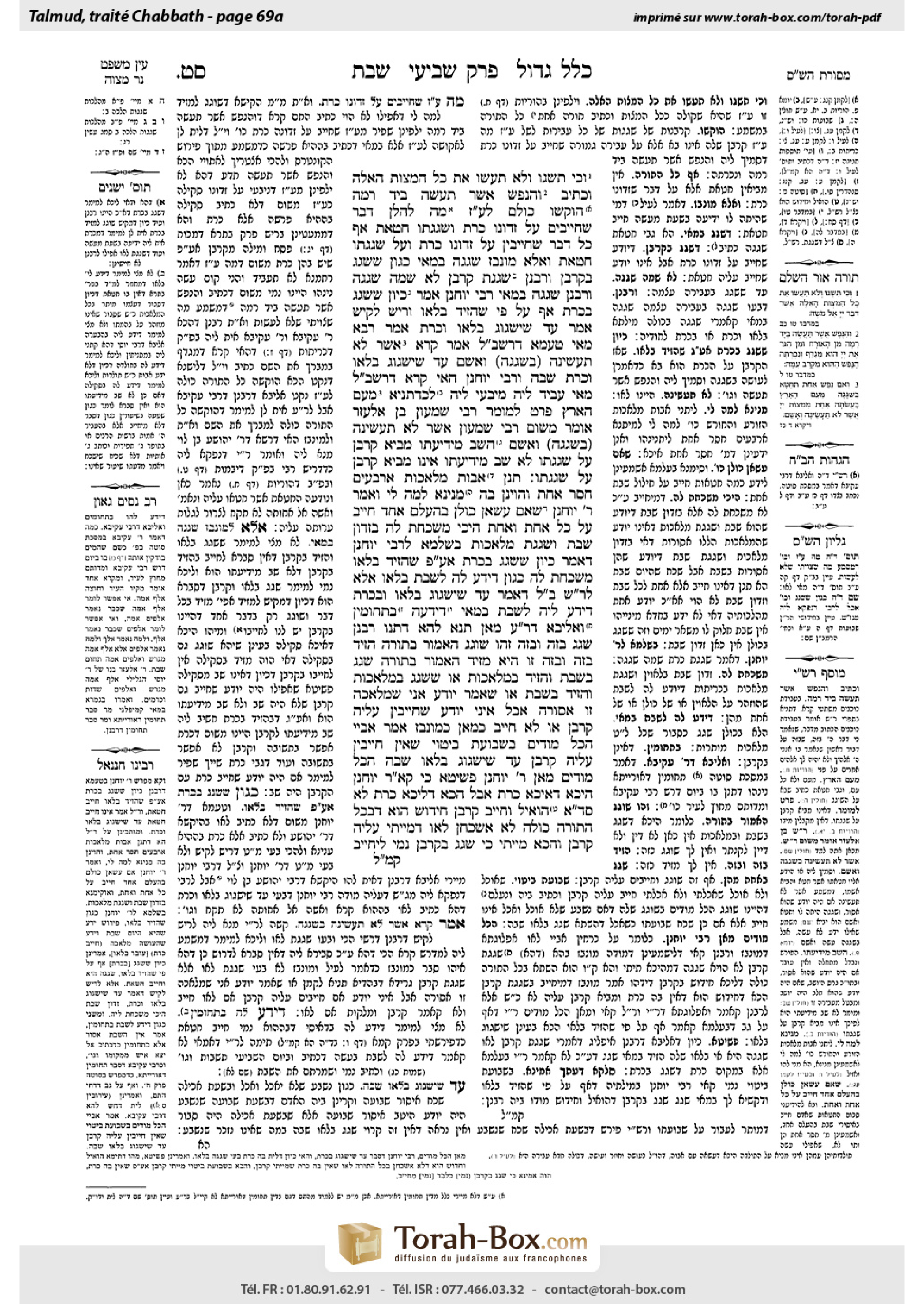
Shabbat 69a: Talmud study for Daf Yomi
Daf Yomi is the daily study of one Talmud folio. Explore 37 tractates with scans, Hebrew text, Sefaria English and AI-generated French translations where annotated.
Passage selection and English or AI-generated French translation are available where the scan has annotations. Daf Study is independent of Torah-Box and Sefaria.
Browse Shabbat · שבת · All tractatesShabbat 69a text and translations
This page of Shabbat includes the Aramaic text, an English translation and an AI-generated French translation, alongside the scan above.
שבת ס״ט א · Aramaic and Hebrew text
״וְכִי תִשְׁגּוּ וְלֹא תַעֲשׂוּ אֵת כׇּל הַמִּצְוֹת הָאֵלֶּה״, וּכְתִיב: ״וְהַנֶּפֶשׁ אֲשֶׁר תַּעֲשֶׂה בְּיָד רָמָה״. הוּקְשׁוּ כּוּלָּם לַעֲבוֹדָה זָרָה: מָה לְהַלָּן דָּבָר שֶׁחַיָּיבִים עַל זְדוֹנוֹ כָּרֵת וְשִׁגְגָתוֹ חַטָּאת, אַף כׇּל דָּבָר שֶׁחַיָּיבִין עַל זְדוֹנוֹ כָּרֵת וְעַל שִׁגְגָתוֹ חַטָּאת.
וְאֶלָּא מוֹנְבַּז, שְׁגָגָה בְּמַאי? כְּגוֹן שֶׁשָּׁגַג בְּקׇרְבָּן. וְרַבָּנַן: שִׁגְגַת קׇרְבָּן לֹא שְׁמָהּ שְׁגָגָה.
וְרַבָּנַן, שְׁגָגָה בְּמַאי? רַבִּי יוֹחָנָן אָמַר: כֵּיוָן שֶׁשָּׁגַג בְּכָרֵת, אַף עַל פִּי שֶׁהֵזִיד בְּלָאו. וְרֵישׁ לָקִישׁ אָמַר עַד שֶׁיִּשְׁגּוֹג בְּלָאו וְכָרֵת. אָמַר רָבָא: מַאי טַעְמָא דְּרַבִּי שִׁמְעוֹן בֶּן לָקִישׁ — אָמַר קְרָא: ״אֲשֶׁר לֹא תֵעָשֶׂינָה בִּשְׁגָגָה וְאָשֵׁם״ — עַד שֶׁיִּשְׁגּוֹג בְּלָאו וְכָרֵת שֶׁבָּהּ.
וְרַבִּי יוֹחָנָן, הַאי קְרָא דְּרַבִּי שִׁמְעוֹן בֶּן לָקִישׁ מַאי עָבֵיד לֵיהּ? מִיבְּעֵי לֵיהּ לְכִדְתַנְיָא: ״מֵעַם הָאָרֶץ״ — פְּרָט לִמְשׁוּמָּד. רַבִּי שִׁמְעוֹן בֶּן אֶלְעָזָר אוֹמֵר מִשּׁוּם רַבִּי שִׁמְעוֹן: ״אֲשֶׁר לֹא תֵעָשֶׂינָה בִּשְׁגָגָה וְאָשֵׁם״. הַשָּׁב מִידִיעָתוֹ — מֵבִיא קׇרְבָּן עַל שִׁגְגָתוֹ, לֹא שָׁב מִידִיעָתוֹ — אֵינוֹ מֵבִיא קׇרְבָּן עַל שִׁגְגָתוֹ.
תְּנַן: אֲבוֹת מְלָאכוֹת אַרְבָּעִים חָסֵר אַחַת. וְהָוֵינַן בַּהּ: מִנְיָנָא לְמָה לִי? וְאָמַר רַבִּי יוֹחָנָן: שֶׁאִם עֲשָׂאָן כּוּלָּן בְּהֶעְלֵם אֶחָד — חַיָּיב עַל כׇּל אַחַת וְאַחַת. הֵיכִי מַשְׁכַּחַתְּ לַהּ — בִּזְדוֹן שַׁבָּת וְשִׁגְגַת מְלָאכוֹת.
בִּשְׁלָמָא לְרַבִּי יוֹחָנָן, דְּאָמַר כֵּיוָן שֶׁשָּׁגַג בְּכָרֵת אַף עַל פִּי שֶׁהֵזִיד בְּלָאו — מַשְׁכַּחַתְּ לַהּ כְּגוֹן דְּיָדַע לֵהּ לְשַׁבָּת בְּלָאו. אֶלָּא לְרַבִּי שִׁמְעוֹן בֶּן לָקִישׁ, דְּאָמַר עַד שֶׁיִּשְׁגּוֹג בְּלָאו וּבְכָרֵת — דְּיָדַע לֵיהּ לְשַׁבָּת בְּמַאי? דְּיָדְעֵהּ בִּתְחוּמִין, וְאַלִּיבָּא דְּרַבִּי עֲקִיבָא.
מַאן תְּנָא לְהָא דְּתָנוּ רַבָּנַן: שָׁגַג בָּזֶה וּבָזֶה — זֶהוּ שׁוֹגֵג הָאָמוּר בַּתּוֹרָה. הֵזִיד בָּזֶה וּבָזֶה — זֶהוּ מֵזִיד הָאָמוּר בַּתּוֹרָה. שָׁגַג בְּשַׁבָּת וְהֵזִיד בִּמְלָאכוֹת, אוֹ שֶׁשָּׁגַג בִּמְלָאכוֹת וְהֵזִיד בְּשַׁבָּת, אוֹ שֶׁאָמַר: יוֹדֵעַ אֲנִי שֶׁמְּלָאכָה זוֹ אֲסוּרָה, אֲבָל אֵינִי יוֹדֵעַ שֶׁחַיָּיבִין עָלֶיהָ קׇרְבָּן אוֹ לֹא — חַיָּיב. כְּמַאן — כְּמוֹנְבַּז.
אָמַר אַבָּיֵי: הַכֹּל מוֹדִים בִּשְׁבוּעַת בִּיטּוּי, שֶׁאֵין חַיָּיבִין עָלֶיהָ קׇרְבָּן עַד שֶׁיִּשְׁגּוֹג בְּלָאו שֶׁבָּהּ. ״הַכֹּל מוֹדִים״, מַאן — רַבִּי יוֹחָנָן. פְּשִׁיטָא, כִּי קָאָמַר רַבִּי יוֹחָנָן, הֵיכָא דְּאִיכָּא כָּרֵת, אֲבָל הָכָא דְּלֵיכָּא כָּרֵת — לָא!
סָלְקָא דַּעְתָּךְ אָמֵינָא, הוֹאִיל וְחַיָּיב קׇרְבָּן — חִידּוּשׁ הוּא, דִּבְכָל הַתּוֹרָה כּוּלָּהּ לָא אַשְׁכְּחַן לָאו דְּמַיְיתֵי עֲלֵיהּ קׇרְבָּן, וְהָכָא מַיְיתֵי — כִּי שָׁגַג בְּקׇרְבָּן נָמֵי לִיחַיַּיב,
Shabbat 69a · English translation
“And if you err, and do not perform all these commandments that God spoke to Moses” (Numbers 15:22). The Sages understood this verse as referring specifically to the laws of idolatry. And it is written: “And the person who acts with a high hand, he blasphemes God and that soul shall be cut off from the midst of his people” (Numbers 15:30), from which we learn that all the mitzvot are derived from this juxtaposition to idolatry. Just as there, with regard to idolatry, the reference is to a matter which, for its intentional violation, one is liable to be punished with karet, as it is stated: “And that soul shall be cut off,” and for its unwitting violation one is liable to bring a sin-offering; so too, any matter that for its intentional violation one is liable to be punished with karet, for its unwitting violation one is liable to bring a sin-offering.
The Gemara asks: However, according to Munbaz, who holds that included in the category of an unwitting sinner is one who at the time of action was aware that it was prohibited; if he were fully aware, in what sense was his action unwitting? The Gemara answers: It is referring to a case where he was unwitting with regard to the sacrifice. He was aware that he was committing a transgression for which one is liable to be punished with karet when performed intentionally; however, he was unaware that he would be liable to bring a sin-offering if he performed the transgression unwittingly. Since he was not aware of all punishments and forms of atonement associated with that transgression, he is considered an unwitting sinner and is liable to bring a sin-offering. The Gemara asks: And what do the Rabbis who disagree with Munbaz hold? They hold: Unwitting with regard to a sacrifice is not considered unwitting.
The Gemara asks: And in the opinion of the Rabbis, lack of awareness with regard to what aspects of the prohibition renders the action unwitting? Rabbi Yoḥanan said: It is an unwitting transgression since he was unwitting with regard to the fact that the punishment for his transgression is karet, even though he was aware that his action was in violation of a Torah prohibition, and he performed the transgression intentionally. And Reish Lakish said that according to the Rabbis it is not considered unwitting until he was unwitting with regard to both the prohibition and karet, i.e., he was unaware that his action was prohibited by Torah law. Rava said: What is the reason for the opinion of Rabbi Shimon ben Lakish? The verse said: “And if one soul shall sin by mistake from the common people, by performing one of God’s commandments that may not be done, and he becomes guilty” (Leviticus 4:27), indicating that it is not considered unwitting until he was unwitting with regard to the prohibition and its concomitant karet. The verse indicates that the individual was unaware that he violated “one of the commandments that may not be done,” i.e., that there is a Torah prohibition with regard to that action.
The Gemara asks: And what does Rabbi Yoḥanan do with that verse cited as proof by Rabbi Shimon ben Lakish? The Gemara answers: He needs it for that which was taught in a baraita: The phrase: “From the common people” (Leviticus 4:27) teaches that only some sinners, not all, bring sacrifices for their unwitting sins. It comes to exclude an apostate. When an apostate sins unwittingly, he is under no obligation to bring a sin-offering even after he repents. Rabbi Shimon ben Elazar says in the name of Rabbi Shimon: This halakha is derived from the phrase in that verse: “That may not be done, and he becomes guilty.” One who repents due to his awareness, i.e., one who repents as soon as he becomes aware that he performed a transgression, brings a sacrifice for his unwitting transgression. However, one who does not repent due to his awareness that he sinned, e.g., an apostate who continues to sin even after he becomes aware that he committed a transgression, does not bring an offering for his unwitting action. Rabbi Yoḥanan understood the verse in accordance with the opinion of Rabbi Shimon ben Elazar.
The Gemara cites proof from what we learned in a mishna: The number of primary categories of prohibited labors on Shabbat is forty-less-one, which the mishna proceeds to list. And we discussed this mishna: Why do I need this tally of forty-less-one? Isn’t merely listing the prohibited labors sufficient? And Rabbi Yoḥanan said: The tally was included to teach that if he performed all of the prohibited labors in the course of one lapse of awareness during which he was unaware of the prohibition involved, he is liable for each and every one. Therefore, the mishna indicated that one could conceivably be liable to bring thirty-nine sin-offerings. Under what circumstances can you find a case where one would be liable for unwittingly violating all thirty-nine labors? It must be in a case where with regard to Shabbat his actions were intentional, as he was aware that it was Shabbat; and with regard to the prohibited labors his actions were unwitting, as he was unaware that these labors are prohibited on Shabbat.
Granted, according to Rabbi Yoḥanan, who said: Once he was unwitting with regard to the fact that the punishment for his transgression is karet, even though he was aware that his action was in violation of a Torah prohibition, and he performed the transgression intentionally, he is considered to have sinned unwittingly, you find that possibility in a case where he was aware that performing labor on Shabbat involves violation of a Torah prohibition, but he was unaware that the punishment for violating that prohibition is karet. However, according to Rabbi Shimon ben Lakish, who said: It is not considered unwitting until he was unwitting with regard to both the prohibition and karet, the result is that he is completely unaware of all the prohibited labors of Shabbat. If so, when Rabbi Yoḥanan said that the case where one would be liable to bring thirty-nine sin-offerings is one where with regard to Shabbat, his actions were intentional as he was aware that it was Shabbat, the question arises: With regard to what aspect of Shabbat was he aware? If he was completely unaware of all the labors prohibited on Shabbat, in what sense were his actions intentional with regard to Shabbat? The Gemara answers: He was aware of the halakhot of the prohibition of Shabbat boundaries, in accordance with the opinion of Rabbi Akiva. According to Rabbi Akiva, the prohibition to go beyond a certain distance outside the city limits on Shabbat is by Torah law and not merely a rabbinic decree.
The Gemara asks: Who is the tanna who taught this baraita? As the Sages taught: If one acted unwittingly with regard to both this, the fact that it is Shabbat, and that, the specific prohibited labors, that is the case of unwitting transgression stated in the Torah. If one acted intentionally with regard to both this and that, that is the case of intentional transgression stated in the Torah. If one acted unwittingly with regard to Shabbat and intentionally with regard to the labors, i.e., he forgot that it was Shabbat, but he was aware that those labors are prohibited when it is Shabbat; or if one acted unwittingly with regard to the labors and intentionally with regard to Shabbat, i.e., he was unaware that these labors are prohibited, but he was aware that labor is prohibited on Shabbat, or, even if he said: I know that this labor is prohibited on Shabbat; however, I do not know whether or not one is liable to bring a sacrifice for its performance, he is liable to bring a sin-offering like anyone who sins unwittingly. In accordance with whose opinion is this baraita? It is in accordance with the opinion of Munbaz, who holds that one is considered an unwitting sinner even in a case where he was unwitting only with regard to the sacrifice.
Abaye said: Everyone agrees with regard to an oath on a statement, a case where one swore to prohibit or to obligate himself to perform an action, that the halakha is as follows: If he violates his oath he is only liable to bring an offering if he was unwitting with regard to its prohibition, i.e., he was unaware that it is prohibited by Torah law to violate an oath. The Gemara asks: To whose opinion is Abaye referring in the phrase: Everyone agrees? Certainly, it is the opinion of Rabbi Yoḥanan with regard to the opinion of the Rabbis in their dispute with Munbaz. Even though Rabbi Yoḥanan generally holds that the fact that one is unwitting with regard to karet is sufficient to render his action unwitting, the case of an oath is different. The Gemara asks: In the case of an oath, it is obvious that he would agree. When Rabbi Yoḥanan says that one need not be unwitting with regard to the prohibition, it is in a case where there is a prohibition punishable by karet; however, here, where there is no punishment of karet, Rabbi Yoḥanan would not say so. Obviously, he agrees that one must be unwitting with regard to the prohibition. There appears to be nothing new in Abaye’s statement.
The Gemara explains: It might enter your mind to say the following: Since the obligation to bring an offering in the case of the oath is a novel halakha, as throughout the whole Torah in its entirety we do not find a prohibition for whose unwitting violation one is liable to bring an offering and for whose intentional violation is not punishable by karet; and here, one is liable to bring an offering for its unwitting violation, I might have said that if he was unwitting, i.e., unaware that he would be obligated, with regard to the offering, let him be liable also according to the Rabbis, who disagree with Munbaz.
Shabbat 69a · Traduction française (IA)
« Si vous commettez une erreur et n’accomplissez pas tous ces commandements que Dieu a énoncés à Moïse » (Nombres 15:22). Les Sages ont compris que ce verset se rapporte spécifiquement aux lois de l’idolâtrie. Il est également écrit : « Mais celui qui agit avec arrogance blasphème Dieu, et cette personne sera retranchée du sein de son peuple » (Nombres 15:30). Nous apprenons ainsi que toutes les mitsvot sont déduites de ce rapprochement avec l’idolâtrie. De même que, dans le cas de l’idolâtrie, il s’agit d’une faute dont la transgression volontaire est passible de karet, comme il est dit : « cette personne sera retranchée », et dont la transgression involontaire oblige à apporter un sacrifice expiatoire, de même, pour toute faute dont la transgression volontaire est passible de karet, la transgression involontaire oblige à apporter un sacrifice expiatoire.
La Guemara demande : Cependant, selon Munbaz, qui considère qu’entre dans la catégorie du pécheur involontaire celui qui, au moment d’agir, savait que son acte était interdit, en quel sens son acte était-il involontaire s’il en avait pleinement conscience ? La Guemara répond : Il s’agit d’un cas où il ignorait l’obligation d’apporter un sacrifice. Il savait qu’il commettait une transgression passible de karet lorsqu’elle est accomplie volontairement ; cependant, il ignorait qu’il devrait apporter un sacrifice expiatoire s’il commettait cette transgression involontairement. Comme il ne connaissait pas toutes les sanctions et les modalités d’expiation associées à cette transgression, il est considéré comme un pécheur involontaire et doit apporter un sacrifice expiatoire. La Guemara demande : Et que pensent les rabbins qui sont en désaccord avec Munbaz ? Ils considèrent qu’ignorer l’obligation d’apporter un sacrifice ne constitue pas une ignorance qui rend l’acte involontaire.
La Guemara demande : Selon les rabbins, l’ignorance de quels aspects de l’interdit rend-elle l’acte involontaire ? Rabbi Yoḥanan dit qu’il s’agit d’une transgression involontaire parce que l’intéressé ignorait que la sanction de sa transgression était le karet, bien qu’il sût que son acte enfreignait une interdiction de la Torah et qu’il ait commis la transgression volontairement. Reish Lakish dit que, selon les rabbins, l’acte n’est considéré comme involontaire que si l’intéressé ignorait à la fois l’interdit et le karet, c’est-à-dire s’il ne savait pas que son acte était interdit par la Torah. Rava dit : Quelle est la raison de l’opinion de Rabbi Shimon ben Lakish ? Le verset dit : « Si une personne du peuple commet involontairement une faute en accomplissant l’un des commandements de Dieu qui ne doivent pas être accomplis, et qu’elle se rend coupable » (Lévitique 4:27), ce qui indique que l’acte n’est considéré comme involontaire que si elle ignorait l’interdit et le karet qui lui est associé. Le verset indique que la personne ignorait qu’elle avait transgressé « l’un des commandements qui ne doivent pas être accomplis », c’est-à-dire qu’une interdiction de la Torah s’applique à cet acte.
La Guemara demande : Et que fait Rabbi Yoḥanan du verset cité comme preuve par Rabbi Shimon ben Lakish ? La Guemara répond : Il en a besoin pour ce qui a été enseigné dans une baraïta : l’expression « du peuple » (Lévitique 4:27) enseigne que seuls certains pécheurs, et non tous, apportent des sacrifices pour leurs fautes involontaires. Elle vient exclure l’apostat. Lorsqu’un apostat commet involontairement une faute, il n’est pas tenu d’apporter un sacrifice expiatoire, même après s’être repenti. Rabbi Shimon ben Elazar dit au nom de Rabbi Shimon : Cette halakha est déduite de l’expression du verset : « qui ne doivent pas être accomplis, et qu’il se rend coupable ». Celui qui se repent après avoir pris conscience de sa faute, c’est-à-dire qui se repent dès qu’il apprend qu’il a commis une transgression, apporte un sacrifice pour sa transgression involontaire. En revanche, celui qui ne se repent pas après avoir pris conscience de sa faute, par exemple un apostat qui continue à pécher même après avoir appris qu’il a commis une transgression, n’apporte pas de sacrifice pour son acte involontaire. Rabbi Yoḥanan comprend le verset conformément à l’opinion de Rabbi Shimon ben Elazar.
La Guemara cite à l’appui ce que nous avons appris dans une Michna : les catégories principales de travaux interdits pendant Chabbat sont au nombre de trente-neuf, et la Michna les énumère ensuite. Nous avons discuté cette Michna : pourquoi faut-il ce décompte de trente-neuf ? Ne suffit-il pas d’énumérer les travaux interdits ? Rabbi Yoḥanan a dit : Ce décompte a été inclus pour enseigner que si quelqu’un accomplit tous les travaux interdits au cours d’une seule période d’inattention, durant laquelle il ignorait l’interdit en cause, il est passible d’un sacrifice pour chacun d’eux. La Michna indique donc qu’on pourrait, en théorie, être tenu d’apporter trente-neuf sacrifices expiatoires. Dans quelles circonstances peut-on trouver un cas où quelqu’un serait tenu d’apporter un sacrifice pour la transgression involontaire de chacun des trente-neuf travaux ? Il faut qu’il s’agisse d’un cas où, s’agissant de Chabbat, ses actes étaient volontaires, car il savait que c’était Chabbat, tandis que, s’agissant des travaux interdits, ses actes étaient involontaires, car il ignorait que ces travaux étaient interdits pendant Chabbat.
Cela se comprend selon Rabbi Yoḥanan, qui a dit que, dès lors que l’intéressé ignorait que la sanction de sa transgression était le karet, bien qu’il sût que son acte enfreignait une interdiction de la Torah et qu’il ait commis la transgression volontairement, il est considéré comme ayant péché involontairement : on peut envisager le cas où il savait qu’accomplir un travail pendant Chabbat enfreignait une interdiction de la Torah, mais ignorait que la transgression de cette interdiction était passible de karet. En revanche, selon Rabbi Shimon ben Lakish, qui a dit que l’acte n’est considéré comme involontaire que si l’intéressé ignorait à la fois l’interdit et le karet, il en résulte qu’il ignorait complètement tous les travaux interdits pendant Chabbat. Dans ce cas, lorsque Rabbi Yoḥanan dit que la situation où quelqu’un serait tenu d’apporter trente-neuf sacrifices expiatoires est celle où, s’agissant de Chabbat, ses actes étaient volontaires puisqu’il savait que c’était Chabbat, la question se pose : quel aspect de Chabbat connaissait-il ? S’il ignorait complètement tous les travaux interdits pendant Chabbat, en quel sens ses actes étaient-ils volontaires s’agissant de Chabbat ? La Guemara répond : Il connaissait les halakhot de l’interdit des limites du Chabbat, conformément à l’opinion de Rabbi Akiva. Selon Rabbi Akiva, l’interdit de dépasser une certaine distance au-delà des limites de la ville pendant Chabbat relève de la Torah et n’est pas simplement un décret rabbinique.
La Guemara demande : Qui est le tanna qui a enseigné cette baraïta ? Car les Sages ont enseigné : Si quelqu’un a agi involontairement sur ces deux points, à savoir le fait que ce soit Chabbat et les travaux interdits concernés, c’est le cas de transgression involontaire énoncé dans la Torah. S’il a agi volontairement sur ces deux points, c’est le cas de transgression volontaire énoncé dans la Torah. S’il a agi involontairement s’agissant de Chabbat et volontairement s’agissant des travaux, c’est-à-dire s’il a oublié que c’était Chabbat, mais savait que ces travaux sont interdits quand c’est Chabbat ; ou s’il a agi involontairement s’agissant des travaux et volontairement s’agissant de Chabbat, c’est-à-dire s’il ignorait que ces travaux sont interdits, mais savait qu’il est interdit de travailler pendant Chabbat ; ou même s’il a dit : « Je sais que ce travail est interdit pendant Chabbat ; toutefois, je ne sais pas si son accomplissement oblige ou non à apporter un sacrifice », il doit apporter un sacrifice expiatoire, comme quiconque pèche involontairement. Selon l’opinion de qui cette baraïta a-t-elle été enseignée ? Selon l’opinion de Munbaz, qui considère qu’on est un pécheur involontaire même lorsqu’on ignorait uniquement l’obligation d’apporter un sacrifice.
Abaye dit : Tout le monde convient, au sujet d’un serment portant sur une déclaration — un cas où quelqu’un a juré de s’interdire une action ou de s’obliger à l’accomplir —, que la halakha est la suivante : s’il viole son serment, il n’est tenu d’apporter un sacrifice que s’il ignorait l’interdit, c’est-à-dire qu’il ne savait pas qu’il est interdit par la Torah de violer un serment. La Guemara demande : À l’opinion de qui Abaye fait-il référence en disant « tout le monde convient » ? Il s’agit certainement de l’opinion de Rabbi Yoḥanan concernant celle des rabbins dans leur désaccord avec Munbaz. Bien que Rabbi Yoḥanan considère généralement qu’ignorer le karet suffit à rendre l’acte involontaire, le cas du serment est différent. La Guemara demande : Dans le cas d’un serment, il est évident que Rabbi Yoḥanan serait d’accord. Lorsqu’il dit qu’il n’est pas nécessaire d’ignorer l’interdit, il s’agit d’un cas où l’interdit est passible de karet ; mais ici, où il n’y a pas de sanction de karet, Rabbi Yoḥanan ne dirait pas cela. Il est évident qu’il convient qu’il faille ignorer l’interdit. La déclaration d’Abaye ne semble donc rien apporter de nouveau.
La Guemara explique : On pourrait penser ceci : puisque l’obligation d’apporter un sacrifice dans le cas du serment constitue une halakha inédite — car, dans toute la Torah, nous ne trouvons aucun interdit dont la transgression involontaire oblige à apporter un sacrifice alors que la transgression volontaire n’est pas passible de karet — et qu’ici, la transgression involontaire oblige à apporter un sacrifice, on aurait pu dire que si l’intéressé ignorait, c’est-à-dire s’il ne savait pas qu’il serait tenu d’apporter un sacrifice, il serait lui aussi passible d’un sacrifice selon les rabbins, qui sont en désaccord avec Munbaz.
Traduction française générée par IA à partir de l’édition anglaise de Sefaria. Vérifie toujours un passage avec le texte source.
Text from Sefaria: William Davidson Edition - Vocalized Aramaic (CC BY NC); William Davidson Edition - English (CC BY NC).