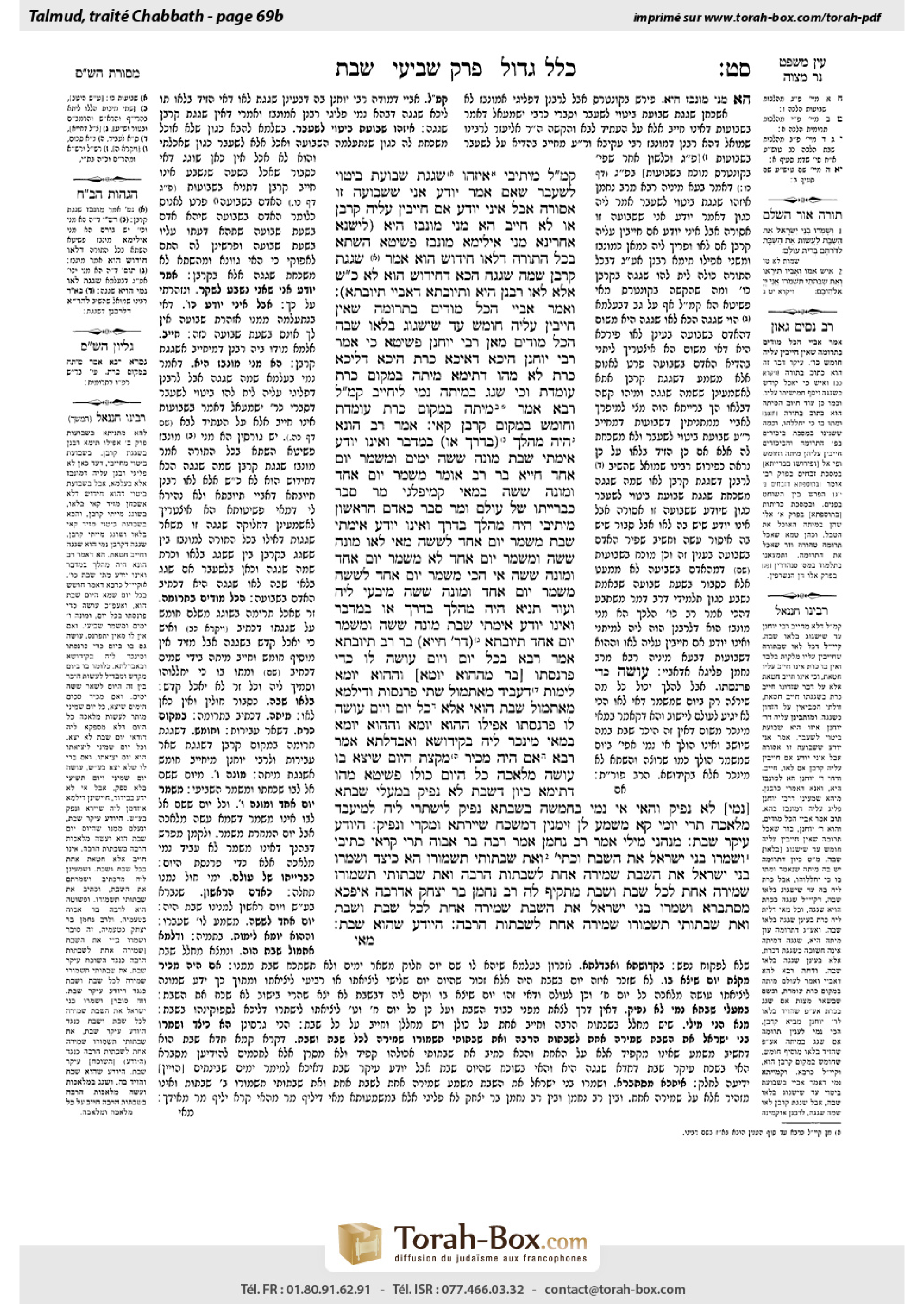
Shabbat 69b: Talmud study for Daf Yomi
Daf Yomi is the daily study of one Talmud folio. Explore 37 tractates with scans, Hebrew text, Sefaria English and AI-generated French translations where annotated.
Passage selection and English or AI-generated French translation are available where the scan has annotations. Daf Study is independent of Torah-Box and Sefaria.
Browse Shabbat · שבת · All tractatesShabbat 69b text and translations
This page of Shabbat includes the Aramaic text, an English translation and an AI-generated French translation, alongside the scan above.
שבת ס״ט ב · Aramaic and Hebrew text
קָא מַשְׁמַע לַן. מֵיתִיבִי: אֵיזוֹהִי שִׁגְגַת שְׁבוּעַת בִּיטּוּי לְשֶׁעָבַר — שֶׁאִם אָמַר ״יוֹדֵעַ אֲנִי שֶׁשְּׁבוּעָה זוֹ אֲסוּרָה, אֲבָל אֵינִי יוֹדֵעַ אִם חַיָּיבִין עָלֶיהָ קׇרְבָּן אוֹ לֹא״ — חַיָּיב! הָא מַנִּי? — מוֹנְבַּז הִיא.
(לִישָּׁנָא אַחֲרִינָא: מַנִּי? אִילֵּימָא מוֹנְבַּז — פְּשִׁיטָא, הַשְׁתָּא בְּכׇל הַתּוֹרָה דְּלָאו חִידּוּשׁ הוּא אָמַר שִׁגְגַת קׇרְבָּן שְׁמָהּ שְׁגָגָה, הָכָא דְּחִידּוּשׁ הוּא — לֹא כׇּל שֶׁכֵּן?! אֶלָּא לָאו רַבָּנַן הִיא, וּתְיוּבְתָּא דְאַבָּיֵי! תְּיוּבְתָּא.)
וְאָמַר אַבָּיֵי: הַכֹּל מוֹדִים בִּתְרוּמָה שֶׁאֵין חַיָּיבִין עָלֶיהָ חוֹמֶשׁ עַד שֶׁיִּשְׁגּוֹג בְּלָאו שֶׁבָּהּ. ״הַכֹּל מוֹדִים״ מַאן? — רַבִּי יוֹחָנָן. פְּשִׁיטָא! כִּי אָמַר רַבִּי יוֹחָנָן הֵיכָא דְּאִיכָּא כָּרֵת, הֵיכָא דְּלֵיכָּא כָּרֵת לָא! מַהוּ דְּתֵימָא: מִיתָה בִּמְקוֹם כָּרֵת עוֹמֶדֶת, וְכִי שָׁגַג בְּמִיתָה נָמֵי לִיחַיַּיב — קָא מַשְׁמַע לַן. רָבָא אָמַר: מִיתָה בִּמְקוֹם כָּרֵת עוֹמֶדֶת וְחוֹמֶשׁ בִּמְקוֹם קׇרְבָּן קָאֵי.
אָמַר רַב הוּנָא: הָיָה מְהַלֵּךְ בַּדֶּרֶךְ אוֹ בַּמִּדְבָּר וְאֵינוֹ יוֹדֵעַ אֵימָתַי שַׁבָּת, מוֹנֶה שִׁשָּׁה יָמִים וּמְשַׁמֵּר יוֹם אֶחָד. חִיָּיא בַּר רַב אוֹמֵר: מְשַׁמֵּר יוֹם אֶחָד, וּמוֹנֶה שִׁשָּׁה. בְּמַאי קָמִיפַּלְגִי — מָר סָבַר כִּבְרִיָּיתוֹ שֶׁל עוֹלָם, וּמָר סָבַר כְּאָדָם הָרִאשׁוֹן. מֵיתִיבִי: הָיָה מְהַלֵּךְ בַּדֶּרֶךְ וְאֵינוֹ יוֹדֵעַ אֵימָתַי שַׁבָּת מְשַׁמֵּר יוֹם אֶחָד לְשִׁשָּׁה. מַאי לָאו, מוֹנֶה שִׁשָּׁה וּמְשַׁמֵּר יוֹם אֶחָד?! לָא, מְשַׁמֵּר יוֹם אֶחָד וּמוֹנֶה שִׁשָּׁה.
אִי הָכִי ״מְשַׁמֵּר יוֹם אֶחָד לְשִׁשָּׁה״ — ״מְשַׁמֵּר יוֹם אֶחָד וּמוֹנֶה שִׁשָּׁה״ מִיבְּעֵי לֵיהּ. וְעוֹד, תַּנְיָא: הָיָה מְהַלֵּךְ בַּדֶּרֶךְ אוֹ בַּמִּדְבָּר וְאֵינוֹ יוֹדֵעַ אֵימָתַי שַׁבָּת, מוֹנֶה שִׁשָּׁה וּמְשַׁמֵּר יוֹם אֶחָד, תְּיוּבְתָּא דְּרַבִּי חִיָּיא בַּר רַב! תְּיוּבְתָּא.
אָמַר רָבָא: בְּכָל יוֹם וָיוֹם עוֹשֶׂה לוֹ כְּדֵי פַרְנָסָתוֹ [בַּר מֵהָהוּא יוֹמָא]. וְהָהוּא יוֹמָא לֵימוּת?! דְּעָבֵיד מֵאֶתְמוֹל שְׁתֵּי פַרְנָסוֹת. וְדִילְמָא מֵאֶתְמוֹל שַׁבָּת הֲוַאי! אֶלָּא כָּל יוֹם וָיוֹם עוֹשֶׂה לוֹ פַּרְנָסָתוֹ, אֲפִילּוּ הָהוּא יוֹמָא. וְהָהוּא יוֹמָא בְּמַאי מִינְּכַר לֵיהּ? בְּקִידּוּשָׁא וְאַבְדָּלְתָּא.
אָמַר רָבָא: אִם הָיָה מַכִּיר מִקְצָת הַיּוֹם שֶׁיָּצָא בּוֹ, עוֹשֶׂה מְלָאכָה כׇּל הַיּוֹם כּוּלּוֹ. פְּשִׁיטָא! מַהוּ דְתֵימָא: כֵּיוָן דְּשַׁבָּת לָא נָפֵיק, בְּמַעֲלֵי שַׁבְּתָא [נָמֵי] לָא נָפֵיק. וְהַאי, אִי נָמֵי בְּחַמְשָׁה בְּשַׁבְּתָא נָפֵיק — לִישְׁתְּרֵי לֵיהּ לְמֶיעְבַּד מְלָאכָה תְּרֵי יוֹמֵי — קָא מַשְׁמַע לַן זִימְנִין דְּמַשְׁכַּח שְׁיָּירְתָּא וּמִקְּרֵי וְנָפֵיק.
הַיּוֹדֵעַ עִיקַּר שַׁבָּת: מְנָהָנֵי מִילֵּי? אָמַר רַב נַחְמָן אָמַר רַבָּה בַּר אֲבוּהּ: תְּרֵי קְרָאֵי כְּתִיבִי: ״וְשָׁמְרוּ בְנֵי יִשְׂרָאֵל אֶת הַשַּׁבָּת״, וּכְתִיב: ״וְאֶת שַׁבְּתֹתַי תִּשְׁמֹרוּ״. הָא כֵּיצַד? ״וְשָׁמְרוּ בְנֵי יִשְׂרָאֵל אֶת הַשַּׁבָּת״ — שְׁמִירָה אַחַת לְשַׁבָּתוֹת הַרְבֵּה. ״וְאֶת שַׁבְּתֹתַי תִּשְׁמֹרוּ״ — שְׁמִירָה אַחַת לְכׇל שַׁבָּת וְשַׁבָּת.
מַתְקִיף לַהּ רַב נַחְמָן בַּר יִצְחָק: אַדְּרַבָּה, אִיפְּכָא מִסְתַּבְּרָא: ״וְשָׁמְרוּ בְנֵי יִשְׂרָאֵל אֶת הַשַּׁבָּת״ — שְׁמִירָה אַחַת לְכׇל שַׁבָּת וְשַׁבָּת. ״וְאֶת שַׁבְּתֹתַי תִּשְׁמֹרוּ״ — שְׁמִירָה אַחַת לְשַׁבָּתוֹת הַרְבֵּה.
הַיּוֹדֵעַ שֶׁהוּא שַׁבָּת.
Shabbat 69b · English translation
Therefore, Abaye teaches us that this is not so. The Gemara raises an objection from a baraita: What is an unwitting violation of an oath on a statement relating to the past? What is an example of one who unwittingly swore falsely with regard to an incident that occurred in the past? It cannot be a case where he forgot the incident, as in that case he is exempt from bringing an offering. It is a case where if he said: I know that taking this false oath is prohibited, but I do not know whether or not one is liable to bring an offering for swearing falsely, he is liable to bring an offering for an unwitting transgression. Apparently, with regard to an oath on a statement, unwitting with regard to the sacrifice renders the action unwitting. The Gemara rejects this: In accordance with whose opinion is this mishna? It is the opinion of Munbaz. In his opinion, one who commits a transgression while unaware whether or not one is liable to bring an offering if he performs that transgression unwittingly is considered to have performed the transgression unwittingly.
There is another version of the discussion of Abaye’s statement where, after quoting the halakha with regard to an oath on a statement, the question was raised: In accordance with whose opinion is this mishna? If you say it is in accordance with the opinion of Munbaz, that is obvious: Now, if throughout the entire Torah where there is no novelty in the obligation to bring an offering, he said that unwitting with regard to an offering is considered unwitting; here, where there is a novelty and the offering in the case of an oath on a statement is more significant than other sin-offerings, certainly unwitting with regard to the offering should be considered unwitting. Rather, is it not the opinion of the Rabbis, and this is a conclusive refutation of the opinion of Abaye? The Gemara concludes: Indeed, it is a conclusive refutation.
And Abaye said: Everyone agrees with regard to teruma that one is only liable to add a payment of one-fifth the value of the teruma for eating it unwittingly if he is unwitting with regard to its prohibition. The Gemara asks: To whose opinion is Abaye referring in the phrase: Everyone agrees? Certainly, it is the opinion of Rabbi Yoḥanan. Even though, in general, he holds that unwitting with regard to karet is sufficient to render the action unwitting, the case of teruma is different. The Gemara asks: In the case of teruma, it is obvious that he would agree. When Rabbi Yoḥanan says that one need not be unwitting with regard to the prohibition, it is in a case where there is a prohibition punishable by karet; however, here, where there is no punishment of karet, Rabbi Yoḥanan would not say so. The Gemara answers that nonetheless Abaye introduced a novel element: Lest you say that since one who intentionally eats teruma is subject to death at the hand of Heaven, perhaps death stands in place of karet. And where he was unwitting with regard to the punishment of death for this sin, he should also be liable to pay the added fifth as one who performed the transgression unwittingly because his case is analogous to one who is considered unwitting due to lack of awareness of karet. Therefore, Abaye teaches us that it is not so. Rava said: Indeed, death stands in place of karet and the added one-fifth stands in place of a sacrifice. One who is unwitting with regard to death at the hand of Heaven and the added fifth has the same legal status as one who is unwitting with regard to karet and an offering.
Rav Huna said: One who was walking along the way or in the desert, and he does not know when Shabbat occurs, he counts six days from the day that he realized that he lost track of Shabbat and then observes one day as Shabbat. Ḥiyya bar Rav says: He first observes one day as Shabbat and then he counts six weekdays. The Gemara explains: With regard to what do they disagree? One Sage, Rav Huna, held: It is like the creation of the world, weekdays followed by Shabbat. And one Sage, Ḥiyya bar Rav, held: It is like Adam, the first man, who was created on the sixth day. He observed Shabbat followed by the six days of the week. The Gemara raises an objection to the opinion of Ḥiyya bar Rav from a baraita: If a person was walking along the way and does not know when Shabbat occurs, he observes one day for every six. What, does this not mean that he counts six and then observes one day in accordance with the opinion of Rav Huna? The Gemara rejects this: No, it could also mean that he observes one day and then counts six.
The Gemara asks: If so, if that is what the baraita meant, why employ the phrase: He observes one day for six? It should have stated: He observes one day and counts six. And furthermore, it was taught in a baraita: If one was walking along the way or was in the desert, and he does not know when Shabbat occurs, he counts six days and observes one day. That is a conclusive refutation of the opinion of Rabbi Ḥiyya bar Rav. The Gemara concludes: Indeed, it is a conclusive refutation of the opinion of Ḥiyya bar Rav.
Rava said: The person who lost track of Shabbat and treats one day a week as Shabbat, each day he makes enough food to sustain himself, except for that day which he designated as Shabbat. The Gemara asks: And on that day let him die? Rather, it means that the day before he makes twice the amount of food that he prepared on the other days to sustain him for that day and the following day. The Gemara asks: And perhaps the day before was actually Shabbat? In that case, not only did he perform labor on Shabbat, but he also performed labor on Shabbat in preparation for a weekday. Rather, on each and every day he makes enough food to sustain himself for that day, including on that day that he designated as Shabbat. And if you ask: And how is that day which he designated as Shabbat distinguishable from the rest? It is distinguishable by means of the kiddush and the havdala that he recites on that day.
Rava said: If he had partial knowledge of the day on which he left, i.e., he does not recall what day of the week it was but he does recall the number of days that passed since he left, every week he can perform labor throughout the day of his departure, since he certainly did not leave his house on Shabbat. The Gemara asks: That is obvious, and what novel element was introduced here? The Gemara answers: Lest you say, since he did not leave on Shabbat, he also did not leave on Friday, and this person, even if he left on Thursday, should be permitted to perform labor for two days, the eighth day and the ninth day from his departure, the same day of the week that he left and the following day. Therefore, Rava teaches us that at times one finds a convoy and happens to leave on a journey even on Friday. Therefore, he is not permitted to perform labor on the day of the week following the day of his departure.
We learned in the mishna that there is a difference in halakha between one who knows the essence of Shabbat and one who does not know it. The Gemara asks: From where in the Torah are these matters derived? Rav Naḥman said that Rabba bar Avuh said: Two verses are written. One states: “And the children of Israel observed the Shabbat, to perform the Shabbat through their generations, an everlasting covenant” (Exodus 31:16). And it is written: “And you shall observe My Shabbatot and you shall revere My Sanctuary, I am God” (Leviticus 26:2). How is it that Shabbat is in the singular in one verse, while in the other it is in the plural [Shabbatot]? It should be understood as follows: “And the children of Israel observed the Shabbat”: One observance for multiple Shabbatot. If one commits several transgressions, in certain cases he is only liable to bring one sacrifice. “And you shall observe My Shabbatot”: One observance for each and every Shabbat. In certain cases, one is liable to bring a sin-offering for each time that he unwittingly desecrated Shabbat.
Rav Naḥman bar Yitzḥak strongly objects: On the contrary, the opposite is reasonable. “And the children of Israel observed the Shabbat”: One observance for each and every Shabbat. “And you shall observe My Shabbatot”: One observance for multiple Shabbatot. In any case, Rav Naḥman bar Yitzḥak also holds that the halakha of our mishna is derived from comparing and contrasting these two verses.
We learned in the mishna that there is a difference between one who is aware that the day is Shabbat and performs labor and one who forgets the essence of Shabbat and performs prohibited labors.
Shabbat 69b · Traduction française (IA)
Abaye nous enseigne donc qu’il n’en est pas ainsi. La Guemara soulève une objection à partir d’une baraïta : Qu’est-ce qu’une transgression involontaire d’un serment portant sur une déclaration relative au passé ? Quel est un exemple de quelqu’un qui a involontairement prêté un faux serment au sujet d’un événement passé ? Il ne peut s’agir d’un cas où il a oublié l’événement, car dans ce cas, il est dispensé d’apporter un sacrifice. Il s’agit d’un cas où il dit : « Je sais qu’il est interdit de prêter ce faux serment, mais j’ignore si l’on est ou non tenu d’apporter un sacrifice pour avoir prêté un faux serment. » Il est alors tenu d’apporter un sacrifice pour une transgression involontaire. Il semble donc que, dans le cas d’un serment portant sur une déclaration, l’ignorance concernant le sacrifice rende l’acte involontaire. La Guemara rejette cette conclusion : Selon l’opinion de qui cette Michna a-t-elle été formulée ? Selon celle de Munbaz. À son avis, celui qui commet une transgression sans savoir si l’on est ou non tenu d’apporter un sacrifice lorsqu’on la commet involontairement est considéré comme ayant commis la transgression involontairement.
Il existe une autre version de la discussion sur la déclaration d’Abaye. Après avoir cité la halakha concernant un serment portant sur une déclaration, on soulève la question suivante : Selon l’opinion de qui cette Michna a-t-elle été formulée ? Si tu dis qu’elle suit l’opinion de Munbaz, cela va de soi : si, dans toute la Torah, là où l’obligation d’apporter un sacrifice ne présente rien de nouveau, il considère que l’ignorance concernant le sacrifice équivaut à l’ignorance de la transgression, à plus forte raison ici, où il y a une particularité et où le sacrifice dans le cas d’un serment portant sur une déclaration a une portée plus importante que les autres sacrifices expiatoires, l’ignorance concernant le sacrifice doit certainement équivaloir à l’ignorance de la transgression. N’est-ce donc pas plutôt l’opinion des Rabbins ? Ce serait alors une réfutation décisive de l’opinion d’Abaye. La Guemara conclut : En effet, c’est une réfutation décisive.
Et Abaye a dit : Tout le monde s’accorde à dire que, pour la terouma, on n’est tenu de payer un cinquième de sa valeur pour l’avoir mangée involontairement que si l’on ignorait que cela était interdit. La Guemara demande : À l’opinion de qui Abaye fait-il référence par l’expression « tout le monde s’accorde » ? Il s’agit certainement de l’opinion de Rabbi Yoḥanan. Bien qu’en général il estime que l’ignorance concernant le retranchement suffit à rendre l’acte involontaire, le cas de la terouma est différent. La Guemara demande : Pour la terouma, il est évident qu’il serait d’accord. Lorsque Rabbi Yoḥanan dit qu’il n’est pas nécessaire d’ignorer l’interdiction, il parle d’un cas où l’interdiction est passible de retranchement ; ici, en revanche, où il n’y a pas de peine de retranchement, Rabbi Yoḥanan ne dirait pas cela. La Guemara répond que, néanmoins, Abaye apporte un élément nouveau : ne va pas croire que, puisque celui qui mange délibérément de la terouma est passible de mort par la main du Ciel, la mort puisse tenir lieu de retranchement. Celui qui ignorait qu’il encourait la peine de mort pour ce péché devrait alors aussi être tenu de payer le cinquième supplémentaire, comme celui qui a commis la transgression involontairement, puisque son cas est analogue à celui de quelqu’un considéré comme ayant agi involontairement en raison de son ignorance du retranchement. Abaye nous enseigne donc qu’il n’en est pas ainsi. Rava a dit : En effet, la mort tient lieu de retranchement, et le paiement du cinquième supplémentaire tient lieu de sacrifice. Celui qui ignore qu’il encourt la mort par la main du Ciel et le paiement du cinquième supplémentaire a le même statut que celui qui ignore qu’il encourt le retranchement et doit apporter un sacrifice.
Rav Houna a dit : Celui qui marche en chemin ou se trouve dans le désert et ne sait pas quand tombe Chabbat compte six jours à partir du jour où il s’est rendu compte qu’il avait perdu le compte des jours, puis observe un jour comme Chabbat. Ḥiyya bar Rav dit : Il observe d’abord un jour comme Chabbat, puis compte six jours de semaine. La Guemara explique : Sur quoi portent leurs divergences ? Un Sage, Rav Houna, estime qu’il faut suivre l’ordre de la création du monde : les jours de semaine, puis Chabbat. L’autre Sage, Ḥiyya bar Rav, estime qu’il faut suivre l’exemple d’Adam, le premier homme, qui fut créé le sixième jour. Il observa Chabbat, puis les six jours de la semaine. La Guemara soulève une objection à l’opinion de Ḥiyya bar Rav à partir d’une baraïta : Si quelqu’un marche en chemin et ne sait pas quand tombe Chabbat, il observe un jour pour six. Cela ne signifie-t-il pas qu’il compte six jours puis en observe un, conformément à l’opinion de Rav Houna ? La Guemara rejette cette interprétation : Non, cela pourrait aussi signifier qu’il observe un jour, puis compte six jours.
La Guemara demande : Dans ce cas, si telle était l’intention de la baraïta, pourquoi employer la formule « il observe un jour pour six » ? Elle aurait dû dire : « Il observe un jour et compte six jours. » De plus, il a été enseigné dans une baraïta : Si quelqu’un marche en chemin ou se trouve dans le désert et ne sait pas quand tombe Chabbat, il compte six jours et observe un jour. C’est une réfutation décisive de l’opinion de Rabbi Ḥiyya bar Rav. La Guemara conclut : En effet, c’est une réfutation décisive de l’opinion de Ḥiyya bar Rav.
Rava a dit : Celui qui a perdu le compte des jours et traite un jour par semaine comme Chabbat prépare chaque jour de quoi se nourrir, sauf le jour qu’il a désigné comme Chabbat. La Guemara demande : Et ce jour-là, qu’il meure donc de faim ? Il faut plutôt dire que, la veille, il prépare deux fois la quantité de nourriture qu’il prépare les autres jours, afin d’avoir de quoi manger ce jour-là et le lendemain. La Guemara demande : Et si la veille était en réalité Chabbat ? Dans ce cas, non seulement aurait-il accompli un travail pendant Chabbat, mais il aurait aussi accompli un travail pendant Chabbat en préparation d’un jour de semaine. Il faut plutôt dire que chaque jour, il prépare de quoi se nourrir pour la journée, y compris le jour qu’il a désigné comme Chabbat. Et si tu demandes : En quoi ce jour qu’il a désigné comme Chabbat se distingue-t-il des autres ? Il se distingue par le kiddouch et la havdala qu’il récite ce jour-là.
Rava a dit : S’il se souvient en partie du jour où il est parti, c’est-à-dire qu’il ne se rappelle pas quel jour de la semaine c’était, mais se souvient du nombre de jours écoulés depuis son départ, il peut chaque semaine travailler toute la journée correspondant au jour de son départ, puisqu’il n’a certainement pas quitté sa maison pendant Chabbat. La Guemara demande : C’est évident ; quel élément nouveau a donc été apporté ici ? La Guemara répond : Ne va pas croire que, puisqu’il n’est pas parti pendant Chabbat, il ne soit pas non plus parti un vendredi, et que cet homme, même s’il est parti un jeudi, devrait être autorisé à travailler pendant deux jours, le huitième et le neuvième jour après son départ, soit le même jour de la semaine que celui de son départ et le jour suivant. Rava nous enseigne donc qu’il arrive que l’on trouve un convoi et que l’on parte en voyage même un vendredi. Il ne lui est donc pas permis de travailler le jour de la semaine qui suit celui de son départ.
Nous avons appris dans la Michna qu’il existe une différence de halakha entre celui qui connaît le principe fondamental de Chabbat et celui qui ne le connaît pas. La Guemara demande : D’où ces règles sont-elles tirées de la Torah ? Rav Naḥman a dit au nom de Rabba bar Avuh : Deux versets sont écrits. L’un dit : « Les enfants d’Israël observeront le Chabbat, afin de pratiquer le Chabbat dans leurs générations, alliance perpétuelle » (Exode 31:16). Et il est écrit : « Vous observerez Mes Chabbatot et vous révérerez Mon sanctuaire ; Je suis Dieu » (Lévitique 26:2). Pourquoi le mot Chabbat est-il au singulier dans un verset et au pluriel [Chabbatot] dans l’autre ? Il faut comprendre ainsi : « Les enfants d’Israël observeront le Chabbat » : une observance pour plusieurs Chabbatot. Si quelqu’un commet plusieurs transgressions, dans certains cas il n’est tenu d’apporter qu’un seul sacrifice. « Vous observerez Mes Chabbatot » : une observance pour chaque Chabbat. Dans certains cas, on est tenu d’apporter un sacrifice expiatoire pour chaque fois que l’on a profané Chabbat involontairement.
Rav Naḥman bar Yitzḥak objecte vivement : Au contraire, c’est le raisonnement inverse qui est logique. « Les enfants d’Israël observeront le Chabbat » : une observance pour chaque Chabbat. « Vous observerez Mes Chabbatot » : une observance pour plusieurs Chabbatot. Quoi qu’il en soit, Rav Naḥman bar Yitzḥak estime lui aussi que la halakha de notre Michna est tirée de la comparaison et de la mise en contraste de ces deux versets.
Nous avons appris dans la Michna qu’il existe une différence entre celui qui sait que c’est Chabbat et accomplit un travail, et celui qui oublie le principe fondamental de Chabbat et accomplit des travaux interdits.
Traduction française générée par IA à partir de l’édition anglaise de Sefaria. Vérifie toujours un passage avec le texte source.
Text from Sefaria: William Davidson Edition - Vocalized Aramaic (CC BY NC); William Davidson Edition - English (CC BY NC).