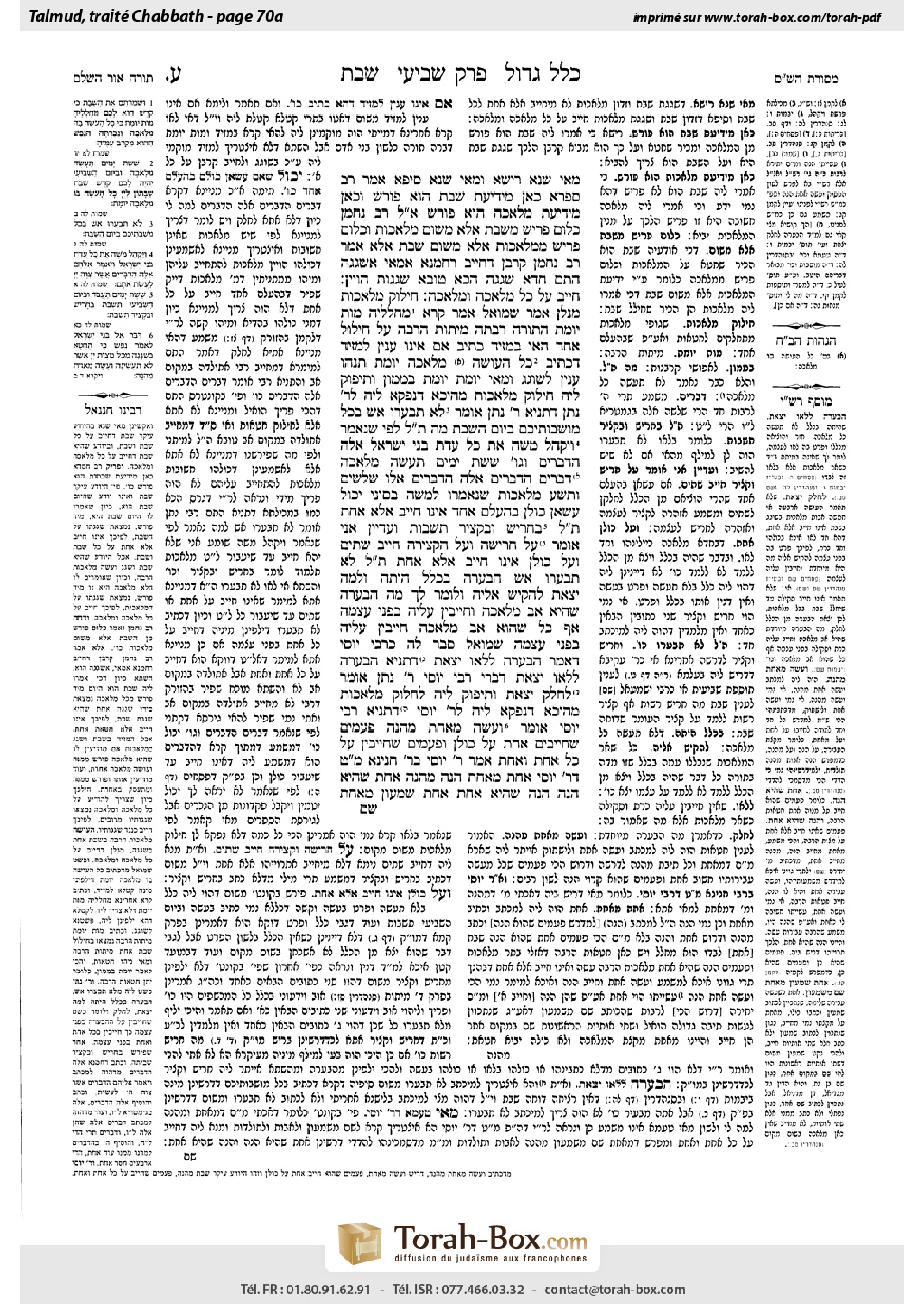
Shabbat 70a: Talmud study for Daf Yomi
Daf Yomi is the daily study of one Talmud folio. Explore 37 tractates with scans, Hebrew text, Sefaria English and AI-generated French translations where annotated.
Passage selection and English or AI-generated French translation are available where the scan has annotations. Daf Study is independent of Torah-Box and Sefaria.
Browse Shabbat · שבת · All tractatesShabbat 70a text and translations
This page of Shabbat includes the Aramaic text, an English translation and an AI-generated French translation, alongside the scan above.
שבת ע׳ א · Aramaic and Hebrew text
מַאי שְׁנָא רֵישָׁא וּמַאי שְׁנָא סֵיפָא? אָמַר רַב סָפְרָא: כָּאן — מִידִיעַת שַׁבָּת הוּא פּוֹרֵשׁ, וְכָאן — מִידִיעַת מְלָאכָה הוּא פּוֹרֵשׁ. אֲמַר לֵיהּ רַב נַחְמָן: כְּלוּם פֵּרֵישׁ מִשַּׁבָּת אֶלָּא מִשּׁוּם מְלָאכוֹת, וּכְלוּם פֵּרֵישׁ מִמְּלָאכוֹת אֶלָּא מִשּׁוּם שַׁבָּת! אֶלָּא אָמַר רַב נַחְמָן: קׇרְבָּן דְּחַיֵּיב רַחֲמָנָא אַמַּאי — אַשְּׁגָגָה. הָתָם חֲדָא שְׁגָגָה, הָכָא טוּבָא שְׁגָגוֹת הָוְיָין.
חַיָּיב עַל כׇּל מְלָאכָה וּמְלָאכָה: חִילּוּק מְלָאכוֹת מְנָלַן? אָמַר שְׁמוּאֵל, אָמַר קְרָא: ״מְחַלְּלֶיהָ מוֹת יוּמָת״ — הַתּוֹרָה רִבְּתָה מִיתוֹת הַרְבֵּה עַל חִילּוּל אֶחָד. הַאי בְּמֵזִיד כְּתִיב! אִם אֵינוֹ עִנְיָן לְמֵזִיד, דִּכְתִיב: ״כׇּל הָעֹשֶׂה מְלָאכָה יוּמָת״, תְּנֵהוּ עִנְיָן לְשׁוֹגֵג. וּמַאי ״יוּמָת״? — יוּמַת בְּמָמוֹן.
וְתִיפּוֹק לֵיהּ חִילּוּק מְלָאכוֹת מֵהֵיכָא דְּנָפְקָא לֵיהּ לְרַבִּי נָתָן! דְּתַנְיָא, רַבִּי נָתָן אוֹמֵר: ״לֹא תְבַעֲרוּ אֵשׁ בְּכֹל מֹשְׁבֹתֵיכֶם בְּיוֹם הַשַּׁבָּת״ מַה תַּלְמוּד לוֹמַר? לְפִי שֶׁנֶּאֱמַר ״וַיַּקְהֵל מֹשֶׁה אֶת כׇּל עֲדַת בְּנֵי יִשְׂרָאֵל אֵלֶּה הַדְּבָרִים וְגוֹ׳ שֵׁשֶׁת יָמִים תֵּעָשֶׂה מְלָאכָה״. ״דְּבָרִים״, ״הַדְּבָרִים״, ״אֵלֶּה הַדְּבָרִים״ — אֵלּוּ שְׁלֹשִׁים וָתֵשַׁע מְלָאכוֹת שֶׁנֶּאֶמְרוּ לְמֹשֶׁה בְּסִינַי.
יָכוֹל עֲשָׂאָן כּוּלָּן בְּהֶעְלֵם אֶחָד אֵינוֹ חַיָּיב אֶלָּא אַחַת? תַּלְמוּד לוֹמַר: ״בֶּחָרִישׁ וּבַקָּצִיר תִּשְׁבֹּת״. וַעֲדַיִין אֲנִי אוֹמֵר: עַל חֲרִישָׁה וְעַל קְצִירָה חַיָּיב שְׁתַּיִם, וְעַל כּוּלָּן אֵינוֹ חַיָּיב אֶלָּא אַחַת?! תַּלְמוּד לוֹמַר: ״לֹא תְבַעֲרוּ אֵשׁ״ — הַבְעָרָה בַּכְּלָל הָיְתָה, וְלָמָּה יָצָאת? — לְהַקִּישׁ אֵלֶיהָ וְלוֹמַר לָךְ: מָה הַבְעָרָה שֶׁהִיא אַב מְלָאכָה וְחַיָּיבִין עָלֶיהָ בִּפְנֵי עַצְמָהּ, אַף כֹּל שֶׁהִיא אַב מְלָאכָה — חַיָּיבִין עָלֶיהָ בִּפְנֵי עַצְמָהּ.
שְׁמוּאֵל סָבַר לַהּ כְּרַבִּי יוֹסֵי, דְּאָמַר: הַבְעָרָה — לְלָאו יָצָאת. דְּתַנְיָא: הַבְעָרָה — לְלָאו יָצָאת, דִּבְרֵי רַבִּי יוֹסֵי. רַבִּי נָתָן אוֹמֵר: לְחַלֵּק יָצָאת.
וְתִיפּוֹק לֵיהּ לְחִלּוּק מְלָאכוֹת מֵהֵיכָא דְּנָפְקָא לֵיהּ לְרַבִּי יוֹסֵי! דְּתַנְיָא, רַבִּי יוֹסֵי אוֹמֵר: ״וְעָשָׂה מֵאַחַת מֵהֵנָּה״, פְּעָמִים שֶׁחַיָּיבִים אַחַת עַל כּוּלָּן, וּפְעָמִים שֶׁחַיָּיבִין עַל כׇּל אַחַת וְאַחַת. וְאָמַר רַבִּי יוֹסֵי בְּרַבִּי חֲנִינָא: מַאי טַעְמָא דְּרַבִּי יוֹסֵי, ״אַחַת״ ״מֵאַחַת״, ״הֵנָּה״ ״מֵהֵנָּה״ — אַחַת שֶׁהִיא הֵנָּה, הֵנָּה שֶׁהִיא אַחַת.
״אַחַת״ — שִׁמְעוֹן. ״מֵאַחַת״ —
Shabbat 70a · English translation
The Gemara asks: What is different about the former clause, which states that he in only liable to bring one sin-offering for each Shabbat, and the latter clause, which states that he is liable for each and every primary category of labor that he performed? Rav Safra said: Here, where he is unaware that the day was Shabbat, when he realizes that he sinned, it is due to awareness of Shabbat that he desists. When he is told that it was Shabbat, he stops immediately. And here, where he is unaware that the labors are prohibited, it is due to awareness of the labors that he desists. When he is told that this labor is prohibited, he stops immediately. Rav Naḥman said to Rav Safra: Does he desist due to Shabbat for any reason other than because he knows that the labors are prohibited? If he did not know that the labor is prohibited, telling him that it is Shabbat would not cause him to desist. And similarly, does he desist from performing the labors when told that it is prohibited for any reason other than because he knows that it is Shabbat? If he did not know that it was Shabbat, there would be no reason for him to desist from labor. Ostensibly, attributing the distinction between the two parts of the mishna to what eventually became known to him in the different cases is incorrect. Rather, Rav Naḥman said: The offering that the Torah obligated him to bring; for what is he so obligated? It is for performing an unwitting transgression. There, where he was unaware that the day was Shabbat, he was unwitting with regard to one matter; here, where he was unaware of the prohibited labors, he was unwitting with regard to multiple matters, and he is liable to bring sin-offerings in accordance with the number of matters of which he was unaware.
We learned in the mishna that one is liable to bring a sin-offering for each prohibited labor that he performs on Shabbat. The Gemara asks: From where do we derive the division of labors? What is the source of the halakha that if one performs numerous prohibited labors on Shabbat in the course of one lapse of awareness, each prohibited labor is considered a separate offense with regard to punishment? Shmuel said that the verse says: “And you shall observe the Shabbat, for it is holy to you; he who desecrates it shall surely die [mot yumat]” (Exodus 31:14). We learn from the double language, mot yumat, that the Torah amplified multiple deaths for a single desecration. Although several violations were committed in the course of a single lapse of awareness, each is considered a separate offense with regard to punishment. The Gemara asks: That verse was written with regard to intentional transgression. The Gemara is seeking a source for multiple sacrifices brought for unwitting transgression. The Gemara answers: If it does not refer to the matter of intentional transgression, as the verse does not teach a halakha applicable to intentional acts, as it was already written: “Six days you shall perform work, and on the seventh day it shall be holy to you, a Shabbat of rest to God; all who desecrate it shall die” (Exodus 35:2), refer it to the matter of unwitting transgression. The verse teaches that that which was written with regard to the death penalty for desecration of Shabbat in general applies to all halakhot of Shabbat, including cases of unwitting transgression. And what, then, is the meaning of the term: Shall die, in the verse? Does it mean that one who commits an unwitting transgression is punishable by death? It means that he shall die by payment of money. Death is used in the sense of punishment; he will be forced to pay for numerous sacrifices to atone for his sins.
The Gemara asks: And let him derive division of labors from where it was derived according to Rabbi Natan, as it was taught in a baraita that Rabbi Natan says that it is written: “You shall not kindle fire in all your dwellings on the day of Shabbat” (Exodus 35:3). Why does the verse state this halakha? The prohibition against kindling is included in the general prohibition against performing labor on Shabbat. Rather, it should be understood as follows. Since it is already stated: “And Moses gathered the entire assembly of the children of Israel and said to them: These are the things [eleh hadevarim] that God has commanded to perform them. Six days you shall perform work, and on the seventh day it shall be holy to you, a Shabbat of rest to God” (Exodus 35:1–2), and Rabbi Natan derives as follows: “These are the things,” which refers to the halakhot of Shabbat, there are emphases in this phrase that are superfluous in the context of the verse. The Torah could have simply stated: This is a thing [davar]. When it states: Things [devarim] in the plural, it teaches at least two points. The addition of the definite article: The things [hadevarim], adds at least a third point. The numerological value of letters of the word eleh: Alef, one; lamed, thirty; and heh, five, is thirty-six. The total numerical value, three plus thirty-six, derived from the phrase: “These are the things.” This alludes to the thirty-nine prohibited labors that were stated to Moses at Sinai.
I might have thought that if one performed them all in the course of one lapse of awareness, forgetting that they are prohibited, he would be liable to bring only one sin-offering? Therefore, the verse states: “Six days you shall work, and on the seventh you shall rest; in plowing time and in harvest time you shall rest” (Exodus 34:21), indicating that there are prohibitions specific to both plowing and harvesting. And still I can say: For plowing and for the harvesting he is liable to bring two sin-offerings, as they were stated explicitly. However, for performing all the other prohibited labors, he is liable for only one. Therefore, the verse states: “You shall not kindle fire in all your dwellings on the day of Shabbat” (Exodus 35:3). This is derived in the following manner: Kindling was included in the general prohibition prohibiting all labors, and why was it singled out and prohibited explicitly? It was singled out in order to equate the other labors to it and to tell you: Just as kindling is a primary category of prohibited labor, and one is liable for performing it on its own, so too, with regard to every primary category of prohibited labor, one is liable for performing it on its own.
Rabbi Natan cited a source proving that there is liability for performance of each prohibited labor of Shabbat on its own. Why doesn’t Shmuel derive that halakha from the same source? The Gemara answers: Shmuel holds in accordance with the opinion of Rabbi Yosei, who disagreed with Rabbi Natan’s interpretation of the verse, as Rabbi Yosei said: The prohibition against kindling on Shabbat was singled out to teach that one who lights a fire on Shabbat merely violates a prohibition. Performing other primary categories of prohibited labor is punishable by stoning or karet. In contrast, one who lights a fire on Shabbat has merely violated a prohibition, as it was taught in a baraita: The prohibition of kindling was singled out as a prohibition; this is the statement of Rabbi Yosei. Rabbi Natan says: Kindling is like any other labor prohibited on Shabbat. It was singled out to divide the various labors and to establish liability for performance of each of them.
The Gemara raises an additional challenge to Shmuel’s opinion. If he holds in accordance with the opinion of Rabbi Yosei with regard to the explicit prohibition of kindling, let him derive the division of labors from where Rabbi Yosei derives it. As it was taught in a baraita that Rabbi Yosei says, it is stated: “Speak to the children of Israel, saying: A soul that sins in error, from all the commandments of God that may not be performed, and performs from one of them [me’aḥat me’hena]” (Leviticus 4:2). Rabbi Yosei interprets the verse that at times one is liable to bring one sin-offering for all of his transgressions, and at times one is liable to bring a sin-offering for each and every transgression. And Rabbi Yosei, son of Rabbi Ḥanina, said: What is the rationale for the opinion of Rabbi Yosei? He interprets the unique phrase employed in that verse: From one of these. The Torah could have merely stated: One [aḥat]. Instead, it stated: From one [me’aḥat]. It could have merely stated: Them [hena]. Instead, it stated: Of them [me’hena]. Rabbi Yosei derives that there are cases of one transgression that, with regard to punishment, are them, i.e., many. And there are cases of them, several transgressions, that, with regard to punishment, are one.
Furthermore: The term one refers to a full-fledged transgression of Shabbat, e.g., one who intended to and wrote a complete name, Shimon. The term from one refers to a case where he performed only part of the transgression, e.g., one who wrote
Shabbat 70a · Traduction française (IA)
La Guemara demande : Quelle différence y a-t-il entre la première partie, qui affirme qu’il n’est tenu d’apporter qu’un seul sacrifice expiatoire pour chaque Chabbat, et la dernière partie, qui affirme qu’il est tenu d’en apporter un pour chacune des catégories principales de travaux qu’il a effectuées ? Rav Safra dit : Dans le premier cas, où il ignorait que ce jour était Chabbat, lorsqu’il prend conscience de sa faute, c’est parce qu’il a pris conscience du Chabbat qu’il cesse. Lorsqu’on lui dit que c’était Chabbat, il s’arrête immédiatement. Dans le second cas, où il ignorait que les travaux étaient interdits, c’est parce qu’il a pris conscience de leur interdiction qu’il cesse. Lorsqu’on lui dit que ce travail est interdit, il s’arrête immédiatement. Rav Naḥman dit à Rav Safra : Cesse-t-il à cause du Chabbat pour une autre raison que parce qu’il sait que les travaux sont interdits ? S’il ne savait pas que le travail est interdit, lui dire que c’est Chabbat ne le ferait pas cesser. De même, cesse-t-il d’effectuer les travaux lorsqu’on lui dit qu’ils sont interdits pour une autre raison que parce qu’il sait que c’est Chabbat ? S’il ne savait pas que c’était Chabbat, rien ne le pousserait à cesser son travail. Apparemment, attribuer la distinction entre les deux parties de la Michna à ce dont il a fini par prendre connaissance dans chacun des cas est inexact. Rav Naḥman dit plutôt : Pour quelle raison la Torah l’oblige-t-elle à apporter le sacrifice ? C’est parce qu’il a commis une transgression par inadvertance. Dans le premier cas, où il ignorait que ce jour était Chabbat, il ignorait une seule chose ; dans le second, où il ignorait que les travaux étaient interdits, il ignorait plusieurs choses, et il est tenu d’apporter des sacrifices expiatoires en fonction du nombre de choses qu’il ignorait.
Nous avons appris dans la Michna qu’on est tenu d’apporter un sacrifice expiatoire pour chaque travail interdit effectué le Chabbat. La Guemara demande : D’où déduit-on la division des travaux ? Quelle est la source de la halakha selon laquelle, si quelqu’un effectue plusieurs travaux interdits le Chabbat au cours d’une seule période d’inadvertance, chaque travail interdit est considéré comme une transgression distincte en matière de sanction ? Chemouel dit que le verset dit : « Vous observerez le Chabbat, car il est saint pour vous ; quiconque le profane sera mis à mort [mot yumat] » (Exode 31,14). Nous déduisons de la formulation redoublée, mot yumat, que la Torah a multiplié les peines de mort pour une seule profanation. Bien que plusieurs transgressions aient été commises au cours d’une seule période d’inadvertance, chacune est considérée comme une transgression distincte en matière de sanction. La Guemara demande : Ce verset a été écrit au sujet d’une transgression volontaire. Or, la Guemara cherche une source établissant l’obligation d’apporter plusieurs sacrifices pour une transgression involontaire. La Guemara répond : Si ce verset ne concerne pas la transgression volontaire, puisqu’il n’enseigne aucune halakha applicable aux actes intentionnels — une halakha ayant déjà été énoncée dans le verset : « Pendant six jours, vous travaillerez, et le septième jour sera saint pour vous, un Chabbat de repos pour l’Éternel ; quiconque le profane sera mis à mort » (Exode 35,2) —, il faut l’appliquer à la transgression involontaire. Le verset enseigne que ce qui a été énoncé au sujet de la peine de mort pour la profanation du Chabbat en général s’applique à toutes les halakhot du Chabbat, y compris aux cas de transgression involontaire. Que signifie alors, dans le verset, l’expression « sera mis à mort » ? Cela signifie-t-il que celui qui commet une transgression involontaire est passible de mort ? Cela signifie qu’il sera « mis à mort » par un paiement d’argent. Le terme « mort » est employé au sens de sanction : il sera contraint de payer les nombreux sacrifices nécessaires à l’expiation de ses fautes.
La Guemara demande : Pourquoi ne déduirait-on pas la division des travaux de la source dont Rabbi Natan la déduit ? Il a été enseigné dans une baraïta que Rabbi Natan dit : Il est écrit : « Vous n’allumerez pas de feu dans toutes vos demeures le jour du Chabbat » (Exode 35,3). Pourquoi le verset énonce-t-il cette halakha ? L’interdiction d’allumer un feu est comprise dans l’interdiction générale d’effectuer un travail le Chabbat. Il faut plutôt comprendre ainsi : puisqu’il est déjà écrit : « Moïse rassembla toute l’assemblée des enfants d’Israël et leur dit : Voici les choses [eleh hadevarim] que l’Éternel a ordonné d’accomplir. Pendant six jours, vous travaillerez, et le septième jour sera saint pour vous, un Chabbat de repos pour l’Éternel » (Exode 35,1-2), Rabbi Natan en déduit ce qui suit : l’expression « voici les choses », qui renvoie aux halakhot du Chabbat, contient des éléments mis en relief qui sont superflus dans le contexte du verset. La Torah aurait pu simplement dire : « une chose » [davar]. En disant « les choses » [devarim] au pluriel, elle enseigne au moins deux éléments. L’article défini ajouté — « les choses » [hadevarim] — en ajoute au moins un troisième. La valeur numérique des lettres du mot eleh — alef, un ; lamed, trente ; et hé, cinq — est de trente-six. La valeur numérique totale, trois plus trente-six, déduite de l’expression « voici les choses », fait allusion aux trente-neuf travaux interdits qui furent énoncés à Moïse au Sinaï.
J’aurais pu penser que si quelqu’un les avait tous effectués au cours d’une seule période d’inadvertance, en oubliant qu’ils étaient interdits, il ne serait tenu d’apporter qu’un seul sacrifice expiatoire. C’est pourquoi le verset dit : « Pendant six jours, tu travailleras, et le septième, tu te reposeras ; au temps des labours et au temps de la moisson, tu te reposeras » (Exode 34,21), indiquant qu’il existe des interdictions spécifiques au labour et à la moisson. Mais je pourrais encore dire : Pour le labour et la moisson, il est tenu d’apporter deux sacrifices expiatoires, puisque ces deux travaux sont explicitement mentionnés. Cependant, pour avoir effectué tous les autres travaux interdits, il n’est tenu d’apporter qu’un seul sacrifice. C’est pourquoi le verset dit : « Vous n’allumerez pas de feu dans toutes vos demeures le jour du Chabbat » (Exode 35,3). On le déduit ainsi : l’allumage était compris dans l’interdiction générale de tous les travaux. Pourquoi a-t-il été distingué et interdit explicitement ? Il a été distingué afin d’assimiler les autres travaux à celui-ci et de t’enseigner ceci : de même que l’allumage est une catégorie principale de travail interdit et que l’on est passible d’une sanction pour l’avoir effectué à lui seul, de même, pour chacune des catégories principales de travail interdit, on est passible d’une sanction pour l’avoir effectuée à elle seule.
Rabbi Natan a cité une source prouvant que l’on est passible d’une sanction pour chacun des travaux interdits du Chabbat pris séparément. Pourquoi Chemouel ne déduit-il pas cette halakha de la même source ? La Guemara répond : Chemouel suit l’opinion de Rabbi Yossi, qui contestait l’interprétation du verset par Rabbi Natan. En effet, Rabbi Yossi a dit : L’interdiction d’allumer un feu le Chabbat a été distinguée afin d’enseigner que celui qui allume un feu le Chabbat ne transgresse qu’une interdiction. L’exécution des autres catégories principales de travaux interdits est punissable de lapidation ou de karet. En revanche, celui qui allume un feu le Chabbat n’a transgressé qu’une interdiction, comme il a été enseigné dans une baraïta : l’interdiction d’allumer un feu a été distinguée en tant qu’interdiction ; telle est la déclaration de Rabbi Yossi. Rabbi Natan dit : l’allumage est semblable à tout autre travail interdit le Chabbat. Il a été distingué afin de diviser les différents travaux et d’établir qu’on est passible d’une sanction pour chacun d’eux.
La Guemara soulève une objection supplémentaire contre l’opinion de Chemouel. S’il suit l’opinion de Rabbi Yossi concernant l’interdiction explicite d’allumer un feu, qu’il déduise la division des travaux de la source dont Rabbi Yossi la déduit. En effet, il a été enseigné dans une baraïta que Rabbi Yossi dit : Il est écrit : « Parle aux enfants d’Israël, en disant : Si une personne pèche par inadvertance, en transgressant l’un des commandements de l’Éternel qui ne doivent pas être accomplis, et en commettant l’un d’eux [me’aḥat me’hena] » (Lévitique 4,2). Rabbi Yossi interprète le verset ainsi : dans certains cas, on est tenu d’apporter un seul sacrifice expiatoire pour toutes ses transgressions ; dans d’autres cas, on est tenu d’apporter un sacrifice expiatoire pour chaque transgression. Rabbi Yossi, fils de Rabbi Ḥanina, a dit : Quel est le fondement de l’opinion de Rabbi Yossi ? Il interprète l’expression particulière employée dans ce verset : « l’un d’eux ». La Torah aurait pu simplement dire « une » [aḥat]. Au lieu de cela, elle dit « de l’une » [me’aḥat]. Elle aurait pu simplement dire « eux » [hena]. Au lieu de cela, elle dit « d’eux » [me’hena]. Rabbi Yossi déduit qu’il existe des cas où une seule transgression, en matière de sanction, équivaut à « eux », c’est-à-dire à plusieurs. Et il existe des cas où plusieurs transgressions équivalent, en matière de sanction, à une seule.
En outre, le terme « une » désigne une transgression du Chabbat à part entière, par exemple le cas de quelqu’un qui avait l’intention d’écrire et qui a écrit un nom complet, Shimon. Le terme « de l’une » désigne un cas où il n’a accompli qu’une partie de la transgression, par exemple quelqu’un qui a écrit
Traduction française générée par IA à partir de l’édition anglaise de Sefaria. Vérifie toujours un passage avec le texte source.
Text from Sefaria: William Davidson Edition - Vocalized Aramaic (CC BY NC); William Davidson Edition - English (CC BY NC).