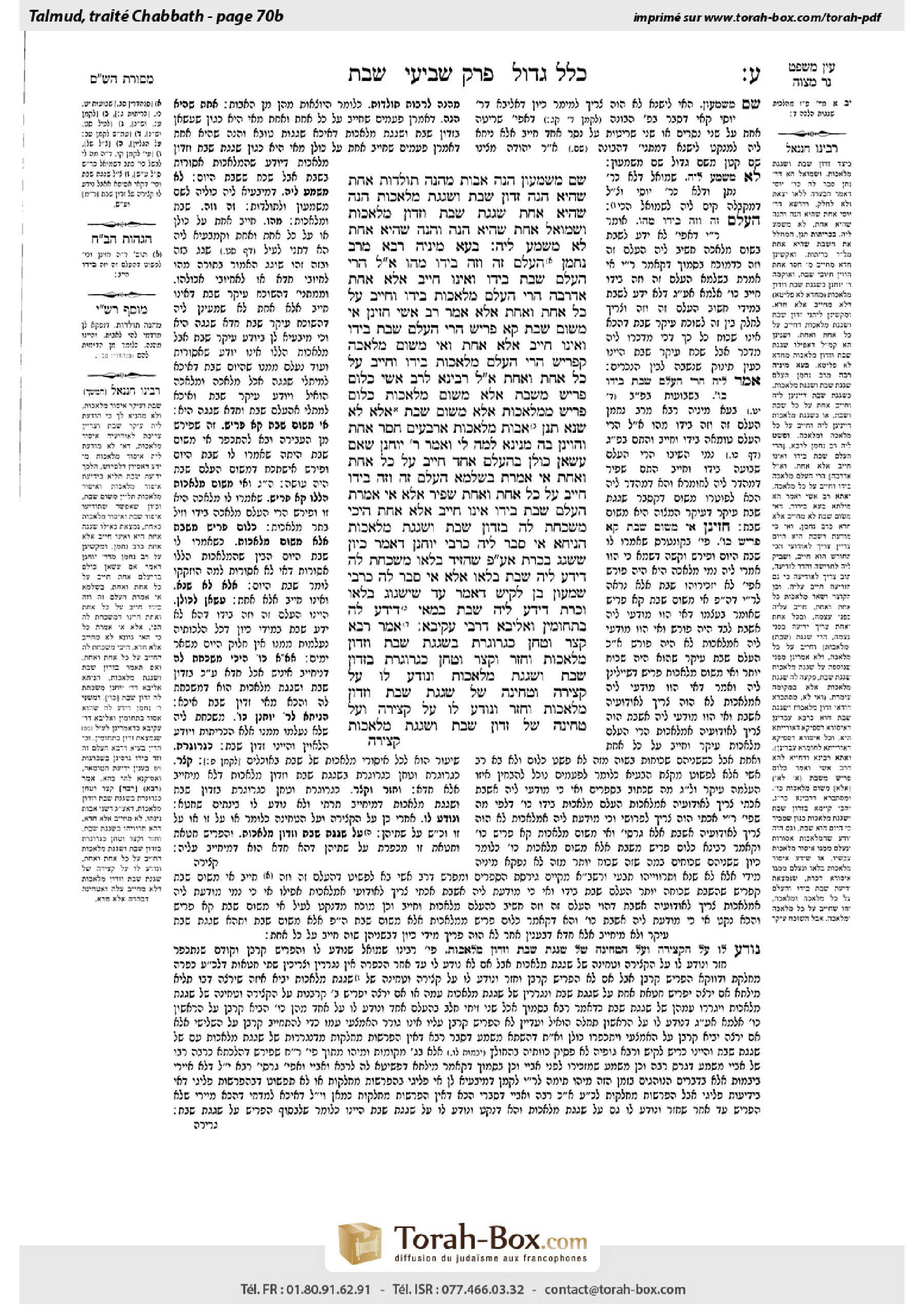
Shabbat 70b: Talmud study for Daf Yomi
Daf Yomi is the daily study of one Talmud folio. Explore 37 tractates with scans, Hebrew text, Sefaria English and AI-generated French translations where annotated.
Passage selection and English or AI-generated French translation are available where the scan has annotations. Daf Study is independent of Torah-Box and Sefaria.
Browse Shabbat · שבת · All tractatesShabbat 70b text and translations
This page of Shabbat includes the Aramaic text, an English translation and an AI-generated French translation, alongside the scan above.
שבת ע׳ ב · Aramaic and Hebrew text
שֵׁם מִשִּׁמְעוֹן. ״הֵנָּה״ — אָבוֹת, ״מֵהֵנָּה״ — תּוֹלָדוֹת. ״אַחַת שֶׁהִיא הֵנָּה״ — זְדוֹן שַׁבָּת וְשִׁגְגַת מְלָאכוֹת. ״הֵנָּה שֶׁהִיא אַחַת״ — שִׁגְגַת שַׁבָּת וּזְדוֹן מְלָאכוֹת. וּשְׁמוּאֵל, ״אַחַת שֶׁהִיא הֵנָּה״ וְ״הֵנָּה שֶׁהִיא אַחַת״ לָא מַשְׁמַע לֵיהּ.
בְּעָא מִינֵּיהּ רָבָא מֵרַב נַחְמָן: הֶעְלֵם זֶה וָזֶה בְּיָדוֹ, מַהוּ? אֲמַר לֵיהּ: הֲרֵי הֶעְלֵם שַׁבָּת בְּיָדוֹ, וְאֵינוֹ חַיָּיב אֶלָּא אַחַת. אַדְּרַבָּה, הֲרֵי הֶעְלֵם מְלָאכוֹת בְּיָדוֹ וְחַיָּיב עַל כׇּל אַחַת וְאַחַת! אֶלָּא אָמַר רַב אָשֵׁי: חָזֵינַן, אִי מִשּׁוּם שַׁבָּת קָא פָרֵישׁ — הֲרֵי הֶעְלֵם שַׁבָּת בְּיָדוֹ וְאֵינוֹ חַיָּיב אֶלָּא אַחַת, וְאִי מִשּׁוּם מְלָאכָה קָפָרֵישׁ — הֲרֵי הֶעְלֵם מְלָאכוֹת בְּיָדוֹ וְחַיָּיב עַל כׇּל אַחַת וְאַחַת. אֲמַר לֵיהּ רָבִינָא לְרַב אָשֵׁי: כְּלוּם פֵּרֵישׁ מִשַּׁבָּת אֶלָּא מִשּׁוּם מְלָאכוֹת, כְּלוּם פֵּרֵישׁ מִמְּלָאכוֹת אֶלָּא מִשּׁוּם שַׁבָּת — אֶלָּא לָא שְׁנָא.
תְּנַן: אֲבוֹת מְלָאכוֹת אַרְבָּעִים חָסֵר אַחַת, וְהָוֵינַן בַּהּ: מִנְיָנָא לְמָה לִי? וְאָמַר רַבִּי יוֹחָנָן: שֶׁאִם עֲשָׂאָן כּוּלָּן בְּהֶעְלֵם אֶחָד — חַיָּיב עַל כׇּל אַחַת וְאַחַת. אִי אָמְרַתְּ בִּשְׁלָמָא הֶעְלֵם זֶה וָזֶה בְּיָדוֹ חַיָּיב עַל כׇּל אַחַת וְאַחַת — שַׁפִּיר, אֶלָּא אִי אָמְרַתְּ הֶעְלֵם שַׁבָּת בְּיָדוֹ אֵינוֹ חַיָּיב אֶלָּא אַחַת, הֵיכִי מַשְׁכַּחַתְּ לַהּ — בִּזְדוֹן שַׁבָּת וְשִׁגְגַת מְלָאכוֹת!
הָנִיחָא אִי סָבַר לַהּ כְּרַבִּי יוֹחָנָן, דְּאָמַר כֵּיוָן שֶׁשָּׁגַג בְּכָרֵת אַף עַל פִּי שֶׁהֵזִיד בְּלָאו, מַשְׁכַּחַתְּ לַהּ דְּיָדַע לֵיהּ לְשַׁבָּת בְּלָאו. אֶלָּא אִי סָבַר לַהּ כְּרַבִּי שִׁמְעוֹן בֶּן לָקִישׁ, דְּאָמַר עַד שֶׁיִּשְׁגּוֹג בְּלָאו וְכָרֵת — דְּיָדַע לֵיהּ לְשַׁבָּת בְּמַאי? דְּיָדַע לֵהּ בִּתְחוּמִין, וְאַלִּיבָּא דְּרַבִּי עֲקִיבָא.
אָמַר רָבָא: קָצַר וְטָחַן כִּגְרוֹגֶרֶת בְּשִׁגְגַת שַׁבָּת וּזְדוֹן מְלָאכוֹת, וְחָזַר וְקָצַר וְטָחַן כִּגְרוֹגֶרֶת בִּזְדוֹן שַׁבָּת וְשִׁגְגַת מְלָאכוֹת, וְנוֹדַע לוֹ עַל קְצִירָה וּטְחִינָה שֶׁל שִׁגְגַת שַׁבָּת וּזְדוֹן מְלָאכוֹת, וְחָזַר וְנוֹדַע לוֹ עַל קְצִירָה וְעַל טְחִינָה שֶׁל זְדוֹן שַׁבָּת וְשִׁגְגַת מְלָאכוֹת —
Shabbat 70b · English translation
only shem, part of the word, the letters shin and mem, from Shimon. Them refers to one who performed the primary categories of labor. Of them refers to one who performed subcategories of prohibited labors. One that is them refers to one transgression with multiple punishments, as in a case where his action was intentional with regard to Shabbat in that he was aware that it was Shabbat, and his action was unwitting with regard to the prohibited labors in that he was unaware that the labors were prohibited. In that case, he is liable for each primary category of labor. Them that are one refers to several transgressions with one punishment, as in a case where his action was unwitting with regard to Shabbat in that he was unaware that it was Shabbat, and his action was intentional with regard to the prohibited labors in that he was aware that the labors were prohibited. In that case, he is liable to bring only one sin-offering. Apparently, Rabbi Yosei has a source for the division of Shabbat labors. Why doesn’t Shmuel derive the halakha from that source? The Gemara answers: Shmuel did not derive one that is them and them that are one from the verse.
Rava raised a dilemma before Rav Naḥman: What is the halakha if a person had a lapse of awareness of both this, Shabbat, and that, a particular labor? He said to him: He had a lapse of awareness with regard to Shabbat and is liable to bring only one sin-offering. Rava said to him: On the contrary, he had a lapse of awareness with regard to prohibited labors, and he should be liable for each and every labor that he performed. Rather, Rav Ashi said: We see, if it is due to awareness of Shabbat that he desists from performing the labor when he is told what day it is, then, apparently, it was a lapse of awareness with regard to Shabbat, and he is liable for only one. And if it is due to awareness of the prohibited labor that he desists, then, apparently, it was a lapse of awareness with regard to the labors and he is liable for each and every one. Ravina said to Rav Ashi: Does he desist due to Shabbat for any reason other than because he knows that the labors are prohibited? And similarly, does he desist from performing the labors when told that it is prohibited for any reason other than because he knows that it is Shabbat? When one desists from labor when he is told that it is Shabbat, it is because he understands that the labor he is performing is prohibited on Shabbat. Similarly, when one desists from his labor when he is told that the labor is prohibited, it is because he understands that the day is Shabbat. Rather, there is no difference between the cases, and in both he is considered unwitting with regard to Shabbat.
The Gemara further discusses the matter from a different perspective. We learned in a mishna: The number of primary categories of prohibited labors on Shabbat is forty-less-one, which the mishna proceeds to list. And we discussed this mishna: Why do I need this tally of forty-less-one? Isn’t merely listing the prohibited labors sufficient? And Rabbi Yoḥanan said: The tally was included to teach that if he performed all the prohibited labors in the course of one lapse of awareness during which he was unaware of the prohibition involved, he is liable for each and every one. Granted, if you say that one who had a lapse of awareness of both this and that is liable for each and every one, it works out well. However, if you say that since one who had a lapse of awareness of this and that had a lapse of awareness with regard to Shabbat, and he is liable to bring only one sin-offering, under what circumstances can you find a case where one would be liable for unwittingly violating all thirty-nine labors? It must be in a case where, with regard to Shabbat, his actions were intentional, as he was aware that it was Shabbat, and, with regard to the prohibited labors, his actions were unwitting, as he was unaware that these labors were prohibited on Shabbat.
It works out well if he holds in accordance with the opinion of Rabbi Yoḥanan, who said: Once he was unwitting with regard to the fact that the punishment for his transgression is karet, even though he was aware that his action was in violation of a Torah prohibition and performed the transgression intentionally, he is considered to have sinned unwittingly. You find that possibility in a case where he was aware that performing labor on Shabbat involves violation of a Torah prohibition, but he was unaware that the punishment for violating that prohibition is karet. However, if he holds in accordance with the opinion of Rabbi Shimon ben Lakish, who said: It is not considered unwitting until he was unwitting with regard to both the prohibition and karet, the result is that he is completely unaware of all the prohibited labors of Shabbat. The question then arises: With regard to what aspect of Shabbat was he aware? If he was completely unaware of all the labors prohibited on Shabbat, in what sense were his actions intentional with regard to Shabbat? The Gemara answers: He was aware of the halakhot of the prohibition of Shabbat boundaries, in accordance with the opinion of Rabbi Akiva, who holds that that prohibition is by Torah law.
Rava said: One who reaped and ground grain in the measure of a dried fig-bulk, the measure that determines liability for the labors of reaping and grinding on Shabbat, while in performing those actions he was unwitting with regard to Shabbat and intentional with regard to the prohibited labors. He was unaware that it was Shabbat, but he was aware that the labors were prohibited. And he did not realize that he had sinned until he again reaped and ground grain in the measure of a dried fig-bulk, while in performing those actions he was intentional with regard to Shabbat and unwitting with regard to the prohibited labors. He was aware that it was Shabbat, but he was unaware that the labors were prohibited. And afterward he became aware that he had performed the labors of reaping and grinding while unwitting with regard to Shabbat and intentional with regard to the prohibited labors. He set aside a sin-offering to atone for his sin, based on the principle that he need set aside only one sin-offering even though he performed two primary categories of labor in the same lapse of awareness. And afterward he became aware that he had performed the labors of reaping and grinding while intentional with regard to Shabbat and unwitting with regard to the prohibited labors. For performing two categories of prohibited labor unwittingly, reaping and grinding, one should be liable to bring two sin-offerings.
Shabbat 70b · Traduction française (IA)
Seul le terme shem, une partie du mot, les lettres shin et mem, tiré de Shimon. « Eux » désigne celui qui a accompli les catégories principales de travaux. « Parmi eux » désigne celui qui a accompli des sous-catégories de travaux interdits. « Un qui est eux » désigne une seule transgression entraînant plusieurs peines, comme dans le cas où son acte était intentionnel à l’égard du Chabbat, puisqu’il savait que c’était Chabbat, mais involontaire à l’égard des travaux interdits, puisqu’il ignorait que ces travaux étaient interdits. Dans ce cas, il est passible d’une offrande pour chaque catégorie principale de travail. « Eux qui sont un » désigne plusieurs transgressions entraînant une seule peine, comme dans le cas où son acte était involontaire à l’égard du Chabbat, puisqu’il ignorait que c’était Chabbat, mais intentionnel à l’égard des travaux interdits, puisqu’il savait que ces travaux étaient interdits. Dans ce cas, il n’est passible que d’un seul sacrifice expiatoire. Apparemment, Rabbi Yosei dispose d’une source pour la distinction entre les travaux du Chabbat. Pourquoi Shmuel ne déduit-il pas la halakha de cette source ? La Guemara répond : Shmuel n’a pas déduit du verset les cas de « un qui est eux » et de « eux qui sont un ».
Rava souleva une question devant Rav Naḥman : quelle est la halakha si une personne a eu un défaut de connaissance à la fois sur ceci, le Chabbat, et sur cela, un travail particulier ? Il lui répondit : Elle a eu un défaut de connaissance au sujet du Chabbat et n’est passible que d’un seul sacrifice expiatoire. Rava lui dit : Au contraire, elle a eu un défaut de connaissance au sujet des travaux interdits et devrait être passible d’un sacrifice pour chaque travail qu’elle a accompli. Rav Ashi dit plutôt : Voyons. Si c’est en apprenant quel jour on est qu’elle cesse d’accomplir le travail, cela montre apparemment qu’elle avait un défaut de connaissance au sujet du Chabbat et qu’elle n’est passible que d’un seul sacrifice expiatoire. En revanche, si c’est en apprenant que le travail est interdit qu’elle cesse, cela montre apparemment qu’elle avait un défaut de connaissance au sujet des travaux et qu’elle est passible d’un sacrifice pour chacun d’eux. Ravina dit à Rav Ashi : Cesse-t-elle son travail en apprenant que c’est Chabbat pour une autre raison que parce qu’elle sait que ces travaux sont interdits ? De même, cesse-t-elle d’accomplir les travaux en apprenant qu’ils sont interdits pour une autre raison que parce qu’elle sait que c’est Chabbat ? Quand quelqu’un cesse son travail en apprenant que c’est Chabbat, c’est parce qu’il comprend que le travail qu’il accomplit est interdit le Chabbat. De même, quand quelqu’un cesse son travail en apprenant que ce travail est interdit, c’est parce qu’il comprend que le jour est Chabbat. Il n’y a donc pas de différence entre ces cas : dans les deux, il est considéré comme ayant eu un défaut de connaissance au sujet du Chabbat.
La Guemara examine encore la question sous un autre angle. Nous avons appris dans une Michna : Le nombre de catégories principales de travaux interdits le Chabbat est de trente-neuf, que la Michna énumère ensuite. Et nous avons discuté cette Michna : Pourquoi ce décompte de trente-neuf est-il nécessaire ? Ne suffit-il pas d’énumérer les travaux interdits ? Rabbi Yoḥanan a dit : Ce décompte a été inclus pour enseigner que si quelqu’un a accompli tous les travaux interdits au cours d’un seul défaut de connaissance, durant lequel il ignorait l’interdiction en cause, il est passible d’un sacrifice pour chacun d’eux. Certes, si tu dis que celui qui a eu un défaut de connaissance à la fois sur ceci et sur cela est passible d’un sacrifice pour chacun d’eux, cela convient. Cependant, si tu dis que celui qui a eu un défaut de connaissance sur ceci et sur cela a eu un défaut de connaissance au sujet du Chabbat et n’est passible que d’un seul sacrifice expiatoire, dans quelles circonstances peut-on trouver un cas où quelqu’un serait passible pour avoir enfreint involontairement les trente-neuf travaux ? Ce doit être un cas où, à l’égard du Chabbat, ses actes étaient intentionnels, car il savait que c’était Chabbat, et où, à l’égard des travaux interdits, ses actes étaient involontaires, car il ignorait que ces travaux étaient interdits le Chabbat.
Cela convient s’il soutient l’opinion de Rabbi Yoḥanan, qui a dit : Dès lors qu’il ignorait que sa transgression était passible de karet, bien qu’il sût que son acte enfreignait une interdiction de la Torah et qu’il ait commis la transgression intentionnellement, il est considéré comme ayant péché involontairement. On peut trouver cette situation dans le cas où il savait que travailler le Chabbat enfreint une interdiction de la Torah, mais ignorait que la peine pour la violation de cette interdiction est le karet. Toutefois, s’il soutient l’opinion de Rabbi Shimon ben Lakish, qui a dit : On n’est considéré comme ayant agi involontairement que si l’on ignorait à la fois l’interdiction et le karet, il s’ensuit qu’il ignorait complètement tous les travaux interdits le Chabbat. La question se pose alors : de quel aspect du Chabbat était-il conscient ? S’il ignorait complètement tous les travaux interdits le Chabbat, en quel sens ses actes étaient-ils intentionnels à l’égard du Chabbat ? La Guemara répond : Il connaissait les halakhot de l’interdiction des limites du Chabbat, conformément à l’opinion de Rabbi Akiva, qui considère que cette interdiction relève de la Torah.
Rava dit : Un homme a moissonné et moulu du grain dans la mesure d’un volume égal à celui d’une figue sèche — la mesure qui détermine la responsabilité pour les travaux de moisson et de mouture le Chabbat — alors qu’en accomplissant ces actes, il avait un défaut de connaissance au sujet du Chabbat et agissait intentionnellement à l’égard des travaux interdits. Il ignorait que c’était Chabbat, mais savait que ces travaux étaient interdits. Il ne se rendit compte qu’il avait péché qu’après avoir de nouveau moissonné et moulu du grain dans la mesure d’un volume égal à celui d’une figue sèche, alors qu’en accomplissant ces actes, il agissait intentionnellement à l’égard du Chabbat et avait un défaut de connaissance au sujet des travaux interdits. Il savait que c’était Chabbat, mais ignorait que ces travaux étaient interdits. Puis il prit conscience qu’il avait accompli les travaux de moisson et de mouture avec un défaut de connaissance au sujet du Chabbat, mais en agissant intentionnellement à l’égard des travaux interdits. Il mit à part un sacrifice expiatoire pour expier sa faute, selon le principe qu’il ne doit mettre à part qu’un seul sacrifice expiatoire, même s’il a accompli deux catégories principales de travaux au cours du même défaut de connaissance. Puis il prit conscience qu’il avait accompli les travaux de moisson et de mouture intentionnellement à l’égard du Chabbat, mais avec un défaut de connaissance au sujet des travaux interdits. Pour avoir accompli involontairement deux catégories de travaux interdits, la moisson et la mouture, il devrait être passible d’apporter deux sacrifices expiatoires.
Traduction française générée par IA à partir de l’édition anglaise de Sefaria. Vérifie toujours un passage avec le texte source.
Text from Sefaria: William Davidson Edition - Vocalized Aramaic (CC BY NC); William Davidson Edition - English (CC BY NC).