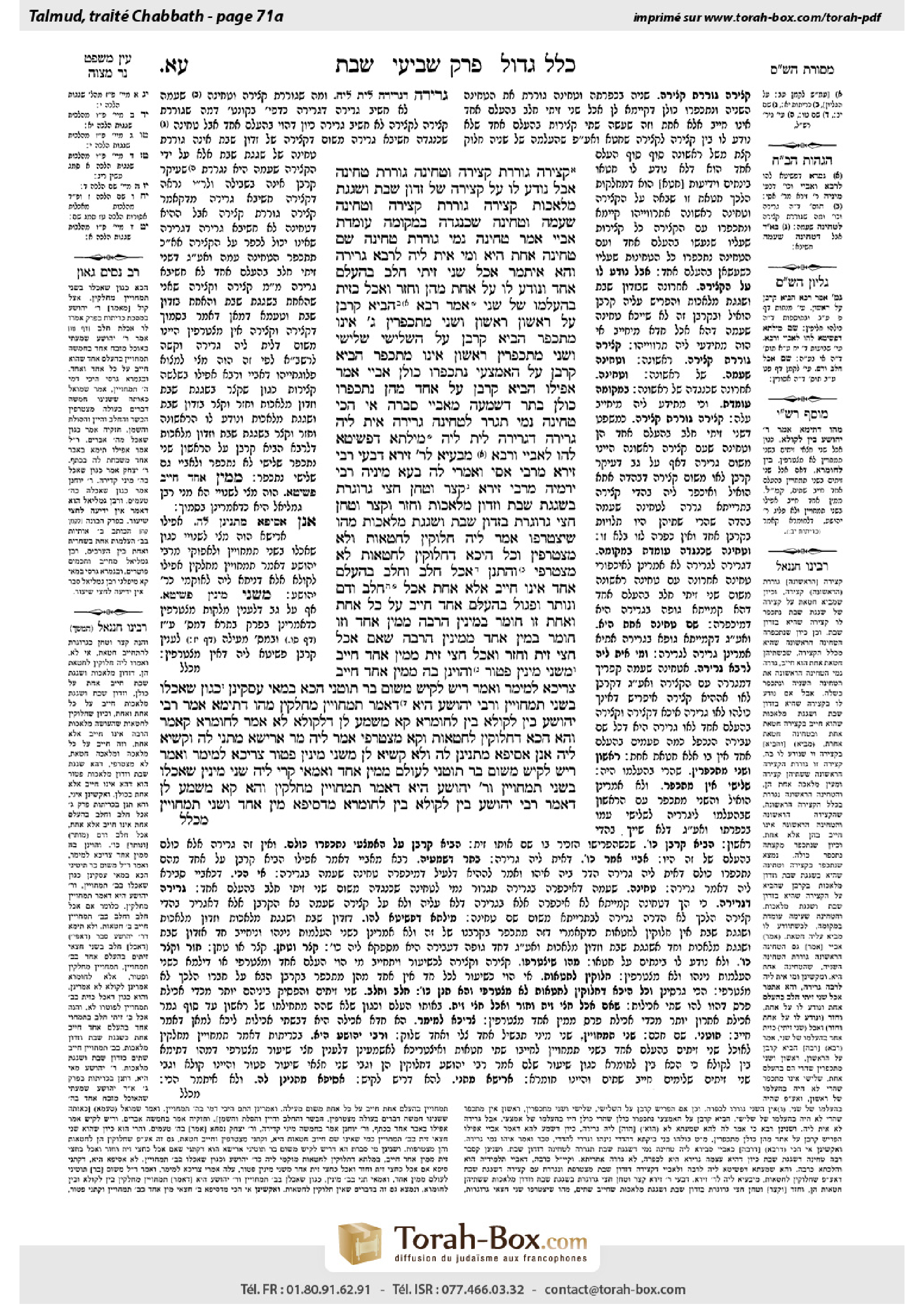
Shabbat 71a: Talmud study for Daf Yomi
Daf Yomi is the daily study of one Talmud folio. Explore 37 tractates with scans, Hebrew text, Sefaria English and AI-generated French translations where annotated.
Passage selection and English or AI-generated French translation are available where the scan has annotations. Daf Study is independent of Torah-Box and Sefaria.
Browse Shabbat · שבת · All tractatesShabbat 71a text and translations
This page of Shabbat includes the Aramaic text, an English translation and an AI-generated French translation, alongside the scan above.
שבת ע״א א · Aramaic and Hebrew text
קְצִירָה גּוֹרֶרֶת קְצִירָה, וּטְחִינָה גּוֹרֶרֶת טְחִינָה. אֲבָל נוֹדַע לוֹ עַל קְצִירָה שֶׁל זְדוֹן שַׁבָּת וְשִׁגְגַת מְלָאכוֹת — קְצִירָה גּוֹרֶרֶת קְצִירָה וּטְחִינָה שֶׁעִמָּהּ, וּטְחִינָה שֶׁכְּנֶגְדָּהּ בִּמְקוֹמָהּ עוֹמֶדֶת.
אַבָּיֵי אָמַר: טְחִינָה נָמֵי גּוֹרֶרֶת טְחִינָה, שֵׁם טְחִינָה אַחַת הִיא. וּמִי אִית לֵיהּ לְרָבָא גְּרִירָה? וְהָא אִיתְּמַר: אָכַל שְׁנֵי זֵיתֵי חֵלֶב בְּהֶעְלֵם אֶחָד, וְנוֹדַע לוֹ עַל אַחַת מֵהֶן, וְחָזַר וְאָכַל כְּזַיִת בְּהֶעְלֵמוֹ שֶׁל שֵׁנִי. אָמַר רָבָא: הֵבִיא קׇרְבָּן עַל רִאשׁוֹן — רִאשׁוֹן וְשֵׁנִי מִתְכַּפְּרִין, שְׁלִישִׁי אֵינוֹ מִתְכַּפֵּר.
הֵבִיא קׇרְבָּן עַל הַשְּׁלִישִׁי — שְׁלִישִׁי וְשֵׁנִי מִתְכַּפְּרִין, רִאשׁוֹן אֵינוֹ מִתְכַּפֵּר. הֵבִיא קׇרְבָּן עַל הָאֶמְצָעִי — נִתְכַּפְּרוּ כּוּלָּן. אַבָּיֵי אָמַר: אֲפִילּוּ הֵבִיא קׇרְבָּן עַל אֶחָד מֵהֶן — נִתְכַּפְּרוּ כּוּלָּן. בָּתַר דְּשַׁמְעַהּ מֵאַבָּיֵי, סַבְרַהּ: אִי הָכִי, טְחִינָה נָמֵי תִּגְרֹר לִטְחִינָה! גְּרִירָה אִית לֵיהּ, גְּרִירָה דִגְרִירָה לֵית לֵיהּ.
מִילְּתָא דִּפְשִׁיטָא לְהוּ לְאַבָּיֵי וְרָבָא מִבַּעְיָא לְרַבִּי זֵירָא. דְּבָעֵי רַבִּי זֵירָא מֵרַבִּי אַסִּי, וְאָמְרִי לַהּ בְּעָא מִינֵּיהּ רַבִּי יִרְמְיָה מֵרַבִּי זֵירָא: קָצַר וְטָחַן חֲצִי גְרוֹגֶרֶת בְּשִׁגְגַת שַׁבָּת וּזְדוֹן מְלָאכוֹת, וְחָזַר וְקָצַר וְטָחַן חֲצִי גְרוֹגֶרֶת בִּזְדוֹן שַׁבָּת וְשִׁגְגַת מְלָאכוֹת, מַהוּ שֶׁיִּצְטָרְפוּ? אֲמַר לֵיהּ: חֲלוּקִין לַחֲטָאוֹת, וְלֹא מִצְטָרְפִין.
וְכׇל הֵיכָא דַּחֲלוּקִין לַחֲטָאוֹת לָא מִצְטָרְפִי? וְהָתְנַן: אָכַל חֵלֶב וְחֵלֶב בְּהֶעְלֵם אֶחָד — אֵינוֹ חַיָּיב אֶלָּא אַחַת. אָכַל חֵלֶב וָדָם וְנוֹתָר וּפִגּוּל בְּהֶעְלֵם אֶחָד — חַיָּיב עַל כׇּל אַחַת וְאַחַת, זֶה חוֹמֶר בְּמִינִין הַרְבֵּה מִמִּין אֶחָד. וְזֶה חוֹמֶר בְּמִין אֶחָד מִמִּינִין הַרְבֵּה: שֶׁאִם אָכַל חֲצִי זַיִת וְחָזַר וְאָכַל חֲצִי זַיִת מִמִּין אֶחָד — חַיָּיב, מִשְּׁנֵי מִינִין — פָּטוּר.
וְהָוֵינַן בַּהּ: מִמִּין אֶחָד חַיָּיב צְרִיכָא לְמֵימַר? וְאָמַר רֵישׁ לָקִישׁ מִשּׁוּם בַּר תּוּטֵנִי: הָכָא בְּמַאי עָסְקִינַן — כְּגוֹן שֶׁאֲכָלוֹ בִּשְׁנֵי תַמְחוּיִין, וְרַבִּי יְהוֹשֻׁעַ הִיא, דְּאָמַר תַּמְחוּיִין מְחַלְּקִין. מַהוּ דְּתֵימָא אָמַר רַבִּי יְהוֹשֻׁעַ בֵּין לְקוּלָּא בֵּין לְחוּמְרָא — קָא מַשְׁמַע לַן דִּלְקוּלָּא לָא אָמַר, לְחוּמְרָא קָאָמַר.
וְהָא הָכָא דַּחֲלוּקִין לַחֲטָאוֹת, וְקָא מִצְטָרְפִי! אֲמַר לֵיהּ: מָר אַרֵישָׁא מַתְנֵי לַהּ וְקַשְׁיָא לֵיהּ. אֲנַן אַסֵּיפָא מַתְנִינַן לַהּ, וְלָא קַשְׁיָא לַן: מִשְּׁנֵי מִינִין פָּטוּר, צְרִיכָה לְמֵימַר? וְאָמַר רֵישׁ לָקִישׁ מִשּׁוּם בַּר תּוּטֵנִי לְעוֹלָם מִמִּין אֶחָד. וְאַמַּאי קָרֵי לֵיהּ ״שְׁנֵי מִינִין״ — שֶׁאֲכָלוֹ בִּשְׁנֵי תַמְחוּיִין, וְרַבִּי יְהוֹשֻׁעַ הִיא דְּאָמַר תַּמְחוּיִין מְחַלְּקִין. וְהָא קָא מַשְׁמַע לַן: דְּאָמַר רַבִּי יְהוֹשֻׁעַ בֵּין לְקוּלָּא בֵּין לְחוּמְרָא.
מִדְּסֵיפָא מִין אֶחָד וּשְׁנֵי תַמְחוּיִין,
Shabbat 71a · English translation
Nevertheless, in that case, the sin-offering that atoned for the unwitting act of reaping, which he performed when his action was unwitting with regard to Shabbat, draws with it atonement for the second unwitting act of reaping, which he performed when his action was unwitting with regard to the prohibited labor, and for which he also was liable to bring a sin-offering. And similarly, the sin-offering that atoned for the unwitting act of grinding, which he performed when his action was unwitting with regard to Shabbat, draws with it atonement for the unwitting act of grinding, which he performed when his action was unwitting with regard to the prohibited labor. Since the offering was sacrificed after he had committed both transgressions, he attains atonement with one sacrifice, even though he performed several forms of the transgression in a single lapse of awareness. However, if the order of events in that case was different in that he became aware of reaping performed when his action was intentional with regard to Shabbat and his action was unwitting with regard to the prohibited labors, and he set aside an offering to atone for his unwitting transgression, and only afterward he became aware that he had performed the labors of reaping and grinding when his actions were unwitting with regard to Shabbat, the sin-offering that he brings for the reaping draws with it atonement for the previous reaping and the concomitant grinding. As far as the lapse of awareness with regard to Shabbat is concerned, reaping and grinding are considered like one sin, and atonement for one atones for the other. And the parallel grinding that he performed together with the latter reaping remains in its place, i.e., he does not attain atonement for that transgression. When he becomes aware of it, he brings a separate offering for atonement.
Abaye said: Grinding also draws the latter grinding with it, as the designation of grinding is one. Since he attained atonement for one act of grinding, atonement is attained for the second act of grinding as well, as they were performed in one lapse of awareness, and he became aware only after the acts were completed. The Gemara asks: And is Rava of the opinion that atonement can be attained by means of drawing? Wasn’t it stated that there is a dispute with regard to that matter in a case where one unwittingly ate two olive-bulks of forbidden fat in one lapse of awareness, e.g., he ate two pieces of forbidden fat from different parts of an animal in the belief that they were permitted fat? One is liable to bring a sin-offering for that transgression. And in a case where he became aware that one of the olive-bulks was forbidden fat, and then ate a third olive-bulk while still in the midst of the lapse of awareness of the second piece of forbidden fat, i.e., he had not yet become aware that the second of the original olive-bulks was indeed prohibited and after eating the third olive-bulk, he became aware of both the second and the third pieces of fat. Rava said: If he brought a sacrifice for the first, atonement is attained for the transgressions of the first and second olive-bulks, since he ate both in one lapse of awareness. However, atonement is not attained for the third because awareness of the first olive-bulk interposes.
If he brought a sacrifice for the third after he became aware that he had sinned, atonement is attained for the transgressions of the third and second, since both were performed in one lapse of awareness. However, atonement is not attained for the transgression of the first, which occurred in a separate lapse of awareness. If he brought a sacrifice for the middle one, atonement is attained for all, since both the first and third olive-bulks have a lapse of awareness common with the second. Abaye said: Even if he brought a sacrifice for any one of them, atonement is attained for all of them by means of drawing. Since he attained atonement for one of the olive-bulks, that atonement draws with it atonement for the other olive-bulks with which it shared a lapse of awareness. In any case, apparently Rava is not of the opinion that atonement draws with it atonement. How, then, does he say that atonement for reaping draws with it atonement for other acts of reaping? The Gemara answers: After he heard this halakha from Abaye, he adopted it. The Gemara raises a difficulty: If so, if Rava accepts the principle of drawing, by that same principle grinding should also draw with it grinding. The Gemara answers: There is a difference. Although he is of the opinion that atonement can be attained by means of drawing, he is not of the opinion that atonement that was attained through drawing can draw additional atonement through drawing. Atonement for the initial transgression of grinding was only attained by means of being drawn by the atonement for reaping. Rava holds that it cannot then proceed to draw atonement for the latter act of grinding.
The Gemara comments: A matter that was obvious to Abaye and Rava was a dilemma for Rabbi Zeira. In a case where one’s action was intentional with regard to Shabbat and unwitting with regard to the labors, and in a case where one’s action was unwitting with regard to Shabbat and intentional with regard to the labors, he is liable to bring only one sin-offering for the unwitting violation of Shabbat. This was not obvious to Rabbi Zeira, as Rabbi Zeira raised a dilemma before Rabbi Asi, and others say that Rabbi Yirmeya raised a dilemma before Rabbi Zeira: If one reaped and ground grain in the measure of half a dried fig-bulk, and his action was unwitting with regard to Shabbat and intentional with regard to the prohibited labors. He is certainly not liable by Torah law because he reaped and ground less than the minimum measure for liability. And then he reaped or ground grain in the amount of half a dried fig-bulk and his action was intentional with regard to Shabbat and unwitting with regard to the prohibited labors, do they join together to constitute the minimum measure that determines liability to bring a sin-offering when he becomes aware that he sinned? He said to him: They are separate with regard to sin-offerings, i.e., if one reaped and ground the minimum measure that determines liability, he is liable to bring two sin-offerings, and therefore they do not join together to constitute the minimum measure.
The Gemara asks: And wherever they are separate with regard to sin-offerings, do they not join together? Didn’t we learn in a mishna: If one ate one piece of forbidden fat and then ate another piece of forbidden fat, each larger than the measure for liability, in one lapse of awareness, he is liable to bring only one sin-offering? In the next case in the mishna, four items are listed. If one eats them unwittingly he is liable to bring a sin-offering. If he ate forbidden fat, and blood, and notar, sacrifices that remained after the time when they may be eaten has expired, and piggul, sacrifices that were invalidated due to inappropriate intent while being offered, in one lapse of awareness, he is liable to bring a sin-offering for each and every one. That is the stricture that applies to many types of prohibitions relative to one, the same, type. And this is the stricture of one type relative to many types: That if one ate half an olive-bulk, and then ate another half an olive-bulk from one type, he is liable because the two half measures join to constitute a single measure. And if he ate two halves of an olive-bulk from two types, he is exempt.
And we discussed this mishna: When we learned of one who ate two halves of an olive-bulk from one type, was it necessary to say that he is liable? That is obvious. And Reish Lakish said in the name of the Sage, bar Tutni: With what are we dealing here? We are dealing with a case where he ate two halves of an olive-bulk from two dishes, where each half was prepared separately, and this is in accordance with the opinion of Rabbi Yehoshua, who said that dishes separate. One who eats two olive-bulks of prohibited food that was prepared in two different dishes in the course of one lapse of awareness is liable to bring a sin-offering for each one. Lest you say that Rabbi Yehoshua stated his opinion that dishes separate both as a leniency and as a stricture, and therefore one who ate two halves of an olive-bulk from two dishes would be exempt, the mishna teaches us that Rabbi Yehoshua did not state his opinion as a leniency. He stated his opinion as a stricture.
But here, where they are separate with regard to the number of sin-offerings, i.e., according to Rabbi Yehoshua one who eats an olive-bulk from each of the two dishes is liable to bring two sin-offerings, and, nevertheless, the two halves of an olive-bulk from the two dishes join together and constitute a full measure and render him liable to bring a sin-offering. Rabbi Zeira said to Rabbi Yirmeya: The Master taught Reish Lakish’s response with regard to the first clause of the mishna, and it is difficult for him. We taught Reish Lakish’s response with regard to the latter clause of the mishna, and it is not difficult for us. When we learned in the latter clause of the mishna: One who ate two halves of an olive-bulk from two types, was it necessary to say that he is exempt? That is obvious. Reish Lakish said in the name of bar Tutni: Actually, it is referring even to a case where the prohibition was from one type of food. And why then does the mishna call it two types? Because he eats it in the two separate dishes in which it was prepared. And this ruling is in accordance with the opinion of Rabbi Yehoshua, who said that dishes separate. And this teaches us that Rabbi Yehoshua stated his opinion that dishes separate both as a leniency and as a stricture.
The Gemara asks: From the fact that the latter clause is referring to one type of food and a case where the two halves of an olive-bulk were prepared in two dishes, as explained above,
Shabbat 71a · Traduction française (IA)
Néanmoins, dans ce cas, le sacrifice expiatoire qui a expié l’acte de moissonner commis par inadvertance — alors que son acte était involontaire au regard du Chabbat — entraîne également l’expiation du second acte de moissonner, commis alors que son acte était involontaire au regard des travaux interdits et pour lequel il était également tenu d’apporter un sacrifice expiatoire. De même, le sacrifice expiatoire qui a expié l’acte de moudre commis par inadvertance — alors que son acte était involontaire au regard du Chabbat — entraîne également l’expiation de l’acte de moudre commis alors que son acte était involontaire au regard du travail interdit. Puisque le sacrifice a été offert après qu’il eut commis les deux transgressions, il obtient l’expiation par un seul sacrifice, même s’il a commis plusieurs formes de la transgression au cours d’une seule période d’inadvertance. Cependant, si les événements se sont déroulés dans un ordre différent — s’il a pris conscience d’avoir moissonné alors qu’il avait agi intentionnellement au regard du Chabbat, mais par inadvertance au regard des travaux interdits, et qu’il a mis à part un sacrifice pour expier sa transgression involontaire, puis qu’il a seulement ensuite pris conscience d’avoir moissonné et moulu par inadvertance au regard du Chabbat —, le sacrifice expiatoire qu’il apporte pour la moisson entraîne également l’expiation de la moisson antérieure et de la mouture qui l’accompagnait. Du point de vue de l’inadvertance au regard du Chabbat, moissonner et moudre sont considérés comme une seule transgression, et l’expiation de l’une vaut pour l’autre. En revanche, la mouture effectuée en même temps que cette dernière moisson reste distincte : il n’obtient pas l’expiation pour cette transgression. Lorsqu’il en prend conscience, il apporte un sacrifice distinct pour expier cette faute.
Abayé dit : La mouture entraîne également la dernière mouture avec elle, car la catégorie de la mouture est unique. Puisqu’il a obtenu l’expiation pour un acte de mouture, il l’obtient aussi pour le second, car ils ont été commis au cours d’une seule période d’inadvertance et il n’en a pris conscience qu’après leur accomplissement. La Guemara demande : Rava pense-t-il que l’on peut obtenir l’expiation par entraînement ? N’a-t-on pas enseigné qu’il existe une controverse sur ce point dans le cas où quelqu’un a mangé par inadvertance deux olives de graisse interdite au cours d’une seule période d’inadvertance, par exemple deux morceaux de graisse interdite provenant de différentes parties d’un animal, croyant qu’il s’agissait de graisse permise ? Il est tenu d’apporter un sacrifice expiatoire pour cette transgression. Et dans le cas où il a pris conscience que l’une des olives était de la graisse interdite, puis a mangé une troisième olive alors qu’il était encore dans la période d’inadvertance concernant le second morceau de graisse interdite — c’est-à-dire qu’il n’avait pas encore pris conscience que le second des deux morceaux initiaux était effectivement interdit —, après quoi il a pris conscience à la fois du deuxième et du troisième morceau, Rava dit : S’il a apporté un sacrifice pour le premier, il obtient l’expiation pour les transgressions liées aux première et deuxième olives, puisqu’il les a mangées au cours d’une seule période d’inadvertance. En revanche, il n’obtient pas l’expiation pour la troisième, car la prise de conscience concernant la première olive s’interpose.
S’il a apporté un sacrifice pour la troisième après avoir pris conscience de son péché, il obtient l’expiation pour les transgressions liées aux troisième et deuxième olives, puisqu’elles ont toutes deux été commises au cours d’une seule période d’inadvertance. En revanche, il n’obtient pas l’expiation pour la première transgression, qui s’est produite au cours d’une période d’inadvertance distincte. S’il a apporté un sacrifice pour celle du milieu, il obtient l’expiation pour toutes, car les première et troisième olives ont chacune une période d’inadvertance commune avec la deuxième. Abayé dit : Même s’il a apporté un sacrifice pour l’une d’entre elles, il obtient l’expiation pour toutes par entraînement. Puisqu’il a obtenu l’expiation pour l’une des olives, cette expiation entraîne celle des autres olives avec lesquelles elle partageait une période d’inadvertance. Quoi qu’il en soit, il semble que Rava ne pense pas qu’une expiation en entraîne une autre. Comment peut-il donc dire que l’expiation pour la moisson entraîne celle des autres actes de moisson ? La Guemara répond : Après avoir entendu cette halakha d’Abayé, il l’a adoptée. La Guemara soulève une difficulté : Dans ce cas, si Rava accepte le principe de l’entraînement, la mouture devrait elle aussi entraîner la mouture. La Guemara répond : Il y a une différence. Bien qu’il pense que l’on peut obtenir l’expiation par entraînement, il ne pense pas qu’une expiation obtenue par entraînement puisse à son tour en entraîner une autre. L’expiation de la transgression initiale de mouture n’a été obtenue que parce qu’elle a été entraînée par l’expiation pour la moisson. Selon Rava, elle ne peut ensuite entraîner l’expiation pour le dernier acte de mouture.
La Guemara fait remarquer : Une question qui était évidente pour Abayé et Rava constituait un problème pour Rabbi Zeira. Dans le cas où quelqu’un a agi intentionnellement au regard du Chabbat et par inadvertance au regard des travaux, comme dans celui où il a agi par inadvertance au regard du Chabbat et intentionnellement au regard des travaux, il est tenu d’apporter un seul sacrifice expiatoire pour la violation involontaire du Chabbat. Cela n’était pas évident pour Rabbi Zeira, car Rabbi Zeira posa cette question à Rabbi Assi — et certains disent que Rabbi Yirmeya la posa à Rabbi Zeira : Si quelqu’un a moissonné et moulu du grain à hauteur d’une demi-mesure de figue sèche, par inadvertance au regard du Chabbat et intentionnellement au regard des travaux interdits, il n’est certainement pas tenu, selon la Torah, d’apporter un sacrifice, puisqu’il a moissonné et moulu moins que la quantité minimale requise pour engager sa responsabilité. Puis il a moissonné ou moulu du grain à hauteur d’une demi-mesure de figue sèche, intentionnellement au regard du Chabbat et par inadvertance au regard des travaux interdits. Ces quantités s’additionnent-elles pour constituer la quantité minimale qui le rend tenu d’apporter un sacrifice expiatoire lorsqu’il prend conscience de son péché ? Il lui répondit : Ces actes sont distincts en ce qui concerne les sacrifices expiatoires ; autrement dit, si quelqu’un a moissonné et moulu la quantité minimale requise pour engager sa responsabilité, il est tenu d’apporter deux sacrifices expiatoires. Par conséquent, ces quantités ne s’additionnent pas pour constituer la quantité minimale.
La Guemara demande : Et lorsque des transgressions sont distinctes en ce qui concerne les sacrifices expiatoires, leurs quantités ne s’additionnent-elles pas ? N’avons-nous pas appris dans une Michna : si quelqu’un a mangé un morceau de graisse interdite, puis un autre morceau, chacun dépassant la mesure requise pour engager sa responsabilité, au cours d’une seule période d’inadvertance, il est tenu d’apporter un seul sacrifice expiatoire ? Dans le cas suivant de la Michna, quatre éléments sont énumérés. Si quelqu’un les mange par inadvertance, il est tenu d’apporter un sacrifice expiatoire. S’il a mangé de la graisse interdite, du sang, du notar — des sacrifices restés après l’expiration du délai pendant lequel ils pouvaient être consommés — et du piggoul — des sacrifices invalidés en raison d’une intention inappropriée au moment de leur offrande — au cours d’une seule période d’inadvertance, il est tenu d’apporter un sacrifice expiatoire pour chacun d’eux. Voilà la rigueur qui s’applique à plusieurs types d’interdictions par rapport à un seul type, identique. Et voici la rigueur d’un type par rapport à plusieurs types : si quelqu’un a mangé une demi-mesure de volume d’olive, puis une autre demi-mesure du même type, il est tenu, car les deux demi-mesures s’additionnent pour constituer une mesure entière. Mais s’il a mangé deux demi-mesures de deux types différents, il est exempt.
Nous avons discuté cette Michna : lorsqu’on a enseigné le cas de quelqu’un qui a mangé deux demi-mesures de volume d’olive d’un même type, était-il nécessaire de préciser qu’il est tenu ? C’est évident. Reish Lakish dit au nom du Sage bar Tutni : De quoi s’agit-il ici ? D’un cas où il a mangé deux demi-mesures de volume d’olive provenant de deux plats, chacune ayant été préparée séparément, et cela conformément à l’opinion de Rabbi Yehoshoua, selon qui les plats créent une séparation. Celui qui mange, au cours d’une seule période d’inadvertance, deux volumes d’olive d’un aliment interdit préparé dans deux plats différents est tenu d’apporter un sacrifice expiatoire pour chacun. De peur que tu ne dises que Rabbi Yehoshoua a exprimé son opinion selon laquelle les plats créent une séparation aussi bien dans le sens d’un allègement que dans celui d’une rigueur, de sorte que celui qui a mangé deux demi-mesures de volume d’olive provenant de deux plats serait exempt, la Michna nous enseigne que Rabbi Yehoshoua n’a exprimé son opinion que dans le sens d’une rigueur.
Mais ici, bien que les actes soient distincts quant au nombre de sacrifices expiatoires — selon Rabbi Yehoshoua, celui qui mange un volume d’olive provenant de chacun des deux plats est tenu d’apporter deux sacrifices expiatoires —, les deux demi-mesures de volume d’olive provenant des deux plats s’additionnent néanmoins pour constituer une mesure entière et le rendent tenu d’apporter un sacrifice expiatoire. Rabbi Zeira dit à Rabbi Yirmeya : Le Maître a enseigné la réponse de Reish Lakish à propos de la première partie de la Michna, et cela lui pose une difficulté. Nous avons enseigné la réponse de Reish Lakish à propos de la dernière partie de la Michna, et cela ne nous pose pas de difficulté. Lorsque nous avons appris, dans la dernière partie de la Michna : « Celui qui a mangé deux demi-mesures de volume d’olive de deux types différents », était-il nécessaire de préciser qu’il est exempt ? C’est évident. Reish Lakish dit au nom de bar Tutni : En réalité, cela se rapporte même à un cas où l’interdiction concerne un seul type d’aliment. Pourquoi la Michna parle-t-elle alors de deux types ? Parce qu’il en mange dans les deux plats distincts où cet aliment a été préparé. Cette décision est conforme à l’opinion de Rabbi Yehoshoua, selon qui les plats créent une séparation. Cela nous enseigne que Rabbi Yehoshoua a exprimé son opinion selon laquelle les plats créent une séparation aussi bien dans le sens d’un allègement que dans celui d’une rigueur.
La Guemara demande : Puisque la dernière partie se rapporte à un seul type d’aliment et au cas où les deux demi-mesures de volume d’olive ont été préparées dans deux plats, comme expliqué ci-dessus,
Traduction française générée par IA à partir de l’édition anglaise de Sefaria. Vérifie toujours un passage avec le texte source.
Text from Sefaria: William Davidson Edition - Vocalized Aramaic (CC BY NC); William Davidson Edition - English (CC BY NC).