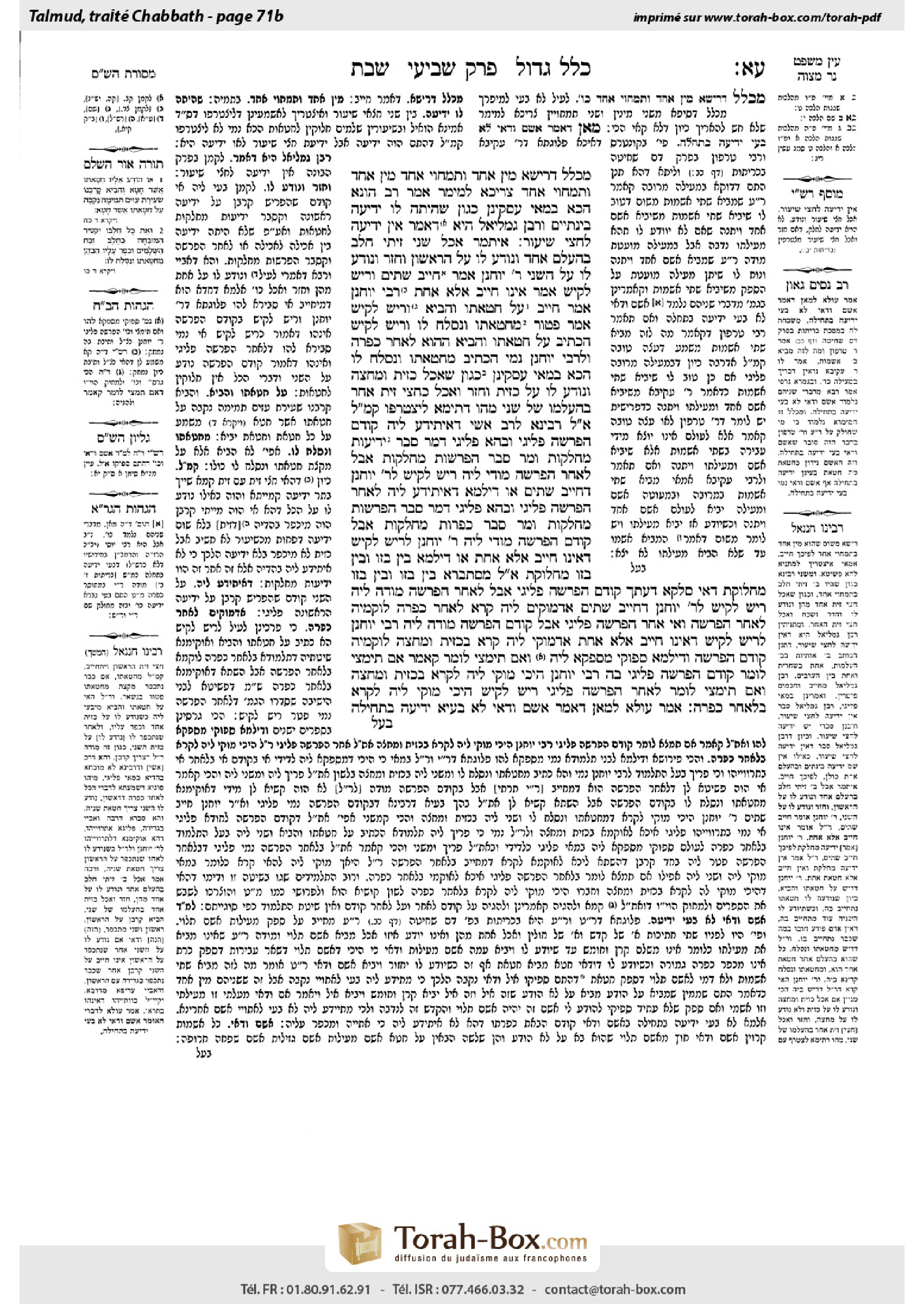
Shabbat 71b: Talmud study for Daf Yomi
Daf Yomi is the daily study of one Talmud folio. Explore 37 tractates with scans, Hebrew text, Sefaria English and AI-generated French translations where annotated.
Passage selection and English or AI-generated French translation are available where the scan has annotations. Daf Study is independent of Torah-Box and Sefaria.
Browse Shabbat · שבת · All tractatesShabbat 71b text and translations
This page of Shabbat includes the Aramaic text, an English translation and an AI-generated French translation, alongside the scan above.
שבת ע״א ב · Aramaic and Hebrew text
מִכְּלָל דְּרֵישָׁא מִין אֶחָד וְתַמְחוּי אֶחָד. מִין אֶחָד וְתַמְחוּי אֶחָד צְרִיכָא לְמֵימַר?! אָמַר רַב הוּנָא: הָכָא בְּמַאי עָסְקִינַן — כְּגוֹן שֶׁהָיְתָה לוֹ יְדִיעָה בֵּינְתַיִים. וְרַבָּן גַּמְלִיאֵל הִיא דְּאָמַר: אֵין יְדִיעָה לַחֲצִי שִׁיעוּר.
אִיתְּמַר: אָכַל שְׁנֵי זֵיתֵי חֵלֶב בְּהֶעְלֵם אֶחָד, וְנוֹדַע לוֹ עַל הָרִאשׁוֹן, וְחָזַר וְנוֹדַע לוֹ עַל הַשֵּׁנִי. רַבִּי יוֹחָנָן אָמַר: חַיָּיב שְׁתַּיִם. וְרֵישׁ לָקִישׁ אָמַר: אֵינוֹ חַיָּיב אֶלָּא אַחַת. רַבִּי יוֹחָנָן אָמַר חַיָּיב: ״עַל חַטָּאתוֹ ... וְהֵבִיא״. וְרֵישׁ לָקִישׁ אָמַר פָּטוּר: ״מֵחַטָּאתוֹ וְנִסְלַח לוֹ״.
וְרֵישׁ לָקִישׁ, הָכְתִיב: ״עַל חַטָּאתוֹ ... וְהֵבִיא״! הַהוּא לְאַחַר כַּפָּרָה. וּלְרַבִּי יוֹחָנָן נָמֵי, הָכְתִיב: ״מֵחַטָּאתוֹ וְנִסְלַח לוֹ״! הָכָא בְּמַאי עָסְקִינַן — כְּגוֹן שֶׁאָכַל כְּזַיִת וּמֶחֱצָה, וְנוֹדַע לוֹ עַל כְּזַיִת, וְחָזַר וְאָכַל כַּחֲצִי זַיִת אַחַר בְּהֶעְלֵמוֹ שֶׁל שֵׁנִי. מַהוּ דְּתֵימָא לִיצְטָרְפוּ — קָא מַשְׁמַע לַן.
אֲמַר לֵיהּ רָבִינָא לְרַב אָשֵׁי: דְּאִיתְיְדַע לֵיהּ קוֹדֶם הַפְרָשָׁה פְּלִיגִי, וּבְהָא פְּלִיגִי: דְּמָר סָבַר יְדִיעוֹת מְחַלְּקוֹת, וּמָר סָבַר הַפְרָשׁוֹת מְחַלְּקוֹת, אֲבָל לְאַחַר הַפְרָשָׁה מוֹדֵי לֵיהּ רֵישׁ לָקִישׁ לְרַבִּי יוֹחָנָן דְּחַיָּיב שְׁתַּיִם. אוֹ דִילְמָא דְּאִיתְיְדַע לֵיהּ לְאַחַר הַפְרָשָׁה פְּלִיגִי, וּבְהָא פְּלִיגִי: דְּמָר סָבַר הַפְרָשׁוֹת מְחַלְּקוֹת, וּמָר סָבַר כַּפָּרוֹת מְחַלְּקוֹת. אֲבָל קוֹדֶם הַפְרָשָׁה מוֹדֵי לֵיהּ רַבִּי יוֹחָנָן לְרֵישׁ לָקִישׁ דְּאֵינוֹ חַיָּיב אֶלָּא אַחַת. אוֹ דִילְמָא בֵּין בָּזוֹ וּבֵין בָּזוֹ מַחֲלוֹקֶת?
אֲמַר לֵיהּ: מִסְתַּבְּרָא בֵּין בָּזוֹ וּבֵין בָּזוֹ מַחֲלוֹקֶת. דְּאִי סָלְקָא דַּעְתָּךְ קוֹדֶם הַפְרָשָׁה פְּלִיגִי, אֲבָל לְאַחַר הַפְרָשָׁה מוֹדֶה לֵיהּ רֵישׁ לָקִישׁ לְרַבִּי יוֹחָנָן דְּחַיָּיב שְׁתַּיִם — אַדְּמוֹקֵים לֵיהּ קְרָא לְאַחַר כַּפָּרָה, לוֹקְמֵיהּ לְאַחַר הַפְרָשָׁה! וְאִי אַחַר הַפְרָשָׁה פְּלִיגִי, אֲבָל קוֹדֶם הַפְרָשָׁה מוֹדֶה לֵיהּ רַבִּי יוֹחָנָן לְרֵישׁ לָקִישׁ דְּאֵינוֹ חַיָּיב אֶלָּא אַחַת, אַדְּמוֹקֵי לֵיהּ קְרָא בִּכְזַיִת וּמֶחֱצָה, לוֹקְמֵיהּ קוֹדֶם הַפְרָשָׁה!
וְדִילְמָא סַפּוֹקֵי מְסַפְּקָא לֵיהּ, וְ״אִם תִּימְצֵי לוֹמַר״ קָאָמַר: אִם תִּימְצֵי לוֹמַר קוֹדֶם הַפְרָשָׁה פְּלִיגִי בַּהּ, רַבִּי יוֹחָנָן הֵיכִי מוֹקֵי לֵיהּ לִקְרָא — בִּכְזַיִת וּמֶחֱצָה. וְאִם תִּימְצֵי לוֹמַר לְאַחַר הַפְרָשָׁה פְּלִיגִי, רֵישׁ לָקִישׁ הֵיכִי מוֹקֵי לֵיהּ לִקְרָא — בִּלְאַחַר כַּפָּרָה.
אָמַר עוּלָּא: לְמַאן דְּאָמַר אָשָׁם וַדַּאי, לָא בָּעֵי יְדִיעָה בַּתְּחִילָּה,
Shabbat 71b · English translation
by inference, the first clause in the mishna is referring to one type of food and one dish. The problem is then more difficult. In a case where one ate two halves of an olive-bulk from one type of food and in one dish, was it necessary to say that he is liable? That is obvious. Rav Huna said: With what are we dealing here? We are dealing with a case where he had a period of awareness between eating the two half olive-bulks. After eating the first half of an olive-bulk, he became aware that he had eaten food that was prohibited. Then he became unaware again and ate the second half of an olive-bulk. Although, with regard to sacrifices, awareness usually serves as a line of demarcation between unwitting transgressions performed prior to the period of awareness and unwitting transgressions performed thereafter, the mishna is in accordance with the opinion of Rabban Gamliel who said: There is no awareness for half a measure. Since one is not liable to bring a sacrifice for half a measure, the fact that one became aware between consumption of the two halves of an olive-bulk is of no significance and does not demarcate between the two half-measures with regard to liability to bring a sin-offering.
A dispute between amora’im was stated: With regard to one who ate two olive-bulks of forbidden fat in one lapse of awareness, and became aware of the transgression of eating the first olive-bulk, and then became aware of the transgression of eating the second, Rabbi Yoḥanan said: He is liable to bring two sin-offerings, one offering for each transgression. And Reish Lakish said: He is liable to bring only one. Both Sages cite proofs for their opinions. Rabbi Yoḥanan said that he is liable as it is stated: “And he shall offer for his sin that he sinned…and he shall bring the ox” (Leviticus 4:3-4), indicating that he is liable to bring a separate sacrifice for each sin. And Reish Lakish said he is exempt, as it is stated: “And the priest shall atone for him from his sin, and it shall be forgiven for him” (Leviticus 4:26), indicating that even if he atoned from his sin, i.e., for part of his sin and not all of his sin, the entire transgression is forgiven.
The Gemara asks: And how can Reish Lakish say that one sin-offering is sufficient? Isn’t it written: “For his sin…and he shall bring”? The Gemara answers: That verse refers to a case where he only became aware of the second sin after attaining atonement for the first. However, if he became aware prior to atonement, he is required to bring only one sin-offering. The Gemara asks: And Rabbi Yoḥanan, too, how can he say that one is liable to bring two sin-offerings? Isn’t it written: “From his sin, and it shall be forgiven for him? The Gemara answers: According to Rabbi Yoḥanan, with what are we dealing here? It is a case where one ate an olive-bulk and a half, and he became aware of his transgression of eating a single olive-bulk, and then he ate another half of an olive-bulk in the course of the lapse of awareness of the second half of an olive-bulk that he ate together with the whole olive-bulk. Lest you say that the two halves of an olive-bulk should join together, and he is liable to bring an additional sin-offering, the verse teaches us that in that case he is exempt because he has already atoned for part of his transgression.
Ravina said to Rav Ashi: In the dispute between Rabbi Yoḥanan and Reish Lakish, they disagree in a case where one became aware of the second transgression prior to designating an animal for the first sin-offering, and this is the point over which they disagree: That one Sage, Rabbi Yoḥanan, holds that periods of awareness separate. Since one became aware of his sins at two different stages, he is liable to bring two sin-offerings. And one Sage, Reish Lakish, holds that only designations of animals for sacrifices separate. However, if one became aware of the second transgression after designation of the animal for the first sin-offering, Reish Lakish agrees with Rabbi Yoḥanan that he is liable to bring two sin-offerings. Or, perhaps they are disagreeing in a case where he became aware of the second sin after designating an animal for the first sin-offering, and this is the point over which they disagree: That one Sage, Rabbi Yoḥanan, holds that designations separate; and one Sage, Reish Lakish, holds that only atonements separate. Only after the sin-offering has been sacrificed on the altar and the sinner has obtained atonement can it be said that the sacrifice’s capacity to atone is spent and cannot atone for a sin of which he became aware afterward. However, if he became aware of the second sin prior to designation of the sacrifice, Rabbi Yoḥanan agrees with Reish Lakish that he is liable to bring only one sin-offering. Or, perhaps, the dispute between them is both in this case, before designation, and in that case, after designation.
Rav Ashi said to him: It is reasonable to say that the dispute is both in this case and in that case. As, should it enter your mind that they disagree only in a case where he became aware of the second sin prior to designation of an animal for the first sin-offering, and in a case where he became aware after designation Reish Lakish agrees with Rabbi Yoḥanan that he is liable to bring two sin-offerings, then rather than establishing the verse that posed a difficulty to Reish Lakish’s opinion in a case where one became aware of the second sin after atonement for the first, let him establish it in a case where one became aware of the transgression after designation of an animal for the first sin-offering. And similarly, if you say that they disagree only in a case where he became aware of the second sin after designation, and in a case where he became aware prior to designation Rabbi Yoḥanan agrees with Reish Lakish that he is only liable to bring one sin-offering, then rather than establishing the verse that posed a difficulty to Rabbi Yoḥanan’s opinion in a case where he ate an olive-bulk and a half, let him establish it in a case where he became aware of the transgression prior to designation.
Ravina does not accept this proof, as, in his opinion, it is flawed: And perhaps there is uncertainty with regard to this matter, and he spoke employing the style of: If you wish to say. If you wish to say that they disagree in a case where he became aware of the second sin prior to designation, then how does Rabbi Yoḥanan establish the verse? He establishes the verse in a case where one ate an olive-bulk and a half. And if you wish to say they disagree in a case where he became aware of the second sin after designation, then how does Reish Lakish establish the verse? He establishes the verse in a case where one became aware of the second sin after attaining atonement.
Ulla said: According to the one who said that in order to designate a definite guilt-offering, a sacrifice brought by one who committed a robbery, misused sacred objects, or had relations with a designated maidservant, one does not require prior knowledge that he definitely sinned,
Shabbat 71b · Traduction française (IA)
Par déduction, la première proposition de la Michna se rapporte à une seule sorte d’aliment et à un seul plat. Le problème est alors plus difficile : dans le cas où quelqu’un a mangé deux demi-volumes d’olive d’une même sorte d’aliment, dans un même plat, fallait-il préciser qu’il est passible ? Cela va de soi. Rav Houna dit : De quel cas s’agit-il ici ? D’un cas où il a connu une période de prise de conscience entre les deux demi-volumes d’olive qu’il a mangés. Après avoir mangé le premier demi-volume d’olive, il a pris conscience qu’il avait consommé un aliment interdit. Puis il est redevenu inconscient et a mangé le second demi-volume d’olive. Bien que, en matière de sacrifices, la prise de conscience marque habituellement une séparation entre les transgressions involontaires commises avant cette période et celles commises après, la Michna suit l’opinion de Rabban Gamliel, qui a dit : Il n’y a pas de prise de conscience pour une demi-mesure. Puisqu’on n’est pas passible d’apporter un sacrifice pour une demi-mesure, le fait qu’il ait pris conscience entre la consommation des deux demi-volumes d’olive n’a aucune importance et ne sépare pas ces deux demi-mesures en ce qui concerne l’obligation d’apporter un sacrifice expiatoire.
Une controverse entre amoraïm a été rapportée : au sujet de celui qui a mangé deux volumes d’olive de graisse interdite au cours d’une seule période d’inconscience, puis a pris conscience de la transgression consistant à manger le premier volume d’olive, et ensuite de celle consistant à manger le second, Rabbi Yoḥanan a dit : Il est passible d’apporter deux sacrifices expiatoires, un pour chaque transgression. Et Reish Lakish a dit : Il est passible d’en apporter un seul. Les deux Sages citent des preuves à l’appui de leurs opinions. Rabbi Yoḥanan dit qu’il est passible, car il est écrit : « Et il apportera pour le péché qu’il a commis… et il amènera le taureau » (Lévitique 4, 3-4), ce qui indique qu’il est passible d’apporter un sacrifice distinct pour chaque péché. Et Reish Lakish dit qu’il est quitte, car il est écrit : « Le prêtre fera pour lui l’expiation de son péché, et il lui sera pardonné » (Lévitique 4, 26), ce qui indique que même s’il a obtenu l’expiation pour son péché, c’est-à-dire pour une partie de celui-ci et non pour sa totalité, toute la transgression est pardonnée.
La Guemara demande : Comment Reish Lakish peut-il dire qu’un seul sacrifice expiatoire suffit ? N’est-il pas écrit : « Pour son péché… et il apportera » ? La Guemara répond : Ce verset se rapporte à un cas où il n’a pris conscience de la seconde transgression qu’après avoir obtenu l’expiation pour la première. Cependant, s’il en a pris conscience avant l’expiation, il ne doit apporter qu’un seul sacrifice expiatoire. La Guemara demande : Et comment Rabbi Yoḥanan peut-il, lui aussi, dire qu’on est passible d’apporter deux sacrifices expiatoires ? N’est-il pas écrit : « De son péché, et il lui sera pardonné » ? La Guemara répond : Selon Rabbi Yoḥanan, de quel cas s’agit-il ici ? D’un cas où quelqu’un a mangé un volume d’olive et demi, a pris conscience de sa transgression consistant à manger un volume d’olive, puis a mangé un autre demi-volume d’olive alors qu’il était encore inconscient de la transgression liée au demi-volume d’olive qu’il avait mangé avec le volume entier. De peur que tu ne dises que les deux demi-volumes d’olive doivent s’additionner et qu’il est passible d’apporter un sacrifice expiatoire supplémentaire, le verset nous enseigne que, dans ce cas, il est quitte, puisqu’il a déjà obtenu l’expiation pour une partie de sa transgression.
Ravina dit à Rav Ashi : Dans la controverse entre Rabbi Yoḥanan et Reish Lakish, ils sont en désaccord dans le cas où quelqu’un a pris conscience de la seconde transgression avant de désigner un animal pour le premier sacrifice expiatoire. Leur désaccord porte sur le point suivant : l’un des Sages, Rabbi Yoḥanan, considère que les périodes de prise de conscience séparent les transgressions. Puisqu’il a pris conscience de ses péchés à deux moments différents, il est passible d’apporter deux sacrifices expiatoires. L’autre Sage, Reish Lakish, considère que seules les désignations d’animaux pour les sacrifices séparent les transgressions. Toutefois, si quelqu’un a pris conscience de la seconde transgression après avoir désigné l’animal pour le premier sacrifice expiatoire, Reish Lakish convient avec Rabbi Yoḥanan qu’il est passible d’apporter deux sacrifices expiatoires. Ou peut-être sont-ils en désaccord dans le cas où il a pris conscience de la seconde transgression après avoir désigné un animal pour le premier sacrifice expiatoire. Leur désaccord porte alors sur le point suivant : l’un des Sages, Rabbi Yoḥanan, considère que les désignations séparent les transgressions, tandis que l’autre Sage, Reish Lakish, considère que seules les expiations les séparent. Ce n’est qu’après que le sacrifice expiatoire a été offert sur l’autel et que le pécheur a obtenu l’expiation qu’on peut dire que le pouvoir expiatoire du sacrifice est épuisé et qu’il ne peut pas expier une transgression dont il a pris conscience par la suite. Toutefois, s’il a pris conscience de la seconde transgression avant la désignation du sacrifice, Rabbi Yoḥanan convient avec Reish Lakish qu’il n’est passible d’apporter qu’un seul sacrifice expiatoire. Ou peut-être leur controverse porte-t-elle à la fois sur ce cas, avant la désignation, et sur cet autre cas, après la désignation.
Rav Ashi lui dit : Il est raisonnable de dire que leur controverse porte à la fois sur ce cas et sur cet autre cas. En effet, si tu envisages qu’ils ne sont en désaccord que dans le cas où il a pris conscience de la seconde transgression avant de désigner un animal pour le premier sacrifice expiatoire, et que, dans le cas où il en a pris conscience après la désignation, Reish Lakish convient avec Rabbi Yoḥanan qu’il est passible d’apporter deux sacrifices expiatoires, alors, plutôt que de situer dans un cas où quelqu’un a pris conscience de la seconde transgression après avoir obtenu l’expiation pour la première le verset qui faisait difficulté à l’opinion de Reish Lakish, qu’on le situe dans un cas où quelqu’un a pris conscience de la transgression après avoir désigné un animal pour le premier sacrifice expiatoire. De même, si tu dis qu’ils ne sont en désaccord que dans le cas où il a pris conscience de la seconde transgression après la désignation, et que, dans le cas où il en a pris conscience avant la désignation, Rabbi Yoḥanan convient avec Reish Lakish qu’il n’est passible d’apporter qu’un seul sacrifice expiatoire, alors, plutôt que de situer dans le cas où quelqu’un a mangé un volume d’olive et demi le verset qui faisait difficulté à l’opinion de Rabbi Yoḥanan, qu’on le situe dans le cas où il a pris conscience de la transgression avant la désignation.
Ravina n’accepte pas cette preuve, car, selon lui, elle est erronée : peut-être la question est-elle incertaine, et Rav Ashi s’est-il exprimé sous la forme « Si tu veux dire… ». Si tu veux dire qu’ils sont en désaccord dans le cas où il a pris conscience de la seconde transgression avant la désignation, comment Rabbi Yoḥanan interprète-t-il le verset ? Il l’interprète comme se rapportant au cas où quelqu’un a mangé un volume d’olive et demi. Et si tu veux dire qu’ils sont en désaccord dans le cas où il a pris conscience de la seconde transgression après la désignation, comment Reish Lakish interprète-t-il le verset ? Il l’interprète comme se rapportant au cas où quelqu’un a pris conscience de la seconde transgression après avoir obtenu l’expiation.
Oula dit : Selon celui qui a dit que, pour désigner un sacrifice de culpabilité certain — sacrifice apporté par celui qui a commis un vol, détourné des objets sacrés ou eu des relations avec une servante désignée — il n’est pas nécessaire de savoir au préalable qu’il a certainement péché,
Traduction française générée par IA à partir de l’édition anglaise de Sefaria. Vérifie toujours un passage avec le texte source.
Text from Sefaria: William Davidson Edition - Vocalized Aramaic (CC BY NC); William Davidson Edition - English (CC BY NC).