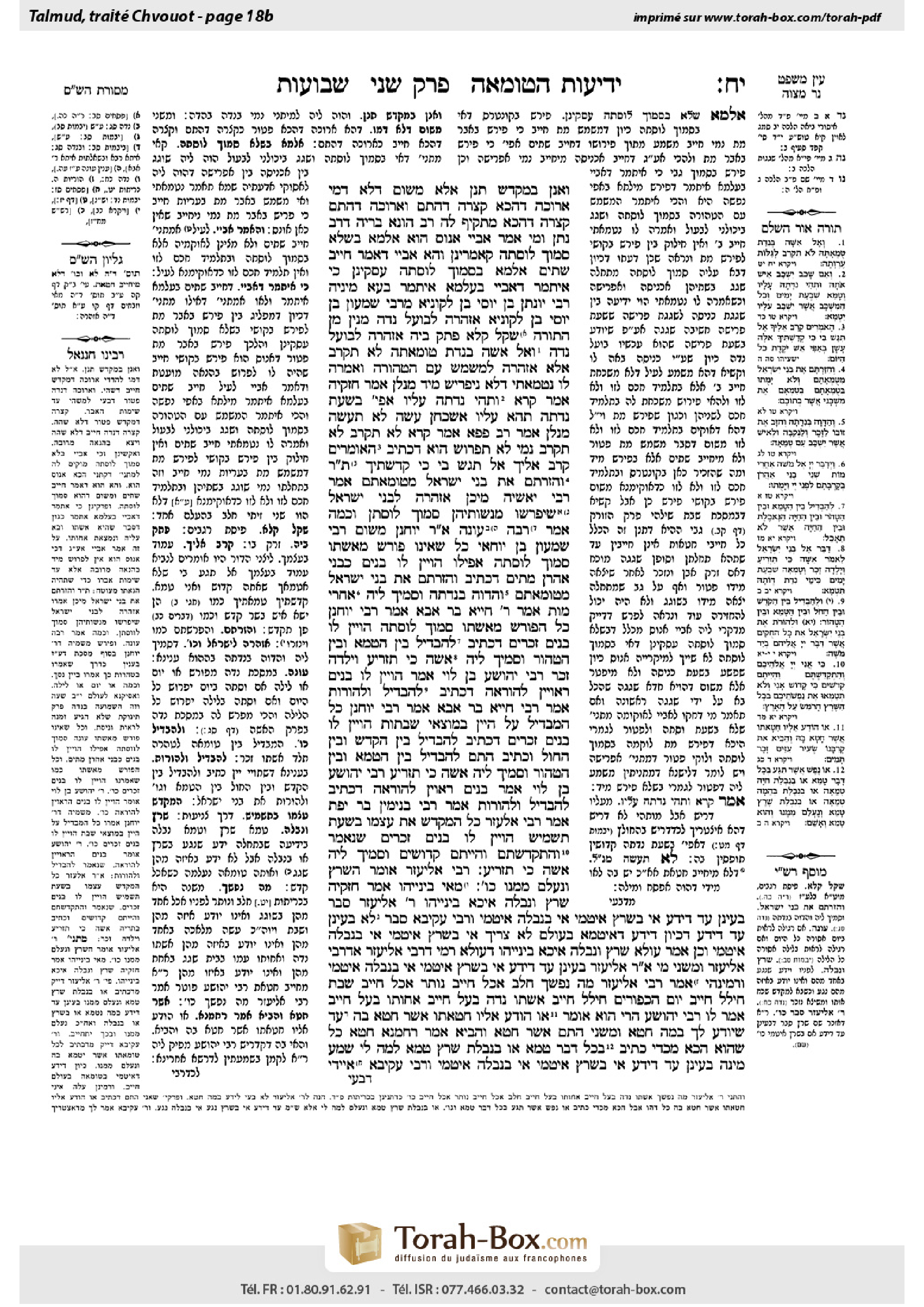
Shevuot 18b: Talmud study for Daf Yomi
Daf Yomi is the daily study of one Talmud folio. Explore 37 tractates with scans, Hebrew text, Sefaria English and AI-generated French translations where annotated.
Passage selection and English or AI-generated French translation are available where the scan has annotations. Daf Study is independent of Torah-Box and Sefaria.
Browse Shevuot · שבועות · All tractatesShevuot 18b text and translations
This page of Shevuot includes the Aramaic text, an English translation and an AI-generated French translation, alongside the scan above.
שבועות י״ח ב · Aramaic and Hebrew text
וַאֲנַן בַּמִּקְדָּשׁ תְּנַן! אֶלָּא מִשּׁוּם דְּלָא דָּמֵי; אֲרוּכָּה דְּהָכָא – קְצָרָה דְּהָתָם, וַאֲרוּכָּה דְּהָתָם – קְצָרָה דְּהָכָא.
מַתְקֵיף לַהּ רַב הוּנָא בְּרֵיהּ דְּרַב נָתָן: מִי אָמַר אַבָּיֵי אָנוּס הוּא – אַלְמָא בְּשֶׁלֹּא סָמוּךְ לְוִסְתָּהּ קָאָמְרִינַן?! וְהָא אַבַּיֵּי דְּאָמַר חַיָּיב שְׁתַּיִם – אַלְמָא בְּסָמוּךְ לְוִסְתָּהּ עָסְקִינַן!
כִּי אִיתְּמַר דְּאַבָּיֵי – בְּעָלְמָא אִיתְּמַר.
בְּעָא מִינֵּיהּ רַבִּי יוֹנָתָן בֶּן יוֹסֵי בֶּן לָקוֹנְיָא מֵרַבִּי שִׁמְעוֹן בֶּן יוֹסֵי בֶּן לָקוֹנְיָא: אַזְהָרָה לְבוֹעֵל נִדָּה, מִנַּיִן מִן הַתּוֹרָה? שְׁקַל קָלָא פְּתַק בֵּיהּ: אַזְהָרָה לְבוֹעֵל נִדָּה?! ״וְאֶל אִשָּׁה בְּנִדַּת טֻמְאָתָהּ לֹא תִקְרַב״!
אֶלָּא אַזְהָרָה לִמְשַׁמֵּשׁ עִם הַטְּהוֹרָה וְאָמְרָה לוֹ ״נִטְמֵאתִי״, דְּלָא נִיפְרוֹשׁ מִיָּד – מְנָלַן? אָמַר חִזְקִיָּה, אָמַר קְרָא: ״וּתְהִי נִדָּתָהּ עָלָיו״ – אֲפִילּוּ בִּשְׁעַת נִדָּתָהּ תְּהֵא עָלָיו.
אַשְׁכְּחַן עֲשֵׂה, לֹא תַעֲשֶׂה מְנָלַן? אָמַר רַב פָּפָּא, אָמַר קְרָא: ״לֹא תִקְרַב״; ״לֹא תִקְרַב״ נָמֵי לָא תִּפְרוֹשׁ הוּא, דִּכְתִיב: ״הָאֹמְרִים קְרַב אֵלֶיךָ אַל תִּגַּשׁ בִּי כִּי קְדַשְׁתִּיךָ״.
תָּנוּ רַבָּנַן: ״וְהִזַּרְתֶּם אֶת בְּנֵי יִשְׂרָאֵל מִטֻּמְאָתָם״ – אָמַר רַבִּי יֹאשִׁיָּה: מִיכָּן אַזְהָרָה לִבְנֵי יִשְׂרָאֵל שֶׁיִּפְרְשׁוּ מִנְּשׁוֹתֵיהֶן סָמוּךְ לְוִסְתָּן. וְכַמָּה? אָמַר רַבָּה: עוֹנָה.
אָמַר רַבִּי יוֹחָנָן מִשּׁוּם רַבִּי שִׁמְעוֹן בֶּן יוֹחַאי: כֹּל שֶׁאֵינוֹ פּוֹרֵשׁ מֵאִשְׁתּוֹ סָמוּךְ לְוִסְתָּהּ, אֲפִילּוּ הוֹיִין לוֹ בָּנִים כִּבְנֵי אַהֲרֹן – מֵתִים; דִּכְתִיב: ״וְהִזַּרְתֶּם אֶת בְּנֵי יִשְׂרָאֵל מִטֻּמְאָתָם וְהַדָּוָה בְּנִדָּתָהּ״, וּסְמִיךְ לֵיהּ: ״אַחֲרֵי מוֹת״.
אָמַר רַבִּי חִיָּיא בַּר אַבָּא אָמַר רַבִּי יוֹחָנָן: כׇּל הַפּוֹרֵשׁ מֵאִשְׁתּוֹ סָמוּךְ לְוִסְתָּהּ – הוֹיִין לוֹ בָּנִים זְכָרִים, דִּכְתִיב: ״לְהַבְדִּיל בֵּין הַטָּמֵא וּבֵין הַטָּהֹר״, וּסְמִיךְ לֵיהּ: ״אִשָּׁה כִּי תַזְרִיעַ וְיָלְדָה זָכָר״. רַבִּי יְהוֹשֻׁעַ בֶּן לֵוִי אָמַר: הוֹיִין לוֹ בָּנִים רְאוּיִין לְהוֹרָאָה, דִּכְתִיב: ״לְהַבְדִּיל... וּלְהוֹרוֹת״.
אָמַר רַבִּי חִיָּיא בַּר אַבָּא, אָמַר רַבִּי יוֹחָנָן: כׇּל הַמַּבְדִּיל עַל הַיַּיִן בְּמוֹצָאֵי שַׁבָּתוֹת – הוֹיִין לוֹ בָּנִים זְכָרִים; דִּכְתִיב: ״לְהַבְדִּיל בֵּין הַקֹּדֶשׁ וּבֵין הַחוֹל״, וּכְתִיב הָתָם: ״לְהַבְדִּיל בֵּין הַטָּמֵא וּבֵין הַטָּהוֹר״, וּסְמִיךְ לֵיהּ: ״אִשָּׁה כִּי תַזְרִיעַ״. רַבִּי יְהוֹשֻׁעַ בֶּן לֵוִי אָמַר: בָּנִים רְאוּיִן לְהוֹרָאָה, דִּכְתִיב: ״לְהַבְדִּיל... וּלְהוֹרוֹת״.
אָמַר רַבִּי בִּנְיָמִין בַּר יֶפֶת, אָמַר רַבִּי אֶלְעָזָר: כׇּל הַמְקַדֵּשׁ אֶת עַצְמוֹ בִּשְׁעַת תַּשְׁמִישׁ – הוֹיִין לוֹ בָּנִים זְכָרִים; שֶׁנֶּאֱמַר: ״וְהִתְקַדִּשְׁתֶּם וִהְיִיתֶם קְדֹשִׁים״, וּסְמִיךְ לֵיהּ: ״אִשָּׁה כִּי תַזְרִיעַ״.
רַבִּי אֱלִיעֶזֶר אוֹמֵר: ״הַשֶּׁרֶץ וְנֶעְלַם מִמֶּנּוּ״ כּוּ׳. מַאי בֵּינַיְיהוּ?
אָמַר חִזְקִיָּה: שֶׁרֶץ וּנְבֵלָה אִיכָּא בֵּינַיְיהוּ – רַבִּי אֱלִיעֶזֶר סָבַר: בָּעֵינַן עַד דְּיָדַע אִי בְּשֶׁרֶץ אִיטַּמִּי אִי בִּנְבֵלָה אִיטַּמִּי; וְרַבִּי עֲקִיבָא סָבַר: לָא בָּעֵינַן עַד דְּיָדַע, דְּכֵיוָן דְּיָדַע (דְּאִיטַּמָּא) [דְּאִיטַּמִּי] בָּעוֹלָם, לָא צְרִיךְ אִי בְּשֶׁרֶץ אִיטַּמִּי אִי בִּנְבֵלָה אִיטַּמִּי.
וְכֵן אָמַר עוּלָּא: שֶׁרֶץ וּנְבֵלָה אִיכָּא בֵּינַיְיהוּ. דְּעוּלָּא רָמֵי דְּרַבִּי אֱלִיעֶזֶר אַדְּרַבִּי אֱלִיעֶזֶר, וּמְשַׁנֵּי – מִי אָמַר רַבִּי אֱלִיעֶזֶר בָּעֵינַן עַד דְּיָדַע אִי בְּשֶׁרֶץ אִיטַּמִּי אִי בִּנְבֵלָה אִיטַּמִּי?!
ורְמִינְהִי, אָמַר רַבִּי אֱלִיעֶזֶר: מָה נַפְשָׁךְ? חֵלֶב אָכַל – חַיָּיב; נוֹתָר אָכַל – חַיָּיב; שַׁבָּת חִילֵּל – חַיָּיב; יוֹם הַכִּפּוּרִים חִילֵּל – חַיָּיב; אִשְׁתּוֹ נִדָּה בָּעַל – חַיָּיב; אֲחוֹתוֹ בָּעַל – חַיָּיב!
אָמַר לוֹ רַבִּי יְהוֹשֻׁעַ, הֲרֵי הוּא אוֹמֵר: ״אוֹ הוֹדַע אֵלָיו חַטָּאתוֹ אֲשֶׁר חָטָא בָּהּ״ – עַד שֶׁיִּוָּדַע לָךְ בַּמֶּה חָטָא.
וּמְשַׁנֵּי: הָתָם, ״אֲשֶׁר חָטָא וְהֵבִיא״ אָמַר רַחֲמָנָא – חֵטְא כׇּל שֶׁהוּא. הָכָא, מִכְּדֵי כְּתִיב ״בְּכׇל דָּבָר טָמֵא״; ״אוֹ בְּנִבְלַת שֶׁרֶץ טָמֵא״ לְמָה לִי? שְׁמַע מִינַּהּ: בָּעֵינַן עַד דְּיָדַע אִי בְּשֶׁרֶץ אִיטַּמִּי אִי בִּנְבֵלָה אִיטַּמִּי.
וְרַבִּי עֲקִיבָא – אַיְּידֵי
Shevuot 18b · English translation
And we learned this difference in the mishna specifically with regard to ritual impurity in the Temple. If such a distinction were also in effect with regard to a menstruating woman, the mishna would mention it. Rather, one can explain: No parallel distinction is made, because the two cases are not similar in their details. The long way here, with regard to a menstruating woman, namely, that the man must wait, is like the shortest way there, with regard to impurity in the Temple, namely, that the impure person must leave the Temple by way of the most direct route. And the long way there, with regard to the Temple, is like the shortest way here, with regard to a menstruating woman.
Rav Huna, son of Rav Natan, objects to what Abaye said: Did Abaye really say with regard to the mishna that if the man withdraws with a flaccid penis he is exempt because he is considered a victim of circumstances beyond his control? Apparently, then, we are speaking of a man who engaged in intercourse with a woman not near the expected date of her menstruation, and therefore the situation is considered beyond his control. But is it not Abaye who says that he is liable to bring two sin-offerings for this transgression, one for his initial entry and one for his withdrawal? Apparently, we are dealing with a man who engaged in intercourse with a woman near the expected date of her menstruation, so he is considered an unwitting transgressor, who is liable to bring a sin-offering, and is not the victim of circumstances beyond his control. Consequently, Abaye’s two statements contradict each other.
The Gemara answers: When this statement of Abaye was stated, that the man is liable to bring two sin-offerings, it was stated in general. It was not relating to the case in the mishna, but was an independent ruling concerning one who engages in intercourse with a woman near the expected date of her menstruation.
§ Rabbi Yonatan ben Yosei ben Lakonya asked Rabbi Shimon ben Yosei ben Lakonya: From where in the Torah is the prohibition concerning one who engages in intercourse with a menstruating woman [nidda] derived? Rabbi Shimon ben Yosei ben Lakonya took a clod [kala] of earth and threw it at him in reproach and said to him: Is there a need to search the Torah for a derivation for the prohibition concerning one who engages in intercourse with a menstruating woman? The verse states: “And a woman who is impure by her uncleanness [nidda] you shall not approach, to uncover her nakedness” (Leviticus 18:19)?
The Gemara explains the intent of the question of Rabbi Yonatan ben Yosei ben Lakonya: Rather, from where do we derive the prohibition with regard to the case in the mishna concerning one who was engaging in intercourse with a ritually pure woman, and she experienced menstrual bleeding and said to him: I have become impure, that he must not withdraw immediately? In response to this question Ḥizkiyya said: The verse states: “And if any man lies with her, and her menstrual flow shall be upon him” (Leviticus 15:24), teaching that even at any time when she is menstruating, the prohibition shall be upon him; therefore, he must not withdraw from her immediately.
The Gemara asks: We found a source for a positive mitzva with regard to the manner in which one must withdraw from a menstruating woman; from where do we derive that immediate withdrawal is also subject to a prohibition? Rav Pappa said: The verse states: “And a woman who is impure by her uncleanness you shall not approach, to uncover her nakedness” (Leviticus 18:19). The Gemara explains: “You shall not approach [tikrav]” means also the opposite: You shall not withdraw, as it is written: “Those who say: Withdraw [kerav] to yourself, come not near to me, for I am holier than you” (Isaiah 65:5), where “kerav” means remove or withdraw.
§ Having mentioned that it is prohibited for a man to engage in intercourse with a woman near the expected date of her menstruation, the Gemara cites a baraita in which the Sages taught: The verse with regard to a menstruating woman states: “And shall you separate the children of Israel from their uncleanness” (Leviticus 15:31), Rabbi Yoshiya says: From here we derive a prohibition to the children of Israel that they must separate from their wives near the expected date of their menstruation. And how long before must they separate? Rabba says: A set interval of time for the ritual impurity of a menstruating woman, which is half of a twenty-four hour day, either the daytime or the nighttime.
Rabbi Yoḥanan says in the name of Rabbi Shimon ben Yoḥai: With regard to anyone who does not separate from his wife near the expected date of her menstruation, even if he has sons who are fit to be great and holy like the sons of Aaron, these sons will die due to his sin, as it is written: “And shall you separate the children of Israel from their uncleanness…this is the law…of her that is sick with her menstrual flow” (Leviticus 15:31–33), and it is stated near it: “After the death of the two sons of Aaron” (Leviticus 16:1).
Concerning this matter, Rabbi Ḥiyya bar Abba says that Rabbi Yoḥanan says: Anyone who separates himself from his wife near the expected date of her menstruation will have male children, as it is written: “To distinguish between the impure and the pure” (Leviticus 11:47), and it is stated near it: “If a woman conceive and bear a male child” (Leviticus 12:2). Rabbi Yehoshua ben Levi says: He will have sons who are worthy of teaching halakha, as it is written: “To distinguish…between the impure and the pure, and to teach the children of Israel all the statutes” (Leviticus 10:10–11).
The Gemara continues to expound these verses: Rabbi Ḥiyya bar Abba says that Rabbi Yoḥanan says: Anyone who recites havdala over wine at the conclusion of Shabbatot, and not over some other beverage, will have male children, as it is written: “To distinguish between the holy and the unholy, and between the impure and the pure” (Leviticus 10:10), and it is written there once again: “To distinguish between the impure and the pure” (Leviticus 11:47), and it is stated near it: “If a woman conceive and bear a male child” (Leviticus 12:2). Rabbi Yehoshua ben Levi says: Anyone who recites havdala over wine at the conclusion of Shabbatot will have sons who are worthy of teaching halakha, as it is written: “To distinguish between the holy and the unholy…and to teach” (Leviticus 10:10–11).
Rabbi Binyamin bar Yefet says that Rabbi Elazar says: Anyone who sanctifies himself with modest conduct while engaging in sexual intercourse will have male children, as it is stated: “You shall sanctify yourselves, and you shall be holy” (Leviticus 11:44), and it is stated near it: “If a woman conceive and bear a male child” (Leviticus 12:2).
§ The mishna teaches: Rabbi Eliezer says: With regard to the sliding-scale offering the verse states: “Or if a person touches any impure thing, whether it is the carcass of a non-kosher undomesticated animal, or the carcass of a non-kosher domesticated animal, or the carcass of a non-kosher creeping animal, and it is hidden from him, so that he is impure” (Leviticus 5:2). The juxtaposition of the words “and it is hidden” to the words “a creeping animal” teaches that one is liable to bring a sliding-scale offering when it was hidden from him that he had contracted ritual impurity from a creeping animal, but not when it was hidden from him that he was entering the Temple or partaking of sacrificial food. Rabbi Akiva says that it is from the words “and it is hidden from him, so that he is impure” that it is derived that one is liable to bring a sliding-scale offering for a lapse of awareness about his impurity, but not for a lapse of awareness about the Temple or the sacrificial food. The Gemara asks: Since Rabbi Eliezer and Rabbi Akiva agree about the halakha, what is the practical difference between them?
Ḥizkiyya says: There is a practical difference between them in a case where one initially knew that he had contracted ritual impurity, but he did not know whether the impurity was contracted from a creeping animal or from the carcass of an unslaughtered animal. Rabbi Eliezer holds that for him to be liable to bring an offering, we require that he initially know whether he contracted impurity from a creeping animal or he contracted impurity from an unslaughtered animal carcass, and if he never knew this, he does not bring an offering. And Rabbi Akiva holds that for him to be liable to bring an offering, we do not require that he know this detail; since he knows in general terms that he contracted impurity, it is not necessary that one know whether he contracted the impurity from a creeping animal or he contracted the impurity from an unslaughtered animal carcass.
And Ulla also says: There is a practical difference between them in a case where the person did not know whether he contracted impurity from a creeping animal or from the carcass of an unslaughtered animal. Ulla did not say this explicitly, but rather he raises a contradiction between this statement of Rabbi Eliezer and another statement of Rabbi Eliezer, and then resolves it. He asked: Does Rabbi Eliezer actually say that in order to be liable to bring a sliding-scale offering, we require that one initially know whether he contracted impurity from a creeping animal or he contracted impurity from an unslaughtered animal carcass?
And he raises a contradiction from a baraita with regard to one who ate a forbidden food but did not know whether it was forbidden fat or it was notar, part of a sacrifice left over after the time allotted for its consumption; or one who performed labor but did not know whether it was Shabbat or Yom Kippur; or one who engaged in intercourse but did not know whether it was with his menstruating wife or with his sister. In all these cases Rabbi Eliezer holds that he must bring a sin-offering, whereas Rabbi Yehoshua deems him exempt. Rabbi Eliezer says: Whichever way you look at it, he is liable. If he ate forbidden fat he is liable; if he ate notar he is liable. If he desecrated Shabbat he is liable; if he desecrated Yom Kippur he is liable. If he engaged in intercourse with his menstruating wife, he is liable; if he engaged in intercourse with his sister, he is liable. In all these cases, he knows that he transgressed, and he is liable to bring a sin-offering.
Rabbi Yehoshua said to Rabbi Eliezer: The verse states with regard to a sin-offering: “Or if his sin, in which he sinned, became known to him” (Leviticus 4:23), teaching that there is no liability for an offering until it becomes known to the sinner the manner in which he sinned. According to this baraita, Rabbi Eliezer himself holds that in order to become liable to bring a sin-offering, it is not necessary that one know precisely which prohibition he violated.
And Ulla resolves the contradiction: There, with regard to liability to bring a sin-offering, the Merciful One states: “Or if his sin, in which he sinned, became known to him, he shall bring his offering” (Leviticus 4:23), teaching that it suffices that he knows that he committed some type of sin. Here, with regard to ritual impurity in the Temple, since it is written at the beginning of the verse: “Or if a person touches any impure thing” (Leviticus 5:2), why do I need that which is stated immediately afterward: “Or the carcass of a non-kosher creeping animal”? Conclude from it that we require that he initially know whether he contracted impurity from a creeping animal or he contracted impurity from an unslaughtered animal carcass, and if he never knew this, he does not bring an offering.
The Gemara asks: And Rabbi Akiva, who does not expound the verses in this way, what does he say to this? The Gemara answers: He maintains that since
Shevuot 18b · Traduction française (IA)
Nous avons appris cette distinction dans la Michna précisément au sujet de l’impureté dans le Temple. Si une distinction semblable s’appliquait également à une femme menstruée, la Michna la mentionnerait. Il faut plutôt expliquer qu’aucune distinction parallèle n’est faite, car les deux cas ne sont pas semblables dans leurs détails. Le long chemin ici, au sujet d’une femme menstruée — c’est-à-dire que l’homme doit attendre — correspond au chemin le plus court là-bas, au sujet de l’impureté dans le Temple — c’est-à-dire que la personne impure doit quitter le Temple par le trajet le plus direct. Et le long chemin là-bas, au sujet du Temple, correspond au chemin le plus court ici, au sujet d’une femme menstruée.
Rav Houna, fils de Rav Natan, objecte à ce qu’a dit Abayé : Abayé a-t-il vraiment dit, au sujet de la Michna, que si l’homme se retire avec le pénis flasque, il est exempté parce qu’il est considéré comme victime de circonstances indépendantes de sa volonté ? Il s’ensuivrait que nous parlons d’un homme qui a eu des rapports avec une femme à une période éloignée de la date présumée de ses règles, et que la situation est donc considérée comme indépendante de sa volonté. Mais n’est-ce pas Abayé qui dit qu’il est passible d’apporter deux sacrifices expiatoires pour cette transgression, l’un pour sa pénétration initiale et l’autre pour son retrait ? Il s’ensuivrait que nous parlons d’un homme qui a eu des rapports avec une femme à l’approche de la date présumée de ses règles ; il est donc considéré comme un transgresseur involontaire, passible d’apporter un sacrifice expiatoire, et non comme victime de circonstances indépendantes de sa volonté. Par conséquent, les deux déclarations d’Abayé se contredisent.
La Guemara répond : La déclaration d’Abayé selon laquelle l’homme est passible d’apporter deux sacrifices expiatoires a été formulée de façon générale. Elle ne concernait pas le cas de la Michna, mais constituait une décision indépendante à propos de celui qui a des rapports avec une femme à l’approche de la date présumée de ses règles.
§ Rabbi Yonatan ben Yossei ben Lakonya demanda à Rabbi Shimon ben Yossei ben Lakonya : D’où la Torah tire-t-elle l’interdiction d’avoir des rapports avec une femme menstruée [nidda] ? Rabbi Shimon ben Yossei ben Lakonya prit une motte [kala] de terre, la lui lança en signe de reproche et lui dit : Faut-il vraiment chercher dans la Torah une déduction de l’interdiction d’avoir des rapports avec une femme menstruée ? Le verset dit : « Tu ne t’approcheras pas d’une femme impure par sa souillure [nidda], pour découvrir sa nudité » (Lévitique 18:19).
La Guemara explique le sens de la question de Rabbi Yonatan ben Yossei ben Lakonya : La question est plutôt de savoir d’où nous déduisons l’interdiction concernant le cas de la Michna, où un homme avait des rapports avec une femme rituellement pure, mais où celle-ci eut des saignements menstruels et lui dit : « Je suis devenue impure », de sorte qu’il ne doit pas se retirer immédiatement. En réponse à cette question, Ḥizkiyya dit : Le verset dit : « Si un homme couche avec elle, son flux menstruel sera sur lui » (Lévitique 15:24). Cela enseigne que même à tout moment où elle est menstruée, l’interdiction s’applique à lui ; il ne doit donc pas se retirer immédiatement.
La Guemara demande : Nous avons trouvé une source pour une mitsva positive concernant la manière dont on doit se retirer d’une femme menstruée ; d’où déduisons-nous que le retrait immédiat fait aussi l’objet d’une interdiction ? Rav Pappa dit : Le verset dit : « Tu ne t’approcheras pas d’une femme impure par sa souillure, pour découvrir sa nudité » (Lévitique 18:19). La Guemara explique : « Tu ne t’approcheras pas [tikrav] » signifie aussi le contraire : tu ne te retireras pas, comme il est écrit : « Ceux qui disent : Éloigne-toi [kerav] de moi, ne t’approche pas, car je suis plus saint que toi » (Isaïe 65:5), où « kerav » signifie s’éloigner ou se retirer.
§ Puisqu’il a été dit qu’il est interdit à un homme d’avoir des rapports avec une femme à l’approche de la date présumée de ses règles, la Guemara cite une baraïta dans laquelle les Sages enseignent : Au sujet d’une femme menstruée, le verset dit : « Vous séparerez les enfants d’Israël de leur impureté » (Lévitique 15:31). Rabbi Yoshiya dit : Nous en déduisons que les enfants d’Israël ont l’interdiction de s’approcher de leurs femmes à l’approche de la date présumée de leurs règles. Combien de temps à l’avance doivent-ils se séparer ? Rabba dit : Il s’agit d’un intervalle de temps fixe correspondant à l’impureté rituelle d’une femme menstruée, soit la moitié d’une journée de vingt-quatre heures, le jour ou la nuit.
Rabbi Yoḥanan dit au nom de Rabbi Shimon ben Yoḥai : Quiconque ne se sépare pas de sa femme à l’approche de la date présumée de ses règles, même s’il a des fils capables de devenir aussi grands et saints que les fils d’Aaron, ces fils mourront à cause de son péché, comme il est écrit : « Vous séparerez les enfants d’Israël de leur impureté… Voici la loi… de celle qui souffre de son flux menstruel » (Lévitique 15:31–33), et il est écrit juste après : « Après la mort des deux fils d’Aaron » (Lévitique 16:1).
À ce sujet, Rabbi Ḥiyya bar Abba dit au nom de Rabbi Yoḥanan : Quiconque se sépare de sa femme à l’approche de la date présumée de ses règles aura des fils, comme il est écrit : « Pour distinguer entre l’impur et le pur » (Lévitique 11:47), et il est écrit juste après : « Si une femme conçoit et enfante un fils » (Lévitique 12:2). Rabbi Yehoshua ben Levi dit : Il aura des fils dignes d’enseigner la halakha, comme il est écrit : « Pour distinguer… entre l’impur et le pur, et pour enseigner aux enfants d’Israël toutes les lois » (Lévitique 10:10–11).
La Guemara poursuit l’interprétation de ces versets. Rabbi Ḥiyya bar Abba dit au nom de Rabbi Yoḥanan : Quiconque récite la havdala sur du vin à la fin des Shabbatot, et non sur une autre boisson, aura des fils, comme il est écrit : « Pour distinguer entre le sacré et le profane, et entre l’impur et le pur » (Lévitique 10:10), et il est écrit une nouvelle fois : « Pour distinguer entre l’impur et le pur » (Lévitique 11:47), puis il est écrit juste après : « Si une femme conçoit et enfante un fils » (Lévitique 12:2). Rabbi Yehoshua ben Levi dit : Quiconque récite la havdala sur du vin à la fin des Shabbatot aura des fils dignes d’enseigner la halakha, comme il est écrit : « Pour distinguer entre le sacré et le profane… et pour enseigner » (Lévitique 10:10–11).
Rabbi Binyamin bar Yefet dit au nom de Rabbi Elazar : Quiconque se sanctifie par une conduite pudique lorsqu’il a des rapports sexuels aura des fils, comme il est écrit : « Vous vous sanctifierez et vous serez saints » (Lévitique 11:44), et il est écrit juste après : « Si une femme conçoit et enfante un fils » (Lévitique 12:2).
§ La Michna enseigne : Rabbi Eliezer dit : Au sujet de l’offrande graduée, le verset dit : « Ou si une personne touche une chose impure, qu’il s’agisse de la carcasse d’un animal sauvage non casher, de la carcasse d’un animal domestique non casher, ou de la carcasse d’un animal rampant non casher, et que cela lui soit caché, de sorte qu’elle soit impure » (Lévitique 5:2). Le rapprochement des mots « et que cela lui soit caché » avec les mots « un animal rampant » enseigne qu’on est passible d’apporter une offrande graduée lorsque l’on ignorait avoir contracté l’impureté rituelle au contact d’un animal rampant, mais non lorsque l’on ignorait pénétrer dans le Temple ou consommer de la nourriture consacrée. Rabbi Akiva dit que c’est des mots « et que cela lui soit caché, de sorte qu’elle soit impure » que l’on déduit qu’on est passible d’apporter une offrande graduée pour une méconnaissance de son impureté, mais non pour une méconnaissance concernant le Temple ou la nourriture consacrée. La Guemara demande : Puisque Rabbi Eliezer et Rabbi Akiva sont d’accord sur la halakha, quelle différence pratique y a-t-il entre eux ?
Ḥizkiyya dit : Il y a une différence pratique entre eux dans le cas où quelqu’un savait au départ qu’il avait contracté une impureté rituelle, mais ignorait si celle-ci provenait d’un animal rampant ou de la carcasse d’un animal non abattu rituellement. Rabbi Eliezer estime que, pour être passible d’apporter une offrande, il faut qu’il sache au départ s’il a contracté l’impureté au contact d’un animal rampant ou de la carcasse d’un animal non abattu rituellement ; s’il ne l’a jamais su, il n’apporte pas d’offrande. Rabbi Akiva, lui, estime qu’il n’est pas nécessaire qu’il connaisse ce détail pour être passible d’apporter une offrande ; puisqu’il sait de manière générale qu’il a contracté une impureté, il n’est pas nécessaire de savoir s’il l’a contractée au contact d’un animal rampant ou de la carcasse d’un animal non abattu rituellement.
Oulla dit également : Il y a une différence pratique entre eux dans le cas où la personne ignorait si elle avait contracté l’impureté au contact d’un animal rampant ou de la carcasse d’un animal non abattu rituellement. Oulla ne l’a pas dit explicitement, mais il soulève une contradiction entre cette déclaration de Rabbi Eliezer et une autre déclaration de Rabbi Eliezer, puis la résout. Il demanda : Rabbi Eliezer dit-il réellement que, pour être passible d’apporter une offrande graduée, il faut savoir au départ si l’on a contracté l’impureté au contact d’un animal rampant ou de la carcasse d’un animal non abattu rituellement ?
Il soulève une contradiction à partir d’une baraïta au sujet de celui qui a mangé un aliment interdit, mais ignorait s’il s’agissait de graisse interdite ou de notar, c’est-à-dire d’un reste de sacrifice après le délai prévu pour sa consommation ; ou de celui qui a accompli un travail, mais ignorait si c’était Chabbat ou Yom Kippour ; ou de celui qui a eu des rapports, mais ignorait s’il s’agissait de son épouse menstruée ou de sa sœur. Dans tous ces cas, Rabbi Eliezer estime qu’il doit apporter un sacrifice expiatoire, tandis que Rabbi Yehoshua le déclare exempté. Rabbi Eliezer dit : Quel que soit le cas, il est passible. S’il a mangé de la graisse interdite, il est passible ; s’il a mangé du notar, il est passible. S’il a profané Chabbat, il est passible ; s’il a profané Yom Kippour, il est passible. S’il a eu des rapports avec son épouse menstruée, il est passible ; s’il a eu des rapports avec sa sœur, il est passible. Dans tous ces cas, il sait qu’il a transgressé et il est passible d’apporter un sacrifice expiatoire.
Rabbi Yehoshua dit à Rabbi Eliezer : Le verset dit au sujet d’un sacrifice expiatoire : « Ou si le péché qu’il a commis lui a été révélé » (Lévitique 4:23). Cela enseigne qu’on n’est pas passible d’apporter une offrande tant que le pécheur ne sait pas de quelle manière il a péché. Selon cette baraïta, Rabbi Eliezer lui-même estime que, pour être passible d’apporter un sacrifice expiatoire, il n’est pas nécessaire de savoir précisément quelle interdiction on a transgressée.
Oulla résout la contradiction : Là-bas, au sujet de l’obligation d’apporter un sacrifice expiatoire, le Miséricordieux dit : « Ou si le péché qu’il a commis lui a été révélé, il apportera son offrande » (Lévitique 4:23). Cela enseigne qu’il suffit qu’il sache qu’il a commis une sorte de péché. Ici, au sujet de l’impureté rituelle dans le Temple, puisque le début du verset dit : « Ou si une personne touche une chose impure » (Lévitique 5:2), pourquoi ai-je besoin de ce qui est énoncé immédiatement après : « Ou la carcasse d’un animal rampant non casher » ? Il faut en conclure que nous exigeons qu’il sache au départ s’il a contracté l’impureté au contact d’un animal rampant ou de la carcasse d’un animal non abattu rituellement ; s’il ne l’a jamais su, il n’apporte pas d’offrande.
La Guemara demande : Et Rabbi Akiva, qui n’interprète pas les versets de cette manière, que répond-il à cela ? La Guemara répond : Il estime que, puisque
Traduction française générée par IA à partir de l’édition anglaise de Sefaria. Vérifie toujours un passage avec le texte source.
Text from Sefaria: William Davidson Edition - Vocalized Aramaic (CC BY NC); William Davidson Edition - English (CC BY NC).