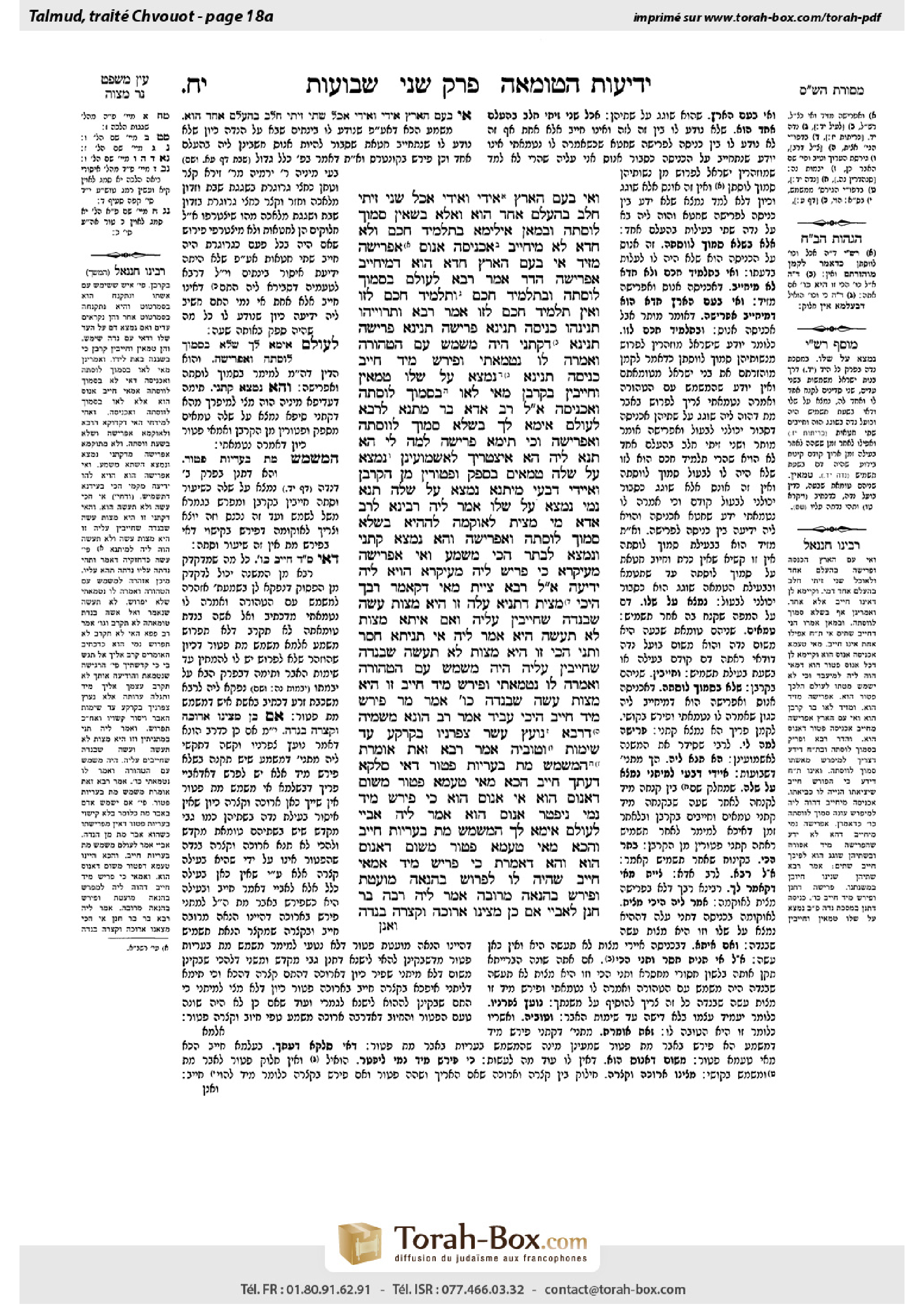
Shevuot 18a: Talmud study for Daf Yomi
Daf Yomi is the daily study of one Talmud folio. Explore 37 tractates with scans, Hebrew text, Sefaria English and AI-generated French translations where annotated.
Passage selection and English or AI-generated French translation are available where the scan has annotations. Daf Study is independent of Torah-Box and Sefaria.
Browse Shevuot · שבועות · All tractatesShevuot 18a text and translations
This page of Shevuot includes the Aramaic text, an English translation and an AI-generated French translation, alongside the scan above.
שבועות י״ח א · Aramaic and Hebrew text
וְאִי בְּעַם הָאָרֶץ – אִידֵּי וְאִידֵּי ״אָכַל שְׁנֵי זֵיתֵי חֵלֶב בְּהֶעְלֵם אֶחָד״ הוּא!
וְאֶלָּא בְּשֶׁאֵין סָמוּךְ לְוִסְתָּהּ? וּבְמַאן? אִילֵּימָא בְּתַלְמִיד חָכָם – וְלָא חֲדָא לָא מִיחַיַּיב; אַכְּנִיסָה – אָנוּס, אַפְּרִישָׁה – מֵזִיד! אִי בְּעַם הָאָרֶץ – חֲדָא הוּא דְּמִיחַיַּיב, אַפְּרִישָׁה!
הֲדַר אָמַר רָבָא: לְעוֹלָם בְּסָמוּךְ לְוִסְתָּהּ, וּבְתַלְמִיד חָכָם, וְתַלְמִיד חָכָם לְזוֹ וְאֵין תַּלְמִיד חָכָם לָזוֹ.
אָמַר רָבָא: וְתַרְוַיְיהוּ תְּנַנְהִי; כְּנִיסָה תְּנֵינָא, פְּרִישָׁה תְּנֵינָא. פְּרִישָׁה תְּנֵינָא – דְּקָתָנֵי: הָיָה מְשַׁמֵּשׁ עִם הַטְּהוֹרָה וְאָמְרָה לוֹ ״נִטְמֵאתִי״, וּפֵירַשׁ מִיָּד – חַיָּיב.
כְּנִיסָה תְּנֵינָא: נִמְצָא עַל שֶׁלּוֹ – טְמֵאִין וְחַיָּיבִין בְּקׇרְבָּן. מַאי, לָאו בְּסָמוּךְ לְוִסְתָּהּ – וְאַכְּנִיסָה?
אֲמַר לֵיהּ רַב אַדָּא בַּר מַתְנָא לְרָבָא: לְעוֹלָם אֵימָא לָךְ, בְּשֶׁלֹּא סָמוּךְ לְוִוסְתָּהּ – וְאַפְּרִישָׁה; וְכִי תֵּימָא: פְּרִישָׁה לְמָה לִי, הָא תְּנָא לֵיהּ; הָא אִיצְטְרִיךְ לְאַשְׁמוֹעִינַן: נִמְצָא עַל שֶׁלָּהּ – טְמֵאִים בְּסָפֵק, וּפְטוּרִין מִן הַקׇּרְבָּן; וְאַיְּידֵי דְּבָעֵי מִיתְנֵא נִמְצָא עַל שֶׁלָּהּ, תְּנָא נָמֵי נִמְצָא עַל שֶׁלּוֹ.
אֲמַר לֵיהּ רָבִינָא לְרַב אַדָּא: מִי מָצֵית לְאוֹקֹמַהּ לְהַהִיא בְּשֶׁלֹּא סָמוּךְ לְוִסְתָּהּ, וְאַפְּרִישָׁה?! וְהָא ״נִמְצָא״ קָתָנֵי, וְ״נִמְצָא״ לְבָתַר הָכִי מַשְׁמַע; וְאִי אַפְּרִישָׁה, מֵעִיקָּרָא כִּי פָּרֵישׁ לֵיהּ – מֵעִיקָּרָא הָוְיָא לֵיהּ יְדִיעָה!
אֲמַר לֵיהּ רָבָא: צָיֵית מַאי דְּקָאָמַר רַבָּךְ. הֵיכִי אֵצֵית? דְּתַנְיָא עֲלַהּ: זוֹ הִיא מִצְוַת עֲשֵׂה שֶׁבְּנִדָּה שֶׁחַיָּיבִין עָלֶיהָ, וְאִם אִיתָא – מִצְוַת לֹא תַעֲשֶׂה הִיא!
אֲמַר לֵיהּ: אִי תָּנֵיתָא – חַסַּר וּתְנִי הָכִי: זוֹ הִיא מִצְוַת לֹא תַעֲשֶׂה שֶׁבְּנִדָּה שֶׁחַיָּיבִין עָלֶיהָ. הָיָה מְשַׁמֵּשׁ עִם הַטְּהוֹרָה וְאָמְרָה לוֹ ״נִטְמֵאתִי״, וּפֵירַשׁ מִיָּד – חַיָּיב, זוֹ הִיא מִצְוַת עֲשֵׂה שֶׁבְּנִדָּה כּוּ׳.
אָמַר מָר: פֵּירַשׁ מִיָּד – חַיָּיב. הֵיכִי עָבֵיד? אָמַר רַב הוּנָא מִשְּׁמֵיהּ דְּרָבָא: נוֹעֵץ עֶשֶׂר צִפׇּרְנָיו בַּקַּרְקַע עַד שֶׁיָּמוּת, וְטוּבֵיהּ.
אָמַר רָבָא: זֹאת אוֹמֶרֶת, הַמְשַׁמֵּשׁ מֵת בַּעֲרָיוֹת – פָּטוּר. דְּאִי סָלְקָא דַעְתָּךְ חַיָּיב, הָכָא מַאי טַעְמָא פָּטוּר? מִשּׁוּם דְּאָנוּס הוּא. אִי אָנוּס הוּא, כִּי פֵּירַשׁ מִיָּד נָמֵי נִיפְּטַר – אָנוּס הוּא!
אֲמַר לֵיהּ אַבָּיֵי: לְעוֹלָם אֵימָא לָךְ, הַמְשַׁמֵּשׁ מֵת בַּעֲרָיוֹת חַיָּיב; וְהָכָא מַאי טַעְמָא פָּטוּר – מִשּׁוּם דְּאָנוּס הוּא. וְהָא דְּאָמְרַתְּ: כִּי פָרֵישׁ מִיָּד אַמַּאי חַיָּיב? שֶׁהָיָה לוֹ לִפְרוֹשׁ בַּהֲנָאָה מוּעֶטֶת, וּפֵירַשׁ בַּהֲנָאָה מְרוּבָּה.
אֲמַר לֵיהּ רַבָּה בַּר חָנָן לְאַבָּיֵי: אִם כֵּן מָצִינוּ אֲרוּכָּה וּקְצָרָה בְּנִדָּה,
Shevuot 18a · English translation
And if we say that we are dealing with an am ha’aretz, an ignoramus, who does not know that it is prohibited for him to engage in intercourse with a woman near the expected onset of her menstruation, and who also does not know that it is prohibited for him to immediately withdraw from her if she experiences menstrual bleeding during intercourse, then for both this and that, his entry and his withdrawal, he should be liable to bring only a single sin-offering, since he had no awareness of his transgression between his two actions. This is like one who ate two olive-bulks of forbidden fat in the course of one lapse of awareness and is therefore liable to bring only one sin-offering. Here too, although he performed two actions for which one could be liable to bring sin-offerings, entry and withdrawal, there was only one lapse of awareness.
Rather, it must be a case where it was not near her expected date of menstruation, and there was no reason for the man to think that the woman would experience menstrual bleeding. And with whom are we dealing? If we say that we are dealing with a Torah scholar, then he should not be liable to bring even one sin-offering, because with regard to his initial entry, he was a victim of circumstances beyond his control, and with regard to his withdrawal, after he knew that she was a menstruating woman, his transgression was intentional, and he would be liable to receive karet. And if we are dealing with an am ha’aretz, he should be liable to bring only one sin-offering, for his immediate withdrawal.
Rava reconsidered and then said: Actually, it is a case where it was near the expected date of the woman’s menstruation, and we are dealing with a Torah scholar. But he is a Torah scholar only with regard to this halakha, that it is prohibited to engage in intercourse with a woman near the expected onset of her menstruation, and he erred in thinking that he could complete the act of intercourse before she experienced menstrual bleeding. Therefore, once he learns that she has experienced menstrual bleeding, he is liable to bring a sin-offering for his unwitting transgression at the time of his entry. But he is not a Torah scholar with regard to that halakha, that it is prohibited for one to immediately withdraw from a woman if she experiences menstrual bleeding during intercourse. Since he had awareness of his transgression between his two actions, this is not an instance of one lapse of awareness, and therefore he is liable to bring a second sin-offering for his unwitting transgression at the time of his withdrawal.
Rava said: And we learn both of these matters for which he is liable to bring a sin-offering; we learn about entry, and we learn about withdrawal. Rava now clarifies the matter: We learn about withdrawal, as the mishna teaches: If a man was engaging in intercourse with a ritually pure woman, and during the course of their act of intercourse she experienced menstrual bleeding and said to him: I have become impure, and unwittingly he immediately withdrew from her, he is liable to bring a sin-offering for engaging in intercourse with a menstruating woman.
Rava continues: We learn about entry in a mishna (Nidda 14a): If a spot of blood is found on his rag, i.e., the rag that he uses to wipe his penis after intercourse, then it is clear that this blood came from the woman during their act of intercourse. Consequently, both the man and the woman are impure and are liable to bring a sin-offering for their unwitting transgression. Rava explains: What, is it not the case that the mishna speaks here of one who engaged in intercourse with a woman near the expected date of her menstruation, and it teaches that he is liable to bring a sin-offering for his initial entry at that time?
Rav Adda bar Mattana said to Rava: Actually, I could say to you that the mishna speaks here of one who engaged in intercourse with a woman not near the expected date of her menstruation, and he is liable to bring a sin-offering for his immediate withdrawal upon learning that she had experienced menstrual bleeding. And if you would say: Why do I need to be taught once again about withdrawal? Didn’t the tanna already teach this in the mishna here? One can respond: It was necessary to teach us this, i.e., the continuation of the mishna in tractate Nidda, which states: If a spot of blood is found on her rag, i.e., the rag that she uses to wipe herself after intercourse, they are impure only because of an uncertainty, as perhaps the bleeding commenced only after they completed their act of intercourse, and therefore they are exempt from bringing a sin-offering. And since the mishna had to teach the case where the blood was found on her rag, it also taught the case where it was found on his rag, even though there is no novel element in this ruling.
Ravina said to Rav Adda: Can you really interpret that mishna as referring to a case where it was not near the expected date of the woman’s menstruation, and that he is liable to bring a sin-offering for his withdrawal? But isn’t it taught in that mishna: If blood is found on his rag? And these words indicate that the blood was found only afterward, after the man had already withdrawn from the woman. That is to say, only after he withdrew from the woman he learned that she had experienced menstrual bleeding. Ravina clarifies the difficulty: And if the mishna is referring to a case where he is liable for his withdrawal, at the outset, when he withdrew from the woman, it was from then that he had knowledge of her menstrual status, as he withdrew because she had informed him that she had experienced bleeding. Of what significance is his finding blood on his rag?
Rava said to Rav Adda: Listen to what your teacher, Ravina, is saying, as he has explained the matter. Rav Adda said to Rava: How can I listen to his words and accept his explanation? As it is taught in a baraita with regard to this mishna concerning blood found on a rag: This is the positive mitzva with regard to a menstruating woman for which one is liable. Rav Adda explains: And if it is so that the mishna is referring to a case where the man is liable for his initial entry, this wording is difficult, as engaging in intercourse with a menstruating woman is not the violation of a positive mitzva, but a prohibition.
Rava said to him: If you learned this baraita in this manner, its wording is imprecise, as it is missing words, and you should teach it like this: When blood is found on the man’s rag, this is the prohibition with regard to a menstruating woman for which one is liable. And additionally, if a man was engaging in intercourse with a ritually pure woman, and during the course of their act of intercourse she experienced menstrual bleeding and said to him: I have become impure, and unwittingly he immediately withdrew from her, he is liable to bring a sin-offering for that act, and this is the positive mitzva for which one is liable with regard to a menstruating woman.
§ The Gemara resumes its discussion of the mishna: The Master said above in the mishna: If he immediately withdrew from the woman after having been informed that she had experienced menstrual bleeding, he is liable to bring a sin-offering for engaging in intercourse with a menstruating woman. The Gemara asks: What should one do in such a situation? Rav Huna said in the name of Rava: He should press his ten fingernails into the ground, i.e., the bed, and restrain himself and do nothing until his penis becomes flaccid, and only then should he withdraw from her, and it is good for him to do so.
Rava said: That is to say, one who engages in intercourse, with a flaccid penis, with those with whom relations are forbidden is exempt. As if it enters your mind to say that he is liable, here, in the mishna, what is the reason that he is exempt if he waits and withdraws only later, after he has lost his erection? You might say that it is because he is a victim of circumstances beyond his control in that the woman experienced menstrual bleeding while he was in the middle of the act of intercourse, and not because he withdrew with a flaccid penis, as one who engages in intercourse with a flaccid penis is liable. But if he is exempt from liability because he is a victim of circumstances beyond his control, then even if he withdraws immediately, before losing his erection, he should also be exempt, for the same reason, that he is a victim of circumstances beyond his control.
Abaye said to Rava: Actually, I could say to you that one who engages in intercourse, with a flaccid penis, with those with whom relations are forbidden is liable. And here, what is the reason that one who waits and withdraws only later, after he has lost his erection, is exempt? It is because he is considered a victim of circumstances beyond his control. And concerning that which you said: Why, then, is he liable if he withdrew immediately, i.e., when you said: He should also be exempt, it is because he should have withdrawn with a flaccid penis and experienced little pleasure, but instead he withdrew with an erect organ and experienced great pleasure.
Rabba bar Ḥanan said to Abaye: If so, according to your opinion, we find a difference in halakha between a long way and a short way with regard to a menstruating woman. If he withdrew the short way, i.e., without waiting, he has committed a transgression, and if he withdrew the long way, i.e., after waiting, he has not committed a transgression.
Shevuot 18a · Traduction française (IA)
Et si l’on dit qu’il s’agit d’un am ha’aretz, un ignorant qui ne sait pas qu’il lui est interdit d’avoir des rapports avec une femme à l’approche de la date prévue de ses règles, et qui ne sait pas non plus qu’il lui est interdit de se retirer immédiatement si elle commence à saigner pendant le rapport, alors, pour les deux actes, son entrée et son retrait, il ne devrait être tenu d’apporter qu’un seul sacrifice expiatoire, puisqu’il n’a pas eu conscience de sa transgression entre ces deux actes. C’est comme celui qui a consommé deux mesures de la taille d’une olive de graisse interdite au cours d’une seule période d’inconscience et qui n’est donc tenu d’apporter qu’un seul sacrifice expiatoire. Ici aussi, bien qu’il ait accompli deux actes susceptibles d’entraîner l’obligation d’apporter des sacrifices expiatoires — l’entrée et le retrait —, il n’y a eu qu’une seule période d’inconscience.
Il faut plutôt qu’il s’agisse d’un cas où la femme n’était pas à l’approche de la date prévue de ses règles et où l’homme n’avait aucune raison de penser qu’elle commencerait à saigner. De qui s’agit-il alors ? Si l’on dit qu’il s’agit d’un érudit en Torah, il ne devrait pas être tenu d’apporter même un seul sacrifice expiatoire : lors de son entrée initiale, il a été victime de circonstances indépendantes de sa volonté, tandis que, lors de son retrait, après avoir appris qu’elle était menstruée, il a transgressé intentionnellement et serait passible de karet. Et s’il s’agit d’un am ha’aretz, il ne devrait être tenu d’apporter qu’un seul sacrifice expiatoire, pour son retrait immédiat.
Rava revint sur sa réflexion, puis dit : En réalité, il s’agit d’un cas où la femme était à l’approche de la date prévue de ses règles et où l’homme est un érudit en Torah. Mais il ne connaît cette halakha — l’interdiction d’avoir des rapports avec une femme à l’approche de la date prévue de ses règles — que pour ce qui est de l’interdiction elle-même ; il s’est trompé en pensant pouvoir terminer le rapport avant qu’elle ne commence à saigner. Par conséquent, lorsqu’il apprend qu’elle a commencé à saigner, il est tenu d’apporter un sacrifice expiatoire pour sa transgression involontaire au moment de son entrée. En revanche, il ne connaît pas l’autre halakha, selon laquelle il est interdit de se retirer immédiatement d’une femme si elle commence à saigner pendant le rapport. Puisqu’il a eu conscience de sa transgression entre ses deux actes, il ne s’agit pas d’une seule période d’inconscience ; il est donc tenu d’apporter un second sacrifice expiatoire pour sa transgression involontaire au moment de son retrait.
Rava dit : Nous apprenons ces deux cas où il est tenu d’apporter un sacrifice expiatoire : le cas de l’entrée et celui du retrait. Rava précise à présent : Nous apprenons le cas du retrait, comme l’enseigne la Michna : Si un homme avait des rapports avec une femme rituellement pure et que, pendant le rapport, elle commençait à saigner et lui disait : « Je suis devenue impure », puis qu’il se retirait immédiatement d’elle sans en avoir conscience, il est tenu d’apporter un sacrifice expiatoire pour avoir eu des rapports avec une femme menstruée.
Rava poursuit : Nous apprenons le cas de l’entrée dans une Michna (Nidda 14a) : Si une tache de sang est trouvée sur son chiffon — celui dont il se sert pour essuyer son pénis après le rapport —, il est clair que ce sang provient de la femme et qu’il est apparu pendant leur rapport. Par conséquent, l’homme et la femme sont tous deux impurs et tenus d’apporter un sacrifice expiatoire pour leur transgression involontaire. Rava explique : La Michna ne parle-t-elle pas ici d’un homme qui a eu des rapports avec une femme à l’approche de la date prévue de ses règles et n’enseigne-t-elle pas qu’il est tenu d’apporter un sacrifice expiatoire pour son entrée initiale à ce moment-là ?
Rav Adda bar Mattana dit à Rava : En réalité, je pourrais te dire que la Michna parle ici d’un homme qui a eu des rapports avec une femme qui n’était pas à l’approche de la date prévue de ses règles, et qu’il est tenu d’apporter un sacrifice expiatoire pour s’être retiré immédiatement après avoir appris qu’elle avait commencé à saigner. Et si tu demandes : Pourquoi fallait-il nous enseigner de nouveau le cas du retrait ? Le tanna ne l’a-t-il pas déjà enseigné dans la Michna ici ? On peut répondre : Il était nécessaire de nous enseigner la suite de la Michna du traité Nidda, qui énonce : Si une tache de sang est trouvée sur son chiffon — celui dont elle se sert pour s’essuyer après le rapport —, ils ne sont impurs qu’en raison d’une incertitude, car il se peut que le saignement n’ait commencé qu’après la fin de leur rapport ; ils sont donc dispensés d’apporter un sacrifice expiatoire. Et puisque la Michna devait enseigner le cas où le sang était trouvé sur son chiffon à elle, elle a également enseigné le cas où il était trouvé sur le chiffon de l’homme, bien que cette décision n’apporte aucun élément nouveau.
Ravina dit à Rav Adda : Peux-tu vraiment interpréter cette Michna comme se rapportant à un cas où la femme n’était pas à l’approche de la date prévue de ses règles et où l’homme est tenu d’apporter un sacrifice expiatoire pour son retrait ? Pourtant, la Michna enseigne : « Si du sang est trouvé sur son chiffon. » Ces mots indiquent que le sang n’a été trouvé qu’après coup, une fois que l’homme s’était déjà retiré de la femme. Autrement dit, ce n’est qu’après s’être retiré d’elle qu’il a appris qu’elle avait commencé à saigner. Ravina précise la difficulté : Mais si la Michna parle d’un cas où il est tenu d’apporter un sacrifice expiatoire pour son retrait, au moment où il s’est retiré de la femme, il savait déjà qu’elle était menstruée, puisqu’il s’est retiré parce qu’elle lui avait annoncé qu’elle avait commencé à saigner. Quelle importance y a-t-il alors à ce qu’il trouve du sang sur son chiffon ?
Rava dit à Rav Adda : Écoute ce que dit ton maître, Ravina, car il a éclairci la question. Rav Adda dit à Rava : Comment pourrais-je écouter ses paroles et accepter son explication ? En effet, une baraïta enseigne à propos de cette Michna concernant le sang trouvé sur un chiffon : « Telle est la mitsva positive relative à une femme menstruée pour laquelle on est passible. » Rav Adda explique : Si la Michna se rapporte à un cas où l’homme est passible pour son entrée initiale, cette formulation pose problème, car avoir des rapports avec une femme menstruée ne constitue pas la transgression d’une mitsva positive, mais celle d’une interdiction.
Rava lui dit : Si tu as appris cette baraïta sous cette forme, sa formulation est imprécise, car des mots en sont omis ; il faut l’enseigner ainsi : « Lorsque du sang est trouvé sur le chiffon de l’homme, telle est l’interdiction relative à une femme menstruée pour laquelle on est passible. Et, en outre, si un homme avait des rapports avec une femme rituellement pure et que, pendant le rapport, elle commençait à saigner et lui disait : “Je suis devenue impure”, puis qu’il se retirait immédiatement d’elle sans en avoir conscience, il est tenu d’apporter un sacrifice expiatoire pour cet acte ; telle est la mitsva positive relative à une femme menstruée pour laquelle on est passible. »
§ La Guemara reprend son examen de la Michna. Le maître a dit plus haut dans la Michna : S’il s’est retiré immédiatement de la femme après avoir appris qu’elle avait commencé à saigner, il est tenu d’apporter un sacrifice expiatoire pour avoir eu des rapports avec une femme menstruée. La Guemara demande : Que doit-on faire dans une telle situation ? Rav Houna dit au nom de Rava : Il doit enfoncer ses dix ongles dans le sol — c’est-à-dire dans le lit — et se retenir sans rien faire jusqu’à ce que son pénis devienne flasque ; ce n’est qu’alors qu’il doit se retirer d’elle, et il agit ainsi à son avantage.
Rava dit : Il en ressort que celui qui a des rapports, le pénis flasque, avec une personne avec laquelle les relations sont interdites est exempt. En effet, si tu pensais qu’il est passible, pourquoi, dans la Michna, est-il exempt s’il attend et ne se retire que plus tard, après avoir perdu son érection ? On pourrait répondre que c’est parce qu’il est victime de circonstances indépendantes de sa volonté : la femme a commencé à saigner alors qu’il était au milieu du rapport, et non parce qu’il s’est retiré avec le pénis flasque ; dans ce cas, celui qui a des rapports avec le pénis flasque serait passible. Mais s’il est exempt parce qu’il est victime de circonstances indépendantes de sa volonté, alors, même s’il se retire immédiatement, avant d’avoir perdu son érection, il devrait également être exempt pour la même raison : il est victime de circonstances indépendantes de sa volonté.
Abayé dit à Rava : En réalité, je pourrais te dire que celui qui a des rapports, le pénis flasque, avec une personne avec laquelle les relations sont interdites est passible. Pourquoi alors celui qui attend et ne se retire que plus tard, après avoir perdu son érection, est-il exempt ? Parce qu’il est considéré comme victime de circonstances indépendantes de sa volonté. Quant à ce que tu as dit — pourquoi est-il passible s’il s’est retiré immédiatement, autrement dit, pourquoi ne serait-il pas lui aussi exempt ? —, c’est parce qu’il aurait dû se retirer avec le pénis flasque et éprouver peu de plaisir ; or il s’est retiré avec le pénis en érection et a éprouvé un grand plaisir.
Rabba bar Ḥanan dit à Abayé : Si c’est le cas, selon toi, il existe une différence de halakha entre le chemin long et le chemin court concernant une femme menstruée. S’il s’est retiré par le chemin court, c’est-à-dire sans attendre, il a commis une transgression ; s’il s’est retiré par le chemin long, c’est-à-dire après avoir attendu, il n’a pas commis de transgression.
Traduction française générée par IA à partir de l’édition anglaise de Sefaria. Vérifie toujours un passage avec le texte source.
Text from Sefaria: William Davidson Edition - Vocalized Aramaic (CC BY NC); William Davidson Edition - English (CC BY NC).