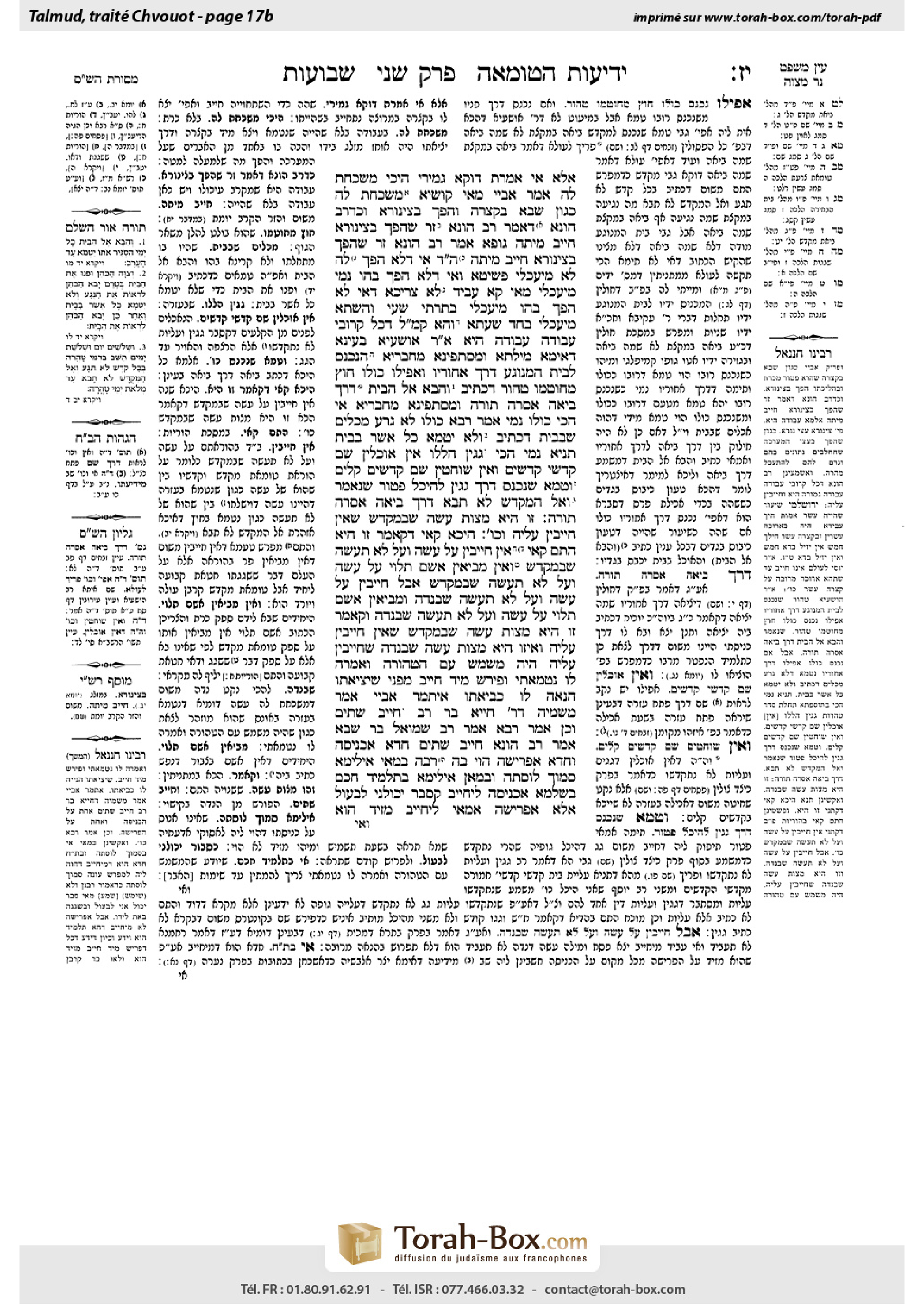
Shevuot 17b: Talmud study for Daf Yomi
Daf Yomi is the daily study of one Talmud folio. Explore 37 tractates with scans, Hebrew text, Sefaria English and AI-generated French translations where annotated.
Passage selection and English or AI-generated French translation are available where the scan has annotations. Daf Study is independent of Torah-Box and Sefaria.
Browse Shevuot · שבועות · All tractatesShevuot 17b text and translations
This page of Shevuot includes the Aramaic text, an English translation and an AI-generated French translation, alongside the scan above.
שבועות י״ז ב · Aramaic and Hebrew text
אֶלָּא אִי אָמְרַתְּ דַּוְקָא גְּמִירִי, הֵיכִי מַשְׁכַּחַתְּ לַהּ?
אָמַר אַבָּיֵי: מַאי קוּשְׁיָא? מַשְׁכַּחַתְּ לַהּ כְּגוֹן שֶׁבָּא בִּקְצָרָה וְהִפֵּךְ בְּצִינּוֹרָא, וְכִדְרַב הוּנָא – דְּאָמַר רַב הוּנָא: זָר שֶׁהִפֵּךְ בְּצִינּוֹרָא, חַיָּיב מִיתָה.
גּוּפָא – אָמַר רַב הוּנָא: זָר שֶׁהִפֵּךְ בְּצִינּוֹרָא, חַיָּיב מִיתָה. הֵיכִי דָמֵי? אִי דְּלָא הַפֵּךְ לַהּ לָא מִיעַכְּלִי – פְּשִׁיטָא! וְאִי דְּלָא הַפֵּךְ בְּהוּ נָמֵי מִיעַכְּלִי – מַאי קָא עָבֵיד?
לָא צְרִיכָא – דְּאִי לָא הַפֵּךְ בְּהוּ מִיעַכְּלִי בְּתַרְתֵּי שָׁעֵי, וְהַשְׁתָּא מִיעַכְּלִי בְּחַד שַׁעְתָּא; וְהָא קָא מַשְׁמַע לַן: דְּכֹל קָרוֹבֵי עֲבוֹדָה – עֲבוֹדָה הִיא.
אָמַר רַבִּי אוֹשַׁעְיָא: בָּעֵינָא דְּאֵימָא מִילְּתָא, וּמִסְתְּפֵינָא מֵחַבְרַיָּא. הַנִּכְנָס לְבַיִת הַמְנוּגָּע דֶּרֶךְ אֲחוֹרָיו, וַאֲפִילּוּ כּוּלּוֹ חוּץ מֵחוֹטְמוֹ – טָהוֹר. דִּכְתִיב: ״וְהַבָּא אֶל הַבַּיִת״ – דֶּרֶךְ בִּיאָה אָסְרָה תּוֹרָה.
וּמִסְתְּפֵינָא מֵחַבְרַיָּא – אִי הָכִי כּוּלּוֹ נָמֵי! אָמַר רָבָא: כּוּלּוֹ – לָא גָּרַע מִכֵּלִים שֶׁבְּבַיִת, דִּכְתִיב: ״וְלֹא יִטְמָא כׇּל אֲשֶׁר בַּבָּיִת״.
תַּנְיָא נָמֵי הָכִי: גַּגִּין הַלָּלוּ – אֵין אוֹכְלִין שָׁם קׇדְשֵׁי קָדָשִׁים, וְאֵין שׁוֹחֲטִין שָׁם קָדָשִׁים קַלִּים; וְטָמֵא שֶׁנִּכְנָס דֶּרֶךְ גַּגִּין לַהֵיכָל – פָּטוּר, שֶׁנֶּאֱמַר: ״וְאֶל הַמִּקְדָּשׁ לֹא תָבֹא״ – דֶּרֶךְ בִּיאָה אָסְרָה תּוֹרָה.
זוֹ הִיא מִצְוַת עֲשֵׂה שֶׁבַּמִּקְדָּשׁ שֶׁאֵין חַיָּיבִין עָלֶיהָ וְכוּ׳. הֵיכָא קָאֵי דְּקָאָמַר ״זוֹ הִיא״? הָתָם קָאֵי – אֵין חַיָּיבִין עַל עֲשֵׂה וְעַל לֹא תַעֲשֶׂה שֶׁבַּמִּקְדָּשׁ,
וְאֵין מְבִיאִין אָשָׁם תָּלוּי עַל עֲשֵׂה וְעַל לֹא תַעֲשֶׂה שֶׁבַּמִּקְדָּשׁ.
אֲבָל חַיָּיבִין עַל עֲשֵׂה וְעַל לֹא תַעֲשֶׂה שֶׁבְּנִדָּה, וּמְבִיאִין אָשָׁם תָּלוּי עַל עֲשֵׂה וְעַל לֹא תַעֲשֶׂה שֶׁבְּנִדָּה.
וְקָאָמַר: זוֹ הִיא מִצְוַת עֲשֵׂה שֶׁבַּמִּקְדָּשׁ שֶׁאֵין חַיָּיבִין עָלֶיהָ; וְאֵיזוֹ הִיא מִצְוַת עֲשֵׂה שֶׁבְּנִדָּה שֶׁחַיָּיבִין עָלֶיהָ? הָיָה מְשַׁמֵּשׁ עִם הַטְּהוֹרָה וְאָמְרָה לוֹ ״נִטְמֵאתִי״, וּפֵירַשׁ מִיָּד – חַיָּיב, מִפְּנֵי שֶׁיְּצִיאָתוֹ הֲנָאָה לוֹ כְּבִיאָתוֹ.
אִיתְּמַר, אַבָּיֵי אָמַר מִשְּׁמֵיהּ דְּרַבִּי חִיָּיא בַּר רַב: חַיָּיב שְׁתַּיִם. וְכֵן אָמַר רָבָא, אָמַר רַב שְׁמוּאֵל בַּר שֶׁבָּא, אָמַר רַב הוּנָא: חַיָּיב שְׁתַּיִם, חֲדָא אַכְּנִיסָה וַחֲדָא אַפְּרִישָׁה.
הָוֵי בַּהּ רַבָּה: בְּמַאי? אִילֵימָא סָמוּךְ לְוִסְתָּהּ – וּבְמַאן? אִילֵּימָא בְּתַלְמִיד חָכָם – בִּשְׁלָמָא אַכְּנִיסָה לִיחַיַּיב, קָסָבַר יָכוֹלְנִי לִבְעוֹל; אֶלָּא אַפְּרִישָׁה אַמַּאי לִיחַיַּיב? מֵזִיד הוּא!
Shevuot 17b · English translation
But if you say that it is learned as a tradition specifically that if an impure person tarries long enough to bow down, he is liable even if he does not exceed the time required to go out the shortest way, then how can you find these circumstances?
Abaye said: What is the difficulty? You find it in a case such as where he went out from the Temple via the shortest way, but as he was leaving he turned over one of the limbs of an offering on the altar with a fork [betzinnora]. This is an action that takes only a brief moment to perform, and yet it is considered priestly service, in accordance with the opinion of Rav Huna. As Rav Huna says: A non-priest who turns over part of an offering on the altar with a fork is liable to receive the death penalty, because he engaged in Temple service restricted to priests.
The Gemara proceeds to analyze the matter itself: Rav Huna says: A non-priest who turns over part of an offering on the altar with a fork is liable to receive the death penalty. What are the circumstances of such a case? If in the event that he had not turned it over, the offering would not have been consumed by the fire, then it is obvious that the non-priest is liable, as he performed the service of burning the offering on the altar. And if in the event that he had not turned it over, it would also have been consumed by the fire, then what service did he perform? Even without his action, the offering would have been burned.
The Gemara answers: No, it is necessary for Rav Huna to state this halakha with regard to a case where, had the non-priest not turned it over, it would have been consumed by the fire in two hours, but now that he turned it over, it is consumed by the fire in one hour. And he teaches us this: That any act that accelerates the service, causing it to be performed more quickly, is itself considered a service.
The Gemara returns to the general topic of one who enters the Temple while in a state of ritual impurity, citing Rabbi Oshaya, who said: I wish to say something, but I am afraid of my colleagues, i.e., I am afraid that they will raise an objection against me. What did he want to say? With regard to one who enters a house afflicted with leprosy, if he enters the house backward, then even if his entire body entered except for his nose, which remained outside the house, he remains pure, as it is written: “He that enters into the house all the time that it is shut up shall be impure until evening” (Leviticus 14:46), teaching that the Torah prohibited, i.e., conferred impurity, only with regard to the normal manner of entering into a house, i.e., face-first.
But I am afraid of my colleagues, as they might raise the following objection: If so, that the impurity depends on the person entering the house in the normal manner, then even if his entire body entered the house, he would also be pure, as he did not go into the house in the normal fashion. Rava said: This is not difficult, as if his entire body entered in this manner, he is impure, because he is no worse now, i.e., his halakha should be no more lenient, than vessels that are in the house, which become impure, as it is written: “And they shall empty the house…so that all that is in the house shall not be made impure” (Leviticus 14:36).
The Gemara comments: This is also taught in a baraita, in accordance with the opinion of Rabbi Oshaya, that wherever entering is mentioned in the Torah, the reference is to the normal manner of entering: With regard to those roofs that covered the various chambers found in the Temple courtyard, offerings of the most sacred order may not be eaten there, on them, and offerings of lesser sanctity may not be slaughtered there, because those roofs do not have the sanctity of the Temple courtyard. And a ritually impure person who enters the Sanctuary via those roofs is exempt, as it is stated with regard to a woman who became ritually impure: “And she shall not enter into the Sanctuary” (Leviticus 12:4), teaching that the Torah prohibited only the normal manner of entering the Temple. So too, in the case of a house afflicted with leprosy, where mention is made of entering, only one who enters into the house in the normal manner becomes impure, as stated by Rabbi Oshaya.
§ The mishna teaches: This mitzva that the ritually impure must be sent out of the Temple is the positive mitzva concerning the Temple for which the Sanhedrin is not liable to bring a bull offering for an erroneous ruling. The Gemara asks: To what does the tanna of the mishna refer when he says: This is the positive mitzva concerning the Temple for which the Sanhedrin is not liable to bring a bull offering for an erroneous ruling? Where was it taught that there is such a mitzva for which they are not liable? The Gemara answers: He is referring to a mishna found there in tractate Horayot (8b), which teaches: The Sanhedrin is not liable to bring a bull offering for an erroneous ruling with regard to a positive mitzva or prohibition concerning ritual impurity in the Temple, as this offering is brought only for an erroneous ruling on a matter whose unwitting violation requires the bringing of a fixed sin-offering, and not a sliding-scale offering.
The mishna there continues: And one who is uncertain whether or not he unwittingly transgressed a prohibition that requires a sin-offering does not bring a provisional guilt-offering for a positive mitzva or prohibition concerning ritual impurity in the Temple, as this offering is brought only when certainty about the unwitting transgression would require a fixed sin-offering, not a sliding-scale offering. Unwitting transgression of a mitzva concerning ritual impurity in the Temple results in an obligation to bring a sliding-scale offering.
The mishna there continues: But the Sanhedrin is liable to bring a bull offering for an erroneous ruling with regard to a positive mitzva or prohibition concerning a menstruating woman. And one who is uncertain whether or not he unwittingly transgressed a prohibition that requires a sin-offering brings a provisional guilt-offering for a positive mitzva or prohibition concerning a menstruating woman.
And it is in reference to that mishna that the tanna in the mishna here says: This mitzva, that the ritually impure must be sent out of the Temple, is the positive mitzva concerning the Temple for which the Sanhedrin is not liable to bring a bull offering for an erroneous ruling. And which is the positive mitzva with regard to a menstruating woman for which the Sanhedrin is liable to bring a bull offering for an erroneous ruling? If a man was engaging in intercourse with a ritually pure woman, and during the course of their act of intercourse she experienced menstrual bleeding and said to him: I have become impure, and unwittingly he immediately withdrew from her and did not wait until his penis became flaccid, he is liable to bring a sin-offering for engaging in intercourse with a menstruating woman, because his withdrawal from her is as pleasant to him as his entry. If the Sanhedrin mistakenly ruled that one may withdraw immediately, they bring a bull offering for their erroneous ruling.
§ The Gemara further clarifies the matter of a man who immediately withdrew from the woman after she told him that she had experienced menstrual bleeding. It was stated that Abaye says in the name of Rabbi Ḥiyya bar Rav: He is liable to bring two sin-offerings for this unwitting transgression. And so Rava says that Rav Shmuel bar Shaba says that Rav Huna says: He is liable to bring two sin-offerings, one for his initial entry and one for his immediate withdrawal.
Rabba discusses this matter, raising a question: About what case are we speaking? If we say that it was near her expected date of menstruation, when sexual intercourse is prohibited due to a concern that the woman might already be menstruating or that she might begin to menstruate during the act of intercourse, and nevertheless they engaged in intercourse, there is a difficulty: With whom are we dealing? If we say that we are dealing with a Torah scholar, granted that he will be liable to bring a sin-offering for his initial entry. That was an unwitting transgression, as he thought to himself: I can engage in intercourse with her before she begins to menstruate. But why will he be liable to bring a sin-offering for his immediate withdrawal? That transgression was intentional, since he is a Torah scholar and he knows that in such a case he must not withdraw immediately, and a sin-offering is not brought for an intentional transgression.
Shevuot 17b · Traduction française (IA)
Mais si tu dis qu’il s’agit d’une tradition selon laquelle un homme impur est passible dès lors qu’il s’attarde le temps nécessaire pour se prosterner, même s’il ne dépasse pas le temps nécessaire pour sortir par le chemin le plus court, comment peut-on concevoir une telle situation ?
Abayé dit : Où est la difficulté ? On peut concevoir le cas où il sort du Temple par le chemin le plus court, mais où, en sortant, il retourne avec une fourche [betzinnora] l’un des membres d’un sacrifice sur l’autel. Cette action ne prend qu’un bref instant, et pourtant elle est considérée comme un service sacerdotal, conformément à l’opinion de Rav Houna. Car Rav Houna dit : Un non-prêtre qui retourne avec une fourche une partie d’un sacrifice sur l’autel est passible de la peine de mort, parce qu’il a accompli un service du Temple réservé aux prêtres.
La Guemara examine à présent la question en elle-même. Rav Houna dit : Un non-prêtre qui retourne avec une fourche une partie d’un sacrifice sur l’autel est passible de la peine de mort. Dans quelles circonstances ? Si, sans qu’il la retourne, le feu n’aurait pas consumé l’offrande, il est évident que le non-prêtre est passible, puisqu’il a accompli le service consistant à brûler l’offrande sur l’autel. Mais si, sans qu’il la retourne, le feu l’aurait tout de même consumée, quel service a-t-il accompli ? Même sans son intervention, l’offrande aurait été brûlée.
La Guemara répond : Non, Rav Houna devait énoncer cette halakha pour le cas où, si le non-prêtre ne l’avait pas retournée, le feu l’aurait consumée en deux heures, tandis qu’après qu’il l’a retournée, le feu la consume en une heure. Il nous enseigne ainsi que tout acte qui accélère le service, en le faisant accomplir plus rapidement, est lui-même considéré comme un service.
La Guemara revient au sujet général de celui qui entre dans le Temple en état d’impureté rituelle et cite Rabbi Ochaya, qui dit : « Je voudrais dire quelque chose, mais je crains mes collègues », c’est-à-dire que je crains qu’ils ne soulèvent une objection contre moi. Que voulait-il dire ? Celui qui entre dans une maison atteinte de tsaraat reste pur s’il y entre à reculons, même si tout son corps est entré, à l’exception de son nez, qui est resté dehors. En effet, il est écrit : « Celui qui entre dans la maison pendant tout le temps où elle est fermée sera impur jusqu’au soir » (Lévitique 14:46). Cela enseigne que la Torah ne confère l’impureté que si l’on entre dans une maison de la manière habituelle, c’est-à-dire face en avant.
Mais je crains mes collègues, car ils pourraient soulever l’objection suivante : s’il en est ainsi, si l’impureté dépend du fait que la personne entre dans la maison de la manière habituelle, alors même si tout son corps entrait dans la maison, elle resterait pure, puisqu’elle n’y serait pas entrée de la manière habituelle. Rava dit : Il n’y a pas de difficulté. Si tout son corps est entré de cette manière, elle est impure, car sa situation ne peut être plus favorable — autrement dit, sa halakha ne peut être plus indulgente — que celle des ustensiles qui se trouvent dans la maison et deviennent impurs, comme il est écrit : « On videra la maison… afin que tout ce qui est dans la maison ne devienne pas impur » (Lévitique 14:36).
La Guemara fait remarquer que cela est également enseigné dans une baraïta, conformément à l’opinion de Rabbi Ochaya, selon laquelle, partout où la Torah mentionne une entrée, il s’agit d’une entrée selon la manière habituelle : les toits qui recouvrent les différentes chambres situées dans la cour du Temple n’ont pas la sainteté de cette cour ; on ne peut donc pas y manger les sacrifices de sainteté suprême ni y abattre les sacrifices de moindre sainteté. Une personne rituellement impure qui entre dans le Sanctuaire en passant par ces toits est exemptée, car il est écrit, à propos d’une femme devenue rituellement impure : « Elle n’entrera pas dans le Sanctuaire » (Lévitique 12:4). Cela enseigne que la Torah n’interdit que l’entrée dans le Temple selon la manière habituelle. De même, dans le cas d’une maison atteinte de tsaraat, où il est question d’entrer, seule la personne qui entre dans la maison de la manière habituelle devient impure, comme l’a dit Rabbi Ochaya.
§ La Michna enseigne : Cette mitsva, qui impose d’expulser du Temple les personnes rituellement impures, est la mitsva positive relative au Temple pour laquelle le Sanhédrin n’est pas tenu d’apporter un taureau en sacrifice à la suite d’une décision erronée. La Guemara demande : À quoi le tanna de la Michna fait-il référence lorsqu’il dit : « C’est la mitsva positive relative au Temple pour laquelle le Sanhédrin n’est pas tenu d’apporter un taureau en sacrifice à la suite d’une décision erronée » ? Où a-t-on enseigné qu’il existe une telle mitsva pour laquelle il n’est pas tenu d’apporter ce sacrifice ? La Guemara répond : Il fait référence à une Michna du traité Horayot (8b), qui enseigne : Le Sanhédrin n’est pas tenu d’apporter un taureau en sacrifice à la suite d’une décision erronée concernant une mitsva positive ou une interdiction relative à l’impureté rituelle dans le Temple, car ce sacrifice n’est apporté qu’à la suite d’une décision erronée concernant une question dont la transgression involontaire exige un sacrifice expiatoire fixe, et non une offrande à tarif variable.
La Michna poursuit : Celui qui ne sait pas avec certitude s’il a ou non transgressé involontairement une interdiction exigeant un sacrifice expiatoire n’apporte pas de sacrifice de culpabilité conditionnel pour une mitsva positive ou une interdiction relative à l’impureté rituelle dans le Temple, car ce sacrifice n’est apporté que lorsque, si la transgression involontaire était certaine, elle exigerait un sacrifice expiatoire fixe, et non une offrande à tarif variable. La transgression involontaire d’une mitsva relative à l’impureté rituelle dans le Temple entraîne l’obligation d’apporter une offrande à tarif variable.
La Michna poursuit : Toutefois, le Sanhédrin est tenu d’apporter un taureau en sacrifice à la suite d’une décision erronée concernant une mitsva positive ou une interdiction relative à une femme menstruée. De même, celui qui ne sait pas avec certitude s’il a ou non transgressé involontairement une interdiction exigeant un sacrifice expiatoire apporte un sacrifice de culpabilité conditionnel pour une mitsva positive ou une interdiction relative à une femme menstruée.
C’est à cette Michna que le tanna fait référence ici lorsqu’il dit : « Cette mitsva, qui impose d’expulser du Temple les personnes rituellement impures, est la mitsva positive relative au Temple pour laquelle le Sanhédrin n’est pas tenu d’apporter un taureau en sacrifice à la suite d’une décision erronée. » Et quelle est la mitsva positive relative à une femme menstruée pour laquelle le Sanhédrin est tenu d’apporter un taureau en sacrifice à la suite d’une décision erronée ? Si un homme avait des rapports avec une femme rituellement pure et que, au cours de leur rapport, elle se mettait à saigner et lui disait : « Je suis devenue impure », mais que, sans s’en rendre compte, il se retirait immédiatement d’elle sans attendre que son pénis soit devenu flasque, il est tenu d’apporter un sacrifice expiatoire pour avoir eu des rapports avec une femme menstruée, car se retirer d’elle lui est aussi agréable que d’entrer en elle. Si le Sanhédrin avait décidé à tort qu’il était permis de se retirer immédiatement, ses membres apportent un taureau en sacrifice à la suite de leur décision erronée.
§ La Guemara précise le cas de l’homme qui s’est retiré immédiatement de la femme après qu’elle lui a annoncé qu’elle avait eu des saignements menstruels. Abayé dit au nom de Rabbi Ḥiyya bar Rav qu’il est tenu d’apporter deux sacrifices expiatoires pour cette transgression involontaire. De même, Rava rapporte au nom de Rav Shmuel bar Shaba, qui le rapporte au nom de Rav Houna, qu’il est tenu d’apporter deux sacrifices expiatoires : l’un pour être entré en elle et l’autre pour s’être retiré immédiatement.
Rabba examine la question et soulève une difficulté : De quel cas parlons-nous ? Si nous disons qu’il s’agissait d’un moment proche de la date prévue de ses règles, où les rapports sexuels sont interdits par crainte que la femme n’ait déjà ses règles ou qu’elle ne commence à les avoir pendant le rapport, et qu’ils ont néanmoins eu des rapports, une difficulté se pose : de qui s’agit-il ? Si nous disons qu’il s’agit d’un érudit en Torah, il est certes tenu d’apporter un sacrifice expiatoire pour être entré en elle, car cette transgression était involontaire : il s’est dit qu’il pouvait avoir des rapports avec elle avant le début de ses règles. Mais pourquoi serait-il tenu d’apporter un sacrifice expiatoire pour s’être retiré immédiatement ? Cette transgression était intentionnelle, puisqu’il est un érudit en Torah et sait que, dans un tel cas, il ne doit pas se retirer immédiatement ; or, aucun sacrifice expiatoire n’est apporté pour une transgression intentionnelle.
Traduction française générée par IA à partir de l’édition anglaise de Sefaria. Vérifie toujours un passage avec le texte source.
Text from Sefaria: William Davidson Edition - Vocalized Aramaic (CC BY NC); William Davidson Edition - English (CC BY NC).