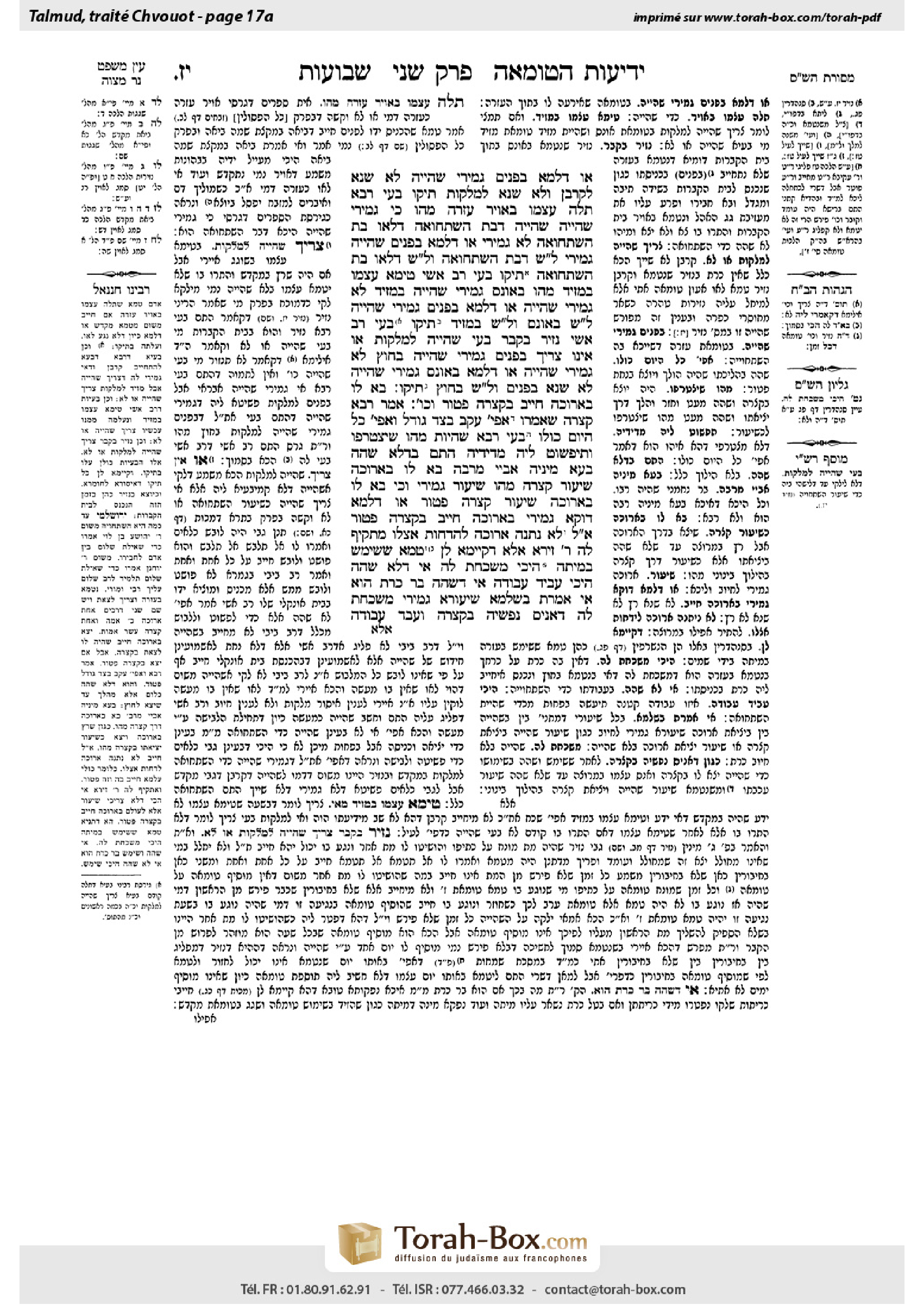
Shevuot 17a: Talmud study for Daf Yomi
Daf Yomi is the daily study of one Talmud folio. Explore 37 tractates with scans, Hebrew text, Sefaria English and AI-generated French translations where annotated.
Passage selection and English or AI-generated French translation are available where the scan has annotations. Daf Study is independent of Torah-Box and Sefaria.
Browse Shevuot · שבועות · All tractatesShevuot 17a text and translations
This page of Shevuot includes the Aramaic text, an English translation and an AI-generated French translation, alongside the scan above.
שבועות י״ז א · Aramaic and Hebrew text
אוֹ דִלְמָא, בִּפְנִים גְּמִירִי שְׁהִיָּיה – לָא שְׁנָא לְקׇרְבָּן וְלָא שְׁנָא לְמַלְקוּת? תֵּיקוּ.
בָּעֵי רָבָא: תָּלָה עַצְמוֹ בַּאֲוִיר עֲזָרָה, מַהוּ? כִּי גְּמִירִי שְׁהִיָּיה – שְׁהִיָּיה דְּבַת הִשְׁתַּחֲוָאָה, דְּלָאו בַּת הִשְׁתַּחֲוָאָה לָא גְּמִירִי; אוֹ דִּלְמָא, בִּפְנִים שְׁהִיָּיה גְּמִירִי – לָא שְׁנָא דְּבַת הִשְׁתַּחֲוָאָה וְלָא שְׁנָא דְּלָאו בַּת הִשְׁתַּחֲוָאָה? תֵּיקוּ.
בָּעֵי רַב אָשֵׁי: טִימֵּא עַצְמוֹ בְּמֵזִיד, מַהוּ? בְּאוֹנֶס גְּמִירִי שְׁהִיָּיה, בְּמֵזִיד לָא גְּמִירִי שְׁהִיָּיה; אוֹ דִּלְמָא, בִּפְנִים גְּמִירִי שְׁהִיָּיה – לָא שְׁנָא בְּאוֹנֶס וְלָא שְׁנָא בְּמֵזִיד? תֵּיקוּ.
בָּעֵי רַב אָשֵׁי: נָזִיר בְּקֶבֶר, בָּעֵי שְׁהִיָּיה לְמַלְקוּת אוֹ אֵינוֹ צָרִיךְ? בִּפְנִים גְּמִירִי שְׁהִיָּיה, בַּחוּץ לָא גְּמִירִי שְׁהִיָּיה; אוֹ דִלְמָא, בְּאוֹנֶס גְּמִירִי שְׁהִיָּיה – לָא שְׁנָא בִּפְנִים וְלָא שְׁנָא בַּחוּץ? תֵּיקוּ.
בָּא לוֹ בַּאֲרוּכָּה חַיָּיב, בִּקְצָרָה פָּטוּר וְכוּ׳. אָמַר רָבָא: קְצָרָה שֶׁאָמְרוּ – אֲפִילּוּ עָקֵב בְּצַד גּוּדָל, וַאֲפִילּוּ כׇּל הַיּוֹם כּוּלּוֹ.
בָּעֵי רָבָא: שְׁהִיּוֹת מַהוּ שֶׁיִּצְטָרְפוּ? וְתִיפְשׁוֹט לֵיהּ מִדִּידֵיהּ! הָתָם בִּדְלָא שְׁהָה.
בְּעָא מִינֵּיהּ אַבָּיֵי מֵרַבָּה: בָּא לוֹ בַּאֲרוּכָּה שִׁיעוּר קְצָרָה, מַהוּ? שִׁיעוּר גְּמִירִי – וְכִי בָּא לוֹ בַּאֲרוּכָּה שִׁיעוּר קְצָרָה פָּטוּר, אוֹ דִּלְמָא דַּוְקָא גְּמִירִי: בַּאֲרוּכָּה – חַיָּיב, בִּקְצָרָה – פָּטוּר? אֲמַר לֵיהּ: לֹא נִתְּנָה אֲרוּכָּה לְהִדָּחוֹת אֶצְלוֹ.
מַתְקֵיף לַהּ רַבִּי זֵירָא, אֶלָּא דְּקַיְימָא לַן: טָמֵא שֶׁשִּׁימֵּשׁ – בְּמִיתָה; הֵיכִי מַשְׁכַּחַתְּ לַהּ? אִי דְּלָא שְׁהָה – הֵיכִי עָבֵיד עֲבוֹדָה? אִי דִּשְׁהָה – בַּר כָּרֵת הוּא!
אִי אָמְרַתְּ בִּשְׁלָמָא שִׁיעוּרָא גְּמִירִי – מַשְׁכַּחַתְּ לַהּ דְּאָנֵיס נַפְשֵׁיהּ בִּקְצָרָה וְעָבֵד עֲבוֹדָה.
Shevuot 17a · English translation
Or perhaps it is learned as a tradition that tarrying is necessary to incur any liability for impurity within the Temple, and it is no different whether the liability is to bring an offering, and it is no different whether it is to receive lashes? The Gemara concludes: The dilemma shall stand unresolved.
Rava raises another dilemma: If an impure person suspended himself in the airspace of the Temple courtyard long enough to bow down, what is the halakha? When it is learned as a tradition that an impure person is liable for tarrying in the Temple, is this only with regard to tarrying that is suited for bowing; but with regard to tarrying that is not suited for bowing, as in this case, where the person cannot bow down as long as he is suspended in the air, it is not learned as a tradition that one is liable? Or perhaps it is learned as a tradition that there is liability for tarrying within the Temple, and it is no different whether the tarrying is suited for bowing, and it is no different whether the tarrying is not suited for bowing. The Gemara concludes: The dilemma shall stand unresolved.
Rav Ashi also raises a dilemma relating to this matter: If one intentionally rendered himself ritually impure while he was in the Temple courtyard, what is the halakha with regard to tarrying? Is it learned as a tradition that tarrying is necessary when one contracts impurity while in the Temple in circumstances beyond his control, but not learned as a tradition that tarrying is necessary when he renders himself impure intentionally? Or perhaps it is learned as a tradition that tarrying is necessary for any liability for impurity within the Temple, and it is no different whether the impurity was contracted in circumstances beyond his control, and it is no different whether it was contracted intentionally. The Gemara concludes: The dilemma shall stand unresolved.
Rav Ashi raises another dilemma: If a nazirite, who is prohibited from contracting impurity imparted by a corpse, found himself alongside a grave, is tarrying there a necessary condition for him to incur lashes, or is tarrying not necessary, and he is liable immediately? Is it learned as a tradition that tarrying is necessary within the Temple, but not learned as a tradition that tarrying is necessary outside the Temple, and the nazirite is liable immediately? Or perhaps it is learned as a tradition that tarrying is necessary for liability for impurity contracted in circumstances beyond one’s control, and it is no different whether the impurity was contracted within the Temple, and it is no different whether it was contracted outside the Temple. The Gemara concludes: The dilemma shall stand unresolved.
§ The mishna teaches: If, at the time that one was unaware either that he was impure, or that he was in the Temple, he went out by way of a longer route when he could have taken a shorter route, he is liable to bring a sliding-scale offering. But if he left the Temple via the shortest way, he is exempt. Rava says: With regard to the short route, which the Sages said here that he is exempt for, this does not necessarily mean that he left the Temple as quickly as possible, as if he took the most direct route he is exempt even if he walked with exceedingly small steps, heel to toe, and even if it took him all day long.
Rava raised a dilemma: What is the halakha with regard to combining periods of tarrying, each of which is less than the amount of time necessary to recite the second portion of the verse mentioned above (II Chronicles 7:3)? If an impure person tarried in the Temple for less than the amount of time needed to bow down, and then started to leave, and then tarried again for less than the amount of time needed to bow down, do those two periods of tarrying combine together, so that if he tarried in total long enough to bow down, he is liable? The Gemara challenges: Let Rava resolve his dilemma from his own statement with regard to one who left the Temple with small steps, heel to toe, as such a person tarries intermittently between steps. The Gemara answers: There Rava is referring to one who did not tarry at all, walking continuously without interruption, albeit slowly. When Rava raised his dilemma here, it was with regard to one who stopped walking altogether and tarried.
Abaye raised a dilemma to Rabba that is the very opposite of the dilemma raised by Rava: If the impure person quickly went out the longer way in the measure of time ordinarily needed to go out the shortest way, what is the halakha? Is it learned as a tradition that he is liable for tarrying for a certain measure of time, and if he went out the longer way in the measure of time ordinarily needed to go out the shortest way, he is exempt? Or perhaps it is learned as a tradition specifically that if he left the longer way, he is liable, whereas if he left the shortest way, he is exempt. Rabba said to Abaye: The liability for leaving using the longer way was not given so that it would be overridden for him; i.e., he is liable if he exits via the longer way, even if he runs.
Rabbi Zeira objects to this: But as for this halakha that we maintain, that an impure priest who intentionally served in the Temple is liable to receive the punishment of death at the hand of Heaven, how can you find these circumstances? If he did not tarry in the Temple long enough to bow down, how could he have performed any service in such a short period of time? And if he tarried long enough to bow down, he is liable to be punished with karet, which is a more severe punishment than death at the hand of Heaven.
Rabbi Zeira explains his objection: Granted, if you say that it is learned as a tradition that one is liable for tarrying for a certain measure of time, and if he did not tarry for the time it takes to bow down and leave the Temple via the shortest way, he is exempt, then you can find a case where the priest could have served in a state of impurity without becoming liable to be punished with karet. The case is where he exerted himself and ran out very quickly via the shortest way after having performed a service in a state of impurity, so that the total time that he was in the Temple was less time than it would ordinarily take him to bow and leave the shortest way. In such a case he is exempt from being punished with karet, and liable only to be punished with death at the hand of Heaven for having performed the Temple service while impure.
Shevuot 17a · Traduction française (IA)
Ou peut-être a-t-on appris par tradition qu’il faut s’attarder pour encourir une quelconque responsabilité liée à l’impureté dans le Temple, qu’il s’agisse d’une responsabilité consistant à apporter un sacrifice ou d’une responsabilité consistant à recevoir la flagellation ? La Guemara conclut : la question reste sans réponse.
Rava soulève une autre question : quelle est la halakha si une personne impure s’est suspendue dans les airs de la cour du Temple pendant le temps nécessaire pour se prosterner ? Lorsqu’on a appris par tradition qu’une personne impure est responsable si elle s’attarde dans le Temple, cela concerne-t-il uniquement une durée d’attente qui permet de se prosterner, tandis qu’une durée qui ne le permet pas — comme dans ce cas, où la personne ne peut pas se prosterner tant qu’elle est suspendue dans les airs — ne relève pas de cette tradition de responsabilité ? Ou bien a-t-on appris par tradition qu’il y a responsabilité dès lors qu’on s’attarde dans le Temple, que cette durée permette ou non de se prosterner ? La Guemara conclut : la question reste sans réponse.
Rav Ashi soulève également une question à ce sujet : si quelqu’un s’est rendu impur intentionnellement alors qu’il se trouvait dans la cour du Temple, quelle est la halakha concernant le fait de s’attarder ? A-t-on appris par tradition qu’il faut s’attarder lorsqu’on contracte l’impureté dans le Temple dans des circonstances indépendantes de sa volonté, mais non lorsqu’on se rend impur intentionnellement ? Ou bien a-t-on appris par tradition qu’il faut s’attarder pour encourir toute responsabilité liée à l’impureté dans le Temple, que l’impureté ait été contractée dans des circonstances indépendantes de sa volonté ou intentionnellement ? La Guemara conclut : la question reste sans réponse.
Rav Ashi soulève une autre question : si un nazir, à qui il est interdit de contracter l’impureté transmise par un cadavre, s’est retrouvé près d’une tombe, le fait de s’attarder sur place est-il une condition nécessaire pour qu’il soit passible de flagellation, ou bien n’est-ce pas nécessaire et est-il passible de flagellation immédiatement ? A-t-on appris par tradition qu’il faut s’attarder dans le Temple, mais non à l’extérieur, de sorte que le nazir est passible de flagellation immédiatement ? Ou bien a-t-on appris par tradition qu’il faut s’attarder pour encourir une responsabilité liée à une impureté contractée dans des circonstances indépendantes de sa volonté, que celle-ci ait été contractée dans le Temple ou à l’extérieur ? La Guemara conclut : la question reste sans réponse.
§ La Michna enseigne : si, au moment où l’on ignorait soit que l’on était impur, soit que l’on se trouvait dans le Temple, on en est sorti par un chemin plus long alors qu’on aurait pu prendre un chemin plus court, on est tenu d’apporter un sacrifice à valeur graduée. Mais si l’on a quitté le Temple par le chemin le plus court, on est exempt. Rava dit : concernant le chemin court, pour lequel les Sages ont enseigné ici qu’on est exempt, cela ne signifie pas nécessairement qu’on a quitté le Temple aussi vite que possible. En effet, si l’on a emprunté le chemin le plus direct, on est exempt même en avançant à tout petits pas, talon contre pointe, quand bien même cela prendrait toute la journée.
Rava soulève une question : quelle est la halakha concernant le cumul de plusieurs périodes d’attente, dont chacune est inférieure au temps nécessaire pour réciter la seconde partie du verset mentionné plus haut (II Chroniques 7,3) ? Si une personne impure s’est attardée dans le Temple moins longtemps que le temps nécessaire pour se prosterner, puis a commencé à sortir et s’est de nouveau attardée moins longtemps que le temps nécessaire pour se prosterner, ces deux périodes d’attente se cumulent-elles, de sorte que si leur durée totale atteint le temps nécessaire pour se prosterner, elle est responsable ? La Guemara objecte : Rava ne peut-il pas trancher sa question à partir de sa propre déclaration concernant celui qui a quitté le Temple à petits pas, talon contre pointe, puisqu’une telle personne s’attarde par intermittence entre les pas ? La Guemara répond : là, Rava parle de quelqu’un qui ne s’est pas du tout arrêté, mais qui a marché sans interruption, quoique lentement. Ici, lorsqu’il a soulevé sa question, il parlait de quelqu’un qui s’est complètement arrêté et s’est attardé.
Abayé soumet à Rabba une question exactement inverse de celle soulevée par Rava : si la personne impure est sortie rapidement par le chemin le plus long, dans le temps qu’il faut ordinairement pour sortir par le chemin le plus court, quelle est la halakha ? A-t-on appris par tradition qu’elle est responsable si elle s’attarde pendant une durée déterminée, auquel cas elle est exemptée si elle emprunte le chemin le plus long dans le temps normalement nécessaire pour sortir par le chemin le plus court ? Ou bien a-t-on appris par tradition précisément que celui qui sort par le chemin le plus long est responsable, tandis que celui qui sort par le chemin le plus court est exempt ? Rabba dit à Abayé : la responsabilité encourue pour être sorti par le chemin le plus long n’a pas été établie de façon à pouvoir être écartée dans son cas ; autrement dit, il est responsable s’il sort par le chemin le plus long, même s’il court.
Rabbi Zeira objecte : mais concernant cette halakha que nous tenons pour établie, selon laquelle un prêtre impur qui a intentionnellement accompli un service dans le Temple est passible de la mort par la main du Ciel, comment peut-on trouver de telles circonstances ? S’il ne s’est pas attardé dans le Temple assez longtemps pour se prosterner, comment aurait-il pu accomplir un service en si peu de temps ? Et s’il s’est attardé assez longtemps pour se prosterner, il est passible de karèt, une peine plus sévère que la mort par la main du Ciel.
Rabbi Zeira explique son objection : admettons que l’on dise qu’on a appris par tradition qu’une personne est responsable si elle s’attarde pendant une durée déterminée, et que si elle ne s’attarde pas pendant le temps nécessaire pour se prosterner puis quitter le Temple par le chemin le plus court, elle est exemptée. On peut alors trouver un cas où le prêtre aurait pu accomplir un service en état d’impureté sans être passible de karèt. Ce serait le cas où, après avoir accompli un service en état d’impureté, il se serait dépêché et aurait couru très vite pour sortir par le chemin le plus court, de sorte que la durée totale de sa présence dans le Temple aurait été inférieure au temps qu’il lui aurait normalement fallu pour se prosterner et sortir par le chemin le plus court. Dans ce cas, il est exempt de la peine de karèt et passible uniquement de la mort par la main du Ciel pour avoir accompli le service du Temple en état d’impureté.
Traduction française générée par IA à partir de l’édition anglaise de Sefaria. Vérifie toujours un passage avec le texte source.
Text from Sefaria: William Davidson Edition - Vocalized Aramaic (CC BY NC); William Davidson Edition - English (CC BY NC).