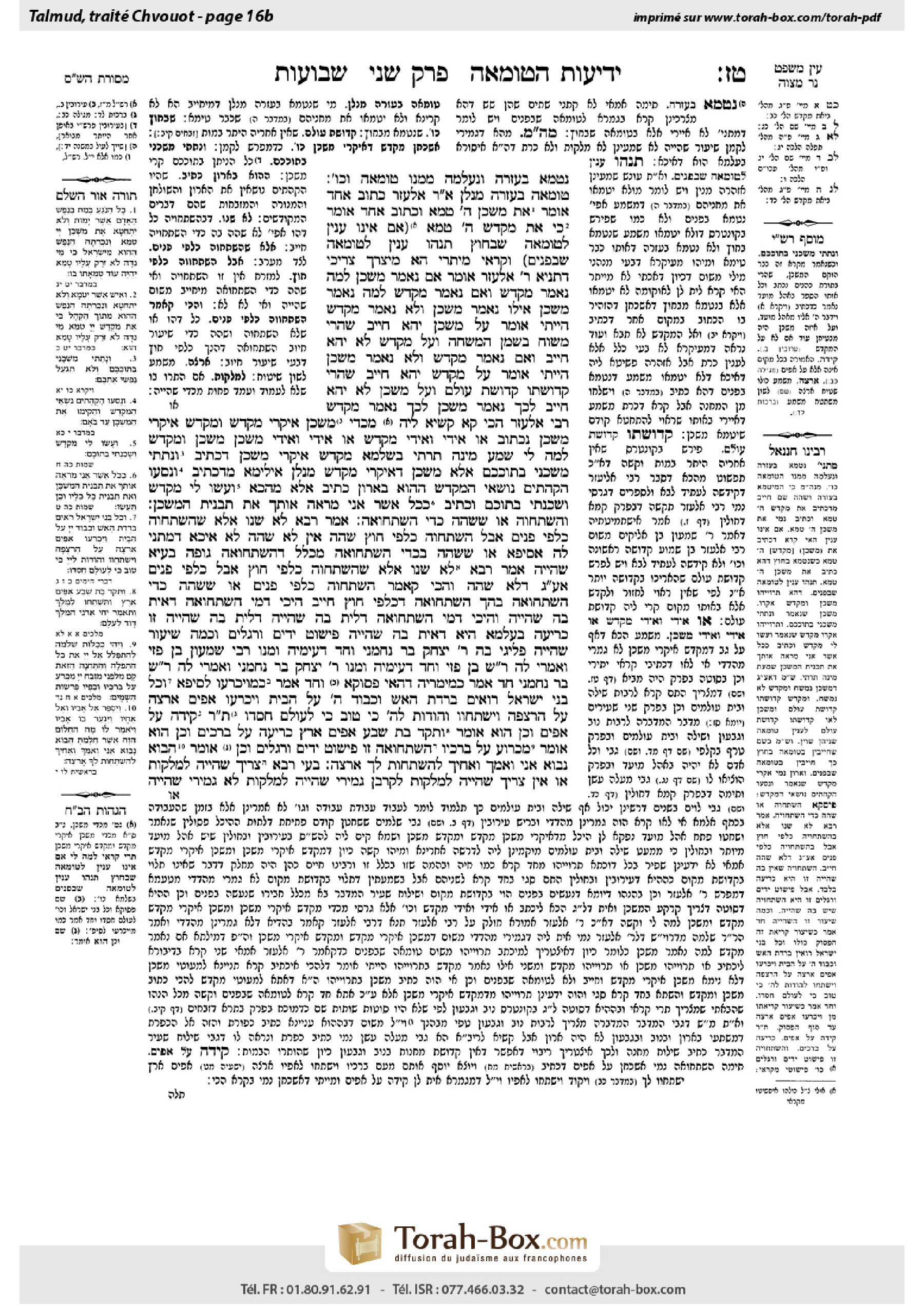
Shevuot 16b: Talmud study for Daf Yomi
Daf Yomi is the daily study of one Talmud folio. Explore 37 tractates with scans, Hebrew text, Sefaria English and AI-generated French translations where annotated.
Passage selection and English or AI-generated French translation are available where the scan has annotations. Daf Study is independent of Torah-Box and Sefaria.
Browse Shevuot · שבועות · All tractatesShevuot 16b text and translations
This page of Shevuot includes the Aramaic text, an English translation and an AI-generated French translation, alongside the scan above.
שבועות י״ו ב · Aramaic and Hebrew text
נִטְמָא בָּעֲזָרָה וְנֶעֶלְמָה מִמֶּנּוּ טוּמְאָה וְכוּ׳. טוּמְאָה בַּעֲזָרָה מְנָלַן? אָמַר רַבִּי אֶלְעָזָר, כָּתוּב אֶחָד אוֹמֵר: ״אֶת מִשְׁכַּן ה׳ טִמֵּא״, וְכָתוּב אֶחָד אוֹמֵר: ״כִּי אֶת מִקְדַּשׁ ה׳ טִמֵּא״; אִם אֵינוֹ עִנְיָן לְטוּמְאָה שֶׁבַּחוּץ, תְּנֵהוּ עִנְיָן לְטוּמְאָה שֶׁבִּפְנִים.
וּקְרָאֵי מְיַתְּרִי?! הָא מִיצְרָךְ צְרִיכִי! דְּתַנְיָא, רַבִּי אֶלְעָזָר אוֹמֵר: אִם נֶאֱמַר ״מִשְׁכָּן״, לָמָּה נֶאֱמַר ״מִקְדָּשׁ״? וְאִם נֶאֱמַר ״מִקְדָּשׁ״, לָמָּה נֶאֱמַר ״מִשְׁכָּן״? אִילּוּ נֶאֱמַר ״מִשְׁכָּן״ וְלֹא נֶאֱמַר ״מִקְדָּשׁ״, הָיִיתִי אוֹמֵר: עַל מִשְׁכָּן יְהֵא חַיָּיב – שֶׁהֲרֵי מָשׁוּחַ בְּשֶׁמֶן הַמִּשְׁחָה, וְעַל מִקְדָּשׁ לֹא יְהֵא חַיָּיב. וְאִם נֶאֱמַר ״מִקְדָּשׁ״ וְלֹא נֶאֱמַר ״מִשְׁכָּן״, הָיִיתִי אוֹמֵר: עַל מִקְדָּשׁ יְהֵא חַיָּיב – שֶׁהֲרֵי קְדוּשָּׁתוֹ קְדוּשַּׁת עוֹלָם, וְעַל מִשְׁכָּן לֹא יְהֵא חַיָּיב. לְכָךְ נֶאֱמַר ״מִשְׁכָּן״, לְכָךְ נֶאֱמַר ״מִקְדָּשׁ״.
רַבִּי אֶלְעָזָר הָכִי קָא קַשְׁיָא לֵיהּ: מִכְּדִי מִשְׁכָּן אִיקְּרִי ״מִקְדָּשׁ״ וּמִקְדָּשׁ אִיקְּרִי ״מִשְׁכָּן״; נִכְתּוֹב אוֹ אִידֵּי וְאִידֵּי ״מִקְדָּשׁ״, אוֹ אִידֵּי וְאִידֵּי ״מִשְׁכָּן״! ״מִשְׁכָּן״ וּ״מִקְדָּשׁ״ לְמָה לִי? שְׁמַע מִינַּהּ תַּרְתֵּי.
בִּשְׁלָמָא מִקְדָּשׁ אִיקְּרִי מִשְׁכָּן – דִּכְתִיב: ״וְנָתַתִּי מִשְׁכָּנִי בְּתוֹכְכֶם״; אֶלָּא מִשְׁכָּן דְּאִיקְּרִי מִקְדָּשׁ – מְנָלַן? אִילֵּימָא מִדִּכְתִיב: ״וְנָסְעוּ הַקְּהָתִים נֹשְׂאֵי הַמִּקְדָּשׁ״ – הָהוּא בְּאָרוֹן כְּתִיב! אֶלָּא מֵהָכָא: ״וְעָשׂוּ לִי מִקְדָּשׁ וְשָׁכַנְתִּי בְּתוֹכָם״, וּכְתִיב: ״כְּכֹל אֲשֶׁר אֲנִי מַרְאֶה אוֹתְךָ אֵת תַּבְנִית הַמִּשְׁכָּן״.
וְהִשְׁתַּחֲוָה אוֹ שֶׁשָּׁהָה כְּדֵי הִשְׁתַּחֲוָאָה. אָמַר רָבָא: לֹא שָׁנוּ אֶלָּא שֶׁהִשְׁתַּחֲוָה כְּלַפֵּי פְנִים, אֲבָל הִשְׁתַּחֲוָה כְּלַפֵּי חוּץ – שָׁהָה אִין, לֹא שָׁהָה לָא.
אִיכָּא דְּמַתְנֵי לַהּ אַסֵּיפָא: אוֹ שֶׁשָּׁהָה בִּכְדֵי הִשְׁתַּחֲוָאָה – מִכְּלַל דְּהִשְׁתַּחֲוָאָה גּוּפַהּ בָּעֲיָא שְׁהִיָּיה; אָמַר רָבָא: לֹא שָׁנוּ אֶלָּא שֶׁהִשְׁתַּחֲוָה כְּלַפֵּי חוּץ, אֲבָל כְּלַפֵּי פְנִים – אַף עַל גַּב דְּלֹא שָׁהָה. וְהָכִי קָאָמַר: הִשְׁתַּחֲוָה כְּלַפֵּי פְנִים, אוֹ שֶׁשָּׁהָה כְּדֵי הִשְׁתַּחֲוָאָה בְּהָךְ הִשְׁתַּחֲוָאָה דִּכְלַפֵּי חוּץ – חַיָּיב.
הֵיכִי דָּמֵי הִשְׁתַּחֲוָאָה דְּאִית בַּהּ שְׁהִיָּיה, וְהֵיכִי דָּמֵי הִשְׁתַּחֲוָאָה דְּלֵית בַּהּ שְׁהִיָּיה? דְּלֵית בַּהּ שְׁהִיָּיה – זוֹ כְּרִיעָה בְּעָלְמָא הִיא, דְּאִית בָּהּ שְׁהִיָּיה – פִּישּׁוּט יָדַיִם וְרַגְלַיִם.
וְכַמָּה שִׁיעוּר שְׁהִיָּיה? פְּלִיגִי בַּהּ רַבִּי יִצְחָק בַּר נַחְמָנִי וְחַד דְּעִימֵּיהּ, וּמַנּוּ – רַבִּי שִׁמְעוֹן בֶּן פַּזִּי; וְאָמְרִי לַהּ רַבִּי שִׁמְעוֹן בֶּן פַּזִּי וְחַד דְּעִימֵּיהּ, וּמַנּוּ – רַבִּי יִצְחָק בַּר נַחְמָנִי, וְאָמְרִי לַהּ רַבִּי שִׁמְעוֹן בַּר נַחְמָנִי. חַד אָמַר: כְּמֵימְרֵיהּ דְּהַאי פְּסוּקָא, וְחַד אָמַר: כְּמִ״וַּיִכְרְעוּ״ לְסֵיפָא. ״וְכֹל בְּנֵי יִשְׂרָאֵל רֹאִים בְּרֶדֶת הָאֵשׁ וּכְבוֹד ה׳ עַל הַבָּיִת, וַיִּכְרְעוּ אַפַּיִם אַרְצָה עַל הָרִצְפָה, וַיִּשְׁתַּחֲווּ וְהוֹדוֹת לַה׳ כִּי טוֹב כִּי לְעוֹלָם חַסְדּוֹ״.
תָּנוּ רַבָּנַן: קִידָּה – עַל אַפַּיִם, וְכֵן הוּא אוֹמֵר: ״וַתִּקֹּד בַּת שֶׁבַע אַפַּיִם אֶרֶץ״. כְּרִיעָה – עַל בִּרְכַּיִם, וְכֵן הוּא אוֹמֵר: ״מִכְּרֹעַ עַל בִּרְכָּיו״. הִשְׁתַּחֲוָאָה – זוֹ פִּישּׁוּט יָדַיִם וְרַגְלַיִם, וְכֵן אוֹמֵר: ״הֲבוֹא נָבוֹא אֲנִי וְאִמְּךָ וְאַחֶיךָ לְהִשְׁתַּחֲוֹת לְךָ אָרְצָה״.
בָּעֵי רָבָא: צָרִיךְ שְׁהִיָּיה לְמַלְקוּת, אוֹ אֵין צָרִיךְ שְׁהִיָּיה לְמַלְקוּת? לְקׇרְבָּן גְּמִירִי שְׁהִיָּיה, לְמַלְקוּת לָא גְּמִירִי שְׁהִיָּיה;
Shevuot 16b · English translation
§ The mishna teaches about one who was ritually pure when he entered the Temple but who became impure while in the Temple courtyard, and afterward his impurity was hidden from him. The Gemara asks: From where do we derive that one is liable even if he contracted impurity in the Temple courtyard and failed to leave immediately by way of the shortest route, and not only if he entered the Temple courtyard when he was already impure? Rabbi Elazar says: One verse states: “He has defiled the Tabernacle of the Lord” (Numbers 19:13), and one verse states: “For he has defiled the Temple of the Lord” (Numbers 19:20). If this second verse is not needed for the matter of one who contracted impurity outside before he entered the Temple courtyard, as this situation is already referred to in the previous verse, apply it to the matter of one who contracted impurity inside the Temple courtyard.
The Gemara asks: But is it really superfluous to have both of these verses, one having been sufficient? Aren’t they each necessary to teach a novel ruling? As it is taught in a baraita: Rabbi Elazar says: If it is stated: “Tabernacle,” why does it state: “Temple”? And if it is stated: “Temple,” why does it state: “Tabernacle”? He explains: Had the verse stated only: “Tabernacle,” and not stated: “Temple,” I would have said that one is liable for entering the Tabernacle in a state of impurity, since it was anointed with the anointing oil, and therefore it carries greater sanctity, but he is not liable for entering the Temple, which was not anointed with the anointing oil. And had the verse stated only: “Temple,” and not stated: “Tabernacle,” I would have said that one is liable for entering the Temple in a state of impurity, since its sanctity is an eternal sanctity, but he is not liable for entering the Tabernacle, whose sanctity was only for its time. For this reason, it is stated: “Tabernacle,” and for this reason, it is stated: “Temple.”
The Gemara answers: Rabbi Elazar did not base his derivation on a superfluous verse, but on the change in wording between the two verses. This is what is difficult for him: Since the Tabernacle is also called Temple and the Temple is also called Tabernacle, then let the verse write either in both verses: Temple, or in both verses: Tabernacle; why do I need both “Tabernacle” and “Temple”? Conclude two conclusions from it, i.e., that one is liable even for impurity contracted inside the grounds, and that the halakha applies both in the Tabernacle and in the Temple.
The Gemara questions its previous assumption: Granted, the Temple is also called Tabernacle, as it is written: “And I will set My Tabernacle among you” (Leviticus 26:11), where the reference is to the Temple, as the verse is referring to that which will transpire after the Jewish people have settled in their land. But from where do we derive that the Tabernacle is also called Temple? If we say that it is derived from that which is written: “And the Kehatites, the bearers of the Temple, set forward” (Numbers 10:21), that instance of the term Temple is not written with regard to the Tabernacle; rather, it is written with regard to the Ark and the other sacred vessels. Rather, it is derived from here: “And let them make Me a Temple, that I may dwell among them” (Exodus 25:8), where the reference is to the Tabernacle, as immediately afterward it is written: “According to all that I show you, the pattern of the Tabernacle” (Exodus 25:9).
§ The mishna teaches: If he bowed down, or he tarried in the Temple courtyard long enough to bow down, or he went out by way of a longer route when he could have taken a shorter route, he is liable to bring a sliding-scale offering. Rava says: They taught this only when he bowed down in the Temple courtyard facing inward, toward the Holy of Holies, as that alone is proper bowing. But if he bowed down facing outward, that is not considered bowing. When he bows facing outward, if he tarried in the Temple courtyard long enough to bow down, yes, he is liable, but if he did not tarry long enough to bow down, he is not liable.
There are those who teach the statement of Rava with regard to the latter clause: Or if he tarried in the Temple courtyard long enough to bow down, he is liable to bring a sliding-scale offering. It may be said by inference that bowing down itself entails tarrying, and the mere act of bowing does not render one liable. With regard to this Rava says: They taught this only when he bowed down facing outward. In such a case, he is liable only if he tarried long enough to bow down. But if he bowed down facing inward toward the Holy of Holies, he is liable even if he did not tarry for that length of time. And this is what the mishna is saying: If he bowed down facing inward, or if he tarried long enough to bow down while he was bowing down facing outward, he is liable.
The Gemara asks: What are the circumstances of bowing in which there is tarrying, and what are the circumstances of bowing in which there is no tarrying? The Gemara answers: With regard to bowing in which there is no tarrying, that is merely kneeling. As for bowing in which there is tarrying, that is prostrating oneself while spreading one’s arms and legs in total submission.
The Gemara asks: And what is the measure of that tarrying? Rabbi Yitzḥak bar Naḥmani and one other Sage who was with him disagree about this. And who is that other scholar? Rabbi Shimon ben Pazi. And some say that it was Rabbi Shimon ben Pazi and one other Sage who was with him. And who is that other scholar? Rabbi Yitzḥak bar Naḥmani. And some say it was Rabbi Shimon bar Naḥmani. One Sage says: It is as long as the time it takes to recite this following verse in its entirety, and one Sage says: It is as long as the time it takes to recite from the term “and they bowed” in the middle of that verse until the end. What is the verse? “And when all the children of Israel saw how the fire came down, and the glory of the Lord upon the House, and they bowed with their faces to the ground upon the pavement, and prostrated themselves, and praised the Lord, saying: For He is good, for His steadfast love endures forever” (II Chronicles 7:3).
The Gemara discusses the different forms of bowing in greater detail. The Sages taught: The term kidda indicates falling upon one’s face, and so the verse states: “Then Bathsheba bowed [vatikkod] with her face to the ground” (I Kings 1:31). Keria means descending upon one’s knees, and so the verse states with regard to Solomon: “He rose from before the altar of the Lord, from kneeling [mikero’a] upon his knees” (I Kings 8:54). Hishtaḥava’a, this is prostrating oneself while spreading one’s arms and legs in total submission, and so the verse states that Jacob asked, in response to Joseph’s relating of his dream: “Shall I and your mother and your brothers indeed come to bow down [lehishtaḥavot] to you to the ground” (Genesis 37:10), i.e., spread out completely on the ground.
§ Rava raises a dilemma: Is tarrying long enough to bow down necessary to incur lashes? If one was warned not to remain in the Temple courtyard in a state of impurity, is he liable to receive lashes only if he remains there long enough to bow down, completely spread out on the ground? Or is tarrying not necessary to incur lashes, and he is immediately liable to receive lashes? The Gemara clarifies the two possibilities: Is it learned as a tradition that tarrying is necessary in order to incur liability to bring an offering, but not learned as a tradition that tarrying is necessary to become liable to receive lashes?
Shevuot 16b · Traduction française (IA)
§ La Michna enseigne le cas de celui qui était rituellement pur lorsqu’il est entré dans le Temple, mais qui est devenu impur dans la cour du Temple, puis a oublié son état d’impureté. La Guemara demande : d’où déduisons-nous qu’il est passible même s’il a contracté l’impureté dans la cour du Temple et n’en est pas sorti immédiatement par le chemin le plus court, et pas seulement s’il est entré dans la cour du Temple alors qu’il était déjà impur ? Rabbi Elazar dit : un verset déclare : « Il a rendu impur le Tabernacle du Seigneur » (Nombres 19,13), et un autre verset déclare : « Car il a rendu impur le Temple du Seigneur » (Nombres 19,20). Si ce second verset n’est pas nécessaire pour le cas de celui qui a contracté l’impureté à l’extérieur avant d’entrer dans la cour du Temple, puisque le verset précédent traite déjà de cette situation, applique-le au cas de celui qui a contracté l’impureté à l’intérieur de la cour du Temple.
La Guemara demande : mais ces deux versets sont-ils vraiment redondants, de sorte qu’un seul aurait suffi ? N’est-il pas nécessaire que chacun enseigne une règle nouvelle ? Car il est enseigné dans une baraïta : Rabbi Elazar dit : s’il est écrit « Tabernacle », pourquoi est-il aussi écrit « Temple » ? Et s’il est écrit « Temple », pourquoi est-il aussi écrit « Tabernacle » ? Il explique : si le verset n’avait mentionné que le « Tabernacle », sans mentionner le « Temple », j’aurais dit qu’on est passible pour être entré dans le Tabernacle en état d’impureté, puisqu’il a été oint avec l’huile d’onction et possède donc une sainteté supérieure, mais qu’on n’est pas passible pour être entré dans le Temple, qui n’a pas été oint avec l’huile d’onction. Et si le verset n’avait mentionné que le « Temple », sans mentionner le « Tabernacle », j’aurais dit qu’on est passible pour être entré dans le Temple en état d’impureté, puisque sa sainteté est éternelle, mais qu’on n’est pas passible pour être entré dans le Tabernacle, dont la sainteté ne valait que pour son temps. C’est pourquoi il est écrit « Tabernacle », et c’est pourquoi il est écrit « Temple ».
La Guemara répond : Rabbi Elazar n’a pas fondé sa déduction sur un verset superflu, mais sur la différence de formulation entre les deux versets. Ce qui lui pose problème, c’est ceci : puisque le Tabernacle est aussi appelé Temple et que le Temple est aussi appelé Tabernacle, que le verset écrive donc « Temple » dans les deux versets, ou « Tabernacle » dans les deux versets ; pourquoi ai-je besoin des deux termes, « Tabernacle » et « Temple » ? Déduis-en deux conclusions : on est passible même pour une impureté contractée à l’intérieur de l’enceinte, et la halakha s’applique aussi bien au Tabernacle qu’au Temple.
La Guemara remet en question son hypothèse précédente : il est établi que le Temple est aussi appelé Tabernacle, comme il est écrit : « Je placerai Mon Tabernacle parmi vous » (Lévitique 26,11), où il est question du Temple, puisque le verset parle de ce qui se produira après que le peuple juif se sera installé dans son pays. Mais d’où déduisons-nous que le Tabernacle est aussi appelé Temple ? Si nous disons que cela se déduit de ce qui est écrit : « Et les Kehatites, porteurs du Temple, se mirent en marche » (Nombres 10,21), le terme « Temple » n’est pas employé ici à propos du Tabernacle ; il désigne plutôt l’Arche et les autres ustensiles sacrés. On le déduit plutôt de ce verset : « Qu’ils Me fassent un Temple, afin que Je réside parmi eux » (Exode 25,8), où il est question du Tabernacle, comme il est écrit juste après : « Selon tout ce que Je te montre, le modèle du Tabernacle » (Exode 25,9).
§ La Michna enseigne : s’il s’est prosterné, ou s’il est resté dans la cour du Temple assez longtemps pour se prosterner, ou s’il est sorti par un chemin plus long alors qu’il aurait pu prendre le plus court, il est passible d’apporter un sacrifice à valeur variable. Rava dit : cela n’a été enseigné que dans le cas où il s’est prosterné dans la cour du Temple en regardant vers l’intérieur, vers le Saint des Saints, car seule cette manière de se prosterner est appropriée. Mais s’il s’est prosterné en regardant vers l’extérieur, cela n’est pas considéré comme une prosternation. Dans ce cas, s’il est resté dans la cour du Temple assez longtemps pour se prosterner, il est passible ; mais s’il n’y est pas resté assez longtemps pour se prosterner, il n’est pas passible.
Certains rapportent la déclaration de Rava à propos de la dernière clause : ou s’il est resté dans la cour du Temple assez longtemps pour se prosterner, il est passible d’apporter un sacrifice à valeur variable. On peut en déduire que la prosternation elle-même implique une durée, et que le simple fait de se prosterner ne rend pas passible. À ce sujet, Rava dit : cela n’a été enseigné que dans le cas où il s’est prosterné en regardant vers l’extérieur. Dans ce cas, il n’est passible que s’il est resté assez longtemps pour se prosterner. Mais s’il s’est prosterné en regardant vers l’intérieur, vers le Saint des Saints, il est passible même s’il n’est pas resté aussi longtemps. Voici donc ce que dit la Michna : s’il s’est prosterné en regardant vers l’intérieur, ou s’il est resté assez longtemps pour se prosterner en se prosternant vers l’extérieur, il est passible.
La Guemara demande : dans quelles circonstances la prosternation implique-t-elle une durée, et dans quelles circonstances n’en implique-t-elle pas ? La Guemara répond : la prosternation qui n’implique pas de durée n’est qu’un agenouillement. Quant à la prosternation qui implique une durée, c’est le fait de se prosterner en étendant les bras et les jambes, dans une soumission totale.
La Guemara demande : quelle est la durée requise ? Rabbi Yitzḥak bar Naḥmani et un autre Sage qui était avec lui sont en désaccord à ce sujet. Et qui est cet autre Sage ? Rabbi Shimon ben Pazi. Certains disent que c’étaient Rabbi Shimon ben Pazi et un autre Sage qui était avec lui. Et qui est cet autre Sage ? Rabbi Yitzḥak bar Naḥmani. D’autres disent qu’il s’agissait de Rabbi Shimon bar Naḥmani. Un Sage dit : c’est le temps nécessaire pour réciter intégralement le verset suivant ; un autre Sage dit : c’est le temps nécessaire pour réciter, à partir des mots « et ils se prosternèrent », au milieu de ce verset, jusqu’à la fin. Quel est ce verset ? « Lorsque tous les enfants d’Israël virent comment le feu était descendu et la gloire du Seigneur sur la Maison, ils se prosternèrent, le visage contre terre, sur le dallage, se prosternèrent et louèrent le Seigneur, en disant : Car Il est bon, car Sa bonté fidèle dure à jamais » (II Chroniques 7,3).
La Guemara examine plus en détail les différentes formes de prosternation. Les Sages ont enseigné : le terme kidda désigne le fait de tomber face contre terre, comme le dit le verset : « Alors Batcheva s’inclina [vatikkod], le visage contre terre » (I Rois 1,31). Keria signifie se mettre à genoux, comme le dit le verset au sujet de Salomon : « Il se releva de devant l’autel du Seigneur, après s’être agenouillé [mikero’a] sur ses genoux » (I Rois 8,54). Hishtaḥava’a désigne le fait de se prosterner en étendant les bras et les jambes, dans une soumission totale, comme le dit le verset où Jacob demande, en réponse au récit de son rêve par Joseph : « Est-ce que nous viendrons vraiment, moi, ta mère et tes frères, nous prosterner [lehishtaḥavot] devant toi jusqu’à terre ? » (Genèse 37,10), c’est-à-dire en nous étendant complètement sur le sol.
§ Rava soulève une question : faut-il rester assez longtemps pour se prosterner afin d’être passible de flagellation ? Si l’on a été averti de ne pas rester dans la cour du Temple en état d’impureté, n’est-on passible de flagellation que si l’on y reste assez longtemps pour se prosterner, entièrement étendu sur le sol ? Ou bien cette durée n’est-elle pas nécessaire pour être passible de flagellation, et en est-on passible immédiatement ? La Guemara précise les deux possibilités : a-t-on reçu par tradition que cette durée est nécessaire pour être passible d’apporter un sacrifice, mais pas que cette durée est nécessaire pour être passible de flagellation ?
Traduction française générée par IA à partir de l’édition anglaise de Sefaria. Vérifie toujours un passage avec le texte source.
Text from Sefaria: William Davidson Edition - Vocalized Aramaic (CC BY NC); William Davidson Edition - English (CC BY NC).