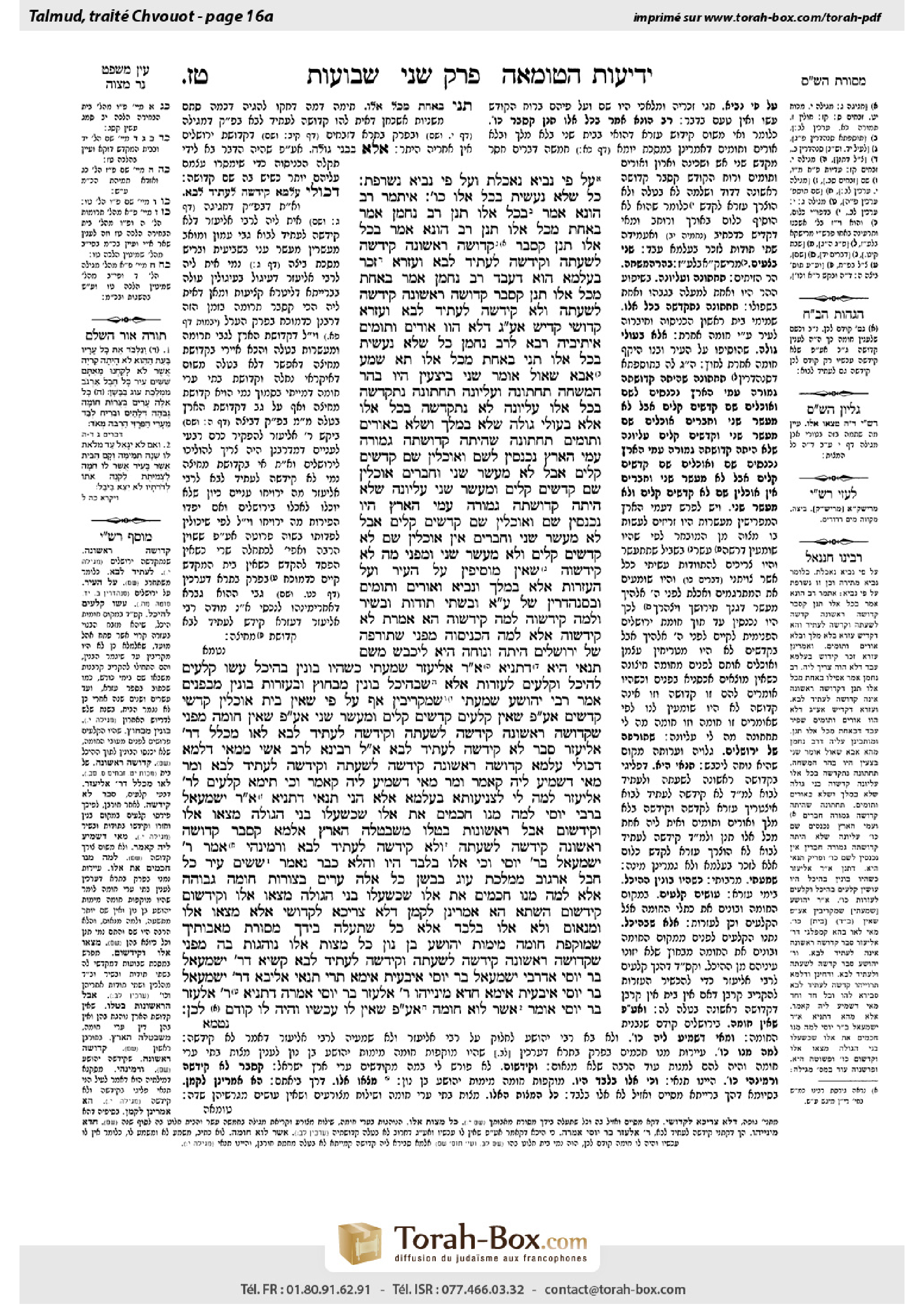
Shevuot 16a: Talmud study for Daf Yomi
Daf Yomi is the daily study of one Talmud folio. Explore 37 tractates with scans, Hebrew text, Sefaria English and AI-generated French translations where annotated.
Passage selection and English or AI-generated French translation are available where the scan has annotations. Daf Study is independent of Torah-Box and Sefaria.
Browse Shevuot · שבועות · All tractatesShevuot 16a text and translations
This page of Shevuot includes the Aramaic text, an English translation and an AI-generated French translation, alongside the scan above.
שבועות י״ו א · Aramaic and Hebrew text
עַל פִּי נָבִיא נֶאֱכֶלֶת וְעַל פִּי נָבִיא נִשְׂרֶפֶת.
כֹּל שֶׁלֹּא נַעֲשֵׂית בְּכׇל אֵלּוּ כּוּ׳. אִיתְּמַר, רַב הוּנָא אָמַר: ״בְּכׇל אֵלּוּ״ תְּנַן, רַב נַחְמָן אָמַר: ״בְּאַחַת מִכׇּל אֵלּוּ״ תְּנַן.
רַב הוּנָא אָמַר ״בְּכׇל אֵלּוּ״ תְּנַן – קָסָבַר קְדוּשָּׁה רִאשׁוֹנָה קִידְּשָׁה לִשְׁעָתָהּ וְקִידְּשָׁה לֶעָתִיד לָבֹא, וְעֶזְרָא זֵכֶר בְּעָלְמָא הוּא דַּעֲבַד.
רַב נַחְמָן אָמַר ״בְּאַחַת מִכׇּל אֵלּוּ״ תְּנַן – קָסָבַר: קְדוּשָּׁה רִאשׁוֹנָה קִידְּשָׁה לִשְׁעָתָהּ וְלֹא קִידְּשָׁה לֶעָתִיד לָבֹא, וְעֶזְרָא קַדּוֹשֵׁי קַדֵּישׁ אַף עַל גַּב דְּלָא הֲווֹ אוּרִים וְתוּמִּים.
אֵיתִיבֵיהּ רָבָא לְרַב נַחְמָן: ״כֹּל שֶׁלֹּא נַעֲשֵׂית בְּכׇל אֵלּוּ״! תָּנֵי: ״בְּאַחַת מִכׇּל אֵלּוּ״.
תָּא שְׁמַע, אַבָּא שָׁאוּל אוֹמֵר: שְׁנֵי בִּיצְעִין הָיוּ בְּהַר הַמִּשְׁחָה, תַּחְתּוֹנָה וְעֶלְיוֹנָה. תַּחְתּוֹנָה – נִתְקַדְּשָׁה בְּכׇל אֵלּוּ; עֶלְיוֹנָה – לֹא נִתְקַדְּשָׁה בְּכׇל אֵלּוּ, אֶלָּא בְּעוֹלֵי גוֹלָה; שֶׁלֹּא בְּמֶלֶךְ וְשֶׁלֹּא בְּאוּרִים וְתוּמִּים.
תַּחְתּוֹנָה שֶׁהָיְתָה קְדוּשָּׁתָהּ גְּמוּרָה – עַמֵּי הָאָרֶץ נִכְנָסִין לְשָׁם, וְאוֹכְלִין שָׁם קָדָשִׁים קַלִּים אֲבָל לֹא מַעֲשֵׂר שֵׁנִי; וַחֲבֵרִים אוֹכְלִים שָׁם קָדָשִׁים קַלִּים וּמַעֲשֵׂר שֵׁנִי.
עֶלְיוֹנָה שֶׁלֹּא הָיְתָה קְדוּשָּׁתָהּ גְּמוּרָה – עַמֵּי הָאָרֶץ הָיוּ נִכְנָסִין שָׁם, וְאוֹכְלִין שָׁם קָדָשִׁים קַלִּים אֲבָל לֹא מַעֲשֵׂר שֵׁנִי; וַחֲבֵרִים אֵין אוֹכְלִין שָׁם לֹא קָדָשִׁים קַלִּים וְלֹא מַעֲשֵׂר שֵׁנִי. וּמִפְּנֵי מָה לֹא קִידְּשׁוּהָ? שֶׁאֵין מוֹסִיפִין עַל הָעִיר וְעַל הָעֲזָרוֹת אֶלָּא בְּמֶלֶךְ וְנָבִיא וְאוּרִים וְתוּמִּים, וּבְסַנְהֶדְרִין שֶׁל שִׁבְעִים וְאֶחָד, וּבִשְׁתֵּי תּוֹדוֹת וּבְשִׁיר.
וְלָמָּה קִידְּשׁוּהָ? לָמָּה קִידְּשׁוּהָ?! הָא אָמְרַתְּ לֹא קִידְּשׁוּהָ! אֶלָּא לָמָה הִכְנִיסוּהָ? מִפְּנֵי שֶׁתּוֹרְפָּהּ שֶׁל יְרוּשָׁלַיִם הָיְתָה, וְנוֹחָה הִיא לִיכָּבֵשׁ מִשָּׁם.
תַּנָּאֵי הִיא; דְּתַנְיָא, אָמַר רַבִּי אֱלִיעֶזֶר: שָׁמַעְתִּי כְּשֶׁהָיוּ בּוֹנִין בַּהֵיכָל, עָשׂוּ קְלָעִים לַהֵיכָל וּקְלָעִים לָעֲזָרוֹת. אֶלָּא שֶׁבַּהֵיכָל בּוֹנִין מִבַּחוּץ, וּבָעֲזָרוֹת בּוֹנִין מִבִּפְנִים.
אָמַר רַבִּי יְהוֹשֻׁעַ: שָׁמַעְתִּי שֶׁמַּקְרִיבִין אַף עַל פִּי שֶׁאֵין בַּיִת, אוֹכְלִין קׇדְשֵׁי קָדָשִׁים אַף עַל פִּי שֶׁאֵין קְלָעִים, קָדָשִׁים קַלִּים וּמַעֲשֵׂר שֵׁנִי אַף עַל פִּי שֶׁאֵין חוֹמָה; מִפְּנֵי שֶׁקְּדוּשָּׁה רִאשׁוֹנָה קִידְּשָׁה לִשְׁעָתָהּ וְקִידְּשָׁה לֶעָתִיד לָבֹא. לָאו מִכְּלָל דְּרַבִּי אֱלִיעֶזֶר סָבַר: לֹא קִידְּשָׁה לֶעָתִיד לָבֹא?
אֲמַר לֵיהּ רָבִינָא לְרַב אָשֵׁי: מִמַּאי? דִּלְמָא דְּכוּלֵּי עָלְמָא קְדוּשָּׁה רִאשׁוֹנָה קִידְּשָׁה לִשְׁעָתָהּ וְקִידְּשָׁה לֶעָתִיד לָבֹא, וּמָר מַאי דִּשְׁמִיעַ לֵיהּ קָאָמַר, וּמָר מַאי דִּשְׁמִיעַ לֵיהּ קָאָמַר. וְכִי תֵּימָא: קְלָעִים לְרַבִּי אֱלִיעֶזֶר לְמָה לִי? לִצְנִיעוּתָא בְּעָלְמָא.
אֶלָּא הָנֵי תַּנָּאֵי – דְּתַנְיָא, אָמַר רַבִּי יִשְׁמָעֵאל בְּרַבִּי יוֹסֵי: לָמָּה מָנוּ חֲכָמִים אֶת אֵלּוּ? שֶׁכְּשֶׁעָלוּ בְּנֵי הַגּוֹלָה, מָצְאוּ אֵלּוּ וְקִידְּשׁוּם. אֲבָל רִאשׁוֹנוֹת בָּטְלוּ מִשֶּׁבָּטְלָה הָאָרֶץ. אַלְמָא קָסָבַר: קְדוּשָּׁה רִאשׁוֹנָה קִידְּשָׁה לִשְׁעָתָהּ וְלֹא קִידְּשָׁה לֶעָתִיד לָבֹא.
ורְמִינְהִי, אָמַר רַבִּי יִשְׁמָעֵאל בְּרַבִּי יוֹסֵי: וְכִי אֵלּוּ בִּלְבַד הָיוּ?! וַהֲלֹא כְּבָר נֶאֱמַר: ״שִׁשִּׁים עִיר כׇּל חֶבֶל אַרְגֹּב מַמְלֶכֶת עוֹג בַּבָּשָׁן, כׇּל אֵלֶּה עָרִים בְּצֻרוֹת חוֹמָה גְבֹהָה״! אֶלָּא לָמָּה מָנוּ חֲכָמִים אֶת אֵלּוּ – שֶׁכְּשֶׁעָלוּ בְּנֵי הַגּוֹלָה מָצְאוּ אֵלּוּ וְקִידְּשׁוּם.
קִידְּשׁוּם הַשְׁתָּא?! הָא אָמְרִינַן לְקַמַּן דְּלָא צְרִיכָא לְקַדּוֹשֵׁי! אֶלָּא מָצְאוּ אֵלּוּ וּמְנָאוּם.
וְלֹא אֵלּוּ בִּלְבַד, אֶלָּא כׇּל שֶׁתַּעֲלֶה בְּיָדְךָ מָסוֹרֶת מֵאֲבוֹתֶיךָ שֶׁמּוּקֶּפֶת חוֹמָה מִימוֹת יְהוֹשֻׁעַ בִּן נוּן – כׇּל מִצְוֹת אֵלּוּ נוֹהֲגוֹת בָּהּ, מִפְּנֵי שֶׁקְּדוּשָּׁה רִאשׁוֹנָה קִידְּשָׁה לִשְׁעָתָהּ וְקִידְּשָׁה לֶעָתִיד לָבֹא. קַשְׁיָא דְּרַבִּי יִשְׁמָעֵאל בַּר יוֹסֵי אַדְּרַבִּי יִשְׁמָעֵאל בַּר יוֹסֵי!
אִיבָּעֵית אֵימָא: תְּרֵי תַּנָּאֵי אַלִּיבָּא דְּרַבִּי יִשְׁמָעֵאל בַּר יוֹסֵי; אִיבָּעֵית אֵימָא: חֲדָא מִינַּיְיהוּ רַבִּי אֶלְעָזָר בַּר יוֹסֵי אַמְרַהּ. דְּתַנְיָא, רַבִּי אֶלְעָזָר בַּר יוֹסֵי אוֹמֵר: ״אֲשֶׁר לוֹא חֹמָה״ – אַף עַל פִּי שֶׁאֵין לוֹ עַכְשָׁיו וְהָיָה לוֹ קוֹדֶם לָכֵן.
Shevuot 16a · English translation
Based on a ruling of a prophet the loaves of one thanks-offering were eaten, and based on a ruling of a prophet the loaves of the other thanks-offering were burned. The prophets Haggai, Zechariah, and Malachi, who lived at the time of Ezra and Nehemiah’s reconsecration of Jerusalem, instructed the people concerning how the ceremony should be conducted, without providing reasons for the procedures.
§ The mishna teaches: And with regard to any addition to the Temple that was not made with all these ceremonial procedures, one who enters there while ritually impure is not liable. It was stated that amora’im disagreed about the text of the mishna. Rav Huna says: We learned in the mishna: With all these, which means that all of these procedures are indispensable, and if even one is missing, the consecration does not take effect. Rav Naḥman says: We learned in the mishna: With one of all these; i.e., any one of these procedures suffices for the consecration to take effect.
The Gemara further clarifies this disagreement. Rav Huna says: We learned in the mishna: With all these. The Gemara explains: He maintains that the initial consecration of the Temple in the days of David and Solomon sanctified it for its time and sanctified it forever. Therefore, the site of the Temple retained its original sanctity even during the days of the Second Temple. And Ezra, who reconsecrated the area, did so merely as a commemoration of the initial consecration. Accordingly, even though there was no king or Urim VeTummim, the entire area was fully consecrated. By contrast, in order to consecrate an area that had not been part of the initial consecration, all of these procedures are necessary and none can be omitted.
Rav Naḥman says: We learned in the mishna: With one of all these. The Gemara explains: He maintains that the initial consecration of the Temple sanctified it for its time only, and did not sanctify it forever. And Ezra consecrated the Temple and its courtyards, even though there was no king or Urim VeTummim. Consequently, it follows that there is no need for all of these procedures in order for the consecration to take effect.
Rava raised an objection to Rav Naḥman: The mishna explicitly states: Any addition that was not made with all these procedures. Rav Naḥman said to him: Emend the mishna and teach it as stating: With one of all these procedures.
The Gemara cites a proof against the opinion of Rav Naḥman: Come and hear a baraita: Abba Shaul says: There were two ponds [bitzin] on the Mount of Olives [Har HaMishḥa], a lower pond and an upper pond. The lower pond was consecrated during the time of the First Temple with all the procedures mentioned in the mishna, and it has the sanctity of Jerusalem for all purposes. By contrast, the upper pond was not consecrated with all these procedures, but rather it was consecrated by those who returned from the exile in Babylonia, without a king and without the Urim VeTummim.
The baraita continues: With regard to the lower pond, whose consecration was complete, amei ha’aretz, uneducated people who were not scrupulous in their observance of the mitzvot relating to tithes and to ritual purity, would enter into there and would partake of offerings of lesser sanctity that may be eaten in all of Jerusalem there, but they would not partake of second tithe there because they conducted themselves stringently concerning this matter. And ḥaverim, who were meticulous in their observance of those mitzvot, would partake of both offerings of lesser sanctity and second tithe there.
The baraita continues: As for the upper pond, whose consecration was incomplete, amei ha’aretz would enter into there and partake of offerings of lesser sanctity there, but they would not partake of second tithe there. And ḥaverim would partake of neither offerings of lesser sanctity nor second tithe there. And for what reason did they not consecrate the upper pond? It was because additions can be made to the city of Jerusalem or to the Temple courtyards only by a special body comprising the king, a prophet, the Urim VeTummim, and the Sanhedrin of seventy-one, and with two thanks-offerings and with a special song.
The Gemara asks: But why did they consecrate the upper pond if they could not do so properly? This Gemara responds: Why did they consecrate it? Didn’t you say that they did not consecrate it? Rather, the question should be asked as follows: Given that they could not consecrate the upper pond, why did they bring it within the walls of the city? The Gemara answers: Because it was a weak point [turpa] of Jerusalem and it would have been easy to conquer the city from there, it became necessary to include it within the wall. This baraita seems to present explicit proof against the opinion of Rav Naḥman, who holds that there is no need for all of the procedures listed in the mishna in order for the consecration to be complete.
The Gemara rejects this proof: This is a dispute between tanna’im as to whether the initial consecration of Jerusalem and the Temple sanctified them only for their time or forever. Abba Shaul maintains that the initial consecration lapsed, and therefore the reconsecration required all of the procedures mentioned in the mishna. Where is this dispute taught? As it is taught in a mishna (Eduyyot 8:6): Rabbi Eliezer says: I heard that when they were building the Sanctuary in the Second Temple, they fashioned temporary curtains for the Sanctuary and temporary curtains for the courtyards to serve as partitions until the construction of the stone walls was completed. The difference was only that in the Sanctuary, the workers built the walls outside the curtains, without entering, and in the courtyards, the workers built the walls within the curtains.
The mishna continues: Rabbi Yehoshua says: I heard that one sacrifices offerings on the altar even if there is no Temple, and one partakes of offerings of the most sacred order in the Temple courtyard even if there are no curtains, and one partakes of offerings of lesser sanctity and second-tithe produce in Jerusalem even if there is no wall surrounding the city. This is due to the fact that the initial consecration sanctified the Temple and Jerusalem for their time and also sanctified them forever. The Gemara concludes: From the fact that Rabbi Yehoshua based his opinion on the principle that the initial consecration sanctified the Temple and Jerusalem forever, can one not learn by inference that Rabbi Eliezer maintains that it did not sanctify them forever? Apparently, this issue is the subject of a dispute between tanna’im.
Ravina said to Rav Ashi: From where do you draw this inference? Perhaps everyone maintains that the initial consecration sanctified the Temple and Jerusalem for their time and also sanctified them forever. And one Sage, Rabbi Eliezer, stated that tradition, which he heard from his teachers, and one Sage, Rabbi Yehoshua, stated that tradition, which he heard from his teachers, and there is no dispute between them. And if you would say: Why do I need curtains at all according to Rabbi Eliezer? The original sanctity remained when Jerusalem was not surrounded by walls, and similarly, the presence or absence of curtains is irrelevant to the sanctity of the Temple area. The Gemara answers: The curtains were established merely for seclusion, as it would have been unbecoming for the activity in this most sacred venue to be visible to all.
Rather, this matter is subject to a dispute between these tanna’im, as it is taught in a baraita with regard to the walled cities listed in the mishna in tractate Arakhin (32a): Rabbi Yishmael, son of Rabbi Yosei, said: Why did the Sages enumerate specifically these nine cities as cities that were walled since the days of Joshua, son of Nun? In fact, there were many more. The reason is that when the exiles ascended to Eretz Yisrael from Babylonia in the time of Ezra, they found these cities and consecrated them as walled cities; but the sanctity of the first walled cities, enumerated in the book of Joshua, was nullified when settlement in Eretz Yisrael was negated and the Jewish people were exiled. The Gemara comments: Apparently, Rabbi Yishmael, son of Rabbi Yosei, maintains: The initial consecration sanctified the Temple and Jerusalem for their time only and did not sanctify them forever.
And the Gemara raises a contradiction from a different baraita: Rabbi Yishmael, son of Rabbi Yosei, says: Were these cities that are enumerated in tractate Arakhin the only walled cities? But isn’t it already stated: “Sixty cities, all the region of Argob, the kingdom of Og, king of Bashan, all these were cities fortified with high walls, gates and bars” (Deuteronomy 3:4–5), indicating that there were many walled cities in the time of Joshua? Rather, why then did the Sages enumerate specifically these cities? It is due to the fact that when the exiles ascended from Babylonia they found these and consecrated them as walled cities.
The Gemara asks: They consecrated them? If their sanctity remained, it should not have been necessary to consecrate them. Now, don’t we say later in the same baraita that it is not necessary to consecrate them? The Gemara clarifies: Rather, this is what the baraita means to say: When the exiles ascended from Babylonia they found these and enumerated them.
The baraita continues: And not only these, but in any city with regard to which you receive a tradition from your ancestors that it was surrounded by a wall from the days of Joshua, son of Nun, all these mitzvot with regard to walled cities are observed in it, due to the fact that the initial consecration sanctified the Temple and Jerusalem for their time and sanctified them forever. The Gemara comments: This is difficult, as there is a contradiction between one statement of Rabbi Yishmael bar Yosei and another statement of Rabbi Yishmael bar Yosei.
The Gemara answers: If you wish, say that there are two tanna’im who disagree with regard to the opinion of Rabbi Yishmael bar Yosei. Each transmitted Rabbi Yishmael’s opinion in a different manner. And if you wish, say instead that one of the traditions is mistaken, as one of the baraitot was stated by Rabbi Elazar bar Yosei, and not his brother, Rabbi Yishmael. As it is taught in a baraita: Rabbi Elazar bar Yosei says that the verse with regard to walled cities states: “Which has [lo] a wall” (Leviticus 25:30). The word lo is written with an alef, meaning no, and accordingly the verse would be stating to the contrary, that the city does not have a wall, but its vocalization is in the sense of its homonym, lo with a vav, meaning that it has a wall. This indicates that even if it does not presently have a wall but it had a wall previously, it retains its status as a walled city. It is Rabbi Elazar bar Yosei who maintains that the first consecration sanctified the Temple and Jerusalem forever.
Shevuot 16a · Traduction française (IA)
Sur la base d’une décision prophétique, les pains d’un sacrifice de reconnaissance furent consommés et, sur la base d’une décision prophétique, ceux de l’autre sacrifice de reconnaissance furent brûlés. Les prophètes Aggée, Zacharie et Malachie, qui vécurent à l’époque où Ezra et Néhémie consacrèrent de nouveau Jérusalem, indiquèrent au peuple comment la cérémonie devait se dérouler, sans donner de raisons pour les différentes procédures.
§ La Michna enseigne : toute extension du Temple qui n’a pas été réalisée au moyen de toutes ces procédures cérémonielles n’engage pas la responsabilité de celui qui y pénètre en état d’impureté rituelle. Il est rapporté que des amoraïm étaient en désaccord sur le texte de la Michna. Rav Houna dit : Nous avons appris dans la Michna : « avec toutes ces procédures », ce qui signifie que chacune d’elles est indispensable et que, s’il en manque ne serait-ce qu’une, la consécration ne prend pas effet. Rav Naḥman dit : Nous avons appris dans la Michna : « avec une seule de toutes ces procédures », autrement dit, n’importe laquelle de ces procédures suffit pour que la consécration prenne effet.
La Guemara précise davantage ce désaccord. Rav Houna dit : Nous avons appris dans la Michna : « avec toutes ces procédures ». La Guemara explique : il soutient que la consécration initiale du Temple, à l’époque de David et de Salomon, l’a sanctifié pour son époque et pour toujours. Par conséquent, le site du Temple a conservé sa sainteté originelle, même à l’époque du Second Temple. Quant à Ezra, qui consacra de nouveau le secteur, il le fit simplement en souvenir de la consécration initiale. Ainsi, bien qu’il n’y eût ni roi ni Ourim ve-Toumim, toute la zone fut pleinement consacrée. En revanche, pour consacrer une zone qui n’avait pas fait partie de la consécration initiale, toutes ces procédures sont nécessaires et aucune ne peut être omise.
Rav Naḥman dit : Nous avons appris dans la Michna : « avec une seule de toutes ces procédures ». La Guemara explique : il soutient que la consécration initiale du Temple l’a sanctifié uniquement pour son époque et non pour toujours. Ezra consacra le Temple et ses parvis, bien qu’il n’y eût ni roi ni Ourim ve-Toumim. Il s’ensuit que toutes ces procédures ne sont pas nécessaires pour que la consécration prenne effet.
Rava objecta à Rav Naḥman : la Michna dit explicitement : « Toute extension qui n’a pas été réalisée au moyen de toutes ces procédures. » Rav Naḥman lui dit : Corrige le texte de la Michna et enseigne qu’il faut lire : « avec une seule de toutes ces procédures ».
La Guemara apporte une preuve contre l’opinion de Rav Naḥman : Viens et entends une baraïta. Abba Shaoul dit : Il y avait deux bassins [bitzin] sur le mont des Oliviers [Har HaMishḥa], un bassin inférieur et un bassin supérieur. Le bassin inférieur fut consacré à l’époque du Premier Temple au moyen de toutes les procédures mentionnées dans la Michna, et il possède, à tous égards, la sainteté de Jérusalem. En revanche, le bassin supérieur ne fut pas consacré au moyen de toutes ces procédures ; il fut consacré par ceux qui revinrent de l’exil de Babylonie, sans roi ni Ourim ve-Toumim.
La baraïta poursuit : Quant au bassin inférieur, dont la consécration était complète, les amei ha’aretz, des gens sans instruction qui n’étaient pas scrupuleux dans l’observance des mitsvot relatives aux dîmes et à la pureté rituelle, y entraient et y consommaient des offrandes de moindre sainteté, qui peuvent être mangées partout à Jérusalem ; mais ils n’y consommaient pas de seconde dîme, car ils adoptaient une conduite rigoureuse à cet égard. Les ḥaverim, qui observaient ces mitsvot avec minutie, y consommaient aussi bien des offrandes de moindre sainteté que de la seconde dîme.
La baraïta poursuit : Quant au bassin supérieur, dont la consécration était incomplète, les amei ha’aretz y entraient et y consommaient des offrandes de moindre sainteté, mais ils n’y consommaient pas de seconde dîme. Les ḥaverim n’y consommaient ni offrandes de moindre sainteté ni seconde dîme. Et pour quelle raison n’ont-ils pas consacré le bassin supérieur ? Parce que l’on ne peut agrandir la ville de Jérusalem ni les parvis du Temple que par l’intermédiaire d’une assemblée spéciale comprenant le roi, un prophète, les Ourim ve-Toumim et le Sanhédrin de soixante et onze membres, au moyen de deux sacrifices de reconnaissance et d’un chant particulier.
La Guemara demande : Mais pourquoi ont-ils consacré le bassin supérieur s’ils ne pouvaient pas le faire correctement ? La Guemara répond : Pourquoi l’auraient-ils consacré ? N’as-tu pas dit qu’ils ne l’ont pas consacré ? La question doit plutôt être posée ainsi : puisqu’ils ne pouvaient pas consacrer le bassin supérieur, pourquoi l’ont-ils inclus à l’intérieur des remparts de la ville ? La Guemara répond : Comme il constituait un point faible [turpa] de Jérusalem, d’où il aurait été facile de conquérir la ville, il devint nécessaire de l’inclure à l’intérieur du rempart. Cette baraïta semble apporter une preuve explicite contre l’opinion de Rav Naḥman, selon laquelle toutes les procédures énumérées dans la Michna ne sont pas nécessaires pour que la consécration soit complète.
La Guemara rejette cette preuve : il s’agit d’un désaccord entre tannaïm sur la question de savoir si la consécration initiale de Jérusalem et du Temple les a sanctifiés uniquement pour leur époque ou pour toujours. Abba Shaoul soutient que la consécration initiale a cessé de produire ses effets ; la consécration renouvelée nécessitait donc toutes les procédures mentionnées dans la Michna. Où ce désaccord est-il enseigné ? Dans une Michna (Eduyyot 8:6), où il est enseigné : Rabbi Eliezer dit : J’ai entendu dire que, lorsqu’ils construisaient le Sanctuaire du Second Temple, ils dressaient des rideaux provisoires pour le Sanctuaire et des rideaux provisoires pour les parvis, afin de servir de cloisons jusqu’à l’achèvement des murs de pierre. La seule différence était que, dans le Sanctuaire, les ouvriers construisaient les murs à l’extérieur des rideaux, sans y pénétrer, tandis que, dans les parvis, ils construisaient les murs à l’intérieur des rideaux.
La Michna poursuit : Rabbi Yehoshoua dit : J’ai entendu dire que l’on offre des sacrifices sur l’autel même en l’absence du Temple, que l’on consomme des offrandes de très haute sainteté dans le parvis du Temple même en l’absence de rideaux, et que l’on consomme des offrandes de moindre sainteté et des produits de seconde dîme à Jérusalem même en l’absence d’un rempart entourant la ville. Cela tient au fait que la consécration initiale a sanctifié le Temple et Jérusalem pour leur époque et pour toujours. La Guemara conclut : Du fait que Rabbi Yehoshoua fonde son opinion sur le principe selon lequel la consécration initiale a sanctifié le Temple et Jérusalem pour toujours, ne peut-on pas déduire que Rabbi Eliezer soutient qu’elle ne les a pas sanctifiés pour toujours ? Apparemment, cette question fait l’objet d’un désaccord entre tannaïm.
Ravina dit à Rav Ashi : Sur quoi fondes-tu cette déduction ? Peut-être tout le monde soutient-il que la consécration initiale a sanctifié le Temple et Jérusalem pour leur époque et pour toujours. Un Sage, Rabbi Eliezer, a rapporté la tradition qu’il avait entendue de ses maîtres, et un autre Sage, Rabbi Yehoshoua, a rapporté celle qu’il avait entendue de ses maîtres ; il n’y a donc aucun désaccord entre eux. Et si tu dis : Pourquoi Rabbi Eliezer a-t-il besoin de rideaux ? La sainteté originelle subsistait même lorsque Jérusalem n’était pas entourée de remparts ; de même, la présence ou l’absence de rideaux est sans incidence sur la sainteté du secteur du Temple. La Guemara répond : Les rideaux furent dressés uniquement pour préserver l’intimité, car il n’aurait pas convenu que les activités de ce lieu très saint soient visibles de tous.
Ce sujet fait plutôt l’objet d’un désaccord entre ces tannaïm, comme il est enseigné dans une baraïta au sujet des villes fortifiées énumérées dans la Michna du traité Arakhin (32a). Rabbi Yishmael, fils de Rabbi Yosei, dit : Pourquoi les Sages ont-ils précisément recensé ces neuf villes comme étant fortifiées depuis l’époque de Josué, fils de Noun ? En réalité, il y en avait beaucoup d’autres. C’est parce que, lorsque les exilés montèrent de Babylonie vers Eretz Israël à l’époque d’Ezra, ils trouvèrent ces villes et les consacrèrent comme villes fortifiées ; mais la sainteté des premières villes fortifiées, énumérées dans le livre de Josué, fut annulée lorsque l’occupation d’Eretz Israël prit fin et que le peuple juif fut exilé. La Guemara fait remarquer : Il semble que Rabbi Yishmael, fils de Rabbi Yosei, soutienne que la consécration initiale n’a sanctifié le Temple et Jérusalem que pour leur époque et ne les a pas sanctifiés pour toujours.
La Guemara soulève une contradiction à partir d’une autre baraïta : Rabbi Yishmael, fils de Rabbi Yosei, dit : Ces villes énumérées dans le traité Arakhin étaient-elles les seules villes fortifiées ? N’est-il pas déjà écrit : « Soixante villes, toute la région d’Argov, le royaume d’Og, roi du Bashân ; toutes ces villes étaient fortifiées de hautes murailles, avec des portes et des barres » (Deutéronome 3:4-5), ce qui indique qu’il y avait de nombreuses villes fortifiées à l’époque de Josué ? Pourquoi, alors, les Sages ont-ils précisément recensé ces villes ? Parce que, lorsque les exilés montèrent de Babylonie, ils les trouvèrent et les consacrèrent comme villes fortifiées.
La Guemara demande : Ils les ont consacrées ? Si leur sainteté s’était maintenue, il n’aurait pas été nécessaire de les consacrer. Or, ne dit-on pas plus loin dans cette même baraïta qu’il n’est pas nécessaire de les consacrer ? La Guemara précise : La baraïta veut plutôt dire ceci : lorsque les exilés montèrent de Babylonie, ils les trouvèrent et les recensèrent.
La baraïta poursuit : Et pas seulement celles-ci ; dans toute ville dont tu as reçu de tes ancêtres la tradition selon laquelle elle était entourée d’un rempart depuis l’époque de Josué, fils de Noun, toutes les mitsvot relatives aux villes fortifiées y sont observées, car la consécration initiale a sanctifié le Temple et Jérusalem pour leur époque et pour toujours. La Guemara fait remarquer : cela pose une difficulté, car une déclaration de Rabbi Yishmael bar Yosei contredit une autre déclaration de Rabbi Yishmael bar Yosei.
La Guemara répond : Si tu veux, dis qu’il y avait deux tannaïm en désaccord sur l’opinion de Rabbi Yishmael bar Yosei. Chacun a transmis l’opinion de Rabbi Yishmael d’une manière différente. Et si tu veux, dis plutôt que l’une des traditions est erronée : l’une des baraïtot a été énoncée par Rabbi Elazar bar Yosei, et non par son frère, Rabbi Yishmael. En effet, il est enseigné dans une baraïta : Rabbi Elazar bar Yosei dit qu’au sujet des villes fortifiées, le verset dit : « qui a [lo] un rempart » (Lévitique 25:30). Le mot lo s’écrit avec un aleph, ce qui signifie « non » ; le verset dirait donc le contraire, à savoir que la ville n’a pas de rempart. Mais sa vocalisation lui donne le sens de son homonyme, lo avec un vav, qui signifie qu’elle a un rempart. Cela indique que même si elle n’a pas de rempart à présent, mais qu’elle en avait un auparavant, elle conserve son statut de ville fortifiée. C’est Rabbi Elazar bar Yosei qui soutient que la première consécration a sanctifié le Temple et Jérusalem pour toujours.
Traduction française générée par IA à partir de l’édition anglaise de Sefaria. Vérifie toujours un passage avec le texte source.
Text from Sefaria: William Davidson Edition - Vocalized Aramaic (CC BY NC); William Davidson Edition - English (CC BY NC).