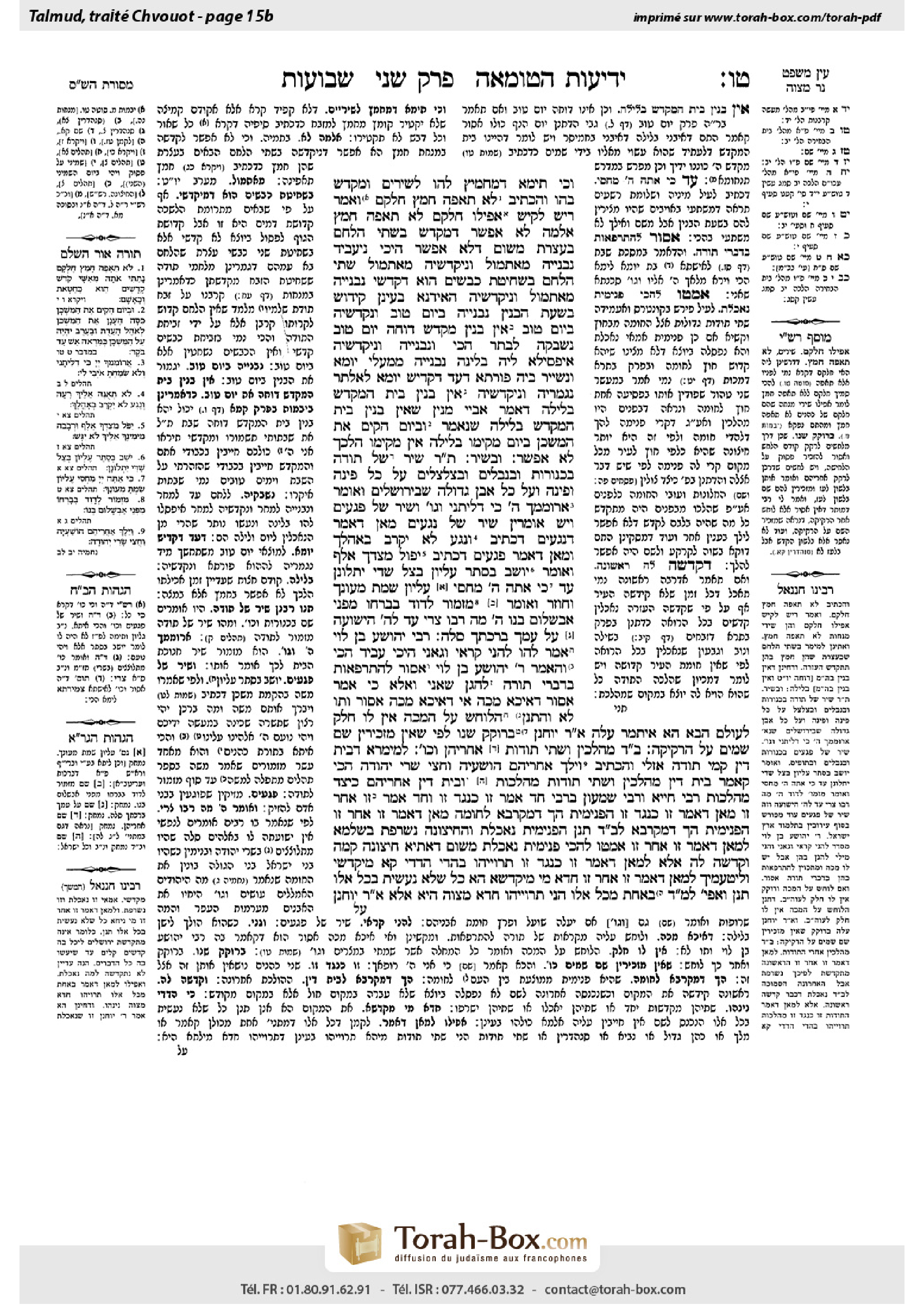
Shevuot 15b: Talmud study for Daf Yomi
Daf Yomi is the daily study of one Talmud folio. Explore 37 tractates with scans, Hebrew text, Sefaria English and AI-generated French translations where annotated.
Passage selection and English or AI-generated French translation are available where the scan has annotations. Daf Study is independent of Torah-Box and Sefaria.
Browse Shevuot · שבועות · All tractatesShevuot 15b text and translations
This page of Shevuot includes the Aramaic text, an English translation and an AI-generated French translation, alongside the scan above.
שבועות י״ה ב · Aramaic and Hebrew text
וְכִי תֵּימָא דְּמַחְמֵיץ לְהוּ לְשִׁירַיִם וּמְקַדֵּשׁ בְּהוּ – וְהָכְתִיב ״לֹא תֵאָפֶה חָמֵץ חֶלְקָם״, וְאָמַר רֵישׁ לָקִישׁ: אֲפִילּוּ חֶלְקָם לֹא תֵאָפֶה חָמֵץ!
אַלְּמָה לָא? אֶפְשָׁר דִּמְקַדֵּשׁ בִּשְׁתֵּי הַלֶּחֶם בָּעֲצֶרֶת! מִשּׁוּם דְּלָא אֶפְשָׁר.
הֵיכִי נֶיעְבֵּיד? נִבְנְיֵיהּ מֵאֶתְמוֹל וְנִיקַדְּשֵׁיהּ מֵאֶתְמוֹל? שְׁתֵּי הַלֶּחֶם בִּשְׁחִיטַת כְּבָשִׁים הוּא דְּקָדְשִׁי.
נִבְנְיֵיהּ מֵאֶתְמוֹל, וְנִיקַדְּשֵׁיהּ הָאִידָּנָא? בָּעֵינַן קִידּוּשׁ בִּשְׁעַת הַבִּנְיָן.
נִבְנְיֵיהּ בְּיוֹם טוֹב וּנְקַדְּשֵׁיהּ בְּיוֹם טוֹב? אֵין בִּנְיַן מִקְדָּשׁ דּוֹחֶה יוֹם טוֹב.
נִשְׁבְּקֵהּ לְבָתַר הָכִי, וְנִבְנְיֵיהּ וְנִיקַדְּשֵׁיהּ? אִיפְּסִילָא לֵיהּ בְּלִינָה.
נִבְנְיֵיהּ מִמַּעֲלֵי יוֹמָא וּנְשַׁיַּיר בֵּיהּ פּוּרְתָּא – דְּעַד דְּקָדֵישׁ יוֹמָא לְאַלְתַּר נִגְמְרֵיהּ וְנִיקַדְּשֵׁיהּ? אֵין בִּנְיַן בֵּית הַמִּקְדָּשׁ בַּלַּיְלָה; דְּאָמַר אַבָּיֵי: מִנַּיִן שֶׁאֵין בִּנְיַן בֵּית הַמִּקְדָּשׁ בַּלַּיְלָה? שֶׁנֶּאֱמַר: ״וּבְיוֹם הָקִים אֶת הַמִּשְׁכָּן״ – בְּיוֹם מְקִימוֹ, בַּלַּיְלָה אֵין מְקִימוֹ. הִלְכָּךְ לָא אֶפְשָׁר.
וּבְשִׁיר. תָּנוּ רַבָּנַן: שִׁיר שֶׁל תּוֹדָה – בְּכִנּוֹרוֹת וּבִנְבָלִים וּבְצֶלְצֶלִים עַל כׇּל פִּינָּה וּפִינָּה וְעַל כׇּל אֶבֶן גְּדוֹלָה שֶׁבִּירוּשָׁלַיִם, וְאוֹמֵר ״אֲרוֹמִמְךָ ה׳ כִּי דִלִּיתָנִי וְגוֹ׳״, וְשִׁיר שֶׁל פְּגָעִים, וְיֵשׁ אוֹמְרִין שִׁיר שֶׁל נְגָעִים.
מַאן דְּאָמַר דִּנְגָעִים – דִּכְתִיב: ״וְנֶגַע לֹא יִקְרַב בְּאׇהֳלֶךָ״, וּמַאן דְּאָמַר פְּגָעִים – דִּכְתִיב: ״יִפֹּל מִצִּדְּךָ אֶלֶף״.
וְאוֹמֵר: ״יֹשֵׁב בְּסֵתֶר עֶלְיוֹן בְּצֵל שַׁדַּי יִתְלוֹנָן״ עַד ״כִּי אַתָּה ה׳ מַחְסִי עֶלְיוֹן שַׂמְתָּ מְעוֹנֶךָ״; וְחוֹזֵר וְאוֹמֵר: ״מִזְמוֹר לְדָוִד בְּבׇרְחוֹ מִפְּנֵי אַבְשָׁלוֹם בְּנוֹ, ה׳ מָה רַבּוּ צָרָי״, עַד ״לַה׳ הַיְשׁוּעָה עַל עַמְּךָ בִרְכָתֶךָ סֶּלָה״.
רַבִּי יְהוֹשֻׁעַ בֶּן לֵוִי אָמַר לְהוּ לְהָנֵי קְרָאֵי, וְגָאנֵי. הֵיכִי עָבֵיד הָכִי? וְהָאָמַר רַבִּי יְהוֹשֻׁעַ בֶּן לֵוִי: אָסוּר לְהִתְרַפְּאוֹת בְּדִבְרֵי תּוֹרָה! לְהָגֵן שָׁאנֵי.
וְאֶלָּא כִּי אָמַר אָסוּר – דְּאִיכָּא מַכָּה? אִי דְּאִיכָּא מַכָּה אָסוּר, וְתוּ לָא?! וְהָתְנַן: הַלּוֹחֵשׁ עַל הַמַּכָּה, אֵין לוֹ חֵלֶק לָעוֹלָם הַבָּא! הָא אִיתְּמַר עֲלַהּ, אָמַר רַבִּי יוֹחָנָן: בְּרוֹקֵק שָׁנוּ; לְפִי שֶׁאֵין מַזְכִּירִין שֵׁם שָׁמַיִם עַל הָרְקִיקָה.
בֵּית דִּין מְהַלְּכִין וּשְׁתֵּי תּוֹדוֹת אַחֲרֵיהֶן וְכוּ׳. לְמֵימְרָא דְּבֵית דִּין קַמֵּי תּוֹדָה אָזְלִי?! וְהָכְתִיב: ״וַיֵּלֶךְ אַחֲרֵיהֶם הוֹשַׁעְיָה וַחֲצִי שָׂרֵי יְהוּדָה״! הָכִי קָאָמַר: בֵּית דִּין מְהַלְּכִין, וּשְׁתֵּי תּוֹדוֹת מְהַלְּכוֹת וּבֵית דִּין אַחֲרֵיהֶם.
כֵּיצַד מְהַלְּכוֹת? רַבִּי חִיָּיא וְרַבִּי שִׁמְעוֹן בְּרַבִּי; חַד אָמַר: זוֹ כְּנֶגֶד זוֹ, וְחַד אָמַר: זוֹ אַחַר זוֹ. מַאן דְּאָמַר זוֹ כְּנֶגֶד זוֹ, ״הַפְּנִימִית״ – הָךְ דִּמְקָרְבָא לַחוֹמָה. מַאן דְּאָמַר זוֹ אַחַר זוֹ, ״הַפְּנִימִית״ – הָךְ דִּמְקָרְבָא לְבֵית דִּין.
תְּנַן: הַפְּנִימִית נֶאֱכֶלֶת וְהַחִיצוֹנָה נִשְׂרֶפֶת. בִּשְׁלָמָא לְמַאן דְּאָמַר זוֹ אַחַר זוֹ, אַמְּטוּ לְהָכִי פְּנִימִית נֶאֱכֶלֶת – מִשּׁוּם דְּאָתְיָא חִיצוֹנָה קַמַּהּ, וְקַדְּשָׁהּ לַהּ. אֶלָּא לְמַאן דְּאָמַר זוֹ כְּנֶגֶד זוֹ, תַּרְוַיְיהוּ בַּהֲדֵי הֲדָדֵי קָא מְיקַדְּשִׁי!
וְלִיטַעְמָיךְ, לְמַאן דְּאָמַר זוֹ אַחַר זוֹ, חֲדָא מִי מְיקַדְּשָׁא?! הָא ״כׇּל שֶׁלֹּא נַעֲשֵׂית בְּכׇל אֵלּוּ״ תְּנַן! וַאֲפִילּוּ לְמַאן דְּאָמַר ״בְּאַחַת מִכׇּל אֵלּוּ״, הָנֵי תַּרְוַיְיהוּ חֲדָא מִצְוָה הִיא!
אֶלָּא אָמַר רַבִּי יוֹחָנָן:
Shevuot 15b · English translation
And if you would say that one leavens the remainder of the meal-offering, which the priests partake of, and he consecrates the Temple courtyard with it, that too is difficult, as isn’t it written: “It shall not be baked leavened, for their portion I have given it to them” (Leviticus 6:10)? And Reish Lakish says in explanation of this verse: Even the priests’ portion shall not be baked leavened, as it is prohibited to bake even a portion of the meal-offering leavened.
The Gemara asks: Still, why not consecrate the Temple courtyard with a leavened meal-offering? It is possible to consecrate it with the two loaves of bread that are brought as a communal offering on the festival of Shavuot, which is a meal-offering that is leavened. The Gemara answers: Because actually it is not possible to do so.
The Gemara explains why not. How could we do it? If we build the addition to the Temple courtyard on the eve of Shavuot and also consecrate it on the eve of the Festival, there is a difficulty, as the two loaves become consecrated as a meal-offering with the slaughter of the two lambs that are sacrificed together with them as peace-offerings, and this occurs on the Festival itself, not on the eve of the Festival.
If we build the addition to the Temple courtyard on the eve of the Shavuot festival, but consecrate it only now, on the Festival, this too is difficult, as we require consecration at the time of the completion of the building.
If we build it on the Festival and consecrate it on the Festival, this also cannot be, as the building of the Temple does not override the Festival.
If we leave the two loaves until after the Festival and build the addition to the Temple courtyard on the day after the Festival, and consecrate it by eating the two loaves on that day, this is difficult as well, as the two loaves were already disqualified by virtue of being left overnight after the Festival.
If we build the addition to the Temple courtyard on the eve of the Festival and leave a little unbuilt until after the Festival, and as soon as the day is over and the Festival is finished, we immediately finish building the addition and consecrate it with the two loaves before they become disqualified, this too is impossible, as the building of the Temple cannot take place at night. This is as Abaye says: From where is it derived that the building of the Temple cannot take place at night? As it is stated: “And on the day that the Tabernacle was erected” (Numbers 9:15), from which it can be derived: One may erect it during the day, but one may not erect it at night. Therefore, it is impossible to consecrate the Temple courtyard with the two loaves; it must be done with the remainder of an unleavened meal-offering.
§ The mishna teaches concerning the consecration of an addition to the city of Jerusalem or the Temple courtyard: And with a song. The Sages taught in a baraita: They sang the song of thanksgiving, i.e., Psalms, chapter 100, which begins: “A psalm of thanksgiving,” accompanied by harps, lyres, and cymbals, at every corner and upon every large stone in Jerusalem. And they also recited Psalms, chapter 30, which begins: “I will extol You, O Lord, for You have lifted me up,” and the song of evil spirits, i.e., Psalms, chapter 91, which begins: “He that dwells in the secret place of the Most High.” And some say that this psalm is called the song of plagues.
The reason of the one who says that it is called the song of plagues is that it is written: “Nor shall any plague come near your dwelling” (Psalms 91:10). And the reason of the one who says that it is called the song of evil spirits is that it is written: “A thousand shall fall at your side and ten thousand at your right hand; but it shall not come near you” (Psalms 91:7).
And they recited the psalm from the verse: “He that dwells in the secret place of the Most High shall abide in the shadow of the Almighty” (Psalms 91:1), until they completed the verse: “Because You, O Lord, are my refuge; You have made the most High Your habitation” (Psalms 91:9). And they would then recite Psalms, chapter 3, which begins: “A psalm of David, when he fled from Absalom his son. Lord, how many are my enemies become,” until they reached the verse: “Salvation belongs to the Lord; Your blessing be upon Your people. Sela” (Psalms 3:9), which is the end of that psalm.
It is related that Rabbi Yehoshua ben Levi would recite these verses to protect him from evil spirits during the night and fall asleep while saying them. The Gemara asks: How could he do that? But doesn’t Rabbi Yehoshua ben Levi himself say: One is prohibited from healing himself with words of Torah? The Gemara answers: To protect oneself is different, as he recited these verses only to protect himself from evil spirits, and not to heal himself.
The Gemara challenges: But rather, when Rabbi Yehoshua ben Levi said that this is prohibited, he was referring to a situation where there is already a wound and one recites these verses in order to heal himself. But if there is already a wound and he recites these verses over it, is only this prohibited, and nothing more? But didn’t we learn in a mishna (Sanhedrin 90a), that one who whispers an incantation over a wound has no share in the World-to-Come? The Gemara answers: Wasn’t it stated with regard to that mishna that Rabbi Yoḥanan says: The mishna was taught with regard to one who spits into the wound and then whispers these verses. And the reason for the severity of this action is that the name of Heaven must not be mentioned in connection with spitting, as doing so is a show of contempt for God.
§ The mishna teaches that as part of the consecration ceremony, the court would move forward, and two thanks-offerings would be brought after them, and all of the Jewish people would follow behind them. The Gemara asks: Is this to say that the members of the court walk in front of the thanks-offering? But isn’t it written in the verse from which this ceremony is derived: “And I placed two large thanks-offerings, and we went in procession to the right upon the wall, toward the dung gate; and after them went Hoshaiah, and half of the princes of Judah” (Nehemiah 12:31–32)? The Gemara answers: This is what the mishna is saying: The court moves forward. And how is this done? The two thanks-offerings move forward, and the court follows after them.
The Gemara clarifies this point: How exactly did the two thanks-offerings move forward? Rabbi Ḥiyya and Rabbi Shimon, son of Rabbi Yehuda HaNasi, disagree about this. One Sage says: One thanks-offering alongside the other. And one Sage says: One behind the other. According to the one who says that the two offerings moved one alongside the other, the thanks-offering that the mishna refers to as the inner one is that which is closest to the wall. According to the one who says that the two offerings moved one behind the other, the thanks-offering that is called the inner one is that which is closest to the members of the court advancing behind the thanks-offerings.
The Gemara analyzes these two opinions: We learned in the mishna: When they would reach the end of the place that they desired to consecrate, the inner thanks-offering would be eaten and the outer one would be burned. Granted, according to the one who says that the two thanks-offerings moved forward one behind the other, and that the inner one is the one that was in the rear, it is due to this that the inner one is eaten, because the outer one came before it and consecrated the additional area, so that it is now a sanctified place fit for the eating of the thanks-offering loaves. But according to the one who says that the two thanks-offerings moved forward one alongside the other, the two of them together consecrated the additional area. Why, then, is the inner one eaten and the outer one burned?
The Gemara asks: And according to your reasoning, according to the one who says that the two offerings moved forward one behind the other, does one offering by itself consecrate the area? Didn’t we learn in the mishna that with regard to any addition that was not made with all these ceremonial procedures, the addition is not consecrated? And even according to the one who says (see 16a) that the correct reading of the mishna is: With regard to any addition that was not made with any one of all these ceremonial procedures, the addition is not consecrated, nevertheless, these two thanks-offerings are one mitzva, and one without the other would not consecrate the area.
Rather, Rabbi Yoḥanan said:
Shevuot 15b · Traduction française (IA)
Et si tu dis que l’on fait fermenter le reste de l’offrande végétale, dont les prêtres consomment une part, et que l’on consacre avec lui la cour du Temple, cela pose également une difficulté : n’est-il pas écrit : « Elle ne sera pas cuite avec du levain, car je la leur ai donnée comme part » (Lévitique 6:10) ? Et Reish Lakish explique ce verset ainsi : même la part des prêtres ne doit pas être cuite avec du levain, car il est interdit de faire fermenter une partie de l’offrande végétale.
La Guemara demande : Pourtant, pourquoi ne pas consacrer la cour du Temple avec une offrande végétale fermentée ? On pourrait la consacrer avec les deux pains apportés comme offrande communautaire à la fête de Chavouot, qui constituent une offrande végétale fermentée. La Guemara répond : en réalité, cela n’est pas possible.
La Guemara explique pourquoi. Comment pourrait-on procéder ? Si l’on construit l’agrandissement de la cour du Temple la veille de Chavouot et qu’on le consacre également la veille de la fête, cela pose une difficulté : les deux pains ne deviennent consacrés comme offrande végétale qu’au moment de l’abattage des deux agneaux qui sont sacrifiés avec eux comme sacrifices de paix, et cela a lieu le jour même de la fête, non la veille.
Si l’on construit l’agrandissement de la cour du Temple la veille de la fête de Chavouot, mais qu’on ne le consacre que maintenant, le jour de la fête, cela pose également une difficulté, car la consécration doit avoir lieu au moment où la construction est achevée.
Si l’on construit l’agrandissement le jour de la fête et qu’on le consacre ce même jour, cela ne peut pas non plus se faire, car la construction du Temple ne repousse pas la fête.
Si l’on garde les deux pains jusqu’après la fête, puis qu’on construit l’agrandissement de la cour du Temple le lendemain de la fête et qu’on le consacre en consommant les deux pains ce jour-là, cela pose également une difficulté, car les deux pains ont déjà été invalidés pour être restés toute la nuit après la fête.
Si l’on construit l’agrandissement de la cour du Temple la veille de la fête, en laissant une petite partie inachevée jusqu’après la fête, puis qu’on achève immédiatement la construction de l’agrandissement dès que le jour s’achève et que la fête est terminée, et qu’on le consacre avec les deux pains avant qu’ils ne soient invalidés, cela est également impossible, car la construction du Temple ne peut pas avoir lieu la nuit. C’est ce qu’Abayé dit : d’où apprend-on que la construction du Temple ne peut pas avoir lieu la nuit ? Comme il est dit : « Le jour où le Tabernacle fut dressé » (Nombres 9:15), d’où l’on déduit qu’on peut le dresser le jour, mais pas la nuit. Il est donc impossible de consacrer la cour du Temple avec les deux pains ; il faut le faire avec le reste d’une offrande végétale sans levain.
§ La Michna enseigne, au sujet de la consécration d’un agrandissement de la ville de Jérusalem ou de la cour du Temple : « et avec un chant ». Les Sages ont enseigné dans une baraïta : on chantait le chant d’action de grâce, c’est-à-dire le psaume 100, qui commence par « Psaume d’action de grâce », accompagné de harpes, de lyres et de cymbales, à chaque angle et sur chaque grande pierre de Jérusalem. On récitait aussi le psaume 30, qui commence par « Je t’exalterai, Seigneur, car tu m’as relevé », ainsi que le chant des esprits malfaisants, c’est-à-dire le psaume 91, qui commence par « Celui qui demeure dans le secret du Très-Haut ». Certains disent que ce psaume est appelé le chant des fléaux.
La raison de celui qui dit qu’il est appelé le chant des fléaux est qu’il est écrit : « Aucun fléau n’approchera de ta demeure » (Psaumes 91:10). Et la raison de celui qui dit qu’il est appelé le chant des esprits malfaisants est qu’il est écrit : « Mille tomberont à ton côté et dix mille à ta droite, mais cela ne t’approchera pas » (Psaumes 91:7).
On récitait le psaume à partir du verset : « Celui qui demeure dans le secret du Très-Haut résidera à l’ombre du Tout-Puissant » (Psaumes 91:1), jusqu’au verset : « Car toi, Seigneur, tu es mon refuge ; tu as fait du Très-Haut ta demeure » (Psaumes 91:9). Puis on récitait le psaume 3, qui commence par « Psaume de David, lorsqu’il fuyait devant son fils Absalom. Seigneur, combien mes ennemis sont nombreux », jusqu’au verset : « Le salut appartient au Seigneur ; que ta bénédiction soit sur ton peuple. Sélah » (Psaumes 3:9), qui est le dernier verset de ce psaume.
Il est rapporté que Rabbi Yehoshua ben Levi récitait ces versets pour se protéger des esprits malfaisants pendant la nuit et s’endormait en les récitant. La Guemara demande : comment pouvait-il faire cela ? Rabbi Yehoshua ben Levi lui-même ne dit-il pas qu’il est interdit de se soigner soi-même au moyen de paroles de Torah ? La Guemara répond : se protéger est différent, car il récitait ces versets uniquement pour se protéger des esprits malfaisants, et non pour se soigner.
La Guemara objecte : Mais alors, lorsque Rabbi Yehoshua ben Levi a dit que cela est interdit, il parlait d’une situation où une plaie existe déjà et où l’on récite ces versets pour se soigner. Mais si une plaie existe déjà et qu’on récite ces versets au-dessus d’elle, cela seul serait-il interdit, et rien de plus ? N’a-t-on pas enseigné dans une Michna (Sanhédrin 90a) que celui qui murmure une incantation sur une plaie n’a pas de part au Monde futur ? La Guemara répond : n’a-t-il pas été dit à propos de cette Michna que Rabbi Yoḥanan enseigne que la Michna parle de quelqu’un qui crache sur la plaie, puis murmure ces versets ? La gravité de cet acte s’explique par le fait qu’il ne faut pas prononcer le nom du Ciel en crachant, car cela témoigne du mépris envers Dieu.
§ La Michna enseigne que, dans le cadre de la cérémonie de consécration, le tribunal avançait, que deux offrandes d’action de grâce étaient amenées derrière lui et que tout le peuple juif suivait derrière elles. La Guemara demande : faut-il comprendre que les membres du tribunal marchaient devant les offrandes d’action de grâce ? Mais n’est-il pas écrit dans le verset d’où cette cérémonie est déduite : « Je plaçai deux grandes offrandes d’action de grâce, et nous marchâmes en procession vers la droite, sur le rempart, en direction de la porte du Fumier ; derrière elles marchaient Hoshaïa et la moitié des princes de Juda » (Néhémie 12:31–32) ? La Guemara répond : voici ce que dit la Michna : le tribunal avance. Et comment cela se passe-t-il ? Les deux offrandes d’action de grâce avancent, et le tribunal les suit.
La Guemara précise ce point : comment exactement les deux offrandes d’action de grâce avançaient-elles ? Rabbi Ḥiyya et Rabbi Shimon, fils de Rabbi Yehuda HaNasi, sont en désaccord à ce sujet. Un Sage dit : l’une à côté de l’autre. Un autre Sage dit : l’une derrière l’autre. Selon celui qui dit que les deux offrandes avançaient côte à côte, l’offrande d’action de grâce que la Michna qualifie d’intérieure est celle qui se trouve le plus près du rempart. Selon celui qui dit que les deux offrandes avançaient l’une derrière l’autre, celle qui est appelée intérieure est celle qui se trouve le plus près des membres du tribunal, qui avancent derrière les offrandes d’action de grâce.
La Guemara examine ces deux opinions : nous avons appris dans la Michna que, lorsqu’ils arrivaient à la limite de la zone qu’ils souhaitaient consacrer, l’offrande intérieure était consommée et l’offrande extérieure était brûlée. Cela se comprend selon celui qui dit que les deux offrandes d’action de grâce avançaient l’une derrière l’autre et que l’offrande intérieure était celle qui se trouvait à l’arrière : c’est pour cette raison que l’offrande intérieure est consommée, car l’offrande extérieure l’a précédée et a consacré la zone supplémentaire, qui est désormais un lieu saint où les pains de l’offrande d’action de grâce peuvent être consommés. Mais selon celui qui dit que les deux offrandes d’action de grâce avançaient côte à côte, elles ont consacré ensemble la zone supplémentaire. Pourquoi, alors, l’offrande intérieure est-elle consommée et l’extérieure brûlée ?
La Guemara demande : et selon votre raisonnement, selon celui qui dit que les deux offrandes avançaient l’une derrière l’autre, une offrande à elle seule consacre-t-elle la zone ? N’avons-nous pas appris dans la Michna que tout agrandissement qui n’a pas été réalisé selon l’ensemble de ces procédures cérémonielles n’est pas consacré ? Et même selon celui qui dit (voir 16a) qu’il faut lire correctement la Michna ainsi : tout agrandissement qui n’a pas été réalisé selon l’une quelconque de ces procédures cérémonielles n’est pas consacré, ces deux offrandes d’action de grâce constituent néanmoins une seule mitsva, et l’une sans l’autre ne consacrerait pas la zone.
Mais Rabbi Yoḥanan a dit :
Traduction française générée par IA à partir de l’édition anglaise de Sefaria. Vérifie toujours un passage avec le texte source.
Text from Sefaria: William Davidson Edition - Vocalized Aramaic (CC BY NC); William Davidson Edition - English (CC BY NC).