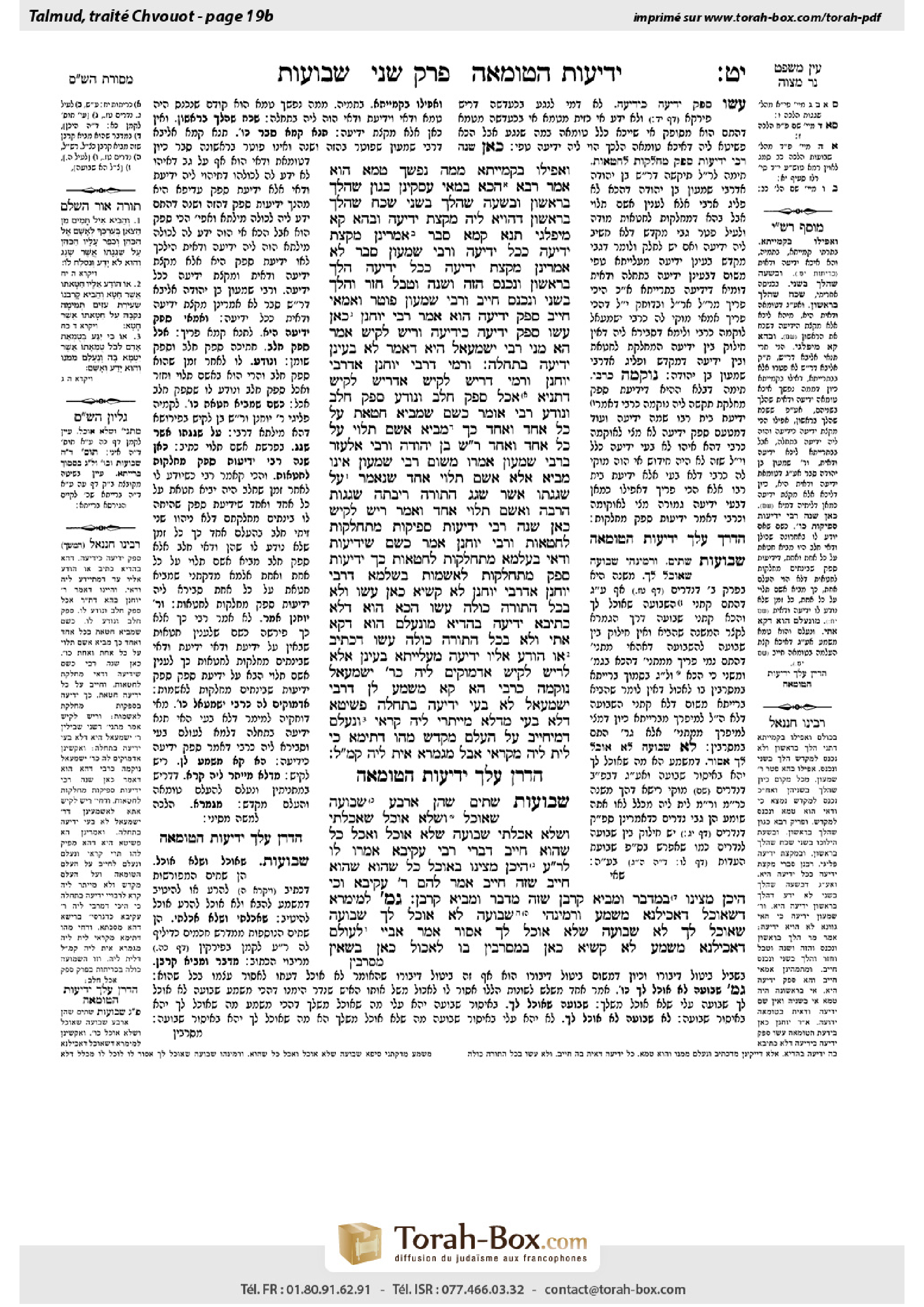
Shevuot 19b: Talmud study for Daf Yomi
Daf Yomi is the daily study of one Talmud folio. Explore 37 tractates with scans, Hebrew text, Sefaria English and AI-generated French translations where annotated.
Passage selection and English or AI-generated French translation are available where the scan has annotations. Daf Study is independent of Torah-Box and Sefaria.
Browse Shevuot · שבועות · All tractatesShevuot 19b text and translations
This page of Shevuot includes the Aramaic text, an English translation and an AI-generated French translation, alongside the scan above.
שבועות י״ט ב · Aramaic and Hebrew text
וַאֲפִילּוּ בְּקַמַּיְיתָא?! מִמָּה נַפְשָׁךְ טָמֵא הוּא! אָמַר רָבָא: הָכָא בְּמַאי עָסְקִינַן – כְּגוֹן שֶׁהָלַךְ בָּרִאשׁוֹן, וּבְשָׁעָה שֶׁהָלַךְ בַּשֵּׁנִי שָׁכַח שֶׁהָלַךְ בָּרִאשׁוֹן; דְּהָוְיָא לֵיהּ מִקְצָת יְדִיעָה.
וּבְהָא קָא מִיפַּלְגִי – תַּנָּא קַמָּא סָבַר: אָמְרִינַן מִקְצָת יְדִיעָה כְּכׇל יְדִיעָה; וְרַבִּי שִׁמְעוֹן סָבַר: לָא אָמְרִינַן מִקְצָת יְדִיעָה כְּכׇל יְדִיעָה.
הָלַךְ בָּרִאשׁוֹן וְנִכְנַס, הִזָּה וְשָׁנָה וְטָבַל, חָזַר וְהָלַךְ בַּשֵּׁנִי וְנִכְנַס – חַיָּיב, וְרַבִּי שִׁמְעוֹן פּוֹטֵר. וְאַמַּאי חַיָּיב? סְפֵק יְדִיעָה הוּא!
אָמַר רַבִּי יוֹחָנָן: כָּאן עָשׂוּ סְפֵק יְדִיעָה כִּידִיעָה. וְרֵישׁ לָקִישׁ אָמַר: הָא מַנִּי – רַבִּי יִשְׁמָעֵאל הִיא, דְּאָמַר: לָא בָּעֵינַן יְדִיעָה בַּתְּחִלָּה.
וּרְמִי דְּרַבִּי יוֹחָנָן אַדְּרַבִּי יוֹחָנָן, וּרְמִי דְּרֵישׁ לָקִישׁ אַדְּרֵישׁ לָקִישׁ. דְּתַנְיָא: אָכַל סְפֵק חֵלֶב וְנוֹדַע, סְפֵק חֵלֶב וְנוֹדַע – רַבִּי אוֹמֵר: כְּשֵׁם שֶׁמֵּבִיא חַטָּאת עַל כׇּל אֶחָד וְאֶחָד, כָּךְ מֵבִיא אָשָׁם תָּלוּי עַל כׇּל אֶחָד וְאֶחָד.
רַבִּי שִׁמְעוֹן בֶּן יְהוּדָה וְרַבִּי אֶלְעָזָר בְּרַבִּי שִׁמְעוֹן אָמְרוּ מִשּׁוּם רַבִּי שִׁמְעוֹן: אֵינוֹ מֵבִיא אֶלָּא אָשָׁם תָּלוּי אֶחָד, שֶׁנֶּאֱמַר: ״עַל שִׁגְגָתוֹ אֲשֶׁר שָׁגָג״ – הַתּוֹרָה רִיבְּתָה שְׁגָגוֹת הַרְבֵּה וְאָשָׁם תָּלוּי אֶחָד.
וְאָמַר רֵישׁ לָקִישׁ: כָּאן שָׁנָה רַבִּי, יְדִיעוֹת סְפֵיקוֹת מִתְחַלְּקוֹת לְחַטָּאוֹת.
וְרַבִּי יוֹחָנָן אָמַר: כְּשֵׁם שֶׁיְּדִיעוֹת וַדַּאי בְּעָלְמָא מִתְחַלְּקוֹת לְחַטָּאוֹת, כָּךְ יְדִיעוֹת סָפֵק מִתְחַלְּקוֹת לַאֲשָׁמוֹת.
בִּשְׁלָמָא דְּרַבִּי יוֹחָנָן אַדְּרַבִּי יוֹחָנָן לָא קַשְׁיָא – כָּאן עָשׂוּ, וְלֹא בְּכׇל הַתּוֹרָה כּוּלָּהּ עָשׂוּ. הָכָא הוּא דְּלָא כְּתִיבָא יְדִיעָה בְּהֶדְיָא, מִ״וְּנֶעְלַם״ הוּא דְּקָא אָתֵי; וְלֹא בְּכׇל הַתּוֹרָה כּוּלָּהּ עָשׂוּ, דִּכְתִיב: ״אוֹ הוֹדַע אֵלָיו״ – יְדִיעָה מְעַלַּיְיתָא בָּעֵינַן.
אֶלָּא לְרֵישׁ לָקִישׁ – אַדְּמוֹקֵים לֵיהּ כְּרַבִּי יִשְׁמָעֵאל, נוֹקְמַהּ כְּרַבִּי! הָא קָא מַשְׁמַע לַן – דְּרַבִּי יִשְׁמָעֵאל לָא בָּעֵי יְדִיעָה בַּתְּחִלָּה.
פְּשִׁיטָא דְּלָא בָּעֵי – מִדְּלָא מְיַיתְּרִי לֵיהּ קְרָאֵי; ״וְנֶעְלַם״ – דְּמִיחַיַּיב עַל הֶעְלֵם מִקְדָּשׁ! מַהוּ דְּתֵימָא: כִּי לֵית לֵיהּ – מִקְּרָאֵי, אֲבָל מִגְּמָרָא אִית לֵיהּ; קָא מַשְׁמַע לַן.
הֲדַרַן עֲלָךְ יְדִיעוֹת הַטּוּמְאָה
מַתְנִי׳ שְׁבוּעוֹת שְׁתַּיִם שֶׁהֵן אַרְבַּע: ״שְׁבוּעָה שֶׁאוֹכַל״ וְ״שֶׁלֹּא אוֹכַל״, ״שֶׁאָכַלְתִּי״ וְ״שֶׁלֹּא אָכַלְתִּי״.
״שְׁבוּעָה שֶׁלֹּא אוֹכַל״, וְאָכַל כׇּל שֶׁהוּא – חַיָּיב. דִּבְרֵי רַבִּי עֲקִיבָא. אָמְרוּ לוֹ לְרַבִּי עֲקִיבָא: הֵיכָן מָצִינוּ בְּאוֹכֵל כָּל שֶׁהוּא שֶׁהוּא חַיָּיב – שֶׁזֶּה חַיָּיב? אָמַר לָהֶם רַבִּי עֲקִיבָא: וְכִי הֵיכָן מָצִינוּ בִּמְדַבֵּר וּמֵבִיא קׇרְבָּן – שֶׁזֶּה מְדַבֵּר וּמֵבִיא קׇרְבָּן?
גְּמָ׳ לְמֵימְרָא דְּ״שֶׁאוֹכַל״ – דְּאָכֵילְנָא מַשְׁמַע?! וּרְמִינְהִי: ״שְׁבוּעָה לֹא אוֹכַל לָךְ״, ״שְׁבוּעָה שֶׁאוֹכַל לָךְ״, ״לֹא שְׁבוּעָה שֶׁלֹּא אוֹכַל לָךְ״ – אָסוּר.
אָמַר אַבָּיֵי: לְעוֹלָם דְּאָכֵילְנָא מַשְׁמַע; לָא קַשְׁיָא, כָּאן בִּמְסָרְבִין בּוֹ לֶאֱכוֹל, כָּאן בְּשֶׁאֵין
Shevuot 19b · English translation
even in the first case, where he walked on both of the paths and did not purify himself in between? This is difficult, as whichever way you look at it, he is impure, since he certainly contracted impurity on one of the two paths. Rava said: What are we dealing with here? We are dealing with a case where he walked on the first path, and then afterward when he was walking on the second path he forgot that he had already walked on the first path, so that his lapse of awareness when he entered the Temple was only a lapse of partial awareness. That is, when he entered the Temple he forgot only that he had walked on the first path, and for this lapse of knowledge by itself he is not liable to bring a sin-offering, as it is not certain that he contracted impurity there.
Rava continues: And the tanna’im disagree with regard to this issue: The first tanna, who teaches that Rabbi Shimon deems the person exempt only where there was purification between the two entries, but not in the first case, maintains that we say that partial awareness of definite impurity is counted as complete awareness. And Rabbi Shimon ben Yehuda, who teaches that Rabbi Shimon deems the person exempt even in the first case, where there was no purification between the two entries, maintains that we do not say that partial awareness of definite impurity is counted as complete awareness.
§ The baraita teaches: If he walked on the first path and entered the Temple, and on the third day he was sprinkled with waters of purification, and on the seventh day he was sprinkled upon again, and he immersed himself in a ritual bath, and then he walked on the second path and entered the Temple, he is liable to bring a sin-offering; and Rabbi Shimon deems him exempt from bringing an offering. The Gemara asks: But why is he liable according to the first tanna? Each time he entered the Temple it was only with a lapse of awareness of uncertain impurity, the first time because he might not yet have become impure, and the second time because he might already have purified himself.
Rabbi Yoḥanan says: Here, since he certainly contracted impurity on one of the paths and entered the Temple in a state of impurity, they made awareness of uncertain impurity like awareness of definite impurity. And Reish Lakish says: In accordance with whose opinion is this? It is in accordance with the opinion of Rabbi Yishmael, who says: We do not require any awareness of impurity whatsoever at the beginning, before he enters the Temple, and it suffices if it becomes known to him at the end that he had been impure at the time of his entry.
And the Gemara raises a contradiction between this statement of Rabbi Yoḥanan and another statement of Rabbi Yoḥanan; and the Gemara raises a contradiction between this statement of Reish Lakish and another statement of Reish Lakish. As it is taught in a baraita: If one ate an item concerning which there was uncertainty as to whether or not it was forbidden fat, and he later became aware of it, and then he ate some other item concerning which there was uncertainty as to whether or not it was forbidden fat, and he later became aware of it, Rabbi Yehuda HaNasi says: Just as he would bring a sin-offering for each and every one of his instances of consumption were he to learn that what he ate was actually forbidden fat, so too, he brings a provisional guilt-offering, brought by one who is uncertain as to whether he committed a transgression that requires a sin-offering, for each and every one of his instances of consumption if after each instance he became aware that he might have eaten forbidden fat.
Rabbi Shimon ben Yehuda and Rabbi Elazar, son of Rabbi Shimon, said in the name of Rabbi Shimon: He brings only one provisional guilt-offering, as it is stated with regard to a provisional guilt-offering: “He shall bring an unblemished ram…for a guilt-offering…to the priest; and the priest shall make atonement for him concerning his unwitting transgression wherein he unwittingly transgressed and knew it not” (Leviticus 5:18). This wording teaches that the Torah included many instances of unwitting transgressions in one provisional guilt-offering. One brings one provisional guilt-offering even if he had committed many unwitting transgressions.
Reish Lakish and Rabbi Yoḥanan disagree about how to understand the opinion of Rabbi Yehuda HaNasi: With regard to which case did he say that one brings a separate sin-offering for each and every one of his instances of consumption? And Reish Lakish says: Here Rabbi Yehuda HaNasi taught that awareness of the uncertain status separates the acts with regard to sin-offerings. If it later became known with certainty that he had actually eaten forbidden fat both times, he would be liable to bring two sin-offerings for the two instances of consumption, despite the fact that the two actions were separated only by awareness of the uncertain status, because such awareness is sufficient to separate the two acts.
And Rabbi Yoḥanan says: Rabbi Yehuda HaNasi does not mean to say that awareness of the uncertain status separates the acts with regard to sin-offerings. He merely established the principle: Just as definite awareness in general separates the acts with regard to sin-offerings, e.g., where one ate forbidden fat and then became aware that it was definitely forbidden fat that he had eaten, and then he forgot and once again ate forbidden fat, so too, awareness of the uncertain status separates the acts with regard to provisional guilt-offerings. But awareness of the uncertain status does not separate the acts with regard to sin-offerings. If the awareness between the acts was only awareness of the uncertain status, he does not bring a sin-offering for each act when he later learns with certainty that it was forbidden fat that he had eaten. Evidently, Rabbi Yoḥanan maintains that awareness of the uncertain status is not like definite awareness, and Reish Lakish maintains that it is like definite awareness. This contradicts what they said above.
The Gemara comments: Granted, the apparent contradiction between one statement of Rabbi Yoḥanan and the other statement of Rabbi Yoḥanan is not difficult, as one can explain that Rabbi Yoḥanan is precise in his wording, as he says: Here, with regard to impurity in the Temple, they made awareness of the uncertain status like definite awareness; but they did not do so everywhere in the entire Torah. There is a basis for this distinction, as here, with regard to impurity in the Temple, awareness at the beginning is not written explicitly in the Torah, but rather it is derived from: “And it is hidden from him” (Leviticus 5:2), which indicates that there must be some awareness that became hidden from him, and for this, awareness of the uncertain status suffices. But by contrast, they did not make awareness of the uncertain status like definite awareness everywhere in the entire Torah, as it is written: “Or if his sin, which he has sinned, becomes known to him” (Leviticus 4:28), which indicates that in general we require full-fledged awareness at the beginning.
But as for Reish Lakish, rather than interpreting this baraita concerning the two paths in accordance with the opinion of Rabbi Yishmael, who does not require any awareness whatsoever at the beginning, let him interpret it in accordance with the opinion of Rabbi Yehuda HaNasi, who holds that awareness of the uncertain status is like definite awareness. The Gemara explains: Reish Lakish teaches us this: That with regard to impurity in the Temple, Rabbi Yishmael does not require any awareness at the beginning.
The Gemara challenges: It is obvious that Rabbi Yishmael does not require awareness at the beginning, since he has no superfluous verses from which to derive such a requirement. Rabbi Akiva learns from the superfluous phrase: “And it is hidden from him” (Leviticus 5:4), that awareness at the beginning is necessary, but Rabbi Yishmael says the verse serves to teach another halakha, that one is liable to bring an offering for a lapse of awareness that he was entering the Temple. The Gemara rejects this challenge: Lest you say: When Rabbi Yishmael does not accept this halakha requiring awareness at the beginning, it means that he does not derive it from a verse, but he accepts it as a tradition; to counter this, Reish Lakish teaches us that according to Rabbi Yishmael there is no requirement whatsoever for awareness at the beginning.
MISHNA: With regard to oaths attesting to the truth about an utterance, which, when violated, render one liable to bring a sliding-scale offering, there are two types that are actually four types. The initial two oaths, which relate to utterances about the future and are explicitly prohibited in the Torah, are: On my oath I will eat, or: On my oath I will not eat. These are expanded to four, to include oaths concerning utterances about the past: On my oath I ate, or: On my oath I did not eat.
If one says: On my oath I will not eat, and he then ate any amount, even less than an olive-bulk, he is liable; this is the statement of Rabbi Akiva. The Rabbis said to Rabbi Akiva: Where do we find that one who eats any amount is liable, leading you to say that this person is liable? Rabbi Akiva said to them: And where do we find one who speaks and is liable to bring an offering for it, as this oath taker merely speaks, i.e., takes an oath, and brings an offering for it?
GEMARA: The Gemara asks: Is this to say that phrasing an oath as: On my oath I will eat, always means that I take an oath that I will eat? The Gemara raises a contradiction from a mishna (Nedarim 16a): If one says: On my oath I will not eat of yours, or: On my oath I will eat of yours, or: Not on my oath I will not eat of yours, the food of the other person is forbidden.
Abaye said: Actually, saying: On my oath I will eat, means that I take an oath that I will eat. It is not difficult, because there is a difference between the contexts of the mishnayot: Here, it is referring to an oath taken in a context where others are importuning him to eat, so when he says: On my oath I will eat of yours, his intention is to indicate his refusal to eat. There, it is a context where others are not
Shevuot 19b · Traduction française (IA)
même dans le premier cas, où il a parcouru les deux chemins sans se purifier entre-temps ? Cela pose problème : quel que soit l’angle sous lequel on l’envisage, il est impur, puisqu’il a certainement contracté l’impureté sur l’un des deux chemins. Rava dit : De quel cas s’agit-il ici ? D’un cas où il a parcouru le premier chemin, puis, alors qu’il parcourait le second chemin, il a oublié qu’il avait déjà parcouru le premier ; ainsi, lorsqu’il est entré dans le Temple, son oubli n’était que partiel. Autrement dit, lorsqu’il est entré dans le Temple, il avait seulement oublié qu’il avait parcouru le premier chemin, et ce seul défaut de connaissance ne le rend pas passible d’apporter un sacrifice expiatoire, car il n’est pas certain qu’il y ait contracté l’impureté.
Rava poursuit : Les tannaïm sont en désaccord sur cette question. Le premier tanna, qui enseigne que Rabbi Chimon considère l’homme comme exempt uniquement lorsqu’il s’est purifié entre les deux entrées, mais pas dans le premier cas, estime qu’un oubli partiel d’une impureté certaine compte comme une connaissance complète. Rabbi Chimon ben Yehouda, qui enseigne que Rabbi Chimon considère l’homme comme exempt même dans le premier cas, où il ne s’est pas purifié entre les deux entrées, estime qu’un oubli partiel d’une impureté certaine ne compte pas comme une connaissance complète.
§ La baraïta enseigne : S’il a parcouru le premier chemin et est entré dans le Temple, puis a reçu l’aspersion des eaux de purification le troisième jour, puis une nouvelle aspersion le septième jour et s’est immergé dans un mikvé, puis a parcouru le second chemin et est entré dans le Temple, il est passible d’apporter un sacrifice expiatoire ; Rabbi Chimon le considère comme exempt d’apporter une offrande. La Guemara demande : Mais pourquoi est-il passible selon le premier tanna ? Lors de chacune de ses entrées dans le Temple, il n’avait conscience que d’une impureté incertaine : la première fois, parce qu’il se peut qu’il ne soit pas encore devenu impur, et la seconde fois, parce qu’il se peut qu’il se soit déjà purifié.
Rabbi Yo’hanan dit : Ici, puisqu’il a certainement contracté l’impureté sur l’un des chemins et est entré dans le Temple alors qu’il était impur, ils ont assimilé la connaissance d’une impureté incertaine à celle d’une impureté certaine. Rech Lakich dit : Selon qui est-ce ? Selon Rabbi Ichmaël, qui dit qu’on n’exige aucune connaissance de l’impureté au départ, avant l’entrée dans le Temple ; il suffit que l’homme apprenne à la fin qu’il était impur au moment de son entrée.
La Guemara soulève une contradiction entre cette déclaration de Rabbi Yo’hanan et une autre de Rabbi Yo’hanan, ainsi qu’entre cette déclaration de Rech Lakich et une autre de Rech Lakich. En effet, il est enseigné dans une baraïta : Si quelqu’un a mangé un aliment dont on ne savait pas s’il s’agissait ou non de graisse interdite, qu’il en a ensuite pris connaissance, puis a mangé un autre aliment dont on ne savait pas s’il s’agissait ou non de graisse interdite, et qu’il en a ensuite pris connaissance, Rabbi Yehouda HaNassi dit : De même qu’il apporterait un sacrifice expiatoire pour chacune de ses consommations s’il apprenait que ce qu’il avait mangé était effectivement de la graisse interdite, de même il apporte un sacrifice de culpabilité provisoire pour chacune de ses consommations si, après chacune d’elles, il apprend qu’il se peut qu’il ait mangé de la graisse interdite.
Rabbi Chimon ben Yehouda et Rabbi Elazar, fils de Rabbi Chimon, ont dit au nom de Rabbi Chimon : Il n’apporte qu’un seul sacrifice de culpabilité provisoire, comme il est dit à propos de ce sacrifice : « Il apportera un bélier sans défaut… en sacrifice de culpabilité… au prêtre ; et le prêtre fera expiation pour lui au sujet de sa faute involontaire, celle qu’il a commise sans le savoir » (Lévitique 5, 18). Cette formulation enseigne que la Torah a regroupé plusieurs fautes involontaires dans un seul sacrifice de culpabilité provisoire. On apporte un seul sacrifice de culpabilité provisoire même si l’on a commis de nombreuses fautes involontaires.
Rech Lakich et Rabbi Yo’hanan divergent quant à la manière de comprendre l’opinion de Rabbi Yehouda HaNassi : dans quel cas a-t-il dit qu’on apporte un sacrifice expiatoire distinct pour chacune de ses consommations ? Rech Lakich dit : Ici, Rabbi Yehouda HaNassi enseigne que la connaissance du statut incertain sépare les actes pour ce qui est des sacrifices expiatoires. Si l’on apprenait par la suite avec certitude qu’il avait effectivement mangé de la graisse interdite les deux fois, il serait passible d’apporter deux sacrifices expiatoires pour les deux consommations, bien que celles-ci aient été séparées uniquement par la connaissance du statut incertain, car une telle connaissance suffit à séparer les deux actes.
Rabbi Yo’hanan dit : Rabbi Yehouda HaNassi ne veut pas dire que la connaissance du statut incertain sépare les actes pour ce qui est des sacrifices expiatoires. Il a seulement établi le principe suivant : de même qu’en général une connaissance certaine sépare les actes pour ce qui est des sacrifices expiatoires — par exemple, lorsqu’une personne a mangé de la graisse interdite, a ensuite appris avec certitude que la graisse qu’elle avait mangée était interdite, puis a oublié et a de nouveau mangé de la graisse interdite —, de même la connaissance d’un statut incertain sépare les actes pour ce qui est des sacrifices de culpabilité provisoires. Mais la connaissance d’un statut incertain ne sépare pas les actes pour ce qui est des sacrifices expiatoires. Si, entre les actes, la personne n’a eu connaissance que du statut incertain, elle n’apporte pas un sacrifice expiatoire pour chaque acte lorsqu’elle apprend ensuite avec certitude qu’elle avait mangé de la graisse interdite. Il apparaît donc que Rabbi Yo’hanan estime que la connaissance d’un statut incertain n’équivaut pas à une connaissance certaine, tandis que Rech Lakich estime qu’elle y équivaut. Cela contredit leurs propos précédents.
La Guemara fait remarquer : Certes, la contradiction apparente entre les deux déclarations de Rabbi Yo’hanan ne pose pas de difficulté, car on peut expliquer que Rabbi Yo’hanan choisit ses termes avec précision : ici, pour ce qui est de l’impureté dans le Temple, ils ont assimilé la connaissance d’un statut incertain à une connaissance certaine ; mais ils ne l’ont pas fait dans l’ensemble de la Torah. Cette distinction se justifie ainsi : ici, pour ce qui est de l’impureté dans le Temple, la connaissance préalable n’est pas explicitement mentionnée dans la Torah ; elle est déduite de « et cela lui était caché » (Lévitique 5, 2), ce qui indique qu’une connaissance a dû lui être cachée, et une connaissance d’un statut incertain suffit à cet égard. En revanche, ils n’ont pas assimilé la connaissance d’un statut incertain à une connaissance certaine dans l’ensemble de la Torah, car il est écrit : « ou si son péché, celui qu’il a commis, lui est révélé » (Lévitique 4, 28), ce qui indique qu’en général une connaissance pleine et entière est requise au départ.
Mais, pour ce qui est de Rech Lakich, au lieu d’interpréter cette baraïta sur les deux chemins conformément à l’opinion de Rabbi Ichmaël, qui n’exige aucune connaissance au départ, qu’il l’interprète conformément à l’opinion de Rabbi Yehouda HaNassi, qui estime que la connaissance d’un statut incertain équivaut à une connaissance certaine ! La Guemara explique : Rech Lakich nous enseigne ceci : pour ce qui est de l’impureté dans le Temple, Rabbi Ichmaël n’exige aucune connaissance au départ.
La Guemara objecte : Il est évident que Rabbi Ichmaël n’exige pas de connaissance au départ, puisqu’il ne dispose d’aucun verset superflu dont il pourrait déduire une telle exigence. Rabbi Akiva déduit de l’expression superflue « et cela lui était caché » (Lévitique 5, 4) que la connaissance au départ est nécessaire ; mais Rabbi Ichmaël dit que ce verset enseigne une autre halakha : on est passible d’apporter une offrande si l’on a oublié qu’on entrait dans le Temple. La Guemara rejette cette objection : De peur que tu ne dises que, lorsque Rabbi Ichmaël ne retient pas cette halakha exigeant une connaissance au départ, cela signifie qu’il ne la déduit pas d’un verset, mais qu’il l’accepte comme une tradition, Rech Lakich nous enseigne que, selon Rabbi Ichmaël, aucune connaissance au départ n’est requise.
Michna : À propos des serments portant sur la véracité d’une parole, dont la violation rend passible d’apporter une offrande à valeur variable, il existe deux types qui en constituent en réalité quatre. Les deux premiers serments, qui portent sur des paroles relatives à l’avenir et sont explicitement interdits dans la Torah, sont : « Par serment, je mangerai » ou « Par serment, je ne mangerai pas ». Ils sont étendus à quatre cas, en incluant les serments portant sur des paroles relatives au passé : « Par serment, j’ai mangé » ou « Par serment, je n’ai pas mangé ».
Si quelqu’un dit : « Par serment, je ne mangerai pas », puis mange une quantité quelconque, même inférieure au volume d’une olive, il est passible ; telle est la déclaration de Rabbi Akiva. Les Sages dirent à Rabbi Akiva : Où trouve-t-on qu’une personne qui mange une quantité quelconque est passible, pour que tu dises que cet homme est passible ? Rabbi Akiva leur dit : Et où trouve-t-on qu’une personne qui parle est passible d’apporter une offrande pour cela, alors que celui qui prononce le serment ne fait que parler, c’est-à-dire prêter serment, et apporte une offrande pour cela ?
Guemara : La Guemara demande : Faut-il en conclure que la formule « Par serment, je mangerai » signifie toujours que je jure que je mangerai ? La Guemara soulève une contradiction à partir d’une Michna (Nedarim 16a) : Si quelqu’un dit : « Par serment, je ne mangerai pas de ce qui est à toi », ou « Par serment, je mangerai de ce qui est à toi », ou « Pas par serment, je ne mangerai pas de ce qui est à toi », la nourriture de l’autre lui est interdite.
Abayé dit : En réalité, dire « Par serment, je mangerai » signifie que je jure que je mangerai. Il n’y a pas de difficulté, car les contextes des Michnayot diffèrent : ici, il s’agit d’un serment prononcé dans un contexte où les autres le pressent de manger ; lorsqu’il dit alors : « Par serment, je mangerai de ce qui est à toi », son intention est de manifester son refus de manger. Là-bas, il s’agit d’un contexte où les autres ne sont pas
Traduction française générée par IA à partir de l’édition anglaise de Sefaria. Vérifie toujours un passage avec le texte source.
Text from Sefaria: William Davidson Edition - Vocalized Aramaic (CC BY NC); William Davidson Edition - English (CC BY NC).