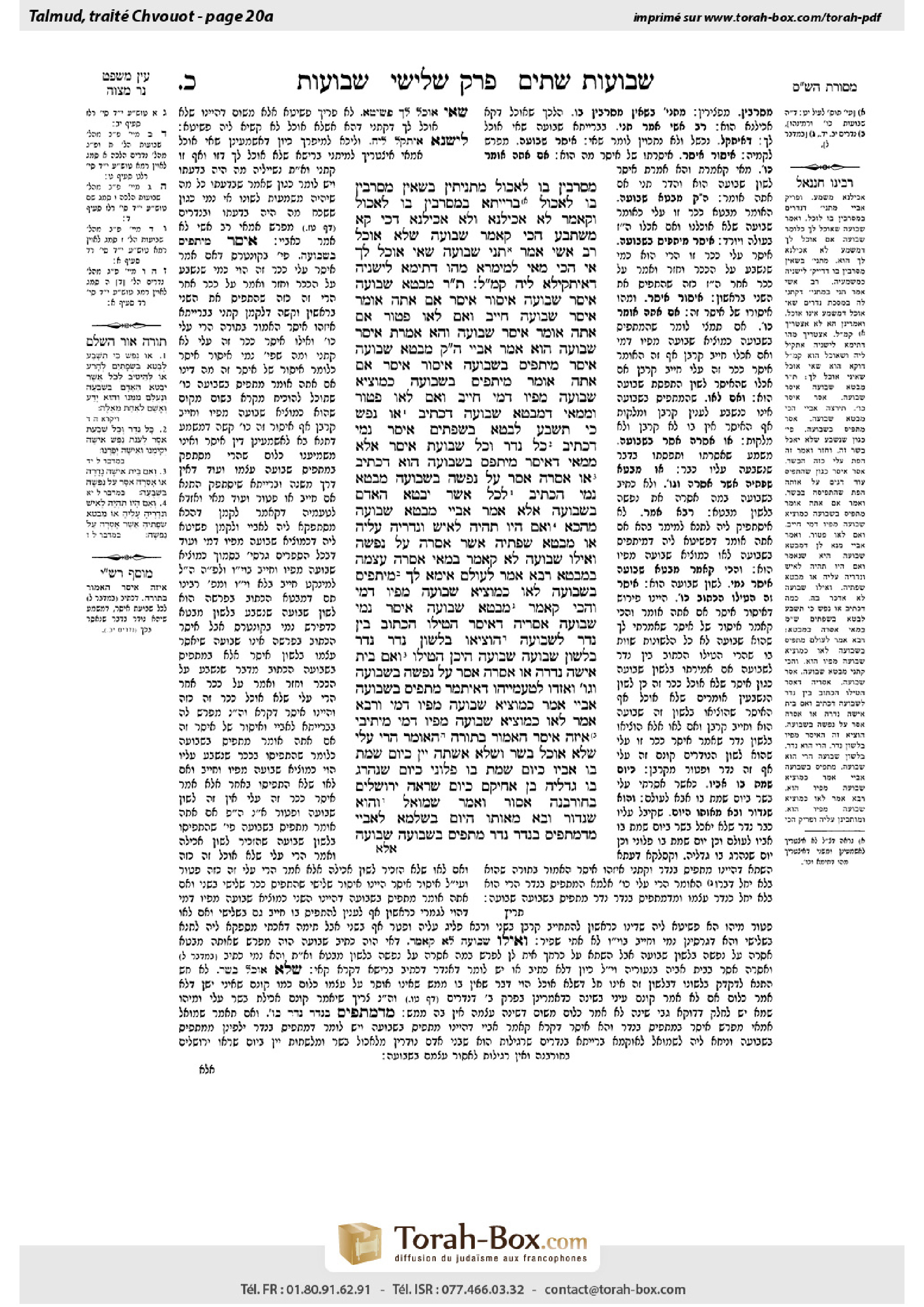
Shevuot 20a: Talmud study for Daf Yomi
Daf Yomi is the daily study of one Talmud folio. Explore 37 tractates with scans, Hebrew text, Sefaria English and AI-generated French translations where annotated.
Passage selection and English or AI-generated French translation are available where the scan has annotations. Daf Study is independent of Torah-Box and Sefaria.
Browse Shevuot · שבועות · All tractatesShevuot 20a text and translations
This page of Shevuot includes the Aramaic text, an English translation and an AI-generated French translation, alongside the scan above.
שבועות כ׳ א · Aramaic and Hebrew text
מְסָרְבִין בּוֹ לֶאֱכוֹל.
מַתְנִיתִין – בְּשֶׁאֵין מְסָרְבִין בּוֹ לֶאֱכוֹל; בָּרַיְיתָא – בִּמְסָרְבִין בּוֹ לֶאֱכוֹל, וְקָאָמַר ״לָא אָכֵילְנָא״ וְ״לָא אָכֵילְנָא״, דְּכִי קָא מִשְׁתְּבַע הָכִי קָאָמַר: ״שְׁבוּעָה שֶׁלֹּא אוֹכַל״.
רַב אָשֵׁי אָמַר: תְּנִי ״שְׁבוּעָה שֶׁאִי אוֹכַל לָךְ״. אִי הָכִי, מַאי לְמֵימְרָא? מַהוּ דְּתֵימָא: לִישָּׁנֵיהּ (דאיתקילא) [אִיתְּקִילא] לֵיהּ, קָא מַשְׁמַע לַן.
תָּנוּ רַבָּנַן: ״מִבְטָא״ – שְׁבוּעָה. ״אִיסָּר״ – שְׁבוּעָה. אִיסּוּר אִיסָּר: אִם אַתָּה אוֹמֵר ״אִיסָּר״ – שְׁבוּעָה, חַיָּיב; וְאִם לָאו, פָּטוּר. ״אִם אַתָּה אוֹמֵר אִיסָּר שְׁבוּעָה״?! וְהָא אָמְרַתְּ: אִיסָּר – שְׁבוּעָה הוּא!
אָמַר אַבָּיֵי: הָכִי קָאָמַר, ״מִבְטָא״ – שְׁבוּעָה. ״אִיסָּר״ – מִיתְּפֵיס בִּשְׁבוּעָה. אִיסּוּר אִיסָּר – אִם אַתָּה אוֹמֵר: מִיתְּפֵיס בִּשְׁבוּעָה כְּמוֹצִיא שְׁבוּעָה מִפִּיו דָּמֵי, חַיָּיב; וְאִם לָאו, פָּטוּר.
מִמַּאי דְּמִבְטָא שְׁבוּעָה – דִּכְתִיב: ״אוֹ נֶפֶשׁ כִּי תִשָּׁבַע לְבַטֵּא בִשְׂפָתַיִם״; אִיסָּר נָמֵי – דִּכְתִיב: ״כׇּל נֵדֶר וְכׇל שְׁבֻעַת אִסָּר״;
אֶלָּא מִמַּאי דְּאִיסָּר מִיתְּפֵס בִּשְׁבוּעָה הוּא? דִּכְתִיב: ״אוֹ אָסְרָה אִסָּר עַל נַפְשָׁהּ בִּשְׁבֻעָה״.
מְבַטֵּא נָמֵי – הָכְתִיב: ״לְכֹל אֲשֶׁר יְבַטֵּא הָאָדָם בִּשְׁבֻעָה״!
אֶלָּא אָמַר אַבָּיֵי: מִבְטָא שְׁבוּעָה מֵהָכָא: ״וְאִם הָיוֹ תִהְיֶה לְאִישׁ וּנְדָרֶיהָ עָלֶיהָ, אוֹ מִבְטָא שְׂפָתֶיהָ אֲשֶׁר אָסְרָה עַל נַפְשָׁהּ״ – וְאִילּוּ שְׁבוּעָה לָא קָאָמַר; בְּמַאי אָסְרָה עַצְמָהּ? בְּמִבְטָא.
רָבָא אָמַר: לְעוֹלָם אֵימָא לָךְ, מִיתְּפֵיס בִּשְׁבוּעָה לָאו כְּמוֹצִיא שְׁבוּעָה מִפִּיו דָּמֵי; וְהָכִי קָאָמַר: ״מִבְטָא״ – שְׁבוּעָה. ״אִיסָּר״ – נָמֵי שְׁבוּעָה. אִסָּרֵיהּ דְּאִיסָּר – הִטִּילוֹ הַכָּתוּב בֵּין נֶדֶר לִשְׁבוּעָה; הוֹצִיאוֹ בִּלְשׁוֹן נֶדֶר – נֶדֶר, בִּלְשׁוֹן שְׁבוּעָה – שְׁבוּעָה.
הֵיכָן הִטִּילוֹ? ״וְאִם בֵּית אִישָׁהּ נָדָרָה אוֹ אָסְרָה אִסָּר עַל נַפְשָׁהּ בִּשְׁבֻעָה וְגוֹ׳״
וְאָזְדוּ לְטַעְמַיְיהוּ; דְּאִיתְּמַר: מַתְפִּיס בִּשְׁבוּעָה – אַבָּיֵי אָמַר: כְּמוֹצִיא שְׁבוּעָה מִפִּיו דָּמֵי, וְרָבָא אָמַר: לָאו כְּמוֹצִיא שְׁבוּעָה מִפִּיו דָּמֵי.
מֵיתִיבִי: אֵיזֶה אִיסָּר הָאָמוּר בַּתּוֹרָה? הָאוֹמֵר: ״הֲרֵי עָלַי שֶׁלֹּא אוֹכַל בָּשָׂר וְשֶׁלֹּא אֶשְׁתֶּה יַיִן״ כַּיּוֹם שֶׁמֵּת בּוֹ אָבִיו, כַּיּוֹם שֶׁמֵּת בּוֹ פְּלוֹנִי, כְּיוֹם שֶׁנֶּהֱרַג בּוֹ גְּדַלְיָה בֶּן אֲחִיקָם, כַּיּוֹם שֶׁרָאָה יְרוּשָׁלַיִם בְּחוּרְבָּנָהּ – אָסוּר. וְאָמַר שְׁמוּאֵל: וְהוּא שֶׁנָּדוּר וּבָא מֵאוֹתוֹ הַיּוֹם.
בִּשְׁלָמָא לְאַבָּיֵי, מִדְּמַתְפִּיס בְּנֶדֶר – נֶדֶר, מַתְפִּיס בִּשְׁבוּעָה – שְׁבוּעָה.
Shevuot 20a · English translation
importuning [mesarevin] him to eat.
The Gemara explains: The mishna here is referring to a case where others are not importuning him to eat; therefore, his oath should be understood literally, as obligating himself to eat. The external mishna, in tractate Nedarim, is referring to a case where others are importuning him to eat and he is saying: I will not eat, I will not eat. Under those circumstances, when he takes an oath, this is what he is saying: On my oath I will not eat.
Rav Ashi, offering a different resolution of the contradiction, says: Teach, i.e., revise the mishna in tractate Nedarim to say in the middle oath: On my oath I will not [she’i] eat of yours, i.e., using a different formulation for: On my oath I will not eat of yours. The Gemara asks: If so, what is the purpose of stating what is effectively the same oath twice? The Gemara answers: Lest you say that there is a concern that the oath was a slip of his tongue and he meant to take an oath that he will eat and instead said: I will not eat, the mishna teaches us that one need not be concerned that this is what occurred.
§ The Sages taught: “The clear utterance of her lips, with which she has bound her soul” (Numbers 30:7), is referring to an oath, and: “A bond with which she has bound her soul” (Numbers 30:5), is also referring to an oath. With regard to the prohibition invoked by the word “bond,” if you say a bond is an oath, he is liable, but if not, he is exempt. The Gemara seeks to explicate this baraita: If you say a bond is an oath? But you already said that a bond is an oath.
Abaye said: This is what the baraita is saying: “Clear utterance” is an oath, whereas “bond” is the association of some object or action with a matter that has already been prohibited by an oath. What is the prohibition invoked by the word “bond”? If you say that creating an association with an oath is like explicitly expressing an oath with his own mouth then he is liable to bring an offering for unwittingly violating the oath and to receive lashes for doing so intentionally. But if it is not like stating an oath explicitly, he is exempt.
The Gemara analyzes Abaye’s explanation: From where may one derive that “clear utterance” is an oath? One derives it from the verse written with regard to an oath on an utterance, as it is written: “Or if anyone take an oath to clearly utter with his lips” (Leviticus 5:4). The Gemara asks: Isn’t “bond” also referring to an oath, as it is written: “Every vow, and every oath of a bond to afflict the soul, her husband may let it stand, or her husband may make it void” (Numbers 30:14)?
Rather, from where may one derive that a bond is the association of some object or action with another matter that has been prohibited by an oath? One may derive it from the verse, as it is written: “Or bound her soul by a bond with an oath” (Numbers 30:11), which indicates that the bond is associated with a preexisting oath.
The Gemara asks: Isn’t the term “clear utterance” also associated with an oath in a verse, as it is written: “Whatsoever it be that a man shall utter clearly with an oath” (Leviticus 5:4)?
Rather, Abaye said: The fact that “clear utterance” means an oath is derived from here: “And if she be married to a husband, while her vows are upon her, or the clear utterance of her lips, with which she has bound her soul” (Numbers 30:7). While in that verse, it does not state: Oath. With what does she impose a prohibition upon herself? She does so with “clear utterance,” indicating that “clear utterance” is referring to an oath.
Rava said: Actually, I will say to you that association with an oath is not like expressing an oath with one’s own mouth, and this is what the baraita is saying: “Clear utterance” is an oath. “Bond” can also be an oath, but it is ambiguous. The verse placed the wording of the prohibition of a bond between that of a vow and that of an oath. Therefore, if one expressed a bond with the language of a vow, it is a vow. If one expressed it with the language of an oath, it is an oath.
The Gemara asks: Where did the verse place the word for “bond” between a vow and an oath? The verse says: “And if she vowed in her husband’s house or bound her soul by a bond with an oath” (Numbers 30:11).
The Gemara comments: Abaye and Rava both follow their own lines of reasoning, as it was stated: With regard to one who associates some object or action with another matter that has been prohibited by an oath, Abaye says: It is like explicitly expressing an oath with his mouth, and Rava says: It is not like explicitly expressing an oath with his mouth.
The Gemara raises an objection from a baraita: What is the bond mentioned in the Torah? A bond applies to one who says: It is incumbent upon me that I will not eat meat and that I will not drink wine like on the day that his, i.e., my, father died, or: Like on the day that so-and-so died, or: Like on the day that Gedaliah ben Ahikam was killed, or: Like on the day on which he saw Jerusalem in its destruction. One who makes one of these pronouncements is prohibited from eating meat and drinking wine. And Shmuel says: This is the case only when he is prohibited from eating meat and drinking wine by vow since that day, e.g., the day his father died.
The Gemara explains the objection: Granted, according to the opinion of Abaye, from the fact that a vow that one associates with another vow is considered a vow, as Shmuel’s ruling demonstrates, one may conclude that an oath that one associates with another oath is considered an oath.
Shevuot 20a · Traduction française (IA)
le pressant [mesarevin] de manger.
La Guemara explique : La Michna ici fait référence à un cas où les autres ne le pressent pas de manger ; son serment doit donc être compris au sens littéral, comme l’engageant à manger. La Michna extérieure, dans le traité Nedarim, fait référence à un cas où les autres le pressent de manger et où il dit : « Je ne mangerai pas, je ne mangerai pas. » Dans ces circonstances, lorsqu’il prête serment, voici ce qu’il veut dire : « Je jure que je ne mangerai pas. »
Rav Ashi propose une autre résolution de la contradiction : Enseigne, c’est-à-dire révise la Michna du traité Nedarim, de sorte que le serment du milieu soit formulé ainsi : « Je jure que je ne [she’i] mangerai pas de ce qui est à toi », c’est-à-dire selon une formulation différente de : « Je jure que je ne mangerai pas de ce qui est à toi. » La Guemara demande : Dans ce cas, pourquoi énoncer deux fois ce qui revient en fait au même serment ? La Guemara répond : De peur que tu ne dises qu’il faut craindre que le serment soit un lapsus et qu’il ait voulu jurer qu’il mangerait, mais qu’il ait dit par erreur : « Je ne mangerai pas », la Michna nous enseigne qu’il n’y a pas lieu de craindre que ce soit ce qui s’est produit.
§ Les Sages ont enseigné : « La parole claire de ses lèvres, par laquelle elle a lié son âme » (Nombres 30:7), fait référence à un serment ; et « un lien par lequel elle a lié son âme » (Nombres 30:5) fait également référence à un serment. Concernant l’interdiction évoquée par le mot « lien », s’il s’agit d’un serment, il est passible ; sinon, il est exempté. La Guemara cherche à expliciter cette baraïta : « S’il s’agit d’un serment » ? Mais tu as déjà dit qu’un lien est un serment.
Abayé dit : Voici ce que dit la baraïta : « Parole claire » désigne un serment, tandis que « lien » désigne le fait d’associer un objet ou une action à une chose déjà interdite par un serment. Quelle est l’interdiction évoquée par le mot « lien » ? Si le fait d’associer quelque chose à un serment équivaut à exprimer explicitement un serment de sa propre bouche, alors il est passible d’apporter un sacrifice pour avoir violé le serment par inadvertance et de recevoir des coups de fouet pour l’avoir violé intentionnellement. Mais si cela n’équivaut pas à énoncer explicitement un serment, il est exempté.
La Guemara examine l’explication d’Abayé : D’où peut-on déduire que « parole claire » désigne un serment ? On le déduit du verset relatif à un serment portant sur une parole, comme il est écrit : « Ou si quelqu’un jure en prononçant clairement de ses lèvres » (Lévitique 5:4). La Guemara demande : « Lien » ne désigne-t-il pas également un serment, comme il est écrit : « Tout vœu et tout serment de lien pour affliger l’âme, son mari peut le maintenir ou son mari peut l’annuler » (Nombres 30:14) ?
Mais alors, d’où peut-on déduire qu’un lien consiste à associer un objet ou une action à une autre chose déjà interdite par un serment ? On peut le déduire du verset, comme il est écrit : « Ou a lié son âme par un lien avec un serment » (Nombres 30:11), ce qui indique que le lien est associé à un serment préexistant.
La Guemara demande : Le terme « parole claire » n’est-il pas lui aussi associé à un serment dans un verset, comme il est écrit : « Quoi que ce soit qu’un homme prononce clairement avec un serment » (Lévitique 5:4) ?
Mais Abayé dit : Le fait que « parole claire » signifie un serment se déduit de ce verset : « Et si elle est mariée à un mari, alors que ses vœux pèsent sur elle, ou la parole claire de ses lèvres, par laquelle elle a lié son âme » (Nombres 30:7). Or, dans ce verset, le mot « serment » n’apparaît pas. Par quoi s’impose-t-elle une interdiction ? Elle le fait par une « parole claire », ce qui indique que « parole claire » désigne un serment.
Rava dit : En réalité, je vais te dire que le fait d’associer quelque chose à un serment n’équivaut pas à exprimer un serment de sa propre bouche, et voici ce que dit la baraïta : « Parole claire » désigne un serment. « Lien » peut également désigner un serment, mais le terme est ambigu. Le verset a placé la formulation de l’interdiction d’un lien entre celle d’un vœu et celle d’un serment. Par conséquent, si quelqu’un a formulé un lien dans le langage d’un vœu, c’est un vœu ; s’il l’a formulé dans le langage d’un serment, c’est un serment.
La Guemara demande : Où le verset a-t-il placé le mot « lien » entre un vœu et un serment ? Le verset dit : « Et si elle a fait un vœu dans la maison de son mari ou a lié son âme par un lien avec un serment » (Nombres 30:11).
La Guemara fait remarquer qu’Abayé et Rava suivent chacun leur propre raisonnement, comme cela a été enseigné : Au sujet de celui qui associe un objet ou une action à une autre chose déjà interdite par un serment, Abayé dit : Cela équivaut à exprimer explicitement un serment de sa bouche ; Rava dit : Cela n’équivaut pas à exprimer explicitement un serment de sa bouche.
La Guemara soulève une objection à partir d’une baraïta : Qu’est-ce que le lien mentionné dans la Torah ? Le lien s’applique à celui qui dit : « Je m’impose de ne pas manger de viande et de ne pas boire de vin comme le jour où mon père est mort », ou : « Comme le jour où untel est mort », ou : « Comme le jour où Guedalia ben Ahikam a été tué », ou : « Comme le jour où il a vu Jérusalem en ruines. » Celui qui prononce l’une de ces formules n’a pas le droit de manger de viande ni de boire de vin. Et Chmouel dit : Cela ne s’applique que lorsqu’il s’interdit par un vœu de manger de la viande et de boire du vin à compter de ce jour, par exemple du jour où son père est mort.
La Guemara expose l’objection : Certes, selon l’opinion d’Abayé, puisque le vœu qu’on associe à un autre vœu est considéré comme un vœu, ainsi que le démontre la décision de Chmouel, on peut conclure qu’un serment qu’on associe à un autre serment est considéré comme un serment.
Traduction française générée par IA à partir de l’édition anglaise de Sefaria. Vérifie toujours un passage avec le texte source.
Text from Sefaria: William Davidson Edition - Vocalized Aramaic (CC BY NC); William Davidson Edition - English (CC BY NC).