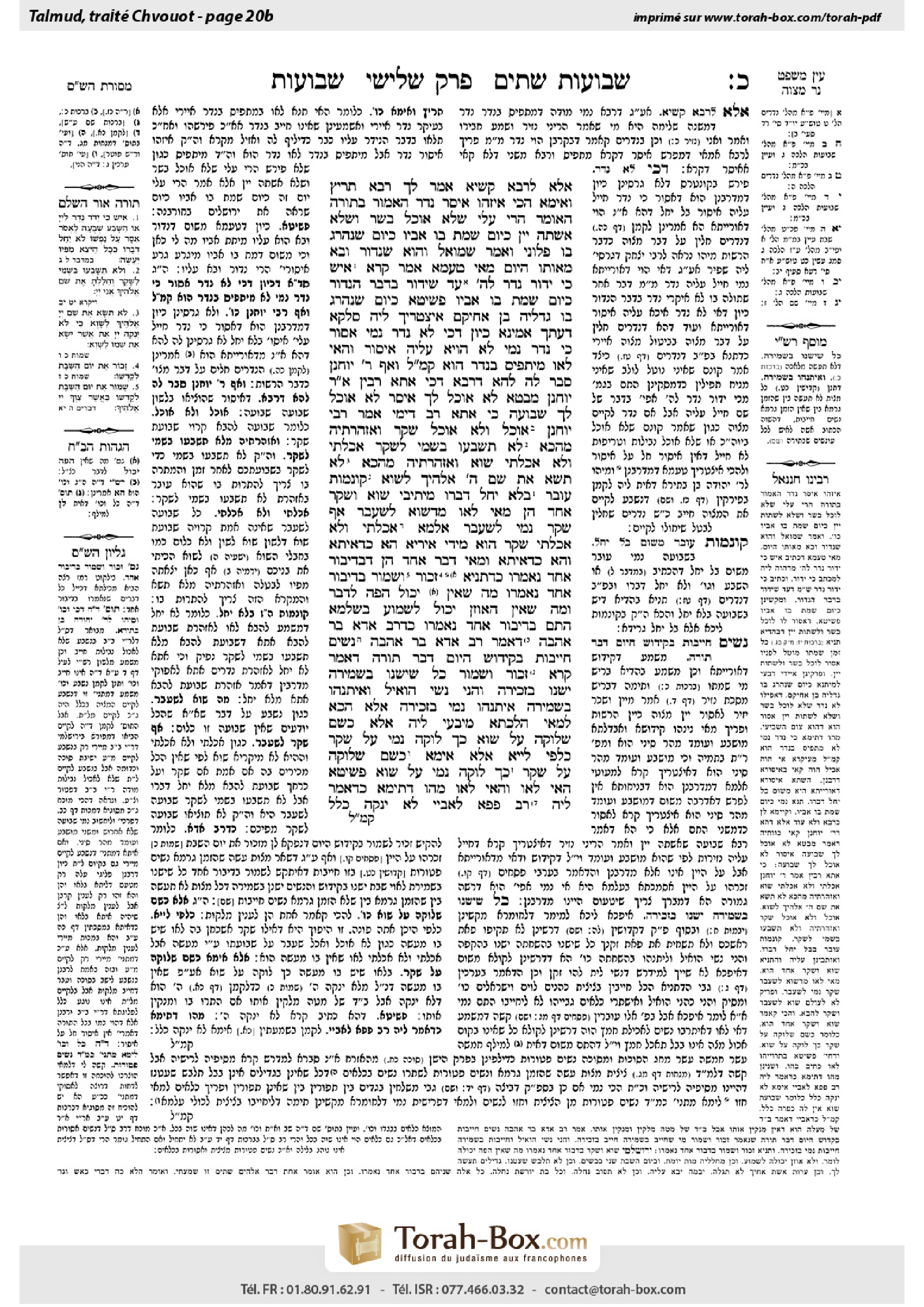
Shevuot 20b: Talmud study for Daf Yomi
Daf Yomi is the daily study of one Talmud folio. Explore 37 tractates with scans, Hebrew text, Sefaria English and AI-generated French translations where annotated.
Passage selection and English or AI-generated French translation are available where the scan has annotations. Daf Study is independent of Torah-Box and Sefaria.
Browse Shevuot · שבועות · All tractatesShevuot 20b text and translations
This page of Shevuot includes the Aramaic text, an English translation and an AI-generated French translation, alongside the scan above.
שבועות כ׳ ב · Aramaic and Hebrew text
אֶלָּא לְרָבָא קַשְׁיָא!
אָמַר לָךְ רָבָא, תָּרֵיץ וְאֵימָא הָכִי: אֵיזֶהוּ אִיסַּר נֶדֶר הָאָמוּר בַּתּוֹרָה? הָאוֹמֵר: ״הֲרֵי עָלַי שֶׁלֹּא אוֹכַל בָּשָׂר וְשֶׁלֹּא אֶשְׁתֶּה יַיִן״ כַּיּוֹם שֶׁמֵּת בּוֹ אָבִיו, כַּיּוֹם שֶׁנֶּהֱרַג בּוֹ פְּלוֹנִי. וְאָמַר שְׁמוּאֵל: וְהוּא שֶׁנָּדוּר וּבָא מֵאוֹתוֹ הַיּוֹם.
מַאי טַעְמָא? אָמַר קְרָא: ״אִישׁ כִּי יִדֹּר נֶדֶר לַה׳״ – עַד שֶׁיִּדּוֹר בְּדָבָר הַנָּדוּר.
כַּיּוֹם שֶׁמֵּת בּוֹ אָבִיו. פְּשִׁיטָא! כְּיוֹם שֶׁנֶּהֱרַג בּוֹ גְּדַלְיָה בֶּן אֲחִיקָם אִיצְטְרִיךְ לֵיהּ, סָלְקָא דַּעְתָּךְ אָמֵינָא: כֵּיוָן דְּכִי לָא נָדַר נָמֵי אָסוּר – כִּי נָדַר נָמֵי לָא הָוְיָא עֲלֵיהּ אִיסּוּר, וְהַאי לָאו מִיתְּפֵיס בְּנֶדֶר הוּא; קָא מַשְׁמַע לַן.
וְאַף רַבִּי יוֹחָנָן סָבַר לַהּ לְהָא דְּרָבָא; דְּכִי אֲתָא רָבִין אָמַר רַבִּי יוֹחָנָן: ״מִבְטָא לֹא אוֹכַל לָךְ״, ״אִיסָּר לֹא אוֹכַל לָךְ״ – שְׁבוּעָה.
כִּי אֲתָא רַב דִּימִי אָמַר רַבִּי יוֹחָנָן: ״אוֹכַל״ וְ״לֹא אוֹכַל״ – שֶׁקֶר, וְאַזְהַרְתֵּיהּ מֵהָכָא: ״לָא תִשָּׁבְעוּ בִשְׁמִי לַשָּׁקֶר״. ״אָכַלְתִּי״ וְ״לֹא אָכַלְתִּי״ – שָׁוְא, וְאַזְהַרְתֵּיהּ מֵהָכָא: ״לֹא תִשָּׂא אֶת שֵׁם ה׳ אֱלֹהֶיךָ לַשָּׁוְא״.
קוּנָּמוֹת – עוֹבֵר בְּ״לֹא יַחֵל דְּבָרוֹ״.
מֵיתִיבִי: שָׁוְא וְשֶׁקֶר אֶחָד הֵן. מַאי, לָאו מִדְּשָׁוְא לְשֶׁעָבַר – אַף שֶׁקֶר נָמֵי לְשֶׁעָבַר? אַלְמָא ״אָכַלְתִּי״ וְ״לֹא אָכַלְתִּי״ שֶׁקֶר הוּא!
מִידֵּי אִירְיָא?! הָא כִּדְאִיתָא, וְהָא כִּדְאִיתָא. וּמַאי ״דָּבָר אֶחָד הֵן״? דִּבְדִיבּוּר אֶחָד נֶאֶמְרוּ, כִּדְתַנְיָא: ״זָכוֹר״ וְ״שָׁמוֹר״ בְּדִיבּוּר אֶחָד נֶאֶמְרוּ – מַה שֶּׁאֵין יָכוֹל הַפֶּה לְדַבֵּר, וּמָה שֶׁאֵין הָאוֹזֶן יָכוֹל לִשְׁמוֹעַ.
בִּשְׁלָמָא הָתָם בְּדִיבּוּר אֶחָד נֶאֶמְרוּ, כִּדְרַב אַדָּא בַּר אַהֲבָה – דְּאָמַר רַב אַדָּא בַּר אַהֲבָה: נָשִׁים חַיָּיבוֹת בְּקִידּוּשׁ הַיּוֹם דְּבַר תּוֹרָה, דְּאָמַר קְרָא ״זָכוֹר״ וְ״שָׁמוֹר״ – כׇּל שֶׁיֶּשְׁנוֹ בִּשְׁמִירָה יֶשְׁנוֹ בִּזְכִירָה, וְהָנֵי נְשֵׁי הוֹאִיל וְאִיתַנְהוּ בִּשְׁמִירָה אִיתַנְהוּ נָמֵי בִּזְכִירָה. אֶלָּא הָכָא לְמַאי הִלְכְתָא מִיבְּעֵי לֵיהּ?
אֶלָּא כְּשֵׁם שֶׁלּוֹקֶה עַל שָׁוְא, כָּךְ לוֹקֶה נָמֵי עַל שֶׁקֶר.
כְּלַפֵּי לְיָיא? אֶלָּא אֵימָא: כְּשֵׁם שֶׁלּוֹקֶה עַל שֶׁקֶר, כָּךְ לוֹקֶה נָמֵי עַל שָׁוְא.
פְּשִׁיטָא – הַאי לָאו וְהַאי לָאו! מַהוּ דְּתֵימָא כְּדַאֲמַר לֵיהּ רַב פָּפָּא לְאַבָּיֵי: ״לֹא יִנָּקֶה״ כְּלָל;
Shevuot 20b · English translation
But according to Rava’s opinion, that association with an oath is not considered an oath, the baraita poses a difficulty, as it indicates that association with a vow is considered a vow; a corresponding rule should apply to an oath.
The Gemara answers: Rava could say to you: Resolve the difficulty posed by the baraita and say that the baraita teaches this: Which is the bond of a vow mentioned in the Torah? When is a bond, i.e., the acceptance of a prohibition on oneself, considered a vow? According to Rava, “bond” in the verse is not referring to association. Rather, it is referring to one who says: It is incumbent upon me that I will not eat meat and that I will not drink wine like on the day that his, i.e., my, father died, or: Like on the day that so-and-so was killed. And Shmuel says: This is the halakha only when he is prohibited from eating meat and drinking wine by vow since that day, e.g., the day his father died.
What is the reason for Shmuel’s caveat? The verse states: “When a man vows a vow to the Lord” (Numbers 30:3). The redundancy in the phrase “vows a vow” teaches that when one associates a vow with another prohibition, it does not take effect unless he vows by associating it with an item forbidden by means of a vow. Association is derived from this verse and is limited to vows.
The Gemara discusses the baraita: One who says: It is incumbent upon me that I will not eat meat and that I will not drink wine like on the day that his father died. The Gemara asks: Isn’t it obvious that he is prohibited from eating meat and drinking wine? Why does the baraita need to mention the specific example of a vow concerning the day his father died? The Gemara answers: It was necessary that the baraita state that the vow takes effect for the sake of the other example: Like on the day that Gedaliah ben Ahikam was killed. Otherwise, it may enter your mind to say: Since, even if he did not vow to refrain from eating meat or drinking wine on that day they would be prohibited to him anyway, as it is a public fast day, when he did vow to refrain from eating and drinking on that day, the prohibition of the vow would not take effect on him, and that subsequent vow would then not be associated with a vow, but with an ordinary prohibition. Therefore, the baraita teaches us that the vow made on the fast day takes effect and the second vow can be associated with it.
The Gemara comments: And Rabbi Yoḥanan also holds in accordance with this opinion of Rava that a bond is not an association with an oath, but an oath itself, as when Ravin came from Eretz Yisrael to Babylonia he reported that Rabbi Yoḥanan says: If one says: By my clear utterance I will not eat of yours, or: On my bond I will not eat of yours, it is an oath.
§ When Rav Dimi came from Eretz Yisrael, he reported that Rabbi Yoḥanan says: If one takes an oath, saying: I will eat, or: I will not eat, relating to the future, and does not fulfill it, it is a false oath. And its prohibition in the Torah is from here: “And you shall not take an oath by My name falsely, so that you profane the name of your God; I am the Lord” (Leviticus 19:12). If one takes an oath, saying: I ate, or: I did not eat, relating to past actions, and it is a lie, it is an oath taken in vain, and its prohibition in the Torah is from here: “You shall not take the name of the Lord your God in vain; for the Lord will not absolve of guilt he that takes His name in vain” (Exodus 20:7).
Rav Dimi continued: With regard to vows where one states that an item is forbidden like an offering [konamot], if he subsequently derives benefit from that item, one violates the prohibition: “When a man vows a vow to the Lord, or takes an oath to bind his soul with a bond, he shall not break his word; he shall do according to all that proceeds out of his mouth” (Numbers 30:3).
The Gemara raises an objection from a baraita: The prohibitions against taking an oath in vain and taking a false oath are one. The Gemara suggests: What, is the baraita not teaching that if an oath taken in vain refers to the past, a false oath also refers to the past? Apparently, the statements: I ate, and: I did not eat, are both false oaths, contrary to Rabbi Yoḥanan’s statement that a false oath is one that relates to the future.
The Gemara answers: Are the cases comparable? This case, of a false oath, is as it is and that case, of an oath taken in vain, is as it is. What, then, is the meaning of the assertion of the baraita that they are one? It is that both were spoken in a single utterance at the giving of the Torah, like that which is taught in a baraita: “Remember the Sabbath day, to keep it holy” (Exodus 20:8), and: “Observe the Sabbath day, to keep it holy” (Deuteronomy 5:12), were spoken in one utterance, in a manner that the human mouth cannot say and that the human ear cannot hear.
The Gemara asks: Granted, there, “remember” and “observe” were spoken in a single utterance in order to teach the halakha that Rav Adda bar Ahava says; as Rav Adda bar Ahava says: Women are obligated to recite kiddush sanctifying the seventh day, by Torah law, even though it is a positive, time-bound mitzva, since the verses state: “Remember,” and: “Observe,” indicating that anyone who is obligated to observe, i.e., is prohibited from performing labor on Shabbat, is obligated to remember, by reciting kiddush. And these women, since they are obligated to observe, they also are obligated to remember. But here, with regard to the prohibitions against taking a false oath and taking an oath in vain, for what halakha is it necessary for them to have been spoken in a single utterance?
The Gemara explains: Rather, the baraita states that these two oaths are one to teach that just as one is flogged for taking an oath in vain, so is one also flogged for taking a false oath.
The Gemara asks: Isn’t it the opposite [kelapei layya]? It is clear that one receives lashes for taking a false oath about the future, which one violates with an action, but an oath taken in vain about the past is merely a verbal pronouncement. Rather, say like this: Just as one is flogged for taking a false oath, i.e., violating one’s oath about the future, so is one also flogged for taking an oath in vain.
The Gemara asks: Why must the baraita state that one is flogged for either type of oath? Isn’t it obvious? This is a prohibition and that is a prohibition, and for both one is liable to receive lashes. The Gemara answers: Lest you say as Rav Pappa said to Abaye, that the verse: “For the Lord will not absolve of guilt he that takes His name in vain” (Exodus 20:7), might indicate that God will not absolve him at all, and even if he is punished he cannot atone for his sin,
Shevuot 20b · Traduction française (IA)
Mais selon l’opinion de Rava, selon laquelle l’association à un serment n’est pas considérée comme un serment, la baraïta pose une difficulté, puisqu’elle indique que l’association à un vœu est considérée comme un vœu ; une règle correspondante devrait s’appliquer au serment.
La Guemara répond : Rava pourrait te dire : Résous la difficulté soulevée par la baraïta en disant qu’elle enseigne ceci : Qu’est-ce que le lien d’un vœu mentionné dans la Torah ? Quand un lien, c’est-à-dire l’acceptation d’une interdiction sur soi-même, est-il considéré comme un vœu ? Selon Rava, le « lien » dans le verset ne désigne pas une association. Il désigne plutôt le cas de celui qui dit : « Il m’incombe de ne pas manger de viande et de ne pas boire de vin, comme le jour où son père — c’est-à-dire mon père — est mort », ou : « Comme le jour où untel a été tué. » Et Chmouel dit : Cette halakha s’applique uniquement lorsqu’il s’interdit, par un vœu, de manger de la viande et de boire du vin à compter de ce jour, par exemple le jour de la mort de son père.
Quelle est la raison de la réserve de Chmouel ? Le verset dit : « Lorsqu’un homme fait un vœu à l’Éternel » (Nombres 30,3). La répétition dans l’expression « fait un vœu » enseigne que, lorsqu’on associe un vœu à une autre interdiction, celui-ci ne prend effet que si l’on fait ce vœu en l’associant à un objet interdit par un vœu. L’association est déduite de ce verset et ne s’applique qu’aux vœux.
La Guemara examine la baraïta : « Celui qui dit : “Il m’incombe de ne pas manger de viande et de ne pas boire de vin, comme le jour où son père est mort.” » La Guemara demande : N’est-il pas évident qu’il lui est interdit de manger de la viande et de boire du vin ? Pourquoi la baraïta doit-elle mentionner précisément l’exemple d’un vœu concernant le jour de la mort de son père ? La Guemara répond : Il était nécessaire que la baraïta précise que le vœu prend effet en vue de l’autre exemple : « Comme le jour où Guedalia ben Ahikam a été tué. » Sinon, tu pourrais penser que, puisqu’il lui aurait de toute façon été interdit de manger de la viande ou de boire du vin ce jour-là, même sans avoir fait le vœu de s’en abstenir, car c’est un jour de jeûne public, le vœu qu’il fait de s’abstenir de manger et de boire ce jour-là ne prendrait pas effet. Ce vœu ultérieur ne serait alors pas associé à un vœu, mais à une interdiction ordinaire. La baraïta nous enseigne donc que le vœu fait le jour du jeûne prend effet et que le second vœu peut y être associé.
La Guemara fait remarquer que Rabbi Yoḥanan partage également cette opinion de Rava : un lien n’est pas une association à un serment, mais un serment lui-même. En effet, lorsque Ravin est venu d’Eretz Israël en Babylonie, il a rapporté que Rabbi Yoḥanan dit : Si quelqu’un dit : « Par ma parole explicite, je ne mangerai pas de ce qui t’appartient », ou : « Par mon lien, je ne mangerai pas de ce qui t’appartient », c’est un serment.
§ Lorsque Rav Dimi est venu d’Eretz Israël, il a rapporté que Rabbi Yoḥanan dit : Si quelqu’un prête serment au sujet de l’avenir en disant : « Je mangerai », ou : « Je ne mangerai pas », et qu’il ne respecte pas son serment, c’est un serment mensonger. L’interdiction correspondante dans la Torah se trouve ici : « Vous ne jurerez pas faussement par Mon nom, profanant ainsi le nom de votre Dieu ; Je suis l’Éternel » (Lévitique 19,12). Si quelqu’un prête serment au sujet d’actes passés en disant : « J’ai mangé », ou : « Je n’ai pas mangé », et que cela est mensonger, c’est un serment prononcé en vain. L’interdiction correspondante dans la Torah se trouve ici : « Tu ne prononceras pas le nom de l’Éternel, ton Dieu, en vain ; car l’Éternel ne tiendra pas pour innocent celui qui prononce Son nom en vain » (Exode 20,7).
Rav Dimi poursuit : En ce qui concerne les vœux par lesquels on déclare qu’un objet est interdit comme une offrande [konamot], si l’on tire ensuite profit de cet objet, on transgresse l’interdiction suivante : « Lorsqu’un homme fait un vœu à l’Éternel, ou prête serment pour lier son âme par un lien, il ne violera pas sa parole ; il fera selon tout ce qui est sorti de sa bouche » (Nombres 30,3).
La Guemara soulève une objection à partir d’une baraïta : Les interdictions de prononcer un serment en vain et de prêter un serment mensonger n’en font qu’une. La Guemara suggère : La baraïta n’enseigne-t-elle pas qu’un serment prononcé en vain porte sur le passé, tout comme un serment mensonger ? Apparemment, les déclarations « J’ai mangé » et « Je n’ai pas mangé » sont toutes deux des serments mensongers, contrairement à l’affirmation de Rabbi Yoḥanan selon laquelle un serment mensonger porte sur l’avenir.
La Guemara répond : Ces cas sont-ils comparables ? Le cas du serment mensonger est ce qu’il est, et celui du serment prononcé en vain est ce qu’il est. Quel est donc le sens de l’affirmation de la baraïta selon laquelle ils n’en font qu’un ? Cela signifie qu’ils ont tous deux été prononcés en une seule parole lors du don de la Torah, comme l’enseigne une baraïta : « Souviens-toi du jour du Chabbat pour le sanctifier » (Exode 20,8) et « Observe le jour du Chabbat pour le sanctifier » (Deutéronome 5,12) ont été prononcés en une seule parole, d’une manière que la bouche humaine ne peut exprimer et que l’oreille humaine ne peut entendre.
La Guemara demande : Certes, dans ce cas, « Souviens-toi » et « Observe » ont été prononcés en une seule parole afin d’enseigner la halakha énoncée par Rav Adda bar Ahava. En effet, Rav Adda bar Ahava dit : Les femmes sont tenues, selon la Torah, de réciter le kiddouch, qui sanctifie le septième jour, bien qu’il s’agisse d’une mitsva positive dépendant du temps, car les versets disent « Souviens-toi » et « Observe », indiquant que quiconque est tenu d’observer, c’est-à-dire à qui il est interdit d’accomplir un travail le Chabbat, est tenu de se souvenir, en récitant le kiddouch. Puisque ces femmes sont tenues d’observer, elles sont également tenues de se souvenir. Mais ici, concernant les interdictions de prêter un serment mensonger et de prononcer un serment en vain, pour quelle halakha fallait-il qu’elles soient prononcées en une seule parole ?
La Guemara explique : La baraïta affirme plutôt que ces deux serments n’en font qu’un afin d’enseigner que, de même qu’on reçoit la flagellation pour avoir prononcé un serment en vain, de même reçoit-on la flagellation pour avoir prêté un serment mensonger.
La Guemara demande : N’est-ce pas l’inverse [kelapei layya] ? Il est clair qu’on reçoit la flagellation pour avoir prêté un serment mensonger portant sur l’avenir, que l’on transgresse par un acte, tandis qu’un serment prononcé en vain au sujet du passé n’est qu’une déclaration verbale. Il faut donc plutôt dire ceci : de même qu’on reçoit la flagellation pour avoir prêté un serment mensonger, c’est-à-dire pour avoir violé son serment concernant l’avenir, de même reçoit-on la flagellation pour avoir prononcé un serment en vain.
La Guemara demande : Pourquoi la baraïta doit-elle préciser qu’on reçoit la flagellation pour l’un ou l’autre type de serment ? N’est-ce pas évident ? Celui-ci est une interdiction et celui-là est une interdiction, et pour les deux on est passible de flagellation. La Guemara répond : De peur que tu ne dises, comme Rav Pappa l’a dit à Abayé, que le verset « car l’Éternel ne tiendra pas pour innocent celui qui prononce Son nom en vain » (Exode 20,7) pourrait indiquer que Dieu ne l’absoudra en aucun cas et que, même s’il est puni, il ne peut expier son péché,
Traduction française générée par IA à partir de l’édition anglaise de Sefaria. Vérifie toujours un passage avec le texte source.
Text from Sefaria: William Davidson Edition - Vocalized Aramaic (CC BY NC); William Davidson Edition - English (CC BY NC).