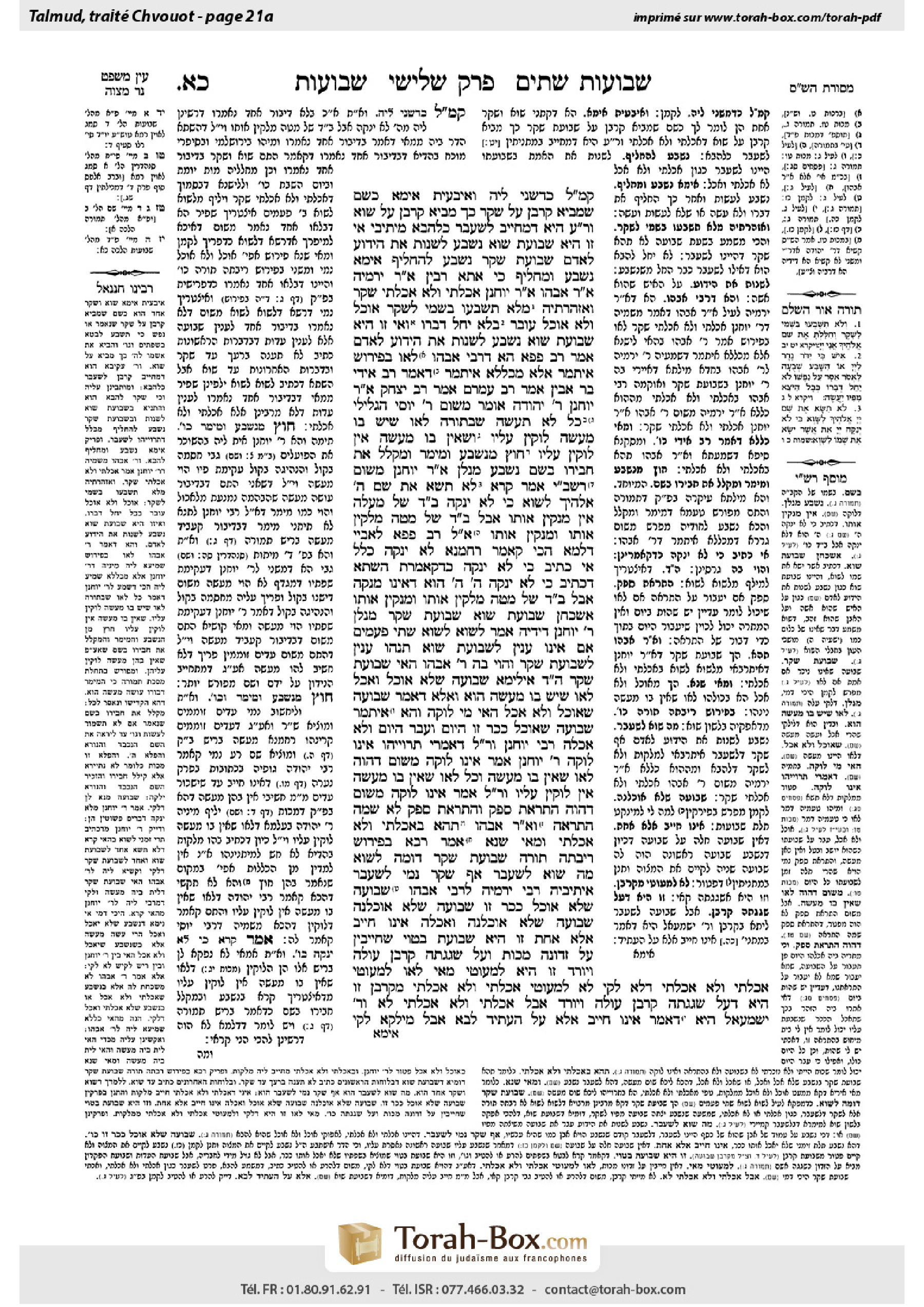
Shevuot 21a: Talmud study for Daf Yomi
Daf Yomi is the daily study of one Talmud folio. Explore 37 tractates with scans, Hebrew text, Sefaria English and AI-generated French translations where annotated.
Passage selection and English or AI-generated French translation are available where the scan has annotations. Daf Study is independent of Torah-Box and Sefaria.
Browse Shevuot · שבועות · All tractatesShevuot 21a text and translations
This page of Shevuot includes the Aramaic text, an English translation and an AI-generated French translation, alongside the scan above.
שבועות כ״א א · Aramaic and Hebrew text
קָא מַשְׁמַע לַן כִּדְשַׁנִּי לֵיהּ.
וְאִיבָּעֵית אֵימָא: כְּשֵׁם שֶׁמֵּבִיא קׇרְבָּן עַל שֶׁקֶר, כָּךְ מֵבִיא קׇרְבָּן עַל שָׁוְא; וְרַבִּי עֲקִיבָא הִיא, דִּמְחַיֵּיב לְשֶׁעָבַר כִּלְהַבָּא.
מֵיתִיבִי: אֵי זוֹ הִיא שְׁבוּעַת שָׁוְא – נִשְׁבָּע לְשַׁנּוֹת אֶת הַיָּדוּעַ לְאָדָם. שְׁבוּעַת שֶׁקֶר – נִשְׁבָּע לְהַחְלִיף! אֵימָא נִשְׁבָּע וּמַחְלִיף.
כִּי אֲתָא רָבִין, אָמַר רַבִּי יִרְמְיָה, אָמַר רַבִּי אֲבָהוּ, אָמַר רַבִּי יוֹחָנָן: ״אָכַלְתִּי״ וְ״לֹא אָכַלְתִּי״ – שֶׁקֶר, וְאַזְהַרְתֵּיהּ מִ״לֹּא תִשָּׁבְעוּ בִשְׁמִי לַשָּׁקֶר״. ״אוֹכַל״ וְ״לֹא אוֹכַל״ – עוֹבֵר בְּ״לֹא יַחֵל דְּבָרוֹ״. וְאֵי זוֹ הִיא שְׁבוּעַת שָׁוְא? נִשְׁבָּע לְשַׁנּוֹת אֶת הַיָּדוּעַ לְאָדָם.
אָמַר רַב פָּפָּא: הָא דְּרַבִּי אֲבָהוּ – לָאו בְּפֵירוּשׁ אִיתְּמַר, אֶלָּא מִכְּלָלָא אִיתְּמַר; דְּאָמַר רַב אִידִי בַּר אָבִין: אָמַר רַב עַמְרָם, אָמַר רַב יִצְחָק, אָמַר רַבִּי יוֹחָנָן, רַבִּי יְהוּדָה אוֹמֵר מִשּׁוּם רַבִּי יוֹסֵי הַגְּלִילִי: כֹּל לֹא תַעֲשֶׂה שֶׁבַּתּוֹרָה – לָאו שֶׁיֵּשׁ בּוֹ מַעֲשֶׂה לוֹקִין עָלָיו, וְשֶׁאֵין בּוֹ מַעֲשֶׂה אֵין לוֹקִין עָלָיו; חוּץ מִנִּשְׁבָּע וּמֵימֵר וּמְקַלֵּל אֶת חֲבֵירוֹ בַּשֵּׁם.
נִשְׁבָּע מְנָלַן? אָמַר רַבִּי יוֹחָנָן מִשּׁוּם רַבִּי שִׁמְעוֹן בֶּן יוֹחַאי, אָמַר קְרָא: ״לֹא תִשָּׂא אֶת שֵׁם ה׳ אֱלֹהֶיךָ לַשָּׁוְא כִּי לֹא יְנַקֶּה״ – בֵּית דִּין שֶׁל מַעְלָה אֵין מְנַקִּין אוֹתוֹ, אֲבָל בֵּית דִּין שֶׁל מַטָּה מַלְקִין אוֹתוֹ וּמְנַקִּין אוֹתוֹ.
אֲמַר לֵיהּ רַב פָּפָּא לְאַבָּיֵי: דִּלְמָא הָכִי קָאָמַר רַחֲמָנָא: ״לֹא יְנַקֶּה״ כְּלָל? אִי כְּתִיב ״כִּי לֹא יְנַקֶּה״ – כִּדְקָאָמְרַתְּ; הַשְׁתָּא דִּכְתִיב ״כִּי לֹא יְנַקֶּה ה׳״ – ה׳ הוּא דְּאֵינוֹ מְנַקֶּה, אֲבָל בֵּית דִּין שֶׁל מַטָּה מַלְקִין אוֹתוֹ וּמְנַקִּין אוֹתוֹ.
אַשְׁכְּחַן שְׁבוּעַת שָׁוְא, שְׁבוּעַת שֶׁקֶר מְנָלַן? רַבִּי יוֹחָנָן דִּידֵיהּ אָמַר: ״לַשָּׁוְא״ ״לַשָּׁוְא״ שְׁתֵּי פְּעָמִים; אִם אֵינוֹ עִנְיָן לִשְׁבוּעַת שָׁוְא, תְּנֵהוּ עִנְיָן לִשְׁבוּעַת שֶׁקֶר.
וְהָוֵי בַּהּ רַבִּי אֲבָהוּ: הַאי שְׁבוּעַת שֶׁקֶר הֵיכִי דָמֵי? אִילֵּימָא ״שְׁבוּעָה שֶׁלֹּא אוֹכַל״, וְאָכַל – לָאו שֶׁיֵּשׁ בּוֹ מַעֲשֶׂה הוּא! וְאֶלָּא דְּאָמַר ״שְׁבוּעָה שֶׁאוֹכַל״, וְלֹא אָכַל – הַאי מִי לוֹקֶה?! וְהָא אִיתְּמַר: ״שְׁבוּעָה שֶׁאוֹכַל כִּכָּר זוֹ הַיּוֹם״, וְעָבַר הַיּוֹם וְלֹא אֲכָלָהּ – רַבִּי יוֹחָנָן וְרֵישׁ לָקִישׁ דְּאָמְרִי תַּרְוַיְיהוּ: אֵינוֹ לוֹקֶה!
רַבִּי יוֹחָנָן אָמַר אֵינוֹ לוֹקֶה – מִשּׁוּם דְּהָוֵה לָאו שֶׁאֵין בּוֹ מַעֲשֶׂה, וְכׇל לָאו שֶׁאֵין בּוֹ מַעֲשֶׂה אֵין לוֹקִין עָלָיו. וְרֵישׁ לָקִישׁ אָמַר אֵינוֹ לוֹקֶה – מִשּׁוּם דְּהָוֵה הַתְרָאַת סָפֵק, וְהַתְרָאַת סָפֵק לֹא שְׁמָהּ הַתְרָאָה.
וְאָמַר רַבִּי אֲבָהוּ: תְּהֵא בְּ״אָכַלְתִּי״ וְ״לֹא אָכַלְתִּי״. וּמַאי שְׁנָא? אָמַר רָבָא: בְּפֵירוּשׁ רִיבְּתָה תּוֹרָה שְׁבוּעַת שֶׁקֶר דּוֹמָה לְשָׁוְא, מָה שָׁוְא לְשֶׁעָבַר, אַף שֶׁקֶר נָמֵי לְשֶׁעָבַר.
אֵיתִיבֵיהּ רַבִּי יִרְמְיָה לְרַבִּי אֲבָהוּ: ״שְׁבוּעָה שֶׁלֹּא אוֹכַל כִּכָּר זוֹ״, ״שְׁבוּעָה שֶׁלֹּא אוֹכְלֶנָּה״, ״שְׁבוּעָה שֶׁלֹּא אוֹכְלֶנָּה״, וַאֲכָלָהּ – אֵינוֹ חַיָּיב אֶלָּא אַחַת. זוֹ הִיא שְׁבוּעַת בִּטּוּי, שֶׁחַיָּיבִין עַל זְדוֹנָהּ מַכּוֹת וְעַל שִׁגְגָתָהּ קׇרְבָּן עוֹלֶה וְיוֹרֵד.
זוֹ הִיא – לְמַעוֹטֵי מַאי? לָאו לְמַעוֹטֵי ״אָכַלְתִּי״ וְ״לֹא אָכַלְתִּי״ – דְּלָא לָקֵי?
לָא, לְמַעוֹטֵי ״אָכַלְתִּי״ וְ״לֹא אָכַלְתִּי״ מִקׇּרְבָּן – זוֹ הִיא דְּעַל שִׁגְגָתָהּ קׇרְבָּן עוֹלֶה וְיוֹרֵד, אֲבָל ״אָכַלְתִּי״ וְ״לֹא אָכַלְתִּי״ לָא. וְרַבִּי יִשְׁמָעֵאל הִיא, דְּאָמַר: אֵינוֹ חַיָּיב אֶלָּא עַל הֶעָתִיד לָבֹא; אֲבָל מִילְקָא לָקֵי.
Shevuot 21a · English translation
it teaches us as Abaye answers him below.
The Gemara offers an alternative resolution of the difficulty posed by the baraita: And if you wish, say that the assertion of the baraita that the prohibitions against taking an oath in vain and taking a false oath are one means: Just as one brings an offering for taking a false oath, so one brings an offering for taking an oath in vain. And this is in accordance with the opinion of Rabbi Akiva, who deems one liable to bring an offering for taking an oath in vain that refers to the past, just as for taking a false oath that refers to the future.
The Gemara raises an objection to Rabbi Yoḥanan’s distinction between a false oath and an oath taken in vain from a baraita: Which oath is an oath taken in vain? It is when one takes an oath to deny that which is known to people to be true. And a false oath is when one takes an oath that contradicts the past. The Gemara answers: Say, i.e., emend the baraita to say, that a false oath is when one takes an oath and subsequently contradicts it by acting otherwise.
§ When Ravin came from Eretz Yisrael to Babylonia, he reported that Rabbi Yirmeya says that Rabbi Abbahu says that Rabbi Yoḥanan says: If one takes an oath, saying: I ate, or: I did not eat, it is a false oath if it is not true. And its prohibition in the Torah is from: “And you shall not take an oath by My name falsely, so that you profane the name of your God; I am the Lord” (Leviticus 19:12). If one takes an oath, saying: I will eat, or: I will not eat, and breaks his oath, he violates the prohibition: “When a man vows a vow to the Lord, or takes an oath to bind his soul with a bond, he shall not break his word” (Numbers 30:3). And which oath is an oath taken in vain? It is when one takes an oath to deny that which is known to people to be true.
Rav Pappa said: This statement of Rabbi Abbahu, i.e., conveying the opinion of Rabbi Yoḥanan, was not stated explicitly by Rabbi Abbahu; rather, it was stated by inference. It was inferred from that which Rav Idi bar Avin says that Rav Amram says that Rav Yitzḥak says that Rabbi Yoḥanan says that Rabbi Yehuda says in the name of Rabbi Yosei HaGelili: With regard to any prohibition in the Torah, if it is a prohibition that involves an action, one is flogged for violating it. But with regard to a prohibition that does not involve an action, one is not flogged for violating it, except in the cases of one who takes an oath, and one who substitutes a different animal for one that is consecrated to be sacrificed (see Leviticus 27:10), and one who curses another using the Divine Name (see Leviticus 19:14).
The Gemara asks: From where do we derive that one who takes an oath that is not true is flogged? Rabbi Yoḥanan says in the name of Rabbi Shimon ben Yoḥai: The verse states: “You shall not take the name of the Lord your God in vain; for the Lord will not absolve of guilt he that takes His name in vain” (Exodus 20:7). It is the heavenly court that does not absolve him; but the earthly court flogs him, and in doing so, absolves him of guilt.
Rav Pappa said to Abaye: Perhaps this is what the Merciful One is saying: He will not be absolved of guilt at all. Abaye answered: If it were written: For he will not be absolved of guilt, it would be as you say. Now that it is written: “For the Lord will not absolve of guilt,” the verse teaches that it is the Lord Who will not absolve one who takes His name in vain; but the earthly court flogs him, and in doing so absolves him of guilt.
The Gemara asks: We found a source for receiving lashes for an oath taken in vain, despite the fact that no physical action was performed. From where do we derive that this is also the halakha with regard to a false oath? Rabbi Yoḥanan himself said: The verse states: “In vain…in vain,” twice. If the second mention is not necessary for the matter of an oath taken in vain, since it was already stated, apply it to the matter of a false oath.
And Rabbi Abbahu discusses this: With regard to this false oath referred to by Rabbi Yoḥanan, what are the circumstances under which one who takes it is flogged? If we say it is when he says: On my oath I will not eat, and he then ate, that is a prohibition that involves an action. And if one would rather say that he says: On my oath I will eat, and he does not eat, is one who breaks his oath like that flogged? But wasn’t it stated that with regard to one who says: On my oath I will eat this loaf today, and the day passed and he did not eat it, Rabbi Yoḥanan and Reish Lakish both say he is not flogged?
Rabbi Yoḥanan says he is not flogged because it is a prohibition that does not involve an action, and concerning any prohibition that does not involve an action, one is not flogged for violating it. And Reish Lakish says he is not flogged because his violation of the prohibition necessarily involves an uncertain forewarning, and an uncertain forewarning is not considered a forewarning at all. Only if one is forewarned immediately prior to violating a prohibition does he receive lashes. Since not fulfilling his oath is a sin of omission, whenever the forewarning is offered, it remains uncertain whether one will fulfill the oath or not.
In response to his own question, Rabbi Abbahu says: The case where one who takes a false oath is flogged will be where he takes an oath saying: I ate, or: I did not eat. The Gemara asks: What is different about oaths relating to the past, for which one is liable to receive lashes even though he did not perform an action, and oaths relating to the future that one violates by omission, and for which one is therefore exempt from lashes according to Rabbi Yoḥanan because it is a prohibition that does not involve an action? Rava said: The Torah explicitly extended the liability to receive lashes to one who takes a false oath that is similar to an oath taken in vain. Just as an oath taken in vain refers to the past, so too, one is liable for a false oath that refers to the past. This discussion of Rabbi Abbahu’s is the source of his inference as to the opinion of Rabbi Yoḥanan mentioned by Rav Pappa.
Rabbi Yirmeya raised an objection to the opinion of Rabbi Abbahu from a mishna (27b): If one says: On my oath I will not eat this loaf, and then says: On my oath I will not eat it, and then again: On my oath I will not eat it, and he subsequently ate it, he is liable only once. This is the oath on an utterance for which one who violates the prohibition intentionally is liable to receive lashes and one who violates it unwittingly is liable to bring a sliding-scale offering.
Rabbi Yirmeya asks: When the mishna says: This is the oath on an utterance, it is to exclude what? Is it not to exclude the case of one who takes an oath relating to the past, saying: I ate, or: I did not eat, thereby indicating that he is not flogged?
The Gemara responds: No. It serves to exclude one who takes an oath saying: I ate, or: I did not eat, from liability to bring an offering. The Gemara explains: This is the oath on an utterance for which one who violates it unwittingly is liable to bring a sliding-scale offering. But if one takes an oath saying: I ate, or: I did not eat, then no, one does not bring an offering. And this is in accordance with the opinion of Rabbi Yishmael, who says: One is liable to bring an offering only for breaking oaths relating to the future, but one is flogged even for false oaths relating to the past.
Shevuot 21a · Traduction française (IA)
cela nous enseigne la réponse qu’Abaye lui donne plus loin.
La Guemara propose une autre manière de résoudre la difficulté soulevée par la baraïta : et si tu veux, dis que l’affirmation de la baraïta selon laquelle les interdictions relatives au serment vain et au faux serment ne font qu’une signifie ceci : de même qu’on apporte un sacrifice pour avoir prêté un faux serment, on en apporte un pour avoir prêté un serment vain. Cela correspond à l’avis de Rabbi Akiva, qui considère qu’on est passible d’apporter un sacrifice pour un serment vain portant sur le passé, tout comme pour un faux serment portant sur l’avenir.
La Guemara soulève, à partir d’une baraïta, une objection à la distinction que Rabbi Yoḥanan établit entre un faux serment et un serment vain : « Quel serment est un serment vain ? C’est lorsqu’on prête serment pour nier ce que les gens savent être vrai. Et un faux serment, c’est lorsqu’on prête serment en contredisant le passé. » La Guemara répond : dis, c’est-à-dire corrige la baraïta afin qu’elle dise qu’un faux serment consiste à prêter serment, puis à se contredire par ses actes.
§ Lorsque Ravin arriva d’Eretz Israël en Babylonie, il rapporta que Rabbi Yirmeya disait au nom de Rabbi Abbahu, qui le disait au nom de Rabbi Yoḥanan : Si quelqu’un jure : « J’ai mangé » ou « Je n’ai pas mangé », et que ce n’est pas vrai, il s’agit d’un faux serment. Son interdiction dans la Torah découle du verset : « Vous ne jurerez pas faussement par Mon nom, profanant ainsi le nom de votre Dieu ; Je suis l’Éternel » (Lévitique 19:12). Si quelqu’un jure : « Je mangerai » ou « Je ne mangerai pas », puis manque à son serment, il transgresse l’interdiction énoncée ainsi : « Lorsqu’un homme fait un vœu à l’Éternel ou prête serment pour s’imposer une obligation, il ne violera pas sa parole » (Nombres 30:3). Et quel serment est un serment vain ? C’est lorsqu’on prête serment pour nier ce que les gens savent être vrai.
Rav Pappa dit : Cette déclaration de Rabbi Abbahu, qui rapporte l’avis de Rabbi Yoḥanan, n’a pas été formulée explicitement par Rabbi Abbahu ; elle a plutôt été déduite. On l’a déduite de l’enseignement suivant : Rav Idi bar Avin dit que Rav Amram dit que Rav Yitzḥak dit que Rabbi Yoḥanan dit que Rabbi Yehuda dit au nom de Rabbi Yosei HaGelili : Pour toute interdiction de la Torah, si sa transgression implique un acte, celui qui la transgresse est passible de flagellation. En revanche, si sa transgression n’implique pas d’acte, il n’est pas passible de flagellation, sauf dans les cas de celui qui prête serment, de celui qui substitue un autre animal à un animal consacré au sacrifice (voir Lévitique 27:10), et de celui qui maudit autrui en employant le Nom divin (voir Lévitique 19:14).
La Guemara demande : D’où déduit-on que celui qui prête un serment faux est passible de flagellation ? Rabbi Yoḥanan dit au nom de Rabbi Shimon ben Yoḥai : Le verset dit : « Tu ne prendras pas en vain le nom de l’Éternel, ton Dieu ; car l’Éternel ne tiendra pas pour innocent celui qui prend Son nom en vain » (Exode 20:7). C’est le tribunal céleste qui ne le tient pas pour innocent ; mais le tribunal terrestre le frappe de flagellation et, ce faisant, le tient pour innocent.
Rav Pappa dit à Abaye : Peut-être le Miséricordieux veut-il dire qu’il ne sera pas tenu pour innocent du tout. Abaye répond : S’il était écrit : « Car il ne sera pas tenu pour innocent », tu aurais raison. Mais puisque le verset dit : « Car l’Éternel ne tiendra pas pour innocent », il enseigne que c’est l’Éternel qui ne tient pas pour innocent celui qui prend Son nom en vain ; tandis que le tribunal terrestre le frappe de flagellation et, ce faisant, le tient pour innocent.
La Guemara demande : Nous avons trouvé une source établissant qu’on reçoit la flagellation pour un serment vain, bien qu’aucun acte physique n’ait été accompli. D’où déduit-on que la même halakha s’applique aussi à un faux serment ? Rabbi Yoḥanan lui-même a dit : Le verset répète deux fois « en vain… en vain ». Si la seconde occurrence n’est pas nécessaire pour le serment vain, puisqu’il en a déjà été question, applique-la au faux serment.
Rabbi Abbahu examine cette question : dans quelles circonstances celui qui prête le faux serment évoqué par Rabbi Yoḥanan est-il passible de flagellation ? Si l’on suppose qu’il dit : « Je jure que je ne mangerai pas », puis qu’il mange, sa transgression implique un acte. Et si l’on suppose plutôt qu’il dit : « Je jure que je mangerai », puis qu’il ne mange pas, celui qui manque ainsi à son serment est-il passible de flagellation ? Mais n’a-t-on pas enseigné que si quelqu’un dit : « Je jure que je mangerai ce pain aujourd’hui », et que le jour s’écoule sans qu’il le mange, Rabbi Yoḥanan et Reish Lakish disent tous deux qu’il n’est pas passible de flagellation ?
Rabbi Yoḥanan dit qu’il n’est pas passible de flagellation parce qu’il s’agit d’une interdiction dont la transgression n’implique pas d’acte, et que celui qui transgresse une telle interdiction n’est pas passible de flagellation. Reish Lakish dit qu’il n’est pas passible de flagellation parce que la transgression implique nécessairement un avertissement incertain, lequel n’est pas considéré comme un avertissement. On ne reçoit la flagellation que si l’on est averti immédiatement avant de transgresser une interdiction. Comme ne pas accomplir son serment est un péché d’omission, au moment où l’avertissement est donné, il reste incertain que la personne accomplisse ou non son serment.
En réponse à sa propre question, Rabbi Abbahu dit : Le cas où celui qui prête un faux serment est passible de flagellation est celui où il jure : « J’ai mangé » ou « Je n’ai pas mangé ». La Guemara demande : En quoi les serments portant sur le passé, pour lesquels on est passible de flagellation bien qu’on n’ait accompli aucun acte, diffèrent-ils des serments portant sur l’avenir, auxquels on manque par omission et pour lesquels on est donc exempt de flagellation selon Rabbi Yoḥanan, puisqu’il s’agit d’une interdiction dont la transgression n’implique pas d’acte ? Rava dit : La Torah a explicitement étendu l’obligation de recevoir la flagellation au faux serment semblable au serment vain. De même qu’un serment vain porte sur le passé, on est également passible de flagellation pour un faux serment portant sur le passé. Cette discussion de Rabbi Abbahu est à l’origine de la déduction de Rav Pappa concernant l’avis de Rabbi Yoḥanan.
Rabbi Yirmeya soulève une objection à l’avis de Rabbi Abbahu à partir d’une Michna (27b) : Si quelqu’un dit : « Je jure que je ne mangerai pas ce pain », puis répète : « Je jure que je ne le mangerai pas », puis le répète encore une fois, et qu’ensuite il le mange, il n’est passible qu’une seule fois. Il s’agit du serment portant sur une parole, dont la transgression intentionnelle rend passible de flagellation et la transgression involontaire, d’un sacrifice à valeur variable.
Rabbi Yirmeya demande : Lorsque la Michna dit : « Il s’agit du serment portant sur une parole », quel cas cherche-t-elle à exclure ? N’est-ce pas celui de quelqu’un qui prête un serment portant sur le passé en disant : « J’ai mangé » ou « Je n’ai pas mangé », indiquant ainsi qu’il n’est pas passible de flagellation ?
La Guemara répond : Non. Cette formulation sert à exclure de l’obligation d’apporter un sacrifice celui qui jure : « J’ai mangé » ou « Je n’ai pas mangé ». La Guemara explique : Pour ce serment portant sur une parole, celui qui le transgresse involontairement est passible d’apporter un sacrifice à valeur variable. Mais si quelqu’un jure : « J’ai mangé » ou « Je n’ai pas mangé », il n’apporte pas de sacrifice. Cela correspond à l’avis de Rabbi Yishmael, qui dit qu’on n’est passible d’apporter un sacrifice que pour avoir manqué à des serments portant sur l’avenir, mais qu’on est passible de flagellation même pour de faux serments portant sur le passé.
Traduction française générée par IA à partir de l’édition anglaise de Sefaria. Vérifie toujours un passage avec le texte source.
Text from Sefaria: William Davidson Edition - Vocalized Aramaic (CC BY NC); William Davidson Edition - English (CC BY NC).