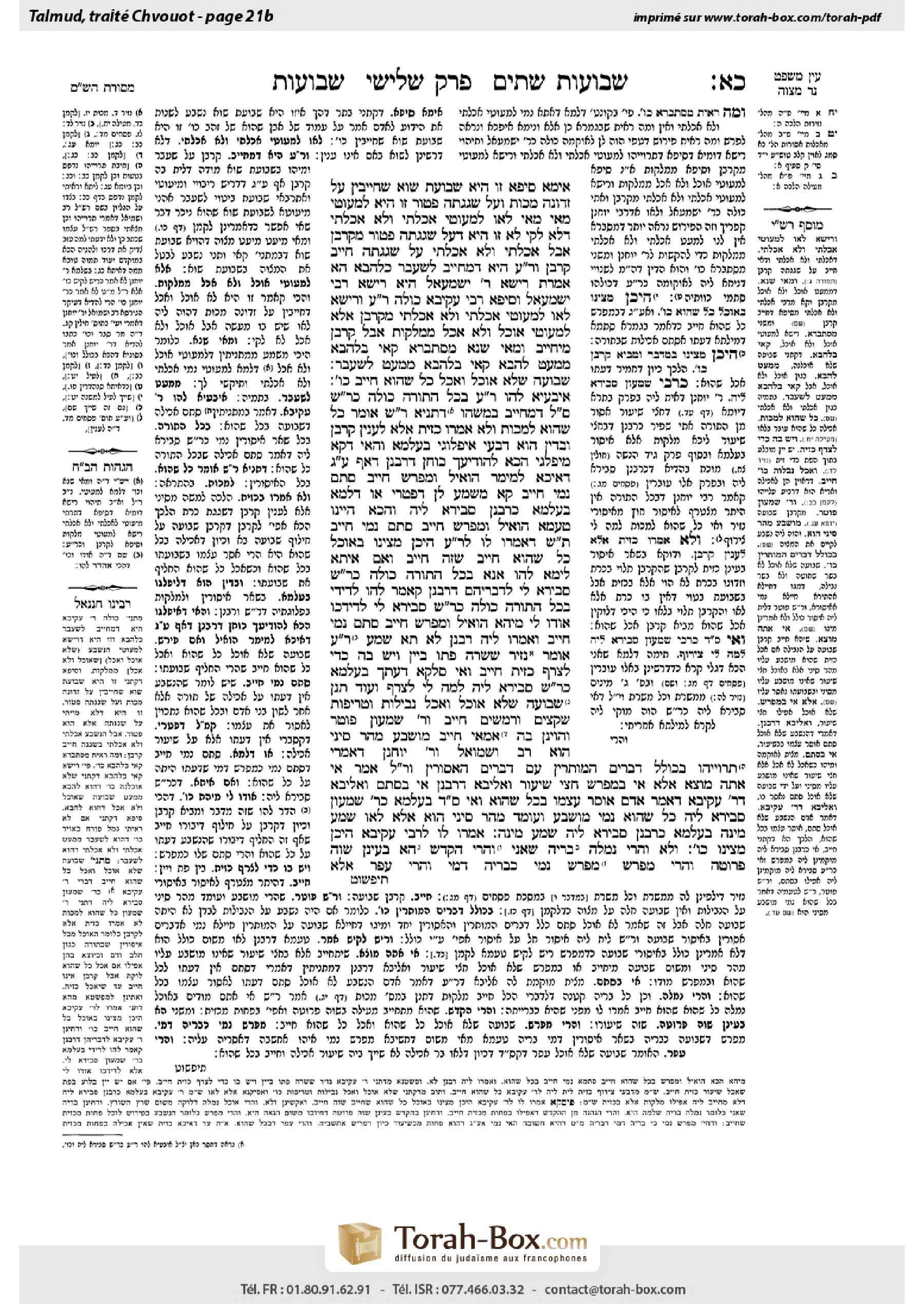
Shevuot 21b: Talmud study for Daf Yomi
Daf Yomi is the daily study of one Talmud folio. Explore 37 tractates with scans, Hebrew text, Sefaria English and AI-generated French translations where annotated.
Passage selection and English or AI-generated French translation are available where the scan has annotations. Daf Study is independent of Torah-Box and Sefaria.
Browse Shevuot · שבועות · All tractatesShevuot 21b text and translations
This page of Shevuot includes the Aramaic text, an English translation and an AI-generated French translation, alongside the scan above.
שבועות כ״א ב · Aramaic and Hebrew text
אֵימָא סֵיפָא: זוֹ הִיא שְׁבוּעַת שָׁוְא שֶׁחַיָּיבִין עַל זְדוֹנָהּ מַכּוֹת וְעַל שִׁגְגָתָהּ פָּטוּר. זוֹ הִיא לְמַעוֹטֵי מַאי? מַאי לָאו לְמַעוֹטֵי ״אָכַלְתִּי״ וְ״לֹא אָכַלְתִּי״ – דְּלָא לָקֵי?
לָא; זוֹ הִיא דְּעַל שִׁגְגָתָהּ פָּטוּר מִקׇּרְבָּן, אֲבָל ״אָכַלְתִּי״ וְ״לֹא אָכַלְתִּי״ עַל שִׁגְגָתָהּ חַיָּיב קׇרְבָּן; וְרַבִּי עֲקִיבָא הִיא, דִּמְחַיֵּיב לְשֶׁעָבַר כִּלְהַבָּא.
הָא אָמְרַתְּ רֵישָׁא רַבִּי יִשְׁמָעֵאל הִיא! רֵישָׁא רַבִּי יִשְׁמָעֵאל וְסֵיפָא רַבִּי עֲקִיבָא?! כּוּלַּהּ רַבִּי עֲקִיבָא, וְרֵישָׁא לָאו לְמַעוֹטֵי ״אָכַלְתִּי״ וְ״לֹא אָכַלְתִּי״ מִקׇּרְבָּן, אֶלָּא לְמַעוֹטֵי ״אוֹכַל״ וְלֹא אָכַל מִמַּלְקוֹת, אֲבָל קׇרְבָּן מִיחַיַּיב.
וּמַאי שְׁנָא? מִסְתַּבְּרָא, קָאֵי בִּלְהַבָּא – מְמַעֵט לְהַבָּא; קָאֵי בִּלְהַבָּא – מְמַעֵט לְשֶׁעָבַר?
״שְׁבוּעָה שֶׁלֹּא אוֹכַל״ וְאָכַל כׇּל שֶׁהוּא, חַיָּיב כּוּ׳. אִיבַּעְיָא לְהוּ: רַבִּי עֲקִיבָא, בְּכׇל הַתּוֹרָה כּוּלָּהּ – כְּרַבִּי שִׁמְעוֹן סְבִירָא לֵיהּ, דִּמְחַיֵּיב בְּמַשֶּׁהוּ? דְּתַנְיָא, רַבִּי שִׁמְעוֹן אוֹמֵר: כׇּל שֶׁהוּא לְמַכּוֹת, וְלֹא אָמְרוּ כְּזַיִת אֶלָּא לְעִנְיַן קׇרְבָּן.
וּבְדִין הוּא דְּבָעֵי אִיפְּלוֹגֵי בְּעָלְמָא, וְהַאי דְּקָא מִיפַּלְגִי הָכָא – לְהוֹדִיעֲךָ כּוֹחָן דְּרַבָּנַן, דְּאַף עַל גַּב דְּאִיכָּא לְמֵימַר: הוֹאִיל וּמְפָרֵשׁ חַיָּיב, סְתָם נָמֵי חַיָּיב; קָא מַשְׁמַע לַן דְּפָטְרִי.
אוֹ דִלְמָא, בְּעָלְמָא – כְּרַבָּנַן סְבִירָא לֵיהּ; וְהָכָא הַיְינוּ טַעְמָא – הוֹאִיל וּמְפָרֵשׁ חַיָּיב, סְתָם נָמֵי חַיָּיב.
תָּא שְׁמַע, דְּאָמְרוּ לוֹ לְרַבִּי עֲקִיבָא: הֵיכָן מָצִינוּ בְּאוֹכֵל כָּל שֶׁהוּא חַיָּיב, שֶׁזֶּה חַיָּיב? וְאִם אִיתָא, לֵימָא לְהוּ: אֲנָא בְּכׇל הַתּוֹרָה כּוּלָּהּ כְּרַבִּי שִׁמְעוֹן סְבִירָא לִי!
לְדִבְרֵיהֶם דְּרַבָּנַן קָאָמַר לְהוּ: לְדִידִי, בְּכׇל הַתּוֹרָה כּוּלָּהּ כְּרַבִּי שִׁמְעוֹן סְבִירָא לִי. לְדִידְכוּ, אוֹדוֹ לִי מִיהָא, הוֹאִיל וּמְפָרֵשׁ חַיָּיב, סְתָם נָמֵי חַיָּיב! וַאֲמַרוּ לֵיהּ רַבָּנַן: לָא.
תָּא שְׁמַע, רַבִּי עֲקִיבָא אוֹמֵר: נָזִיר שֶׁשָּׁרָה פִּתּוֹ בְּיַיִן, וְיֵשׁ בָּהּ כְּדֵי לְצָרֵף כְּזַיִת – חַיָּיב. וְאִי סָלְקָא דַעְתָּךְ בְּעָלְמָא כְּרַבִּי שִׁמְעוֹן סְבִירָא לֵיהּ, לְמָה לִי לְצָרֵף?
וְעוֹד תְּנַן: ״שְׁבוּעָה שֶׁלֹּא אוֹכַל״, וְאָכַל נְבֵילוֹת וּטְרֵיפוֹת, שְׁקָצִים וּרְמָשִׂים – חַיָּיב. וְרַבִּי שִׁמְעוֹן פּוֹטֵר. וְהָוֵינַן בַּהּ: אַמַּאי חַיָּיב? מוּשְׁבָּע מֵהַר סִינַי הוּא! רַב וּשְׁמוּאֵל וְרַבִּי יוֹחָנָן דְּאָמְרִי תַּרְוַיְיהוּ: בְּכוֹלֵל דְּבָרִים הַמּוּתָּרִין עִם דְּבָרִים הָאֲסוּרִין.
וְרֵישׁ לָקִישׁ אָמַר: אִי אַתָּה מוֹצֵא אֶלָּא אִי בִּמְפָרֵשׁ חֲצִי שִׁיעוּר – וְאַלִּיבָּא דְרַבָּנַן, אִי בִּסְתָם – וְאַלִּיבָּא דְּרַבִּי עֲקִיבָא דְּאָמַר: אָדָם אוֹסֵר עַצְמוֹ בְּכׇל שֶׁהוּא.
וְאִי סָלְקָא דַעְתָּךְ בְּעָלְמָא כְּרַבִּי שִׁמְעוֹן סְבִירָא לֵיהּ, כָּל שֶׁהוּא נָמֵי מוּשְׁבָּע וְעוֹמֵד מֵהַר סִינַי הוּא! אֶלָּא לָאו שְׁמַע מִינַּהּ: בְּעָלְמָא כְּרַבָּנַן סְבִירָא לֵיהּ? שְׁמַע מִינַּהּ.
אָמְרוּ לוֹ לְרַבִּי עֲקִיבָא: הֵיכָן מָצִינוּ כּוּ׳. וְלָא?! וַהֲרֵי נְמָלָה! בְּרִיָּה שָׁאנֵי.
וַהֲרֵי הֶקְדֵּשׁ! הָא בָּעֵינַן שָׁוֶה פְּרוּטָה.
וַהֲרֵי מְפָרֵשׁ! מְפָרֵשׁ נָמֵי כִּבְרִיָּה דָּמֵי.
וַהֲרֵי עָפָר! אֶלָּא
Shevuot 21b · English translation
The Gemara asks: Say the latter clause of the mishna (29a): Which oath is an oath taken in vain? It is when one takes an oath to deny that which is known to people to be true, like one says with regard to a stone column that it is made of gold. This is an oath taken in vain, for which one is liable to receive lashes if he takes the oath intentionally, and for which he is exempt if he takes it unwittingly. When the mishna says: This is an oath taken in vain, it is to exclude what? What, isn’t that phrase added to the mishna to exclude one who takes an oath saying: I ate, or: I did not eat, teaching that he is not flogged?
The Gemara responds: No, the mishna adds: This is an oath, to teach that for violating the prohibition against taking an oath in vain unwittingly, one is exempt from bringing an offering; but one who takes an oath saying: I ate, or: I did not eat, is liable to bring an offering for an unwitting violation. And this is in accordance with the opinion of Rabbi Akiva, who deems one liable to bring an offering for oaths referring to the past just like one is liable for oaths referring to the future.
The Gemara asks: But didn’t you say that the first clause of that mishna is in accordance with the opinion of Rabbi Yishmael? How can the first clause follow Rabbi Yishmael’s opinion and the latter clause follow Rabbi Akiva’s conflicting opinion? The Gemara answers: The entire mishna is in accordance with the opinion of Rabbi Akiva, and the first clause does not serve to exclude one who took an oath saying: I ate, or: I did not eat, from the liability to bring an offering. Rather, it serves to exclude one who took an oath saying: I will eat, and who subsequently did not eat, from the liability to receive lashes. But he is still liable to bring an offering.
The Gemara asks: And what is different about this way of understanding the mishna that it is to be preferred? The Gemara answers: It stands to reason that when the mishna is addressing an oath referring to the future, it excludes an oath referring to the future, in accordance with the reading that the entire mishna is in accordance with the opinion of Rabbi Akiva. Does it makes sense that when addressing an oath referring to the future, it excludes an oath referring to the past, as the reading of the first clause in accordance with the opinion of Rabbi Yishmael would have it? Therefore, the added sentence: This is an oath on an utterance, in the first clause, serves to exclude one who took an oath saying: I will eat, and who subsequently did not eat, from the liability to receive lashes; and the whole mishna can be understood as being in accordance with the opinion of Rabbi Akiva that one is liable to bring an offering even for oaths relating to the past.
§ The mishna teaches that if one says: On my oath I will not eat, and he then ate any amount, even less than an olive-bulk, he is liable according to Rabbi Akiva. A dilemma was raised before the Sages: Does Rabbi Akiva in the entire Torah, i.e., in general, hold that the halakha is in accordance with the opinion of Rabbi Shimon, who deems one liable for eating any amount of forbidden food? As it is taught in a baraita: Rabbi Shimon says: One who eats any amount of forbidden food is liable to receive lashes, and the Sages stated the measure of an olive-bulk only in the matter of determining liability to bring an offering.
And if in fact Rabbi Akiva agrees with the opinion of Rabbi Shimon, then by right, the mishna should have taught that Rabbi Akiva and the Rabbis disagree in general. And the reason that it states only here that they disagree is to convey to you the far-reaching nature of the opinion of the Rabbis. The Rabbis hold that even though it is possible to say that since one who eats less than an olive-bulk after taking an oath in which he specifically forbids himself any amount is liable, one who eats less than an olive-bulk without so specifying in his oath will also be liable, as that is included in his oath not to eat, that reasoning is not accepted. The mishna therefore states the dispute in the context of an oath that he will not eat in order to teach us that, according to the Rabbis, as long as he did not specify that his oath includes any amount, he is exempt from receiving lashes.
The Gemara presents the other side of the dilemma: Or perhaps, in general, Rabbi Akiva holds like the Rabbis that one must consume at least an olive-bulk in order to be liable for a prohibition that involves eating. And here, with regard to an oath that one will not eat, this is the reason he disagrees: Since one who specifically forbids himself any amount is liable, one who eats less than an olive-bulk without so specifying in his oath will also be liable.
Come and hear that which the Rabbis said to Rabbi Akiva: Where do we find that one who eats any amount is liable, leading you to say that this person is liable? The Gemara explains why this is relevant: If it is so that according to Rabbi Akiva one is always liable for eating any amount, let him say to them: In the entire Torah I hold in accordance with the opinion of Rabbi Shimon.
The Gemara answers: The fact that Rabbi Akiva did not answer the Rabbis in that way does not necessarily indicate that he does not agree with Rabbi Shimon in general. Perhaps he is speaking to the Rabbis in accordance with their own statement, and this is how he would respond to their question: As far as my opinion is concerned, in the entire Torah I hold that the halakha is in accordance with the opinion of Rabbi Shimon that one is liable for all prohibitions involving eating when one eats any amount. According to you, admit to me at least that since one who specifically forbids himself any amount is liable, one who eats less than an olive-bulk without so specifying in his oath will also be liable. And the Rabbis said to him: No, we will not admit that.
The Gemara presents another attempt to resolve the dilemma. Come and hear a mishna (Nazir 34b): Rabbi Akiva says: A nazirite who soaked his bread in wine and ate it, and the two together contain enough to combine to an olive-bulk, is liable, even though there is less than the minimal measure of wine. And if it should enter your mind that he holds in accordance with the opinion of Rabbi Shimon in general, then why do I need the wine and bread to combine to the measure of an olive-bulk? Consumption of any amount of wine should be sufficient for him to be liable.
And additionally, we learned in a mishna (22b): If one says: On my oath I will not eat, and then ate the meat of unslaughtered carcasses, or animals with a wound that will cause them to die within twelve months [tereifot], or repugnant creatures, or creeping animals, he is liable; and Rabbi Shimon deems him exempt. And we discussed it: Why is he liable for breaking his oath when he eats non-kosher food? He is already under oath from Mount Sinai not to eat forbidden food, and an oath cannot take effect to render a matter forbidden that is already forbidden. Rav and Shmuel and Rabbi Yoḥanan both, i.e., all, say that this is a case where he incorporates into the oath that he will not eat some permitted items, along with the statement concerning the forbidden items. Since the oath takes effect with regard to the permitted items, it extends also to the forbidden ones.
And Reish Lakish says: You find that one is liable for eating forbidden food as the result of an oath only if it is both an oath where he specifies that it includes a half-measure, in this case, less than an olive-bulk, and in accordance with the opinion of the Rabbis that one is not liable for eating a half-measure unless it is specified in the oath. Since eating a half-measure is not prohibited by the Torah, the oath takes effect. Alternatively, you find that one is liable if he took the oath without specifying that the oath prohibits less than the usual measure and in accordance with the opinion of Rabbi Akiva, who says that a person renders himself prohibited from eating any amount by taking an oath not to eat.
And if it enters your mind that Rabbi Akiva holds in accordance with the opinion of Rabbi Shimon in general, this is difficult, as one who consumes any amount is also already under oath from Mount Sinai. Why should the oath take effect according to Reish Lakish? Rather, must one not conclude from it: In general, Rabbi Akiva holds like the Rabbis, and it is only with regard to unspecified oaths that he deems one liable for eating any amount? The Gemara affirms: Conclude from it that Rabbi Akiva holds like the Rabbis.
§ The mishna teaches: The Rabbis said to Rabbi Akiva: Where do we find that one who eats any amount is liable, leading you to say that this person is liable? The Gemara asks: And do we not? But isn’t one who eats an ant liable, despite the fact that it is smaller than an olive-bulk? The Gemara answers: A whole entity is different, since it has significance.
The Gemara asks: But isn’t one who eats less than an olive-bulk of consecrated food liable? The Gemara answers: In order to be liable for eating consecrated food, we require a different measure, an amount worth one peruta. One is not liable for eating an amount worth less than that.
The Gemara asks: But isn’t one who specifies in his oath that he is prohibited from eating any amount liable for doing so? The Gemara answers: One who specifies that eating any amount is prohibited is indeed comparable to one who eats a whole entity, since he has granted it significance.
The Gemara asks: But isn’t there an unresolved question with regard to one who took an oath not to eat and then ate dirt? If, as the Rabbis claim, one is not liable for eating less than a full measure, you could rather
Shevuot 21b · Traduction française (IA)
La Guemara demande : Considère la dernière partie de la Michna (29a) : « Quel serment est un serment vain ? » C’est lorsqu’on jure pour nier ce que tout le monde sait être vrai, par exemple en affirmant qu’une colonne de pierre est en or. C’est un serment vain : celui qui le prononce intentionnellement est passible de flagellation, tandis que celui qui le prononce par inadvertance en est exempt. Lorsque la Michna dit : « C’est un serment vain », qu’est-ce que ces mots viennent exclure ? N’est-ce pas pour exclure celui qui jure : « J’ai mangé » ou « Je n’ai pas mangé », et enseigner qu’il n’est pas passible de flagellation ?
La Guemara répond : Non. La Michna ajoute les mots « C’est un serment » pour enseigner que celui qui transgresse par inadvertance l’interdiction de prononcer un serment vain est exempt d’apporter une offrande. En revanche, celui qui jure : « J’ai mangé » ou « Je n’ai pas mangé » est passible d’apporter une offrande pour cette transgression involontaire. Cela est conforme à l’opinion de Rabbi Akiva, qui rend passible d’apporter une offrande pour les serments portant sur le passé, tout comme pour ceux portant sur l’avenir.
La Guemara demande : Mais n’as-tu pas dit que la première partie de cette Michna est conforme à l’opinion de Rabbi Yishmaël ? Comment la première partie pourrait-elle suivre l’opinion de Rabbi Yishmaël et la dernière partie celle de Rabbi Akiva, qui est en désaccord avec lui ? La Guemara répond : Toute la Michna est conforme à l’opinion de Rabbi Akiva, et la première partie ne vise pas à exclure de l’obligation d’apporter une offrande celui qui a juré : « J’ai mangé » ou « Je n’ai pas mangé ». Elle vise plutôt à exclure de la peine de flagellation celui qui a juré : « Je mangerai », puis n’a pas mangé. Il reste néanmoins passible d’apporter une offrande.
La Guemara demande : Pourquoi cette manière de comprendre la Michna est-elle préférable ? La Guemara répond : Il est logique que, lorsque la Michna traite d’un serment portant sur l’avenir, elle en exclue un autre qui porte sur l’avenir, selon la lecture d’après laquelle toute la Michna est conforme à l’opinion de Rabbi Akiva. Est-il raisonnable que, lorsqu’elle traite d’un serment portant sur l’avenir, elle en exclue un qui porte sur le passé, comme le supposerait la lecture de la première partie conforme à l’opinion de Rabbi Yishmaël ? Par conséquent, la phrase ajoutée dans la première partie, « C’est un serment portant sur une parole », vise à exclure de la peine de flagellation celui qui a juré : « Je mangerai », puis n’a pas mangé. Ainsi, toute la Michna peut être comprise comme étant conforme à l’opinion de Rabbi Akiva, selon laquelle on est passible d’apporter une offrande même pour des serments portant sur le passé.
§ La Michna enseigne que si quelqu’un dit : « Par serment, je ne mangerai pas », puis mange n’importe quelle quantité, même inférieure au volume d’une olive, il est passible selon Rabbi Akiva. Une question fut posée aux Sages : Rabbi Akiva considère-t-il, dans toute la Torah, c’est-à-dire de manière générale, que la halakha suit l’opinion de Rabbi Shimon, qui rend passible celui qui mange n’importe quelle quantité d’un aliment interdit ? Car il est enseigné dans une baraïta : Rabbi Shimon dit : « Celui qui mange n’importe quelle quantité d’un aliment interdit est passible de flagellation ; les Sages n’ont fixé la mesure d’un volume d’olive que pour déterminer l’obligation d’apporter une offrande. »
Si Rabbi Akiva est effectivement d’accord avec l’opinion de Rabbi Shimon, la Michna aurait dû enseigner que Rabbi Akiva et les Rabbins sont en désaccord de manière générale. Si elle ne mentionne leur désaccord qu’ici, c’est pour montrer toute la portée de l’opinion des Rabbins. Ceux-ci soutiennent que, même si l’on pourrait dire que celui qui mange moins qu’un volume d’olive après avoir expressément juré de ne manger aucune quantité est passible, celui qui mange moins qu’un volume d’olive sans l’avoir précisé dans son serment le serait également, puisque cela est inclus dans son serment de ne pas manger, ce raisonnement n’est pas admis. La Michna expose donc le désaccord à propos d’un serment de ne pas manger afin de nous enseigner que, selon les Rabbins, tant qu’il n’a pas précisé que son serment porte sur n’importe quelle quantité, il est exempt de flagellation.
La Guemara présente l’autre possibilité : peut-être Rabbi Akiva est-il, de manière générale, d’accord avec les Rabbins : il faut consommer au moins le volume d’une olive pour être passible au titre d’une interdiction liée à la consommation. Mais ici, à propos d’un serment de ne pas manger, voici pourquoi il est en désaccord : puisque celui qui s’interdit expressément n’importe quelle quantité est passible, celui qui mange moins qu’un volume d’olive sans l’avoir précisé dans son serment le sera également.
Examinons ce que les Rabbins ont dit à Rabbi Akiva : « Où trouve-t-on que celui qui mange n’importe quelle quantité est passible, pour que tu dises que cet homme est passible ? » La Guemara explique la pertinence de cette question : si, selon Rabbi Akiva, on est toujours passible pour avoir mangé n’importe quelle quantité, qu’il leur réponde : « Dans toute la Torah, je suis l’opinion de Rabbi Shimon. »
La Guemara répond : Le fait que Rabbi Akiva n’ait pas répondu ainsi aux Rabbins ne prouve pas nécessairement qu’il ne partage pas de manière générale l’opinion de Rabbi Shimon. Peut-être leur répond-il en se plaçant sur leur propre terrain. Voici ce qu’il répondrait à leur question : « Pour ce qui est de mon opinion, dans toute la Torah, je considère que la halakha suit l’opinion de Rabbi Shimon, selon laquelle on est passible pour toutes les interdictions liées à la consommation dès lors qu’on mange n’importe quelle quantité. Quant à vous, admettez-moi au moins que, puisque celui qui s’interdit expressément n’importe quelle quantité est passible, celui qui mange moins qu’un volume d’olive sans l’avoir précisé dans son serment le sera également. » Les Rabbins lui répondirent : « Non, nous ne l’admettrons pas. »
La Guemara présente une autre tentative de résoudre la question. Examinons une Michna (Nazir 34b) : Rabbi Akiva dit : « Un nazir qui a trempé son pain dans du vin et l’a mangé est passible si le pain et le vin réunis atteignent le volume d’une olive, même si la quantité de vin est inférieure à la mesure minimale. » Or, si l’on envisage qu’il suit de manière générale l’opinion de Rabbi Shimon, pourquoi faudrait-il que le vin et le pain réunis atteignent le volume d’une olive ? N’importe quelle quantité de vin consommée devrait suffire à le rendre passible.
De plus, nous avons appris dans une Michna (22b) : « Si quelqu’un dit : “Par serment, je ne mangerai pas”, puis mange de la viande de bêtes mortes sans abattage rituel, de bêtes atteintes d’une blessure qui les fera mourir dans les douze mois [tereifot], de créatures répugnantes ou de bêtes rampantes, il est passible ; Rabbi Shimon le déclare exempt. » Nous avons alors examiné cette Michna : pourquoi est-il passible d’avoir enfreint son serment en mangeant un aliment non casher ? Il est déjà lié par le serment prêté au mont Sinaï de ne pas manger d’aliments interdits, et un serment ne peut prendre effet pour rendre interdit ce qui l’est déjà. Rav, Shmuel et Rabbi Yoḥanan disent tous que cela concerne un cas où il inclut dans son serment, en plus des aliments interdits, certains aliments permis qu’il s’engage à ne pas manger. Puisque le serment prend effet à l’égard des aliments permis, il s’étend aussi aux aliments interdits.
Et Reish Lakish dit : On ne trouve le cas où quelqu’un est passible d’avoir mangé un aliment interdit à la suite d’un serment que si les deux conditions suivantes sont réunies : il a précisé dans son serment que celui-ci englobe une demi-mesure, c’est-à-dire une quantité inférieure au volume d’une olive, et il suit l’opinion des Rabbins, selon laquelle on n’est pas passible pour avoir mangé une demi-mesure, sauf si le serment l’a précisé. Puisque la Torah n’interdit pas la consommation d’une demi-mesure, le serment prend effet. Autre possibilité : ce cas se présente s’il a juré sans préciser que son serment interdit une quantité inférieure à la mesure habituelle et s’il suit l’opinion de Rabbi Akiva, selon laquelle une personne s’interdit n’importe quelle quantité en jurant de ne pas manger.
Or, si l’on envisage que Rabbi Akiva suit de manière générale l’opinion de Rabbi Shimon, cela pose problème, car celui qui consomme n’importe quelle quantité est lui aussi déjà lié par le serment prêté au mont Sinaï. Pourquoi le serment prendrait-il effet, selon Reish Lakish ? Ne faut-il pas plutôt en conclure que, de manière générale, Rabbi Akiva suit l’opinion des Rabbins et que ce n’est qu’à propos des serments non spécifiés qu’il rend passible celui qui mange n’importe quelle quantité ? La Guemara confirme : conclus-en que Rabbi Akiva suit l’opinion des Rabbins.
§ La Michna enseigne : « Les Rabbins dirent à Rabbi Akiva : “Où trouve-t-on que celui qui mange n’importe quelle quantité est passible, pour que tu dises que cet homme est passible ?” » La Guemara demande : Mais ne trouve-t-on pas un tel cas ? Celui qui mange une fourmi n’est-il pas passible, bien qu’elle soit plus petite qu’un volume d’olive ? La Guemara répond : Une entité entière constitue un cas différent, car elle a de l’importance.
La Guemara demande : Mais celui qui mange moins qu’un volume d’olive d’un aliment consacré n’est-il pas passible ? La Guemara répond : Pour être passible d’avoir mangé un aliment consacré, une autre mesure est requise : une valeur d’une perouta. On n’est pas passible pour en avoir mangé une quantité d’une valeur inférieure.
La Guemara demande : Mais celui qui précise dans son serment qu’il lui est interdit de manger n’importe quelle quantité n’est-il pas passible s’il en mange ? La Guemara répond : Celui qui précise qu’il lui est interdit de manger n’importe quelle quantité est effectivement comparable à celui qui mange une entité entière, puisqu’il lui a conféré de l’importance.
La Guemara demande : Mais la question de savoir si celui qui a juré de ne pas manger puis a mangé de la terre n’est-elle pas restée sans réponse ? Si, comme le soutiennent les Rabbins, on n’est pas passible pour avoir mangé moins qu’une mesure complète, on pourrait plutôt
Traduction française générée par IA à partir de l’édition anglaise de Sefaria. Vérifie toujours un passage avec le texte source.
Text from Sefaria: William Davidson Edition - Vocalized Aramaic (CC BY NC); William Davidson Edition - English (CC BY NC).