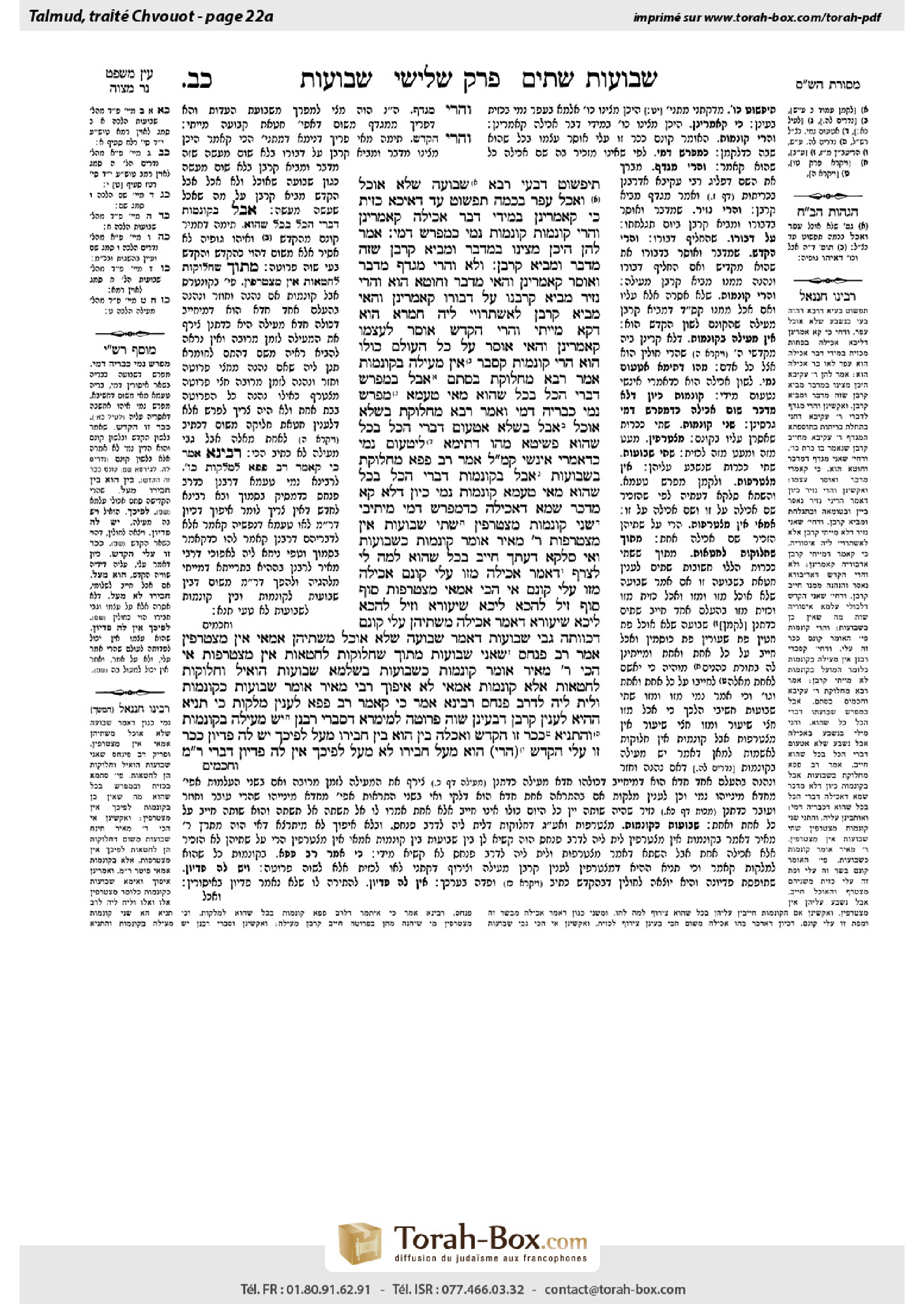
Shevuot 22a: Talmud study for Daf Yomi
Daf Yomi is the daily study of one Talmud folio. Explore 37 tractates with scans, Hebrew text, Sefaria English and AI-generated French translations where annotated.
Passage selection and English or AI-generated French translation are available where the scan has annotations. Daf Study is independent of Torah-Box and Sefaria.
Browse Shevuot · שבועות · All tractatesShevuot 22a text and translations
This page of Shevuot includes the Aramaic text, an English translation and an AI-generated French translation, alongside the scan above.
שבועות כ״ב א · Aramaic and Hebrew text
תִּיפְשׁוֹט דְּבָעֵי רָבָא: ״שְׁבוּעָה שֶׁלֹּא אוֹכַל״ וְאָכַל עָפָר, בְּכַמָּה? תִּפְשׁוֹט עַד דְּאִיכָּא כְּזַיִת! כִּי קָאָמְרִינַן – בְּמִידֵּי דְּבַר אֲכִילָה קָאָמְרִינַן.
וַהֲרֵי קוּנָּמוֹת! קוּנָּמוֹת נָמֵי כִּמְפָרֵשׁ דָּמֵי.
אָמַר לָהֶן: הֵיכָן מָצִינוּ בִּמְדַבֵּר וּמֵבִיא קׇרְבָּן, שֶׁזֶּה מְדַבֵּר וּמֵבִיא קׇרְבָּן. וְלָא?! וַהֲרֵי מְגַדֵּף! מְדַבֵּר וְאוֹסֵר קָאָמְרִינַן, וְהַאי מְדַבֵּר וְחוֹטֵא הוּא.
וַהֲרֵי נָזִיר! מֵבִיא קׇרְבָּנוֹ עַל דִּבּוּרוֹ קָאָמְרִינַן, וְהַאי מֵבִיא קׇרְבָּן – לְאִשְׁתְּרוֹיֵי לֵיהּ חַמְרָא הוּא דְּקָא מַיְיתֵי.
וַהֲרֵי הֶקְדֵּשׁ! אוֹסֵר לְעַצְמוֹ קָאָמְרִינַן, וְהַאי אוֹסֵר עַל כׇּל הָעוֹלָם כּוּלּוֹ הוּא.
הֲרֵי קוּנָּמוֹת! קָסָבַר אֵין מְעִילָה בְּקוּנָּמוֹת.
אָמַר רָבָא: מַחֲלוֹקֶת בִּסְתָם, אֲבָל בִּמְפָרֵשׁ – דִּבְרֵי הַכֹּל בְּכׇל שֶׁהוּא. מַאי טַעְמָא? מְפָרֵשׁ נָמֵי כִּבְרִיָּה דָּמֵי.
וְאָמַר רָבָא: מַחְלוֹקֶת בְּ״שֶׁלֹּא אוֹכַל״, אֲבָל בְּ״שֶׁלֹּא אֶטְעוֹם״ – דִּבְרֵי הַכֹּל בְּכׇל שֶׁהוּא. פְּשִׁיטָא! מַהוּ דְּתֵימָא: לִיטְעוֹם נָמֵי – כִּדְאָמְרִי אִינָשֵׁי; קָא מַשְׁמַע לַן.
אָמַר רַב פָּפָּא: מַחְלוֹקֶת בִּשְׁבוּעוֹת, אֲבָל בְּקוּנָּמוֹת – דִּבְרֵי הַכֹּל בְּכׇל שֶׁהוּא. מַאי טַעְמָא? קוּנָּמוֹת נָמֵי, כֵּיוָן דְּלָא קָא מַדְכַּר שְׁמָא דַּאֲכִילָה, כְּדִמְפָרֵשׁ דָּמֵי.
מֵיתִיבִי: שְׁנֵי קוּנָּמוֹת מִצְטָרְפִין, שְׁתֵּי שְׁבוּעוֹת אֵין מִצְטָרְפוֹת. רַבִּי מֵאִיר אוֹמֵר: קוּנָּמוֹת כִּשְׁבוּעוֹת. וְאִי סָלְקָא דַעְתָּךְ חַיָּיב בְּכׇל שֶׁהוּא, לְמָה לִי לְצָרֵף?
דְּאָמַר: ״אֲכִילָה מִזּוֹ עָלַי קוּנָּם״, ״אֲכִילָה מִזּוֹ עָלַי קוּנָּם״. אִי הָכִי, אַמַּאי מִצְטָרְפוֹת? סוֹף סוֹף – זִיל לְהָכָא לֵיכָּא שִׁיעוּרָא, וְזִיל לְהָכָא לֵיכָּא שִׁיעוּרָא! דְּאָמַר: ״אֲכִילָה מִשְּׁתֵּיהֶן עָלַי קוּנָּם״.
דִּכְוָותַהּ גַּבֵּי שְׁבוּעוֹת – דְּאָמַר: ״שְׁבוּעָה שֶׁלֹּא אוֹכַל מִשְּׁתֵּיהֶן״, אַמַּאי אֵין מִצְטָרְפִין? אָמַר רַב פִּנְחָס: שָׁאנֵי שְׁבוּעוֹת, מִתּוֹךְ שֶׁחֲלוּקוֹת לְחַטָּאוֹת, אֵין מִצְטָרְפוֹת.
אִי הָכִי, רַבִּי מֵאִיר אוֹמֵר: קוּנָּמוֹת כִּשְׁבוּעוֹת – בִּשְׁלָמָא שְׁבוּעוֹת, הוֹאִיל וַחֲלוּקוֹת לְחַטָּאוֹת; אֶלָּא קוּנָּמוֹת, אַמַּאי לָא? אֵיפוֹךְ – רַבִּי מֵאִיר אוֹמֵר: שְׁבוּעוֹת כְּקוּנָּמוֹת. וְלֵית לֵיהּ לִדְרַב פִּנְחָס.
רָבִינָא אָמַר: כִּי קָאָמַר רַב פָּפָּא – לְעִנְיַן מַלְקוֹת; כִּי תַּנְיָא הָהִיא – לְעִנְיַן קׇרְבָּן, דְּבָעֵינַן שָׁוֶה פְּרוּטָה.
לְמֵימְרָא דְּסָבְרִי רַבָּנַן יֵשׁ מְעִילָה בְּקוּנָּמוֹת?! וְהָתַנְיָא: ״כִּכָּר זוֹ הֶקְדֵּשׁ״, וַאֲכָלָהּ – בֵּין הוּא בֵּין חֲבֵירוֹ מָעַל; לְפִיכָךְ יֵשׁ לָהּ פִּדְיוֹן. ״כִּכָּר זוֹ עָלַי הֶקְדֵּשׁ״ – הֲרֵי הוּא מָעַל, חֲבֵירוֹ לֹא מָעַל; לְפִיכָךְ אֵין לָהּ פִּדְיוֹן. דִּבְרֵי רַבִּי מֵאִיר.
Shevuot 22a · English translation
answer that which Rava asks with regard to one who says: On my oath I will not eat, and who then ate dirt. Rava’s question is: How much must he eat in order to be liable? Based on the Rabbis’ statement, you could answer that he is not liable unless there is an olive-bulk that he has eaten. The Gemara rejects this conclusion: When we say in the mishna that there are no cases where a person who eats less than a full measure is liable, we say it with regard to items that are edible.
The Gemara asks: But aren’t konamot an example of a case where one is liable for eating even less than an olive-bulk? The Gemara answers: Konamot are also like a case where he specifies that any amount is forbidden for consumption.
§ The mishna teaches that Rabbi Akiva said to the Rabbis: Where do we find one who speaks and is liable to bring an offering for it, as this oath taker merely speaks, i.e., takes an oath, and brings an offering for it? The Gemara asks: And do we not? But isn’t a blasphemer liable to bring an offering according to the opinion of Rabbi Akiva (see Karetot 7a)? The Gemara answers: We are speaking of one who speaks and in doing so generates a prohibition. And this one, the blasphemer, is merely one who speaks and sins but does not bring an offering.
The Gemara challenges: But doesn’t a nazirite render wine forbidden to himself through speech, by making a vow? And he does bring an offering. The Gemara answers: We are speaking of one who brings an offering specifically for his speaking, and this one, the nazirite, brings an offering at the end of his naziriteship in order to permit wine to himself.
The Gemara challenges: But isn’t consecrated property a case where one renders an item forbidden via speech alone and brings an offering for its misuse? The Gemara answers: We are speaking of one who, by speaking, generates a prohibition for himself, and nevertheless brings an offering. And this one, who consecrates an item, generates a prohibition for the whole world.
The Gemara challenges: Aren’t konamot an example of a case where one renders an item forbidden to himself by speech alone and brings an offering for using it? The Gemara answers: Rabbi Akiva holds that there is no prohibition of misuse of consecrated property with regard to konamot.
§ Rava says: The dispute between Rabbi Akiva and the Rabbis is with regard to where one took the oath without specifying that he is liable for eating any amount. But in a case where he specifies that his oath applies to any amount, everyone agrees that he is liable for eating any amount. What is the reason for this? One who specifies this renders any amount significant like a whole entity.
And Rava says: The dispute is with regard to a case where one takes an oath saying: On my oath I will not eat, but in a case where one says: On my oath I will not taste, all agree that he is liable for tasting any amount. The Gemara asks: Isn’t it obvious that he is liable in that case? Tasting has no defined measure. The Gemara answers: Rava nevertheless taught it, lest you say that even if one takes an oath saying: I will not taste, he is liable only if he eats an olive-bulk, as people say: To taste, as a way of saying: To eat. Therefore, Rava teaches us that this is not the case.
§ Rav Pappa says: The dispute in the mishna is with regard to oaths, but with regard to konamot, all agree that one is liable for eating any amount. What is the reason for this? Indeed, with regard to konamot, since in the vow he did not explicitly mention eating, which has a defined measure, but only that the item is forbidden to him like an offering, it is as if he specified that he is liable for eating any amount.
The Gemara raises an objection from that which is taught in a baraita: Items that are forbidden by two konamot combine to produce a full measure for which one is liable; items forbidden by two oaths do not so combine. Rabbi Meir says: Items forbidden by konamot are like those forbidden by oaths. The Gemara explains the objection: And if it enters your mind that with regard to items forbidden by konamot, one is liable for eating any amount, why do I need them to combine?
The Gemara answers: They combine in a case where he said: Eating from this one is konam for me; eating from that one is konam for me. Since he explicitly mentions eating, he is not liable unless he eats an olive-bulk. The Gemara asks: If so, why do they combine to produce a full measure? Ultimately, since he took two separate vows, go to this item and there is not a full measure, and go to that item and there is not a full measure. The Gemara answers: They combined to produce one full measure when he said: Eating from both of them is konam for me.
The Gemara asks: In the corresponding situation with regard to oaths, where he said: On my oath I will not eat from both of them, why do they not combine? Rav Pineḥas said: Oaths are different. Since two items that are forbidden by a single oath are distinct with regard to sin-offerings, in that one is liable to bring a sin-offering for eating each one, so too eating a small amount from each does not combine in order to produce a full measure.
The Gemara asks: If so, how did Rabbi Meir say that items forbidden by konamot are like those forbidden by oaths and do not combine to produce a full measure? Granted that items forbidden by oaths do not combine, since they are distinct with regard to sin-offerings, but why do items forbidden by konamot not combine? The Gemara answers: Reverse the language so that the baraita has Rabbi Meir say: Items forbidden by oaths are like items forbidden by konamot. Neither combines to produce a full measure, and Rabbi Meir does not accept the statement of Rav Pineḥas that items forbidden by oaths are different.
Ravina said: When Rav Pappa says that one is liable for eating any amount of an item forbidden by konamot, that is with regard to the matter of lashes. When it is taught in the baraita that items forbidden by konamot combine to produce a full measure, that is with regard to the matter of an offering for misuse of consecrated property, where we require that one derive benefit equal to the value of one peruta from the forbidden item.
The Gemara asks: Is that to say that the Sages hold that the halakhot of misuse of consecrated property extend to items forbidden by konamot? But isn’t it taught in a baraita: If one said: This loaf is consecrated, and subsequently ate it, then either he or another who ate it is liable for misusing consecrated property; consequently, since the loaf is consecrated, it is subject to redemption. If one said: This loaf is forbidden to me as if it were consecrated, i.e., it is konam for me, and then he ate it, he is liable for misusing consecrated property, but another is not liable for misusing consecrated property; consequently, since the loaf is not fully consecrated, it is not subject to redemption. This is the statement of Rabbi Meir.
Shevuot 22a · Traduction française (IA)
Répondre à la question que Rava pose au sujet de celui qui dit : « Par serment, je ne mangerai pas », puis mange de la terre. La question de Rava est la suivante : quelle quantité doit-il manger pour être passible ? D’après les propos des Rabbins, on pourrait répondre qu’il n’est passible que s’il a mangé le volume d’une olive. La Guemara rejette cette conclusion : lorsque la Michna dit qu’il n’existe aucun cas où une personne est passible pour avoir mangé moins qu’une mesure entière, cela concerne les aliments comestibles.
La Guemara demande : Mais les konamot ne constituent-ils pas un exemple de cas où l’on est passible même pour avoir mangé moins que le volume d’une olive ? La Guemara répond : Les konamot aussi sont comparables au cas où il précise que toute quantité est interdite à la consommation.
§ La Michna enseigne que Rabbi Akiva dit aux Rabbins : Où trouve-t-on quelqu’un qui parle et qui est passible d’apporter une offrande pour cela, puisque celui qui prête serment ne fait que parler, c’est-à-dire qu’il prête serment, et apporte une offrande pour cela ? La Guemara demande : N’en trouve-t-on pas ? Le blasphémateur n’est-il pas passible d’apporter une offrande selon l’opinion de Rabbi Akiva (voir Karetot 7a) ? La Guemara répond : Nous parlons de quelqu’un qui, en parlant, crée une interdiction. Quant au blasphémateur, il ne fait que parler et pécher, mais n’apporte pas d’offrande.
La Guemara objecte : Mais le nazir ne s’interdit-il pas le vin par la parole, en prononçant un vœu ? Et il apporte bien une offrande. La Guemara répond : Nous parlons de quelqu’un qui apporte une offrande spécifiquement pour ses paroles ; quant au nazir, il apporte une offrande à la fin de son naziréat afin de pouvoir de nouveau consommer du vin.
La Guemara objecte : Mais les biens consacrés ne constituent-ils pas un cas où une personne interdit un objet par la seule parole et apporte une offrande pour son utilisation illicite ? La Guemara répond : Nous parlons de quelqu’un qui, par ses paroles, crée une interdiction qui s’applique à lui-même et qui, malgré cela, apporte une offrande. Or celui qui consacre un objet crée une interdiction pour le monde entier.
La Guemara objecte : Les konamot ne constituent-ils pas un exemple de cas où une personne interdit un objet pour elle-même par la seule parole et apporte une offrande pour l’avoir utilisé ? La Guemara répond : Rabbi Akiva considère qu’il n’y a pas d’interdiction d’utilisation illicite des biens consacrés dans le cas des konamot.
§ Rava dit : La controverse entre Rabbi Akiva et les Rabbins concerne le cas où quelqu’un a prêté serment sans préciser qu’il serait passible pour avoir mangé une quantité quelconque. Mais s’il précise que son serment s’applique à toute quantité, tous s’accordent à dire qu’il est passible pour avoir mangé une quantité quelconque. Pour quelle raison ? Celui qui le précise confère à toute quantité l’importance d’une entité entière.
Et Rava dit : La controverse porte sur le cas où quelqu’un prête serment en disant : « Par serment, je ne mangerai pas », mais si quelqu’un dit : « Par serment, je ne goûterai pas », tous s’accordent à dire qu’il est passible dès qu’il goûte, quelle qu’en soit la quantité. La Guemara demande : N’est-il pas évident qu’il est passible dans ce cas ? Le fait de goûter n’a pas de mesure définie. La Guemara répond : Rava l’enseigne néanmoins, de peur que tu ne dises que, même si quelqu’un prête serment en disant : « Je ne goûterai pas », il n’est passible que s’il mange le volume d’une olive, car les gens emploient « goûter » pour signifier « manger ». Rava nous apprend donc que ce n’est pas le cas.
§ Rav Pappa dit : La controverse dans la Michna concerne les serments ; mais pour les konamot, tous s’accordent à dire qu’on est passible pour avoir mangé une quantité quelconque. Pour quelle raison ? En effet, dans le cas des konamot, puisqu’il n’a pas explicitement mentionné dans son vœu le fait de manger, qui a une mesure définie, mais a seulement déclaré que l’objet lui était interdit comme une offrande, c’est comme s’il avait précisé qu’il serait passible pour avoir mangé une quantité quelconque.
La Guemara soulève une objection à partir de ce qui est enseigné dans une baraïta : des objets interdits par deux konamot se combinent pour atteindre la mesure entière à partir de laquelle on est passible ; des objets interdits par deux serments ne se combinent pas ainsi. Rabbi Meïr dit : les objets interdits par des konamot sont comme ceux interdits par des serments. La Guemara explique l’objection : si tu penses que, dans le cas des objets interdits par des konamot, on est passible pour avoir mangé une quantité quelconque, pourquoi aurait-on besoin qu’ils se combinent ?
La Guemara répond : Ils se combinent dans le cas où il a dit : « Manger de celui-ci m’est konam ; manger de celui-là m’est konam. » Puisqu’il mentionne explicitement le fait de manger, il n’est passible que s’il mange le volume d’une olive. La Guemara demande : Dans ce cas, pourquoi se combinent-ils pour atteindre la mesure entière ? Après tout, puisqu’il a prononcé deux vœux distincts, qu’on considère le premier objet : il n’y a pas de mesure entière ; qu’on considère le second : il n’y en a pas non plus. La Guemara répond : Ils se combinent pour atteindre une mesure entière lorsqu’il a dit : « Manger de ces deux objets m’est konam. »
La Guemara demande : Dans la situation correspondante concernant les serments, lorsqu’il a dit : « Par serment, je ne mangerai pas de ces deux objets », pourquoi ne se combinent-ils pas ? Rav Pineḥas a dit : Les serments sont différents. Puisque deux objets interdits par un seul serment sont distincts du point de vue des sacrifices expiatoires, en ce sens qu’on est passible d’apporter un sacrifice expiatoire pour avoir mangé chacun d’eux, de même, les petites quantités mangées de chacun ne se combinent pas pour atteindre la mesure entière.
La Guemara demande : Dans ce cas, comment Rabbi Meïr a-t-il pu dire que les objets interdits par des konamot sont comme ceux interdits par des serments et ne se combinent pas pour atteindre une mesure entière ? Il est compréhensible que les objets interdits par des serments ne se combinent pas, puisqu’ils sont distincts du point de vue des sacrifices expiatoires ; mais pourquoi les objets interdits par des konamot ne se combineraient-ils pas ? La Guemara répond : Inverse la formulation, de sorte que la baraïta fasse dire à Rabbi Meïr : les objets interdits par des serments sont comme ceux interdits par des konamot. Ni les uns ni les autres ne se combinent pour atteindre une mesure entière, et Rabbi Meïr n’accepte pas l’affirmation de Rav Pineḥas selon laquelle les objets interdits par des serments sont différents.
Ravina dit : Lorsque Rav Pappa affirme qu’on est passible pour avoir mangé une quantité quelconque d’un objet interdit par des konamot, cela concerne les coups de fouet. Lorsque la baraïta enseigne que les objets interdits par des konamot se combinent pour atteindre une mesure entière, cela concerne l’offrande pour utilisation illicite des biens consacrés, pour laquelle il faut que la personne tire de l’objet interdit un bénéfice d’une valeur équivalente à une perouta.
La Guemara demande : Cela signifie-t-il que les Sages considèrent que les lois relatives à l’utilisation illicite des biens consacrés s’appliquent aux objets interdits par des konamot ? Mais n’est-il pas enseigné dans une baraïta : si quelqu’un dit : « Ce pain est consacré », puis le mange, lui-même ou une autre personne qui le mange est passible pour utilisation illicite de biens consacrés ; par conséquent, puisque le pain est consacré, il peut faire l’objet d’un rachat. Si quelqu’un dit : « Ce pain m’est interdit comme s’il était consacré », c’est-à-dire qu’il est konam pour lui, puis le mange, il est passible pour utilisation illicite de biens consacrés, mais une autre personne n’en est pas passible ; par conséquent, puisque le pain n’est pas pleinement consacré, il ne peut pas faire l’objet d’un rachat. Telle est la déclaration de Rabbi Meïr.
Traduction française générée par IA à partir de l’édition anglaise de Sefaria. Vérifie toujours un passage avec le texte source.
Text from Sefaria: William Davidson Edition - Vocalized Aramaic (CC BY NC); William Davidson Edition - English (CC BY NC).