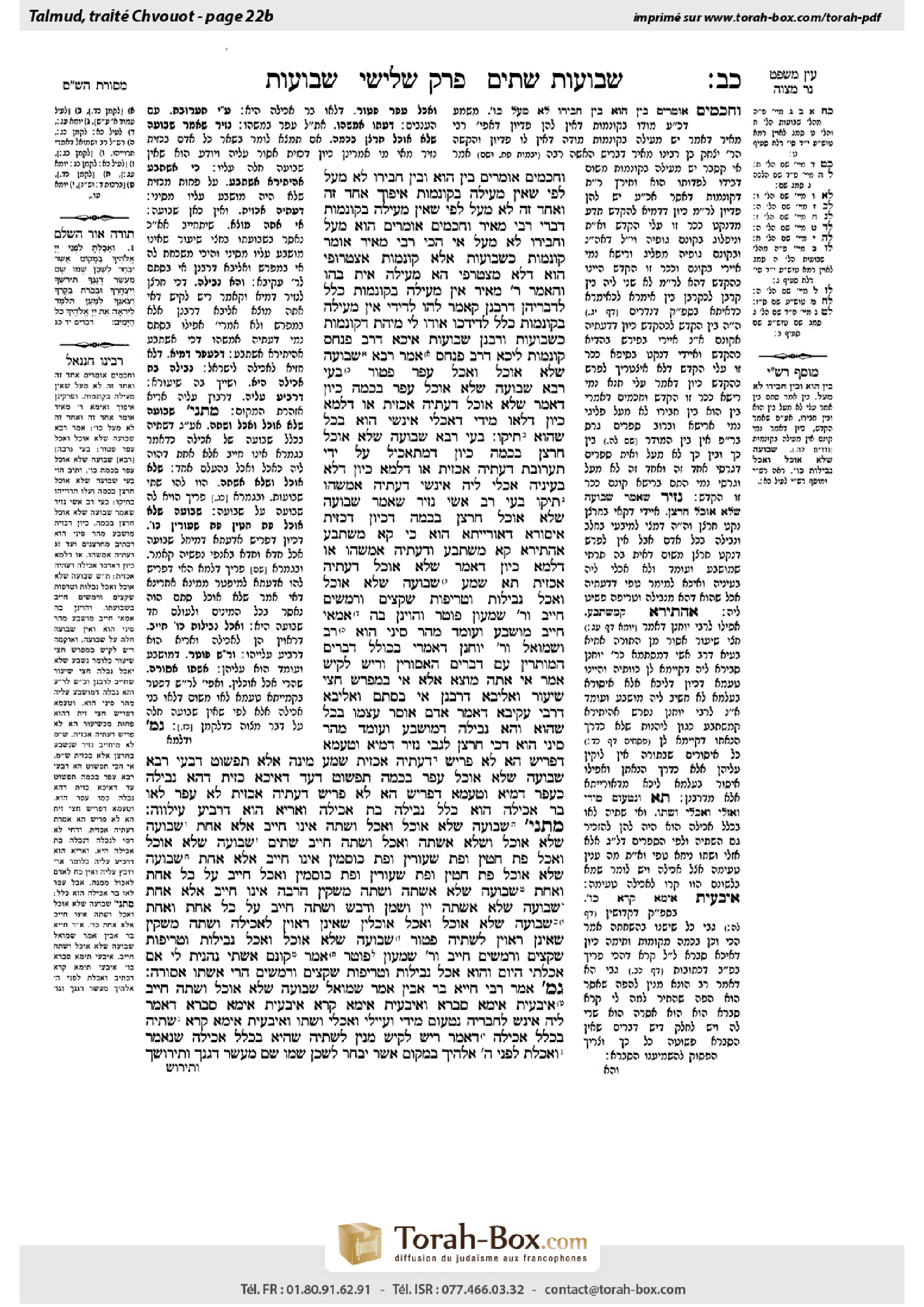
Shevuot 22b: Talmud study for Daf Yomi
Daf Yomi is the daily study of one Talmud folio. Explore 37 tractates with scans, Hebrew text, Sefaria English and AI-generated French translations where annotated.
Passage selection and English or AI-generated French translation are available where the scan has annotations. Daf Study is independent of Torah-Box and Sefaria.
Browse Shevuot · שבועות · All tractatesShevuot 22b text and translations
This page of Shevuot includes the Aramaic text, an English translation and an AI-generated French translation, alongside the scan above.
שבועות כ״ב ב · Aramaic and Hebrew text
וַחֲכָמִים אוֹמְרִים: בֵּין הוּא וּבֵין חֲבֵירוֹ לֹא מָעַל, לְפִי שֶׁאֵין מְעִילָה בְּקוּנָּמוֹת.
אֵיפוֹךְ: אֶחָד זֶה וְאֶחָד זֶה לֹא מָעַל, לְפִי שֶׁאֵין מְעִילָה בְּקוּנָּמוֹת. דִּבְרֵי רַבִּי מֵאִיר. וַחֲכָמִים אוֹמְרִים: הוּא מָעַל, וַחֲבֵירוֹ לֹא מָעַל.
אִי הָכִי, רַבִּי מֵאִיר אוֹמֵר קוּנָּמוֹת כִּשְׁבוּעוֹת – אֶלָּא קוּנָּמוֹת אִצְטְרוֹפֵי הוּא דְּלָא מִצְטָרְפִי, הָא מְעִילָה אִית בְּהוּ?! וְהָאָמַר רַבִּי מֵאִיר: אֵין מְעִילָה בְּקוּנָּמוֹת כְּלָל!
לְדִבְרֵיהֶן דְּרַבָּנַן קָאָמַר לְהוּ: לְדִידִי – אֵין מְעִילָה בְּקוּנָּמוֹת כְּלָל; לְדִידְכוּ – אוֹדוֹ לִי מִיהַת דְּקוּנָּמוֹת כִּשְׁבוּעוֹת!
וְרַבָּנַן – שְׁבוּעוֹת אִיכָּא דְּרַב פִּנְחָס, קוּנָּמוֹת לֵיכָּא דְּרַב פִּנְחָס.
אָמַר רָבָא: ״שְׁבוּעָה שֶׁלֹּא אוֹכַל״, וְאָכַל עָפָר – פָּטוּר. בָּעֵי רָבָא: ״שְׁבוּעָה שֶׁלֹּא אוֹכַל עָפָר״, בְּכַמָּה? כֵּיוָן דְּאָמַר ״שֶׁלֹּא אוֹכַל״ – דַּעְתֵּיהּ אַכְּזַיִת; אוֹ דִלְמָא, כֵּיוָן דְּלָאו מִידֵּי דְּאָכְלִי אִינָשֵׁי הוּא, בְּכׇל שֶׁהוּא? תֵּיקוּ.
בָּעֵי רָבָא: ״שְׁבוּעָה שֶׁלֹּא אוֹכַל חַרְצָן״, בְּכַמָּה? כֵּיוָן דְּמִתְאֲכִיל עַל יְדֵי תַּעֲרוֹבֶת – דַּעְתֵּיהּ אַכְּזַיִת; אוֹ דִלְמָא, כֵּיוָן דְּלָא בְּעֵינֵיהּ אָכְלִי לֵיהּ אִינָשֵׁי – דַּעְתֵּיהּ אַמַּשֶּׁהוּ? תֵּיקוּ.
בָּעֵי רַב אָשֵׁי: נָזִיר שֶׁאָמַר ״שְׁבוּעָה שֶׁלֹּא אוֹכַל חַרְצָן״, בְּכַמָּה? דְּכֵיוָן דִּכְזַיִת אִיסּוּרָא דְּאוֹרָיְיתָא הוּא, כִּי קָא מִשְׁתְּבַע – אַהֶתֵּירָא קָא מִשְׁתְּבַע, וְדַעְתֵּיהּ אַמַּשֶּׁהוּ; אוֹ דִלְמָא, כֵּיוָן דְּאָמַר ״שֶׁלֹּא אוֹכַל״, דַּעְתֵּיהּ אַכְּזַיִת?
תָּא שְׁמַע: ״שְׁבוּעָה שֶׁלֹּא אוֹכַל״, וְאָכַל נְבֵילוֹת וּטְרֵיפוֹת, שְׁקָצִים וּרְמָשִׂים – חַיָּיב. וְרַבִּי שִׁמְעוֹן פּוֹטֵר. וְהָוֵינַן בַּהּ: אַמַּאי חַיָּיב? מוּשְׁבָּע וְעוֹמֵד מֵהַר סִינַי הוּא! רַב וּשְׁמוּאֵל וְרַבִּי יוֹחָנָן דְּאָמְרִי: בְּכוֹלֵל דְּבָרִים הַמּוּתָּרִין עִם דְּבָרִים הָאֲסוּרִין.
וְרֵישׁ לָקִישׁ אָמַר: אִי אַתָּה מוֹצֵא אֶלָּא אִי בִּמְפָרֵשׁ חֲצִי שִׁיעוּר, וְאַלִּיבָּא דְרַבָּנַן; אִי בִּסְתָם, וְאַלִּיבָּא דְּרַבִּי עֲקִיבָא דְּאָמַר: אָדָם אוֹסֵר עַצְמוֹ בְּכׇל שֶׁהוּא.
וְהָא נְבֵילָה – דְּמוּשְׁבָּע וְעוֹמֵד מֵהַר סִינַי הוּא, דְּכִי חַרְצָן לְגַבֵּי נָזִיר דָּמְיָא; וְטַעְמָא דְּפָרֵישׁ, הָא לָא פָּרֵישׁ – דַּעְתֵּיהּ אַכְּזַיִת! שְׁמַע מִינַּהּ.
אֶלָּא תִּפְשׁוֹט דְּבָעֵי רָבָא: ״שְׁבוּעָה שֶׁלֹּא אוֹכַל עָפָר״, בְּכַמָּה? תִּפְשׁוֹט דְּעַד דְּאִיכָּא כְּזַיִת – דְּהָא נְבֵילָה כְּעָפָר דָּמְיָא; וְטַעְמָא דְּפָרֵישׁ, הָא לֹא פָּרִישׁ – דַּעְתֵּיהּ אַכְּזַיִת!
לֹא; עָפָר – לָאו בַּר אֲכִילָה הוּא כְּלָל; נְבֵילָה – בַּת אֲכִילָה, וְאַרְיָא הוּא דִּרְבִיעַ עִילָּוַוהּ.
מַתְנִי׳ ״שְׁבוּעָה שֶׁלֹּא אוֹכַל״, וְאָכַל וְשָׁתָה – אֵינוֹ חַיָּיב אֶלָּא אַחַת. ״שְׁבוּעָה שֶׁלֹּא אוֹכַל וְשֶׁלֹּא אֶשְׁתֶּה״, וְאָכַל וְשָׁתָה – חַיָּיב שְׁתַּיִם. ״שְׁבוּעָה שֶׁלֹּא אוֹכַל״, וְאָכַל פַּת חִטִּין וּפַת שְׂעוֹרִין וּפַת כּוּסְּמִין – אֵינוֹ חַיָּיב אֶלָּא אַחַת. ״שְׁבוּעָה שֶׁלֹּא אוֹכַל פַּת חִטִּין וּפַת שְׂעוֹרִין וּפַת כּוּסְּמִין״, וְאָכַל – חַיָּיב עַל כׇּל אַחַת וְאַחַת. ״שְׁבוּעָה שֶׁלֹּא אֶשְׁתֶּה״, וְשָׁתָה מַשְׁקִין הַרְבֵּה – אֵינוֹ חַיָּיב אֶלָּא אַחַת. ״שְׁבוּעָה שֶׁלֹּא אֶשְׁתֶּה יַיִן וְשֶׁמֶן וּדְבַשׁ״, וְשָׁתָה – חַיָּיב עַל כׇּל אַחַת וְאַחַת.
״שְׁבוּעָה שֶׁלֹּא אוֹכַל״, וְאָכַל אֳוכָלִין שֶׁאֵינָן רְאוּיִן לַאֲכִילָה, וְשָׁתָה מַשְׁקִין שֶׁאֵינָן רְאוּיִן לִשְׁתִיָּה – פָּטוּר. ״שְׁבוּעָה שֶׁלֹּא אוֹכַל״, וְאָכַל נְבֵילוֹת וּטְרֵיפוֹת, שְׁקָצִים וּרְמָשִׂים – חַיָּיב. וְרַבִּי שִׁמְעוֹן פּוֹטֵר. אָמַר: ״קוּנָּם אִשְׁתִּי נֶהֱנֵית לִי אִם אָכַלְתִּי הַיּוֹם״, וְהוּא אָכַל נְבֵילוֹת וּטְרֵיפוֹת, שְׁקָצִים וּרְמָשִׂים – הֲרֵי אִשְׁתּוֹ אֲסוּרָה.
גְּמָ׳ אָמַר רַבִּי חִיָּיא בַּר אָבִין אָמַר שְׁמוּאֵל: ״שְׁבוּעָה שֶׁלֹּא אוֹכַל״, וְשָׁתָה – חַיָּיב. אִיבָּעֵית אֵימָא סְבָרָא, וְאִיבָּעֵית אֵימָא קְרָא.
אִיבָּעֵית אֵימָא סְבָרָא – דַּאֲמַר לֵיהּ אִינָשׁ לְחַבְרֵיהּ: ״נִטְעוֹם מִידֵּי״, וְעָיְילִי וְאָכְלִי וְשָׁתוּ. וְאִיבָּעֵית אֵימָא קְרָא – שְׁתִיָּה בִּכְלַל אֲכִילָה; דְּאָמַר רֵישׁ לָקִישׁ: מִנַּיִן לִשְׁתִיָּה שֶׁהִיא בִּכְלַל אֲכִילָה? שֶׁנֶּאֱמַר: ״וְאָכַלְתָּ לִפְנֵי ה׳ אֱלֹהֶיךָ בַּמָּקוֹם אֲשֶׁר יִבְחַר לְשַׁכֵּן שְׁמוֹ שָׁם מַעְשַׂר דְּגָנְךָ וְתִירֹשְׁךָ״;
Shevuot 22b · English translation
And the Rabbis say: Both he and the other are not liable for misusing consecrated property, because there is no prohibition of misuse of consecrated property with regard to konamot.
The Gemara responds: Reverse the opinions and say as follows: Both this one and that one are not liable for misusing consecrated property, because there is no prohibition of misuse of consecrated property with regard to konamot. This is the statement of Rabbi Meir. And the Rabbis say: He is liable for misuse of consecrated property and the other is not liable for misuse of consecrated property.
The Gemara asks: If so, how is it that Rabbi Meir says in the previous baraita: Items forbidden by konamot are like those forbidden by oaths? Items forbidden by konamot do not combine to produce a full measure that renders one liable for misuse of consecrated property, but this indicates that misuse of consecrated property nevertheless applies to them. But doesn’t Rabbi Meir say, according to the reversal of the opinions, that with regard to konamot, there is no prohibition of misuse of consecrated property at all?
The Gemara answers: When Rabbi Meir says that items forbidden by konamot do not combine to produce a full measure, he is saying this to the Rabbis in accordance with their statement, as follows: According to my opinion with regard to konamot, there is no prohibition of misuse of consecrated property at all. According to your opinion, at least admit to me that items forbidden by konamot are like items forbidden by oaths and do not combine to produce a full measure.
And the Rabbis? They explain that with regard to items forbidden by oaths one should apply the reasoning of Rav Pineḥas that since two items that are forbidden by a single oath are distinct with regard to sin-offerings, they do not combine in order to produce a full measure. With regard to konamot the reasoning of Rav Pineḥas does not apply.
§ Rava says that if one said: On my oath I will not eat, and then he ate dirt, he is exempt, because eating dirt is not considered to be eating. Rava raises a dilemma: If one says: On my oath I will not eat dirt, how much dirt must he eat in order to be liable? Is the halakha that since he said: I will not eat dirt, his intention is that the prohibition applies to an olive-bulk? That is the standard measure for prohibitions with regard to eating. Or perhaps, since dirt is not something that people eat, he is liable for eating any amount. The Gemara concludes: The dilemma shall stand unresolved.
Rava raises a dilemma: If one says: On my oath I will not eat a grape seed, how much must he eat in order to be liable? Is the halakha that since it is ordinarily eaten in a mixture, i.e., as part of a grape, his intention is that the prohibition applies to a complete olive-bulk measure of grape seeds? Or perhaps, since people do not eat it by itself but always in a mixture, his intention is to be liable for eating any amount. The Gemara concludes: The dilemma shall stand unresolved.
§ Rav Ashi raises a dilemma: In the case of a nazirite who says: On my oath I will not eat a grape seed, how much must he eat in order to be liable? A nazirite is prohibited from eating grape seeds (see Numbers 6:4). Is the halakha that since eating an olive-bulk is a prohibition by Torah law, when he takes an oath of this sort, he is taking the oath to prohibit that which is permitted to him and his intention in taking the oath is to prohibit eating any amount? Or perhaps, since he said: I will not eat a grape seed, his intention is that the prohibition applies to an olive-bulk, which is the standard measure for what is considered eating.
The Gemara suggests: Come and hear proof from a mishna (22b): With regard to one who said: On my oath I will not eat, and then ate the meat of unslaughtered carcasses or tereifot, repugnant creatures or creeping animals, he is liable. And Rabbi Shimon deems him exempt. And we discussed it: Why is he liable for violating his oath when he eats non-kosher food? He is already under oath from Mount Sinai not to eat forbidden food, and an oath cannot take effect to prohibit that which is already forbidden. Rav and Shmuel and Rabbi Yoḥanan all say that this is a case where he incorporates into the oath that he will not eat some permitted items, along with the statement concerning the forbidden items. Since the oath takes effect with regard to the permitted items, it extends also to the forbidden ones.
And Reish Lakish says: You find that one is liable for eating non-kosher food after taking an oath not to eat only if it is both a case where he specifies in the oath that his oath includes a half-measure and in accordance with the opinion of the Rabbis that one is not liable for eating a half-measure unless it is specified in the oath. Since eating a half-measure is not prohibited by the Torah, the oath takes effect. Alternatively, you find that one is liable if he took the oath without specifying that the oath prohibits less than the usual measure and in accordance with the opinion of Rabbi Akiva, who says that a person renders himself prohibited from eating any amount by taking an oath not to eat.
The Gemara comments: But isn’t a carcass an item for which one is already under oath from Mount Sinai? In that respect it resembles a grape seed for a nazirite, and yet the reason that Reish Lakish says he is liable according to the Rabbis is that he specified that the oath prohibits him from eating even a half-measure, indicating that if he did not specify, his intention is that the oath refer to an olive-bulk. Conclude from it that a nazirite who takes an oath not to eat a grape seed is liable only if he eats an olive-bulk.
The Gemara asks: But according to this, resolve the dilemma that Rava raises with regard to one who says: On my oath I will not eat dirt, asking how much he must eat in order to be liable? Resolve the dilemma by saying that he is not liable unless he eats an olive-bulk, since a carcass resembles dirt, and the reason he is liable is that he specified that the oath prohibits him from eating even a half-measure, indicating that if he did not specify, his intention is that the oath refers to an olive-bulk.
The Gemara answers: No, the dilemma cannot be resolved based on this comparison. Dirt is entirely inedible. A carcass, by contrast, is edible, but a lion crouches on it, i.e., eating it is prohibited by the Torah. Therefore, one cannot derive the halakha concerning dirt from the halakha concerning a carcass.
MISHNA: If one said: On my oath I will not eat, and then he ate and drank, he is liable to bring only one offering, because an oath to refrain from eating includes refraining from drinking. If he said: On my oath I will not eat and I will not drink, and then he ate and drank, he is liable to bring two offerings. If he said: On my oath I will not eat, and then he ate wheat bread and barley bread and spelt bread, he is liable to bring only one offering. If he said: On my oath I will not eat wheat bread or barley bread or spelt bread, and then he ate all of them, he is liable to bring an offering for each and every one. If he said: On my oath I will not drink, and then he drank several kinds of liquids, he is liable to bring only one offering. If he said: On my oath I will not drink wine or oil or honey, and then he drank all of them, he is liable to bring an offering for each and every one.
If he said: On my oath I will not eat, and he ate foods that are inedible or drank liquids that are not potable, he is exempt. If he said: On my oath I will not eat, and then he ate the meat of unslaughtered carcasses or tereifot, repugnant creatures or creeping animals, he is liable. And Rabbi Shimon deems him exempt, since he is already under oath from Mount Sinai not to eat them and an oath cannot take effect where another oath is in force. But if he said: It is konam for my wife to derive benefit from me if I ate today, and he had eaten carcasses or tereifot, repugnant creatures or creeping animals, his wife is prohibited from deriving benefit from him.
GEMARA: Rabbi Ḥiyya bar Avin says that Shmuel says: If one said: On my oath I will not eat, and then he drank, he is liable. If you wish, you may propose a logical argument for this ruling, and if you wish, you may cite a verse to explain it.
The Gemara explains: If you wish, you may propose a logical argument for this ruling: It is clear that drinking is included in eating from the fact that a person will say to another: Let’s have a taste of something, and they go in and eat and drink. And if you wish, cite a verse as the source for this ruling, as Reish Lakish says: From where is it derived that drinking is included in eating? It is derived from that which is stated: “And you shall eat before the Lord your God, in the place that He shall choose to cause His name to dwell there, the tithe of your grain, of your tirosh, and of your oil” (Deuteronomy 14:23).
Shevuot 22b · Traduction française (IA)
Et les Rabbins disent : ni l’un ni l’autre n’est passible pour détournement de biens consacrés, car l’interdiction de détourner des biens consacrés ne s’applique pas aux konamot.
La Guemara répond : Inversez les opinions et dites ainsi : ni l’un ni l’autre n’est passible pour détournement de biens consacrés, car l’interdiction de détourner des biens consacrés ne s’applique pas aux konamot. Telle est l’opinion de Rabbi Meïr. Et les Rabbins disent : celui-ci est passible pour détournement de biens consacrés, tandis que l’autre ne l’est pas.
La Guemara demande : Dans ce cas, comment Rabbi Meïr peut-il dire dans la baraïta précédente que les objets interdits par des konamot sont comparables à ceux qui sont interdits par des serments ? Les objets interdits par des konamot ne s’additionnent pas pour atteindre une mesure complète qui rend passible de détournement de biens consacrés ; cela indique pourtant que l’interdiction de détourner des biens consacrés s’applique malgré tout à ces objets. Mais Rabbi Meïr ne dit-il pas, selon l’inversion des opinions, qu’en ce qui concerne les konamot, l’interdiction de détourner des biens consacrés ne s’applique pas du tout ?
La Guemara répond : Lorsque Rabbi Meïr dit que les objets interdits par des konamot ne s’additionnent pas pour atteindre une mesure complète, il s’adresse aux Rabbins conformément à leur opinion, comme suit : selon mon opinion, en ce qui concerne les konamot, l’interdiction de détourner des biens consacrés ne s’applique pas du tout. Selon votre opinion, reconnaissez-moi au moins que les objets interdits par des konamot sont comparables à ceux qui sont interdits par des serments et ne s’additionnent pas pour atteindre une mesure complète.
Et les Rabbins ? Ils expliquent qu’en ce qui concerne les objets interdits par des serments, il faut appliquer le raisonnement de Rav Pineḥas : puisque deux objets interdits par un seul serment sont distincts du point de vue des sacrifices expiatoires, ils ne s’additionnent pas pour atteindre une mesure complète. En ce qui concerne les konamot, le raisonnement de Rav Pineḥas ne s’applique pas.
§ Rava dit que si quelqu’un jure : « Je ne mangerai pas », puis mange de la terre, il est exempt, car manger de la terre n’est pas considéré comme manger. Rava soulève une question : si quelqu’un dit : « Je jure que je ne mangerai pas de terre », quelle quantité de terre doit-il manger pour être passible ? La halakha est-elle que, puisqu’il a dit : « Je ne mangerai pas de terre », il entend que l’interdiction s’applique à une mesure équivalant à une olive ? C’est la mesure habituelle pour les interdictions alimentaires. Ou peut-être, puisque la terre n’est pas une chose que l’on mange, est-il passible dès qu’il en mange une quantité quelconque ? La Guemara conclut : la question demeure sans réponse.
Rava soulève une question : si quelqu’un dit : « Je jure que je ne mangerai pas de pépin de raisin », quelle quantité doit-il en manger pour être passible ? La halakha est-elle que, puisqu’on le consomme habituellement mélangé à autre chose, c’est-à-dire dans le raisin, il entend que l’interdiction s’applique à une mesure complète de pépins de raisin équivalant à une olive ? Ou peut-être, puisqu’on ne le mange pas seul, mais toujours mélangé à autre chose, entend-il être passible dès qu’il en mange une quantité quelconque ? La Guemara conclut : la question demeure sans réponse.
§ Rav Ashi soulève une question : dans le cas d’un nazir qui dit : « Je jure que je ne mangerai pas de pépin de raisin », quelle quantité doit-il en manger pour être passible ? Un nazir a l’interdiction de manger des pépins de raisin (voir Nombres 6:4). La halakha est-elle que, puisque consommer une mesure équivalant à une olive est interdit par la Torah, en prononçant un tel serment, il jure de s’interdire ce qui lui est permis et entend, par son serment, interdire d’en manger quelle que soit la quantité ? Ou peut-être, puisqu’il a dit : « Je ne mangerai pas de pépin de raisin », entend-il que l’interdiction s’applique à une mesure équivalant à une olive, qui est la mesure habituelle pour définir ce qui est considéré comme une consommation ?
La Guemara propose : Venez entendre une preuve tirée d’une Michna (22b) : celui qui dit : « Je jure que je ne mangerai pas », puis mange de la viande de bêtes mortes sans abattage rituel ou de tereifot, des créatures répugnantes ou des animaux rampants, est passible. Rabbi Chimon l’en exempte. Nous avons discuté de ce cas : pourquoi est-il passible d’avoir violé son serment en mangeant des aliments non cachères ? Il est déjà lié par le serment du mont Sinaï de ne pas manger d’aliments interdits, et un serment ne peut prendre effet pour interdire ce qui est déjà interdit. Rav, Chmouel et Rabbi Yoḥanan disent tous qu’il s’agit d’un cas où il inclut dans son serment certains aliments permis, en déclarant qu’il ne les mangera pas, en même temps que les aliments interdits. Puisque le serment prend effet pour les aliments permis, il s’étend aussi aux aliments interdits.
Et Rech Lakich dit : on ne peut trouver un cas où une personne est passible pour avoir mangé des aliments non cachères après avoir juré de ne pas manger que si elle a précisé dans son serment que celui-ci porte aussi sur une demi-mesure, et conformément à l’opinion des Rabbins, selon laquelle on n’est pas passible pour une demi-mesure à moins de l’avoir précisé dans le serment. Puisque manger une demi-mesure n’est pas interdit par la Torah, le serment prend effet. Autre possibilité : elle est passible si elle a prêté serment sans préciser que le serment interdit une quantité inférieure à la mesure habituelle, et conformément à l’opinion de Rabbi Akiva, qui dit qu’une personne s’interdit toute quantité en jurant de ne pas manger.
La Guemara fait remarquer : mais la viande d’une bête morte sans abattage rituel n’est-elle pas une chose que l’on est déjà tenu, par le serment du mont Sinaï, de ne pas manger ? À cet égard, elle ressemble au pépin de raisin pour un nazir. Pourtant, selon les Rabbins, la raison pour laquelle Rech Lakich dit que la personne est passible est qu’elle a précisé que son serment lui interdit même une demi-mesure, ce qui indique que, sans cette précision, elle entend que le serment porte sur une mesure équivalant à une olive. Conclus-en qu’un nazir qui jure de ne pas manger de pépin de raisin n’est passible que s’il en mange une mesure équivalant à une olive.
La Guemara demande : mais, selon cela, tranchez la question soulevée par Rava au sujet de celui qui dit : « Je jure que je ne mangerai pas de terre », et qui demande quelle quantité il doit en manger pour être passible. Tranchez la question en disant qu’il n’est passible que s’il en mange une mesure équivalant à une olive, puisque la viande d’une bête morte sans abattage rituel ressemble à la terre ; et que la raison pour laquelle il est passible est qu’il a précisé que son serment lui interdit même une demi-mesure, ce qui indique que, sans cette précision, il entend que le serment porte sur une mesure équivalant à une olive.
La Guemara répond : Non, la question ne peut pas être tranchée sur la base de cette comparaison. La terre est entièrement immangeable. En revanche, une bête morte sans abattage rituel est comestible, mais un lion est accroupi dessus, c’est-à-dire que sa consommation est interdite par la Torah. On ne peut donc pas déduire la halakha concernant la terre de celle concernant une bête morte sans abattage rituel.
MICHNA : Si quelqu’un dit : « Je jure que je ne mangerai pas », puis mange et boit, il n’est passible que d’un seul sacrifice, car un serment de s’abstenir de manger inclut l’abstention de boire. S’il dit : « Je jure que je ne mangerai pas et que je ne boirai pas », puis mange et boit, il est passible de deux sacrifices. S’il dit : « Je jure que je ne mangerai pas », puis mange du pain de blé, du pain d’orge et du pain d’épeautre, il n’est passible que d’un seul sacrifice. S’il dit : « Je jure que je ne mangerai ni pain de blé, ni pain d’orge, ni pain d’épeautre », puis mange de tous ces pains, il est passible d’un sacrifice pour chacun d’eux. S’il dit : « Je jure que je ne boirai pas », puis boit plusieurs sortes de liquides, il n’est passible que d’un seul sacrifice. S’il dit : « Je jure que je ne boirai ni vin, ni huile, ni miel », puis boit de tous ces liquides, il est passible d’un sacrifice pour chacun d’eux.
S’il dit : « Je jure que je ne mangerai pas », puis mange des aliments immangeables ou boit des liquides impropres à la consommation, il est exempt. S’il dit : « Je jure que je ne mangerai pas », puis mange de la viande de bêtes mortes sans abattage rituel ou de tereifot, des créatures répugnantes ou des animaux rampants, il est passible. Rabbi Chimon l’en exempte, puisqu’il est déjà lié par le serment du mont Sinaï de ne pas en manger, et qu’un serment ne peut prendre effet lorsqu’un autre serment est déjà en vigueur. Mais s’il dit : « Il sera konam pour ma femme de tirer profit de moi si j’ai mangé aujourd’hui », et qu’il a mangé de la viande de bêtes mortes sans abattage rituel ou de tereifot, des créatures répugnantes ou des animaux rampants, sa femme n’a pas le droit de tirer profit de lui.
GUEMARA : Rabbi Ḥiyya bar Avin dit au nom de Chmouel : si quelqu’un dit : « Je jure que je ne mangerai pas », puis boit, il est passible. Si tu le souhaites, tu peux proposer un raisonnement logique à l’appui de cette règle ; si tu le souhaites, tu peux citer un verset pour l’expliquer.
La Guemara explique : si tu le souhaites, tu peux proposer un raisonnement logique à l’appui de cette règle : il est clair que boire est inclus dans manger, comme le montre le fait qu’une personne dit à une autre : « Allons goûter quelque chose », puis qu’ils entrent et mangent et boivent. Et si tu le souhaites, cite un verset comme source de cette règle. En effet, Rech Lakich dit : d’où apprend-on que boire est inclus dans manger ? On l’apprend de ce qui est écrit : « Tu mangeras devant l’Éternel ton Dieu, au lieu qu’Il choisira pour y faire résider Son nom, la dîme de ton blé, de ton vin nouveau et de ton huile » (Deutéronome 14:23).
Traduction française générée par IA à partir de l’édition anglaise de Sefaria. Vérifie toujours un passage avec le texte source.
Text from Sefaria: William Davidson Edition - Vocalized Aramaic (CC BY NC); William Davidson Edition - English (CC BY NC).